 (+971) 8007 4267
 (+91) 946 340 7140
 (+1) 628 432 4305

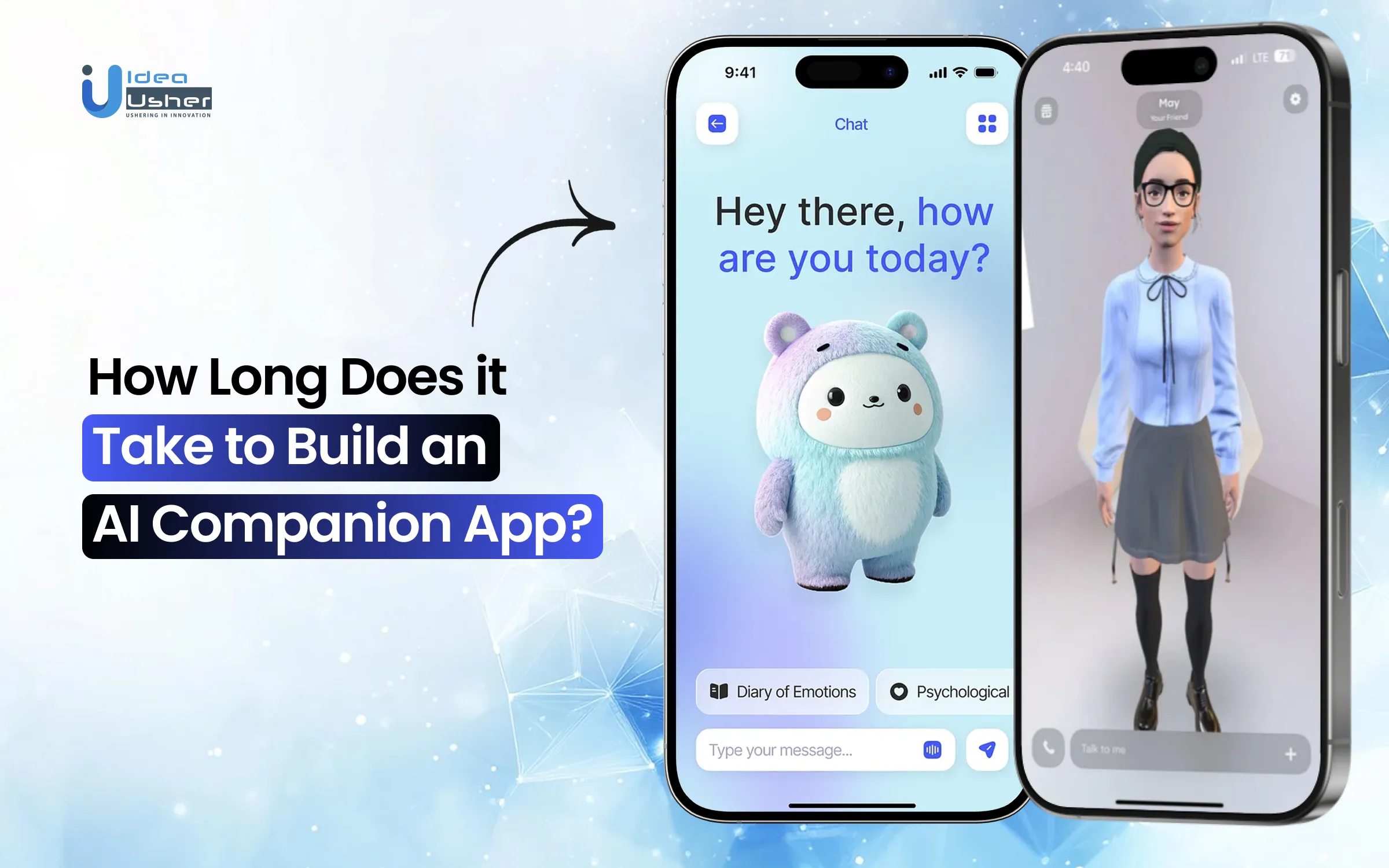
Every promising idea often starts with urgency and a quiet question about how long it will truly take to build. When the product is an AI companion app, the answer is rarely straightforward. You may need to train models, carefully shape personality systems, and repeatedly test responses until they feel natural.
The interface may appear simple, while the underlying architecture operates continuously in real time. Data pipelines, safety controls, and scalability planning usually extend timelines in ways that are not obvious early on. You should expect iteration, because initial builds often reveal hidden technical gaps. This is why creating an AI companion requires patience, clear planning, and strong technical judgment from the beginning.
Over the years, we’ve built numerous AI companion platforms powered by LLM orchestration and affective computing frameworks. With this hands-on experience, we’re sharing this blog to clearly explain how long it takes to build an AI companion app and what factors shape that timeline. Let’s get started.
Key Market Takeaways for AI Companion App
According to Grandview Research, AI companion apps are entering a rapid growth phase, with the global market projected to expand from USD 28.19 billion in 2024 to about USD 140.75 billion by 2030, reflecting a 30–34% CAGR. This surge is driven by rising comfort with conversational AI and demand for always-on emotional and practical support. Companions are no longer niche chatbots; they are being embedded across social platforms, games, and productivity tools as persistent digital partners.

Source: Grandview Research
User engagement is unusually deep and monetizable. Leading apps now report ARPU above USD 1 per download, and the broader AI companionship category is expected to exceed USD 100 million in annual app-store revenue by the mid-2020s.
Replika, for example, has surpassed 30 million downloads and built a sustainable freemium business, with many users describing their AI as a romantic or emotional partner, highlighting how personal these relationships have become.
The ecosystem is also expanding through platforms and partnerships. Character.AI, valued at around USD 1 billion, allows users to interact with thousands of customizable personas for entertainment, mentorship, and productivity. Its partnership with Google, which includes cloud infrastructure support and non-exclusive model licensing, signals growing interest from enterprises and platforms.

What Is an AI Companion App?
An AI companion app is designed to do more than answer questions or complete tasks—it’s built to be present. These apps use artificial intelligence to maintain natural, ongoing conversations with users, providing companionship, emotional support, motivation, and guidance over time.
Unlike traditional software, AI companions learn who you are. They remember past conversations, adapt to your preferences, and respond with empathy rather than canned replies. Some check in on your mental well-being, others help you stay focused on goals, and many simply offer a space to talk, without judgment, pressure, or social friction.
How AI Companion Apps Differ from Chatbots and Assistants?
It is easy to group all AI under one label, but the differences are foundational.
| Aspect | Chatbots | Virtual Assistants | AI Companions |
| Primary purpose | Built for task completion such as FAQs and support tickets | Built for productivity such as reminders, automation, and quick information | Built for relationship-building focused on emotional resonance and long-term engagement |
| Interaction style | Short, session-based interactions | Functional and command-driven exchanges | Ongoing and evolving conversations |
| Core goal | Solve and close | Optimize and assist | Connect and retain |
| Memory capability | No memory beyond the current chat window | Limited contextual memory such as the last command | Long-term memory that remembers stories, preferences, and emotional patterns |
| Responsiveness | Reactive and only responds when prompted | Reactive and operates strictly on commands | Proactive and capable of initiating check-ins, reflections, and encouragement |
Types of AI Companion Apps Businesses Are Building
AI companion apps reflect the many ways people seek connection, guidance, and support. Forward-thinking companies are using these systems to create experiences that feel personal, continuous, and meaningful.
1. Emotional support & Mental Wellness
These apps provide accessible and judgment-free spaces where users can express emotions, practice mindfulness, and work through everyday stress or emotional challenges. By learning from past interactions, they offer support that feels increasingly personal over time.
Example: Wysa — An AI wellness companion that supports emotional expression, stress management, and mindfulness through empathetic conversation.
2. Lifestyle, Motivation, & Productivity
More than simple task managers, these companions act as proactive coaches. They understand personal goals, track progress, and offer encouragement and reminders that are tailored to the user’s habits, energy levels, and history.
Example: Fabulous — A habit-building companion that helps users stay motivated by guiding routines and tracking long-term progress.
3. Virtual Friends or Digital Partners
Designed for companionship, these AI personalities engage in casual conversation, share interests, and provide ongoing social interaction. They offer a sense of presence and familiarity for users seeking connection or conversation.
Example: Replika — A conversational AI friend designed for ongoing companionship and emotionally aware dialogue.
4. Brand-Owned Companions
These companions help brands move beyond transactional relationships. Living on users’ devices, they provide personalized support, exclusive content, and interactions that strengthen emotional loyalty and long-term engagement.
Example: Sephora Virtual Assistant — A brand companion that delivers personalized beauty recommendations and ongoing customer engagement.
How to Develop an AI Companion App?
Start by defining the companion’s role and designing a clean dialogue flow, backed by a secure user profile, to store preferences securely.
The core should combine a chat interface with a conversation service that calls an LLM via guarded prompts, and a tools layer for actions such as scheduling, while logging events for debugging. Over the years, we have delivered numerous AI companion apps, and this is how the work gets done.
1. Personality & Boundaries
We begin by creating a clear “character bible” that defines the companion’s tone, values, traits, flaws, and emotional limits. This foundation ensures consistent behavior, alignment with the client’s brand, and healthy emotional interactions without fostering dependency.
2. Long-Term Memory
We design a layered memory system that separates short-term context from long-term understanding. By combining semantic and episodic memory using vector databases and knowledge graphs, the companion can recall user preferences and past interactions in a coherent, human-like way.
3. Agentic Decisions
We build agentic decision loops that determine when the companion should engage, follow up, or remain silent. These systems balance proactivity and restraint, allowing the AI to feel present and thoughtful rather than intrusive.
4. Multimodal Interaction
We integrate multimodal capabilities, including voice, sentiment analysis, and optional vision-based context. This enables the companion to interpret emotional cues and environmental signals more effectively, resulting in more natural and empathetic interactions.
5. Privacy-First Design
We implement privacy-first infrastructure with encrypted data flows, on-device memory where possible, and user-controlled data settings. This approach ensures compliance, builds trust, and protects sensitive user information.
6. Emotional Consistency
We validate long-term behavior through extended simulations and user testing to detect personality drift or emotional instability. Continuous tuning ensures the companion remains consistent, safe, and emotionally aligned over time.
How Long Does It Take to Build an AI Companion App?
You can ship a basic AI companion in about 4 to 8 weeks if you focus on an LLM API a chat UI, and short context memory. A production-grade companion should take 3 to 5 months to build, as it will include retrieval memory, voice pipelines, evaluation loops, and security.
A lifelike agent may take 6 to 10 months to build, covering agentic planning, multimodal IO, scalable infrastructure, and privacy-by-design.

1. Basic Companion MVP (4 to 8 Weeks)
This is your foundation, a functional prototype that demonstrates core conversational ability.
What You Get:
- API-based LLM integration (OpenAI GPT, Claude, or similar) with custom prompting
- Text-only interaction through a clean chat interface
- Limited short-term memory using a context window, typically 8K to 128K tokens
- Basic persona design and tone customization
- Simple mobile or web deployment
Best For: Startups validating market interest or brands testing companion concepts before major investment.
Key Limitation: The AI will suffer from “digital amnesia.” Conversations reset, there is no long-term memory, and behavior is purely reactive.
2. Specialized Companion App (3 to 5 Months)
Here, your companion gains depth and specializes in mental wellness, coaching, education, or brand engagement.
What You Get:
- Domain-specific personality and knowledge through fine-tuning or advanced RAG
- Long-term memory foundations using vector databases like Pinecone or Weaviate
- Sentiment-aware responses with basic emotional intelligence layers
- Voice interaction capabilities, including text-to-speech and speech-to-text
- Custom UI and UX with engagement features such as mood tracking and memory journals
- Basic proactive triggers like time-based check-ins
Best For: Businesses targeting specific verticals where expertise and emotional resonance matter.
The Leap: This companion remembers past conversations and adapts its tone based on detected sentiment.
3. Advanced, Lifelike AI Companion (6 to 10+ Months)
This is where science meets art. You’re building not just an app, but a persistent digital entity.
What You Get:
- Knowledge graph-based memory (GraphRAG) that understands relationships, not just text snippets
- Multimodal interaction, including vision, image understanding, nuanced voice with emotional intonation, and contextual awareness
- Proactive agentic behavior such as autonomous scheduling, personalized interventions, and goal-oriented initiative
- Privacy-first architecture with optional on-device processing for sensitive data
- Dynamic personality evolution based on interaction history
- Advanced analytics dashboards showing engagement depth and bond strength
Best For: Enterprises building market-defining products or companies creating subscription-based companion services with high retention goals.
The Differentiator: This companion doesn’t just respond. It anticipates. It doesn’t just remember facts. It understands your story.
Hidden Timeline Factors in AI Companion Development
Every client asks about the visible timeline, coding, features, and deployment. But the true craftsmanship of an AI companion happens in the invisible layers: the personality, the memory, the vibe, and the conscience. These are the factors that separate a functional chatbot from a companion that feels alive.
Here’s what really takes time and why rushing it means building something forgettable.

1. Data and Personality Design (2 to 6+ Weeks)
Before a single line of code is written, we’re writing a character bible. This isn’t a technical spec sheet. It’s the origin story, personality matrix, and emotional rulebook of your AI companion.
What This Entails:
- Backstory and Motivations: Why does this companion exist? What’s its past? This informs how it relates to users.
- Communication Style Lexicon: Does it use emojis? Short sentences? Poetic language? Humor style such as witty, dry, or playful.
- Boundaries and Ethics: What won’t it discuss? How does it handle sensitive topics? Where does it gently redirect?
- Growth Arcs: How should its personality evolve over 100 interactions versus 1,000? This requires narrative design thinking.
Why Timeline Fluctuates (2 to 6+ Weeks):
- Simple Archetype: 2 to 3 weeks for a basic, consistent persona.
- Complex, Evolving Character: 5 to 6+ weeks for multi-layered personalities with narrative arcs.
- Factor: Stakeholder alignment on brand voice and ethical boundaries can add significant time.
2. Memory Architecture (3 to 10+ Weeks)
Anyone can store chat history. Building a memory that understands and recalls meaningfully is where months vanish and where magic is made.
The Technical Deep Dive:
- From Vector Search to Knowledge Graphs: Moving beyond simple semantic search to structured relationship mapping
- Contextual Retrieval Logic: Teaching the system when to recall a memory.
- Memory Decay and Prioritization: How the system values recent versus emotionally charged memories.
Why Timeline Fluctuates (3 to 10+ Weeks):
- Basic Vector Memory: 3 to 4 weeks for simple chat history with embeddings.
- Advanced Knowledge Graph: 8 to 10+ weeks for relationship-aware memory with contextual recall.
- Factor: The complexity of user data and required recall accuracy dramatically impacts development time.
3. The “Vibe” Alignment (Ongoing)
This is the most subjective, human-centric phase, aligning the AI’s output to feel consistently authentic, empathetic, and engaging.
What We’re Constantly Calibrating:
- Temperature and Creativity: Balancing predictability with spontaneity.
- Response Length and Pacing: Mirroring natural human conversation flow.
- Emotional Tone Matching: Calibrated empathy without melodrama.
- Error Recovery Personality: How the AI handles confusion or misunderstanding.
Why Timeline Fluctuates (2 to 8+ Weeks Initial):
- Standard Personality: 2 to 3 weeks for basic tone alignment.
- Nuanced, Adaptive Vibe: 6 to 8+ weeks for emotionally intelligent responses across multiple scenarios.
- Factor: Number of emotional states and interaction contexts requiring unique calibration.
4. Ethical &Safety Implementation (3 to 6+ Weeks)
This isn’t a phase. It’s a layer woven into every other stage. Underestimating it risks product failure or real harm.
Critical Components:
- Dependency Guardrails: Monitoring unhealthy attachment patterns.
- Mental Health Safeguards: Crisis detection and escalation protocols.
- Bias and Fairness Audits: Ensuring equitable interaction across demographics.
- Transparency Features: Clear user understanding of automation and limitations.
Why Timeline Fluctuates (3 to 6+ Weeks):
- Basic Content Filtering: 3 to 4 weeks for standard moderation.
- Comprehensive Safety Framework: 5 to 6+ weeks for mental health protocols, bias testing, and regulatory compliance.
- Factor: Industry vertical (e.g., healthcare vs. entertainment) and geographic regulations significantly increase scope.
Why 1 in 10 Teens Prefer AI Conversations?
According to reports, about 1 in 10 teenagers finds AI conversation more satisfying than human interaction. This preference may stem from systems that respond instantly, remember context reliably, and maintain emotional consistency without pressure. Over time, these predictable interactions can subtly feel safer and more controllable within a digitally native emotional landscape.

1. 24/7 Availability
Adolescent emotions and crises do not operate on a nine-to-five schedule. A panic attack at two AM, anxiety before a big game, or excitement over a small win often happens when friends and family are asleep or busy.
The AI Difference. AI is perpetually on call. This constant availability aligns with the instant text and response culture Gen Z has grown up with. There is no waiting, no message left on read, and no need to assess whether support is becoming a burden.
The Contrast. A human friend may be asleep, busy, or emotionally drained. An AI companion is never too tired, never preoccupied, and never requires emotional reciprocity. It becomes a one-sided yet reliable source of comfort.
2. Consistent Memory and Attentiveness
In human friendships, forgetting details such as a game date a pet name or a past insecurity can feel like betrayal or a signal that someone was not fully heard. Human attention is often fragmented.
The AI Difference. AI companions equipped with long-term memory architectures such as RAG do not forget. They can recall conversations from months earlier with precision. For example, mentioning a moment of stress from a previous season and asking whether it has returned.
The Psychological Impact. This consistent recall creates a powerful sense of being known and remembered. It satisfies a deep human need that is often inconsistently met in fast-paced digital social environments.
3. Controlled Conflict & Predictable Outcomes
Human relationships are complex and emotionally demanding. They involve disagreement, misunderstanding, and friction. While essential for growth, these dynamics can be overwhelming, especially for neurodiverse teens or those with social anxiety.
The AI Difference. Conversations with AI are predictable and controlled. The user sets the tone, direction, and conclusion. An AI does not argue, emotionally withdraw, or abruptly end a relationship. It offers a low-risk environment for expression without lasting social consequences.
The Appeal. For teens who find social nuance stressful or unsafe, AI conversations feel relieving. The interaction is simplified, reward-driven, and free from interpersonal risk.
4. Customizable Identity and Projection
In offline life, identity is constantly negotiated with others. In digital spaces and with AI, it becomes flexible and self-directed. Teens can explore different versions of themselves.
The AI Difference. An AI companion can adapt to multiple roles, such as tutor, motivator, debate partner, or calming presence: language tone and behavior shift based on need. The AI serves as a reflective surface for self-exploration, free from the constraints of another person’s fixed identity.
How Often Do AI Companion Models Need Retraining or Updates?
AI companion models require updates at varying intervals, depending on their intelligence layer. Core models are typically refreshed quarterly or annually; personality tuning occurs every few months, and memory systems learn continuously through regular optimization. This layered approach keeps the companion accurate, consistent, and emotionally relevant over time.
The Short Answer. It Depends on the Brain Layer
An AI companion evolves across three distinct layers. Each layer follows its own update cadence based on its impact on behavior, memory, and emotional intelligence.
| Layer | What It Is | Update Frequency | Why |
| Base Model | Core LLM such as GPT 4 or Llama | Quarterly to annually | New models improve reasoning, safety, and cost efficiency. |
| Fine-Tuned Persona | Companion voice and knowledge | Every 3 to 6 months | User behavior reveals drift and refinement needs. |
| Memory and Context | User memory and knowledge graphs | Real-time with weekly tuning | Continuous learning needs regular recall optimization. |
Signs Your AI Companion Needs an Update
Calendars alone are not enough. Behavioral signals reveal far more.
The Broken Record Effect
When an AI companion begins repeating similar responses across different emotional situations, it signals conversational decay. This usually means the system is no longer adapting to subtle changes in user intent and needs prompt or behavior tuning.
Memory Glitches
If the companion forgets personal details it previously recalled correctly, the issue often lies in memory retrieval. Vector indexing or knowledge graph relationships may need optimization to restore consistent recall.
Emotional Tone Deafness
Generic or emotionally mismatched replies indicate drift in sentiment detection or persona prompts. Over time, this can weaken trust and make interactions feel less natural.
User Engagement Drop
A noticeable decline in daily active users or conversation depth is a strong signal that the companion feels stale. This typically calls for a personality refresh or meaningful feature updates to restore engagement.
How AI Memory & Context Storage Impact Monetization?
Without memory, an AI is replaceable. With memory, it becomes personal.
Over time, as users feel understood, they no longer compare pricing to generic AI tools. Instead, it is compared to the value of an ongoing relationship. That shift changes everything from churn rates to upgrade behavior.
This is where memory becomes a monetization engine rather than a cost center.
The Cost Revenue Paradox of AI Memory Systems
The Real Development Cost of Memory
Building meaningful memory is expensive, and the costs are unavoidable.
- A basic RAG implementation typically costs between $40,000 and $80,000.
- An advanced knowledge graph-based memory system ranges from $120,000 to $250,000.
- Ongoing memory optimization adds $5,000 to $15,000 per month in AI compute and engineering.
On the surface, memory appears to be a margin killer. In reality, it enables premium pricing models that basic AI products cannot sustain.
How Memory Unlocks Higher Pricing Power
Memory fundamentally changes how users perceive what they are paying for.
- Without sophisticated memory, pricing sounds like this: “Pay $9.99 per month for unlimited AI chats.”
Users compare the product to ChatGPT and cancel once the novelty fades.
- With sophisticated memory, pricing sounds like this. “Invest $29.99 per month in an AI that truly knows you.”
Users pay for accumulated understanding, shared history, and time invested.
Case Study Insight
Replika demonstrates this shift clearly. After implementing deeper memory systems, they moved from a flat subscription model to a tiered memory access model. Their Advanced Memory tier was priced 300 percent higher than the basic plan. Retention within the premium tier increased by 65 percent.
Primary Monetization Models Built on AI Memory
1. Memory as a Service Tiering Model
This model offers different memory depths at different price points.
- The free tier offers seven-day memory with basic retrieval.
- The Pro tier at 14.99 per month includes 90-day memory and personality insights.
- Ultimate tier at 39.99 per month offers unlimited memory, relationship analytics, and predictive support.
The psychological lever here is not functionality. It is loss avoidance. Users upgrade to avoid losing shared history.
2. Memory-Based Upsell Model
Here, the core app remains free, but memory awareness drives conversion. In the free experience, the AI remembers a name and basic preferences. At the right moment, the system surfaces a contextual upsell.
For example, noticing repeated mentions of work anxiety and offering to track patterns and provide weekly coping insights through an upgrade. These prompts convert 15 to 30 percent better than generic upgrade banners because they feel personally relevant rather than promotional.
3. Data as Value Model
In this model, users pay for insights created from their own memory data.
- Memory digest reports, such as a monthly productivity relationship summary, are priced at 4.99 per month.
- Pattern recognition insights, such as identifying stress triggers, are available for 9.99 as a one-time unlock.
- Predictive guidance based on six months of interaction is reserved for premium tiers.
The AI wellness companion Remente uses this approach heavily. Memory-derived insights account for 40 percent of their average revenue per user.
The Most Powerful Monetization Effect of Memory
The strongest financial impact of memory is not upsells or premium tiers. It is churn reduction.
Industry data consistently shows the pattern.
- AI apps with session-based memory experience 45 to 60 percent monthly churn.
- AI apps with 30-day or longer memory see churn drop to 15-25 percent.
- AI apps with lifetime memory context further reduce churn to 5-12 percent per month.
The reason is psychological rather than technical. After three months of sharing personal details, preferences, and emotional states, users are not abandoning an app. They are abandoning a confidant.
That sunk relationship cost is the strongest retention mechanism an AI product can have.
5 Most Popular AI Companion Apps in the USA
We explored several AI companion solutions with strong feature design. We reviewed how conversational intelligence and continuity are implemented. You might notice clear differences in technical maturity.
1. Paradot

Paradot offers a highly customizable AI companion with strong emotional awareness. The app focuses on building meaningful relationships through adaptive responses and evolving dialogue. It uses contextual memory to adjust tone and behavior over repeated interactions.
2. Talkie AI

Talkie AI blends AI companionship with game-like features and character progression. Users unlock new interactions and experiences as their relationship with the AI develops. The system emphasizes engagement loops and character state progression.
3. Grok (Ani)

Grok’s companion features, such as Ani, are part of xAI’s conversational ecosystem. They are known for witty, bold, and expressive dialogue, with a more opinionated personality. The companion leverages real-time reasoning to keep conversations dynamic.
4. Pi AI

Pi AI is a friendly conversational companion designed for thoughtful discussions and emotional reflection. It is often used for advice, journaling-style conversations, and mental clarity. The platform prioritizes calm response patterns and conversational safety.
5. Sweet AI

Sweet AI focuses on virtual companionship with a romantic or friendly tone. It provides personalized conversations designed to create emotional connection and engagement. The app relies on preference tracking to maintain conversational consistency.
Conclusion
Building an AI companion app takes more time than a simple chatbot. You are not just shipping responses; you are designing memory layers and emotional logic that should behave consistently under load. This work must be done carefully, or the system may break user trust. If the execution is strong, the product can retain users and generate recurring revenue over time. These systems may adapt gradually as usage grows and patterns become clearer. The value comes from depth, not speed.
Looking to Develop an AI Companion App?
IdeaUsher can help you architect an AI companion app by aligning your product vision with scalable ML models and secure cloud infrastructure. We would carefully manage data pipelines, NLP engines, and real-time inference to ensure your companion responds intelligently and reliably.
Our team of ex-MAANG/FAANG developers, backed by over 500,000 hours of coding experience, specializes in turning visionary ideas into intelligent, scalable, and emotionally resonant AI companions.
- We don’t just integrate APIs. We engineer personality.
- We don’t just store data. We build long-term memory with GraphRAG.
- We don’t just react. We design proactive, agentic companions that engage first.
Check out our latest projects to see how we’ve helped others bring intelligent digital beings to life.


FAQs
A1: A fully featured AI companion app typically takes several months to reach production readiness. You are building memory pipelines, behavior logic, and reliability layers that must mature through testing. Most teams should expect a timeline of six to ten months or longer, depending on scale.
A2: An AI companion app is typically more expensive than a basic chatbot. Long-term memory, emotional reasoning, and proactive behavior add ongoing infrastructure and engineering costs. These systems must be maintained carefully to avoid degradation over time.
A3: AI companion apps can work partially offline with the right design. Lightweight edge models may handle memory access and sensitive processing locally. Full reasoning will still usually require periodic cloud connectivity.
A4: AI companion apps can be safe when privacy is treated as a core system requirement. Zero-knowledge designs and local-first storage may significantly reduce exposure risk. Security should be enforced at both the model and infrastructure levels.


