 (+971) 8007 4267
 (+91) 946 340 7140
 (+1) 628 432 4305

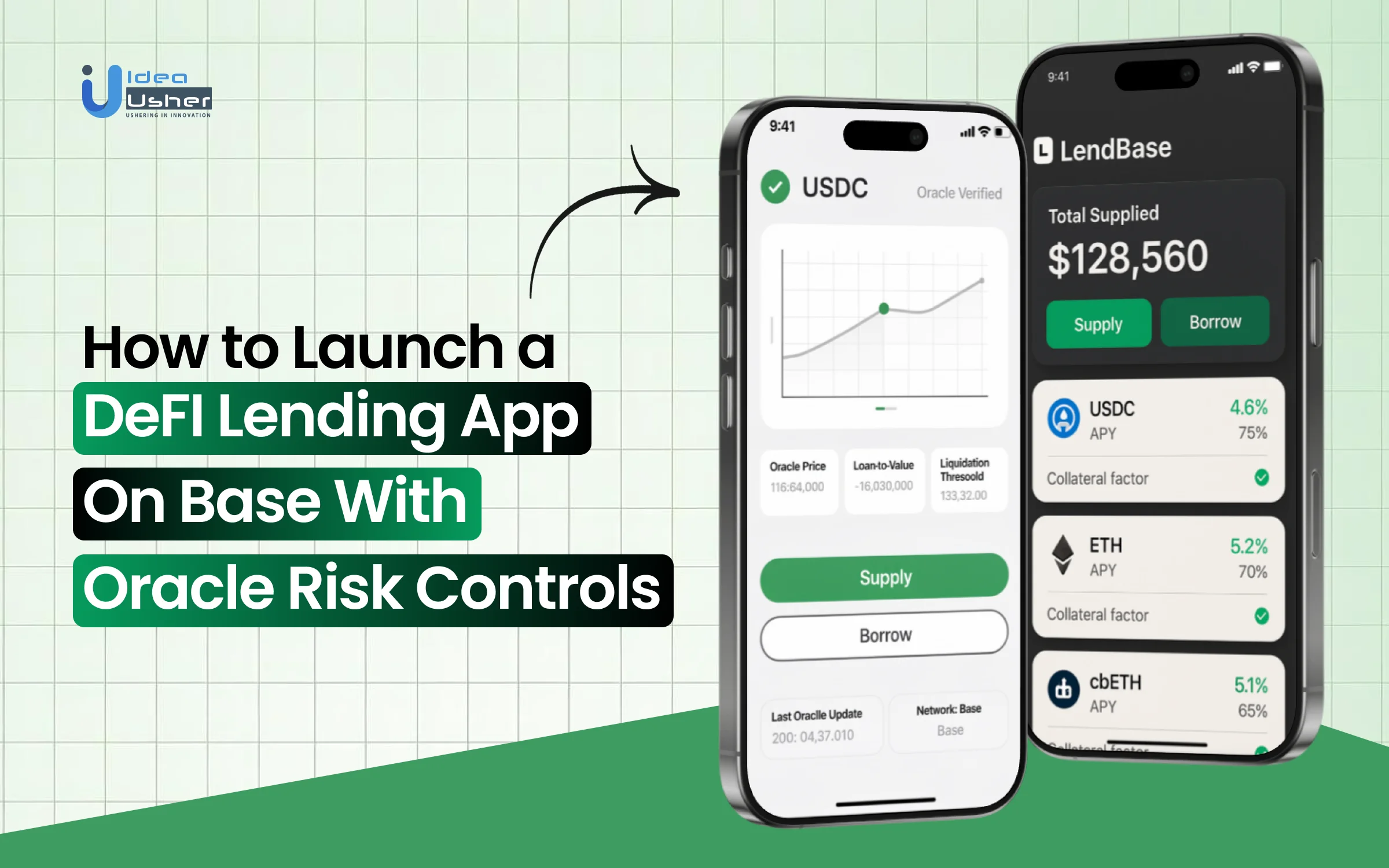
Real-world lending activity quickly exposes risk like small gaps between price updates, collateral valuation, and liquidation execution, which can compound once volume and volatility increase. Teams building lending protocols often discover that oracle behavior matters as much as core lending logic. This is why base DeFi lending app development places so much emphasis on how pricing data is sourced, updated, and enforced on-chain.
Oracle design becomes especially visible once borrowing, liquidation, and collateral management are running in production. Price update frequency, fallback logic, and resistance to manipulation must align closely with liquidation thresholds and execution timing. On Base, faster settlement and lower fees amplify both good and bad oracle decisions, making careful integration essential for maintaining solvency and user trust.
In this blog, we explain how to launch a DeFi lending app on Base with oracle risk control by breaking down oracle architecture, risk mitigation strategies, and the design considerations involved in building a resilient on-chain lending protocol.
What Is a DeFi Lending App?
A DeFi lending app is a blockchain protocol using smart contracts that allows users to supply digital assets, borrow against collateral, and earn interest without centralized intermediaries. Users deposit assets into lending pools and borrow up to a Loan-to-Value (LTV) ratio, while interest rates and liquidation thresholds adjust algorithmically based on utilization and risk parameters. All operations execute transparently on-chain.
What Roles Do Oracles Play in Risk Control in DeFi Lending Apps?
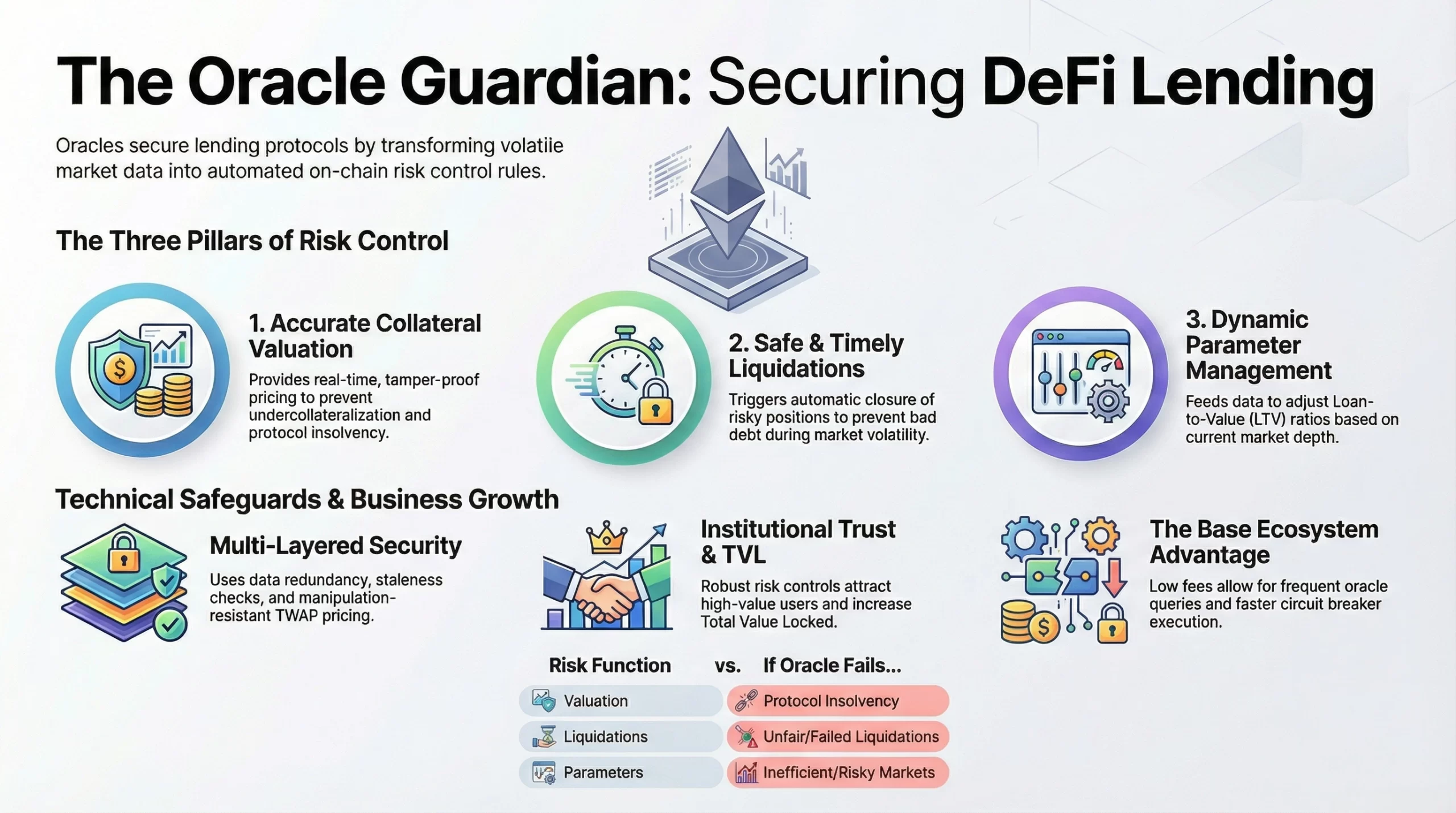
Oracles are mission-critical security infrastructure in DeFi lending apps, acting as the guardians of financial integrity by securing the three core pillars of risk management: collateral valuation, liquidation triggering, and parameter adjustment. These are Oracle’s specific roles in risk control:
| Core Risk Control Function | Role of the Oracle | Consequence of Oracle Failure |
| 1. Accurate Collateral Valuation | Provides real-time, tamper-proof prices to calculate the value of a user’s collateral. | Undercollateralization: Users can borrow more than their collateral is worth, creating bad debt and protocol insolvency. |
| 2. Safe & Timely Liquidations | Supplies the price that triggers automatic liquidations of undercollateralized positions. | Failed Liquidations: Insolvent positions aren’t closed, or Unfair Liquidations: Solvent positions are incorrectly liquidated due to price spikes. |
| 3. Dynamic Risk Parameter Management | Feeds on-chain data (e.g., volatility, liquidity depth) to adjust Loan-to-Value (LTV) ratios and liquidation thresholds. | Static, Inefficient Markets: The protocol cannot adapt to changing market conditions, becoming either too risky or too conservative. |
Advanced Oracle Risk Control Mechanisms
Advanced oracle risk control mechanisms ensure accurate pricing, prevent manipulation, and maintain lending protocol stability during market volatility.
- Data Redundancy & Decentralization: Using multiple, independent oracle nodes (like Chainlink or Pyth) and taking a median price to prevent manipulation by a single source.
- Data Validity Checks: Implementing staleness checks (rejecting old data), price deviation bounds (sanity checks), and circuit breakers (pausing operations during extreme volatility).
- Manipulation-Resistant Pricing: Employing Time-Weighted Average Prices (TWAPs), especially from DEXes like Uniswap V3, makes it economically unfeasible to manipulate the price over a sustained period.
Business Benefits to Launch on Base
Launching on Base delivers strong business advantages through low costs and reliable oracle infrastructure. Robust oracle design improves risk control, builds trust, and creates a clear competitive advantage.
- Trust & Capital Attraction: A protocol known for sophisticated oracle risk controls attracts more institutional and high-value users, directly increasing Total Value Locked (TVL).
- Enabling Innovation: Advanced oracles allow for new products, such as undercollateralized loans or more complex collateral types, which require deeper, real-time risk assessment.
- The Base Ecosystem Benefit: Building on Base enhances these controls. Its low transaction fees make constantly querying multiple oracles and using TWAPs affordable, while its high throughput allows for faster execution of safety mechanisms like circuit breakers.
Oracles transform subjective market risk into objective, automated on-chain rules. For a lending app, investing in a robust, multi-layered oracle stack (as detailed in our previous discussions on choosing the right stack) is the most fundamental investment in its long-term security and business viability.
Why is the DeFi Lending App on Base gaining popularity?
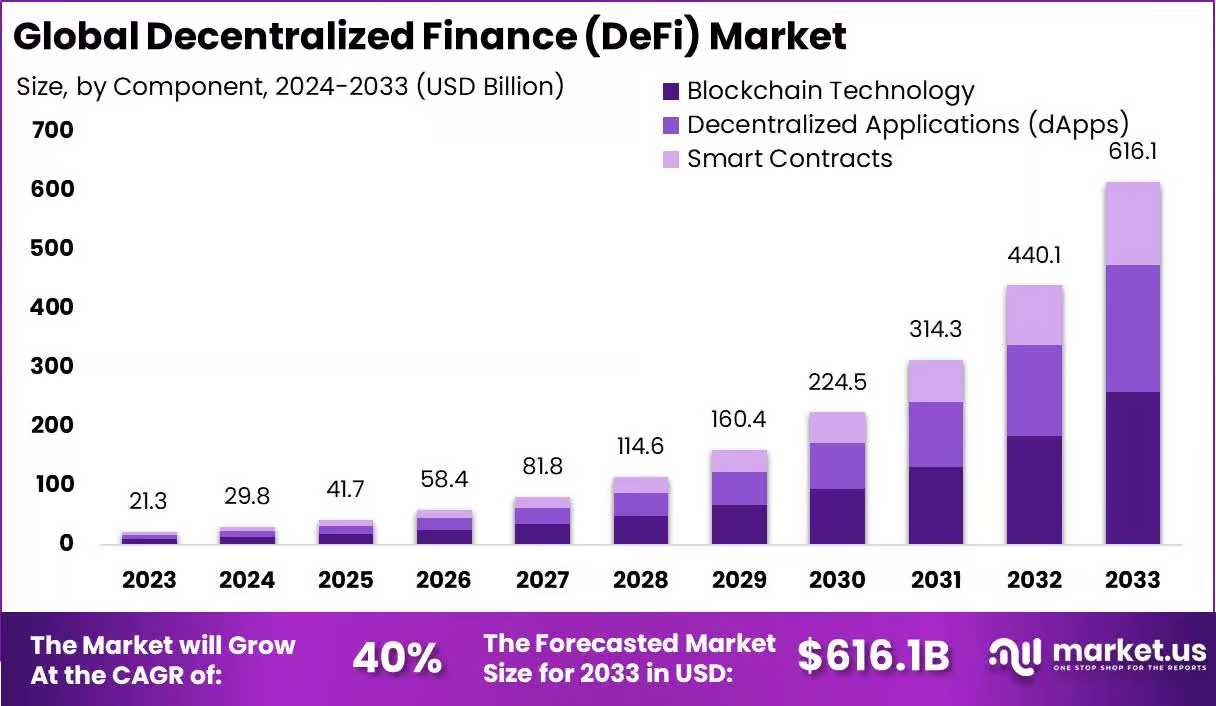
The global Decentralized Finance (DeFi) market is expected to reach USD 616.1 billion by 2033, up from USD 21.3 billion in 2023, growing at a CAGR of 40% from 2024 to 2033. This rapid expansion is being fueled by growing demand for permissionless financial services, yield-generating products, and on-chain credit markets.
Base’s overall DeFi ecosystem has grown significantly, with over $6.6 billion in total DeFi deposits (TVL) across DeFi protocols on the network, making Base one of the top 5 chains in DeFi based on capital deployed.
Morpho, a DeFi lending app launched on Base, achieved $6.8 billion TVL (January 2026) with total deposits surpassing $13 billion, representing ~5.2%market share among top lending protocols by late 2025.
The user base grew from 67,000 to 1.4 million in 2025, capturing 44% of monthly active users in DeFi lending (H2 2025). The “DeFi mullet” strategy onboarded mainstream users via CEX integrations (Coinbase, Crypto.com, Gemini).
Another platform, Aave, also launched on Base, dominates DeFi lending with $29.94 billion in total value locked, about 60 percent of the market, and a peak above $50 billion in mid 2025.
Aave’s strategic position is strengthened by growing regulatory clarity, highlighted by the U.S. SEC’s late 2025 decision not to pursue enforcement action. Looking ahead, Aave V4 and the expansion of its GHO stablecoin signal a focused roadmap aimed at improving capital efficiency and protocol resilience.
Why Base Is Ideal for Oracle Risk Management in DeFi Lending?
Base offers a unique environment that actively enhances Oracle security for DeFi lending platforms beyond providing a neutral foundation. Its technical architecture and ecosystem make it ideal for implementing sophisticated, next-generation risk management.
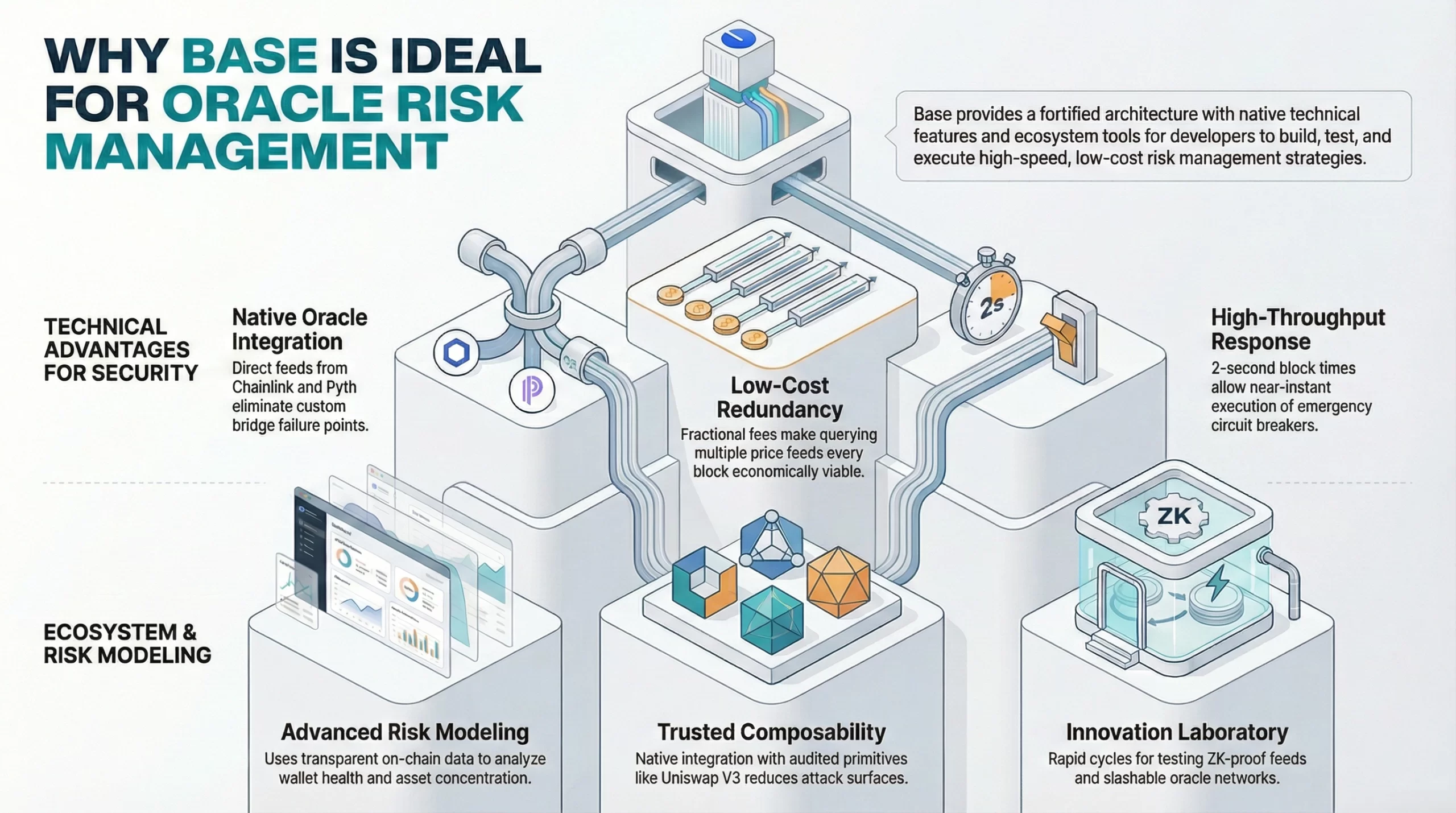
A. Inherent Technical Advantages for Oracle Security
The core design of Base provides built-in features that directly improve the reliability and security of Oracle operations.
1. Native Integration with Leading Oracle Networks
Base benefits from a first-class Oracle provider support. Chainlink CCIP and Pyth Network have deployed native, low-latency feeds on Base, eliminating common failure points of custom bridges and relayers and ensuring secure, frequently updated price data for accurate liquidations.
2. Ultra-Low Cost of Redundancy
Multi-sourcing data is the most effective oracle risk strategy. Base’s fractional fees make querying multiple price feeds (Chainlink, Pyth, Uniswap V3 TWAP) on every block economically viable, but validation and redundancy are prohibitively expensive on the Ethereum mainnet.
3. High Throughput for Emergency Response
Speed is critical during detected anomalies or attacks. Base’s high throughput (~2 seconds per block) enables rapid execution of circuit breakers and pause functions, freezing operations within seconds of identifying suspicious oracle activity and minimizing damage.
B. Ecosystem Synergies for Enhanced Risk Modeling
Beyond pure technology, Base’s growing ecosystem provides tools and data that enable more advanced forms of risk management.
1. Access to Rich, On-Chain User Behavior Data
As a central hub within the Coinbase and Superchain ecosystem, Base generates massive transparent on-chain activity enabling advanced risk oracles. These analyze wallet health, asset concentration, and cross-protocol exposure, allowing dynamic adjustment of collateral factors or debt ceilings.
2. Seamless Composability with Trusted Primitives
Platforms on Base can natively integrate with audited, battle-tested DeFi primitives like Uniswap V3 pools for TWAP data or Aerodrome Finance’s liquidity gauges for asset stability. Building on trusted components reduces attack surface versus deploying standalone, unaudited contracts.
3. A Live Laboratory for Novel Risk Mechanisms
Base’s collaborative developer community and rapid upgrade cycle make it ideal for piloting innovative Oracle solutions. Concepts like staking-slashable oracle networks, zero-knowledge proof verified feeds, or cross-chain risk aggregation can be tested more effectively than on conservative networks.
How a DeFi Lending App on Base Is Actually Structured?
A Base DeFi lending app development is structured around modular smart contracts, secure oracle integrations, and scalable Layer 2 infrastructure, ensuring efficient capital management, risk control, and seamless user interactions.
| Layer | Component | What It Does | Why It Matters on Base |
| Protocol Core | Lending Smart Contracts | Handle deposits, borrowing, repayments, interest accrual, and liquidation eligibility using deterministic on-chain logic. | Low Base gas fees allow frequent state updates without making borrowing or liquidation economically inefficient. |
| Collateral Management | Asset Vaults & Pools | Lock user collateral, track balances, and enforce asset-specific LTV and liquidation thresholds. | Enables isolated or pooled markets optimized for Base’s fast execution environment. |
| Oracle Layer | Price Feed Oracles | Provide real-time asset pricing used to calculate collateral value and borrower health factors. | Accurate, fast-updating price feeds are critical to prevent oracle manipulation and false liquidations. |
| Risk Engine | Oracle Risk Control Logic | Validates oracle data using staleness checks, deviation bounds, TWAPs, and fallback pricing. | Acts as the protocol’s security backbone, preventing catastrophic pricing errors from propagating on-chain. |
| Liquidation System | Liquidation Contracts | Trigger partial or full liquidations when health factors fall below thresholds. | Base enables faster liquidations with lower gas costs, reducing bad debt accumulation. |
| Keeper Network | Liquidation Bots & Keepers | Monitor positions and execute liquidations or risk updates automatically. | Low transaction fees incentivize active keepers and reduce delayed liquidation risk. |
| Data Aggregation | TWAP & Median Pricing | Smooths short-term volatility by averaging prices across time or sources. | Makes flash-loan and short-term manipulation attacks economically impractical on Base. |
How to Launch a DeFi Lending App on Base With Oracle Risk Control?
A Base DeFi lending app development demands secure architecture, efficient smart contracts, and oracle-driven risk controls. Our developers follow best practices to enhance security, manage volatility, and ensure sustainability.
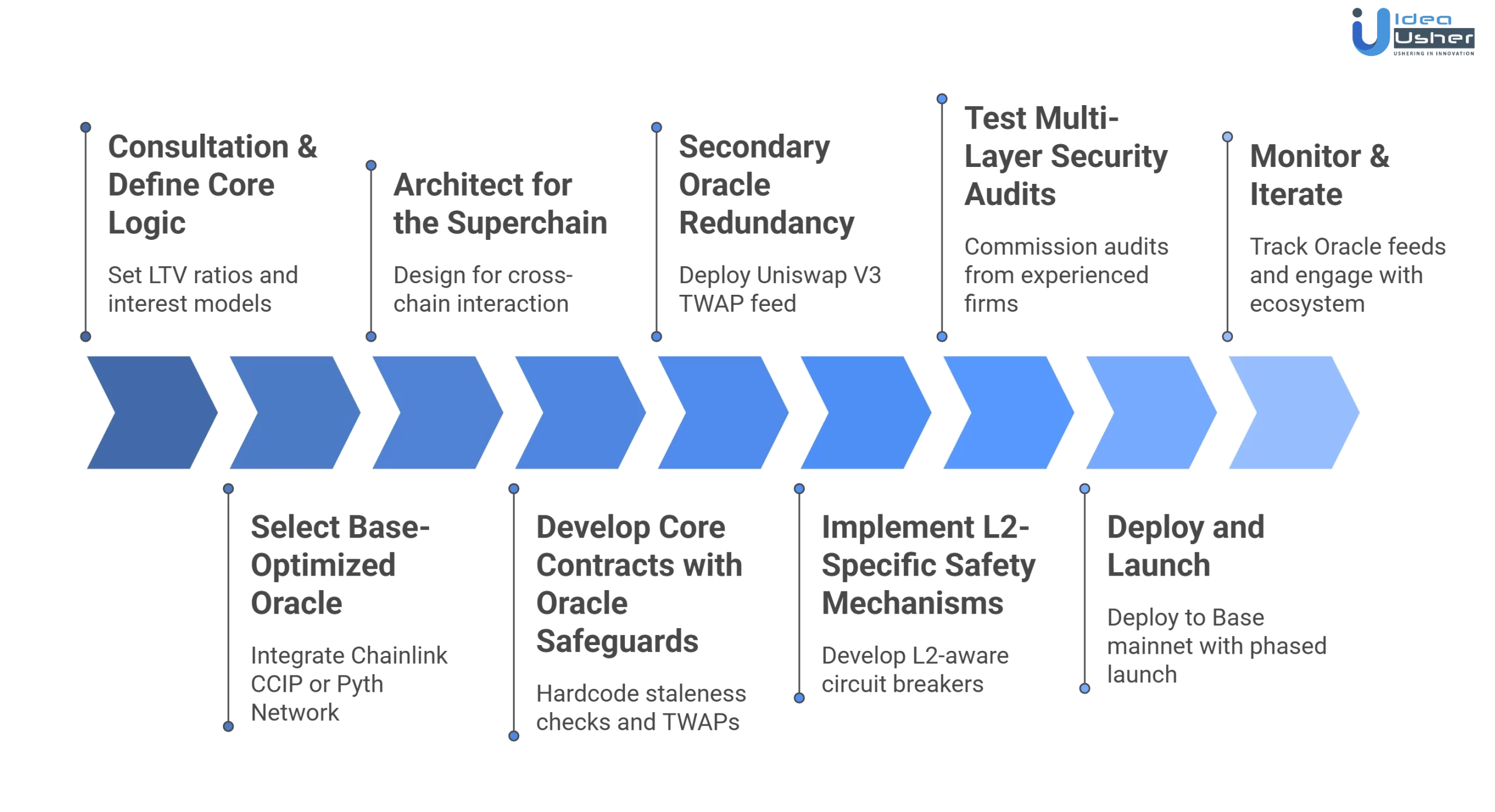
A. Foundation & Base-Specific Design
This phase focuses on defining protocol fundamentals aligned with Base’s ecosystem. The goal is to reduce infrastructure risk, anchor liquidity early, and design contracts that scale with the Superchain vision.
1. Define Core Logic & Base-First Asset Strategy
We’ll start by setting our loan-to-value (LTV) ratios and interest models. Our initial strategy should focus on Base-native canonical assets like ETH, cbBTC, and USDC. This minimizes bridge dependency risks and leverages the deepest liquidity pools on the chain from day one, ensuring smoother operations.
2. Select Base-Optimized Oracle Infrastructure
Choosing the right oracle is critical. We must integrate a low-latency, Base-native oracle service like Chainlink CCIP or Pyth Network as our primary feed. Their direct L2 updates are essential to avoid dangerous data delays that could compromise our price accuracy during fast market moves.
3. Architect for the Superchain & Composability
Our contract architecture should be built with the OP Stack’s Superchain future in mind. We must design for potential cross-chain composability and ensure our contracts can interact seamlessly with other Base-native DeFi primitives, like Aerodrome for liquidity, to maximize our platform’s utility and integration.
B. Building with L2-Aware Risk Controls
Here, Base DeFi lending app development centers on embedding oracle-aware safeguards directly into lending logic. The objective is to mitigate manipulation risks while accounting for Base’s L2-specific execution and sequencing characteristics.
1. Develop Core Contracts with Oracle Safeguards
As we write our lending pools, we’ll hardcode essential risk controls: staleness checks (rejecting outdated prices), reasonable price bands, and TWAPs for volatile assets. These are our first line of defense against corrupted data feeds and must be non-negotiable.
2. Engineer Redundancy with a Secondary Oracle
We cannot rely on a single data source. We’ll deploy a secondary oracle, such as a Uniswap V3 TWAP feed on Base, and build a secure aggregation contract that takes the median price. This design filters out outliers and significantly raises the cost of any manipulation attempt.
3. Implement L2-Specific Safety Mechanisms
We must account for Base’s sequencer centralization. Our system needs L2-aware circuit breakers that can pause liquidations during proven sequencer downtime and consider implementing an L1 escape hatch for users to force actions if the L2 is unresponsive, ensuring user protection.
C. Security, Launch, and Ecosystem Growth
This phase emphasizes validation, controlled deployment, and long-term sustainability. Security reviews, phased launch strategies, and ecosystem integrations ensure protocol resilience, adoption, and responsible growth of Base DeFi lending app development.
1. Execute Rigorous, Multi-Layer Security Audits
Before mainnet, we will commission audits from firms experienced with L2 and oracle implementations. We’ll complement this with internal audits and a bug bounty program, focusing intensely on our unique risk control modules and cross-chain message validation.
2. Deploy and Launch with a Controlled Rollout
We’ll deploy our audited contracts to the Base mainnet. Our launch strategy should be phased: starting with a permissioned or capped pool for blue-chip assets only. This allows us to monitor Oracle performance and liquidation mechanics in a real but controlled economic environment.
3. Monitor, Iterate, and Leverage the Base Flywheel
Post-launch, we’ll use monitoring dashboards to track Oracle feeds and protocol health. We’ll actively engage with the Base ecosystem, exploring integrations like Coinbase’s Smart Wallet for account abstraction to streamline user onboarding and leverage Base’s massive distribution potential.
Choosing the Right Oracle Stack for Risk Control on Base
Selecting the optimal oracle stack is the most critical technical decision for a Base DeFi lending app development, defining risk ceiling, operational resilience, and innovation capacity. Evaluation should focus on L2-native performance, data robustness, and operational maturity.
Core Criteria for Evaluation
Priority should be given to solutions that provide low-latency updates directly on Base, robust cryptographic proof of data integrity, and a proven track record of securing significant value on Ethereum L2s. Cost and developer experience are secondary to these foundational security principles.
1. Primary Provider: Chainlink (The Battle-Tested Standard)
Chainlink offers native CCIP feeds on Base, powered by a decentralized network of nodes. Its strong industry reputation and mature infrastructure provide a reliable, well-understood foundation. Consideration must be given to its operational cost model and the architectural complexity of its upgradeable proxy system.
2. Primary Provider: Pyth Network (The Low-Latency Challenger)
Pyth Network delivers high-frequency price updates directly to Base with very low latency. Its first-party data model, sourced directly from major trading venues, offers a distinct approach to data integrity. Its pull-based oracle model and the economic security of its newer protocol are important evaluation points.
3. Essential Secondary Source: Uniswap V3 TWAPs
Integrating Uniswap V3 TWAP oracles for key trading pairs on Base serves as a critical secondary, decentralized price source. This provides crypto-native price discovery and vital redundancy. The TWAP window must be carefully calibrated to balance manipulation resistance with price relevance.
4. Aggregation & Risk Layer: Custom Smart Contract Logic
A secure aggregation contract must be developed to calculate a median price from multiple sources. This contract is also responsible for enforcing staleness checks, price deviation limits, and circuit breaker logic, codifying the platform’s unique risk parameters.
Key Technical Decision Matrix
This matrix compares Oracle options based on reliability, latency, decentralization, and Base compatibility to support informed architectural decisions of Base DeFi lending app development.
| Consideration | Chainlink | Pyth Network | Uniswap V3 TWAP |
| Primary Use Case | Main, reliable feed for blue-chip assets. | Main feed for low-latency, high-frequency assets. | Critical secondary/fallback price discovery. |
| Key Advantage | Time-tested, decentralized, widely integrated. | Extremely fast, first-party data, cost-efficient. | Fully decentralized, trust-minimized, on-chain. |
| Implementation Note | Manage upgrade risks and cost model. | Handle pull-oracle pattern, assess protocol maturity. | Set optimal window, manage liquidity reliance. |
| Base-Specific Fit | Native CCIP feeds; high reliability. | Direct Wormhole integration; very low latency. | Native Base pools; perfect composability. |
Recommended Stack Architecture for a Platform
This architecture outlines a layered oracle strategy of Base DeFi lending app development that balances speed, security, and redundancy to protect lending operations on Base.
- Primary Feed: Pyth Network is often selected for core assets due to superior speed and cost on Base, which is critical for liquidation safety. Chainlink remains a stable alternative if prioritizing maximal proven security over latency.
- Secondary Verification: Deploying Uniswap V3 TWAP oracles for major asset pairs (e.g., ETH/USDC) is essential. The aggregation contract uses this as a constant benchmark.
- Aggregation & Control: A custom RiskAggregator.sol contract should: 1) Fetch prices from all sources, 2) Validate against staleness and deviation thresholds, 3) Output a validated median price for all protocol functions.
- Monitoring & Response: Real-time alerts for price feed divergence and sequencer status are necessary, alongside a clear playbook for manual intervention if circuit breakers activate.
Building this multi-layered, Base-optimized oracle stack creates a robust, verifiable truth foundation for all lending, borrowing, and liquidation activities, forming the platform’s most critical competitive advantage.
How Base Prevent Oracle Exploits and Price Manipulation Attacks?
Preventing Oracle exploits is not a single feature but a comprehensive security architecture built around redundancy, validation, and Base-specific safeguards. Price manipulation is the most direct path to protocol insolvency, making these defenses non-negotiable.

1. Implement Multi-Layered Oracle Redundancy
Relying on a single oracle creates a critical failure point. A robust system integrates multiple independent sources: Chainlink for institutional data, Pyth for low-latency feeds, and Uniswap V3 TWAP for on-chain verification. The aggregation contract should use the median price to automatically filter outliers from compromised sources.
2. Utilize Time-Weighted Average Prices (TWAPs)
Spot prices from DEXes are highly susceptible to flash loan manipulation. Integrating Uniswap V3 TWAP oracles forces attackers to manipulate prices over sustained periods (e.g., 15-30 minutes), making attacks economically prohibitive due to rising arbitrage costs and increasing detection likelihood.
3. Enforce Rigorous On-Chain Data Validation
Every price update must pass automated checks before acceptance. Staleness checks reject outdated data (e.g., prices older than 1 block on Base). Price deviation bounds set absolute sanity limits, while cross-oracle deviation checks trigger alerts or pauses if sources disagree beyond safe thresholds (e.g., 2-3%).
4. Design L2-Aware Liquidation Protections
Base’s sequencer model introduces unique risks. A circuit breaker should pause liquidations during sequencer downtime or extreme congestion to prevent unfair liquidations. Additionally, implementing gradual, Dutch-auction style liquidation mechanisms can mitigate the market impact of large positions.
5. Adopt a Conservative Collateral and Listing Policy
The safest oracle is one not needed for marginal assets. Platforms should initially support only high-liquidity, Base-canonical assets (e.g., ETH, cbBTC, USDC) with deep markets. For new assets, require over-collateralization and lower debt ceilings to limit potential damage from successful manipulation.
Top DeFi Lending Protocols on Base
Leading DeFi lending protocols on Base enable efficient borrowing and yield generation through low-cost, scalable infrastructure. These platforms demonstrate how Base supports secure, capital-efficient decentralized lending at scale.
1. Seamless Protocol
Seamless Protocol is the first fully decentralized DeFi lending platform on Base, offering automated liquidity markets, Integrated Liquidity Markets (ILMs), and Leverage Tokens. It emphasizes capital efficiency, auto-compounding, risk monitoring, and SEAM token governance. Users benefit from low fees and composability while earning rewards.
2. Aave
Aave on Base offers battle-tested lending markets with variable and stable interest rates. Users can supply, borrow, and earn incentives with deep liquidity, robust risk controls, and industry-leading security across multiple assets.
3. Compound
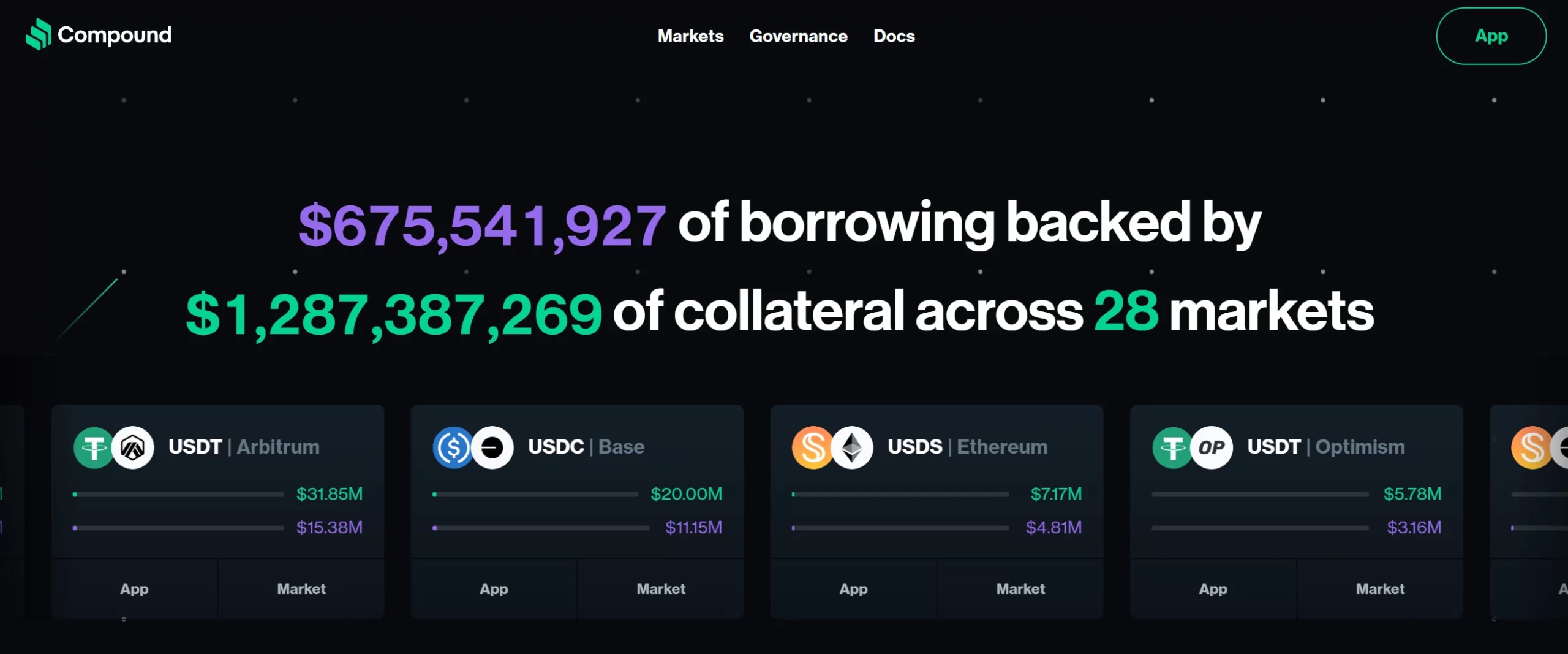
Compound enables algorithmic interest rate markets on Base. Users earn yield by supplying assets or borrow against collateral, with rates adjusting automatically based on utilization and transparent, fully on-chain money markets.
4. Morpho
Morpho optimizes lending by matching peer-to-peer liquidity on top of protocols like Aave and Compound. On Base, it improves capital efficiency, lowers rates for borrowers, and boosts returns for lenders.
5. Fluid Finance
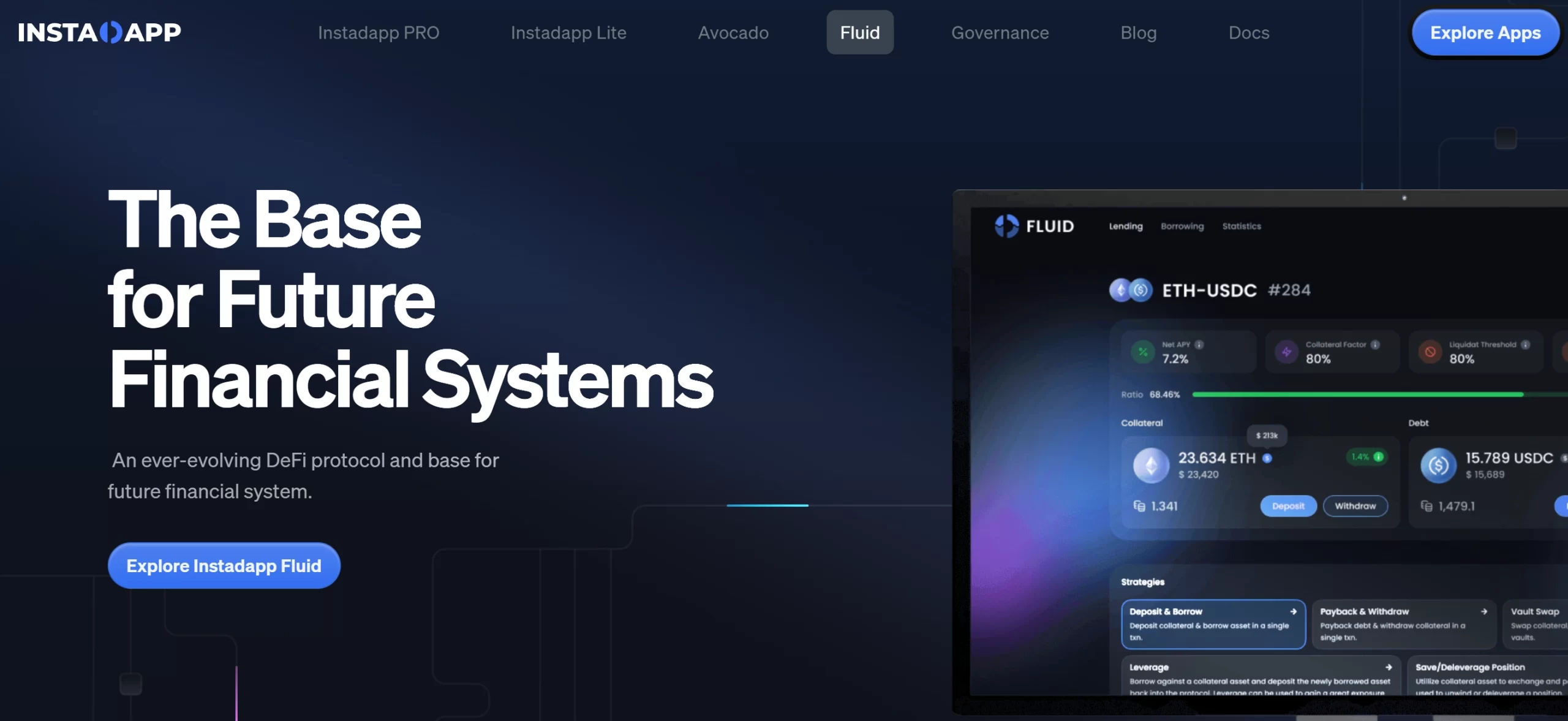
Fluid Finance focuses on highly capital-efficient liquidity and lending. Deployed on Base, it combines smart liquidity routing with lending primitives to reduce spreads, improve utilization, and enhance returns across DeFi markets.
Conclusion
Launching a DeFi lending app on Base with oracle-driven risk control is a practical path to scalable, transparent finance. When pricing, collateral, and liquidation logic are informed by reliable data, trust follows. Success depends on thoughtful protocol design, security-first engineering, and governance that anticipates volatility. Treat compliance, audits, and monitoring as ongoing commitments, not milestones. With a clear roadmap and disciplined execution, base defi lending app development can move from concept to resilient production, while aligning incentives for borrowers, lenders, and the broader ecosystem over time with confidence.
Why Choose IdeaUsher for Your DeFi Lending App on Base?
At IdeaUsher, we bring years of hands-on experience in building dApps, DeFi platforms, and advanced blockchain solutions. By applying this deep technical expertise, we help startups and enterprises design and develop secure DeFi lending platforms on Base, equipped with oracle-driven risk control mechanisms for reliable and trustless lending.
Why Partner With Us?
- DeFi & Layer 2 Expertise: Our team has deep experience building lending protocols on Ethereum-compatible chains, ensuring seamless deployment and optimal performance on Base.
- Oracle-Based Risk Management: We integrate advanced oracle solutions for real-time price feeds, liquidation triggers, and dynamic risk assessment to protect both lenders and borrowers.
- End-to-End Development: From smart contract architecture and tokenomics to UI/UX and compliance readiness, we handle the entire product lifecycle.
- Security & Scalability First: We design lending apps with audited smart contracts, scalable infrastructure, and future-ready governance models.
Explore our portfolio to see how we’ve helped DeFi startups bring innovative financial products to market.
Book a free consultation today and let’s build a DeFi lending app on Base that’s secure, resilient, and ready to scale.


FAQs
A.1. The timeline typically ranges from three to six months, depending on protocol complexity, oracle integrations, and audit cycles. Faster launches are possible with modular architectures, but security testing and risk validation should never be rushed.
A.2. Oracle risk control ensures accurate asset pricing, prevents manipulation, and protects collateral logic. Reliable oracles reduce bad debt risk, improve liquidation fairness, and maintain user trust, especially during high volatility or low liquidity market conditions.
A.3. Base offers lower transaction costs, Ethereum compatibility, and faster settlement, making it suitable for scalable DeFi lending. These benefits help teams attract users, optimize capital efficiency, and deploy complex lending logic without excessive gas overhead.
A.4. Security measures include smart contract audits, oracle validation testing, access control checks, and continuous monitoring. Teams should also implement fail-safes, pause mechanisms, and clear governance rules to respond quickly to unexpected market or protocol risks.