 (+971) 8007 4267
 (+91) 946 340 7140
 (+1) 628 432 4305


Crypto wallets sit at the center of how users interact with blockchain applications, making reliability and security critical from the outset. Beyond holding assets, modern wallets are expected to support transactions, token management, dApps, and seamless onboarding without exposing users to unnecessary complexity. These expectations shape Base crypto wallet app development, where design choices directly affect usability, safety, and long-term trust.
A wallet really starts to take shape once real interactions are involved. Transactions need to be signed securely, keys must be managed without friction, gas handling has to be predictable, and integrations with dApps and services should feel seamless. While Base offers faster settlement and lower fees, wallet architecture still needs to balance performance with strong security controls and a smooth user experience.
In this blog, we explain how to build a crypto wallet app using Base by breaking down core wallet components, architectural decisions, and the technical considerations involved in launching a secure and scalable wallet application.
What Is Base Blockchain and Why Use It for a Crypto Wallet App?
Base is an Ethereum Layer 2 blockchain designed to make Web3 applications faster, more affordable, and easier to use at scale. Built with support from Coinbase, Base focuses on solving some of the biggest challenges faced by blockchain applications today, especially high fees, slow transactions, and poor user experience.
For crypto wallet apps, these challenges affect adoption since a wallet is often the first Web3 interaction. Performance, cost, and trust are crucial and it addresses these by merging Ethereum security with a user-friendly layer.
1. Base as an Ethereum Layer 2 Network
Base operates on top of Ethereum, which means it inherits Ethereum’s security, decentralization, and smart contract standards. Transactions are processed on Base and ultimately settled on Ethereum, reducing congestion while maintaining trust and immutability. For wallet developers, this ensures:
- Compatibility with existing Ethereum tokens and NFTs
- Support for standard wallet interactions and smart contracts
- Long-term reliability backed by Ethereum’s ecosystem
2. Lower Transaction Costs for Everyday Wallet Usage
One of the biggest limitations of wallet apps on the Ethereum mainnet is high gas fees. Base significantly reduces transaction costs, making it practical for everyday wallet activities such as:
- Token transfers
- NFT interactions
- Frequent DApp usage
This cost efficiency is especially important for consumer-focused wallet apps where users expect small, frequent transactions without excessive fees.
3. Faster Transactions and Better User Experience
Wallet usability depends heavily on transaction speed and clarity. Base processes transactions more efficiently, resulting in faster confirmations compared to the Ethereum mainnet. For a crypto wallet app, this translates into:
- Near-instant transaction feedback
- Reduced failed or stuck transactions
- A smoother experience comparable to Web2 financial apps
This improvement plays a major role in reducing user drop-offs and increasing wallet retention.
4. Full Compatibility With Ethereum Wallet Standards
Base supports Ethereum wallet standards for seamless integration and ecosystem support. As an EVM-compatible network, it enables wallet apps to easily support the following features:
- ERC-20 tokens
- ERC-721 and ERC-1155 NFTs
- Existing Ethereum smart contracts
Developers can reuse established Ethereum libraries, wallet SDKs, and security practices, significantly reducing development complexity and time-to-market.
5. Easier Onboarding for Non-Crypto Users
A major advantage of Base is its close alignment with the Coinbase ecosystem. This makes it easier for wallet apps to onboard users who are new to crypto by offering:
- Familiar onboarding flows
- Seamless fiat-to-crypto access
- Higher trust due to Coinbase’s brand credibility
For startups building wallet apps aimed at mass adoption, this lowers the entry barrier for first-time users.
Why Base Is a Strong Choice for Crypto Wallet Apps?
Choosing the right blockchain is crucial for a crypto wallet app, impacting user experience, security, costs, and scalability. Base offers a strong balance of Ethereum’s security with performance and usability. Below are the key reasons why Base is particularly well-suited for building modern crypto wallet apps.

1. Low and Predictable Transaction Fees
Crypto wallets are used frequently for transfers, swaps, NFT interactions, and DApp access. Base significantly lowers gas fees compared to the Ethereum mainnet, making everyday wallet actions affordable and predictable. For wallet apps, this means:
- Users are not discouraged by high transaction costs
- Micro-transactions and frequent interactions become viable
- Wallet usage scales without increasing operational friction
2. Faster Transactions for a Better Wallet Experience
Speed plays a major role in how users perceive a wallet app. Base processes transactions more efficiently, resulting in faster confirmations and fewer failed or pending transactions. This leads to:
- Near-instant transaction feedback
- Smoother asset transfers and approvals
- A wallet experience closer to traditional Web2 financial apps
3. Ethereum-Grade Security and Compatibility
Base inherits the security and decentralization guarantees of Ethereum, ensuring that wallet interactions remain trustless and secure. At the same time, it is fully compatible with Ethereum’s smart contract and token standards. For developers and businesses, this ensures:
- Support for ERC-20 tokens and NFTs
- Seamless integration with existing Ethereum-based DApps
- Long-term reliability without ecosystem lock-in
4. Consumer-Ready Infrastructure for Mass Adoption
Base is designed with consumer applications in mind unlike many blockchains optimized mainly for DeFi protocols. This makes it a strong fit for wallet apps targeting mainstream users rather than only crypto-native audiences. Key benefits include:
- Support for high volumes of wallet transactions
- Infrastructure suited for mobile-first applications
- Easier onboarding flows for new crypto users
5. Trust and Ecosystem Support
Base benefits from strong ecosystem backing and infrastructure alignment with Coinbase, which adds credibility and long-term stability to applications built on the network. For wallet apps, this translates into:
- Higher user trust during onboarding
- Easier access to ecosystem tools and integrations
- Confidence in long-term network support and growth
Types of Crypto Wallet Apps You Can Build on Base
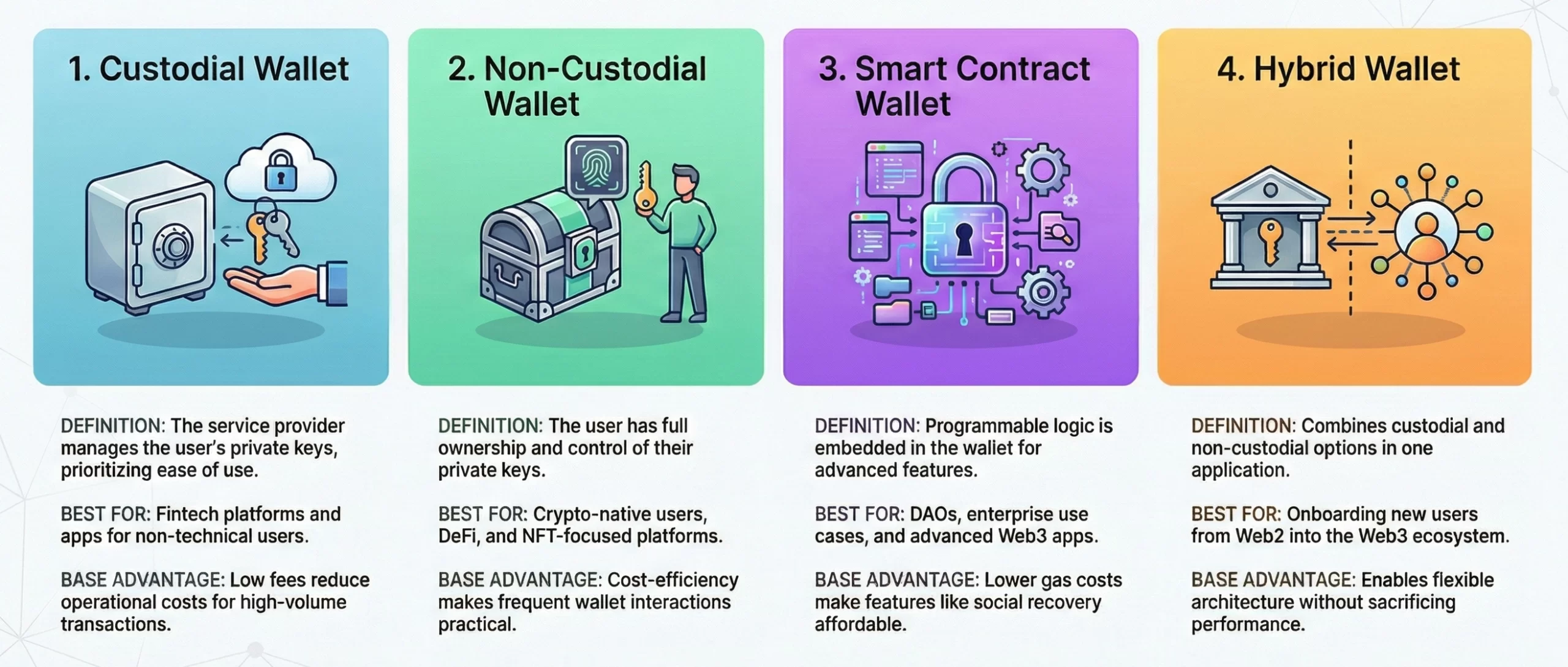
Choosing the right wallet model early is key in building a crypto wallet app on Base. The wallet type affects user interactions, security, and control. Base’s low fees, fast transactions, and Ethereum compatibility support various wallets, from custodial to smart contract types.
1. Custodial Crypto Wallet Apps
Custodial wallets are platforms where private keys are managed by the service provider rather than the end user. This model prioritizes ease of use and is often preferred by beginners and mainstream users.
Best suited for
- Fintech platforms and exchanges
- Consumer-facing apps targeting non-technical users
- Businesses requiring account recovery and support features
Why build custodial wallets on Base: Base’s fast transactions and low fees improve user experience while reducing operational costs for high-volume wallet usage.
2. Non-Custodial Crypto Wallet Apps
Non-custodial wallets give users full ownership of their private keys, offering maximum decentralization and control. These wallets appeal strongly to crypto-native users who prioritize self-custody and privacy.
Best suited for
- Web3-native users and developers
- DeFi and NFT-focused platforms
- Privacy-conscious applications
Why build non-custodial wallets on Base: Ethereum compatibility ensures seamless support for tokens and NFTs, while Base’s cost efficiency makes frequent wallet interactions more practical.
3. Smart Contract Wallet Apps
Smart contract wallets extend beyond traditional wallets by embedding programmable logic directly into wallet behavior. These wallets enable advanced features such as social recovery and automated transactions.
Best suited for
- Advanced Web3 applications
- DAO and enterprise use cases
- Wallets requiring enhanced security and flexibility
Why build smart contract wallets on Base: Base supports scalable smart contract execution with lower gas costs, making advanced wallet features affordable and user-friendly.
4. Hybrid Wallet Apps
Hybrid wallets combine custodial and non-custodial features, allowing users to choose between managed custody and self-custody within the same application.
Best suited for
- Platforms onboarding Web2 users into Web3
- Apps offering tiered user experiences
- Businesses balancing usability with decentralization
Why build hybrid wallets on Base: Base enables a flexible architecture that supports multiple custody models without compromising performance or security.
How a Crypto Wallet App Works on Base?
A Base crypto wallet connects users to the blockchain, enabling asset storage, transaction signing, and DApp interaction. Though simple for users, multiple processes ensure security, speed, and reliability. Below is a clear, step-by-step explanation of how a Base-powered crypto wallet app functions.

1. Wallet Creation and Key Generation
When a user creates a wallet, the app generates a cryptographic key pair consisting of a public address and a private key. The public address is used to receive assets, while the private key is required to authorize transactions.
In non-custodial wallet apps, these keys are generated and stored securely on the user’s device. In custodial setups, key management is handled by secure backend systems, often using hardware security modules. This step establishes ownership and control within the wallet.
2. Asset Storage and Balance Tracking
Crypto assets are not stored inside the wallet itself. Instead, the wallet reads data from the blockchain to display balances associated with the user’s address. A Base crypto wallet continuously:
- Queries the Base network for token and NFT balances
- Tracks transaction history
- Updates asset values in real time
This ensures users always see an accurate representation of their on-chain assets.
3. Transaction Creation and Signing
When a user initiates an action such as sending tokens or interacting with a DApp, the wallet prepares a transaction request. This includes details like the recipient address, amount, and network fees.
The transaction is then cryptographically signed using the user’s private key, proving authorization without exposing sensitive data. Signing happens locally in non-custodial wallets, ensuring the private key never leaves the user’s control.
4. Transaction Execution on Base
Once signed, the transaction is broadcast to the Base network. Base processes the transaction off the Ethereum mainnet, which significantly reduces costs and improves speed. After execution, the transaction is:
- Confirmed on Base
- Batched and settled on Ethereum
- Marked as complete within the wallet interface
This layered approach allows wallets to offer fast confirmations while maintaining Ethereum-grade security.
5. Gas Fee Handling and User Transparency
A Base crypto wallet calculates gas fees before the transaction is submitted and displays them clearly to the user. Because Base has lower and more predictable fees, users are less likely to encounter unexpected costs. Wallet apps can also implement features such as:
- Fee estimation and optimization
- Transaction speed options
- Fee visibility in fiat values
This improves trust and reduces friction for everyday wallet usage.
6. Interaction With DApps and Smart Contracts
Modern crypto wallets do more than store assets. They act as gateways to decentralized applications. A Base wallet connects users to DApps by securely approving smart contract interactions. Through the wallet, users can:
- Swap tokens
- Interact with DeFi platforms
- Access NFT marketplaces and games
All approvals and transactions are signed by the user, ensuring full control and transparency.
7. Notifications, Updates, and User Feedback
To enhance usability, a Base crypto wallet app monitors transaction status and network updates. Users receive notifications when transactions are confirmed, fail, or require action. This feedback loop helps users stay informed and confident while using blockchain-based applications.

Why High Crypto Wallet Usage Creates Strong Opportunities for New Wallet Apps?
The global crypto wallet market was estimated at USD 12.59 billion in 2024 and is projected to reach USD 100.77 billion by 2033, growing at a CAGR of 26.3% from 2025 to 2033. This sustained growth is being driven by rising on-chain activity, increasing user ownership of digital assets, and the growing role of wallets as the primary gateway to Web3 applications.

As blockchain use grows in payments, NFTs, gaming, and decentralized apps, crypto wallets are shifting from passive storage to essential, utility-driven tools used daily.
With over 820 million active crypto wallets globally, wallet usage has clearly moved beyond niche adoption and into mainstream on-chain activity. This scale highlights wallets as one of the most widely used entry points into the Web3 ecosystem.
This behavior is visible at the product level as well. As of 2025, Coinbase Wallet, one of the most widely used self-custody Web3 wallets, reports approximately 3.2 million monthly active users. This level of recurring usage demonstrates that wallet apps are not passive tools but products users return to regularly.
Why Rising Wallet Usage Signals Strong Market Readiness?
Growing wallet usage indicates that crypto wallets have moved beyond early adoption into consistent, recurring use across multiple on-chain activities.
- Wallets as daily interaction tools: Users now rely on wallets for frequent actions such as transfers, approvals, NFT interactions, and DApp access, signaling sustained engagement rather than one-time usage.
- Increasing demand for better user experience: As wallet usage grows, users expect faster transactions, clearer fee visibility, and smoother onboarding, creating space for improved and differentiated wallet products.
- Expansion beyond crypto-native audiences: Improved interfaces and simplified flows are attracting non-technical users, turning wallets into mainstream applications rather than tools limited to advanced users.
Why This Is a Perfect Time to Build a Crypto Wallet App on Base?
For startups and businesses planning to build crypto wallet apps, timing and infrastructure choice play a crucial role in long-term success.
- Infrastructure suited for high-frequency wallet usage: Base offers low and predictable transaction fees, making it well-aligned with wallets that handle frequent, everyday onchain interactions.
- Support for evolving wallet use cases: As wallets expand beyond storage into payments, NFTs, gaming, and DApp access, Base provides the scalability and performance needed to support these growing demands.
- Early positioning within a rapidly scaling ecosystem: Building wallet apps on Base today allows teams to establish product maturity, user trust, and ecosystem presence before competition intensifies.
Rising crypto wallet usage reflects active demand, not market saturation. As wallets become the central access point for Web3, opportunities increasingly favor teams that can deliver faster, more intuitive, and scalable wallet experiences. Building on Base enables developers to align with this usage trend while keeping costs low and user experience high.
How Base Improves Usability and Cost Efficiency for Wallet Users?
Base enhances wallet usability through faster transactions, lower fees, and seamless Ethereum compatibility. These efficiencies improve user experience and cost predictability, showcasing a practical Layer-2 approach for everyday wallet interactions.
1. Reduced Transaction Costs for Everyday Wallet Actions
Base lowers the cost of common wallet interactions such as transfers, swaps, and app connections. This improves affordability for frequent users and makes smaller-value transactions viable without eroding balances through excessive fees.
2. Faster Transaction Confirmations and Feedback
Wallet actions on Base benefit from quicker confirmations compared to mainnet execution. Faster settlement improves user confidence, reduces uncertainty during transfers, and allows wallets to deliver near real-time status updates and balance changes.
3. Smoother User Experience for High-Frequency Interactions
Lower fees and faster execution allow wallet apps to support frequent actions without friction. Users can interact with assets, applications, and services more naturally, making wallets feel closer to modern financial apps.
4. Consistent Fee Behavior and Predictable Costs
Base provides more stable fee behavior, allowing wallets to estimate transaction costs accurately. Predictable fees improve transparency, reduce failed transactions, and help users make informed decisions before signing actions.
5. Improved Accessibility for New and Mainstream Users
Base lowers entry friction for new users by reducing cost barriers and execution delays. Wallets built on Base can onboard users more easily, supporting broader adoption beyond crypto-native audiences.
Key Features of a Crypto Wallet App Using Base
Base crypto wallet apps offer low fees, fast confirmations, and Ethereum compatibility for secure daily use. These core features highlight a scalable, user-focused foundation for modern wallet ecosystems.

1. Multi-Asset Support
A wallet should support multiple tokens and asset types within a single interface. This allows users to manage native assets, stablecoins, and custom tokens seamlessly, improving portfolio visibility and reducing the need to switch between multiple wallet applications.
2. Private Key and Seed Phrase Management
Secure generation and storage of private keys and recovery phrases are fundamental. Wallets must ensure self-custody control, encrypted storage, and safe recovery mechanisms so users retain full ownership without exposing sensitive credentials.
3. Secure Authentication and Account Protection
Strong account protection mechanisms such as biometric authentication, device-level security, and optional multi-factor verification help prevent unauthorized access. These measures protect wallets against theft while maintaining a balance between security and everyday usability.
4. On/Off-Ramp Integration (Fiat to Crypto)
Integrated fiat on-ramps allow users to purchase crypto directly within the wallet. This reduces onboarding friction and enables non-technical users to enter the ecosystem without relying on external exchanges or complex setup processes.
5. Send, Receive, and Transfer Functionality
Core wallet functionality includes simple asset transfers with address validation, QR code support, and transaction confirmations. Clear transfer flows ensure users can move assets confidently while minimizing errors and failed transactions.
6. Real-Time Balance and Transaction History
Users should have access to accurate balances and detailed transaction records updated in real time. Transparent history tracking helps users monitor activity, verify transfers, and maintain confidence in wallet reliability.
7. Network and Gas Fee Customization
Wallets should allow users to adjust transaction fees based on urgency and cost preferences. Fee customization enables better control over execution speed while optimizing transaction costs on Layer-2 networks like Base.
8. Token Swap and Cross-Asset Exchange
Built-in swap functionality allows users to exchange tokens directly within the wallet. This feature improves convenience, reduces dependency on external platforms, and enables faster access to liquidity across supported assets.
9. Staking and Yield Tools
Integrated staking and yield options enable users to earn returns on supported assets without leaving the wallet. These tools encourage long-term engagement while simplifying participation in on-chain earning opportunities.
10. NFT and Digital Asset Support
Support for NFTs and digital collectibles allows users to store, view, and transfer non-fungible assets alongside tokens. Unified asset management improves user experience across financial and digital ownership use cases.
11. Multi-Chain and EVM Compatibility
Multi-chain support ensures the wallet can interact with Base and other EVM-compatible networks. This flexibility allows users to manage assets across ecosystems while preserving a consistent experience and reducing network lock-in.

How to Build a Crypto Wallet App Using Base?
Base crypto wallet app development enables faster transactions, lower fees, and seamless Ethereum integration for scalable performance. Our developers follow proven frameworks, security best practices, and structured development workflows to deliver reliable, future-ready wallet applications.

1. Consultation
We start by understanding the wallet’s purpose, target users, custody model, and supported assets. This phase aligns business goals, compliance expectations, and user experience priorities before defining any technical or architectural direction.
2. Wallet Model and Use Case Definition
Our team defines whether the wallet is self-custodial, assisted, or hybrid. We map core use cases such as payments, asset management, and ecosystem access to ensure the wallet solves specific user problems at launch.
3. Architecture and Flow Planning
We design the overall wallet architecture, defining how keys, transactions, and user interactions are handled. This step focuses on secure data flows, clear responsibility boundaries, and scalability without overcomplicating the core wallet experience.
4. Security and Key Management Design
Security is planned early by defining how private keys, recovery phrases, and authentication are handled. We prioritize user-controlled ownership, encrypted storage, and safe recovery paths to reduce loss, misuse, or unauthorized access.
5. User Experience and Interaction Design
We design intuitive onboarding, transaction flows, and asset views that minimize complexity. The focus is on clarity and trust, ensuring users understand actions, confirmations, and balances without needing deep blockchain knowledge.
6. Transaction Handling and Network Behavior
Our developers define how transactions are created, confirmed, and tracked across networks. This includes handling fees, confirmations, and failures to ensure predictable transaction behavior and consistent user feedback.
7. Testing, Validation, and Security Review
We test wallet behavior across common and edge scenarios including failed transactions, recovery flows, and network changes. This phase ensures reliability and user safety before exposing the wallet to real assets.
8. Deployment and Launch Readiness
Before launch, we prepare deployment, monitoring, and update processes. This ensures the wallet is ready for real users, supports growth, and can evolve safely as usage and ecosystem requirements expand.
Cost to Build a Crypto Wallet App Using Base
Estimating the cost of Base crypto wallet app development depends on features, security needs, and integration complexity. This overview highlights key pricing factors for informed planning and budgeting.
| Development Phase | Short Description | Estimated Cost |
| Consultation & Discovery | Defines wallet goals, custody model, compliance scope and target user requirements. | $3,000 – $6,000 |
| Wallet Model & Use Case Design | Structures self-custody logic, asset support, user flows for real-world usability. | $5,000 – $8,000 |
| Architecture & Flow Planning | Plans secure key flows, transaction lifecycle, scalability boundaries across wallet operations. | $6,000 – $10,000 |
| Security & Key Management Design | Designs private key storage, recovery paths, authentication safeguards for user asset protection. | $15,000 – $24,000 |
| User Experience & Interface Development | Builds onboarding flows, asset views, transaction confirmations for intuitive wallet usage. | $12,000 – $18,000 |
| Transaction Handling & Network Logic | Implements send, receive, fee handling, network behavior with predictable execution. | $18,000 – $26,000 |
| Testing & Security Validation | Tests edge cases, recovery scenarios, transaction failures to ensure reliability. | $8,000 – $12,000 |
| Deployment & Launch Support | Prepares production deployment, monitoring setup, update readiness for public release. | $6,000 – $10,000 |
Total Estimated Cost: $55,000 – $108,000
Note: Base crypto wallet app costs vary by custody model, supported assets, security level, and compliance needs. Advanced features like multi-chain support or fiat integration can increase investment.
Consult with IdeaUsher for a personalized cost estimate and development roadmap for a secure, scalable Base crypto wallet app.
Architecture Considerations for a Scalable Base Crypto Wallet App
Designing a crypto wallet for long-term scale on Base requires architectural decisions that balance security, performance, and usability. The following considerations address real constraints encountered as wallet usage and transaction volume grow.
1. Separation of Onchain and Offchain Responsibilities
A scalable wallet architecture clearly separates on-chain transaction execution from off-chain services like indexing, notifications, and analytics. This division improves performance, reduces latency, and prevents non-critical processes from impacting core wallet operations.
2. Secure and Modular Key Management Design
Key management should be isolated into dedicated, well-defined components. Modular design reduces the blast radius of failures, simplifies audits, and supports future upgrades without exposing private keys or disrupting user access.
3. Efficient Data Indexing and State Synchronization
Wallets must handle frequent balance updates and transaction history queries. Efficient indexing and synchronization strategies ensure accurate, real-time views of assets while avoiding performance degradation as the user base expands.
4. Network Abstraction and Multi-Chain Readiness
Developers should abstract network-specific logic to support Base as the primary execution layer while allowing future expansion. This approach prevents tight coupling and enables consistent wallet behavior across supported EVM networks.
5. Scalability and Update Strategy Planning
Wallet infrastructure should be designed for continuous updates without breaking user sessions. Scalable architectures support feature expansion, security patches, and performance improvements while maintaining stability for active users.

Challenges and How Our Developers Solve Them?
Base crypto wallet app development presents challenges around scalability, security, and seamless integration with existing ecosystems. Our developers address these with proven frameworks, best practices, and reliable solutions that demonstrate real-world capability.

1. Secure Private Key Management
Challenge: Designing secure private key storage while keeping onboarding simple is difficult, especially for non-technical users unfamiliar with self-custody responsibilities.
Solution: Our developers design secure key flows first, then layer user-friendly onboarding, encrypted storage, and guided recovery prompts so security remains intact without overwhelming users during setup.
2. Handling Transaction Failures
Challenge: Users often face failed or pending transactions due to network conditions, gas settings, or incorrect inputs, creating confusion and loss of trust.
Solution: We implement clear transaction state tracking, meaningful error messaging, and retry guidance so users understand what happened and how to act without assuming asset loss.
3. Simplified Multi-Chain Support
Challenge: Supporting multiple EVM networks alongside Base can introduce inconsistent behavior, UI confusion, and higher maintenance overhead during development.
Solution: Our developers design network-aware interaction flows and standardized asset handling, ensuring Base remains primary while additional chains integrate cleanly without fragmenting the wallet experience.
4. Reducing User Transfer Errors
Challenge: Mistyped addresses, wrong networks, or unsupported assets are common causes of irreversible user errors during transfers.
Solution: We add pre-transaction validation, address checks, network warnings, and confirmation summaries to reduce mistakes before execution rather than reacting after funds are lost.
5. Scaling Wallet Performance
Challenge: As wallet usage increases, real-time balance updates and transaction tracking can become unreliable without careful architectural planning.
Solution: Our developers design efficient data handling and update strategies early, ensuring balances, histories, and notifications remain accurate and responsive as transaction volume scales.
Monetization Models for Crypto Wallet Apps on Base
Base crypto wallet apps adopt diverse monetization models while maintaining usability and trust. From transaction-based revenue to premium features, these approaches highlight sustainable growth strategies in practice.

1. Transaction and Network Fee Margins
Wallets can earn revenue by adding a small margin on network fees for send, receive, or contract interactions. This model scales naturally with usage while remaining predictable and transparent for active users.
2. In-App Token Swaps and Exchange Fees
Integrated token swap functionality enables wallets to earn a percentage-based fee per swap. Revenue increases with trading activity while users benefit from convenience and reduced dependency on external platforms.
3. Fiat On-Ramp and Off-Ramp Commissions
Wallets can monetize fiat-to-crypto conversions by earning commissions from on-ramp and off-ramp providers. This model is especially effective for onboarding new users entering the ecosystem for the first time.
4. Staking and Yield Participation Fees
By offering staking or yield tools directly within the wallet, platforms can earn a share of generated rewards. This creates recurring revenue while encouraging users to keep assets engaged rather than idle.
5. Partner Integrations and Ecosystem Incentives
Wallets can generate revenue through partnerships with DeFi platforms, NFT marketplaces, or payment services. Incentivized integrations create additional income streams while expanding the wallet’s ecosystem value.
Conclusion
Building a secure wallet on Base gives users confidence to manage digital assets with ease. By focusing on strong encryption, smooth onboarding, and reliable transaction processing, you create an experience people can trust. Base crypto wallet app development also supports scalability and low-cost operations, which helps your product grow without friction. When technical decisions align with user needs, the result is a wallet that feels intuitive and dependable. A well-planned approach ensures your app remains relevant as blockchain adoption continues to expand globally for modern users everywhere today.
Why Partner With Us for Your Base Crypto Wallet App?
Building a secure and user-friendly crypto wallet on Base requires deep blockchain expertise and a clear understanding of user experience. At IdeaUsher, we help businesses design and develop wallet applications that are scalable, compliant, and optimized for Base’s Layer-2 ecosystem.
What We Bring to the Table
- Base & Ethereum L2 Expertise: We build wallets optimized for Base’s low fees, speed, and Ethereum compatibility.
- End-to-End Development: From wallet architecture and smart contract integration to UI/UX and security audits, we handle it all.
- Security-First Approach: We implement industry-standard encryption, key management, and best security practices to protect user assets.
- Future-Ready Scalability: Our wallet solutions are designed to evolve with new features, tokens, and dApps.
Explore our portfolio to see how we’ve helped companies bring robust blockchain applications to life.
Get in touch today for a free consultation and start building your crypto wallet app on Base with confidence.


FAQs
A.1. To build a wallet on Base, developers typically use Solidity for smart contracts, Ethereum-compatible libraries like ethers.js, secure key management tools, and backend services supporting scalability, APIs, and user authentication.
A.2. Base lowers gas fees by processing transactions off-chain while retaining Ethereum security. This reduces operational costs, makes testing affordable, and enables wallet apps to support frequent user transactions without high network expenses.
A.3. Yes, wallets built on Base can support multi-chain access by integrating Ethereum-compatible bridges and APIs. This allows users to manage assets across networks while benefiting from Base’s low fees and fast transaction processing.
A.4. When launching a wallet app on Base, teams should evaluate KYC requirements, data privacy laws, and regional crypto regulations. Early compliance planning helps avoid legal risks and supports smoother market entry.


