 (+971) 8007 4267
 (+91) 946 340 7140
 (+1) 628 432 4305

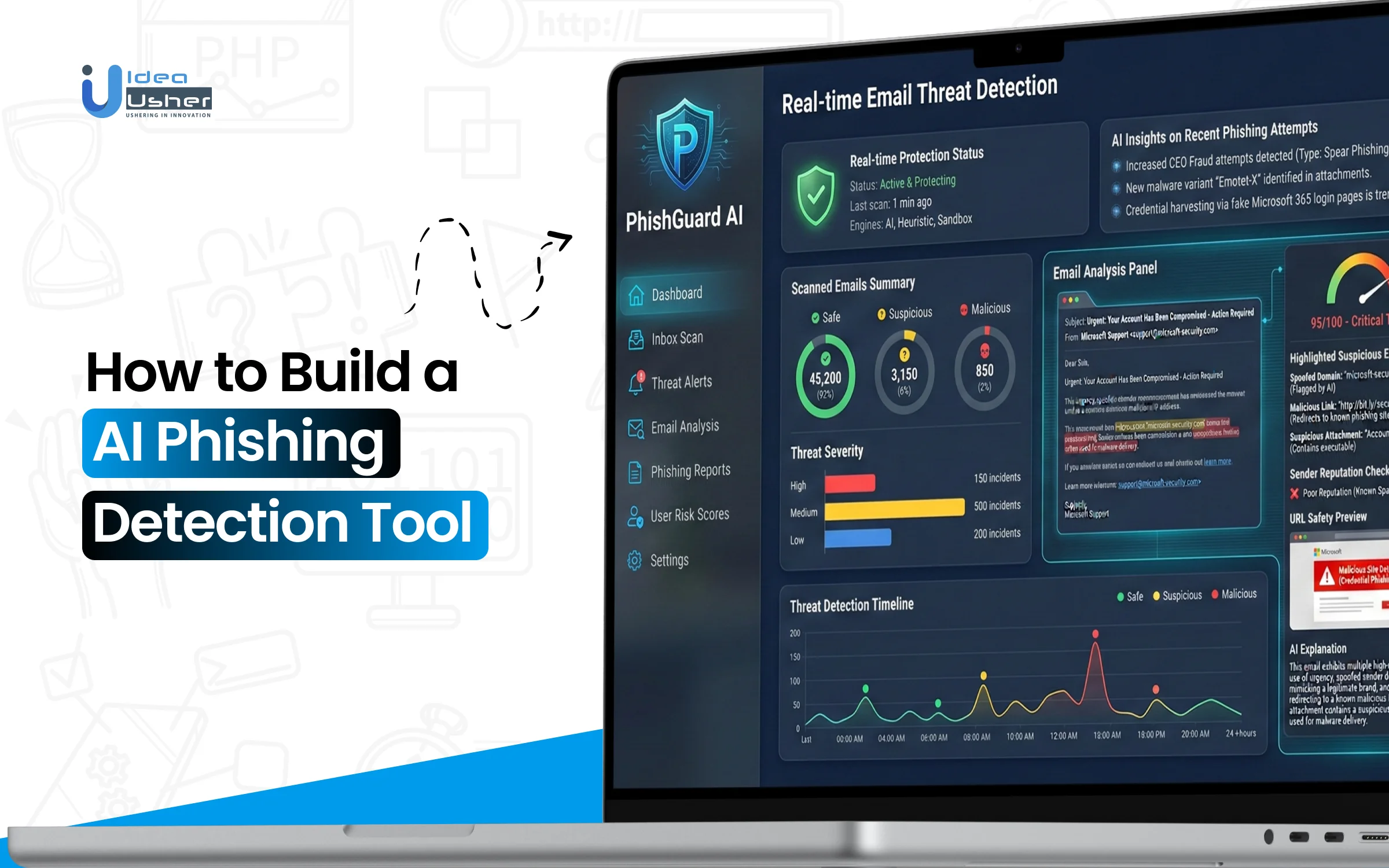
Cyberthreats continue to evolve, and phishing is one of the most damaging risks for businesses and users. Fraudulent emails, fake login pages, and impersonation schemes are increasingly difficult to detect. Organizations are adopting AI phishing detection tools that identify subtle cues humans might miss, stopping attacks proactively and protecting sensitive data before threats can cause serious damage.
Modern AI security systems combine pattern recognition, natural language analysis, and real-time anomaly detection to protect users at scale. By monitoring messages, URLs, and behavioral signals, they flag suspicious activity, learn from emerging threats, and adapt faster than traditional systems, transforming how organizations safeguard data, accounts, and workflows.
In this blog, we explore how to build a robust AI phishing detection solution, covering essential features, machine learning techniques, architecture, and integration steps. As we have helped many enterprises with their AI solutions, IdeaUsher has the expertise to create a secure, scalable, and high-impact phishing defense tool.

What is an AI Phishing Detection Tool?
An AI Phishing Detection Tool uses machine learning, NLP, and behavioral analytics to identify and block phishing across email, messaging, and web channels. It analyzes language, sender behavior, URLs, and activity to detect malicious intent in real time. Continuously learning from new threats, it adapts quickly, offering higher accuracy and fewer false positives.
AI phishing detection is surging as attackers use generative AI for convincing, personalized scams, making traditional defenses ineffective. Organizations rely on AI tools like LLMs for intent, computer vision for fake sites, analytics for anomalies, and automated threat intelligence. These technologies make AI-powered detection crucial in cybersecurity today.
- Context-aware interpretation understands tone, urgency, and social-engineering cues, enabling detection of highly natural or personalized phishing attempts.
- Cross-channel correlation connects signals across email, SMS, and web activity to uncover coordinated multi-channel attacks.
- Self-optimizing models continuously refine detection using automated feedback loops, adapting quickly to new attack styles.
- Pre-delivery prevention blocks malicious content at the server or gateway before it reaches users’ inboxes, reducing human error risk.
- Adversarial AI resistance identifies generative-AI-crafted spoofing and writing-style mimicry using model-to-model detection techniques.
How an AI Phishing Detection Tool Works?
An AI phishing detection tool analyzes language, behavior patterns, sender identity, and real-time signals to identify threats before they reach users.
Below, we’ll use a sample enterprise tool called SentriAI Protect to show what happens behind the scenes when it processes a message.

1. Message Intake & Pre-Processing
The system receives incoming emails, links or attachments and prepares them for analysis by extracting metadata, formatting content and preserving essential indicators such as sender details, timestamps and routing information.
Platform Example:
SentriAI Protect uses a stream ingestion layer to capture thousands of messages per second.
A metadata extraction engine pulls headers, routing paths and authentication signals, while a normalization pipeline cleans and structures content for deeper AI layers.
At scale, an enterprise setup often processes 5,000+ messages per second with near-zero latency.
2. Language & Intent Understanding
The tool evaluates message text using context-aware language analysis to detect manipulative tone, suspicious wording, urgency cues and hidden intent that often signal phishing attempts crafted to appear legitimate.
Platform Example:
SentriAI Protect applies a contextual NLP engine that breaks text into semantic vectors, comparing them to known phishing patterns.
Its intent vector mapping layer may detect a 42 percent similarity score to past social engineering attempts, allowing the system to uncover manipulation even when wording is altered.
3. Sender & Identity Verification
Next, the platform checks the authenticity of the sender by comparing domain reputation, communication history and identity patterns. Any mismatch or unusual activity signals potential impersonation or compromised accounts.
Platform Example:
A sender reputation classifier evaluates domain trust scores, while identity graph modeling compares long term communication behavior.
If behavioral deviation exceeds 0.78 on a 0 to 1 scale, the system flags the message as an impersonation risk.
4. Behavioral, Link & Attachment Analysis
The system inspects links for malicious redirects, misleading parameters and cloned domains, while attachments are examined in isolated environments. It also checks behavioral anomalies such as odd message timing or unexpected sender actions.
Platform Example:
SentriAI Protect uses a combination of advanced security technologies to strengthen defenses against evolving phishing threats, including:
- A URL decomposition engine to analyze redirects and domain age
- Sandboxed micro-environments for attachment behavior checks
- Behavioral anomaly detection to compare timing, sending habits and interaction patterns
For instance, a domain created within the last 24 to 72 hours triggers elevated risk.
5. Visual Page & Multi-Signal Risk Scoring
If the message includes a webpage, visual analysis detects fake login screens and spoofed layouts. All signals are then fused into a unified risk score representing the message’s overall threat level.
Platform Example:
If the user is expected to land on a webpage, SentriAI Protect uses pixel-level visual modeling to compare the site layout with known legitimate templates.
It looks for mismatched font weights, logo distortions and structural inconsistencies.
All signals so far feed into a multi-layer fusion engine, which generates a unified risk score from:
- Language intent: Analyzes the wording and tone of messages to detect suspicious or manipulative content.
- Sender identity: Verifies if the sender is legitimate to prevent email or message spoofing.
- Link reputation: Checks URLs for signs of phishing or malicious activity.
- Behavioral anomalies: Detects unusual user or system behavior that may indicate a threat.
- Page visual similarity: Compares webpages to spot fake sites mimicking legitimate ones.
Any score above 0.65 is considered high risk and triggers an immediate containment action.
6. Automated Response and Security Insights
Based on the risk score, the tool automatically blocks, quarantines or flags the message. Security teams receive detailed insights into threat indicators, supporting better awareness and faster decision-making.
Platform Example:
Once the risk score is finalized, the platform triggers the correct response using the policy orchestration engine:
- Block message: Stops suspicious emails or messages from reaching the user’s inbox.
- Quarantine: Moves potentially harmful messages to a secure area for review.
- Redirect to security review: Sends flagged messages to the security team for further analysis.
- Notify targeted user: Alerts the intended recipient about a possible threat so they can take precautions.
SentriAI Protect then logs all indicators into the Threat Telemetry Dashboard, allowing teams to see:
- Which signals triggered the alert: Identifies the specific indicators, such as suspicious links, unusual language, or sender anomalies, that caused the system to flag the message.
- How the message compares to known attack clusters: Assesses whether the message matches patterns or characteristics of previously identified phishing or malware campaigns.
- Whether the pattern appears in active global campaigns: Checks if similar attacks are currently circulating worldwide, helping prioritize threats based on real-time risk.
This intelligence feedback loop helps refine future detection accuracy.
Core Intelligence Behind a Modern Phishing Detection Engine
Modern phishing detection engines rely on advanced AI and machine learning to analyze patterns, identify anomalies, and detect threats with high accuracy. This core intelligence enables organizations to prevent sophisticated phishing attacks in real time.
| Intelligence Layer | What It Does | Why It Matters |
| Contextual Language Understanding | Analyzes tone, semantics, and intent with advanced interpretation. | Identifies socially engineered messages crafted to sound natural. |
| Behavioral Pattern Modeling | Learns sender and user behavior over time to detect anomalies. | Flags unusual communication patterns that indicate impersonation or compromise. |
| Visual Page & Layout Analysis | Examines webpage structure and design to spot spoofed interfaces. | Detects fake login portals or spoofed interfaces used for credential theft. |
| Relationship Mapping & Identity Intelligence | Builds communication graphs to validate sender authenticity. | Reveals identity inconsistencies and prevents internal impersonation attacks. |
| Real Time Risk Scoring Engine | Scores emails, URLs, and files instantly across key signals. | Delivers instant threat assessments to block high-risk content. |
| Adaptive Learning Logic | Updates detection signals using new threats and feedback. | Keeps the system effective as new phishing techniques emerge. |

How 87% Financial Institution Adoption Proves AI Phishing Detection Is Essential?
The AI Phishing Detection market was valued at $1.7 billion in 2024 and is expected to reach $8.2 billion by 2033, with an 18.9% CAGR. Growth is driven by increasing demand as organizations see that traditional security can’t match AI-enhanced phishing. This underscores the urgent need for advanced AI defense solutions.

By 2025, 87% of global financial institutions use AI fraud detection, up from 72% in early 2024, a 21% annual increase. Most report their programs save more money than they cost, showing a clear ROI. This rapid adoption across finance sectors confirms that AI phishing detection is now essential infrastructure.
A. AI Detects 53% More Threats with 99.2% Accuracy Than Traditional Method
AI-driven phishing detection achieves 99.2% accuracy, demonstrating AI’s significant leap in security over traditional methods. It enables faster threat identification and stronger protection for organizations.
- Post-July 2024 AI improvements raised phishing-site detection to 87.3% and lookalike domain detection to 85.94%, nearly doubling legacy performance at 37.8%.
- Financial institutions using AI prevented over $25.5B in attempted fraud in 2024, proving strong ROI.
- Advanced AI models reached up to 99.89% accuracy (2021–2024), with CNNs, RNNs, XGBoost (99.89%), and PILFER (99.5%) performing at top levels.
- AI enables healthcare to detect incidents 98 days faster, saving nearly $1M per breach, with 2024 attacks affecting 92% of organizations, mostly malware (67%).
- 79% of financial institutions use AI for fraud detection, and 79% expect cyber budgets to rise, up from 65% in 2023, showing broad deployment.
- 90% of financial institutions use AI against fraud, with over 50% of fraud involving AI. Major threats include voice cloning (60%) and AI-powered SMS/phishing (59%), highlighting urgent detection needs.
B. 52% of Leaders Flag Catastrophic GenAI Threats, Urging AI Defense
52% of business and tech leaders expect GenAI to cause catastrophic cyberattacks in the next year, according to PwC’s 2024 survey of 3,800 leaders worldwide. Also, AI-enhanced malicious attacks topped Gartner’s Q1 2024 risk rankings, from a survey of 345 senior risk executives.
- 69% of organizations plan to use GenAI for cyber defense , with over 50% of leaders expecting catastrophic AI-driven attacks, driving immediate adoption against AI-enhanced phishing.
- Gartner predicts 17% of cyberattacks will involve generative AI by 2027, ranked as the #1 emerging risk, making AI detection a top priority for CISOs.
- AI-generated phishing emails bypass filters and training, with McKinsey reporting 53% more fraud detection than traditional methods, emphasizing the shift to AI-powered solutions.
- 79% of organizations expect cyber budgets to rise, with 4 of 5 allocating more resources, accelerating adoption and simplifying procurement for AI phishing detection.
- 87% of financial institutions report cost-saving fraud programs, while healthcare saves $1M per incident, providing strong ROI and easing budget approval for regulated sectors.
The rapid adoption of AI phishing detection across financial institutions and other sectors, combined with proven accuracy and measurable ROI, highlights that AI is now essential. With rising GenAI threats and evolving attack methods, organizations must deploy advanced AI defenses to stay ahead of increasingly sophisticated phishing attacks.
Real World Use Cases Across Industries
AI phishing detection tools are being adopted across industries to prevent cyberattacks, protect sensitive data, and reduce financial losses. These real-world use cases highlight how different sectors leverage AI to enhance security and maintain operational resilience.

1. Banking & Financial Services
Attackers sent realistic PayPal emails asking users to “verify” payment details. Victims who followed the link surrendered credentials to a cloned portal, enabling account takeover and fraudulent transfers. This shows how brand-spoofing emails bypass legacy filters and cause direct financial loss.
2. Healthcare & Medical Networks
Hospital staff received messages mimicking internal IT alerts requesting MFA revalidation to access electronic health records. Several accounts were compromised, exposing patient data and disrupting scheduling systems. AI detection is critical to flag subtle internal language mimicry and protect sensitive healthcare workflows.
3. SaaS & Cloud-Based Companies
Attackers used automated phishing kits to harvest Microsoft 365 credentials and bypass MFA at scale, then used stolen sessions to pivot into customer environments. Security teams found that credential theft was often the first step in larger cloud breaches. AI tools are needed to spot rapid, automated credential harvesting and session anomalies.
4. IT Services & Managed Security Providers
A global smishing campaign registered hundreds of thousands of malicious domains and used coordinated SMS, email, and voice lures to target MSP support lines and client admins. The multi-vector attack aimed to trick helpdesk staff into granting remote access. Service providers require cross-client intelligence to spot wide-scale, multi-channel campaigns.
5. Government & Public Sector Agencies
UK officials were targeted with phishing on WhatsApp and Signal posing as platform support teams to capture authentication codes and personal data. Some incidents led to temporary account lockouts and sensitive correspondence exposure. Multi-channel detection is essential for protecting public sector communications.
Key Features of an AI Phishing Detection Tool
AI phishing detection tools use advanced machine learning to identify threats that traditional filters miss. Below are the key features that enable faster, more accurate protection against modern, AI-enhanced attacks.

1. Advanced Language & Intent Analysis
AI models use contextual NLP to interpret tone, semantics and psychological manipulation cues. By evaluating sentiment shifts and conversation patterns through semantic embedding analysis, the system identifies hidden malicious intent, enabling more reliable detection of sophisticated phishing attempts that appear linguistically natural.
2. Behavioral & Anomaly Monitoring
The tool builds behavioral baselines using pattern modeling and flags deviations such as unusual login timing, inconsistent communication patterns or atypical attachment behavior. This behavioral intelligence strengthens the detection of zero-day threat vectors that bypass static filters.
3. Real-Time Threat Detection & Response
AI engines process incoming messages and URLs through real-time inference pipelines to block suspicious content before delivery. This preemptive threat interception reduces user exposure and minimizes reliance on manual investigation cycles.
4. Computer Vision for Website & Page Analysis
Computer vision models inspect visual elements of landing pages including layout, font patterns and brand assets. By applying pixel-level similarity mapping, the system identifies counterfeit login portals or spoofed interfaces that mimic legitimate platforms with high fidelity.
5. Pre-Delivery Email & Content Filtering
The system evaluates messages, URLs and attachments at the server or gateway stage using multi-layer risk scoring to block high-risk content before it reaches users. This approach enhances enterprise-grade protection by reducing the chance of human error.
6. Cross-Channel Correlation & Signal Fusion
The tool correlates signals across email, SMS, chat and web interactions using multi-modal data fusion. By integrating metadata, network indicators and linguistic patterns, it uncovers multi-vector attacks that remain hidden when channels are analyzed separately.
7. Automated Threat Intelligence Integration
AI systems ingest global threat feeds and internal telemetry using API driven enrichment pipelines to update phishing indicators and risk models. This automation improves predictive accuracy and helps anticipate emerging attack clusters.
8. User Risk Scoring & Adaptive Protection
The platform assigns dynamic risk scores using behavioral heuristics and interaction history, then adjusts filtering sensitivity for each user. This adaptive protection model enhances overall security posture and reduces vulnerability among high-risk user groups.
9. Identity Graph & Sender Authenticity Scoring
The platform builds a dynamic identity graph using entity relationship modeling to map communication patterns and trust signals. It assigns an authenticity score to each message, helping detect impersonation, lateral phishing attempts and AI-generated spoofing.
10. Adaptive Deception Layer for Phishing Analysis
Suspicious messages are routed into an isolated deception layer powered by sandboxed execution environments to safely analyze attacker behavior. This controlled engagement produces high-fidelity threat signatures, enabling proactive blocking of attack variants before they appear in production environments.

How to Build an AI Phishing Detection Tool
Building an AI phishing detection tool requires combining advanced machine learning, threat intelligence, and real-time analysis. This guide outlines the core steps needed to create a system that accurately identifies and blocks modern phishing attacks.

1. Consultation
We start by consulting with the client’s security landscape, phishing risks, and business goals for building and launching an AI phishing detection tool. Planning sessions define detection objectives, product vision, data readiness, and workflows to ensure the solution meets operational and market needs.
2. Data Collection & Preparation
Our developers gather diverse phishing and legitimate communication samples from verified datasets and enterprise archives. We normalize, label and refine this information to create high-fidelity training data, enabling the system to recognize subtle behavioral and linguistic threat patterns.
3. Feature Engineering & Signal Design
We craft intelligent detection signals that capture intent indicators, sender credibility patterns, contextual anomalies and visual inconsistencies. These engineered signals help the AI system interpret real-world communication behavior with higher precision and broader threat awareness.
4. Model Development & Training
We train specialized models tuned for phishing detection using curated data and evaluation cycles. Our developers refine accuracy, balance sensitivity and strengthen context-aware decision boundaries, ensuring the model reliably identifies complex social engineering patterns.
5. Real-Time Analysis Pipeline Integration
We build real-time processing layers that analyze emails, URLs, and attachments as they enter the system. These pipelines deliver instant risk scoring and automated blocking actions that reduce exposure time and improve response efficiency.
6. AI Content Interpretation Layer
We develop an interpretation layer that analyzes message tone, semantics and manipulation cues using deep contextual understanding. This helps detect sophisticated phishing messages designed to mimic natural communication patterns and bypass traditional filters.
7. AI Sender Profiling & Relationship Mapping
Our developers implement profiling mechanisms that analyze long-term communication behavior. The system builds relationship intelligence by mapping trust patterns, detecting identity anomalies and identifying impersonation attempts that appear legitimate on the surface.
8. AI-Assisted Threat Simulation & Stress Testing
We perform large-scale AI-driven simulations that generate synthetic phishing scenarios and adversarial variations. This process exposes detection gaps, enhances threat resilience and ensures the platform performs reliably against evolving, AI-enhanced attack strategies.
9. Multi-Layer Validation & Testing
We run controlled tests using simulated phishing campaigns and real-world attack samples. This process validates system resilience, evaluates detection thresholds and strengthens attack surface awareness before deployment.
10. Deployment & Workflow Integration
Our developers integrate the detection engine into the client’s existing communication and security workflows. We configure alerting rules, routing logic and administrative controls to ensure the platform aligns with operational processes.
Cost to Build an AI Phishing Detection Tool
The cost to build an AI phishing detection tool depends on model complexity, data requirements, and integration needs. This breakdown helps you understand the key factors that influence pricing and what to expect when budgeting for development.
| Development Phase | Description | Estimated Cost |
| Consultation | Defines project scope and core detection objectives through structured planning sessions. | $5,000 – $8,000 |
| Data Preparation | Builds and refines models with context-aware decision boundaries for accurate detection. | $12,000 – $15,000 |
| Feature Engineering & Design | Crafts intelligent detection signals capturing intent, anomalies and sender credibility. | $15,000 – $26,000 |
| Model Development & Training | Uses AI-driven simulations to strengthen threat resilience and expose detection gaps. | $14,000 – $22,000 |
| Real Time Analysis | Implements pipelines enabling instant risk scoring for messages, URLs and attachments. | $12,000 – $18,000 |
| AI Content Interpretation Layer | Adds deep NLP capabilities for identifying manipulation cues and semantic patterns. | $13,000 – $20,000 |
| AI Sender Profiling & Relationship Mapping | Maps communication patterns to uncover identity anomalies and impersonation attempts. | $14,000 – $27,000 |
| AI Threat Simulation & Testing | Verifies robustness through controlled attack scenarios and multi-angle validation. | $12,000 – $18,000 |
| Security Testing | Verifies robustness through controlled attack scenarios and multi angle validation. | $5,000 – $12,000 |
| Deployment & Integration | Integrates the platform into client workflows with optimized security routing. | $4,000 – $9,000 |
Total Estimated Cost: $67,000 – $128,000
Note: Development costs can vary depending on solution complexity, dataset quality, compliance needs and the level of AI sophistication required for enterprise deployment.
Consult with IdeaUsher for a tailored cost estimate and roadmap to develop a robust, market-ready AI phishing detection tool aligned with your business and security goals.
Cost-Affecting Factors to Consider during Development
Several technical, data, and infrastructure factors influence the total cost of developing an AI phishing detection tool, making it essential to understand each before planning your build.
1. Core Requirements & Feature Complexity
Broader functionality, advanced detection layers and workflow automation increase development effort. Adding multi-channel analysis or adaptive protection features raises overall cost due to expanded architecture and testing requirements.
2. Data Quality & Availability
High-quality datasets reduce preprocessing time and improve model performance. Limited or noisy data increases cost because developers must invest more effort in cleaning, labeling and balancing samples.
3. Depth of Intelligence Required for Detection
More advanced capabilities such as contextual understanding or identity mapping, demand deeper model tuning. Higher sophistication directly increases development cost due to longer training cycles and evaluation phases.
4. Precision Target & False Positive Tolerance
Achieving low false positives often requires additional refinement and iterative testing. Stricter accuracy goals raise cost by extending optimization and model validation efforts.
5. Integration Complexity
Seamless integration with communication servers, security tools and admin workflows requires extra configuration. Higher integration complexity increases cost as more customization and validation is needed.
Challenges & How Our Developers Will Solve Those?
Building an AI phishing detection tool comes with technical, security, and scalability challenges. Here’s how our developers address each one to ensure a robust, high-performance solution.

1. Detecting Sophisticated Phishing Attacks
Challenge: Phishing attacks often mimic real communication patterns, using context awareness and polished language to hide harmful intent within authentic-looking messages.
Solution: We apply contextual behavioral analysis and layered intent scoring that examine tone shifts, communication history and structural irregularities, enabling our system to detect advanced phishing attempts crafted to appear legitimate.
2. High Accuracy With Low False Positives
Challenge: Security systems commonly overflag harmless messages, creating alert fatigue while still failing to identify subtle phishing attempts buried in normal communication flow.
Solution: We refine model thresholds using precision-centric evaluation cycles that balance sensitivity and accuracy, ensuring alerts focus on real threats while reducing unnecessary noise for security teams.
3. Handling Incomplete or Noisy Data
Challenge: Email and message datasets often contain fragmented text, inconsistent formatting or mislabeled samples that reduce model reliability during training and inference.
Solution: We build structured preprocessing workflows that clean, normalize and validate communication data, allowing the model to learn distinct threat indicators even when raw inputs contain imperfections or inconsistencies.
4. Real-Time Threat Detection
Challenge: Large organizations process thousands of messages every minute and require immediate identification of malicious content without slowing communication flow.
Solution: We design optimized real-time pipelines supported by stream-based analysis, allowing incoming messages, links, and attachments to be parsed, scored, and classified instantly without disrupting system performance.

Recommended Tech Stacks for an AI Phishing Detection Tool
Choosing the right tech stack is essential for building a reliable and scalable AI phishing detection tool. Below are the recommended frameworks, languages, and platforms that support high-accuracy threat detection and real-time performance.
| Category | Why We Use It For | Suggested Technologies |
| AI & Machine Learning Tools | Help the system learn phishing patterns and identify suspicious behavior automatically. | TensorFlow, PyTorch |
| Language Understanding Tools | Allow the platform to understand tone, intent and manipulation within messages. | Hugging Face, spaCy |
| Visual Analysis Tools | Detect fake webpages and spoofed login screens through visual comparison. | OpenCV, Vision Transformers |
| Data Storage Systems | Securely store emails, alerts and training datasets for analysis and model updates. | PostgreSQL, MongoDB |
| Real Time Processing Layer | Analyze incoming messages the moment they arrive to catch threats instantly. | Kafka, Redis |
| Backend Platform | Runs the core detection logic and connects all major components of the system. | Python, Node.js |
| Admin Dashboard Tools | Provide a user interface for viewing alerts, insights and threat patterns. | React, Angular |
| Security & Access Controls | Protect sensitive information through secure access and encrypted communication. | IAM tools, TLS encryption |
| Deployment & Scaling Tools | Ensure the platform runs smoothly, scales effectively and updates without downtime. | Docker, Kubernetes |
Top AI Phishing Detection Tools to Benchmark in 2025
Before building your own AI phishing detection solution, it’s essential to understand the leading tools already shaping the market. These top platforms offer a clear benchmark for features, performance, and innovation in 2025.
1. Aegis AI

Aegis AI is a next-generation agentic email-security platform using autonomous AI agents to detect phishing, BEC attacks, and zero-day threats. It analyzes language intent, behavioral cues, and communication context, making it a powerful alternative to traditional rule-based tools.
2. Kitecyber

Kitecyber delivers real-time AI-powered phishing prevention across emails, apps, and chat platforms. Its machine-learning models identify risky links, suspicious behavior, and malicious patterns before users interact with them.
3. Foresiet

Foresiet provides an adaptive phishing detection engine that uses AI and behavioral analysis to block evolving threats. The platform continuously learns from new attack data, helping organizations keep pace with increasingly sophisticated techniques.
4. Varonis

Varonis delivers advanced AI-driven phishing and email threat detection designed to protect organizations from credential theft, impersonation attempts, and social-engineering attacks. Its platform analyzes communication patterns, user behavior, and contextual signals in real time, providing strong defense across email, messaging apps, and collaboration tools.
5. Arsen

Arsen focuses on identifying AI-driven social engineering threats including phishing, smishing, vishing, and impersonation attempts. Its AI models are complemented by awareness and simulation tools for comprehensive protection.
Conclusion
Building an AI Phishing Detection Tool requires a balanced approach that combines technical precision with a clear understanding of evolving cyber risks. By focusing on data quality, model accuracy, and responsible deployment, you create a solution that supports real security needs. It also helps to align development with practical workflows so users can trust the system to guide better decisions. When these elements come together, your AI Phishing Detection Tool becomes a dependable part of a stronger defense strategy that protects both organizations and individuals in their daily digital activities.
Why Partner With IdeaUsher for an AI Phishing Detection Tool?
IdeaUsher builds intelligent security solutions designed to detect evolving threats with precision. Our team develops AI-driven phishing detection tools that analyze communication patterns, flag risks early, and strengthen your organization’s defense ecosystem. We ensure each solution adapts continuously to new phishing techniques.
Why Work With Us?
- Deep Expertise in Cybersecurity AI: We create models capable of recognizing subtle phishing signatures across emails, texts, and digital touchpoints.
- End-to-End Custom Solutions: From data pipelines to real-time alerts, our tools are engineered to fit seamlessly into your existing security stack.
- Enterprise-Grade Security: We follow strict development standards to ensure your detection system remains reliable, resilient, and adaptable.
- Proven Results: Our AI solutions help businesses reduce vulnerabilities and maintain a secure digital environment.
Explore our portfolio to see how we’ve helped top organizations launch impactful digital solutions in education, security, and enterprise tech.
Connect with us to build a powerful AI Phishing Detection Tool that protects your teams, infrastructure, and long-term digital resilience.


FAQs
An AI phishing detection tool needs a clean dataset, feature extraction methods, machine learning models, and automated alerting. These elements work together to identify suspicious patterns, classify harmful messages, and reduce the risk of successful phishing attempts.
Deep learning models like CNNs and RNNs, along with ensemble methods such as XGBoost, are highly effective. They can identify subtle patterns in language, behavior, and sender identity, enabling accurate detection of sophisticated or highly personalized phishing attacks.
Essential features include real-time risk scoring, contextual content analysis, sender profiling, adaptive learning, and cross-channel correlation. These capabilities allow the tool to identify complex attacks, prevent impersonation, and evolve with new phishing tactics.
Integration is done through APIs, security gateways, and email server connectors. This approach allows seamless message scanning, real-time alerts, and automated actions without disrupting workflows, ensuring employees stay protected while maintaining normal communication processes.


