 (+971) 8007 4267
 (+91) 946 340 7140
 (+1) 628 432 4305

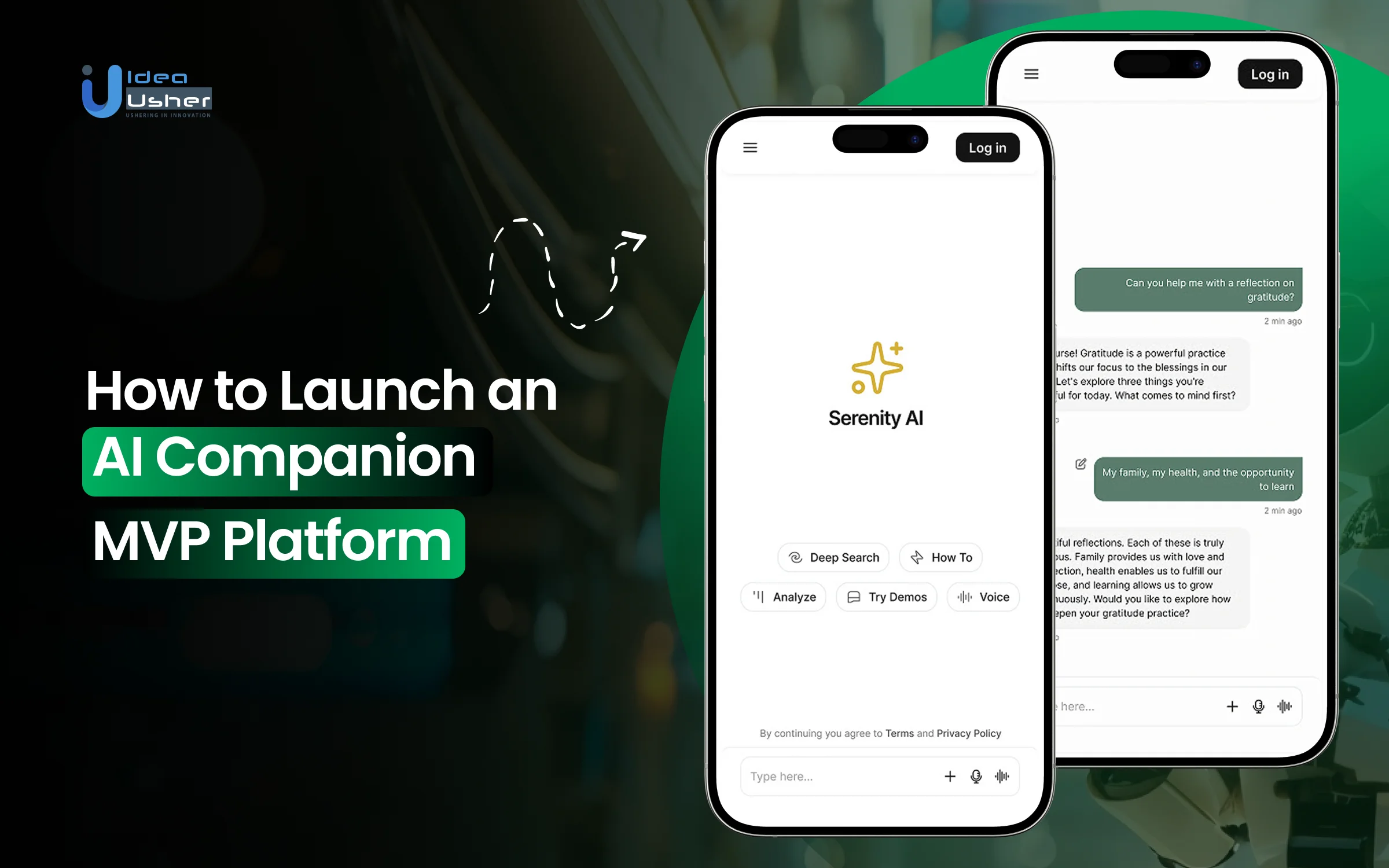
Launching an AI companion startup starts with a simple idea but raises key questions: “How personal should the experience be?” “Which features matter?” and “How to ensure users return?” Building a full product too early is risky, making an AI companion MVP platform the practical way to test user interest, behavior, and emotional engagement effectively.
An AI companion MVP platform focuses on fundamentals like meaningful conversation, memory, emotional context, and continuity rather than advanced intelligence. Using a lean feature set, lightweight architecture, and rapid iteration, startups can validate their concept, gather feedback, and refine interactions before scaling or adding complexity.
In this blog, we’ll break down how to launch an MVP for an AI companion startup, covering what to include, what to postpone, and how to approach technology choices at an early stage. This guide will help you move from concept to a working MVP with clarity and confidence.
Understanding the Nature of AI Companion Platforms
AI companion platforms are relationship-centric systems designed to maintain ongoing, context-aware interactions that adapt to individual users over time. Unlike task-based AI, they learn preferences, retain context, and continuously adjust behavior to deliver personalized, long-term engagement and recurring value.
- Relationship-first architecture designed for repeated, long-term use, not one-off tasks
- Persistent context and memory logic that enables continuity across sessions
- Adaptive behavior models that evolve tone and guidance as user familiarity grows
- Proactive yet restrained intelligence that engages based on relevance and timing
- High-retention interaction loops that support subscription and lifecycle monetization
- Multi-use platform core capable of serving wellness, lifestyle, productivity, and enterprise use cases
What Differentiates an AI Companion Platform from Traditional AI Products?
AI Companion Platforms focus on user behavior over time, not isolated outcomes. This affects retention, trust, and monetization, requiring a unique MVP strategy and product mindset unlike typical AI solutions.
| Dimension | AI Companion Platform | Typical AI Products |
| Design Objective | Built for long-term user relationships and repeated engagement | Built for task completion or problem resolution |
| Interaction Lifecycle | Designed for ongoing, evolving conversations across sessions | Designed for single-session or short interactions |
| Memory Strategy | Uses persistent, selective memory to maintain continuity | Relies on limited session memory or static data |
| Behavior Model | Behavior adapts gradually based on user familiarity | Behavior remains largely fixed after deployment |
| Proactivity Approach | Engages selectively based on context and timing | Mostly reactive and prompt-driven |
| Success Metrics | Measured by retention, interaction depth, and return frequency | Measured by accuracy, speed, or task success |
| Monetization Alignment | Supports subscriptions and lifecycle-based revenue | Often tied to usage, licensing, or one-time value |
Why User Trust & Comfort Matter Early?
AI companion platforms depend on repeated, voluntary engagement, making early user trust essential. If users feel uncomfortable or misunderstood at first, they may disengage before seeing the platform’s value.
Early on, users assess if the companion feels safe, predictable, and respectful. Signals like tone, boundaries, and pacing influence comfort, affecting whether they return or abandon the experience.
For MVPs, trust depends on restraint, clarity, and reliability, not just intelligence. Platforms that prioritize comfort early experience higher return rates and deeper engagement, supporting retention, feedback, and future growth.
Why AI Companion Platforms Require a Different MVP Approach?
AI companion platforms require a different MVP approach due to their focus on long-term interaction, personalization, and learning over time. This section explains why validation must prioritize user engagement and behavioral continuity.
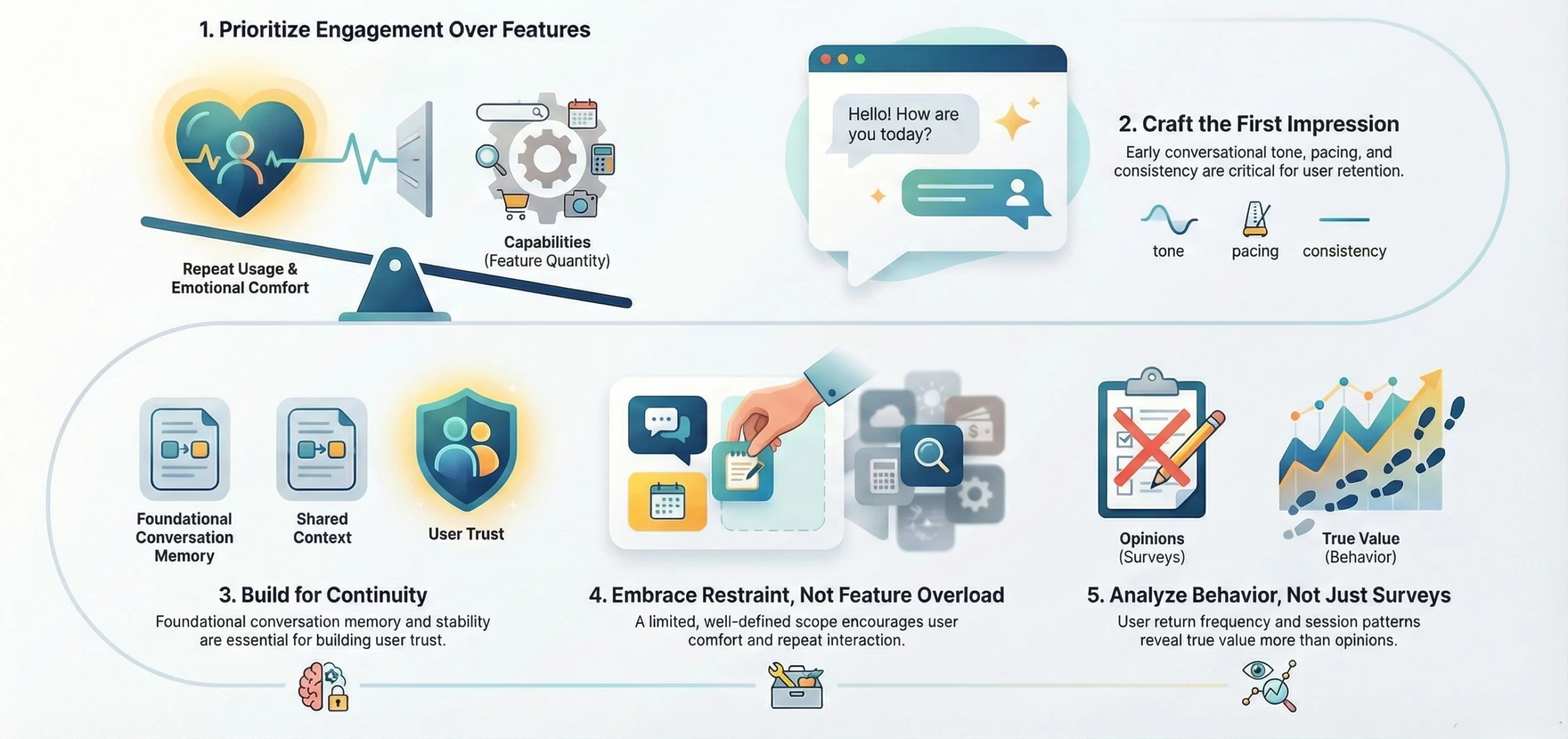
1. MVP Success Depends on User Engagement
Traditional MVPs validate functionality, but AI companion MVPs validate repeat usage and emotional comfort. Early success depends on whether users return naturally, not how many capabilities are available in the first release.
2. Early Experience Influences Retention
In companion platforms, users form opinions quickly based on tone, pacing, and conversational consistency. If early interactions feel awkward or overwhelming, retention drops regardless of later feature improvements.
3. Ensure Continuity from Launch
Even an MVP must support basic conversation continuity and behavioral stability. Without this foundation, adding memory and personalization later becomes complex and risks breaking user trust.
4. Prioritize Restraint Over Feature Overload
AI companion MVPs benefit from a controlled interaction scope. Limited, well-calibrated behavior encourages comfort and repeat engagement, while excessive intelligence early often leads to disengagement.
5. Act on User Feedback, Don’t Just Collect It
User feedback for companion MVPs comes from behavioral signals like return frequency and session patterns. These insights reveal real value more accurately than surveys or explicit opinions.
How Do AI Companions Help 57% of Depressed Students Prevent Suicide?
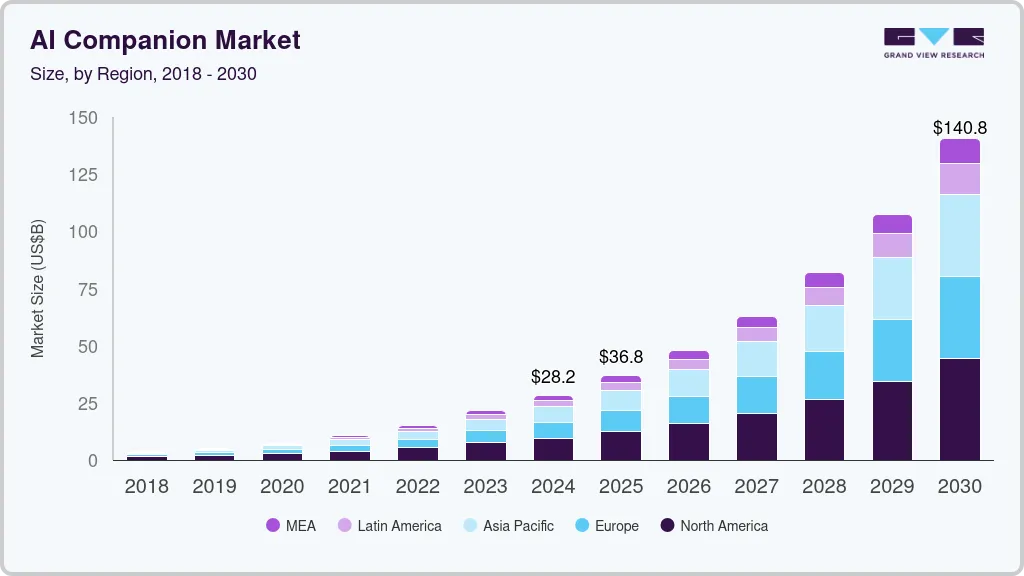
The global AI companion market was valued at USD 28.19 billion in 2024 and is projected to reach USD 140.75 billion by 2030, growing at a 30.8% CAGR. This rapid expansion reflects growing adoption across healthcare, wellness, education, and lifestyle applications.
Studies show that 57% of depressed students reported AI companions helped prevent or reduce suicidal thoughts, highlighting the profound real-world impact of AI companions. This demonstrates that thoughtfully designed platforms can deliver both emotional support and measurable mental health benefits.
A. How Market Demand Shapes MVP Feature Prioritization?
The growing market, supported by both user adoption and investor funding, signals which MVP features are likely to succeed. For instance, 48% of users rely on AI companions for mental health support, highlighting the need to focus on high-impact, meaningful features.
- Prioritize core problem-solving features: Focus on functionalities that meet user needs, like mood tracking, personalized guidance, or conversation quality, not peripheral add-ons.
- Enhance emotional engagement: Design interactions to feel responsive and human-like from the start, fostering trust and retention.
- Validate through early adopter feedback: Insights from initial users refine feature relevance, interaction quality, and overall usability, ensuring the MVP resonates before scaling.
B. Why Rapid Iteration Is Crucial for MVP Success?
The AI companion market is expanding quickly, and funded platforms like Replika ($11M), Character.AI ($193M), and Chai AI ($55M) illustrate that scalable MVPs combined with iterative development can achieve strong growth.
- Test, learn & optimize fast: Continuous analytics and user feedback help identify friction points, gaps in conversation quality, or usability issues for immediate improvement.
- Adopt modular architecture: Ensure the MVP allows easy addition of new AI capabilities or features without large-scale rework.
- Track meaningful engagement metrics: Measure session length, retention, repeat interactions, and emotional engagement to guide future iterations and investor confidence.
- Leverage market adoption for validation: AI companion apps have been downloaded 220 million times worldwide, with 88% annual growth, showing strong demand and validating opportunities for MVP testing and scaling.
The rapid adoption of AI companions, combined with their measurable impact on mental health and strong market growth, highlights a prime opportunity for launching an MVP. By prioritizing core features, iterative improvements, and meaningful user engagement, developers can create platforms that deliver real-world value, build trust, and establish a foundation for sustainable growth and long-term market presence.
What Existing AI Companion Platforms Reveal About the Market?
Existing AI companion platforms provide insights into user preferences, engagement patterns, and monetization strategies. This section highlights key market trends and lessons that inform successful platform development and growth.
1. Replika
Replika validates strong demand for emotionally driven, relationship-based AI, especially in personal companionship. However, its limitations around behavioral flexibility and user control highlight opportunities for platforms that balance emotional depth with greater personalization transparency.
2. Pi by Inflection AI
Pi demonstrates user appetite for thoughtful, calm, and supportive conversations without aggressive proactivity. Its minimal personalization and lack of persistent relationship modeling suggest room for companions that evolve more visibly with individual users over time.
3. Kindroid
Kindroid shows how persona customization and long-term memory increase user attachment. At the same time, its complexity reveals a gap for MVP-focused platforms that deliver similar depth with simpler onboarding and clearer interaction boundaries.
4. Character.AI
Character.AI proves massive interest in persona-driven, creative AI interactions. However, its focus on characters over continuity exposes a market gap for platforms centered on one-to-one, evolving companion relationships rather than fragmented roleplay experiences.
5. Nomi
Nomi highlights growing demand for intimate, lifestyle-oriented AI companions with memory and emotional awareness. Its early-stage nature indicates an opportunity for new entrants to improve consistency, control, and long-term engagement design.
Key Features of AI Companion MVP Platform
An AI companion MVP platform focuses on essential features that support personalization, context awareness, and consistent interaction. This section highlights the core capabilities required to validate user value and engagement early.

1. Persona & Character Customization
Users must be able to shape the companion’s personality, tone, and interaction style. Even limited customization increases emotional alignment and helps validate whether users feel ownership and connection with the AI companion.
2. Context-Aware Proactive Interaction
The MVP should offer selective proactive engagement such as gentle check-ins or timely prompts. This helps test whether users find anticipation helpful rather than intrusive in real usage conditions.
3. Long-Term Conversation Memory
The platform must remember important user preferences and recurring topics across sessions. This feature validates whether continuity improves comfort and encourages repeat interaction during early adoption.
4. Natural Language Conversation
The MVP should enable natural, human-like conversations through context-aware interactions, multi-turn dialogue, session-level memory, coherent topic flow, clarifying questions, and support for both casual exchanges and deeper, meaningful discussions.
5. Emotional Tone Calibration
The companion should adjust response tone and intensity based on user language patterns and interaction history. Even light emotional alignment improves comfort and helps validate whether users feel understood early on.
6. Session Re-Entry Recognition
Users should feel recognized when returning through contextual session openings. This feature reinforces continuity and tests whether familiarity drives higher engagement compared to generic greetings.
7. Companion Response Control
The MVP should allow users to guide or correct the companion’s behavior during interaction. This empowers users, reduces frustration, and provides valuable signals for refining behavior models.
8. Interaction History Access
Providing limited conversation history visibility helps users feel continuity and control. It also supports transparency, which is essential for trust during early-stage platform adoption.
How to Launch an AI Companion MVP Platform?
Launching an AI companion MVP platform requires a structured approach focused on core functionality and user validation. Our developers apply proven frameworks to build and refine MVPs that support meaningful interactions.
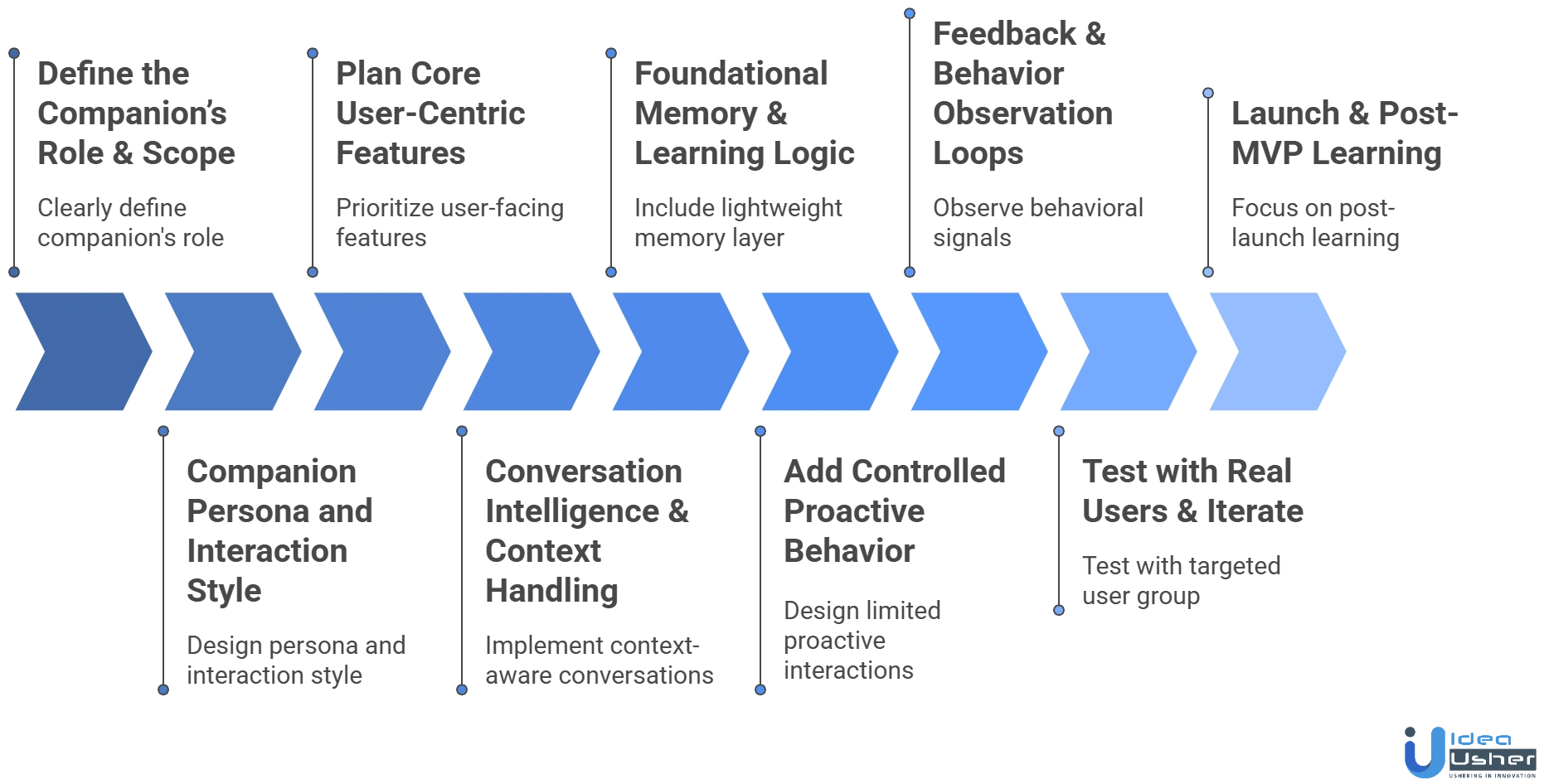
1. Define the Companion’s Role & Scope
We start by clearly defining who the companion is, what role it plays, and what it will not do. This prevents scope creep and ensures the MVP is focused on validating one meaningful user relationship, not multiple shallow experiences.
2. Companion Persona and Interaction Style
Our team designs the persona, tone, and conversational boundaries early. This includes how formal or casual the companion is, how it asks questions, and how it responds emotionally, which directly impacts early trust and comfort.
3. Plan Core User-Centric Features
We prioritize must-have user-facing features such as persona customization, conversation memory, and proactive interaction. Each feature is selected based on whether it helps validate engagement, comfort, and repeat usage at the MVP stage.
4. Conversation Intelligence & Context Handling
We implement context-aware, multi-turn conversations that can maintain topic continuity within and across sessions. This step focuses on making interactions feel coherent, natural, and responsive rather than technically impressive.
5. Foundational Memory & Learning Logic
The MVP includes a lightweight memory layer to retain key preferences and recurring topics. Memory usage is intentionally selective to test whether continuity improves user experience without introducing complexity too early.
6. Add Controlled Proactive Behavior
We design limited and intentional proactive interactions, such as gentle check-ins or follow-up prompts. This helps evaluate how users respond to anticipation while avoiding interruption or fatigue during early adoption.
7. Feedback & Behavior Observation Loops
Instead of relying only on surveys, we instrument the platform to observe behavioral signals like return frequency, session length, and conversation depth, which provide more reliable MVP validation.
8. Test with Real Users & Iterate
We release the MVP to a small, targeted user group and iterate based on real interaction patterns. Feedback is used to refine tone, pacing, and feature behavior rather than adding new features prematurely.
9. Launch & Post-MVP Learning
Before launch, we ensure stability, consistency, and clarity of expectations. Post-launch, we focus on learning how users naturally interact with the companion, guiding decisions for scaling and feature expansion.
Cost to Build an AI Companion MVP Platform
The cost to build an AI companion MVP platform depends on feature scope, AI complexity, and development approach. This section explains the primary factors that influence budgeting and early investment decisions.
| Development Phase | Description | Estimated Cost |
| Discovery & MVP Scoping | Define core companion role, user intent, and MVP validation scope | $4,000 – $8,000 |
| Persona & Experience Design | Design companion personality, tone consistency, and interaction boundaries | $6,000 – $12,000 |
| Conversation Intelligence Setup | Build context-aware, multi-turn conversations with coherent topic flow | $12,000 – $22,000 |
| Memory & Personalization (Lightweight) | Implement selective memory for preferences and recurring conversation context | $8,000 – $15,000 |
| Proactive Interaction Logic | Add limited, well-timed proactive prompts and follow-up behaviors | $5,000 – $10,000 |
| User-Facing Feature Implementation | Develop customization, session re-entry, and user correction handling | $10,000 – $18,000 |
| Testing & Early User Validation | Validate comfort, engagement patterns, and behavioral consistency | $5,000 – $10,000 |
| Launch Readiness & Iteration | Prepare stable MVP launch with monitoring and iteration readiness | $4,000 – $8,000 |
Total Estimated Cost: $55,000 – $110,000
Note: MVP development costs depend on interaction depth, memory, personalization, and iterations. A focused MVP aims to validate user comfort and retention first, not full-scale intelligence.
Consult with IdeaUsher for a tailored cost estimate and roadmap to launch an AI Companion MVP that validates user engagement and supports scalable growth.
Cost-Affecting Factors to Consider
Development costs for an AI companion MVP depend on technical complexity, features, data, and infrastructure, requiring careful planning for accurate budgeting.
1. Companion Role Clarity
The companion’s role is precisely defined, and development remains focused on specific behaviors and interaction goals. Ambiguous roles increase experimentation, rework, and iteration cycles, directly raising MVP development time and cost.
2. Personalization Depth at Launch
Deeper personalization raises costs due to additional learning logic and tuning effort. MVPs should validate value with minimal preference handling before expanding personalization layers.
3. Memory Scope & Retention Logic
Costs rise as decisions expand around what the companion remembers and when it recalls context. Selective memory handling reduces engineering effort while still validating continuity and user comfort at the MVP stage.
4. Proactive Interaction Frequency
Frequent proactive interactions demand more timing rules and behavioral calibration. Restrained proactivity lowers development effort and helps teams evaluate whether users actually welcome anticipation-based engagement.
5. Persona Complexity
Highly nuanced personas increase cost through tone consistency checks and edge-case handling. MVPs benefit from simpler, well-defined personalities that are easier to test and refine.
Measuring Success Metrics for an AI Companion MVP
Measuring success for an AI companion MVP focuses on engagement, retention, and user behavior over time. This section outlines key metrics for evaluating performance and validation.
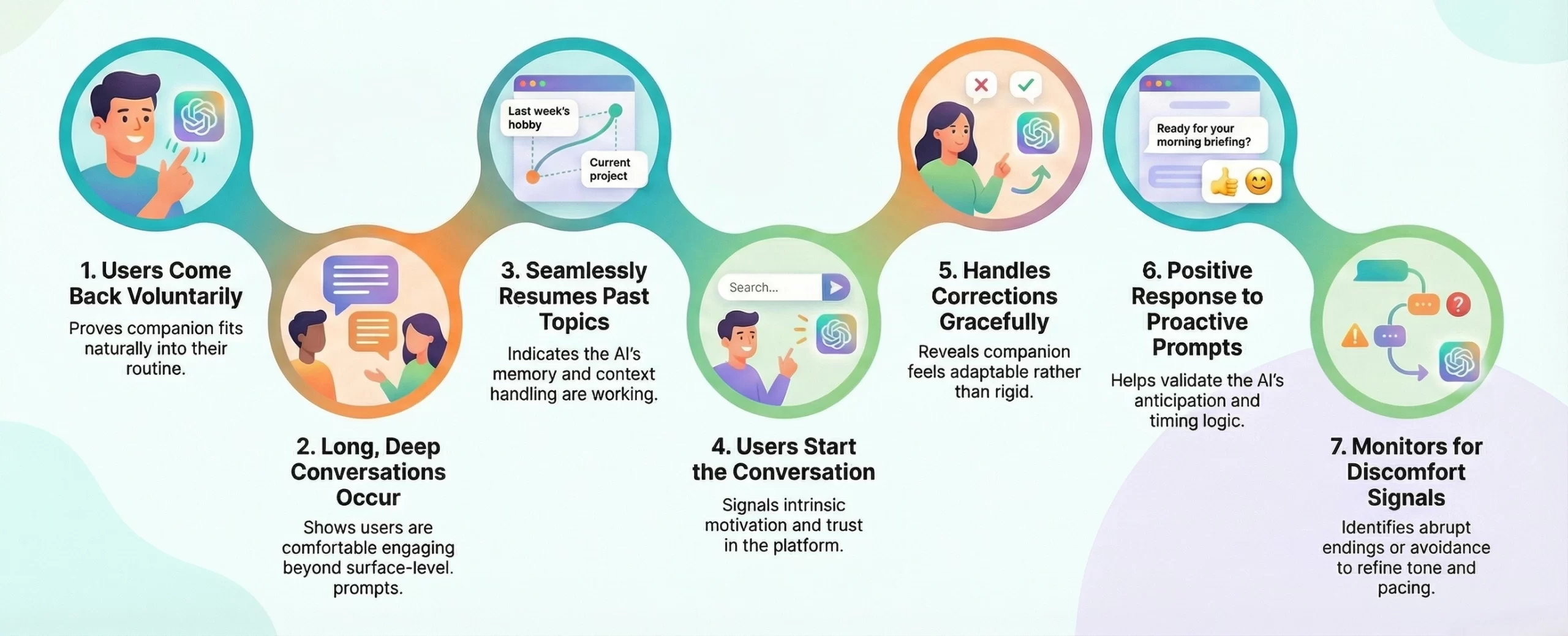
1. Return Frequency & Retention
The most critical metric is how often users return voluntarily. Daily or weekly return patterns indicate comfort and perceived value, proving the companion fits naturally into users’ routines rather than being a one-time novelty.
2. Session Length & Interaction Depth
Healthy MVPs show meaningful session duration and multi-turn conversations. Longer sessions with coherent dialogue suggest users are comfortable engaging beyond surface-level prompts and are exploring deeper interaction with the companion.
3. Conversation Continuity Success
This metric evaluates whether users resume previous topics without friction. Successful continuity indicates memory and context handling are working as intended and that users feel recognized rather than reset each time they return.
4. User-Initiated Interactions
A strong signal of value is how often users initiate conversations themselves. High user-initiated engagement suggests intrinsic motivation and trust, which are essential for long-term adoption of an AI companion platform.
5. Correction and Guidance Acceptance
Tracking how users correct the companion and continue engaging afterward reveals trust levels. Smooth recovery from corrections shows the companion feels adaptable rather than frustrating or rigid.
6. Proactive Interaction Responsiveness
This measures whether users respond positively to proactive prompts. Engagement with these moments helps validate timing logic and determines whether anticipation-based features should be expanded post-MVP.
7. Drop-Off & Discomfort Signals
Monitoring abrupt session endings, reduced engagement, or avoidance patterns helps identify early discomfort or fatigue. These signals are crucial for refining tone, pacing, and boundaries before scaling.
Common Mistakes to Avoid When Launching an AI Companion MVP
Many AI companion MVPs fail due to feature overload, ignoring early user feedback, or lacking personalization. This section highlights key pitfalls to avoid for a successful and user-centered launch.
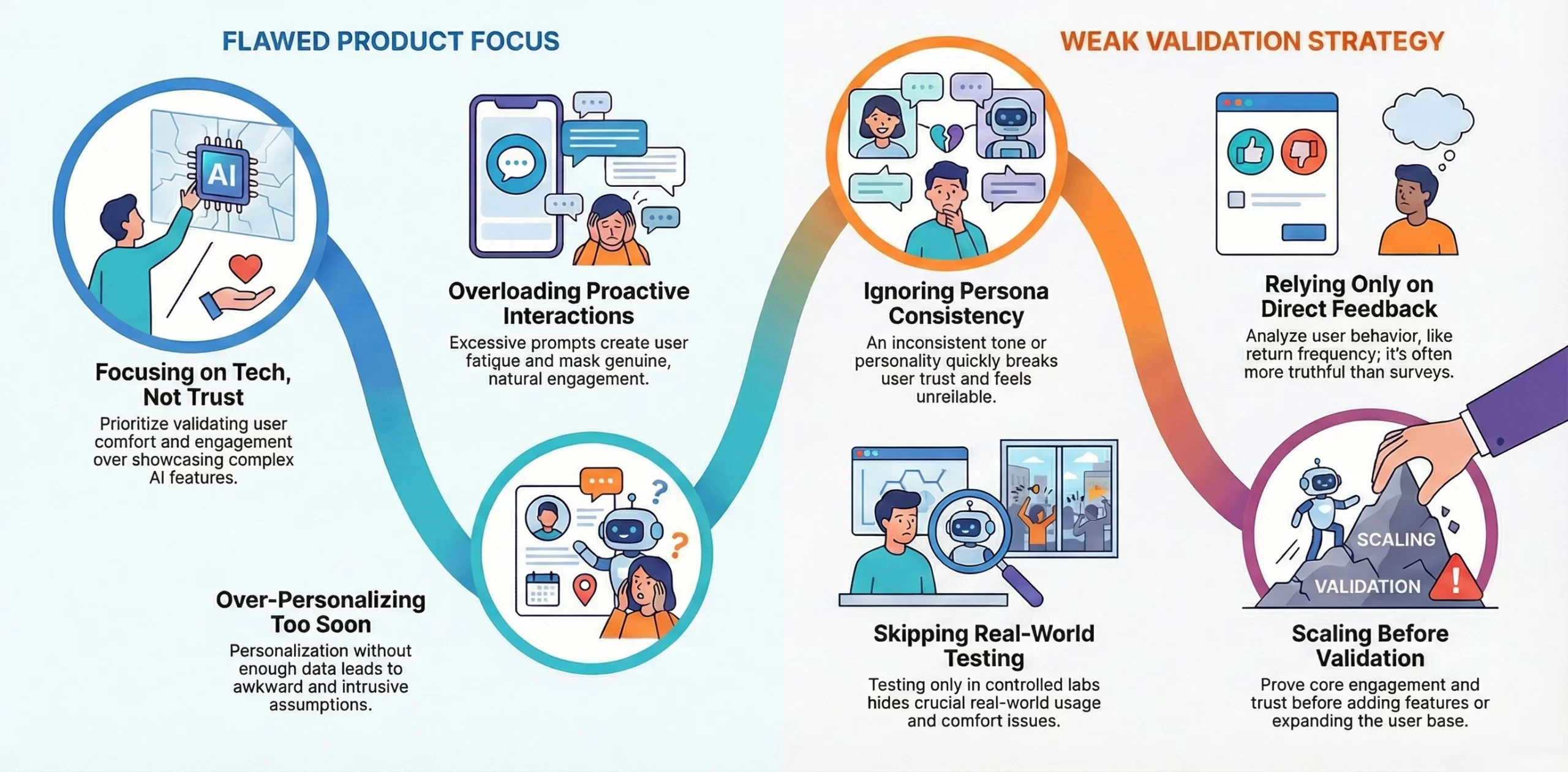
1. Treating the MVP Like a Feature Demo
Many teams focus on showcasing intelligence instead of validating user comfort and repeat engagement. An AI companion MVP should prove relationship value, not overwhelm users with advanced but unnecessary capabilities.
2. Overloading Proactive Interactions Early
Excessive proactive prompts often create friction and fatigue. MVPs that push too hard fail to observe natural user behavior, making it difficult to assess whether engagement is genuine or forced.
3. Ignoring Tone and Persona Consistency
Inconsistent tone or personality breaks trust quickly. Early users notice subtle shifts, and without persona stability, even technically sound companions feel unreliable and uncomfortable.
4. Over-Personalizing Too Soon
Deep personalization without enough interaction data leads to awkward assumptions. MVPs should earn personalization gradually, ensuring relevance before depth to avoid intrusive or inaccurate responses.
5. Relying Only on Direct User Feedback
Surveys and verbal feedback often conflict with real behavior. Teams that ignore return frequency and session patterns miss critical signals about whether the companion is truly valuable.
6. Skipping Real-World Usage Testing
Testing only in controlled environments hides discomfort issues. Launching without observing real user contexts and timing patterns increases the risk of early churn and misaligned product decisions.
7. Scaling Before Behavioral Validation
Expanding features or user base too early locks in flawed assumptions. MVPs must validate trust, continuity, and engagement quality before investing in scale or advanced intelligence layers.
Monetization Strategy for an AI Companion MVP Platform
Assessing monetization readiness early helps ensure your AI companion MVP can generate revenue while meeting user needs. This section explores strategies to balance value delivery with sustainable business models.
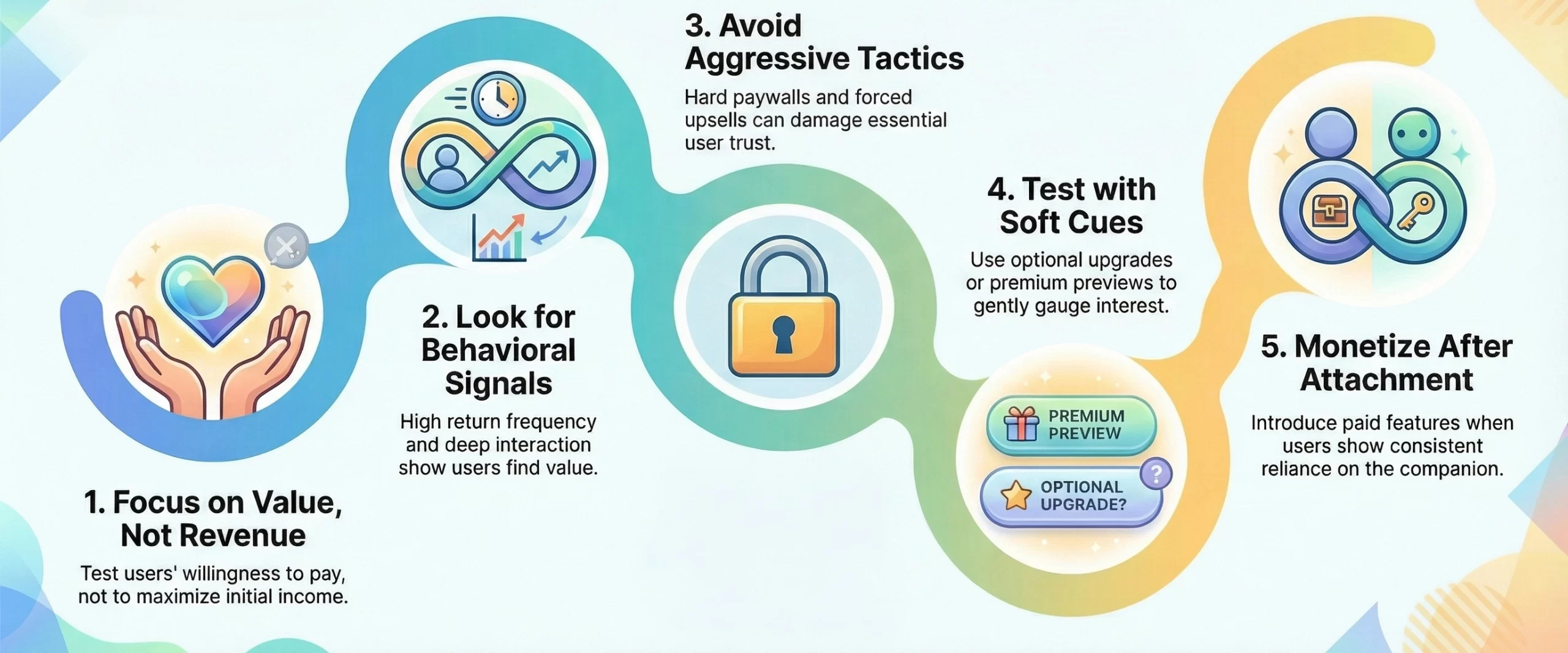
1. Focus on Willingness to Pay, Not Revenue
At the MVP stage, monetization is about testing perceived value, not maximizing income. The goal is to understand whether users would pay without disrupting trust or early engagement patterns.
2. Use Behavioral Signals as Monetization Indicators
Return frequency, session depth, and voluntary interaction act as early monetization signals. These behaviors show whether the companion delivers enough value to support future paid offerings.
3. Avoid Aggressive Monetization Too Early
Hard paywalls and forced upsells can damage user comfort and trust. MVPs should delay heavy monetization until engagement and emotional alignment are established, ensuring a positive user experience and long-term retention.
4. Test Soft Monetization Cues
Light experiments such as premium feature previews or optional upgrades help gauge user interest without pressure. These cues inform pricing strategy while preserving the MVP experience.
5. Monetize After Attachment Is Evident
True readiness appears when users show consistent reliance on the companion. At that point, monetization enhances the relationship instead of feeling like an interruption, creating opportunities for premium features and long-term engagement.
Conclusion
Launching an MVP is about learning with intention rather than proving perfection. Clear user problems, focused features, and fast feedback loops create momentum without unnecessary complexity. When early users feel heard, the product direction becomes clearer with each iteration. A strong AI companion MVP platform balances technical feasibility with empathy, ensuring the experience feels useful, respectful, and reliable. By validating assumptions early and refining based on real behavior, founders build a foundation that supports scalability while preserving the trust and relevance required for long term growth across evolving user needs.
Launch Your AI Companion MVP Platform with IdeaUsher!
IdeaUsher helps startups bring AI companion ideas to market through focused MVP development. We emphasize clarity, speed, and validation, ensuring your MVP demonstrates real value while laying the groundwork for future growth.
Why founders choose IdeaUsher:
- MVP Scoping with Clear Validation Goals: We help define the smallest set of features that prove demand, reduce risk, and deliver measurable learning from real users.
- AI Models Designed for Early-Stage Products: Our team implements reliable, constrained AI behaviors that perform well in MVP environments while allowing room for future improvement.
- Rapid Iteration Based on User Feedback: We structure development cycles to capture insights early, enabling smarter decisions without overbuilding or wasting resources.
- Startup-Focused Delivery Experience: With experience supporting early-stage teams, we align timelines, budgets, and technical decisions with investor and market expectations.
Explore our portfolio to see how we have helped startups successfully launch AI-driven MVPs.
Request a free consultation to launch your AI companion MVP platform with clear product goals, technical feasibility, and user trust.


FAQs
An MVP should focus on one core problem, minimal but meaningful features, and a reliable user experience. Investors expect proof of demand, while builders need early feedback that validates usability and technical feasibility.
Validation comes from real user engagement, retention metrics, and qualitative feedback. Early adopters help confirm whether the AI provides consistent value, guiding product refinement before scaling development or pursuing funding.
Overbuilding features, ignoring user feedback, and underestimating data quality are common issues. Successful teams keep scope tight, test assumptions early, and focus on delivering clear value rather than showcasing technical complexity.
Early metrics include activation rates, session depth, and repeat usage. These indicators show whether users understand the product, find it useful, and are willing to integrate it into regular routines.