 (+971) 8007 4267
 (+91) 946 340 7140
 (+1) 628 432 4305

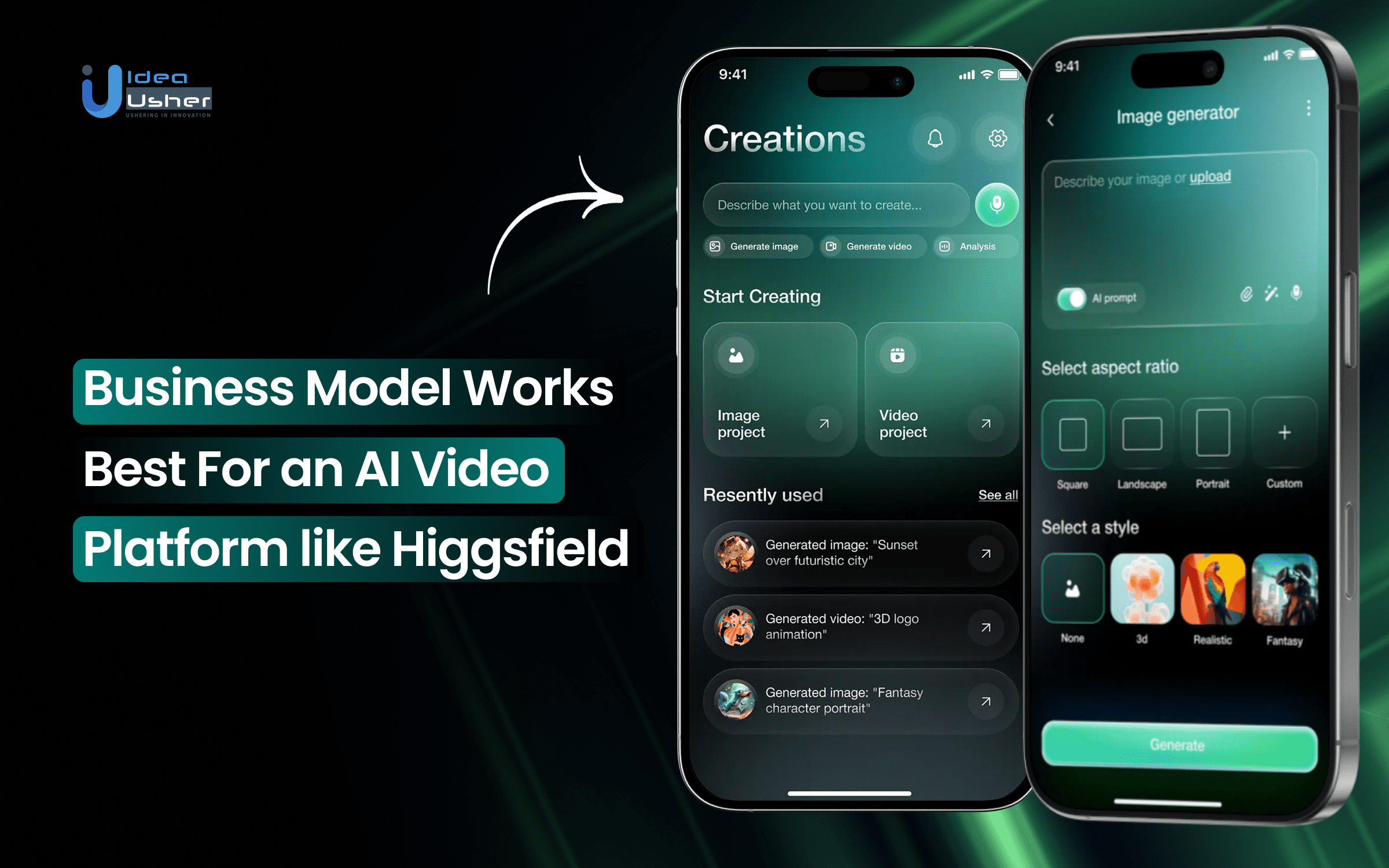
AI video platforms sit at the intersection of high compute costs and fast-moving creative demand, which makes choosing the right monetization approach critical from day one. While user interest may be driven by visual quality or speed, long-term viability depends on how value is packaged, priced, and sustained as usage grows. These dynamics shape the AI video platform business model, where revenue must scale alongside infrastructure rather than outpace it.
Different usage patterns call for different models. Individual creators, teams, and enterprises interact with video generation tools in distinct ways, affecting how subscriptions, usage-based pricing, API access, or enterprise licensing perform over time. Platforms like Higgsfield highlight the importance of aligning pricing with workflow intensity, output volume, and production frequency rather than relying on a single monetization lever.
In this blog, we examine which business models work best for an AI video platform like Higgsfield by analyzing common pricing structures, cost dynamics, and the factors that influence sustainable revenue as adoption scales.

Understanding Higgsfield’s Core Value Engine (Before Monetization)
Higgsfield is positioned as a cinematic-grade AI video generation platform, built for creators and teams who prioritize visual realism, controlled motion, and shot-level consistency over fast, disposable content. Unlike generic AI video tools optimized for volume, Higgsfield focuses on high-fidelity outputs where every frame aligns with a defined creative intent, making it especially relevant for filmmakers, creative studios, agencies, and high-end content teams working on commercial or narrative projects.
This positioning is defined by a distinct value engine:
- The platform is optimized for precision and creative control, not mass video generation
- Each output is compute-intensive, with higher GPU usage tied directly to quality and realism
- Video generation is iteration-driven, where users refine shots rather than produce in bulk
- The perceived value lies in outcome fidelity, not the number of clips generated
- Users expect reliability, consistency, and cinematic depth, not instant, low-cost renders
This value engine fundamentally shapes how the platform operates. Longer render cycles, higher inference costs, and fewer but more meaningful exports are inherent to Higgsfield’s design philosophy. As a result, the platform’s business viability depends on monetizing precision, reliability, and creative depth rather than raw usage volume.
Why Business Model Matters More Than Architecture?
A strong AI video platform business model can attract early users, but sustainability depends on whether monetization aligns with compute economics. In cinematic AI video platforms, pricing decisions directly influence system design, scalability, and long-term margins.
1. Model Quality vs Business Viability
High-fidelity video models scale GPU costs faster than user growth. Without pricing that accounts for variable inference complexity, even technically superior AI video platforms struggle to sustain margins at scale.
2. Business Model Shapes Architecture
Render queues, batching, resolution caps, priority inference, and rate limits are cost-control mechanisms. In AI video platforms, architecture follows monetization logic, not the other way around.
3. Why Flat SaaS Pricing Fails
Flat or unlimited SaaS plans ignore compute variance across renders. A single cinematic video can consume more GPU resources than hundreds of low-quality outputs, making traditional pricing models financially unstable.
4. Monetization as Part of the Technical System
Credit systems, usage-based limits, premium tiers, and enterprise licensing align creative value with compute economics, protecting infrastructure while enabling predictable scaling and sustainable revenue growth.
5. User Behavior Impacts Costs
Prompt looping, iteration-heavy workflows, and batch exports rapidly amplify GPU usage. Without usage-aware monetization, power users silently become the platform’s largest cost centers.
Global Market Growth of AI Video Platforms
The global AI video generator market was valued at USD 716.8 million in 2025 and is expected to grow from USD 847 million in 2026 to USD 3,350.00 million by 2034, with an average CAGR of 18.80% during this period. This trend indicates ongoing commercial use rather than just temporary experimentation.

Higgsfield’s user base is geographically diversified, with the United States accounting for 20.64% of users, followed by India at 7.02%, then Russia, South Korea, and Japan. The remaining 58% of traffic comes from other regions worldwide.
This platform shows strong traction and engagement, attracting 11.7 million monthly visits and recording a 50.8% growth surge in October after launching its Video Enhancer for Sora 2.
Higgsfield has raised a total of $138M across 3 rounds, including an $80M Series A in January 2026. It became a unicorn in 2025, just two years after founding. The current valuation is $1.3 billion.
It is on a $200 million annual revenue run rate, doubling from $100 million in roughly two months, reflecting strong product-market fit in a highly compute-constrained category.
Users spend nearly 10 minutes per session, view 9+ pages on average, and maintain a low 31.93% bounce rate, indicating deep, intent-driven platform usage rather than quick exits.
Mapping AI Video Platform Costs for Sustainable Revenue Models
The AI video generation market is growing rapidly, yet many platforms struggle with high churn and negative unit economics. In many cases, weaknesses in the AI video platform business model stem from poor visibility into how compute and infrastructure costs scale against subscription revenue.

1. Fixed vs Variable Cost Centers
Before setting prices or plans, AI video platform businesses must clearly separate costs that remain stable from those that scale with usage. Misclassifying variable compute expenses as fixed overhead is the fastest path to broken unit economics.
- GPUs (Variable/Hard Cost): The single largest variable expense. Every video frame rendered consumes GPU cycles. In a serverless model, this is a direct cost per inference.
- Storage (Semi-Variable): The cost of storing raw assets, generated outputs, and user uploads. While cheap at a small scale, it compounds exponentially with user growth if not managed (e.g., lazy deletion policies).
- Model Training (Fixed/Sunk): The cost of pre-training or fine-tuning the base model. This is a fixed R&D expense that must be amortized over the lifetime of the model.
- Infrastructure & Orchestration (Fixed/Variable): Kubernetes overhead, API gateways, and load balancers. These are relatively fixed until scaling triggers the need for dedicated headcount or larger instance sizes.
- Monitoring & Observability (Fixed): Tools for logging, metrics, and alerting (e.g., Datadog, Grafana). Necessary for stability but a fixed operational overhead.
2. Per-User Cost Limitation
AI video generation breaks the traditional SaaS assumption that every user costs the same. The AI video platform business model must account for wide variation in resource consumption driven by video length, complexity, and user behavior.
- Compute Variance: A user generating a 5-second, low-motion clip costs a fraction of a user generating a 30-second, high-action video. Treating them as the same “user” economically is a recipe for loss.
- Render Complexity: The chosen model matters. Using a lightweight latent diffusion model vs. a high-definition video transformer changes compute time (and cost) by an order of magnitude.
- User Behavior: “Power users” or bad actors can run hundreds of generations in a single night. If pricing is based on a “seat,” a single user can burn through the gross margin contributed by 50 casual users.
3. Hidden Cost Amplifiers
The true cost of AI video generation extends far beyond a single render. Iteration cycles, exports, resolution upgrades, and failed jobs compound silently, turning seemingly affordable features into major margin killers.
- Iteration Loops: Users rarely get the perfect output on the first try. The cost of a finished video isn’t the cost of one render; it’s the cost of 5, 10, or 20 renders plus “negative prompts” and regenerations.
- Exporting & Transcoding: The cost of converting a raw tensor output into a playable MP4 (transcoding) and serving it to the user (egress) is often overlooked but adds up quickly.
- Resolution Scaling: Offering 4x upscaling or slow-motion frame interpolation (commonly called “Cost Amplifiers” in the industry) can double or triple the total compute required for a single asset.
- Retries and Failures: Failed jobs that have to be re-queued by the system represent pure waste. You pay for the failed compute time and the successful retry.
4. Revenue Aligned with Compute
Sustainable AI video platforms’ price is based on how value is created and costs are incurred. When infrastructure costs scale with usage and complexity, revenue models must reflect that variability to remain profitable.
- Granular Credits: Move away from “unlimited” plans. Use a credit system where different actions (Standard render, HD render, Upscale) have different credit costs. This caps liability.
- Usage Caps: Implement “max compute” limits on lower tiers to protect against the “one user ruining the batch” scenario.
- Premium Tiers for Efficiency: Offer “Priority” or “Turbo” tiers. While these users consume compute faster, they are paying a premium for the speed, which often aligns with higher-margin professional use cases.
- Enterprise: Hybrid Consumption: For enterprise clients, consider a hybrid model: a base seat fee (for platform access and management) + a committed consumption amount (pre-purchased GPU hours).
5. Revenue Loss from Misaligned Pricing
Platforms that ignore usage-based pricing often appear healthy while quietly losing money. In an AI video platform business model, failing to align consumption with billing allows heavy users to erode margins and distort growth metrics.
- The “Netflix” Trap: Flat-rate subscription pricing for a compute-bound utility like video generation creates a moral hazard. The platform hopes users use it less; users are incentivized to use it as much as possible.
- Hidden Negative Unit Economics: The platform might be acquiring customers and seeing revenue growth, but if the heaviest users are the most expensive to serve and aren’t paying extra, the CAC payback period becomes infinite.
- Commoditization Risk: Without usage-based tiers, platforms compete solely on output quality. Aligning pricing with consumption enables competition on efficiency and value, allowing light users to pay less and heavy users to self-select into appropriate, profitable plans.
The Business Model That Works Best for AI Video Platforms Like Higgsfield
For AI video platforms, pricing is not a marketing decision but a structural one. The winning strategy isn’t choosing one pricing model, but orchestrating a hybrid system that aligns user value with compute reality.
Why a Single Pricing Model Is Not Enough
A single pricing model fails because AI video platforms face conflicting incentives. Subscriptions reward overuse, usage-based pricing suppresses creativity, and enterprise-only focus sacrifices adoption, resilience, and long-term platform scale.

1. Hybrid Credit-Based Subscriptions
The foundation of a scalable AI video platform business model is the “subscription + walled garden” model, where the unit of value is the credit, not the seat or the video. This aligns user access with controlled compute consumption.
- The Mechanism: Users pay a recurring fee (e.g., $29/month) to access the platform. This fee grants them a monthly allocation of “Credits.”
- Compute-Weighted Value: Crucially, a 5-second standard clip costs 1 credit, but a 30-second 4K clip with complex motion costs 20 credits. This maps revenue directly to GPU cost.
- The Psychology: The subscription feels like a membership (recurring revenue for you), while the credits act as a spending guide (preventing runaway costs for you).
2. Capability-Driven Tier Design
Most platforms make the mistake of offering tiers like “Basic (10 videos)” and “Pro (100 videos)”, which misrepresents how AI video delivers value. In practice, AI video value lies in capability, control, and quality, not raw quantity.
- Resolution & Quality: Basic tier caps at 720p; Pro tier unlocks 4K.
- Creative Control: Basic users get standard presets; higher tiers unlock advanced controls (negative prompting, seed control, motion strength sliders).
- Speed (SLA): Basic users go to the back of the queue (lower priority during peak times). Pro users get “Turbo” mode with dedicated GPU routing.
- Duration: Basic tier limits generations to 5 seconds; Pro unlocks 30-second generations.
3. Usage-Based Upsells That Margins
Within a subscription ecosystem, high-cost actions must be metered separately to protect the unit economics of the core plan. Usage-based upsells ensure expensive operations are monetized without penalizing everyday usage.
- Paid Exports & Watermark Removal: The basic plan includes watermarked previews. Removing the watermark costs a small credit fee.
- HD/Super-Resolution Renders: Upscaling a video to 4K is computationally expensive. This is a perfect “bolt-on” credit cost.
- Advanced Motion Modules: Access to high-frame-rate slow motion or complex camera movement scripts (pan, zoom, rotate) can be an additional cost-per-use, as they require significantly more inference steps.
- Premium LUTs/Presets: While the use of a preset might be free, the generation using a licensed, proprietary style (e.g., “Cinematic Studio”) can incur a micro-charge to recoup licensing or training costs.
3. API & Platform Embedding Revenue
For platforms like Higgsfield, the highest-margin opportunity often exists beyond the front-end application. Exposing video generation through APIs and embedded workflows turns backend infrastructure into a scalable revenue engine.
- API Access: Allow third-party apps (design tools, marketing platforms) to generate video via API. This shifts the compute cost directly to the customer on a “pay-as-you-go” basis, with a high markup.
- SDK Integrations: Embedding video generation directly into platforms like Canva, Adobe, or Figma creates a distribution channel where you capture revenue share without direct customer acquisition costs.
- White-Label Solutions: Offer agencies the ability to spin up their own branded version of your platform, charging a management fee plus usage overage.
4. Enterprise Licensing Revenue
To stabilize cash flow and fund ongoing R&D, enterprise licensing forms the bedrock of annual recurring revenue (ARR). Enterprise contracts provide predictability while supporting higher-touch, infrastructure-intensive use cases.
- Annual Contracts + Committed GPU: Move beyond “seats.” Sell committed compute (e.g., “$50k/year for X GPU hours”). This guarantees revenue and allows you to plan infrastructure procurement.
- Private & Sovereign Deployments: Large media companies require their data to stay within their VPC (Virtual Private Cloud). Offering a private deployment option commands premium pricing (often 2-3x the standard rate).
- Custom Model Fine-Tuning: Enterprise clients want the base model trained on their IP or brand assets. This is a high-touch, high-margin services layer that converts into a long-term licensing deal.
- SLAs and Dedicated Support: Enterprises pay for peace of mind. Offering guaranteed uptime, priority support, and account management turns the AI tool into a mission-critical utility.
This hybrid AI video platform business model scales because it aligns incentives across every layer of the platform. Casual users are safely capped, power users self-select into higher tiers, enterprises fund infrastructure stability, and compute consumption always maps back to revenue.
The Right Business Model for Your AI Video Platform Vision
While hybrid monetization works best for most AI video platform business models, the exact mix depends on what you are building, who you are building for, and how your infrastructure is designed. Business models should emerge from product intent, not the other way around.

1. Creator-First vs Enterprise Platform
Creator-first platforms prioritize accessibility, experimentation, and self-serve onboarding, making credit-based subscriptions and usage caps essential. Enterprise-first platforms, however, optimize for predictability, security, and scale, where committed compute contracts and private deployments take precedence.
2. Open vs Controlled Platform
Open platforms that allow wide prompt freedom and third-party integrations require stricter usage controls to prevent abuse. More controlled cinematic engines can price higher by limiting variability and offering guaranteed quality, speed, and consistency.
3. Validation vs Scale Optimization
Early-stage platforms should focus on validating willingness to pay without overengineering pricing complexity. At scale, pricing must evolve to reflect real usage patterns, cost hotspots, and customer segmentation discovered through data.
4. Custom Models & Infrastructure
As platforms mature, off-the-shelf models and generic infrastructure often become cost bottlenecks. Custom model tuning, optimized inference pipelines, and tailored pricing logic are usually required to protect margins and unlock enterprise-grade opportunities.
5. Usage Data & Pricing Feedback
AI video platforms rarely get pricing right on day one. The ability to observe usage patterns, identify cost hotspots, and iteratively adjust credits, tiers, and caps often determines long-term profitability.
Why Certain Business Models Fail in AI Video Platforms?
Many AI video platforms fail not because the technology is weak, but because the AI video platform business model ignores how compute-heavy systems behave at scale. These monetization mistakes often look attractive early on, yet quietly destroy margins as usage grows.
1. Unlimited Subscription Plans
Offering unlimited generations without hard compute caps invites abuse and unpredictable costs. Power users quickly consume disproportionate GPU resources, forcing the platform to throttle usage or absorb unsustainable losses.
2. Flat SaaS Pricing
Video generation has radically different cost dynamics than text or image AI. Applying flat monthly pricing ignores inference variance, leading to situations where a small percentage of users generate the majority of infrastructure costs.
3. Creator-Only Monetization
Relying solely on individual creators limits revenue ceilings and exposes the platform to churn. Without API access, enterprise licensing, or embedded use cases, long-term revenue stability becomes difficult to achieve.
4. Ad-Based or One-Time Pricing
Advertising and lifetime deals work poorly for compute-intensive products. Revenue remains fixed while inference costs scale indefinitely, creating a structural mismatch that cannot be corrected later without breaking user trust.
5. Freemium Models
Freemium access without strict compute limits quickly becomes a cost sink. Free users experiment heavily, drive GPU usage without revenue contribution, and force premature throttling that damages trust and conversion rates.
Conclusion
Choosing the right path for growth depends on how value is created and shared. An AI video platform business model must balance creative freedom, compute costs, and predictable revenue. Subscription tiers, usage-based pricing, and enterprise licensing each serve different user intents. What matters most is aligning pricing with output quality, speed, and reliability. When creators feel fairly supported and businesses see a clear return, adoption follows naturally. A thoughtful model also leaves room for experimentation, partnerships, and ethical AI practices that sustain trust while the platform scales responsibly over time.
Build a Scalable AI Video Generation Platform With IdeaUsher!
We build AI-powered products and solutions across industries, with deep expertise in performance-intensive systems, model integration, and scalable infrastructure. Our experience enables us to design AI video platforms that balance rendering quality, inference cost, and business sustainability.
Our ex-FAANG and MAANG engineers bring over 500,000+ hours of hands-on AI development experience, allowing us to architect AI video platforms aligned with creative workflows, performance benchmarks, and monetization strategies.
Why Work With Us?
- Production-Grade AI Engineering: We build real-world AI systems that perform reliably under real-world user load, not experimental demos.
- Rendering and Inference Optimization: Our architectures focus on compute efficiency, intelligent batching, and cost control without sacrificing output quality.
- Business Aligned Platform Design: Every system is built around monetization logic, usage patterns, and long-term scalability.
- End-to-End Product Ownership: From model integration to platform performance and growth readiness, we design with the full lifecycle in mind.
Explore our portfolio to see how we design and scale AI-powered platforms built for real market demands.
Contact us for a free consultation and let’s turn your ideas into production-ready solutions.


FAQs
A.1. Subscription-based pricing combined with usage limits scales well for AI video platforms. It ensures predictable revenue while aligning costs with compute usage, rendering time, and output quality across individual creators, teams, and enterprise customers.
A.2. Enterprise monetization usually includes custom pricing, API access, priority rendering, security controls, and dedicated support. These buyers value reliability, integration flexibility, and compliance more than low cost, making contract-based licensing an effective revenue approach.
A.3. Pricing depends on compute costs, output quality, speed, user volume, and target audience. A strong pricing strategy reflects creative value delivered while ensuring margins remain sustainable as model complexity, infrastructure demand, and customer expectations increase.
A.4. Creator retention is essential because acquisition costs are high. Retention improves when platforms offer consistent output quality, predictable pricing, saved workflows, and evolving features that integrate into long-term creative or marketing processes.


