 (+971) 8007 4267
 (+91) 946 340 7140
 (+1) 628 432 4305

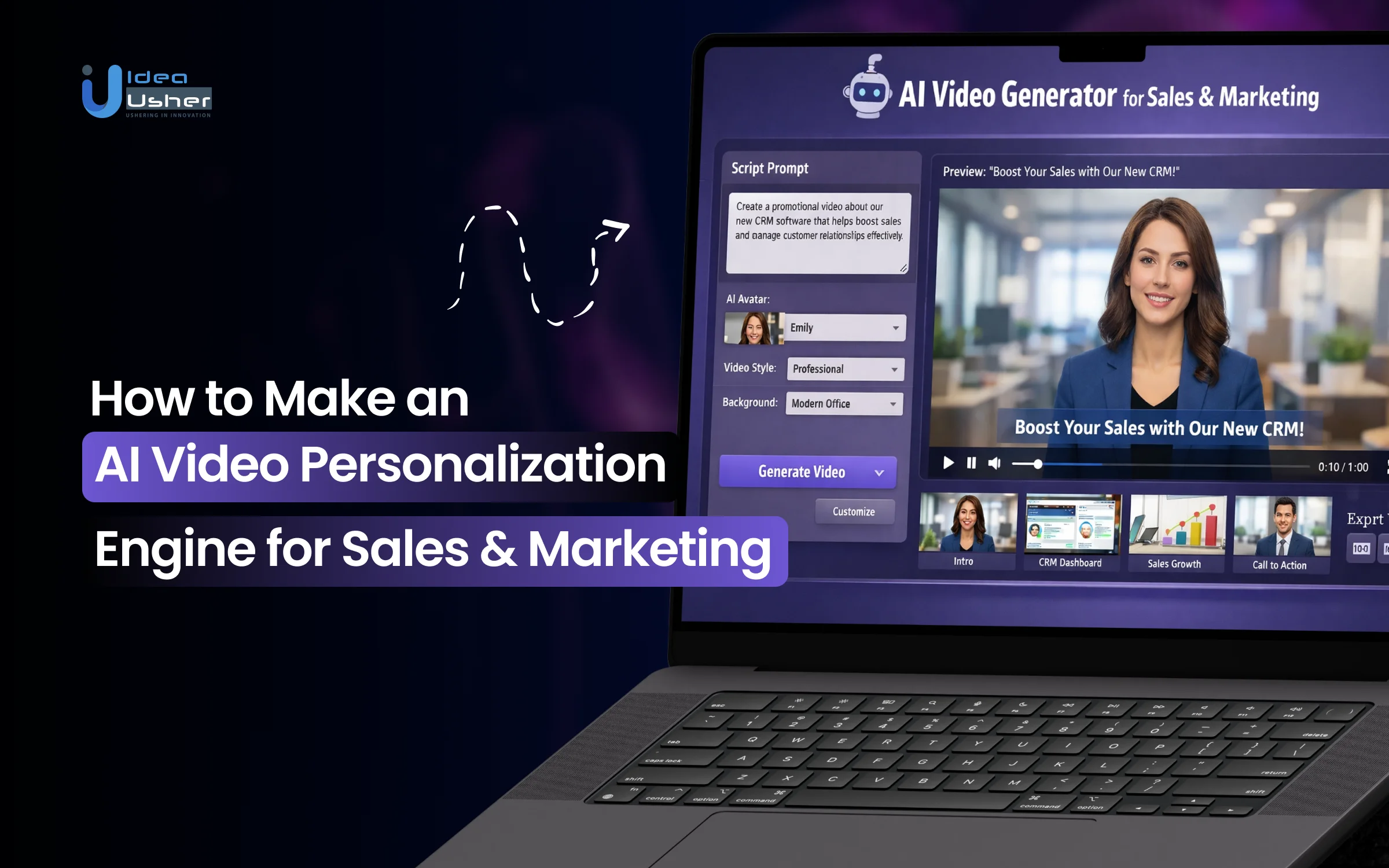
Sales and marketing teams increasingly rely on personalized outreach, but producing tailored video content at scale has traditionally been impractical. Recording individual videos for every prospect or customer does not scale, while generic content often fails to convert. This gap is driving demand for an AI video personalization engine that can dynamically generate customized video experiences based on user data, behavior, and campaign context.
Making personalization work in video requires more than inserting a name into a template. Data mapping, variable scene injection, script adaptation, rendering pipelines, and performance tracking all need to operate together in real time. The effectiveness of the system depends on how well personalization logic integrates with CRM platforms, marketing automation tools, and analytics systems without slowing production or compromising quality.
In this blog, we explain how to make an AI video personalization engine for sales and marketing by breaking down core system components, architectural considerations, and practical steps involved in building scalable, data-driven video experiences.

What Is an AI Video Personalization Engine?
An AI video personalization engine follows a “one-to-one” model, uses machine learning and generative AI to create data-driven, real-time video experiences for individual viewers, unlike traditional one-to-many production. It assembles modular assets like visuals, audio, text, and data into a dynamic, personalized experience based on user attributes.
The engine links a brand’s CRM data to its visual strategy, using variables like name, purchase history, location, or behavior to dynamically customize videos. This creates personalized content that boosts engagement, click-throughs, and brand recall compared to generic videos.
A. Core Components of a Personalization Engine
To function at a professional grade, an AI video personalization engine relies on a high-performance stack comprising four primary layers: the Data Integration Layer, the Creative Template Engine, the Generative AI Module, and the Rendering Pipeline.
- Data Integration Layer: The nervous system of the engine. Connects via APIs to external sources (Salesforce, HubSpot, proprietary SQL databases) to ingest personalization “signals.” Ensures the right data point reaches the right video frame without latency.
- Creative Template Engine: Built on intelligent templates with defined “dynamic zones” where text, images, or footage can be swapped. Supports complex logic like conditional branching (e.g., “If User X is a Gold Member, show the VIP background; otherwise, show the Standard background”).
- Generative AI Module: The modern differentiator. Uses neural networks for lip-syncing, voice cloning (brand-consistent Text-to-Speech), and image synthesis, allowing videos to address users by name or include localized details with high audiovisual fidelity.
- High-Concurrency Rendering Pipeline: Optimized “headless” rendering distributed across cloud GPU clusters (AWS G5, Azure N-series) to generate thousands of unique videos simultaneously without bottlenecks.
B. How It Differs from Basic Video Automation Tools
While basic automation focuses on efficiency, a true AI video personalization engine focuses on authenticity and relevance. The following table breaks down the technical and functional gaps between these two approaches:
| Feature | Basic Video Automation | AI Personalization Engine |
| Modification Depth | Simple overlays (text/images) on top of a “locked” video file. | Deep synthesis; modifies the actual audio and visual layers of the media. |
| Audio Integration | Generic background music or pre-recorded static voiceovers. | Dynamic Text-to-Speech (TTS) with voice cloning and lip-syncing. |
| Narrative Flow | Linear; every user sees the same scenes in the same order. | Non-linear; uses branching logic to show different scenes based on user data. |
| Production Value | Often looks like a template; feels automated and “robotic.” | Indistinguishable from custom-shot footage; feels personally crafted. |
| Strategic Goal | High-volume output and time savings. | High-intent engagement and relationship building. |
Why AI Video Personalization Is Replacing Static Content?
The digital landscape of the AI video personalization engine has shifted from “broad reach” to “hyper-relevance,” as static video fails to penetrate the noise of content saturation and meet modern consumer demands for personalized experiences.

A. The Shift from Mass Campaigns to 1:1 AI Video
The transition from broad-market broadcasting to individual synthesis represents a fundamental change in how brands leverage their CRM data to build authentic human connections at scale.
- From Segments to Individuals: Move beyond “target demographics” to “target identities,” where the AI engine dynamically generates unique narratives for every single recipient in your database.
- Modular Narrative Logic: Unlike static files, 1:1 AI video uses branching logic to swap scenes, voiceovers, and visual data points based on the specific intent and history of the viewer.
- Production Decoupling: Generative AI allows you to create thousands of “bespoke” video versions without the linear increase in time, budget, or manual editing typically required for high-touch content.
B. Why Generic Video Funnels Are Losing Conversions
Generic funnels suffer from “Contextual Friction,” forcing the viewer to mentally translate a broad value proposition into their specific situation, which leads to immediate disengagement and high drop-off rates.
| Performance Gap | Generic Video Funnels | Personalized AI Funnels |
| Attention Span | High “skip” rates within the first 5 seconds. | Immediate hook via “Cocktail Party Effect” (hearing/seeing one’s own data). |
| Cognitive Load | High; viewer must guess how the product fits them. | Low; the video demonstrates the exact fit for the viewer’s specific use case. |
| CTA Effectiveness | Static, one-size-fits-all “Book a Call” buttons. | Dynamic CTAs that change based on the viewer’s real-time lead score or location. |
| Brand Perception | Seen as a “mass marketer” or generic vendor. | Seen as a sophisticated “strategic partner” who understands the client. |
C. Personalization as a Revenue Multiplier, Not a Feature
Strategic leaders must view AI personalization as a core engine for financial growth, as it directly addresses the two most common leaks in any revenue funnel: engagement fatigue and lack of trust.
- Accelerated Sales Cycles: By answering specific customer objections within a personalized video, you remove the back-and-forth friction that typically stalls B2B and high-ticket B2C deals.
- Average Order Value (AOV) Expansion: Use AI to visually demonstrate upselling or cross-selling opportunities that are logically mapped to a customer’s purchase history, making the recommendation feel like a service rather than a pitch.
- Retention and LTV: Personalized onboarding and “milestone” videos reduce churn by making the customer feel seen and valued, turning a single transaction into a long-term, high-value relationship.
Why AI Video Platforms Are Popular in Sales & Marketing?
The global AI video generator market size was valued at USD 716.8 million in 2025 and is projected to grow from USD 847 million in 2026 to USD 3,350.00 million by 2034, exhibiting a CAGR of 18.80% during the forecast period. As the market grows, businesses are investing in AI video personalization for sales and marketing, making scalable, enterprise-ready systems essential for delivering high-conversion content.

Businesses experience an 80–95% reduction in per-video production costs with AI video tools compared to traditional human-led editing processes. Meanwhile, 82% of eCommerce platforms include AI-generated product videos, which contribute to an average 46% boost in conversion rates.
Approximately 58% of small- to medium-sized eCommerce businesses utilize AI-generated videos, reducing production costs by 53%. Additionally, 62% of marketers experience more than 50% faster content creation, with AI helping to save approximately 34% of editing time.
According to HiggsField, users spend nearly 10 minutes per session, view 9+ pages on average, and maintain a low 31.93% bounce rate, indicating deep, intent-driven platform usage rather than quick exits.
High-Impact Use Cases for Sales & Marketing Teams
Strategic implementation of AI video allows sales and marketing teams to transcend the limitations of manual content production, creating high-touch digital touchpoints that drive measurable revenue across the funnel.

1. AI Sales Outreach Videos at Scale
Sales Development Representatives (SDRs) no longer need to record hundreds of individual videos. An AI video personalization engine allows for a “record once, personalize infinitely” model that maintains a human connection.
- Dynamic Visual Backgrounds: Automatically overlay a prospect’s LinkedIn profile or company website behind the speaker to prove immediate research and intent.
- Voice & Lip-Sync Synthesis: Use generative AI to swap names, company details, and specific pain points while maintaining the original speaker’s natural tone and facial movements.
- Volume Without Burnout: Empower a single rep to send 500+ “personalized” videos per day, achieving the conversion rates of high-touch outreach with the efficiency of mass mailing.
Real-World Example:
Deel used Tavus and HeyGen to scale outbound efforts, creating a “master” template. The AI generated thousands of versions with the SDR’s voice and lips matching each prospect’s name, instead of spending 15 minutes on one video.
The Result: They saw a massive lift in “reply rates” because prospects felt the video was a 1-to-1 message, unaware that an algorithm handled the personalization.
2. Personalized ABM Video Campaigns
Account-Based Marketing (ABM) requires a level of precision that static assets cannot provide. AI engines allow marketing teams to create bespoke narratives for high-value stakeholders within a target account.
- Stakeholder-Specific Relevance: Replace generic “all-hands” decks with unique videos tailored to specific roles, such as technical deep-dives for CTOs and ROI-centric briefings for CFOs.
- Granular Data Integration: Move beyond broad trends by dynamically injecting the prospect’s actual quarterly earnings, real-time market position, or competitive data directly into the visual narrative.
- Accelerated Creative Agility: Eliminate weeks of manual revisions with instant, AI-driven iterations that adapt to the latest account intelligence or shifting market conditions on the fly.
- Strategic Narrative Branching: Use automated logic to adjust script complexity based on account tiering, ensuring “must-win” targets receive the most sophisticated, high-touch generative elements.
Real-World Example:
Snowflake employs personalized videos, like using Gan.ai to showcase a company’s actual data warehouse (e.g., AT&T), to penetrate Tier-1 accounts in high-stakes Account-Based Marketing.
The Result: This level of “bespoke” detail moves the needle from a “vendor” relationship to a “strategic partner” mindset, often bypassing the initial gatekeepers.
3. E-commerce Video Personalization
In e-commerce, the “Paradox of Choice” often leads to cart abandonment. AI personalization acts as a digital concierge, narrowing the field to the most relevant products for the individual shopper.
- Tailored Lookbooks: Generate videos showing products that complement the user’s past purchases or browsing history.
- Localized Offers: Automatically adjust pricing, currency, and “closest store” mentions based on the viewer’s IP address.
- Cart Recovery with Context: Instead of a generic “You forgot something” email, send a video showing the specific item in the cart with a personalized discount code.
Real-World Example:
Nike (Member Days) made personalized “Year in Review” videos for Nike+ members with Idomoo, creating millions of unique videos showing users’ favorite sports, miles run, and shoe recommendations based on mileage and terrain.
The Result: A significant increase in repeat purchase rates and brand loyalty through “Digital Concierge” storytelling.
4. AI-Powered Video in Email Funnels
Email remains the primary driver of digital ROI, but engagement is falling. Integrating personalized AI video into automated sequences transforms a text-heavy inbox into a dynamic media experience.
- Subject Line Synergy: Using “[Video for You]” in subject lines increases open rates by nearly 20% when paired with a personalized thumbnail.
- The “Thumbnail Hook”: Use a dynamic GIF thumbnail showing the recipient’s name on a whiteboard or their website to practically guarantee a click.
- Post-Click Continuity: Ensure the landing page video begins exactly where the thumbnail promised, creating a seamless, high-trust transition.
Real-World Example:
HubSpot’s Marketing Team often leverages Vidyard to integrate video into their nurture sequences. They use “Whiteboard Personalization,” where the video thumbnail in the email shows a real person holding a whiteboard that says, “Hi [Name], I have a question about [Company]!”
The Result: This visual “pattern interrupt” in a crowded inbox has been shown to boost click-through rates (CTR) by up to 3x compared to standard text-based emails
5. SaaS Onboarding Personalization
The “First Time to Value” (TTFV) is the most critical metric for SaaS retention. AI-personalized onboarding videos guide users through the specific features they need, reducing the learning curve.
- Feature-Specific Guidance: If a user signed up for “Analytics,” the onboarding video skips general setup and dives deep into data visualization.
- Milestone Celebration: Automatically trigger a “Congratulations” video when a user hits a specific usage threshold, reinforcing the platform’s value.
- Executive Check-ins: Send automated “Quarterly Business Review” videos to account owners, summarizing their team’s usage stats and ROI without manual reporting.
Real-World Example:
Canva’s onboarding process is segmented when a new user joins. A “Teacher” user is presented with classroom templates highlighted by AI. Companies such as Synthesia assist SaaS firms in creating “Avatars” that function as 24/7 success managers.
The Result: By showing the user exactly what they need (and nothing else), companies like Pendo have found that “Time to First Value” (TTFV) is slashed by hours, directly impacting long-term churn rates.
Architecture of an AI Video Personalization System
The technical backbone of an AI video personalization engine must balance high-concurrency data processing with intensive GPU rendering to deliver low-latency, unique video assets at a global scale.

1. Data Collection & Identity Resolution Layer
This layer acts as the system’s “source of truth,” ingesting raw data from disparate silos to create the unified Customer 360 profile that drives the narrative.
| Category | Technology/Tool | Purpose & Notes |
| Data Ingestion | Airbyte / Fivetran | APIs and connectors to pull raw data from CRM, E-commerce, and Support platforms. |
| Identity Engine | Segment / mParticle | Uses deterministic matching (emails) and probabilistic matching (IP/Device) to unify records. |
| Storage Layer | Snowflake / Redshift | A centralized data warehouse that serves as the “source of truth” for unified profiles. |
| Output Logic | Structured JSON | Transforms messy data into a clean object: {user_id: 123, industry: “Retail”, intent: “High”}. |
2. Personalization Logic & Decision Engine
The decision engine of the AI video personalization engine serves as the “brain,” interpreting the customer profile to determine the creative direction and technical specifications for the video.
| Category | Technology/Tool | Purpose & Notes |
| Rules Engine | Configurable Logic | Marketer-defined “If-Then” rules that select templates based on industry or behavior. |
| Prompt Engineering | Dynamic LLM Hooks | Automatically constructs the AI prompt (e.g., “Generate a 15s clip for a winter jacket”). |
| Asset Management | DAM (Digital Asset Mgmt) | A repository of pre-rendered clips, music, and overlays the engine selects to combine. |
| Optimization | A/B Testing Module | Tracks which variables drive the most ROI and feeds data back to the rules engine. |
3. AI Video Generation Pipeline
This is the core production layer of the AI video personalization engine where generative models and traditional rendering techniques converge to synthesize the actual audio and visual components.
| Category | Technology/Tool | Purpose & Notes |
| Orchestration | Apache Airflow / Celery | A workflow manager that calls AI models in the correct order and manages dependencies. |
| Script & Audio | GPT-4o & ElevenLabs | The LLM generates or refines the script while the TTS model creates a natural voice-over. |
| Visual Synthesis | Runway Gen-3 / Sora | Generates new footage or 3D renders based on the text prompt from the decision engine. |
| Compositing | Nexrender (After Effects) | Layers the background, voice-over, and dynamic text into a single, cohesive video file. |
4. Rendering Infrastructure & CDN Delivery
To scale to millions of users, the rendering layer handles massive parallel processing and ensures the final video is delivered instantly across the globe.
| Category | Technology/Tool | Purpose & Notes |
| Render Farm | AWS Batch / Kubernetes | Spins up thousands of parallel GPU instances to render unique videos simultaneously. |
| Transcoding | FFmpeg / Transcoder API | Encodes raw output into multiple bitrates (H.264/VP9) for smooth, multi-device playback. |
| Edge Delivery | Cloudflare / Akamai | Caches videos on edge servers close to the user to eliminate buffering and origin load. |
| Storage (Hot) | Amazon S3 / Google Cloud | High-durability object storage for hosting the final optimized files for streaming. |
Tech Stack to Build an AI Video Engine for Sales & Marketing
Building a robust AI video personalization engine requires a specialized stack that integrates high-performance frontend interfaces with intensive backend orchestration and GPU-accelerated rendering pipelines.

1. Frontend Technologies
The frontend must handle complex state management for video players while providing a seamless interface for users to input data or interact with dynamic elements.
| Category | Technology/Tool | Purpose & Notes |
| Framework | Next.js 15+ / React | Utilizes Server Actions and PPR (Partial Prerendering) for near-instant UI loads. |
| Video Playback | Video.js / Cloudinary | Supports adaptive bitrate streaming (HLS/DASH) and interactive overlays. |
| State Management | Redux / Zustand | Manages the data flow between user inputs and real-time personalization previews. |
| Styling/UI | Tailwind CSS | Ensures a responsive, high-performance interface across mobile and desktop devices. |
| Generative UI | Vercel v0 / GenUI | Allows for “ephemeral interfaces” that adapt the UI based on the user’s video interaction. |
2. Backend Frameworks for AI Orchestration
The backend acts as the conductor, managing API calls to AI models, database queries, and the queuing of heavy rendering tasks.
| Category | Technology/Tool | Purpose & Notes |
| Core API | Python (FastAPI) | The industry standard for high-speed, asynchronous AI model orchestration. |
| Task Queue | Celery + Redis | Manages the “Rendering Queue” to ensure high-priority users get their videos first. |
| Vector DB | Pinecone / pgvector | Stores “video embeddings” to allow the AI to find and reuse similar clips efficiently. |
| Identity Layer | Auth0 / Clerk | Securely maps personal user data (from CRM) to the video generation logic. |
3. AI Models for Script and Scene Generation
Generative AI models are the “creative” core, responsible for transforming raw data into coherent scripts, voices, and visual modifications.
| Category | Technology/Tool | Purpose & Notes |
| LLMs (Text) | GPT-4o / Claude 3.5 | Rewrites scripts for personalization and handles context-aware messaging. |
| Speech (TTS) | ElevenLabs / OpenAI | Provides hyper-realistic voice cloning with high emotional prosody. |
| Voice Synthesis | ElevenLabs / Murf | High-fidelity voice cloning that carries emotional nuance and localized accents. |
| Lip-Sync/Face | Sync Labs / Wav2Lip | Provides seamless phoneme-to-viseme mapping for hyper-realistic mouth movement. |
| Video Generation | Sora 2 / Runway Gen-4.5 | Used for generating unique b-roll or background scenes tailored to the user. |
4. Video Rendering & Compositing Tools
This layer takes the raw AI outputs and “flattens” them into a professional video file through programmatic editing.
| Category | Technology/Tool | Purpose & Notes |
| Core Engine | FFmpeg | The primary tool for stitching video segments, transcoding, and applying overlays. |
| Motion Graphics | Nexrender | A headless wrapper for Adobe After Effects to render high-end creative templates. |
| Web-Native | Remotion | Allows developers to write videos in React, enabling code-driven, scalable rendering. |
| Asset Mgmt | Cloudinary API | Automates the manipulation and optimization of visual assets before rendering. |
5. Cloud Infrastructure for Scaling Video Output
Video generation is computationally expensive, requiring a cloud architecture that can scale GPU resources up and down based on demand.
| Category | Technology/Tool | Purpose & Notes |
| Compute/GPU | AWS G5 (NVIDIA A10G) | High-performance GPU instances required for AI inference and rapid rendering. |
| Serverless GPU | Modal | Perfect for “bursty” workloads where you only pay for the seconds the GPU is active. |
| Storage | Amazon S3 / Cloudflare R2 | R2 is often preferred in 2026 for its zero-egress fees when moving large video files. |
| Edge Delivery | Akamai / CloudFront | Distributes the final personalized assets to global users with sub-100ms latency. |
| Monitoring | Datadog / Sentry | Tracks rendering performance, GPU health, and API latency in real-time. |
How to Build the Personalization Logic Engine?
The personalization logic engine serves as the “brain” of the platform, orchestrating the complex transition from raw data points to a cohesive, individualized narrative through a mix of deterministic rules and generative AI.
1. Personalization Decision Layer
The decision layer is the high-level conductor that determines the balance between rigid brand guidelines and fluid AI creativity.
- Rule Engine: The foundational layer that handles “If-This-Then-That” logic (e.g., ensuring a VIP client always receives the premium background).
- AI Orchestration Layer: The middleware that sends structured prompts to LLMs and video models, ensuring the output is contextually relevant to the user’s specific industry or history.
- Fallback Logic: A safety net that detects if an AI model or data source is unresponsive and automatically reverts to a high-quality “Default” version of the scene to preserve the user experience.
2. Rule Engine for Deterministic Flows
A robust rule engine ensures that critical business logic is followed without the unpredictability of pure AI generation, providing a stable framework for automated decision-making.
- Conditions and Triggers: Define the precise “When” (e.g., Lead Score > 80) and “What” (Trigger Video), ensuring high-value prospects receive immediate, high-touch responses based on their behavior.
- Event Mapping: This connects specific user actions such as a webinar signup or a cart abandonment to the correct video template, preventing the delivery of irrelevant content.
- Priority Handling: When a user qualifies for multiple logic branches, this protocol resolves conflicts to ensure the most impactful or strategically significant message takes precedence.
- Global Overrides: Administrative rules that can be toggled to apply seasonal branding, mandatory legal disclaimers, or promo-specific banners across all generated assets regardless of user data.
3. AI-Driven Contextual Personalization Models
This layer leverages Large Language Models (LLMs) to inject “soul” into the video by generating scripts that feel uniquely researched and human.
- User Context Injection: The engine feeds the LLM specific snippets of CRM data (e.g., “Company recently raised Series B”) to influence the script’s tone and mentions.
- LLM Prompting: Highly engineered system prompts ensure the AI narrator remains in “Sales Consultant” mode and doesn’t hallucinate non-existent features.
- Temperature Control: Maintaining a low temperature (0.2–0.4) for the LLM ensures consistent, factual output, while a slightly higher temperature might be used for “Creative” marketing hooks.
4. CRM and Behavioral Data to Video Blocks
Effective personalization requires mapping data points directly to specific “slots” within the video structure.
- Scene Mapping: Linking an “Industry” tag to a specific background video (e.g., “Finance” displays a trading floor).
- Overlay Injection: Programmatically placing the viewer’s company logo on a digital screen within the video world.
- Voice Line Variables: Replacing “Customer Name” and “Last Purchase” variables in the script before the Text-to-Speech model renders the audio.
5. Dynamic & Variable Scene Rendering
The rendering process must be modular, treating the video as a set of instructions rather than a static file.
- JSON Templates: The engine creates a master manifest defining every variable placeholder, timing, and asset link.
- Runtime Rendering: The engine assembles these components at the moment of request, injecting variables directly into the rendering pipeline (e.g., Remotion or FFmpeg).
- Variable Validation: A pre-render check ensures that injected text doesn’t exceed character limits and that all image URLs are active.
6. Real-Time vs Batch Personalization Workflows
The decision between real-time and batch processing depends on the urgency of the user journey and the available compute budget.
| Workflow Type | Mechanism | Best Use Case |
| Real-Time (On-Demand) | Triggered by a click; rendered in seconds. | Website calculators, interactive demos, live chatbots. |
| Batch Processing | Scheduled runs; thousands of videos rendered at once. | Monthly financial statements, mass email marketing campaigns. |
| Hybrid Approach | Pre-renders the “base” and overlays the “personalization” live. | High-traffic landing pages where speed is critical. |
7. Handling Edge Cases and Data Gaps
Data is rarely perfect. A professional-grade engine must be designed to handle “messy” data without breaking the narrative.
- Default Fallbacks: If the “First Name” field is missing, the script must intelligently revert to a generic greeting like “Hello there” without a pause.
- Missing Fields Logic: If a specific data point (like “Last Purchase”) is null, the engine should skip the entire “Review” scene and move to a “New Arrival” scene.
- Null Data Sanitization: Automated filters that catch and remove technical jargon or “NULL” strings from being spoken by the AI avatar.
Data Sources That Power AI Video Personalization Engine
AI video personalization is powered by diverse data sources that help tailor content to individual viewers. From user behavior and demographics to real-time interactions, data enables smarter, more engaging video experiences.
| Data Source | Key Data Points | Integration Method | Primary Use Case |
| CRM Data Integration | Name, company, job title, industry, lead score, customer tier | API sync (REST/SOAP), batch exports, middleware connectors (e.g., Workato) | Personalize greetings, industry context, account value, and reference support interactions dynamically. |
| Website Behavior & Event Tracking | Pages viewed, time on site, content downloads, feature usage, clickstream data | JavaScript SDKs/trackers (e.g., Segment, RudderStack), server-to-server events | Reference viewed content, demonstrate familiarity, and retarget based on recent site activity. |
| Purchase and Intent Signals | Product views, cart additions/abandonments, past purchases, subscription status | E-commerce platform API (Shopify, Magento), custom order database queries | Trigger cart recovery offers, cross-sell recommendations, and lifecycle-based upgrade announcements. |
| Third-Party Enrichment APIs | Firmographics, technographics, social media handles | API calls to services, triggered during profile resolution | Add contextual firmographics and intent data for hyper-targeted creative personalization. |
Development Roadmap of AI Video Personalization Engine
A successful deployment of an AI video personalization engine follows a structured progression from strategic data mapping to high-performance rendering, ensuring each technical layer aligns with the overarching business objectives and user experience goals.

1. Defining Personalization Strategy
Establish clear objectives by identifying high-value touchpoints and mapping specific user data to narrative goals. This stage focuses on selecting key performance indicators and defining the emotional tone for individualized video content.
2. Designing the Video Template Engine
Develop a modular architecture using JSON-based manifests to define dynamic zones. This engine allows for the programmatic swapping of visual assets, text overlays, and audio tracks while maintaining brand consistency across all variations.
3. Integrating AI Models
Connect specialized generative models for voice cloning, lip-syncing, and script rewriting. This phase involves fine-tuning LLM prompts and establishing API pipelines to synthesize realistic human elements that adapt to unique viewer profiles.
4. Rendering & Performance Optimization
Scale your infrastructure using GPU-accelerated cloud clusters to minimize latency. Implement parallel processing and edge caching strategies to ensure that personalized videos are delivered instantly, whether generated in real-time or via batch.
5. Analytics and Feedback Loops
Deploy tracking mechanisms to monitor viewer engagement and conversion metrics. Use these insights to refine the personalization logic, optimize AI prompts, and continuously improve the narrative flow based on real-world user behavior.
Case Study: Building an AI Sales Video Platform
Developing a custom AI video engine requires transforming a complex, manual sales process into a scalable, high-conversion digital ecosystem that addresses specific market inefficiencies.

A. Client Problem & Market Gap
A mid-market SaaS provider struggled with a 2% response rate on cold outreach because their manual “personalized” videos took 20 minutes each to produce. The market lacked a solution that could synthesize authentic-looking video at scale while maintaining a human-to-human connection.
B. Architecture We Designed
We engineered a high-concurrency “Video-as-a-Service” (VaaS) architecture that separated the data orchestration layer from the heavy GPU rendering, allowing for both real-time and bulk processing modes.
- Logic Engine: A Python-based FastAPI layer that mapped Salesforce CRM data to specific video scene variables.
- Rendering Layer: A distributed cluster of AWS G5 instances running Remotion for programmatic, React-based video stitching.
- Asset Management: A dynamic library of pre-rendered “base” clips that were layered with AI-synthesized faces and voices.
C. AI Models & APIs Integrated
The platform utilized a multi-model “ensemble” approach to ensure that the voice, lip-sync, and script generation felt indistinguishable from a live recording.
| Model Category | Technology Used | Strategic Implementation |
| Script Generation | GPT-4o API | Personalized hooks based on the prospect’s recent LinkedIn activity. |
| Voice Cloning | ElevenLabs | Created a digital twin of the SDR’s voice to maintain personal branding. |
| Lip-Sync | Sync Labs | Synchronized the SDR’s video avatar to match the AI-generated script. |
| Image Injection | Cloudinary | Injected the prospect’s company website as a blurred, professional background. |
D. Performance Metrics After Deployment
By shifting to an AI-driven model, the client eliminated the human bottleneck in content production, resulting in a dramatic shift in operational efficiency and output quality.
- Production Speed: Reduced from 20 minutes per video to 45 seconds of total processing time.
- Daily Output: Scaled from 15 videos per rep to over 500 personalized videos per day without increasing headcount.
- Latency: Achieved a “Time-to-First-Frame” of under 3 seconds for real-time web-based interactions.
E. Revenue & Conversion Impact
The ultimate measure of success was the impact on the sales funnel, where hyper-personalization proved to be a direct catalyst for increased engagement and closed-won deals.
- Response Rates: Outbound email response rates jumped from 2% to 14% within the first 60 days.
- Sales Cycle: The average time from initial contact to “Demo Scheduled” decreased by 30% due to higher prospect trust.
- Direct Revenue: Attributed $1.2M in new pipeline growth directly to the personalized video campaigns in the first quarter post-launch.
Conclusion
Building a high-performance AI video personalization engine marks the transition from broadcast marketing to individualized digital experiences. By integrating a robust data resolution layer with GPU-accelerated rendering and generative AI, enterprises can bypass the content saturation that renders static video ineffective. Success lies in balancing deterministic business rules with the creative fluidity of LLMs and voice synthesis. As this infrastructure matures, organizations that prioritize scalable, one-to-one visual communication will define the next standard of customer trust, dramatically accelerating sales cycles and long-term revenue growth.
Why Choose IdeaUsher for AI Video Personalization Development?
Creating a video personalization engine that dynamically adapts to customer data requires a delicate balance of creative flexibility and technical rigor.
We build AI-driven products across industries, specializing in systems that merge performance with personalization, ensuring every video feels custom-made without breaking the bank on inference costs.
Our ex-FAANG and MAANG engineers bring over 500,000+ hours of hands-on AI development experience, allowing us to architect video platforms that align perfectly with creative workflows, performance benchmarks, and monetization strategies.
Why Hire Us:
- AI & Marketing Tech Expertise: We engineer ecosystems that pull real-time CRM data, deploy custom NLP models for script generation, and ensure visual consistency across thousands of personalized variants, delivering superior quality over standard API solutions.
- Custom Fine-Tuning for Brand Identity: We specialize in model fine-tuning and backend optimization, giving your platform a proprietary edge that maintains brand aesthetics and visual integrity at scale.
- End-to-End Commercial Readiness: From concept to launch, we handle the full cycle, integrating with your sales stack, optimizing for cost-per-render, and ensuring your T2V product is technologically advanced and market-ready.


FAQs
A.1. CRM data, behavioral analytics, firmographic details, engagement history, intent signals, and real-time triggers are commonly used to personalize messaging.
A.2. By combining dynamic templates, variable data insertion, AI voice/video synthesis, and automated rendering pipelines that generate thousands of variants programmatically.
A.3. Personalized videos increase engagement, response rates, and conversion by delivering context-aware messaging tailored to each prospect or segment.
A.4. Key metrics include open rates, watch time, click-through rate (CTR), meeting bookings, conversion rate, pipeline velocity, and revenue influenced by video campaigns.


