 (+971) 8007 4267
 (+91) 946 340 7140
 (+1) 628 432 4305

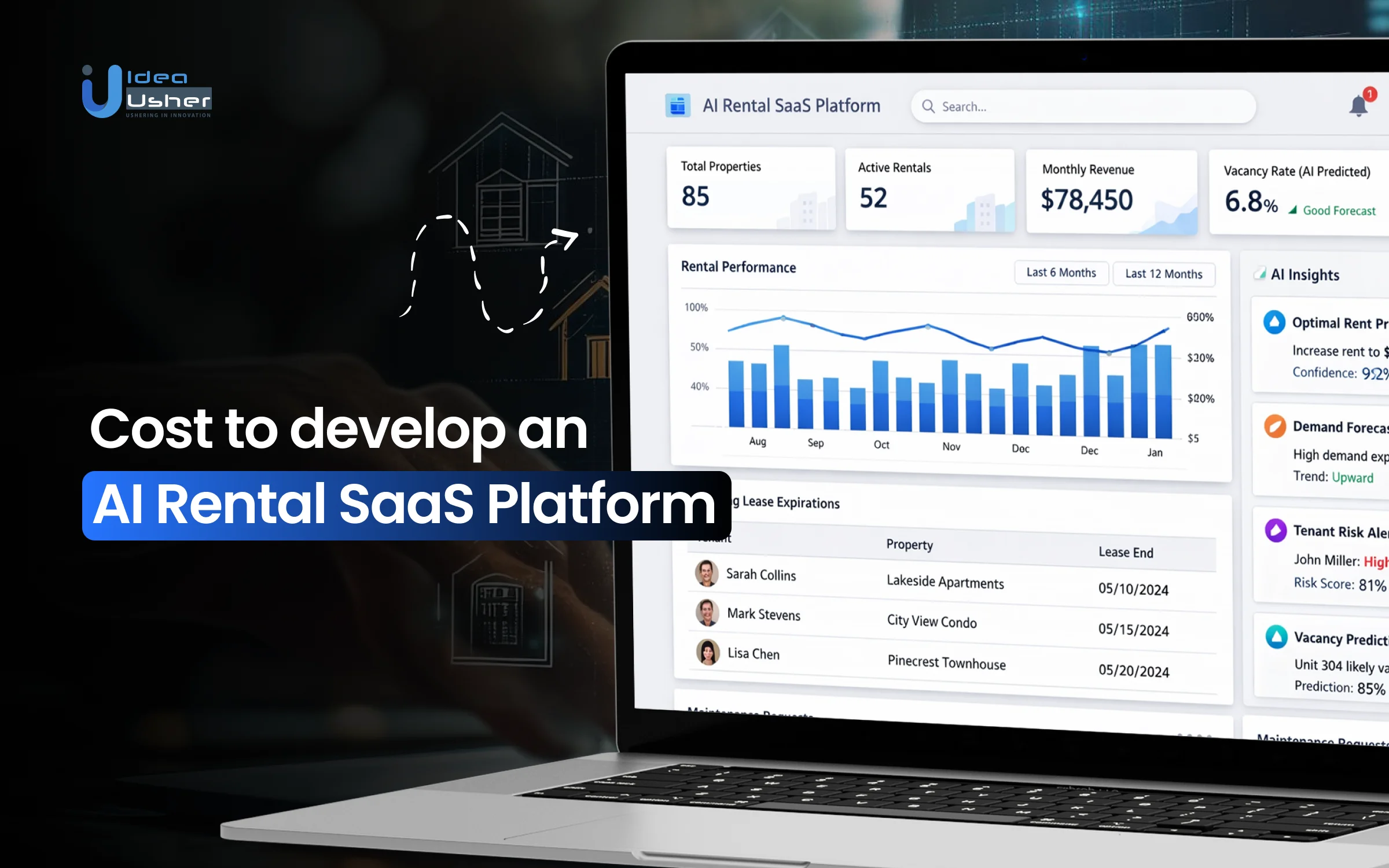
Rental platforms rarely stay focused on a single workflow, expanding from listings or lead management into screening, onboarding, payments, maintenance coordination, analytics, and automation across the rental lifecycle. As functionality accumulates, value shifts from individual features to how much operational ground the platform can cover within one system, which is central to understanding AI rental SaaS platform development costs as intelligence and capability are layered into the product.
As scope expands, features stop behaving independently and start depending on shared data and logic. Search, communication, decision support, and automation must work together without breaking context or consistency. Each added capability raises requirements around data architecture, integrations, permissions, and reliability, making cost less about isolated features and more about the overall density of value delivered through the platform.
In this blog, we break down the cost to develop an AI rental SaaS platform by examining how feature scope, system depth, and long-term product expansion influence development effort, infrastructure planning, and ongoing investment.

What is an AI Rental SaaS Platform?
An AI rental SaaS platform is a cloud-based solution that enables businesses to manage rental inventory, bookings, pricing, and customer interactions online. The provider hosts and maintains all software, security, and updates, allowing companies to scale rapidly and reduce upfront costs.
The platform uses machine learning and predictive analytics to deliver intelligent pricing, personalized experiences, and operational insights that improve occupancy rates and revenue. Investors value its recurring revenue potential, scalability, and AI-driven differentiation in competitive markets.
- Agentic AI workflows automate rental operations like move-ins, lease addendums, and maintenance alerts, reducing overhead and speeding decisions.
- Generative user interfaces adapt dashboards by role, giving managers risk and cash-flow insights while showing tenants personalized listings.
- Predictive maintenance uses IoT sensor data to forecast failures, cutting emergency repair costs by up to 30%.
- Behavioral lead scoring identifies high-intent prospects from user activity, boosting conversion rates by 35–50%.
- Automated fraud detection applies biometric and document analysis to reduce identity and income fraud risks.
- Immersive AI staging enables AR/VR property tours, reducing site visits by up to 60%.
- Dynamic hyper-local pricing adjusts rent in real time based on market signals, lowering pricing errors by up to 30%.
- Neurosymbolic AI blends machine learning with compliance rules to ensure regulatory-safe automation.
Who Benefits Most from Using AI Rental SaaS Platforms?
AI rental SaaS platforms support diverse rental businesses by improving efficiency, pricing accuracy, and scalability across operations, making them valuable.
| Beneficiary Type | How They Benefit | Business Impact |
| Startup founders | Launch rental platforms faster with lower upfront infrastructure investment | Faster time to market and controlled development costs |
| Property managers | Automate bookings, pricing, maintenance, and tenant communication | Reduced operational workload and higher occupancy rates |
| Real estate rental businesses | Optimize pricing and asset utilization using AI-driven insights | Improved revenue consistency and better portfolio performance |
| Equipment rental companies | Track asset availability and predict maintenance needs accurately | Reduced downtime and improved asset lifespan |
| Co-living and short-term rental operators | Manage high booking volume and dynamic pricing efficiently | Increased operational efficiency and faster booking cycles |
| Enterprise rental providers | Enforce compliance, manage complex contracts, and scale across regions | Standardized operations and scalable growth |
How Does an AI Rental SaaS Platform Work?
An AI rental SaaS platform manages the entire rental lifecycle, from onboarding assets to post-rental optimization. It uses AI at key points to automate operations, minimize risk, and enhance profitability.
1. Asset, Business, and Rule Configuration
The platform begins by onboarding rental businesses, assets, and operational rules. Owners configure asset details, availability logic, pricing constraints, legal policies, and regional compliance settings, which create the structured foundation required for AI-driven automation and accurate decision making.
2. Market Intelligence and Demand Modeling
AI engines analyze historical rentals, real-time market signals, competitor pricing, seasonality, and location data. The system builds predictive demand models for each asset, which enable accurate forecasting, utilization planning, and intelligent pricing recommendations across different market conditions.
3. Renter Discovery and Behavioral Analysis
Prospective renters interact with listings through web or mobile applications. The platform tracks behavioral signals such as search intent, feature preferences, and engagement depth. AI models evaluate this data to identify high-intent renters and personalize recommendations in real time.
4. Dynamic Pricing, Screening, and Approval
When a renter initiates a booking, the platform calculates optimal pricing using demand velocity and asset performance data. AI simultaneously performs identity verification, fraud detection, and risk assessment to approve qualified renters while reducing non-payment and compliance risks.
5. Automated Contracts, Payments, and Active Rental Management
The system generates rental agreements and payment schedules automatically. During the rental period, AI agents monitor usage, payment status, and operational conditions, triggering maintenance workflows, alerts, and contract updates without manual intervention.
6. Post-Rental Business Optimization
After rental completion, the platform analyzes revenue performance, asset utilization, renter behavior, and operational costs. AI models use these insights to refine pricing strategies, screening accuracy, and automation rules, which continuously improve profitability and scalability.
Types of Businesses That Use AI Rental SaaS Platforms
AI rental SaaS platforms support a wide range of rental-based business models by automating operations, improving asset utilization, and enabling data-driven decision-making across different industries.
1. Property Management Companies
Property management firms use AI rental SaaS platforms to manage listings, bookings, tenant screening, maintenance workflows, and pricing across multiple properties while improving operational efficiency and occupancy rates.
2. Real Estate Rental Businesses
Residential and commercial rental businesses rely on these platforms to automate leasing, optimize rental pricing, manage contracts, and gain visibility into asset performance across different locations and market conditions.
3. Equipment and Asset Rental Companies
Businesses that rent equipment such as construction tools, vehicles, or machinery use AI rental SaaS platforms to track asset availability, manage scheduling, reduce downtime, and predict maintenance needs.
4. Co-Living and Short-Term Rental Operators
Co-living spaces and short-term rental operators use these platforms to handle frequent bookings, dynamic pricing, tenant communication, and operational coordination across high-turnover rental environments.
5. Vacation Rental and Hospitality Providers
Hospitality-driven rental businesses use AI rental SaaS platforms to personalize guest experiences, optimize seasonal pricing, manage reservations, and streamline operations across multiple properties.
6. Corporate and Enterprise Rental Providers
Large enterprises offering long-term or bulk rentals use these platforms to enforce compliance, manage complex contracts, integrate with internal systems, and scale operations across regions.
Rental Search Apps Are the Preferred Choice for 73% of Renters
The global online home rental market is estimated to be valued at USD 23.32 billion in 2025 and is expected to reach USD 55.92 billion by 2032, exhibiting a CAGR of 13.3% from 2025 to 2032. This growth reflects a steady shift toward digital-first rental experiences, where tenant expectations are increasingly shaped by speed, convenience, and personalization.

Also, according to a survery Renter behavior data shows a clear preference for digital-first discovery, with 73% of renters using rental search apps or websites as their primary tools, followed by apartment community websites (53%) and search engines (46%), reinforcing the growing importance of app- and platform-led rental experiences.
Growing Expectations for Digital-First Rental Experiences
As rental discovery and management move online, tenants now expect the same level of responsiveness and personalization they experience in other consumer apps.
- On-demand access to rental information: Renters increasingly prefer platforms that provide instant answers to availability, pricing, amenities, and policies without waiting for manual responses.
- Preference for guided, low-friction journeys: Complex application processes and unclear next steps reduce engagement, pushing demand toward apps that simplify browsing, inquiries, and applications.
- Experience-driven platform choice: With multiple rental platforms available, tenants are more likely to stay engaged with apps that feel intuitive, responsive, and tailored to their needs.
Why Engagement Metrics Are Shaping the AI Rental App Opportunity
Higher tenant engagement is not just a UX metric it is becoming a key indicator of platform competitiveness and long-term growth potential.
- Stronger engagement leads to higher platform stickiness: Apps that keep tenants active through personalized recommendations and timely interactions see higher repeat usage and longer session times.
- Satisfaction influences landlord and property adoption: Platforms that deliver better tenant experiences are more attractive to property owners, accelerating two-sided marketplace growth.
- Engagement-driven differentiation in a crowded market: As rental apps proliferate, measurable engagement and satisfaction gains create room for new entrants to position themselves competitively.
Key Features of an AI Rental SaaS Platform
AI rental SaaS platforms include core features that support automation, scalability, and intelligent decision-making. These features shape AI rental SaaS platform development and determine the overall technical scope and implementation approach.
1. Multi-Tenant SaaS Architecture
This feature enables a single cloud platform to serve multiple rental businesses with isolated data, configurable workflows, and shared infrastructure, which supports scalable growth, faster onboarding, and recurring SaaS revenue models.
- Enables multiple rental businesses to operate on a single platform while keeping data securely isolated for each tenant.
- Supports rapid client onboarding without duplicating infrastructure or development effort.
- Reduces long-term operational costs by sharing core services across tenants.
- Allows the platform to scale revenue without proportional increases in hosting or engineering resources.
Estimated development cost: $30,000 to $60,000, driven by tenant isolation logic, database partitioning, role segmentation, and scalable cloud architecture design.
2. User Roles and Access Management
This feature defines secure access control across tenants, property managers, admins, and support teams by enforcing role-based permissions, authentication layers, and activity tracking to protect sensitive rental, financial, and identity data.
- Controls access to sensitive data through clearly defined permission levels for each user type.
- Prevents unauthorized actions across bookings, payments, and contract workflows.
- Supports audit trails and accountability for compliance and security reviews.
- Improves usability by tailoring system access to operational responsibilities.
Estimated development cost: $15,000 to $30,000, influenced by authentication flows, permission matrices, security testing, and role-based interface handling.
3. Booking, Scheduling, and Availability Engine
This feature manages real-time asset availability, bookings, extensions, and cancellations through intelligent scheduling logic that synchronizes inventory across locations, prevents conflicts, and ensures accurate revenue capture at scale.
- Synchronizes real-time availability across assets, locations, and time zones.
- Prevents double bookings through automated conflict detection and resolution logic.
- Handles booking modifications such as extensions and cancellations without manual intervention.
- Ensures accurate revenue tracking through consistent availability management.
Estimated development cost: $25,000 to $50,000, based on real-time synchronization, conflict resolution logic, calendar management, and performance optimization.
4. 24/7 Virtual Maintenance Concierge
This feature uses AI-driven automation to receive maintenance requests, assess urgency, route tasks, and notify service teams instantly, which enables proactive asset care and continuous operational support without manual intervention.
- Receives maintenance requests at any time through automated channels.
- Assesses issue urgency using predefined rules and AI-driven classification.
- Routes tasks to appropriate service teams or vendors automatically.
- Reduces downtime by initiating maintenance actions without human delays.
Estimated development cost: $35,000 to $70,000, driven by conversational AI workflows, ticket prioritization logic, system integrations, and automation testing.
5. Automated Contract and Lease Management
This feature automates the creation, execution, renewal, and modification of rental agreements using predefined legal rules and templates, which reduces administrative errors and accelerates customer onboarding and compliance workflows.
- Generates rental agreements using predefined legal and business rules.
- Updates contracts automatically when pricing, duration, or policies change.
- Maintains version control and audit history for compliance purposes.
- Reduces administrative workload across renewals and addendums.
Estimated development cost: $20,000 to $40,000, influenced by document templates, rule-based automation, version control, and compliance validation logic.
6. Dynamic Pricing and Demand Forecasting Engine
This feature applies machine learning models to analyze demand patterns, occupancy trends, and market signals in order to optimize rental pricing dynamically and improve asset revenue performance.
- Analyzes real-time demand signals and historical rental performance.
- Adjusts pricing dynamically to reflect occupancy trends and market conditions.
- Reduces revenue leakage caused by static or outdated pricing rules.
- Supports strategic decision-making through data-driven pricing insights.
Estimated development cost: $45,000 to $90,000, driven by machine learning model development, data pipelines, pricing logic, and continuous model tuning.
7. Behavioral Lead Scoring and Personalization
This feature analyzes renter behavior such as search activity, engagement depth, and interaction patterns to score lead intent and deliver personalized listings, recommendations, and offers that improve conversion efficiency.
- Tracks renter behavior such as search activity and engagement depth.
- Identifies high-intent prospects using predictive scoring models.
- Personalizes listings and recommendations based on user preferences.
- Improves conversion rates while reducing sales and marketing inefficiencies.
Estimated development cost: $30,000 to $60,000, influenced by behavioral tracking, scoring algorithms, personalization logic, and AI model training.
8. Fraud Detection and Identity Verification
This feature leverages AI-based document analysis, biometric verification, and risk scoring to validate renter identities and detect fraudulent behavior before booking approval and payment processing.
- Reduces non-payment and fraud exposure
- Validates renter identities using automated document analysis.
- Detects fraudulent behavior through AI-driven risk scoring.
- Reduces non-payment and compliance risks before booking approval.
- Strengthens platform trust for rental businesses and end users.
Estimated development cost: $40,000 to $80,000, driven by AI document analysis, biometric verification, third-party integrations, and security validation.
AI Rental SaaS Platform Development Cost
The AI rental SaaS platform development cost varies based on feature scope, AI complexity, integrations, and scalability requirements. Understanding these variables helps businesses estimate investment needs with greater clarity and confidence.

Phase 1: Product Strategy and Technical Planning
Our developers consult with you to define the platform vision, target users, core workflows, and technical scope. The team validates business goals, identifies AI use cases, selects the technology stack, and documents functional and non-functional requirements to avoid rework in later phases.
| Activity | Description | Estimated Cost |
| Product discovery workshops | Define business goals, user personas, and success metrics | $4,000 to $7,000 |
| Feature and scope definition | Finalize MVP and future phase features | $3,000 to $6,000 |
| AI feasibility assessment | Identify viable AI models and data requirements | $4,000 to $8,000 |
| Technical architecture planning | Design system architecture and tech stack | $3,000 to $6,000 |
| Compliance and risk analysis | Identify regulatory, security, and data risks | $2,000 to $4,000 |
Estimated Cost for Phase 1: $16,000 to $31,000
This phase requires senior-level expertise to define product direction, AI scope, and architecture, which helps control AI rental SaaS platform development cost by reducing risk and avoiding costly changes.
Key Takeaways
- This phase establishes a clear roadmap for development and investment.
- Early AI and architecture decisions significantly influence total platform cost.
- Proper planning reduces timeline overruns and feature misalignment.
- Skipping this phase often leads to rework, budget overruns, and scalability issues.
Phase 2: UX Design and System Architecture
Our designers and engineers translate product requirements into user journeys, interface designs, and system blueprints. The team designs intuitive user experiences, defines data flows, and finalizes backend architecture to ensure scalability, security, and performance across all platform modules.
| Activity | Description | Estimated Cost |
| User journey mapping | Define user flows for tenants, managers, and admins | $3,000 to $6,000 |
| UI and UX design | Create wireframes, prototypes, and design systems | $6,000 to $12,000 |
| Information architecture | Structure navigation, data hierarchy, and workflows | $3,000 to $5,000 |
| Backend system architecture | Finalize databases, services, and infrastructure design | $5,000 to $9,000 |
| API and integration planning | Define integration points and data exchange logic | $3,000 to $6,000 |
Estimated Cost for Phase 2: $20,000 to $38,000
This phase demands detailed design and architectural precision to control AI rental SaaS platform development cost by avoiding usability issues, performance bottlenecks, and expensive rework.
Key Takeaways
- Strong UX design directly impacts platform adoption and retention.
- Early architecture decisions determine scalability and long-term maintenance cost.
- Clear workflows reduce development complexity in later phases.
- This phase aligns user experience goals with technical feasibility.
Phase 3: Core SaaS Platform Development
Our developers build the foundational SaaS platform by implementing multi-tenant architecture, user management, booking workflows, payment processing, and core APIs. The team focuses on performance, security, and reliability to support real-world rental operations at scale.
| Activity | Description | Estimated Cost |
| Multi-tenant platform setup | Implement tenant isolation and shared infrastructure | $8,000 to $15,000 |
| User authentication and roles | Build secure login, permissions, and access controls | $5,000 to $9,000 |
| Booking and availability engine | Develop real-time scheduling and conflict resolution | $8,000 to $14,000 |
| Payment and subscription system | Integrate payments, billing, and invoicing workflows | $6,000 to $12,000 |
| Core API and backend services | Build scalable backend logic and service communication | $7,000 to $13,000 |
Estimated Cost for Phase 3: $34,000 to $63,000
This phase represents the largest engineering effort because it establishes the operational backbone that supports every AI feature, workflow, and user interaction.
Key Takeaways
- This phase transforms designs into a functional, market-ready platform.
- Core SaaS stability determines future scalability and feature expansion.
- Strong backend foundations reduce performance and security risks.
- Rushing this phase often leads to technical debt and higher long-term costs.
Phase 4: AI Model Development and Integration
Our AI engineers and developers design, train, and integrate machine learning models that power dynamic pricing, lead scoring, fraud detection, and predictive maintenance. The team builds data pipelines, connects AI outputs to platform workflows, and ensures reliable real-time decision making.
| Activity | Description | Estimated Cost |
| Data pipeline setup | Collect, clean, and structure data for AI models | $6,000 to $12,000 |
| Pricing and demand models | Develop and train dynamic pricing algorithms | $8,000 to $16,000 |
| Behavioral analytics models | Build lead scoring and personalization logic | $7,000 to $14,000 |
| Fraud detection and verification | Implement AI-based identity and risk assessment | $8,000 to $15,000 |
| AI workflow integration | Connect AI outputs with platform automation | $6,000 to $12,000 |
Estimated Cost for Phase 4: $35,000 to $69,000
This phase involves advanced AI development, data engineering, and testing, which increases complexity but delivers long-term automation, revenue optimization, and competitive advantage.
Key Takeaways
- AI features create differentiation and defensibility for the platform.
- Data quality directly impacts AI accuracy and business outcomes.
- Proper integration ensures AI decisions translate into real actions.
- This phase significantly influences long-term operational efficiency and ROI.
Phase 5: Testing, Security, and Compliance Validation
Our developers validate platform stability, AI accuracy, and system security through structured testing and compliance checks. The team identifies performance issues, fixes vulnerabilities, and ensures regulatory readiness before public release or enterprise onboarding.
| Activity | Description | Estimated Cost |
| Functional and regression testing | Validate platform features, workflows, and integrations for consistent behavior | $6,000 to $10,000 |
| AI model validation and accuracy testing | Verify reliability and business alignment of AI outputs | $5,000 to $9,000 |
| Security testing and vulnerability assessment | Identify and fix security gaps across the platform | $6,000 to $12,000 |
| Compliance validation and audit preparation | Confirm data handling and consent workflows meet regulations | $4,000 to $8,000 |
| Performance and load testing | Test system stability under high usage and data volume | $5,000 to $9,000 |
Estimated Cost for Phase 5: $26,000 to $48,000
This phase protects the platform from security risks, compliance failures, and performance issues that can delay launch or damage business credibility.
Key Takeaways
- Testing ensures platform reliability before market exposure.
- Security validation protects user data and business trust.
- Compliance readiness reduces legal and operational risk.
- Performance testing prepares the platform for real-world usage at scale.
Phase 6: Deployment, Launch, and Scaling Preparation
Our developers prepare the platform for production by deploying it to a live cloud environment, configuring monitoring and backups, and optimizing performance for real users. The team ensures smooth launch execution, stability, and readiness for user growth.
| Activity | Description | Estimated Cost |
| Production deployment setup | Deploy the platform to live cloud infrastructure | $4,000 to $7,000 |
| DevOps and monitoring configuration | Set up logging, alerts, and performance monitoring | $5,000 to $9,000 |
| Scalability and performance optimization | Optimize services to handle increasing user and data load | $6,000 to $11,000 |
| Backup and disaster recovery setup | Configure automated backups and recovery processes | $3,000 to $6,000 |
| Launch support and stabilization | Monitor system behavior and resolve post-launch issues | $4,000 to $8,000 |
Estimated Cost for Phase 6: $22,000 to $41,000
This phase ensures production stability and scalability, which helps manage AI rental SaaS platform development cost by preventing downtime, performance degradation, and expensive post-launch disruptions.
Key Takeaways
- Proper deployment reduces launch-related risks and failures.
- Monitoring and alerts enable rapid issue resolution.
- Scalability preparation supports future growth without reengineering.
- A stable launch builds early customer trust and confidence.
Total Development Cost Breakdown
The total AI rental SaaS platform development cost depends on product scope, AI depth, scalability requirements, and go-to-market strategy, with budgets varying significantly between MVP, mid-scale, and full-scale implementations.
| Build Type | Platform Scope | Total Estimated Cost |
| MVP | Core SaaS features, limited AI models, basic automation, and essential integrations | $67,000 to $115,000 |
| Mid-Scale Platform | Advanced AI features, automation workflows, analytics, and multi-market readiness | $120,000 to $200,000 |
| Full-Scale Platform | Enterprise-grade AI, autonomous workflows, compliance layers, and global scalability | $220,000 to $320,000 |
Note: These estimated costs vary by features, AI complexity, integrations, compliance, and timeline. Early planning and phased development help control costs and boost scalability and ROI.
Consult with IdeaUsher to receive a tailored cost estimate and development roadmap aligned with your business goals, target market, and growth strategy.
Ongoing and Post-Launch Costs of an AI Rental SaaS Platform
After AI rental SaaS platform development, continuous investment is required to maintain performance, security, and competitiveness. These ongoing costs support system reliability, AI accuracy, and business scalability over time.
1. Cloud Infrastructure and Hosting Costs
Cloud infrastructure costs cover servers, databases, storage, and content delivery networks required to run the platform reliably. As user volume, data processing, and AI workloads grow, infrastructure spending increases proportionally.
2. AI Model Maintenance and Retraining
AI models require ongoing retraining, performance monitoring, and data updates to maintain accuracy and relevance. These costs grow as the platform processes more behavioral, pricing, and operational data across expanding markets.
3. Platform Maintenance and Feature Enhancements
Ongoing maintenance includes bug fixes, performance optimization, and incremental feature improvements. Regular updates help prevent technical debt, support new business requirements, and maintain competitive positioning in evolving rental markets.
4. Security Monitoring and Compliance Management
Security and compliance costs cover continuous monitoring, vulnerability management, audit readiness, and regulatory updates. These efforts protect sensitive user data and ensure adherence to evolving data protection and industry regulations.
5. Third-Party Services and API Usage
Third-party costs include payment gateways, identity verification services, analytics tools, and communication APIs. Usage-based pricing models cause these expenses to rise as transaction volume and user engagement increase.
6. Customer Support and Operational Management
Post-launch operations require dedicated resources for customer support, system monitoring, and issue resolution. These costs ensure platform reliability, user satisfaction, and consistent service quality as the user base grows.
Design Decisions That Shape the Long-Term Cost of AI Rental SaaS Platforms
Early design decisions directly influence AI rental SaaS platform development cost, scalability, and operational efficiency throughout the platform lifecycle. Founders who evaluate these choices early avoid reengineering expenses and maintain predictable growth paths.
1. Architecture Choices and Scalability Planning
The decision to adopt a modular, cloud-native architecture determines how easily the platform scales. Well-structured services reduce future redevelopment costs and support faster feature expansion as usage grows.
2. Depth of AI Integration
Choosing between basic automation and advanced AI-driven decision systems impacts both initial and ongoing costs. Deeper AI integration increases development effort but delivers stronger long-term efficiency and revenue optimization.
3. Data Strategy and Ownership
Designing a clear data collection, storage, and governance strategy affects AI accuracy and compliance costs. Early investment in clean data pipelines reduces retraining overhead and improves model performance over time.
4. Security and Compliance by Design
Embedding security and compliance into the platform architecture lowers future remediation costs. Early implementation prevents costly audits, retrofits, and operational disruptions as regulations evolve.
5. Feature Phasing and Product Roadmap
Phasing features based on business priorities helps manage budget and risk. A disciplined roadmap ensures each release delivers measurable value without overextending development resources.
Conclusion
Building an AI rental SaaS platform is not just about features; it is about making smart choices that match your business goals and budget. The AI rental saas platform development cost depends on factors like automation level, data requirements, security standards, and future scalability. Every decision, from core functionality to user experience, shapes the final investment. Planning early helps control expenses and avoid unnecessary complexity. When you clearly define your priorities, you can create a solution that delivers real value while staying financially practical and aligned with long-term growth objectives for your business.
Why Choose IdeaUsher for AI Rental App Development?
IdeaUsher helps businesses create smart rental apps that improve user experience and operational efficiency. From intelligent recommendations to automated support, we build solutions that align with modern rental market demands.
Why Work With Our Team?
- AI Expertise: We integrate advanced AI features to optimize booking, pricing, and customer interactions.
- Tailored Approach: Our developers craft apps based on your business model and target audience.
- Reliable Performance: We focus on building secure, high-performing apps that scale with growth.
- End-to-End Support: From planning to post-launch support, we ensure smooth execution.
Browse our portfolio to see how we’ve helped brands bring their app ideas to life.
Reach out for a free consultation and start building your AI rental app with confidence.


FAQs
Developing an AI rental SaaS platform typically costs between $67,000 to $115,000. The final price depends on platform complexity, AI capabilities, user roles, data security features, and scalability requirements.
Advanced features like predictive analytics, dynamic pricing, automated tenant screening, payment gateways, CRM integration, and real-time reporting significantly increase development costs due to added engineering and testing requirements.
Yes, AI integration increases costs because it requires data modeling, machine learning training, cloud infrastructure, and continuous optimization. However, it adds long-term value by automating operations and improving user experience.
You can reduce costs by launching a lean MVP, using no-code tools, adopting cloud-based services, and prioritizing essential features first. Iterative development helps validate market demand before scaling the platform.


