 (+971) 8007 4267
 (+91) 946 340 7140
 (+1) 628 432 4305

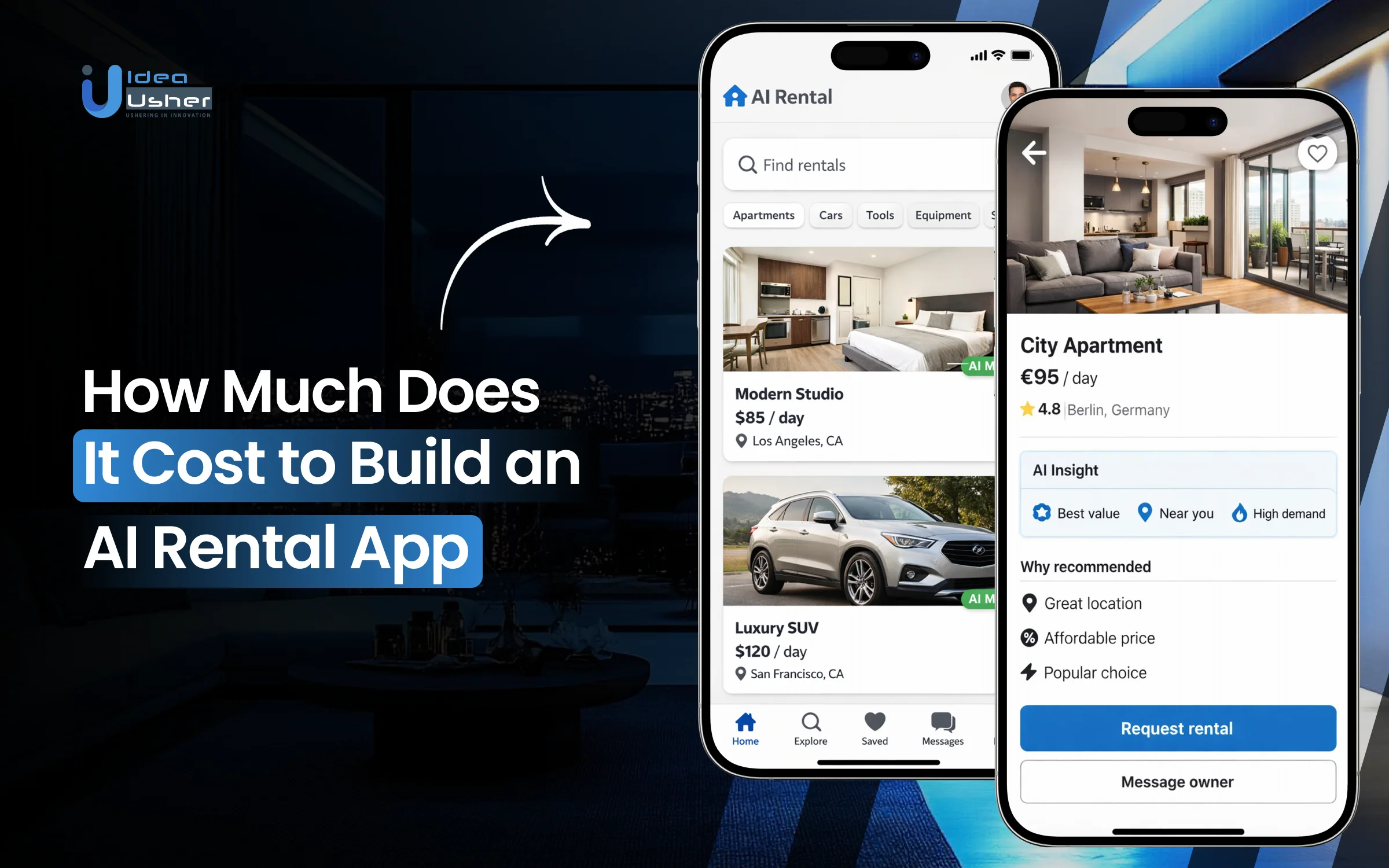
AI rental apps are increasingly expected to handle search, communication, screening, and ongoing renter interactions within a single system. Delivering this level of intelligence requires more than a chat interface or basic automation. Once real-world data, integrations, and operational workflows come into play, estimating the AI rental app development cost becomes a question of scope, system complexity, and execution depth rather than a simple build estimate.
Beyond initial development, execution realities quickly influence budget planning. An AI rental app must integrate with property listings, tenant data, payment systems, and maintenance workflows while maintaining reliability at scale. Ongoing expenses such as model tuning, infrastructure scaling, monitoring, and support often exceed early projections, especially for apps built for long term use in real-world environments.
In this blog, we explain how much it costs to build an AI rental app by breaking down the key cost drivers, development components, and operational factors that influence budgeting for a scalable and production-ready solution.

What Is an AI Rental App?
An AI rental app is a digital platform that uses artificial intelligence to automate and enhance rental-related interactions between property owners, managers, and renters. It supports tasks such as renter inquiries, property discovery, communication, and decision-making through intelligent, data-driven workflows.
Unlike traditional rental applications, an AI rental app adapts to user behavior, responds in real time, and reduces manual effort across rental operations. It combines automation, conversational interfaces, and data analysis to deliver faster responses, improved renter experience, and more efficient rental management at scale.
- Uses behavioral data to continuously refine renter interactions by analyzing search patterns, inquiries, and responses, allowing the app to deliver more relevant and accurate experiences over time.
- Operates as an always-available digital interface that responds instantly to renter actions, ensuring consistent engagement and support beyond traditional business hours.
- Learns from historical rental data to improve property matching, pricing guidance, and response accuracy, helping renters and property managers make better decisions.
- Reduces friction across the renter journey by automating repetitive tasks such as inquiries and follow-ups, creating smoother interactions and faster outcomes.
- Scales efficiently across multiple properties and locations by centralizing data, workflows, and AI logic within a single, unified platform.
How AI Rental Apps Are Different from Traditional Rental Apps?
AI rental apps differ from traditional rental apps by using intelligent automation, predictive insights, and personalized interactions instead of manual workflows. This comparison highlights how AI enhances efficiency, decision-making, and user experience across the rental lifecycle.
| Aspect | Traditional Rental App | AI Rental App |
| Core functionality | Operates on fixed logic and predefined workflows that require manual setup and ongoing human intervention to function correctly. | Uses artificial intelligence to automate workflows, interpret data, and adjust behavior dynamically based on real-world rental interactions. |
| User interaction | Depends heavily on property managers or support teams to respond to renter inquiries and actions, often with delays. | Engages renters instantly through intelligent, context-aware responses that adapt to user intent and interaction history. |
| Decision-making | Follows static rules that do not evolve unless manually updated by the development or operations team. | Continuously learns from renter behavior, historical data, and outcomes to improve recommendations and interaction quality. |
| Operational effort | Requires significant manual effort to manage inquiries, updates, and follow-ups as rental activity increases. | Automates repetitive rental tasks, reducing operational workload and allowing teams to focus on higher-value activities. |
| Scalability | Becomes more complex and costly to manage as the number of properties, listings, or users grows. | Scales efficiently by applying the same AI logic across multiple properties and locations without proportional increases in effort. |
| Experience consistency | User experience varies depending on team availability, response quality, and operational capacity. | Delivers consistent, reliable experiences across all renter touchpoints regardless of time, volume, or location. |
How AI Rental Apps Are Transforming the Rental Market?
AI rental apps are transforming rental businesses and customer experiences by boosting efficiency, lowering costs, and streamlining operations. Here’s how AI is changing the rental market.

1. Smarter Search and Personalized Discovery
AI rental apps analyze user behavior with machine learning, recommending relevant rentals. This shortens search time and boosts bookings, helping customers find options faster and rental businesses close more deals with less effort.
2. Dynamic Pricing and Revenue Optimization
AI allows rental apps to adjust prices in real time based on demand, seasonality, availability, and competitor data. The system assesses market conditions and suggests optimal prices. This helps rental businesses maximize revenue and stay competitive, while customers see fair market pricing.
3. Automated Booking and Inventory Management
AI-powered systems automatically manage inventory by tracking availability, preventing overbooking, and updating listings in real time. This automation reduces errors and saves costs, allowing rental businesses to handle large inventories efficiently without growing their team.
4. Predictive Maintenance and Asset Protection
AI rental apps analyze usage and maintenance data to predict servicing needs, alert operators before breakdowns, reduce downtime, extend asset lifespan, lower costs, and enhance customer satisfaction by avoiding last-minute cancellations.
5. Fraud Detection and Secure Transactions
AI algorithms monitor user behavior and transactions to detect suspicious activity, flag potential fraud early, and protect rental platforms from chargebacks, fake bookings, and identity misuse. This enhances customer confidence in a secure app.
6. Improved Customer Support with AI Assistants
AI chatbots and virtual assistants handle common customer questions like availability, pricing, booking status, and policies, providing instant, 24/7 responses. This reduces service costs while maintaining quality, letting human agents focus on complex, personal issues.
Rental Search Apps Are the Preferred Choice for 73% of Renters
The global online home rental market is estimated to be valued at USD 23.32 billion in 2025 and is expected to reach USD 55.92 billion by 2032, exhibiting a CAGR of 13.3% from 2025 to 2032. This growth reflects a steady shift toward digital-first rental experiences, where tenant expectations are increasingly shaped by speed, convenience, and personalization.

Following this market growth trend, renter behavior data shows a clear preference for digital-first discovery, with 73% of renters using rental search apps or websites as their primary tools, followed by apartment community websites (53%) and search engines (46%), reinforcing the growing importance of app- and platform-led rental experiences.
Growing Expectations for Digital-First Rental Experiences
As rental discovery and management move online, tenants now expect the same level of responsiveness and personalization they experience in other consumer apps.
- On-demand access to rental information: Renters increasingly prefer platforms that provide instant answers to availability, pricing, amenities, and policies without waiting for manual responses.
- Preference for guided, low-friction journeys: Complex application processes and unclear next steps reduce engagement, pushing demand toward apps that simplify browsing, inquiries, and applications.
- Experience-driven platform choice: With multiple rental platforms available, tenants are more likely to stay engaged with apps that feel intuitive, responsive, and tailored to their needs.
Why Engagement Metrics Are Shaping the AI Rental App Opportunity?
Higher tenant engagement is not just a UX metric it is becoming a key indicator of platform competitiveness and long-term growth potential.
- Stronger engagement leads to higher platform stickiness: Apps that keep tenants active through personalized recommendations and timely interactions see higher repeat usage and longer session times.
- Satisfaction influences landlord and property adoption: Platforms that deliver better tenant experiences are more attractive to property owners, accelerating two-sided marketplace growth.
- Engagement-driven differentiation in a crowded market: As rental apps proliferate, measurable engagement and satisfaction gains create room for new entrants to position themselves competitively.
How Much Does It Cost to Build an AI Rental App?
Building an AI rental app involves multiple factors, including features, platform choice, and AI capabilities that influence development cost. This section outlines key pricing elements to help readers understand the investment scope.

Phase 1: Strategy, Consultation, and Architecture Planning
Our developers and solution architects collaborate with you to define the business vision, validate AI use cases, and establish a strong technical foundation. We convert your rental business goals into a clear platform strategy and scalable architecture that supports long-term growth and controlled development costs.
| Activity | Scope | Estimated Cost |
| Business Requirement Analysis | Define rental workflows, user roles, and revenue model | $2,000 – $3,000 |
| Technical Consultation | Validate AI feasibility and system-level technical decisions | $1,500 – $2,500 |
| Platform Architecture Design | Design scalable system architecture and data flow structure | $2,500 – $4,000 |
| Technology Stack Selection | Choose frameworks, databases, AI tools, and cloud services | $1,000 – $2,000 |
| Project Roadmap and Documentation | Create timelines, milestones, and structured development documentation | $1,000 – $1,500 |
Estimated Cost for Phase 1: $8,000 – $13,000
The final AI rental app development cost depends on the complexity of the rental model, the number of AI-driven features, and the expected user scale. Investing in structured planning helps prevent architectural changes that typically increase costs during development and scaling.
Key Takeaways from Phase 1
- Strategic planning reduces the risk of architectural changes that often increase development time and overall project cost during later phases.
- Architecture decisions influence how efficiently AI models process data, scale with user growth, and maintain consistent performance.
- Clear documentation helps development teams work faster, avoid misalignment, and maintain better control over timelines and budgets.
- Early AI validation ensures the platform invests only in feasible AI features that deliver measurable business value.
Phase 2: UI UX Design and Prototyping
Our UI UX designers work closely with you to craft intuitive user journeys that simplify browsing, booking, and rental management. We design visually consistent interfaces and interactive prototypes that reflect your brand while improving usability, engagement, and conversion rates.
| Activity | Scope | Estimated Cost |
| User Research and Persona Definition | Analyze target users, behaviors, and rental interaction patterns | $1,500 – $2,500 |
| User Journey and Wireframe Design | Map user flows and design low-fidelity wireframes | $2,000 – $3,000 |
| UI Visual Design | Create high-fidelity screens aligned with brand identity | $2,500 – $4,000 |
| Interactive Prototyping | Build clickable prototypes for usability validation | $1,500 – $2,500 |
| Design Validation and Iterations | Refine designs based on stakeholder and user feedback | $1,000 – $1,500 |
Estimated Cost for Phase 2: $8,500 – $14,500
The AI rental app development cost varies based on the number of user roles, screen complexity, and level of design customization. Investing in strong UI/UX design reduces development rework, improves user adoption, and increases long-term revenue potential.
Key Takeaways from Phase 2
- Well-designed user journeys reduce friction and improve booking conversions across the platform.
- Interactive prototypes help validate ideas early and prevent costly design changes during development.
- Consistent UI design strengthens brand trust and improves overall user satisfaction.
- Early usability testing lowers support costs by addressing user issues before launch.
Phase 3: Rental App Development and Integrations
Our developers build the core rental application by turning approved designs into a functional platform. We develop essential rental features, integrate third-party services, and ensure smooth interactions between users, assets, and transactions across the system.
| Activity | Scope | Estimated Cost |
| Frontend App Development | Build responsive user interfaces for web and mobile platforms | $6,000 – $10,000 |
| Backend Development | Develop business logic, APIs, and rental management workflows | $7,000 – $12,000 |
| Admin Panel Development | Create dashboards for listings, bookings, and user management | $3,000 – $5,000 |
| Third-Party Integrations | Integrate payments, notifications, maps, and analytics services | $3,000 – $5,000 |
| Database Setup and Optimization | Structure and optimize databases for rental and user data | $2,000 – $3,000 |
Estimated Cost for Phase 3: $21,000 – $35,000
This phase represents the largest AI rental app development cost segment due to full-scale application development. Costs vary based on complexity, integrations, and platform support. A strong core app ensures stability, performance, and future AI feature expansion.
Key Takeaways from Phase 3
- Core development establishes the functional backbone of the AI rental platform.
- Backend architecture directly impacts performance, scalability, and future AI integration.
- Third-party integrations add convenience but increase development and testing effort.
- A stable core application reduces technical debt and lowers long-term maintenance costs.
Phase 4: AI Model Development and Implementation
Our AI engineers build the intelligence layer that powers personalization, pricing decisions, demand forecasting, and smart discovery across your rental platform. We design custom machine learning models aligned with your rental workflows, user behavior, and business goals to ensure AI delivers measurable value at scale.
| Activity | Scope | Estimated Cost |
| AI Strategy and Feature Mapping | Define AI-driven workflows for pricing, discovery, and demand | $3,000 – $5,000 |
| Data Pipeline and Feature Engineering | Structure, clean, and transform data for model training | $6,000 – $9,000 |
| Custom Model Development | Build tailored models for recommendations and dynamic pricing | $10,000 – $16,000 |
| Model Training and Evaluation | Train models and validate accuracy using real rental data | $5,000 – $8,000 |
| AI Workflow Integration | Embed AI outputs into booking, search, and pricing systems | $5,000 – $7,000 |
Estimated Cost for Phase 4: $29,000 – $45,000
This phase significantly influences the AI rental app development cost, as it requires specialized AI engineers, longer development timelines, and iterative testing cycles, with costs varying based on data volume, prediction complexity, and personalization depth.
Key Takeaways from Phase 4
- AI models form the decision-making backbone that drives pricing, discovery, and demand prediction.
- Data preparation and feature engineering directly influence model accuracy and performance.
- Custom-built AI solutions deliver higher business value than generic third-party AI tools.
- Proper AI integration ensures intelligent decisions without impacting platform speed or stability.
Phase 5: Testing, Security, and Compliance
Our quality assurance engineers and security specialists ensure the rental platform performs reliably, protects user data, and meets industry compliance standards. We validate functionality, secure AI workflows, and identify risks before the platform reaches real users.
| Activity | Scope | Estimated Cost |
| Functional and Regression Testing | Verify core features, workflows, and system stability | $3,000 – $5,000 |
| Performance and Load Testing | Test scalability under high user and transaction loads | $2,500 – $4,000 |
| AI Model Validation Testing | Validate AI predictions, accuracy, and response consistency | $2,000 – $3,500 |
| Security Testing and Hardening | Identify vulnerabilities and implement security best practices | $3,000 – $5,000 |
| Compliance Review and Data Protection | Ensure compliance with data privacy and security regulations | $2,000 – $3,000 |
Estimated Cost for Phase 5: $12,500 – $20,500
Testing and security in overall AI rental app development cost vary based on platform complexity, data sensitivity, and regulatory requirements, but investing early helps prevent data breaches, system failures, and expensive post-launch fixes.
Key Takeaways from Phase 5
- Thorough testing ensures platform stability and consistent user experience at scale.
- Security validation protects sensitive user, payment, and AI-generated data.
- AI-specific testing ensures predictions remain accurate and reliable in real usage.
- Compliance readiness prevents legal risks and costly post-launch modifications.
Phase 6: Launch, Monitoring, and Scaling
Our deployment specialists prepare your AI rental app for a smooth market launch and long-term growth. We handle production deployment, monitor system performance, and optimize infrastructure to support increasing users, data, and AI workloads.
| Activity | Scope | Estimated Cost |
| Production Deployment Setup | Configure servers, databases, and live environment | $2,000 – $3,500 |
| App Store and Platform Launch | Prepare builds, listings, and release management | $1,500 – $2,500 |
| Monitoring and Analytics Setup | Track performance, usage, and AI behavior | $2,000 – $3,000 |
| Post-Launch Optimization | Optimize performance based on real user data | $3,000 – $5,000 |
| Scalability and Infrastructure Planning | Plan cloud scaling and cost optimization strategies | $2,000 – $3,500 |
Estimated Cost for Phase 6: $10,500 – $17,500
Launch and scaling costs depend on user acquisition speed, infrastructure usage, and AI processing demands. Proactive monitoring and optimization help control cloud expenses and maintain platform stability as the business grows.
Key Takeaways from Phase 6
- A structured launch process reduces downtime and post-release issues.
- Continuous monitoring ensures platform stability and AI performance.
- Post-launch optimization improves user experience and operational efficiency.
- Scalable infrastructure planning prevents unexpected cost spikes during growth.
Total Estimated Cost of an AI Rental App Development
The overall AI rental app development cost depends on platform scope, AI depth, and scalability requirements. Below is a high-level cost estimate based on different stages of business growth.
| Project Type | Capabilities | Estimated Cost |
| MVP AI Rental App | Core rental listings, booking flow, basic search, admin panel, limited AI recommendations | $70,000 – $100,000 |
| Mid-Scale AI Rental App | Advanced search, dynamic pricing, personalized recommendations, integrations, scalable backend | $110,000 – $160,000 |
| Full-Scale AI Rental App | Custom AI models, predictive analytics, enterprise security, automation, multi-region scalability | $180,000 – $250,000+ |
Note: Actual costs depend on rental category complexity, AI training needs, data volume, and performance goals. A phased development approach enables faster launch while managing investment efficiently.
Consult IdeaUsher for a detailed cost breakdown aligned with your business goals. Our team helps define scope, prioritize AI investments, and build a scalable, future-ready AI rental platform.
Key Factors That Influence the Cost of an AI Rental App
Several technical and business-specific factors directly impact the AI rental app development cost. Understanding these variables helps founders and decision-makers plan realistic budgets and prioritize the right investments.

1. AI Model Complexity and Customization Level
AI sophistication level affects development costs; basic engines are cheaper, while custom models for pricing and forecasting need more data, training, and optimization. Highly customized AI requires specialized engineers and longer cycles, increasing costs but offering stronger competitive advantages.
2. Data Availability and Data Quality
AI systems rely on data. Platforms with clean, structured, sufficient data reduce data prep and training time. When data is limited or unstructured, teams spend more time on collection, cleaning, and feature engineering, increasing costs.
3. Rental Business Model and Asset Complexity
The rental business type affects development and AI costs, with short-term, subscription, or high-value assets needing different workflows, pricing, and compliance. Complex rules and tracking raise backend complexity, testing, and AI decision complexity.
4. Number of Platforms and User Roles
The app for web, iOS, and Android raises AI rental app development cost and development time due to the need for testing, optimization, and performance tuning on each platform. Multiple user roles like renters, owners, vendors, and admins add complexity to access, dashboards, and features.
5. Third-Party Integrations and External Services
Integrations with payment gateways, mapping services, identity verification tools, analytics platforms, and CRM systems add value but raise development and maintenance costs. Custom or region-specific integrations need more testing and security validation, affecting the budget.
6. Scalability and Infrastructure Requirements
AI rental apps must manage expanding user bases, data, and AI demands. Building scalable cloud systems needs careful planning and higher initial costs. Such platforms often have higher upfront expenses but prevent costly infrastructure changes later.
Common Misconceptions About AI Rental App Development Costs
Many businesses hesitate to invest in AI rental apps due to incorrect assumptions about development costs. Clarifying these misconceptions helps founders plan realistic budgets and make informed decisions.
1. AI Rental Apps Are Always Expensive
AI rental app costs vary based on scope and implementation strategy. Businesses can start with focused AI features and expand gradually, which keeps initial investment manageable while still delivering measurable operational and revenue benefits.
2. Off-the-Shelf AI Tools Are Enough
Prebuilt AI tools often fail to address rental-specific workflows such as dynamic pricing and availability forecasting. Custom AI development may cost more initially but delivers higher accuracy, flexibility, and long-term value.
3. AI Requires a Huge Amount of Data
AI systems can start with limited datasets and improve over time. Development teams design models that learn continuously, allowing platforms to launch early while refining predictions as real user and rental data grows.
4. Building an AI MVP Costs Same as a Full-Scale Platform
An AI MVP focuses on essential features and basic intelligence. Full-scale platforms include advanced automation, security, and scalability, which significantly increases cost. Phased development helps control investment at each stage.
5. AI Development Costs End After Platform Launch
AI rental apps require ongoing monitoring, model retraining, and performance optimization. These post-launch investments ensure accuracy and reliability, preventing long-term revenue loss caused by outdated or underperforming AI models.
Conclusion
Understanding how much it costs to build an AI rental app comes down to the features, technology stack, and level of customization required. The AI rental app development cost varies based on automation needs, platform choice, and integration complexity. Whether the focus is smart recommendations, chat support, or seamless booking, each component shapes the final budget. Planning ahead helps avoid unexpected expenses and ensures better return on investment. With a clear strategy, businesses can build a reliable solution that meets user expectations and supports long term growth without compromising quality or performance.
Why Choose IdeaUsher for AI Rental App Development?
IdeaUsher helps businesses create smart rental apps that improve user experience and operational efficiency. From intelligent recommendations to automated support, we build solutions that align with modern rental market demands.
Why Work With Our Team?
- AI Expertise: We integrate advanced AI features to optimize booking, pricing, and customer interactions.
- Tailored Approach: Our developers craft apps based on your business model and target audience.
- Reliable Performance: We focus on building secure, high-performing apps that scale with growth.
- End-to-End Support: From planning to post-launch support, we ensure smooth execution.
Browse our portfolio to see how we’ve helped brands bring their app ideas to life.
Reach out for a free consultation and start building your AI rental app with confidence.


FAQs
A.1. The cost to build an AI rental app usually falls between $70,000 and $120,000+. Pricing depends on app complexity, AI features, integrations, and platform choice. More advanced automation and analytics increase development expenses.
A.2. Chatbots, smart recommendations, automated bookings, and real-time data syncing significantly influence cost. Advanced AI models, user dashboards, and third-party integrations require additional development time and specialized expertise.
A.3. Yes, building for iOS, Android, or both affects overall cost. Cross-platform development may reduce expenses, while native apps offer better performance. The decision depends on target users and long-term business strategy.
A.4. Maintenance costs cover server hosting, bug fixes, security updates, and AI model improvements. Regular updates help ensure stable performance, protect user data, and adapt to changing market needs.


