 (+971) 8007 4267
 (+91) 946 340 7140
 (+1) 628 432 4305

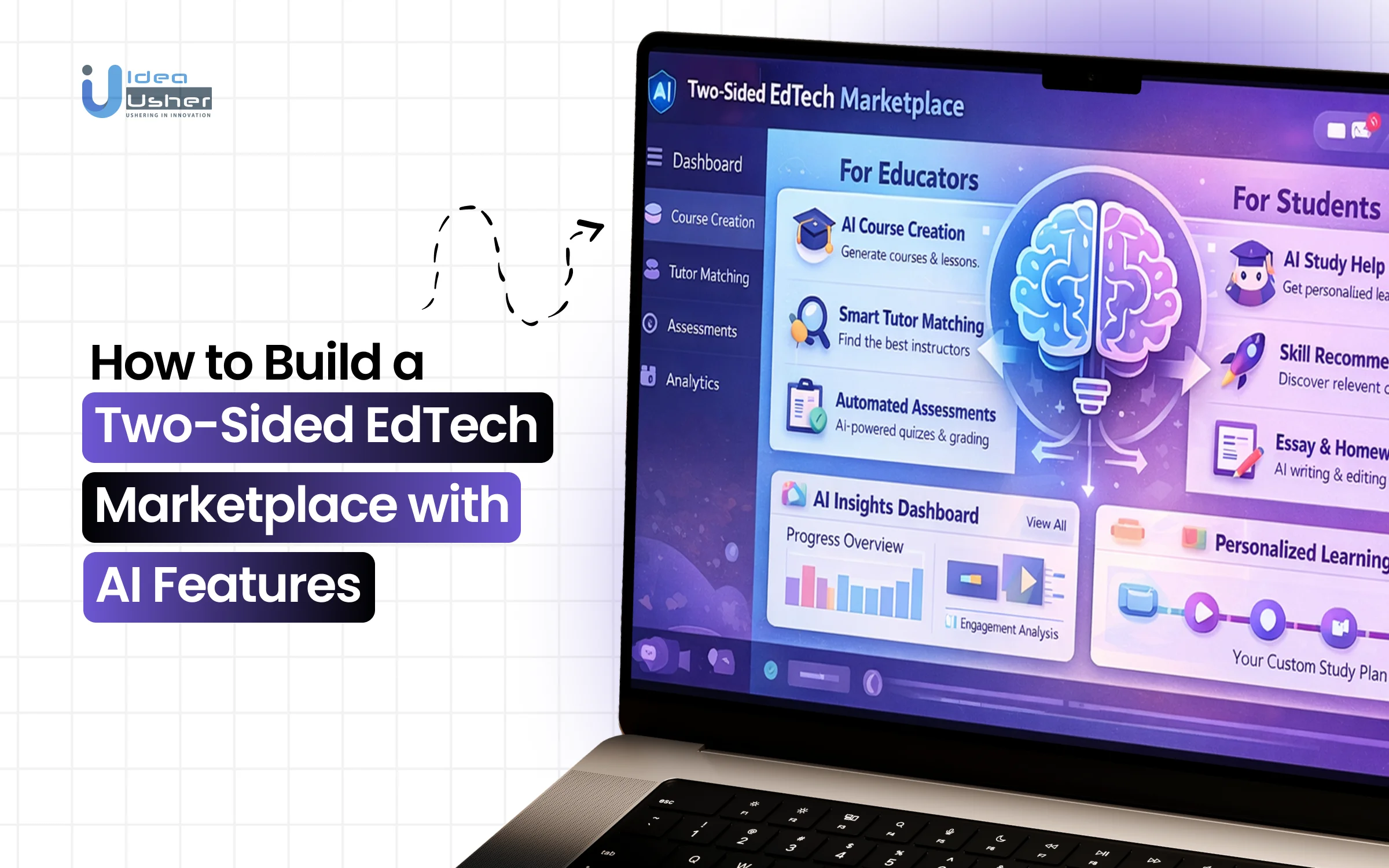
Two-sided EdTech marketplaces bring together learners seeking knowledge and educators offering expertise within a shared digital environment. Building a platform that balances supply and demand, maintains quality, and supports smooth interactions requires more than basic marketplace functionality. These realities are shaping AI edtech marketplace development, where intelligent systems help manage discovery, matching, engagement, and platform operations at scale.
AI enhances every stage of the user journey in these platforms. Recommendation systems match learners with courses or tutors, automated moderation maintains content quality, and analytics reveal learning insights. These features work best when AI integrates seamlessly with marketplace mechanics like onboarding, search, payments, scheduling, and feedback.
In this blog, we explain how to build a two-sided EdTech marketplace with AI features by breaking down core platform components, architectural considerations, and practical steps involved in launching and scaling an AI-enabled learning marketplace.

What is a Two-Sided EdTech Marketplace?
A Two-Sided EdTech Marketplace is a digital platform in the education sector that connects two distinct groups of users, typically educators (such as teachers, tutors, or course creators) and learners (students) and facilitates interactions or transactions between them.
The platform acts as an intermediary that enables these groups to exchange educational services, courses, or learning resources while providing infrastructure such as discovery, communication, and payment systems.
Key Components of the Two-Sided Model
- The Learner Side: Students or professionals seeking personalized educational content, tutoring, or certifications.
- The Provider Side: Teachers, subject matter experts, or institutions offering courses, mentorship, or specialized instructional materials.
- The Marketplace Operator: The platform itself (e.g., Coursera, Preply, or GoStudent) that manages the ecosystem using AI to drive efficiency and growth.
What Defines a Two-Sided EdTech Marketplace?
A two-sided EdTech marketplace is a digital ecosystem that facilitates the exchange of educational value between two distinct user groups: learners (demand) and educators (supply). Unlike a standard course platform, a marketplace thrives on the network effects created by these interactions, supported by a robust administrative layer.

1. Learning Discovery and Personalization
The student experience centers on finding the right mentor at the right time. AI-driven discovery engines move beyond simple keyword searches, using student profiles and past performance data to recommend specific tutors or modules that align with their current skill gaps and learning pace.
2. Course Creation and Monetization Tools
For educators, the marketplace provides a “business-in-a-box.” This includes AI-assisted content creation tools that help format curriculum, integrated payment gateways for global monetization, and detailed dashboards to track student engagement, revenue growth, and course performance metrics.
3. Marketplace Governance and Moderation
The administrative layer ensures quality and safety across the ecosystem. Admins utilize AI-powered moderation tools to verify tutor credentials, monitor sessions for compliance with safety standards, and manage dispute resolution, ensuring the platform remains an authoritative and trustworthy environment for all users.
4. Real-Time Interaction Between Students and Tutors
The core value of a marketplace is the live connection. High-performance platforms integrate low-latency video, real-time whiteboarding, and in-app instant messaging. These tools allow for immediate feedback loops, transforming static learning into a collaborative, synchronous experience that mimics 1:1 in-person tutoring.
5. Marketplace Liquidity and Supply Demand Balance
A successful marketplace must maintain “liquidity” ensuring there are enough tutors to meet student demand without oversaturating the supply. Platforms use predictive analytics to identify trending subjects, incentivizing tutors to create content in high-demand niches and ensuring students never face a shortage of expert guidance.
Global Market Growth of AI EdTech Marketplace
The Global AI in Edtech Market is expected to reach USD 92.09 Billion by 2033, up from USD 3.65 Billion in 2023, with a CAGR of 38.1% from 2024 to 2033. This growth offers strong opportunities to develop two-sided AI EdTech marketplaces connecting educators and learners through personalized features.

Early adoption of AI in education is already showing measurable results. Universities using AI-driven learning systems have reported exam score improvements of up to 10% and a 15% increase in passing rates, demonstrating how intelligent learning tools can directly enhance academic performance.
Personalized AI-powered learning paths help students complete courses more effectively, increasing completion rates by nearly 70% over traditional formats. AI-based predictive analytics enable institutions to identify at-risk students early, boosting retention by up to 30%.
AI is also transforming the way educators manage their workload and teaching efficiency. AI tools can automate 20% to 40% of a teacher’s workload, particularly in tasks like grading and lesson planning. AI-powered grading systems further streamline this process by reducing the time spent evaluating assessments by at least 70%.
As a result, educators who adopt AI for administrative and instructional planning report saving around 6 to 13 hours per week, allowing them to focus more on teaching, mentoring, and improving student outcomes.
Must-Have AI Features in a Two-Sided EdTech Marketplace
AI edtech marketplace development requires a sophisticated balance between intuitive user experience and robust backend intelligence. These essential features ensure high retention, seamless knowledge transfer, and scalable revenue growth.

A. Student-Side Marketplace Features
The learner’s journey must prioritize friction-free discovery and hyper-personalized support during AI edtech marketplace development. These features transform a standard course catalog into an adaptive, results-oriented digital classroom that mirrors private tutoring.
1. Smart Course Discovery with AI Recommendations
Leveraging Neural Collaborative Filtering, the discovery engine analyzes student intent and past behavior. It bypasses generic tags to suggest high-relevance modules, ensuring learners find the exact “micro-skill” required for their goals.
2. AI-Powered Learning Paths and Skill Tracking
Dynamic “Knowledge Mapping” tracks a student’s mastery in real-time. The system automatically adjusts the curriculum difficulty, creating a non-linear path that prioritizes weak areas while accelerating progress through mastered concepts.
3. Live Classes and Interactive Video Learning
Low-latency WebRTC integration enables real-time whiteboarding and breakout rooms. Interactive overlays allow students to engage with “shoppable” resources or quizzes directly within the video stream, boosting active participation and retention.
4. AI-Generated Practice Tests and Instant Feedback
LLM-driven assessment engines generate unique mock exams based on course transcripts. Students receive instant pedagogical feedback, explaining not just what they got wrong, but the underlying logic required for correction.
5. AI Study Assistants for 24/7 Learning Support
Embedded AI companions provide immediate clarification on lecture content. These assistants use RAG (Retrieval-Augmented Generation) to answer questions based strictly on the tutor’s materials, preventing hallucinations and maintaining academic integrity.
6. Secure Payments and Subscription Management
Multi-currency gateways with automated escrow services ensure student funds are protected. Flexible billing models, including “Pay-per-Session” or tiered subscriptions, allow learners to customize their financial commitment based on their needs.
B. Tutor-Side Marketplace Features
Modern AI edtech marketplace development provides educators with high-leverage tools that slash administrative tasks. These features empower tutors to act as “solopreneurs,” bridging expert knowledge with scalable technology in a professional digital ecosystem.
1. Course Creation and Content Management Tools
A drag-and-drop Course Builder simplifies multimodal uploads. Tutors can seamlessly integrate video, interactive PDFs, and SCORM-compliant files, while version control ensures the curriculum stays updated with the latest industry standards.
2. AI Tools for Quiz and Assignment Generation
Tutors use Generative AI overlays to transform hour-long lectures into structured quizzes and rubrics instantly. This eliminates hours of manual administrative work, allowing educators to focus entirely on teaching and mentorship.
3. AI Tutor Matching and Student Recommendations
The “Lead Match” algorithm identifies students whose learning styles and goals align with a tutor’s specific expertise. This proactive matching ensures a steady stream of high-intent learners, optimizing tutor utilization rates.
4. Classroom Engagement and Interaction Tools
Advanced dashboards provide a “heat map” of student engagement. Tutors can see exactly where students drop off in a video, allowing them to intervene with targeted messages or live office hours.
5. Revenue Dashboard and Earnings Analytics
Real-time financial tracking provides transparency into net earnings, tax withholdings, and “payout-ready” balances. Predictive analytics help tutors forecast future income based on current enrollment trends and seasonal demand shifts.
6. Reputation Systems and Tutor Rating Algorithms
A multi-factor “Trust Score” combines student reviews with objective data like response time and course completion rates. This merit-based system ensures high-quality educators gain the highest visibility on the platform.
C. Admin-Side Marketplace Features
The administrative core of AI edtech marketplace development manages the marketplace’s integrity, safety, and profitability. These high-level controls are critical for B2B operators who need to oversee thousands of simultaneous global transactions and interactions.
1. Tutor Verification and Credential Management
Automated KYC (Know Your Customer) and credential-checking pipelines verify academic degrees and professional certifications. This “Vetting Gateway” ensures that only qualified experts are permitted to monetize their knowledge on the platform.
2. AI Moderation for Content and Fraud Detection
Sophisticated NLP filters scan for “off-platform” payment attempts, toxic behavior, and copyright infringements. AI-driven fraud detection monitors transaction patterns to prevent chargebacks and protect the marketplace’s financial health and reputation.
3. Marketplace Commission and Revenue Controls
Admin panels allow for dynamic commission splitting and tiered fee structures. Operators can adjust platform takes based on tutor performance, subject categories, or promotional periods to balance marketplace liquidity and growth.
4. Learning Analytics and Marketplace Insights
Big-data dashboards aggregate platform-wide trends, identifying “content gaps” where student demand outstrips supply. These insights allow admins to strategically recruit tutors for high-growth subjects like AI, Web3, or healthcare.
5. Platform Security and Data Compliance
End-to-end encryption and SOC2-compliant storage protect sensitive student-tutor data. Integrated tools manage GDPR/FERPA “Right to be Forgotten” requests, ensuring the platform stays ahead of global data privacy regulations and legal requirements.
AI-Powered Two-Sided EdTech Marketplace Development Process
AI edtech marketplace development requires a strategic fusion of pedagogical excellence and scalable cloud architecture to create a seamless, value-driven ecosystem for global learners.

1. Consult & Define Marketplace Niche
Success begins with surgical precision in market positioning. Rather than a broad “horizontal” platform, focus on high-value domains where a specialized AI can provide a distinct competitive advantage.
- Subject Domain: Identify high-stakes categories like Executive Leadership, Specialized Software Engineering (e.g., Rust, AI Ops), or Post-Graduate Medical Certifications.
- Learner Demographics: Define the “Job to be Done.” Are users seeking immediate career pivots (B2B/B2C) or supplemental K-12 support?
- Tutor Supply: Determine if your supply side consists of university professors, industry practitioners, or independent content creators.
2. Validate the Marketplace Idea
Rigorous validation moves your project from an assumption-based model to an evidence-based strategy by identifying the systemic failures of current incumbents.
- Analyze the “Completion Gap”: Investigating why traditional MOOCs suffer from massive dropout rates allows you to position AI as the solution for student persistence and accountability.
- Evaluate Pricing Elasticity: Study whether your target audience prefers the commitment of a monthly subscription, the flexibility of pay-per-course, or a credit-based “micro-learning” model.
- Identify Functional Friction: Map out the UX flaws in existing platforms, such as delayed tutor responses or generic curriculum paths, to define where your AI can provide instant, personalized interventions.
- Benchmarking Feature Moats: Determine which features (e.g., live coding environments or gamified assessments) are industry standards versus “blue ocean” opportunities where your platform can lead.
- Assess Supply-Side Satisfaction: Research the pain points of tutors on rival sites—often high commissions or lack of ownership—to build a more attractive ecosystem for top-tier educators.
3. Plan the Marketplace Business Model
A robust financial architecture balances platform sustainability with participant incentives through diversified, non-conflicting revenue channels.
- Transaction Commissions: The standard marketplace “take rate” (typically 15%–30%) on every booking or course sale.
- Tiered Subscriptions: A “Freemium” model where basic videos are free, but AI-powered tutoring and certifications require a monthly pass.
- SaaS-Enabled Marketplace (SEM): Charging tutors for “Pro” tools, such as AI course generators, student sentiment analytics, or automated grading suites.
- Enterprise Licensing: Selling curated learning paths directly to HR departments for workforce upskilling.
4. Design the Platform Architecture
The technical blueprint of AI edtech marketplace development must facilitate a “three-sided” interaction model such as Student, Tutor, and Admin while ensuring the system remains modular and scalable.
The Core Workflows:
The Student Journey: Discovery → AI Matching → Transaction → Learning → Certification.
The Tutor Journey: Onboarding → Content Upload → AI Enhancement → Engagement → Payout.
The Admin Journey: Vetting → Moderation → Dispute Resolution → Analytics.
5. Prioritize Core Marketplace AI Features
The MVP AI edtech marketplace development must be lean enough for rapid deployment but functional enough to complete the “Value Loop” without technical friction.
- Discovery Engine: Advanced search with filters for expertise level, rating, and price.
- Scheduling & Real-time Sync: Integration with calendars (Google/Outlook) for synchronous 1:1 sessions.
- Secure Payment Infrastructure: Support for global gateways (Stripe/PayPal) with automated split-payment logic.
- Basic LMS Core: A reliable environment for hosting video, PDFs, and interactive text.
6. Build the Student, Tutor, and Admin Modules
AI edtech marketplace development focuses on creating isolated yet interoperable modules that handle the heavy lifting of user management and content delivery.
- Student Portal: Mobile-first interface focusing on progress tracking and low-latency video streaming.
- Tutor Dashboard: A command center for managing student rosters, curriculum updates, and financial withdrawals.
- Global Admin Panel: A high-level view for monitoring marketplace liquidity, managing content flags, and auditing transactions.
7. Integrate AI Features
This is the “moat” of your platform. AI transforms a static directory into an intelligent learning partner that evolves with the user.
- Intelligent Matching: Using vector embeddings to pair students with tutors based on learning style and pace.
- Automated Content Creation: AI tools that help tutors generate lesson summaries, quizzes, and flashcards from video transcripts.
- Predictive Analytics: Identifying students “at risk” of dropping out and triggering automated encouragement or tutoring interventions.
8. Test the Platform and Prepare for Beta Launch
Before the public release, the platform undergoes rigorous stress tests to ensure security compliance and infrastructure reliability under load.
- Usability Testing: Observing beta users to identify “UI friction” that leads to cart abandonment.
- Performance Optimization: Ensuring high-concurrency video handling and rapid AI inference response times.
- Security & Compliance: Hardening the platform against data breaches and ensuring GDPR/SOC2 compliance for educational data.
9. Launch the EdTech Marketplace
The launch phase is about achieving “Liquidity” the delicate balance where supply meets demand consistently.
- Supply-Side Incentives: Offer “Early Bird” tutors 0% commission for the first 90 days to populate the platform with high-quality content.
- Demand Generation: Use SEO-driven content marketing targeting specific “how-to” keywords relevant to your niche.
- Feedback Loops: Use the first 1,000 users to refine the AI algorithms before scaling marketing spend.
AI EdTech Marketplace Development Cost
The following table breaks down the investment required for each phase of the AI edtech marketplace development to provide a transparent budgetary outlook. These estimates reflect 2026 market rates for a specialized AI-integrated platform, balancing high-performance infrastructure with cost-efficient execution.
| Development Phase | Deliverables & Key Activities | Estimated Cost Range |
| Strategic Discovery | Market & Niche validation, Target audience personas, Competitor gap analysis report. | $5,000 – $10,000 |
| Architecture & UX Design | Interactive wireframes, Three-sided user journeys (Student/Tutor/Admin), System blue-prints. | $8,000 – $15,000 |
| Core MVP Development | Functional Student & Tutor modules, Secure payment split-logic, Discovery engine. | $25,000 – $45,000 |
| AI Feature Integration | Adaptive learning matching, Automated quiz generation, Predictive engagement analytics. | $20,000 – $55,000 |
| QA & Security Hardening | UAT testing, Stress testing for video concurrency, GDPR/SOC2 compliance audit. | $7,000 – $15,000 |
| Launch & Early Onboarding | Cloud deployment (AWS/Azure), Tutor vetting portal, Initial marketing & SEO activation. | $10,000 – $25,000 |
| Total Estimated Investment | End-to-end build from discovery to market-ready AI platform. | $75,000 – $165,000+ |
Strategic Financial Considerations
- Strategic Global Outsourcing: Partnering with specialized offshore development firms allows you to optimize your budget, potentially reducing the financial outlay for the “Core MVP” and “AI Integration” by 40% to 60% while ensuring access to top-tier technical talent.
- Infrastructure Scaling: Post-launch, expect an annual maintenance and cloud infrastructure cost of approximately 15%–20% of the initial build cost to account for model retraining and server scaling.
- API vs. Custom Models: Starting with pre-trained models (like GPT-4o or Gemini 1.5 Pro) for initial features can lower the “AI Feature Integration” cost significantly compared to building custom proprietary LLMs from scratch.
AI Tech Stack Used in EdTech Marketplace Development
The underlying technology must handle complex data processing in the two-sided AI edtech marketplace development while remaining scalable. This tech stack balances cutting-edge AI models with robust cloud infrastructure to ensure 24/7 reliability.
| Tech Layer | Core Technologies & Models | Strategic Educational Value |
| AI Models for Personalization | GPT-4o, Claude 3.5, Llama 3 | These models drive the platform’s “pedagogical brain,” adjusting explanations and difficulty based on each student’s performance. |
| Recommendation Systems | TensorFlow Recommenders, Pinecone (Vector DB) | Matches students with tutors and courses by true intent, not just keywords, using Semantic Search and collaborative filtering. |
| NLP for Study Assistants | LangChain, RAG Pipelines, Mistral 7B | Lets assistants “read” your course PDFs and transcripts for instant, source-backed answers, never relying on general web data/ |
| Cloud Infrastructure | AWS SageMaker, Google Vertex AI, NVIDIA H100s | Provides the raw “compute power” needed to run real-time AI workloads, ensuring low-latency video streaming and instant AI responses globally. |
Major Challenges in Building an AI EdTech Marketplace Platform

AI edtech marketplace development involves navigating complex operational hurdles that require a sophisticated balance of automated governance and scalable technical architecture.
1. Marketplace Liquidity and Supply Balance
Challenge: Achieving the “critical mass” where enough tutors exist to satisfy student demand without creating an oversupply that devalues tutor earnings.
Solution: Our developers implement dynamic matching algorithms and geo-targeted supply-side incentives, ensuring that tutor acquisition is programmatically throttled or accelerated based on real-time student search volume and category-specific conversion data.
2. Maintaining Course Quality Across Tutors
Challenge: Preventing a “race to the bottom” where low-quality content or unverified teaching methods dilute the platform’s educational credibility and brand.
Solution: We build automated AI-driven content auditing tools that scan video quality, transcript accuracy, and pedagogical structure, combined with a mandatory “probationary period” for new tutors based on verified student sentiment.
3. Preventing Fraud and Fake Tutors
Challenge: Protecting the platform from sophisticated scammers, credential spoofing, and bot-generated content that compromises user trust and financial security.
Solution: Our team integrates multi-factor biometric verification, LinkedIn API credential cross-referencing, and AI behavioral analysis to detect anomalous transaction patterns or plagiarized course materials, ensuring a high-integrity ecosystem.
4. AI-Powered Learning Agents
Challenge: Traditional platforms treat learning as a linear path, failing to account for how students actually forget or master specific sub-concepts over time.
Solution: Our developers use Bayesian Knowledge Tracing (BKT) or Deep Knowledge Tracing models to track each student’s mastery of key concepts in real time. When the AI detects confusion on a formula, it adjusts the lesson or notifies the tutor to intervene early.
5. Scaling AI Infrastructure Cost-Effectively
Challenge: Managing the high computational overhead and API costs associated with real-time AI personalization as the user base grows exponentially.
Solution: We utilize a “hybrid inference” model, deploying lightweight open-source models for routine tasks while reserving premium LLMs for complex reasoning, significantly reducing token consumption without sacrificing platform intelligence.
Monetization Models for AI EdTech Marketplaces
To achieve long-term profitability, your platform must leverage a multi-tiered revenue strategy that extracts value from transactional interactions, recurring usage, and advanced AI-driven utilities.

1. Commission on Courses and Tutoring Sessions
This model serves as the foundational revenue stream, positioning the platform as a high-trust intermediary between educators and learners.
- Automated Split-Payments: Implementing real-time logic that routes the tutor’s earnings and the platform’s “take rate” instantly upon transaction completion.
- Performance-Based Tiers: Incentivizing high-quality supply by offering lower commission percentages to tutors who maintain exceptional ratings or high student volume.
- Secure Escrow Protection: Providing a safety net by holding funds until the learning milestone is confirmed, which minimizes disputes and builds platform credibility.
Real-World Example: Wyzant (US) and Preply (Global) utilize this model where the platform handles the high-trust infrastructure like scheduling, payment processing, and dispute resolution, in exchange for a percentage of the tutor’s hourly rate.
2. Subscription Plans for Students
Transitioning to a recurring revenue model ensures predictable cash flow and fosters a long-term commitment from the learner base.
- Unlimited Foundational Access: Offering a “Netflix-style” library of pre-recorded courses for a flat monthly fee to drive high-frequency usage.
- Hybrid Credit Systems: Allocating monthly credits that students can redeem for 1:1 sessions, allowing for a mix of passive and active learning.
- Exclusive Member Perks: Providing premium benefits such as ad-free interfaces, offline course downloads, and early access to high-demand webinars.
Real-World Example: Skillshare (Global) and MasterClass (US) operate primarily on an annual or monthly subscription basis, providing learners with an “all-access pass” to their entire catalog of expert-led creative and professional content.
3. Premium AI Learning Features
In a 2026 landscape, advanced AI utilities represent a high-margin upsell opportunity for students seeking a more personalized, accelerated learning experience.
- 24/7 AI Teaching Assistants: Providing instant, context-aware support outside of live tutoring hours through RAG-based chatbots.
- Hyper-Personalized Study Paths: Utilizing machine learning to dynamically restructure curriculum modules based on the student’s unique pace and knowledge gaps.
- AI Career Readiness Tools: Offering automated mock interviews, real-time code analysis, and resume optimization as specialized add-on services.
Real-World Example: Khan Academy (Khanmigo) and Duolingo Max. These platforms charge a premium subscription fee specifically for access to advanced AI tutors that offer Socratic coaching, error explanation, and real-time conversation practice.
4. Enterprise Training Programs
Scaling into B2B sectors allows the platform to capture high-contract value by addressing the specific upskilling needs of corporate organizations.
- Bulk Seat Licensing: Facilitating large-scale deployments where companies purchase access for hundreds of employees under a single enterprise agreement.
- HR & Management Dashboards: Delivering deep analytics that allow leadership to monitor team progress, certification rates, and skill-gap trends.
- White-Label Integration: Providing the option for corporations to skin the platform with their own branding for internal employee development portals.
Real-World Example: LinkedIn Learning (US/Global) and Pluralsight (US) focus heavily on the enterprise market, selling bulk licenses and skill-intelligence dashboards to Fortune 500 companies to manage large-scale technical and leadership training.
Examples of Two-Sided AI EdTech Marketplace in The Market
Two-sided AI EdTech marketplaces connect learners with educators on a single platform, using AI to personalize learning and efficiently match students with suitable courses or tutors. These platforms use AI to recommend content, optimize matches, and help educators reach global learners at scale.
1. Adventus.io

The Marketplace: A global B2B marketplace connecting universities looking to recruit international students with recruitment agents worldwide.
AI Features:
- Intelligent Matching: Uses AI to filter and match students with the most suitable international programs based on academic background, financial capacity, and visa probability.
- Document Verification: Employs AI to pre-screen and verify student application documents, reducing administrative friction for university admissions offices.
2. Amboss

The Marketplace: A specialized medical education platform connecting medical students and practitioners with high-yield clinical knowledge and assessment tools.
AI Features:
- Adaptive Learning: An AI-driven “Study Planner” that identifies a user’s medical knowledge gaps and adjusts the difficulty of clinical cases and practice questions.
- Contextual AI Insights: Provides real-time, AI-powered summaries of medical research and clinical guidelines integrated directly into its learning modules.
3. StudyStream

The Marketplace: A “social learning” marketplace that connects global students to virtual focus rooms and mentors for collaborative, real-time study sessions.
AI Features:
- Community Moderation: Uses AI to manage and secure massive 24/7 video-based study rooms, ensuring a safe and productive environment.
- Matching Algorithms: Leverages AI to group students based on similar academic subjects or exam timelines (e.g., matching medical students studying for USMLE) to enhance peer accountability.
4. Mindstone

The Marketplace: An AI-native learning marketplace that connects professionals with subject matter experts who curate “learning playlists” from across the web (articles, videos, and podcasts).
AI Features:
- AI-Powered Distillation: Automatically summarizes long-form content into “Flashcards” and “Key Takeaways,” allowing learners to digest expert-curated materials faster.
- The “Knowledge Graph”: An AI engine that tracks what a user has learned across different sources and suggests the next logical piece of content to fill specific skill gaps.
- Confidence Scoring: Uses AI-driven quizzes to measure how well a learner actually understands the marketplace content, adjusting the curriculum in real-time based on their “retention score.”
5. Preply

The Marketplace: A massive tutoring marketplace connecting learners with thousands of vetted tutors for over 50 languages and academic subjects.
AI Features:
- AI Tutor Matching: An “Intelligent Concierge” that analyzes student learning goals and personality to find the highest-retention tutor match.
- Preply AI Assistant: Provides tutors with AI-generated lesson summaries, vocabulary lists, and practice exercises based on the content discussed during live video sessions.
Conclusion
The evolution of AI edtech marketplace development marks a shift from simple content hosting to intelligent, result-driven ecosystems. By integrating sophisticated AI matching, automated tutoring agents, and diversified monetization models, you can create a platform that offers unparalleled value to both students and educators. While the technical and operational hurdles are significant, a strategic approach focused on niche validation, scalable architecture, and data-driven personalization ensures a sustainable competitive advantage. In 2026, the most successful marketplaces will leverage AI to humanize and accelerate the mastery of new skills globally.
Why Choose IdeaUsher for EdTech Marketplace Development?
Building a two-sided EdTech marketplace requires orchestrating complex interactions between learners and educators while leveraging AI to enhance matching, engagement, and outcomes.
We build AI-driven products across industries, specializing in performance systems, model integration, and scalable infrastructure. Our expertise helps us create EdTech marketplaces that balance supply-demand dynamics, user experience, and business sustainability.
Our ex-FAANG and MAANG engineers bring over 500,000+ hours of hands-on AI development experience, allowing us to architect educational platforms aligned with marketplace growth, trust-building mechanisms, and revenue optimization strategies.
Why Hire Us:
- Marketplace & AI Expertise: We build high-traffic ecosystems, deploy smart tutor-student matching, and ensure seamless real-time messaging across global time zones.
- Custom Trust & Safety: We create proprietary verification, authentic review algorithms, and smart scheduling to give your platform a trusted edge over generic solutions.
- Full-Cycle Ownership: We manage infrastructure, payment integration, education data compliance, and scalable architecture so your EdTech marketplace is ready from launch.


FAQs
A.1. The most effective architecture utilizes Retrieval Augmented Generation or RAG. This framework ensures the AI assistant pulls answers directly from your uploaded course materials rather than general internet data. This strategy prevents misinformation and maintains high academic integrity across your platform.
A.2. Security starts with SOC2 compliance and end to end encryption for all student records. You should implement automated PII scrubbing to remove sensitive personal details before data reaches the AI model. This approach ensures full compliance with global FERPA and GDPR regulations.
A.3. Yes, machine learning algorithms analyze student learning styles and specific skill gaps to suggest the perfect tutor match. This automated pairing increases successful outcomes by ensuring the educator’s teaching method aligns perfectly with the learner’s current needs and professional goals.
A.4. The platform requires seamless integrations with video conferencing tools like Zoom or Daily.co and secure payment gateways like Stripe. Additionally, connecting to an LLM provider via secure API allows for real-time tutoring features without building a model from scratch.


