 (+971) 8007 4267
 (+91) 946 340 7140
 (+1) 628 432 4305

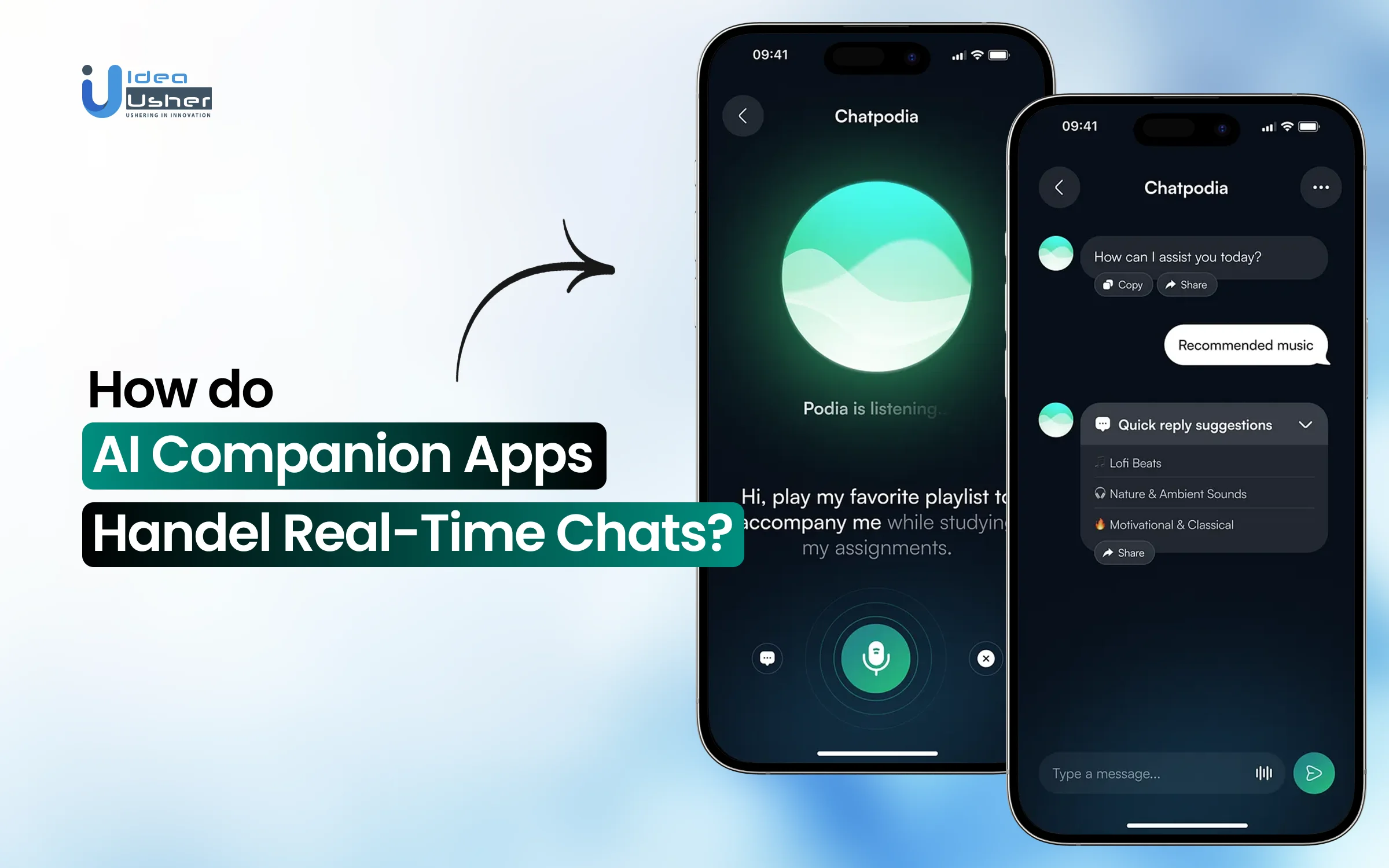
Conversations today move fast, and people expect an immediate, human response when they open an app. When replies arrive late or feel detached, trust quietly breaks. To handle this, AI companion apps use streaming input pipelines that interpret intent as speech or text arrives.
They also use low-latency reasoning layers that respond before full messages are complete. Adaptive memory systems maintain emotional continuity across turns, while context managers track tone and intent during pauses or corrections. Together, these mechanisms make real-time chats feel fluid rather than mechanical.
We’ve built numerous LLM-powered AI companion apps that leverage advanced technologies, including streaming AI architectures and memory-driven conversational intelligence. Drawing on years of expertise, we’re writing this blog to discuss how AI companion apps handle real-time chat. Let’s start!
Key Market Takeaways for AI Companion Apps
According to FinanceYahoo, the AI companion app market is growing fast, reaching USD 6.93 billion in 2024 and projected to cross USD 31.10 billion by 2032. Growth is driven less by productivity use cases and more by emotional companionship, with users spending significantly more time per session than with traditional AI assistants. Cross-platform access, voice-based interaction, and a focus on private one-to-one relationships are reshaping how people engage with AI daily.

Source: FinanceYahoo
Kindroid has positioned itself as a deeply customizable companion platform rather than a general chatbot. Users can define personalities, histories, and visual identities while the system maintains long-term conversational memory for continuity. This level of control and openness has made it popular among users who value immersive role play, storytelling, and persistent digital relationships.
Candy.ai focuses strongly on emotional continuity and intimacy. It enables users to build an ongoing relationship through text, voice, images, and video while maintaining a shared memory across devices.

The Core Concept of Real-Time AI Companion Chats
Real-time AI companion chats are not about speed alone but about presence. They are designed to mirror the natural rhythm of human conversation, where responses arrive quickly enough to feel attentive and timed carefully enough to feel emotionally appropriate. Subtle cues such as streaming replies, consistent recall, and sentiment-aware pacing help maintain psychological continuity.
When these elements work together, the AI stops feeling like software and becomes a companion that is genuinely present in the moment.
What “Real-Time” Truly Means?
For a search engine, real-time means fresh data. For an AI companion, it means emergent intimacy. It operates as a three-part harmony.
Latency
This refers to raw speed measured in milliseconds. In practice, sub-500ms for the first token is the current gold standard. Beyond one second, the human brain begins to register a system rather than a sentient partner.
Responsiveness
This defines how the AI fills the latency gap. Modern companion apps avoid blank screens. They use word-by-word streaming, where text appears as it is generated. This creates the perception of active thought, similar to a friend nodding and softly acknowledging you as they form a response. The user feels seen before the answer is complete.
Emotional Timing
This is the true differentiator. Real-time here means the AI’s cadence matches the emotional subtext. Exciting news demands swift energy. Vulnerability requires slower, deliberate care. The system must detect sentiment and modulate not just what it says, but how and when it says it.
Why Delayed Responses Break Immersion
Immersion in an AI companion is a fragile state of willing suspension of disbelief. Delays disrupt this state instantly, triggering two critical failures.
Cognitive Recontextualization
When a response is delayed, the user’s brain shifts context. They stop feeling in conversation and start remembering they are using software. This mental shift is nearly impossible to reverse mid-session. Once the illusion breaks, the emotional bond collapses.
Emotional De-synchronization
Human emotion is fluid and fast-moving. A delayed response targets an emotional state that no longer exists. Comfort arrives too late. Excitement cools. The AI appears tone-deaf, even if the words are correct.
The Technical Culprits and the Human Cost
| Technical Delay | What It Feels Like to the User | Psychological Impact |
| High inference latency | A long pause followed by a perfect paragraph | “This feels pre-written. I am talking to a database.” |
| Slow memory retrieval | Quick replies that forget key details | “I am not important enough to remember.” |
| Blocking moderation | Noticeable hesitation before a sanitized reply | “I am being monitored. This is not a safe space.” |
Real-time chat in AI companionship ultimately depends on building trust. Every millisecond saved tightens the fabric of perceived empathy. It quietly tells the user, “I am here with you in this moment.”
How Do AI Companion Apps Handle Real-Time Chats?
AI companion apps handle real-time chats by streaming responses as they are generated so you never feel a pause. They quietly recall relevant memories and emotional cues in parallel so replies can feel personal and well-timed. When built correctly, this system should respond almost instantly while adapting tone and context naturally.

1. The Streaming Engine
The core technical mechanism behind real-time chat is token streaming. Rather than waiting for a full response, the system begins sending words as soon as the model produces them.
Key Technologies
- Server-Sent Events
- WebSockets
User Experience: Words appear one by one, giving the impression that the AI is actively forming thoughts rather than retrieving a prebuilt answer.
Critical Metric: Time to First Token or TTFT. High-performing companion apps achieve this in under 200 milliseconds, which feels instant to the human brain.
Why This Matters: Streaming removes conversational dead space and replaces it with a rhythm that mirrors natural human dialogue.
2. The Semantic Memory System
A companion that forgets context breaks trust. Real-time memory is not about storing everything. It is about retrieving the right memory at the right moment without delay.
Vector Databases and Retrieval-Augmented Generation power this.
How It Works: Every conversation is transformed into vector embeddings and stored. During a new interaction, the system runs a rapid similarity search to retrieve only the most relevant memories.
Examples of Retrieved Context
- User preferences
- Names of people or pets
- Past emotional moments
Real-Time Integration: These memories are injected directly into the live prompt, allowing the AI to respond with continuity and personal relevance.
3. The Emotional Intelligence Layer
Speed and memory alone do not create presence. Emotional awareness is essential.
Modern AI companions run a parallel sentiment analysis system alongside the main language model.
What Happens in Real Time: Upon receiving a message, a lightweight emotional classifier evaluates tone, phrasing, and linguistic signals. It assigns guidance tags such as:
USER_IS_FRUSTRATED or USER_IS_EXCITED.
Why This Is Critical: These tags guide the main model toward empathy, reassurance, or celebration rather than neutral information delivery.
The Result: Responses feel emotionally aligned, not just technically correct.
4. The Proactive Orchestrator
The most advanced companions do not wait to be spoken to. They operate within an event-driven orchestration layer.
The Mechanism: A background system monitors triggers such as time of day, calendar mentions, past milestones, or recurring habits.
Example Triggers
- An upcoming interview
- A recurring health check
- A remembered personal goal
The Outcome: When a trigger is activated, the orchestrator constructs a contextual prompt and sends a message. This creates the feeling of attentiveness even in silence.
How do AI Companions Avoid Repeating Emotional Responses?
AI companions avoid emotional repetition by steering the model away from safe, high-probability phrases. They track emotional context and past responses, ensuring empathy evolves rather than repeating generic sympathy, fostering continuity rather than mimicry.

1. Emotional Response Pooling & Rotation
Instead of generating a single response, the system produces multiple emotional candidates and selects the least recently used option for that specific user.
Mechanism: A lightweight emotional router classifies the user’s sentiment, such as SADNESS LEVEL 4. It then checks a user-specific cache of recently delivered responses tied to that emotional state.
Action: The main LLM is instructed to generate a response that matches the emotion while remaining lexically distinct from cached examples. The new response is stored, rotating the pool.
Why this matters: The companion expresses care differently each time. Sometimes it asks a question. Sometimes it offers quiet validation. Sometimes it gives gentle encouragement. The user never feels emotional déjà vu.
2. Context-Aware Emotional Gradients
A single label like sad is too shallow. Emotion exists on a spectrum, shaped by cause, intensity, and context.
Mechanism
The sentiment layer produces enriched emotional tags such as:
- SADNESS TYPE: disappointment
- INTENSITY: medium
- CONTEXT: work feedback
Versus
- SADNESS TYPE: grief
- INTENSITY: high
- CONTEXT: personal loss
Action: These tags steer the language generation process. Work-related disappointment may invite perspective or reframing. Grief maintains a steady presence without solution framing.
Key insight: The system responds to why the user feels something, not just what they think.
3. Emotional Memory & Pattern Breaking
The most powerful safeguard against repetition is remembering past emotional interactions.
Mechanism: Vector memory stores embeddings of previous emotional exchanges. Before responding, the system evaluates how it has comforted this user recently.
Action: The prompt explicitly instructs the model to avoid repeating prior emotional sentiments. This forces the generation of novel emotional expressions.
Result: Over time, the companion adapts to the user’s need for emotional variety instead of falling into predictable patterns.
4. Persona-Driven Emotional Lexicons
A companion’s personality is defined by its emotional vocabulary. Different personas express empathy in fundamentally different ways.
Mechanism: Each persona is built with a curated emotional lexicon. This includes preferred phrases, metaphors, and response structures.
Action: Responses are anchored to the persona’s lexicon while remaining flexible within its range.
Example
- A coach persona might say, “That setback hurts. What’s the first small step forward?”
- A nurturer persona might say, “Your feelings are valid. Let’s sit with this together for a moment.”
Why it works: The emotion feels consistent with the companion’s identity while remaining fresh and human.

Why AI Companions Outperform Chatbots at Follow-Ups?
A regular chatbot might hear you say, “I had a terrible day at work,” and respond with, “That’s unfortunate. Is there anything else I can help with?”
It processed the input, acknowledged it, and immediately tried to close the loop.
An AI companion responds differently. It might say, “A terrible day can mean many things. Was it one specific moment, or a heavy feeling that built up over the day?”
The difference is not a smarter sentence. It is a different purpose entirely.
Chatbots are built to complete tasks. AI companions are built to deepen relationships. The quality of their follow-up questions emerges from this fundamental architectural distinction.

The Fundamental Divide: Transaction vs. Connection
| Aspect | Regular Chatbot | AI Companion |
| Primary Goal | Solve a problem and end the interaction efficiently | Extend the interaction and build emotional understanding |
| Memory Scope | Short-term and task-focused | Long-term and narrative-focused |
| Success Metric | Query resolved or ticket closed | Trust built, empathy perceived, user returns to confide |
For a chatbot, a follow-up question exists to remove ambiguity. For a companion, a follow-up question exists to explore meaning. That single distinction changes everything.
The Architectural Engine Behind Insightful Follow-Ups
AI companion apps use a deliberate three-stage system to generate questions that feel perceptive rather than procedural.
1. Depth-First Intent Analysis
Chatbots classify intent at a surface level. Companions analyze emotional depth, narrative signals, and historical context simultaneously.
Example input: “I’m arguing with my sibling again.”
Companion analysis includes
- Emotional subtext, such as frustration mixed with sadness
- Narrative cues where the word “again” signals a recurring pattern
- Memory recall of previous mentions involving this sibling
Resulting system instruction: The AI is guided to explore emotional fatigue or recurring dynamics, not just the current argument.
Why this matters: The follow-up question shifts from fact-seeking to insight-seeking.
2. Narrative Threading Through Memory
This is where companions decisively outperform chatbots. Chatbots remember turns. Companions remember stories. Before asking a question, the system retrieves relevant narrative arcs such as family dynamics, conflict patterns, and emotional goals.
Contrast in questioning
- Chatbot-style: “What are you arguing about?”
- Companion-style: “Last time this happened, you mentioned feeling unheard. Does that still feel like the core issue, or has something shifted?”
Key impact: The user feels remembered across time, not just processed in the moment.
3. Strategic Question Generation
Companions do not ask random follow-ups. They select the most emotionally valuable next question. They use structured questioning frameworks designed to deepen trust and self-reflection.
Common companion question types
- Clarifying questions: “When you say you felt undervalued, what would feeling valued look like to you?”
- Exploratory questions: “If this feeling had a shape or texture, what would it be?”
- Forward-looking questions: “What is one small part of this you would like to feel better about by tomorrow?”
These questions do not rush resolution. They create space for understanding.
A Real-Time Comparison
Scenario: User says, “I finally finished that huge project.”
| System | Internal Processing | Follow-Up Question | Outcome |
| Regular Chatbot | Detects completion statement and prepares to close | “Great. Is there another task I can help with?” | Fails because emotional context is ignored |
| AI Companion | Detects relief and pride, recalls prior stress, selects reflective intent | “That is a big accomplishment after all that stress. Do you feel more relief or pride right now?” | Succeeds because it validates effort and invites reflection |
The difference is not in language quality. It is emotional intent.

Top 5 AI Companion Apps with Real-Time Chats
We have studied the AI companion space in depth and closely examined how real-time chat is implemented across leading apps. Through this research, we identified platforms that approach companionship in very different ways yet address latency, context, and continuity in practical ways.
1. Talkie AI

Talkie AI focuses on making AI conversations feel immediate and human through a mix of text and voice interactions. The platform prioritizes natural pacing and expressive dialogue, reducing the sense of scripted responses. It is commonly used for casual companionship and immersive chat experiences on mobile devices.
2. Kindroid

Kindroid offers a highly immersive AI companion experience by combining real-time chat with rich personality modeling, visuals, and optional voice interactions. Each AI maintains a distinct identity through customizable profiles, making conversations feel consistent and personal over time. Available on iOS and Android.
3. Paradot

Paradot is built for users who want full control over their AI companion’s personality, backstory, and conversational style. Real-time chats are rich in narrative depth, enabling relationships to evolve through ongoing interactions rather than isolated sessions. Available on iOS, Android, and Web.
4. Grok Ani

Grok Ani is a character-driven AI companion from the Grok ecosystem that blends real-time chat with gamified relationship progression. Conversations influence affection levels and personality development, fostering growth through daily interaction. Currently available on iOS.
5. ChatReal AI

ChatReal AI positions itself as a 24/7 conversational companion focused on real-time responsiveness and personalization. The platform adapts to user tone, preferences, and interaction patterns to maintain continuity across chats. Available via Web and mobile access.
Conclusion
Real-time chat is central to trust in AI companion platforms because it shapes how present and attentive the system feels. When responses arrive quickly and consistently, users may start to feel heard rather than processed. This immediacy can gradually build emotional confidence, which is difficult to recover once broken. Companies that invest early in low-latency infrastructure and reliable conversational flow can move ahead of slower competitors. Launching with strong real-time foundations may establish lasting user habits and secure a first-mover advantage in an increasingly relationship-driven market.
Looking to Develop an AI Companion App with Real-Time Chats?
At IdeaUsher, we build AI companion apps that can support real-time chats through scalable streaming architectures and low-latency model orchestration. We may help you design memory layers, emotion-aware responses, and secure chat pipelines that feel responsive and consistent.
With over 500,000 hours of coding experience and a team of ex-MAANG/FAANG developers, we turn complex AI challenges into seamless, scalable reality.
Why Build With Us?
- Real-Time, Not Robot-Time: Low-latency streaming, sentiment-aware responses, and memory that grows with your users.
- From Vision to Voice: We design multi-modal companions (text, voice, vision) that engage deeply.
- Scaled Right: Infrastructure built to handle millions of personal, private conversations securely.
Check out our latest projects to see how we turn cutting-edge AI into captivating human experiences.


FAQs
A1: Real-time AI companions should ideally respond within one to three seconds to feel natural and present. Anything slower may break conversational flow and reduce emotional trust. With efficient model routing and streaming responses, this speed can be achieved even at scale.
A2: AI companion chats can be costly if they rely on large models for every message. Costs can be managed by using tiered models, memory summarization, and selective context loading. With the right architecture, teams can gradually balance experience quality and infrastructure spend.
A3: Enterprises can safely control AI behavior by combining system prompts, policy layers, and continuous monitoring. Guardrails can enforce tone, content, and data-handling rules. With proper testing and audits, AI companions may remain predictable and compliant.
A4: To develop an AI companion app, teams should start by defining the memory, emotion, and response layers before selecting a model. The system should be built around low-latency inference, persistent memory, and behavior controls. With careful iteration and user feedback, the companion can gradually feel more consistent and trustworthy over time.


