

Key Takeaways
- A casino game development timeline usually takes 2–8 months from initial concept to development, while testing, certification and RGS integration can add another 2–4 months.
- Simple slots and table games can take 2–4 months, while advanced 3D and live dealer games need much more time.
- The timeline mostly depends on game math, visuals, multiplayer features, platform integrations and the number of markets you want to enter.
- A US-regulated casino game development cost can range from around $25,000 to $250,000+, depending on the game type and technical complexity.
- Math changes, complex animations, testing issues and third-party integrations are some of the biggest reasons a game gets delayed.
- The timeline can be cut down by finalizing the math early, reusing tested game components and running development, testing and certification work in parallel.
A typical casino game development timeline is 2–8 months, from initial concept to development, depending on the game type and mechanics, visual complexity, integrations and testing requirements. Certification and RGS integration can also add another 2–4 months, depending on the US state. Simple slots or table games take less time to release, while premium slots, crash games and live dealer experiences often add more time to development.
The development timeline does not only depend on coding. It also depends on math modeling, RNG implementation, game design, frontend development, backend and RGS integration, QA and security testing, and regulatory certification. These stages can also overlap, allowing teams to reduce the overall calendar time without compromising validation.
In this blog, we will talk about the key casino game development phases, timelines, testing and certification requirements, and the factors that can accelerate or delay a casino game app launch, understanding how each phase affects the schedule helps set realistic launch expectations.
Why Is Casino Game Development Growing Globally?
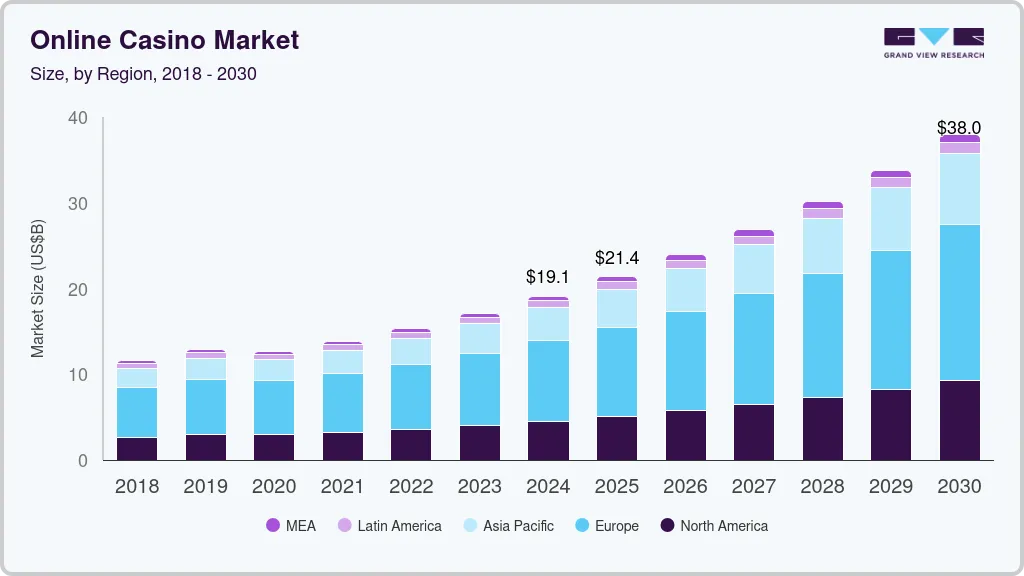
The global online casino market size was valued at $19.1 billion in 2024 and is projected to grow from $23.9 billion in 2026 to $38.0 billion by 2030, at a CAGR of 12.2% from 2025 to 2030. This growth reflects rising demand for digital gaming platforms, creating opportunities for operators to expand across regulated markets with scalable casino products.
Demand is also reflected in the expanding online player base. EGBA gaming association reported 43.8 million active customer accounts in 2025, representing 13% year-over-year growth and a 47% increase since 2021. This expanding user base is encouraging operators to diversify content and invest in scalable casino game development.
A. What Is Driving Demand for New Casino Games?
Player engagement relies on variety, accessibility, and session-friendly options. According to Casino Org, mobile devices accounted for 58% of European online gambling revenue in 2024, reflecting a shift toward mobile-first experiences over classic 3-reel slots.
- Mobile-First Gameplay: Over 60% of digital casino wagers originate from mobile devices, making portrait layouts, low-latency gameplay and one-handed navigation essential.
- Localization & Cultural Customization: Operators need localized themes, regional audio and tailored game mechanics, such as high-volatility slots for Western markets and quick-session formats for Asian and LATAM markets.
- Live Dealer & Real-Time Studios: Live Roulette, Blackjack, Baccarat and Game Shows combine digital convenience with the experience of a land-based casino.
- Crash & Instant-Win Formats: Crash games like Aviator and instant-win titles attract younger players through transparent, social and skill-adjacent mechanics.
- Cross-Platform HTML5 Engineering: Modern HTML5 game engines enable a single build across desktop browsers, iOS apps, Android WebViews and low-bandwidth networks without major performance loss.
- Global Regulatory Expansion: Growing iGaming markets such as Brazil, Ontario and additional US states increase demand for certified game portfolios adapted to local regulatory requirements.
B. Why Development Speed Matters for Casino Operators
For casino operators, content freshness directly affects player engagement. eGaming Monitor found that an average of 1,433 new casino games launched monthly in Q3 2024, highlighting the industry’s rapid content cycle. Relying on static game libraries can limit operators’ ability to respond to trends, maintain competitive lobbies and sustain engagement.
- Faster Time to Market: Launch new titles in weeks rather than quarters to capture market share ahead of competitors, respond to demand and keep acquisition campaigns fresh.
- Capitalizing on Viral & Seasonal Trends: Rapid development enables themed titles for sporting events, holidays and emerging game trends, including quick adaptations of mechanics such as crash games.
- Low-Risk Concept Testing: Modular micro-games let operators analyze player retention, engagement and math model performance before committing significant marketing budgets.
- Agile Entry into New Regulated Markets: When a state or country opens its licensing framework, rapid certification pipelines and GLI-11 compliance help operators deploy certified game portfolios quickly and gain an early-mover advantage.
- Maintaining a Competitive Content Portfolio: A continuous stream of new titles keeps the casino lobby dynamic, supports engagement and can increase DAU and overall wager volume.
Enterprise Takeaway: Development speed is not only a technical advantage. It directly affects market entry, content competitiveness and revenue opportunities. For casino operators, understanding how long development takes helps align product launches with market demand, seasonal events and regulatory timelines.

How Long Does Casino Game Development Take?
Building a commercial-grade casino game typically takes between 2 to 8 months from initial game design to market deployment. However, this timeline only covers core software production, independent laboratory testing (such as GLI-11), jurisdictional certification, and Remote Game Server (RGS) integration frequently add 2 to 4 additional months before a title can accept live real-money wagers.
Casino Game Development Timeline at a Glance
Casino game development timelines vary by game complexity, mechanics, visual requirements, integrations and testing needs, with advanced and live formats requiring longer production cycles overall. The table below outlines production timeframes by game category, excluding state-level regulatory review windows:
| Casino Game Type | Typical Development Time | Key Production Milestones |
| Simple Slot Game | 2 – 4 Months | 2D reel art, standard paylines, static wild mechanics, basic GLI-11 math. |
| Table Game | 2 – 4 Months | RNG Blackjack, Baccarat, or Roulette; multi-seat UI, core payout rules engine. |
| Crash Game | 3 – 5 Months | Real-time multiplayer synchronization, provably fair / RNG multiplier curve, responsive mobile UI. |
| Advanced Slot | 4 – 6 Months | Megaways/cascading mechanics, multi-tier bonus rounds, 2D/3D visual effects, progressive jackpot links. |
| Premium 3D Casino Game | 5 – 8 Months | High-fidelity 3D assets, cinematic reward sequences, custom audio score, deep volatility profiles. |
| Live Dealer Game | 6 – 12+ Months | Physical studio build, optical character recognition (OCR) camera feeds, ultra-low latency streaming, dealer control interface. |
Note: Timelines represent end-to-end engineering and quality assurance. Independent lab testing (e.g., GLI, BMM), state gaming board approvals (e.g., NJ DGE, PGCB), and platform integration can extend time-to-market significantly.
What Determines the Casino Game Development Timeline?
The casino game development timeline depends mainly on the complexity of its mathematics, visual assets, multiplayer requirements, platform integrations, and regulatory certification across target jurisdictions.
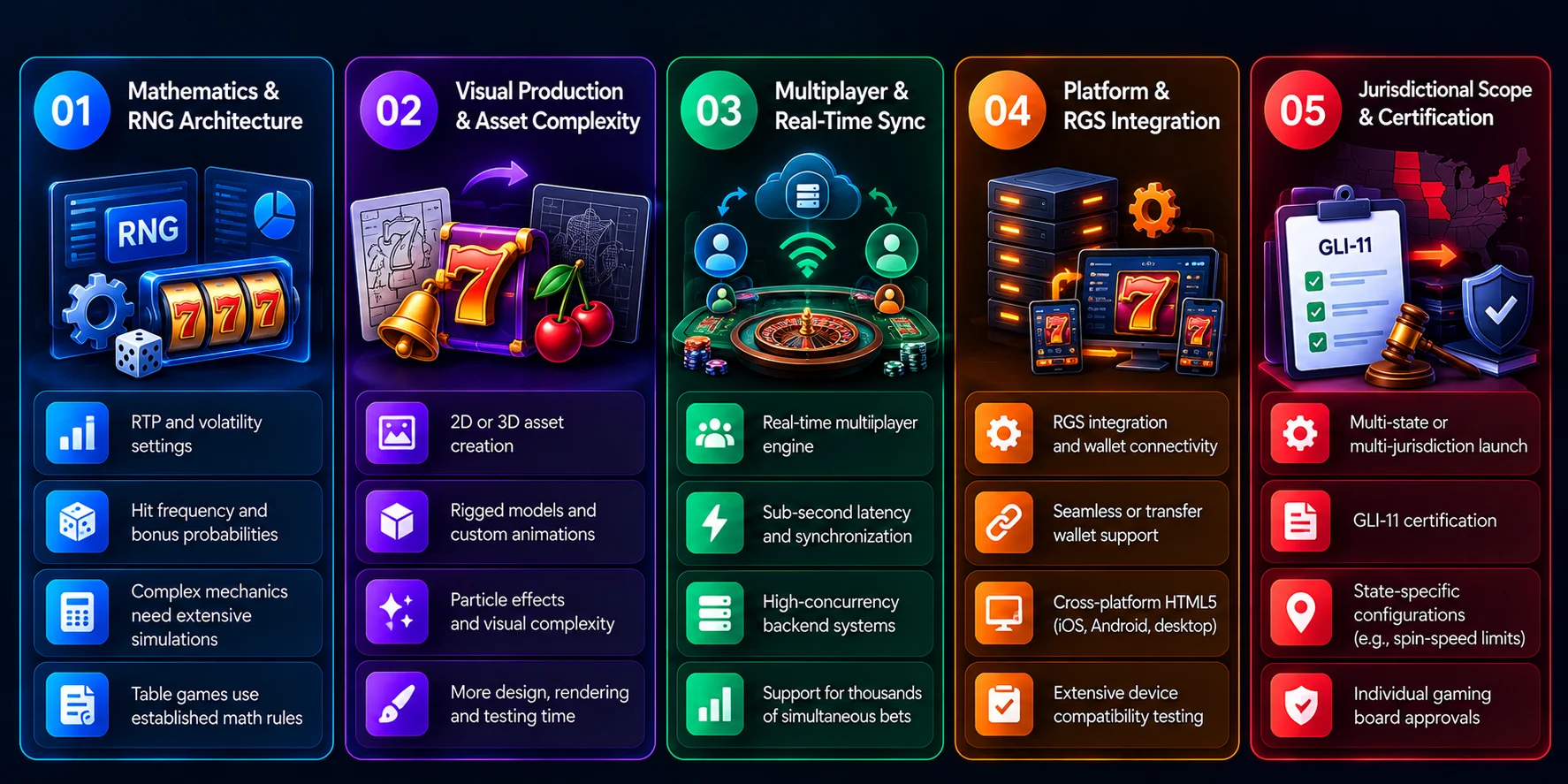
1. Mathematics & RNG Architecture
The math model and RNG architecture establish RTP, volatility, hit frequency and bonus probabilities. Complex slot mechanics need millions of simulations, while table games generally follow established mathematical rules.
2. Visual Production & Asset Complexity
Visual complexity directly affects production time. Moving from 2D vector assets to rigged 3D models, particle effects and custom animations requires more design, rendering and testing resources.
3. Multiplayer & Real-Time Sync
Multiplayer casino games require more engineering than single-player RNG titles, with WebSocket state management, sub-second latency and high-concurrency backend systems supporting thousands of simultaneous bets.
4. Platform & RGS Integration
RGS integration adds development and testing requirements, particularly when supporting seamless or transfer wallets. Cross-platform HTML5 compatibility across iOS, Android and desktop also requires extensive device testing.
5. Jurisdictional Scope & Certification
The regulatory certification timeline increases with jurisdictional coverage. Multi-state launches may require GLI-11 certification, state-specific configurations such as spin-speed limits or disabled autoplay, and individual gaming board approvals.
What Are the Stages of Casino Game Development?
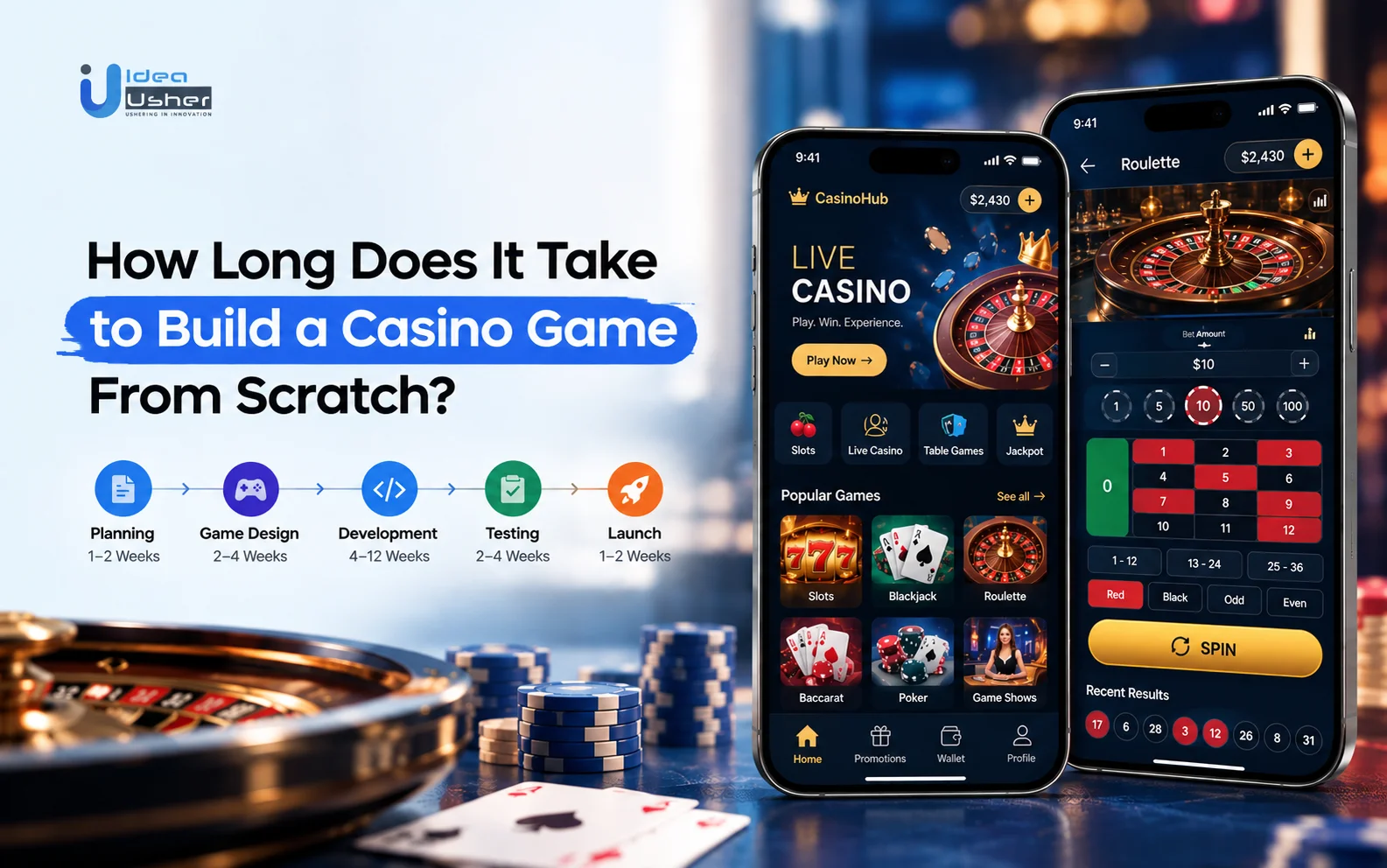
Building a commercial casino game involves coordinated stages covering game design, mathematics, development, integration, testing, certification and deployment. For a standard-to-advanced game, the complete casino game development timeline typically spans around 34 weeks (approximately 8 months). These phases overlap, so their individual durations should not be added together.
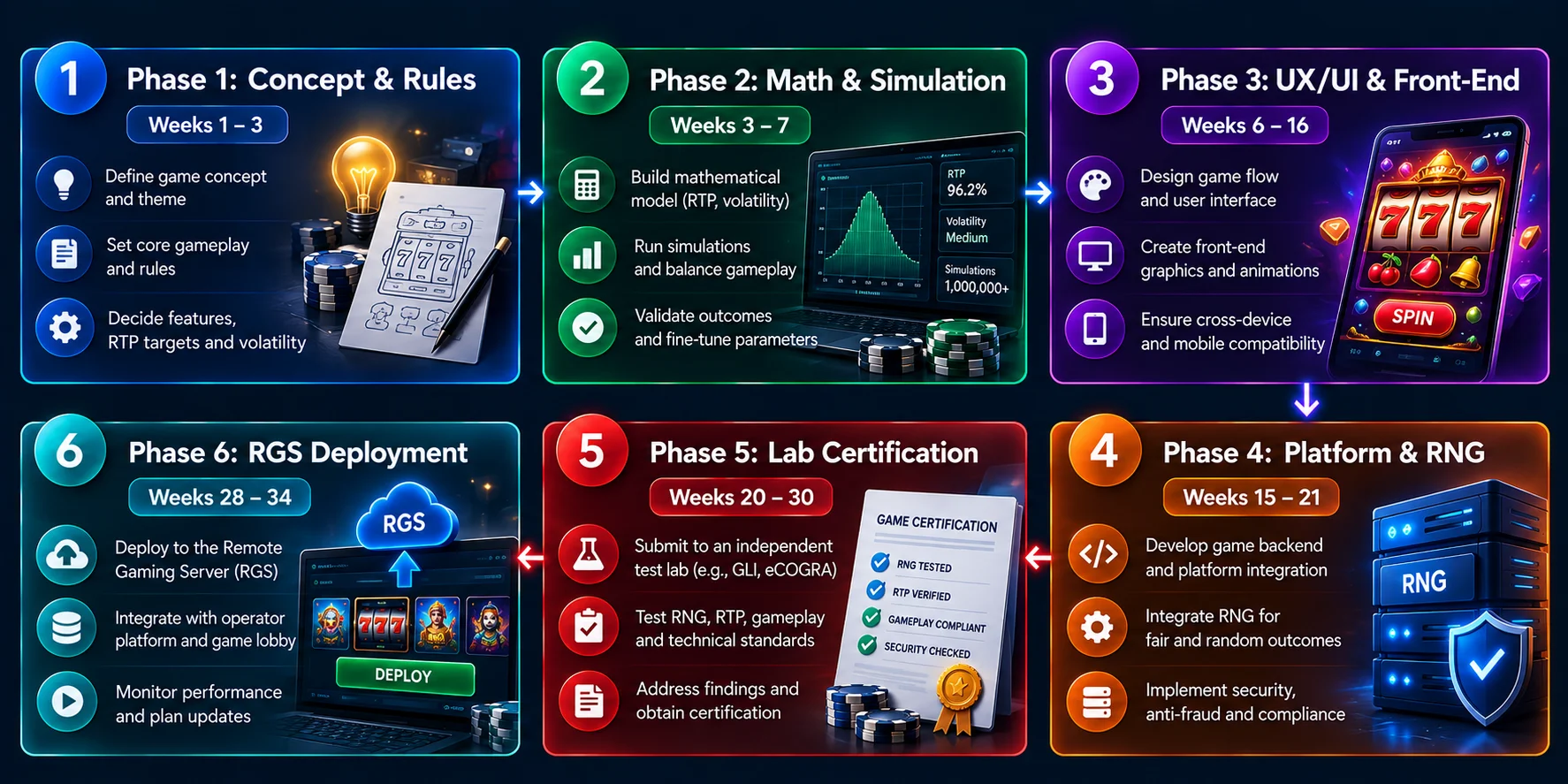
1. Game Concept and Mechanics
Phase Timeline: Weeks 1 – 3 (Duration: ~3 Weeks)
Before drafting code or designing art, product leads and game designers define the functional blueprint.
- Game Design Document (GDD): Creation of a detailed specification covering reel configuration (e.g., 5×3 reels, Megaways, or grid-pay), payline structures, bonus features (free spins, hold-and-spin, multipliers), and target demographic profiling.
- Jurisdictional & Market Alignment: Establishing baseline compliance restrictions early (e.g., checking if local target markets permit feature-buy mechanics or auto-play options).
- Visual & Sound Briefing: Setting theme aesthetics (2D vs. 3D, particle effects, UI themes) and audio direction.
2. Mathematical Modeling and RTP Calculation
Phase Timeline: Weeks 3 – 7 (Duration: ~4 Weeks)
The math model is the core operational engine of any casino game. It governs theoretical revenue, player retention, and volatility profiles.
- PAR Sheet (Probability and Accounting Report) Development: Mathematicians build mathematical models defining Return to Player (RTP) percentages (typically configured between 92% and 97%), volatility indices, hit frequencies, and win distribution bounds.
- Monte Carlo Simulations: Running automated scripts over 100 million to 1 billion simulated spins to verify that real-world statistical outcomes match the theoretical math model without unintended variance leaks.
- Configurable RTP Variants: Creating multiple RTP profiles (e.g., 96%, 94%, 92%) within the same paytable code so operators can adjust settings based on local state tax rates.
3. UX/UI Design and Game Development
Phase Timeline: Weeks 6 – 16 (Duration: ~10 Weeks)
This phase translates the visual concept and mathematical rules into high-performance front-end client software.
- Asset Creation & Spine Animation: Graphic artists and 3D animators build symbol sets, character rigs, background environments, and victory animations using tools like Spine 2D or Blender.
- Responsive HTML5 Front-End Engineering: Developing lightweight, cross-platform client builds (Cocos Creator, PixiJS, or Phaser) optimized for immediate rendering in mobile web view browsers and native iOS/Android wrappers.
- Audio Engineering: Composing dynamic background music, reel-spin sound effects, and win-tier celebratory audio cues.
4. RNG and Casino Platform Integration
Phase Timeline: Weeks 15 – 21 (Duration: ~6 Weeks)
During this phase, the client UI is connected to the backend game server and Random Number Generator (RNG) infrastructure.
- RNG Logic & State Engine: Wiring the game logic directly to a cryptographically secure Random Number Generator (hardware or software-based).
- Seamless Wallet API Integration: Implementing REST/gRPC backend protocols to handle real-money bet deductions, win credits, transaction rollbacks, and mid-spin disconnection recovery.
- Regulatory Event Logging: Engineering immutable audit logs recording every round ID, seed, balance change, timestamp, and player input to meet GLI-11 data retention specifications.
5. Testing, Certification and Compliance
Phase Timeline: Weeks 20 – 30 (Duration: ~10 Weeks)
Before public launch, the completed game build is submitted to an accredited Independent Testing Laboratory (ITL) such as GLI, BMM Testlabs, or iTech Labs—for formal certification.
- Source Code & Hash Verification: Auditors inspect the source code to verify that math execution matches the PAR sheet and generate SHA-256 cryptographic signature hashes.
- Statistical RNG Audits: Independent verification of outcome randomness and RTP distribution under stress load.
- Edge-Case & Interruption Testing: Forcing connection drops, system reboots, and wallet timeouts mid-bonus round to ensure session state recovers accurately without loss of player funds.
6. Deployment and Casino Game Launch
Phase Timeline: Weeks 28 – 34 (Duration: ~6 Weeks)
Once certified, the game binary and lab reports are deployed to operator networks for commercial release.
- Remote Game Server (RGS) Upload: Deploying certified game builds to regional server nodes hosting the game client and outcome engine.
- Operator Aggregator Distribution: Connecting the RGS feed to casino platform lobbies, enabling single-click activation across multiple online operator sites.
- Controlled Soft Launch & Live Monitoring: Monitoring live player metrics, latency, wallet throughput, and error rates during a brief soft-launch window before initiating full commercial marketing campaigns.
How Much Does It Cost to Build a Casino Game?
Developing a single commercial casino game for US regulated markets generally ranges from $25,000 to $250,000+ per title. While offshore or social gaming titles can be produced for significantly less, real-money iGaming titles deployed in states like New Jersey, Pennsylvania, or Michigan incur specialized mathematical, certification, and remote server integration expenses that elevate the baseline capital expenditure.
A. How Game Complexity Changes Development Cost
Casino game development costs scale directly with the underlying mechanics, art fidelity, and backend infrastructure required to run the game reliably at scale:
| Game Category | Estimated Market Cost | Key Cost Drivers & Engineering Scope |
| Basic 2D Video Slot | $25,000 – $50,000 | Standard 5×3 reel layout, static wild symbols, fixed paylines, single RTP configuration, standard GLI-11 compliance. |
| Mid-Tier Feature Slot | $50,000 – $100,000 | 2D/3D hybrid assets, cascading reels, free spin bonus rounds, expanding wilds, multi-RTP variant profiles. |
| Advanced / Megaways Slot | $100,000 – $180,000+ | Complex variable reel mechanics, multi-level interactive bonus mini-games, high-polygon 3D animations, custom sound score. |
| RNG Table Game | $30,000 – $65,000 | Digital Blackjack, Roulette, or Baccarat; multi-hand betting UI, strict statutory house-edge math, side-bet logic. |
| Real-Time Crash / Instant-Win | $45,000 – $95,000 | High-concurrency WebSocket server backend, sub-second latency state sync, provably fair / RNG multiplier curve execution. |
| Live Dealer Studio Setup | $150,000 – $400,000+ | Physical studio infrastructure, optical character recognition (OCR) camera feeds, dealer control interfaces, multi-stream encoding. |
B. What Factors Affect Casino Game Development Cost?
The final casino app development production budget depends heavily on four primary cost categories:
- Art & Visual Production (30% – 40% of budget): The jump from 2D vector reels to rigged 3D models, dynamic particle effects, and cinematic win animations requires specialized technical artists and Spine animators.
- Mathematical Modeling & Simulation (15% – 25% of budget): Complex paytables, Megaways reel expansions, or multi-tiered progressive jackpots require extensive Monte Carlo simulation runs (100M+ spins) to verify RTP accuracy and volatility profiles.
- Software & RGS Engineering (25% – 35% of budget): Building cross-platform HTML5 clients that execute smoothly across native iOS WebViews, Android, and desktop browsers, alongside secure Remote Game Server (RGS) communication layers.
- Independent Lab Certification (10% – 20% of budget): Fees paid directly to accredited testing labs (such as GLI, BMM Testlabs, or iTech Labs) for GLI-11 RNG and source code verification, plus individual state gaming board administrative filings.
C. Does Faster Development Increase Casino Game Cost?
Attempting to accelerate production without altering the game’s scope naturally increases overall expenditure due to resource re-allocation and risk mitigation:
- Overtime & Parallel Team Allocation (+20% to +40% labor cost): Compressing a 6-month development schedule into 3 months requires assigning multiple front-end engineers, artists, and QA testers simultaneously, increasing coordination overhead.
- Rush Fees for Lab Certification (+25% to +50% lab surcharge): Independent testing laboratories charge priority surcharges to expedite source code reviews and RNG simulation verification.
- Higher Post-Launch Patching Risk: Rushing mathematical verification or client optimization increases the probability of post-launch edge-case bugs, potentially leading to emergency game withdrawals, platform downtime, or regulatory penalties.
Commercial Strategy Note: Rather than rushing a single bespoke title at a premium cost, established operators build games on a modular engine framework. By reusing core wallet wrappers, reel math engines, and UI layouts across multiple titles, studios reduce per-game development costs by up to 50% while cutting time-to-market in half.
What Can Delay a Casino Game Development Timeline?
Even well-funded casino development projects can run into costly timeline overruns if critical dependencies are managed reactively. Because regulated online gaming operates at the intersection of complex software engineering, advanced mathematics, and strict statutory compliance, a bottleneck in any single domain can stall a game’s release for weeks or months.
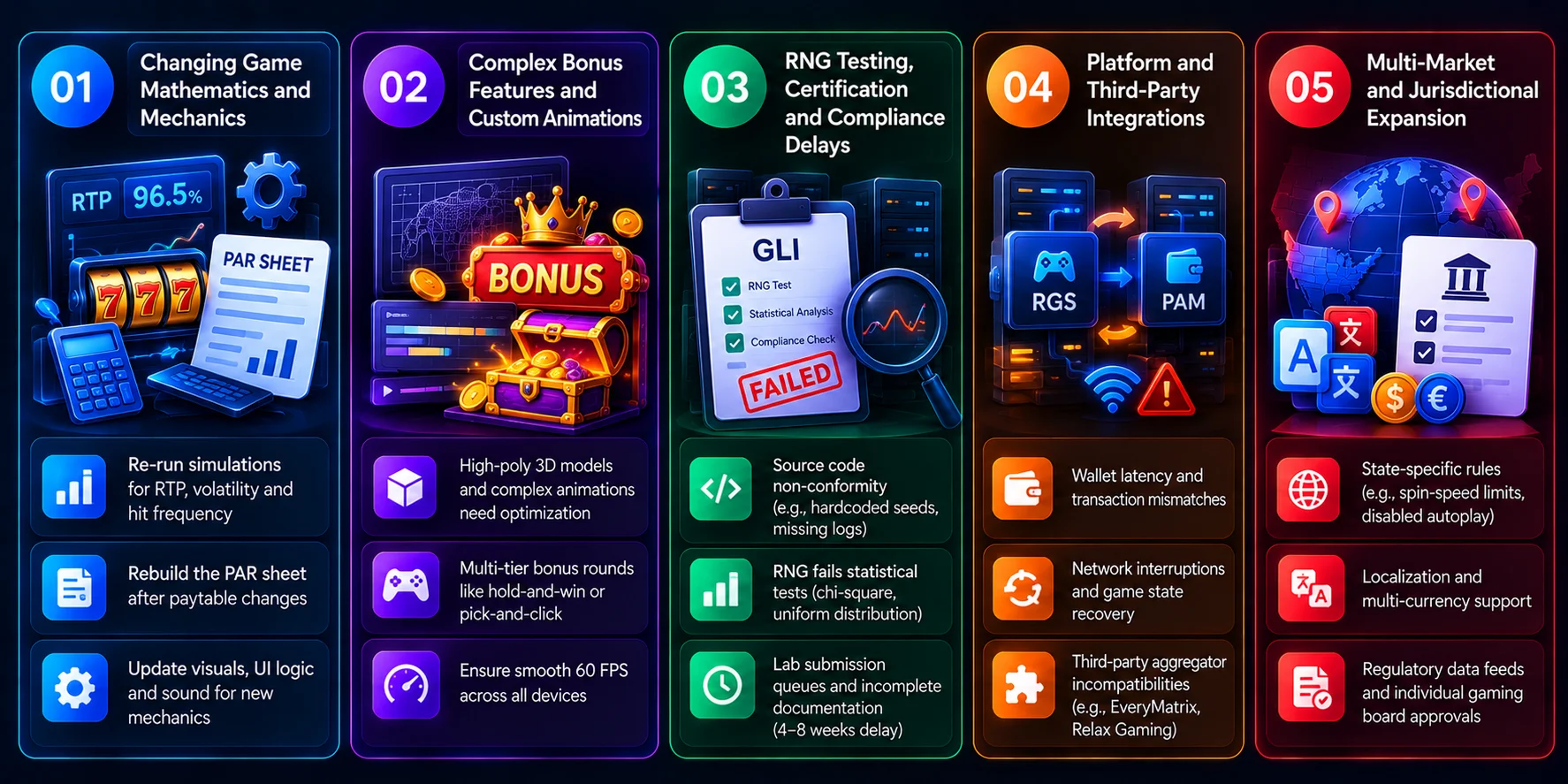
A. Changing Game Mathematics and Mechanics Mid-Development
Altering core mechanics, paytable structures, or bonus rules after coding has begun creates a cascade of rework across both the front-end animation and backend simulation pipelines.
- Re-running Monte Carlo Simulations: Changes to RTP, volatility or hit frequency require re-running simulations across 100 million to 1 billion spins to validate payout boundaries.
- Rebuilding the PAR Sheet: Paytable changes require mathematicians to rebuild the Probability and Accounting Report (PAR Sheet), potentially invalidating existing state-machine logic.
- Front-End & Sound Re-alignment: Mechanics changes, such as converting a static payline game into a cascading multiplier title, require updated visual assets, UI state logic and win-tier sound compositions.
B. Complex Bonus Features and Custom Game Animations
Feature creep and high-fidelity production assets are among the most common causes of visual and performance bottlenecks during client-side engineering.
- Heavy 3D Asset Optimization: High-poly 3D models, cinematic intros and complex particle effects increase file sizes, requiring heavy optimization to prevent mobile WebView crashes.
- Complex Interactive Mini-Games: Multi-tier bonus rounds, such as hold-and-win or pick-and-click mechanics, require dedicated sub-state machines, custom Spine 2D animations and complex event listeners.
- Cross-Device Performance Bottlenecks: Maintaining smooth 60 FPS performance across low-end Android devices, iPhones and desktop browsers requires extensive memory and performance optimization.
C. RNG Testing, Certification and Compliance Delays
Submitting code to an Independent Testing Laboratory (ITL) such as GLI, BMM Testlabs, or iTech Labs without pre-compliance testing is a leading cause of multi-month release delays.
- Source Code Non-Conformity: Failed audits caused by hardcoded seed values, non-compliant disconnection logic or missing state logging require code refactoring and resubmission.
- RNG Simulation & Statistical Failures: If the RNG fails chi-square or uniform distribution tests during lab verification, the engine must be debugged and re-tested.
- Lab Submission Queues: Testing labs operate on scheduled queues. Incomplete documentation, missing compile instructions or flawed build packages can push submissions to the back of the queue, adding 4–8 weeks of delay.
D. Complex Casino Platform and Third-Party Integrations
Connecting a Remote Game Server (RGS) or game client to a Player Account Management (PAM) system, aggregator API, or casino wallet introduces technical friction across network protocols.
- Wallet Latency & Transaction Mismatches: Differences between game transaction speed and PAM wallet API response times can cause session timeouts or failed bet validations.
- Network Interruption & State Recovery: If a player disconnects mid-spin or during a bonus round, the platform must restore the exact game state and balance data upon re-login.
- Aggregator Middleware Incompatibilities: Third-party aggregator integrations such as EveryMatrix and Relax Gaming require custom casino integration testing for each aggregator engine.
E. Expanding the Game for Multiple Markets and Jurisdictions
Deploying a single game build across multiple state or international jurisdictions requires managing varying regulatory rules, localization standards, and technical specs.
| Jurisdictional Requirement | Operational Impact | Potential Delay Factors |
| State-Specific Gameplay Rules | Adjusting spin speeds, disabling auto-play or removing bonus-buy features based on state requirements. | Requires conditional client-side logic and multi-build QA testing. |
| Localization & Multi-Currency | Translating paytables, UI text and voiceovers while supporting dynamic currency formatting. | Text overflow, font-rendering issues and incorrect currency scaling. |
| Regulatory Vault Data Feeds | Formatting daily or real-time audit logs for state revenue databases such as NJ DGE or PGCB vaults. | Schema mismatches or missing state-mandated logging parameters. |
| Individual State Gaming Board Approvals | Obtaining formal approval from state gaming authorities after laboratory certification. | Administrative backlogs at state gaming commissions can delay deployment. |
How Can You Reduce Casino Game Development Time?
Accelerating time to market without compromising jurisdictional compliance or mathematical integrity requires shifting from bespoke, linear development to a modular, parallel engineering framework. By decoupling creative production from compliance engineering and establishing reusable core systems, studios can collapse production cycles from 6–9 months down to 2 to 4 months per title.
A. Finalize Game Mathematics Before Development
Changing paytables, RTP percentages, or volatility profiles midway through production forces immediate rework across asset pipelines, reel animations, audio timing, and server-side state machines.
- Freeze Math Specifications Early: Secure signed approval for the PAR sheet and volatility parameters during discovery, before front-end development or 3D rigging begins.
- Run Early Monte Carlo Simulations: Execute 100-million to 1-billion spin simulations in the initial sprint to validate RTP bounds and hit frequencies, avoiding costly post-development math changes.
- Build Multi-RTP Profiles Upfront: Pre-configure interchangeable RTP variants (96%, 94%, 92%) in the PAR sheet architecture so operators can adjust settings for different jurisdictions without code changes.
B. Use Reusable Game Development Components
Reinventing core mechanics for every game slows production down unnecessarily. Studios can cut development time by maintaining a modular, tested repository of core software components.
- Modular Reel & State Engines: Use standardized HTML5 game frameworks such as PixiJS or Cocos Creator with reusable modules for reel spins, cascades, wild expansions and win-line calculations.
- Standardized Wallet & Disconnect Wrappers: Use pre-certified API wrappers for wallet transactions, session recovery and mid-spin disconnection logic across different PAM platforms.
- Templated UI/UX & Responsive Layouts: Maintain reusable control-bar templates for bet selection, spin, auto-play and balance displays across mobile portrait and desktop browsers to accelerate front-end development.
C. Prepare Certification Requirements Early
Regulatory submission delays often stem from simple administrative oversights, incomplete technical documentation, or missing compile instructions.
- Pre-Assemble the ITL Submission Package: Compile source code, SHA-256 hashes, math simulation logs and dependency lists alongside initial development to avoid submission delays.
- Conduct Pre-Compliance Audits In-House: Run static code analysis, vulnerability scans and disconnect recovery tests before submitting builds to labs such as GLI or BMM Testlabs.
- Maintain Jurisdictional Compliance Checklists: Keep an updated compliance matrix mapping state-specific requirements, such as spin-speed caps, disabled auto-play and responsible gaming overlays, to improve first-pass approval rates.
D. Run Testing and Compliance in Parallel
Waiting for a game to be 100% finished before starting QA testing or lab reviews introduces major bottlenecks near the end of the project.
- Parallel Math & RNG Verification: Submit the math engine, PAR sheet and RNG logic for lab review while front-end teams complete art and animation, reducing sequential development time.
- Automated Regression & Stress QA: Use automated tests from day one to continuously simulate client-server load, network dropouts and edge-case bonus triggers throughout development.
- Staged RGS Integration: Integrate wallet systems and sandbox testing on a staging RGS alongside final certification, enabling commercial release soon after lab certificates are issued.
How IdeaUsher Can Build Your Casino Game
Developing a casino game requires more than creating an engaging interface. The game must combine accurate mathematics, balanced RTP models, reliable RNGs, secure gameplay logic and regulatory testing to deliver a fair and production-ready experience.
IdeaUsher leverages 11+ years of software experience, 250+ technologists a 4.9/5 Clutch rating, and 1,000+ delivered builds to create custom iGaming products. We manage game mechanics, math models, backend architecture, integrations, and regulatory compliance.
A. Custom Casino Game Development
We design custom casino games around the intended player experience and mathematical model, combining configurable RTP, balanced volatility and tested game logic for different formats.
- Math Engine & Volatility Modeling: We design custom mathematics, paytables, payout distributions and configurable RTP parameters for slots, crash games, table games and live dealer formats.
- Game Logic Prototyping: Our developers run millions of automated simulations to stress-test paytables, bonus triggers and edge cases before visual production.
B. Casino Game UI, Animation and Gameplay Development
Our developers build responsive casino game interfaces with optimized rendering, animation and audio, ensuring smooth gameplay across mobile, desktop and different network conditions.
- Cross-Platform HTML5 & WebGL Engines: Deploy lightweight, mobile-first clients with PixiJS, Phaser or Unity WebGL for smooth 60fps performance across devices.
- Dynamic Audio & Visual Production: Create rich 2D/3D assets, Spine animations, particle effects and adaptive sound optimized for responsive gameplay.
C. RNG, Backend and Casino Platform Integration
We engineer secure backend systems that execute game outcomes server-side while connecting casino titles with RGS, aggregators and PAM platforms through reliable APIs.
- Deterministic Server-Side Game Logic: Execute outcomes server-side using cryptographically secure hardware/software RNGs to prevent client-side tampering.
- Aggregator & PAM Integration: Build standardized RGS architectures with seamless API connectors for leading game aggregators and Player Account Management (PAM) systems.
D. QA, Security and Certification Readiness
Our team prepares casino games for independent testing by combining structured documentation, statistical verification, security checks and clean source code that simplifies certification.
- GLI & BMM Audit Preparation: Provide game documentation, source logs and statistical verification data structured for GLI-19/BMM certification testing.
- Zero Vendor Lock-In: Retain 100% IP ownership through clean, modular and fully documented source code.
Have a casino game concept but need a realistic development timeline? Talk to Idea Usher to scope your game mechanics, technology stack, platform integrations, and certification requirements to get a comprehensive project estimate.
Conclusion
A realistic launch plan starts with understanding how mathematics, game complexity, technology, testing, certification and platform integrations influence the schedule. The casino game development timeline can range from a few months to nearly a year depending on the game format and regulatory scope. Clear requirements, early math validation, parallel testing and modular engineering can help minimize avoidable delays. With the right technical and compliance expertise, businesses can establish a predictable roadmap and move from concept to a market-ready casino game with greater confidence.
FAQs
A.1. A commercial casino game development timeline typically takes 2 to 8 months for core development, while certification, RGS integration and jurisdictional approvals can extend the overall launch timeline.
A.2. Casino game development timeline certification typically takes several weeks to 2–4 months, depending on game complexity, documentation, laboratory queues, testing requirements and the number of jurisdictions targeted for launch.
A.3. Game type, mathematical complexity, visual production, multiplayer requirements, platform integrations, RNG testing and jurisdictional certification requirements directly influence the overall casino game development timeline.
A.4. Yes, a casino game can support multiple markets through localization, multi-currency capabilities, jurisdiction-specific gameplay configurations, regulatory data requirements and separate certification or approval processes where applicable.