

Key Takeaways
- CVO software automates provider intake, primary source verification, sanctions monitoring and audit-ready reports, while final credentialing decisions stay with the client.
- NCQA evaluates more than the software: CVOs need documented procedures, quality checks, secure data handling and real operational evidence.
- Core CVO software features include provider profiles, verification tracking, discrepancy handling, reviewer workflows, audit trails and role-based access.
- The CVO software development typically costs $100,000–$550,000+; a foundational platform may cost $100,000–$180,000, while enterprise builds can exceed $550,000.
- Strong security, reliable source integrations and ongoing human review help support compliance, but software alone does not guarantee NCQA certification.
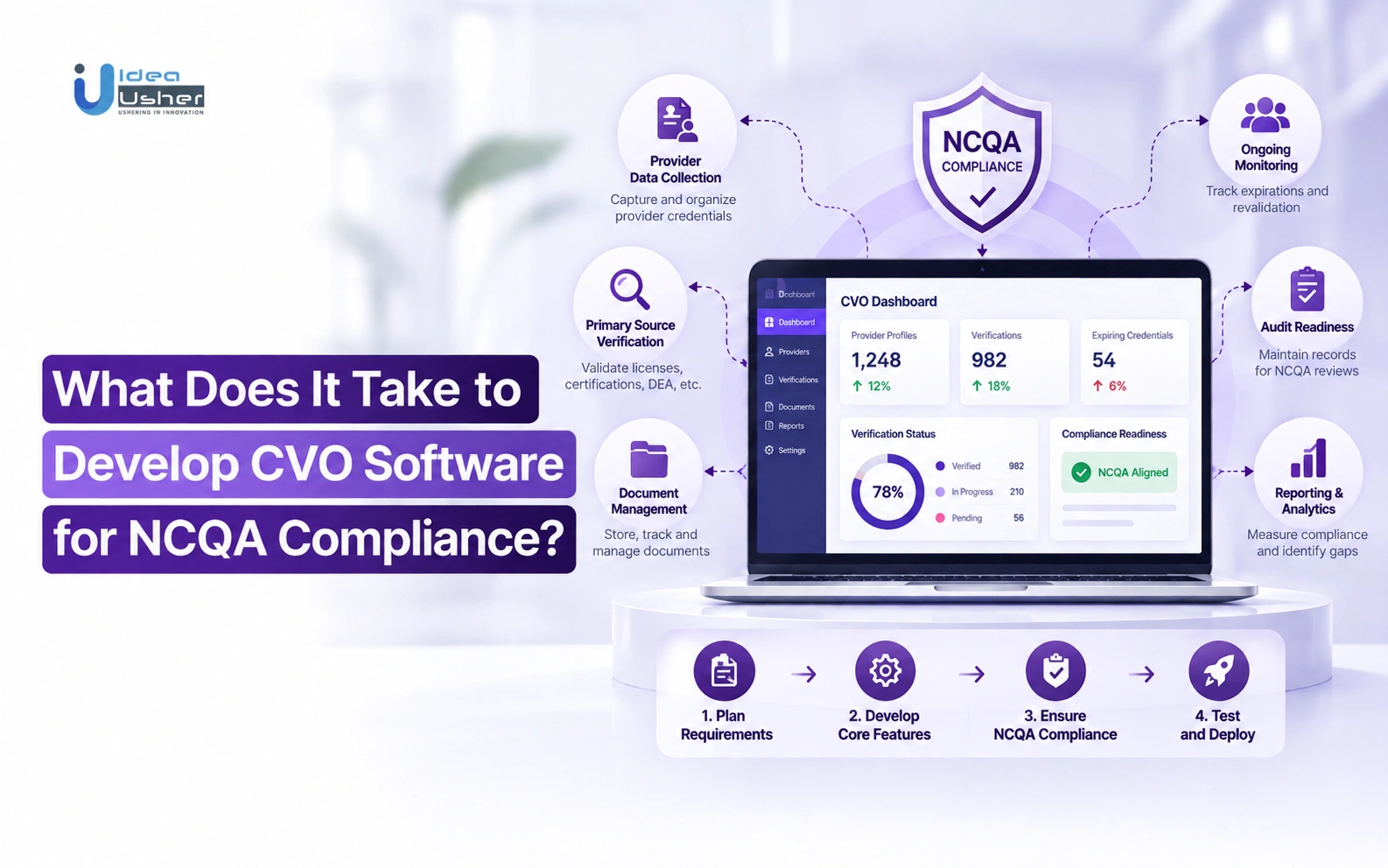
CVO software development for NCQA compliance requires a secure credentialing platform that supports primary source verification, provider data management, credential tracking, audit trails and standardized workflows. The software should be designed around applicable NCQA requirements, with integrations for sources such as NPPES, OIG, NPDB and state licensing boards. It should also include role-based access, document management, automated expiration alerts, reporting and complete verification histories to help CVOs maintain consistent and auditable credentialing processes.
A purpose-built platform needs more than document storage. The CVO software should bring together provider data, primary-source verification, credentialing workflows, recredentialing schedules and evidence tracking. It should give authorized team members a clear view of each case, with compliance built into the system from the start rather than added as a final step.
In this blog, we will talk about the core features, development steps, integrations, security measures and key considerations for healthcare CVO software development aligned with NCQA requirements, along with industry developments and compliance considerations that shape successful product launches and long-term scalability.
What Is CVO Software and Why Does NCQA Compliance Matter?
A Credentials Verification Organization (CVO) operates as an independent, specialized entity that conducts Primary Source Verification (PSV) on behalf of health plans, hospital systems, telehealth providers, and ambulatory networks. Rather than every clinic or payer running duplicate inquiries to verify the same doctor’s medical degree or state license, a CVO centralizes data collection, runs external source checks, and assembles audit-ready verification files.
For healthcare enterprises, partnering with or operating as an NCQA-certified CVO is a strategic growth driver:
- Instant Delegated Credentialing: Commercial health plans and Medicaid programs delegate credentialing directly to organizations using an NCQA-certified CVO. This bypasses slow credentialing committees, cutting clinician start dates from 120+ days to a few weeks.
- Deemed Status & Audit Relief: When health plans are surveyed by regulators, contracting with an NCQA-certified CVO confers automatic credit for the certified verification elements, eliminating redundant file audits.
A. What Does a Credentials Verification Organization Do?
A CVO handles the heavy administrative and investigative legwork required to prove a practitioner’s professional standing before clinical privileges or network participation are granted:
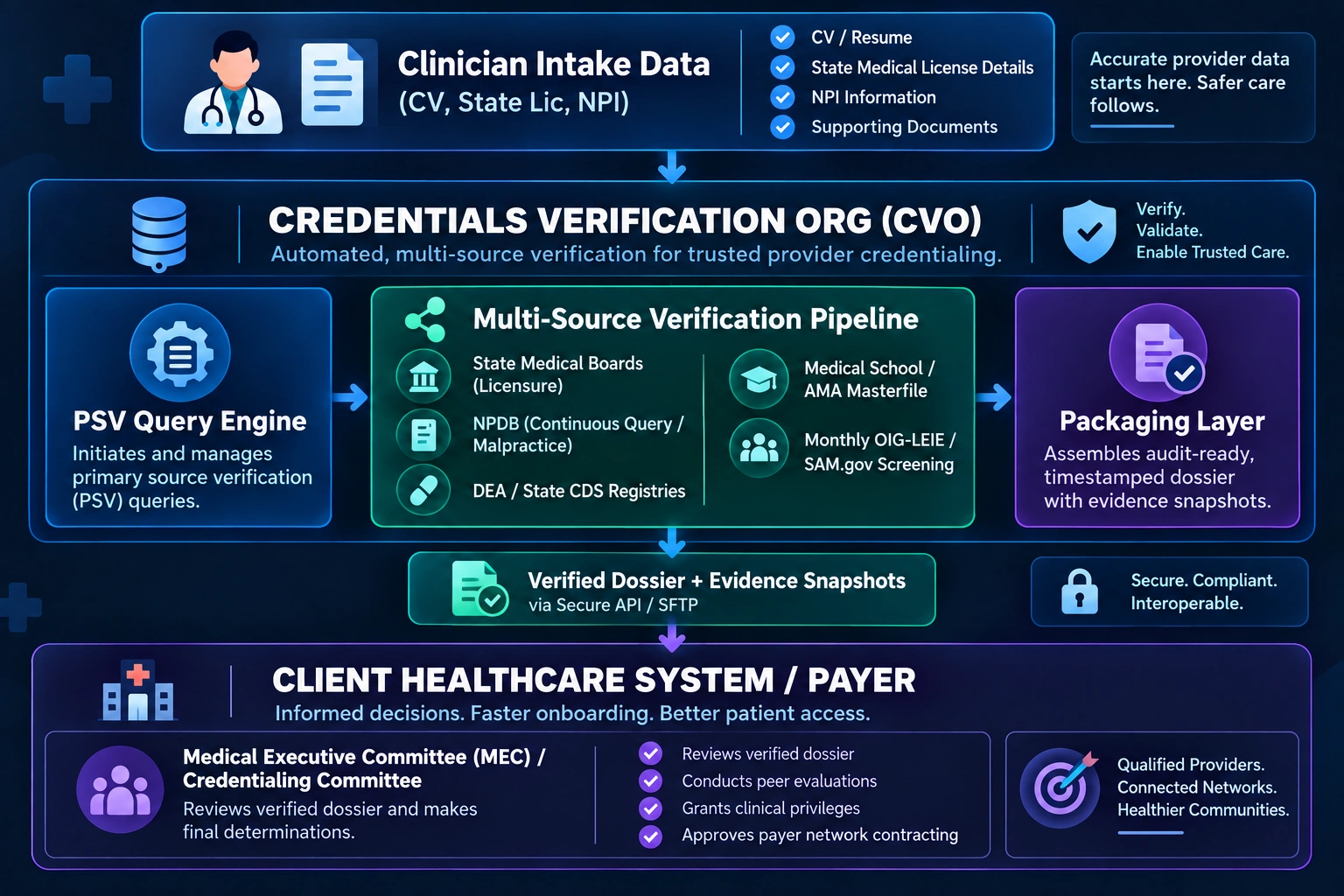
The workflow typically moves from provider intake and primary source verification to ongoing monitoring and final dossier preparation, creating a structured process that supports accurate, compliant and timely credentialing decisions.
- Intake & Application Processing: Collects applications, signed attestations, work histories, and consent forms from providers.
- Primary Source Verification: Directly queries official registries (state boards, medical schools, DEA, NPDB) to validate claimed credentials.
- Ongoing Sanctions Monitoring: Continuously screens active provider rosters against state and federal exclusion lists (OIG-LEIE, SAM.gov, Medicaid exclusions).
- Dossier Packaging: Delivers completed, timestamped verification files back to the client’s internal Credentialing Committee or Medical Executive Committee (MEC).
Critical Distinction: A CVO collects and verifies the facts, but it does not make clinical decisions. The legal authority to grant clinical privileges or approve network participation always remains with the hiring health system or health plan’s credentialing committee.
B. How Does NCQA CVO Certification Differ From Accreditation?
While both designations come from the National Committee for Quality Assurance (NCQA), they evaluate fundamentally different scopes of organizational responsibility:
| Dimension | NCQA CVO Certification | NCQA Credentialing Accreditation |
| Target Organization | Third-party verification agencies, credentialing platforms and data networks. | Health plans, MCOs, hospitals and provider groups. |
| Evaluation Scope | Specific verification elements, such as licenses, education, DEA and sanctions. | Full credentialing lifecycle, including verification, peer review, appeals and network decisions. |
| Decision-Making | Assesses verification accuracy, timeliness and security, not committee decisions. | Assesses whether committee decisions are compliant, sound and non-discriminatory. |
| Client Benefit | Clients may meet related NCQA survey requirements by using a certified CVO. | Demonstrates that the organization’s broader credentialing process meets NCQA standards. |
C. Why Do CVOs Need Software Beyond Basic Credentialing?
Basic credentialing software is designed for an internal HR or medical staff team managing their own clinicians. A CVO operates as a multi-client service provider or platform-as-a-service, requiring distinct enterprise capabilities:
- Multi-Tenant Data Isolation: Supports dozens or hundreds of client organizations while preventing cross-client access to provider rosters, peer reviews and contract terms.
- Verification Time-Window Tracking: Tracks when each verification was performed, not just credential expiry, and flags checks nearing NCQA’s 90- or 120-day limits before committee review.
- High-Volume Verification Automation: Uses distributed queues, RPA and direct APIs to process thousands of primary-source checks across all 50 states in parallel, far beyond a typical hospital team’s monthly volume.
- Auditable Client Handoffs: Compiles verification dossiers with primary-source snapshots and securely delivers them to client EHRs or committee portals via webhooks or SFTP.
How Is the Global Healthcare Credentialing Software Market Growing?
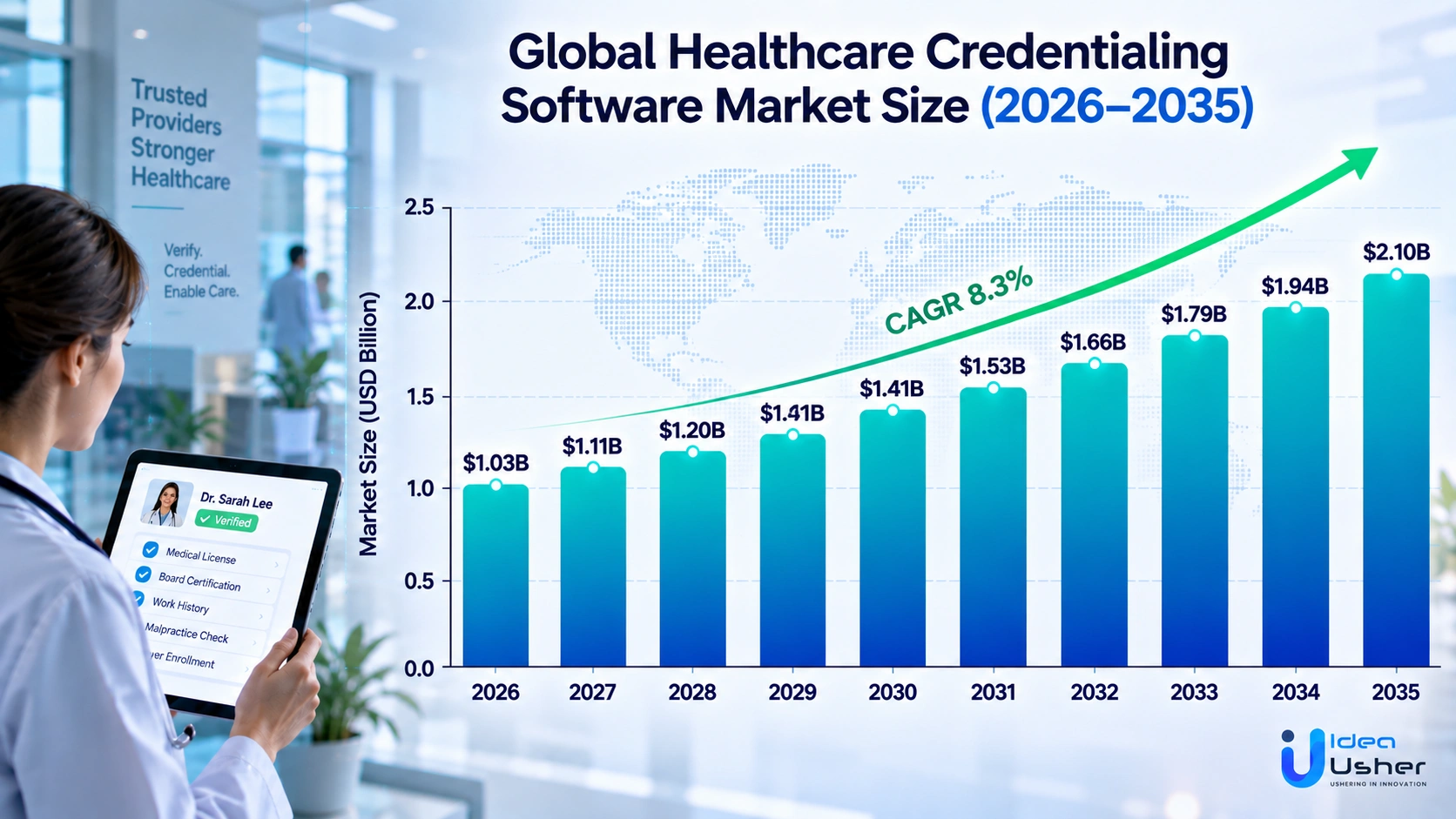
The global healthcare credentialing software and services market is projected to grow from $1.03 billion in 2026 to $2.10 billion by 2035, registering a CAGR of approximately 8.3% from 2026 to 2035. This surge signals that automation is fast becoming the default expectation, not a competitive edge, for credentialing operations.
Important Consideration: NCQA Compliance Requires More Than Software
Software alone does not make a CVO NCQA-compliant. NCQA evaluates verification operations, policies, documentation, quality processes and information protection, while software provides the controls and evidence supporting them.
NCQA states that the typical CVO evaluation timeframe is about 12 months from application submission to decision, depending on organizational readiness.
Fewer than 80 credentialing verification organizations across the United States currently hold NCQA certification or URAC accreditation, according to PCVS, showing how few platforms actually clear this bar despite the widespread software adoption driving the market growth figures reported above
A. Why Credentialing Software Launches Can Stall Without NCQA Readiness
NCQA-certified platforms can complete credentialing in as little as 48 hours, compared with the industry-standard 60 to 120 day turnaround most organizations still experience today, a gap that often exposes readiness shortfalls the moment a platform tries to scale later. This creates three practical failure points for teams that treat certification as a post-launch add-on:
- Evidence gaps surface late: A platform can verify credentials correctly in production for months and still fail certification if it never captured the documentation NCQA requires as proof of the process.
- Delegation agreements stall: Health plans and hospital networks often won’t sign delegated credentialing agreements with a CVO that isn’t certified, which caps revenue potential until certification clears.
- Rework costs compound: Retrofitting audit trails, policy documentation and quality processes into a live platform is significantly more expensive than designing for NCQA’s evidence requirements from day one.
The practical result: a technically functional platform and an NCQA-ready one are not the same product, and the gap between them is measured in months of delegation revenue, not just engineering hours.
B. What Should Enterprises Evaluate Before Investing in CVO Software?
Symplr’s CVO division reportedly processes more than 3 million provider files annually while maintaining full certification across all 11 NCQA verification elements, illustrating the operational scale enterprises should realistically expect before signing a large, long-term platform contract.
- Certification scope: Does the platform support all relevant NCQA verification elements, or only a partial subset that will need workarounds later?
- Operational readiness: Can the vendor demonstrate documented policies and quality processes, not just software features, that map to NCQA’s actual evaluation criteria?
- Verification workflows: Does PSV logic match how your organization actually delegates and reviews credentialing decisions internally?
- Security and data protection: Does the platform meet HIPAA and NCQA’s information-protection standards for storing sensitive provider data?
- Evidence management: Can the system generate audit-ready documentation automatically, rather than requiring manual reconstruction during a review?
- Integration depth: Does it connect natively to CAQH, NPDB, EHR and PM systems, or will data still move manually between platforms?
This checklist is what determines whether a platform is a genuine long-term investment or a tool that will need re-architecting the moment certification or scale enters the picture, which is exactly the ground the feature comparison and cost breakdown sections above cover in detail.
What Does NCQA Evaluate in a CVO’s Verification Process?
The National Committee for Quality Assurance (NCQA) evaluates Credentials Verification Organizations (CVOs) to confirm credential data supplied to health plans and clinical systems is accurate, timely, and independently verified. Certification requires a thorough audit of operational policies, data pipelines, and system integrity.
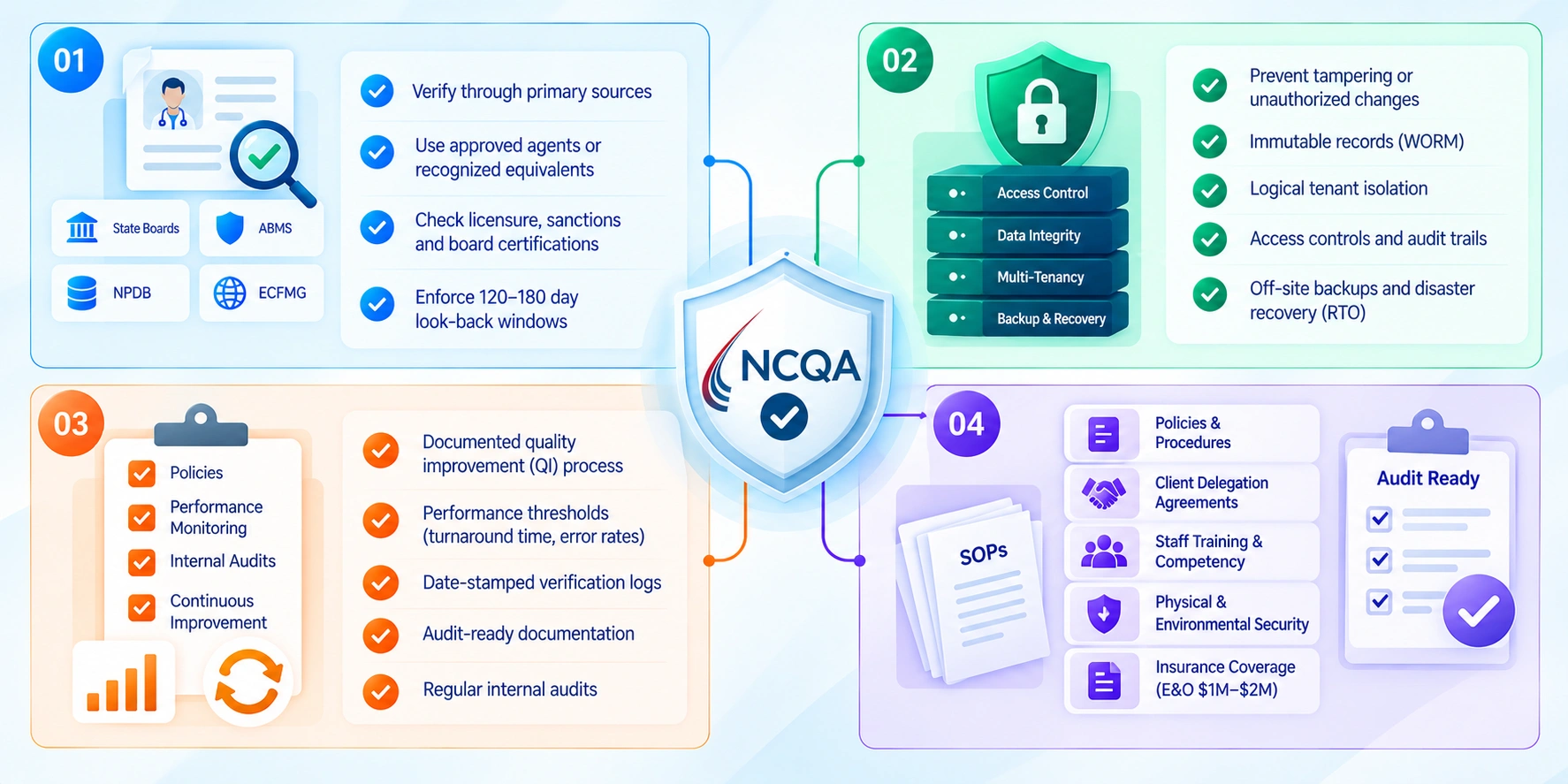
NCQA assesses performance across three structural pillars: Verifying Credentials, Protecting Credentialing Information, and an Internal Quality Improvement (QI) Process.
A. Primary Source Verification and Recognized Sources
NCQA assesses whether qualifications are verified through primary sources, approved agents, or recognized equivalents such as licensing boards, ABMS, AMA/AOA Masterfiles, NPDB and ECFMG. It also enforces time-limit look-back windows, checking whether licensure, sanctions and board certifications were verified within 120 or 180 days before client committee transmission.
B. Credentialing Information Protection and Access Controls
NCQA standards strictly scrutinize how provider data is protected against tampering, unauthorized alteration, and security breaches.
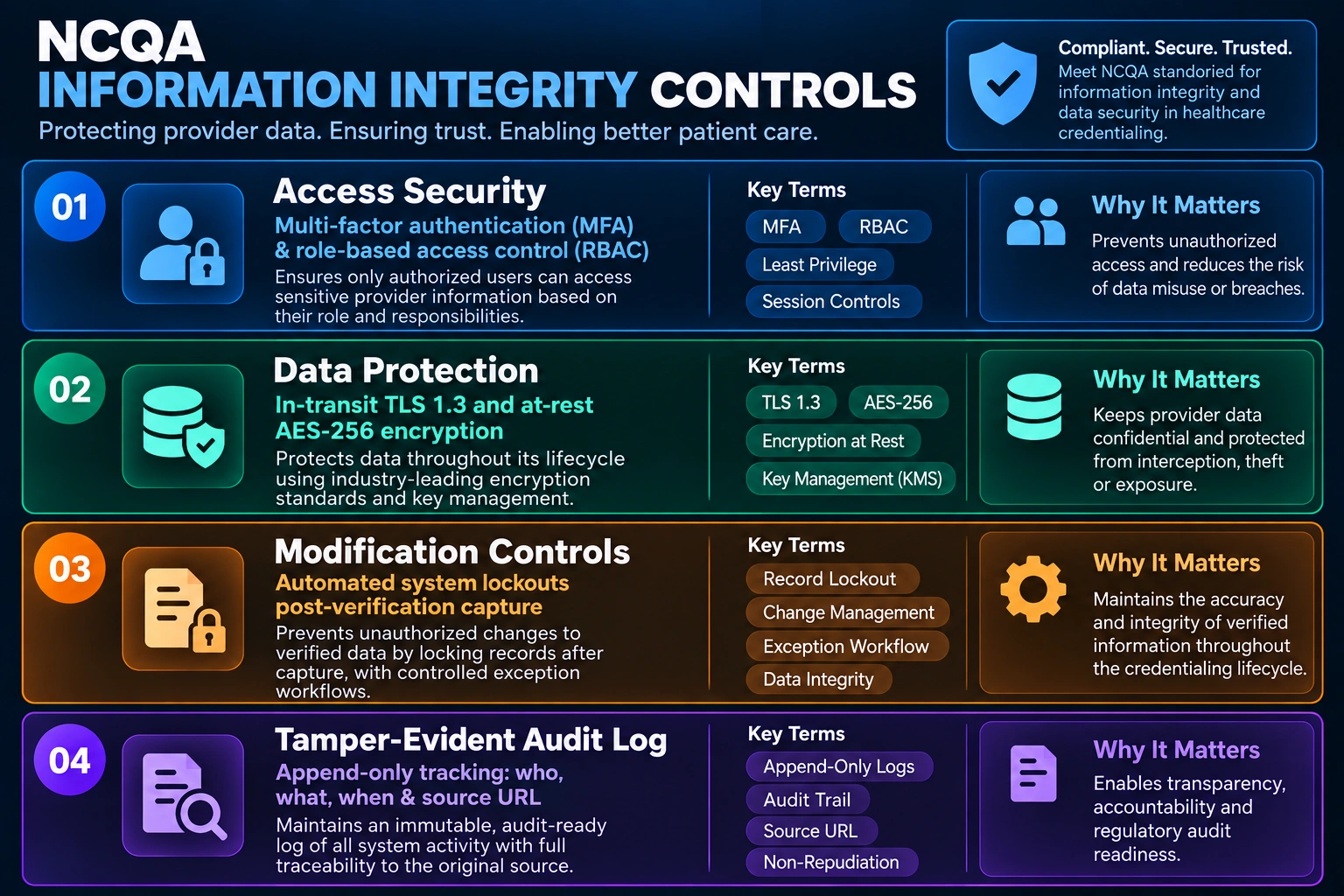
Evaluators audit the software’s underlying data protection architecture, focusing on access controls, data integrity, tenant isolation and recovery mechanisms that support secure credentialing operations.
- Data Immutability (WORM): Once a primary source confirmation or webpage snapshot is ingested, the record must be programmatically locked. Auditors verify that operators cannot alter verification dates, credential numbers or status flags without an indelible system audit trail.
- Security & Multi-Tenancy: The CVO must prove logical data partitioning, ensuring Client A cannot access Client B’s provider records, peer files or contracting data.
- Business Continuity & Disaster Recovery: Evaluators review off-site backups, automated failover and recovery time objectives (RTO) to ensure credential records cannot be permanently lost.
C. Documentation, Quality Improvement, and Audit Readiness
NCQA evaluates formal Quality Improvement (QI) processes. CVOs must document clear policies, establish performance thresholds for verification turnaround times and error rates, and conduct regular internal audits. Surveyors review sampled provider files for complete, date-stamped verification logs and documented application workflows.
D. How NCQA Evaluates CVO Operations Beyond Software
An NCQA survey is a deep-dive operational inspection conducted over months, typically requiring a 6-month look-back period of active operational evidence before initial certification:
| Operational Area | What Evaluators Inspect |
| Policies & Procedures | SOPs for escalating verification anomalies, provider discrepancies and license restrictions. |
| Client Delegation Agreements | Written contracts defining responsibilities, reporting schedules and client audit rights. |
| Staff Training & Competency | Records of onboarding, annual compliance training and credentialing staff competency reviews. |
| Physical & Environmental Security | Clean-desk rules, visitor badges, server-room access and secure paper-record disposal. |
| Insurance Coverage | Active Errors & Omissions (E&O) insurance, typically $1M–$2M, for negligent credentialing claims. |
Passing an NCQA evaluation requires enterprise leaders to align software automation with operational discipline, proving to survey teams that the technology, team, and oversight framework operate as a unified, audit-proof engine.
Which Features Should NCQA-Aligned CVO Software Include?
NCQA-aligned CVO software should include primary source verification, automated sanction monitoring, immutable audit trails, provider data management, quality improvement workflows and reporting tools.
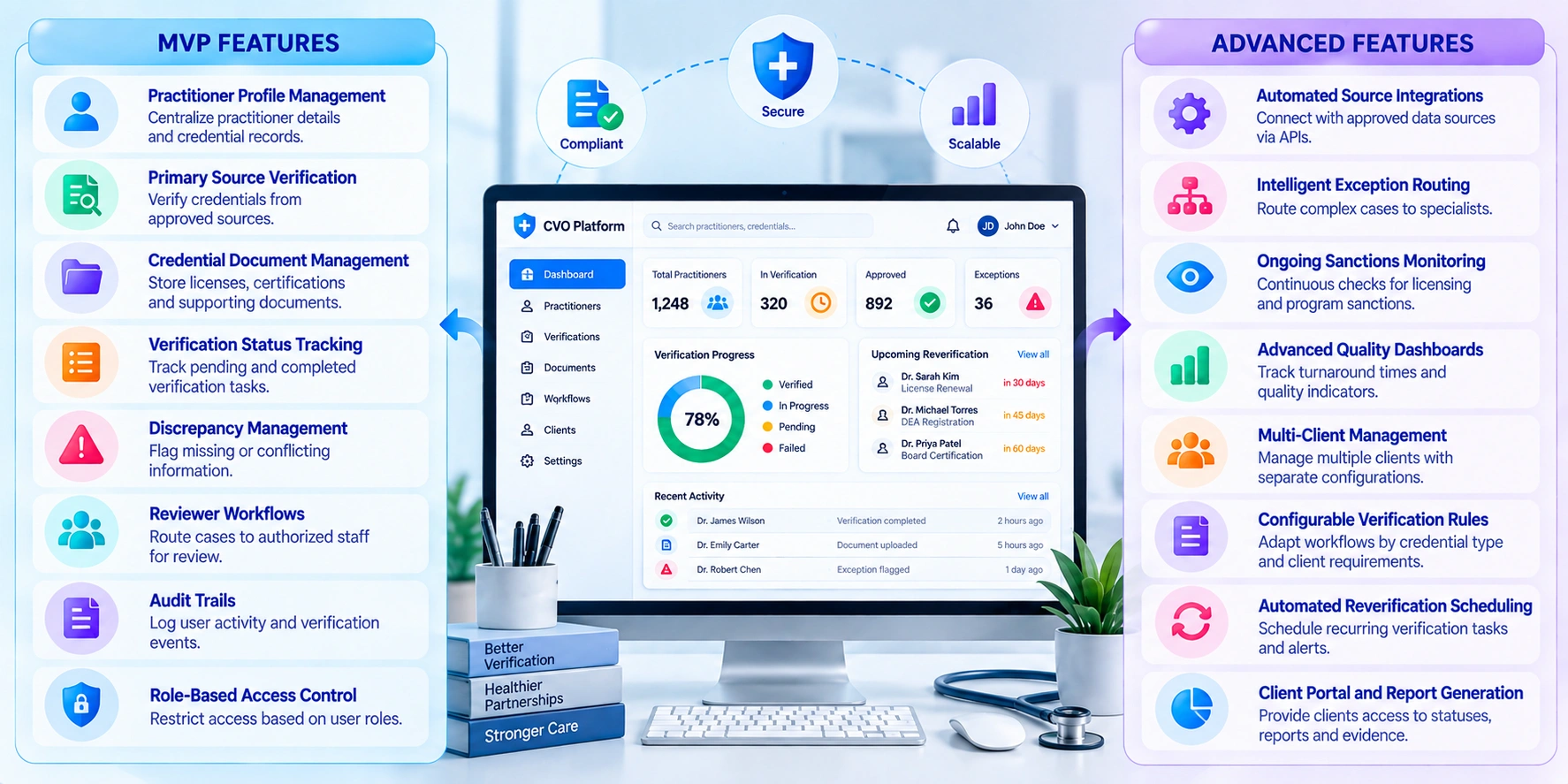
The following tables detail MVP features of CVO software development to run intake and verification capabilities as well as advanced enterprise integrations, exception routing, and multi-client operational management.
A. Essential CVO Software Features for an MVP
An NCQA-aligned CVO’s MVP needs to support practitioner intake, documented verification, secure credential storage, and controlled record access from day one, since these eight capabilities form the defensible core of any compliant verification process.
| Feature | What It Does | Why It Matters |
| Practitioner Profile Management | Centralizes practitioner details, applications, and credential records in one unified system | Reduces duplicate data entry and keeps verification information organized across every file |
| Primary Source Verification | Records credential checks against primary sources or other recognized verification authorities directly | Supports documented verification processes and full source traceability for every credential reviewed |
| Credential Document Management | Stores licenses, education records, certifications, and supporting documents for each practitioner | Makes credential evidence accessible for review, retrieval, and audit at any time |
| Verification Status Tracking | Tracks pending, completed, and failed verification tasks across the practitioner’s full file | Helps teams identify incomplete files early and manage verification workload effectively |
| Discrepancy Management | Flags conflicting, missing, or inconsistent credential information as it’s discovered during review | Ensures exceptions receive appropriate staff review before a file moves forward |
| Reviewer Workflows | Routes verification results to authorized staff for review and resolution promptly | Supports accountability and consistent internal procedures across every reviewer involved |
| Audit Trails | Records relevant user activity, changes, and verification events across the entire file | Helps demonstrate how records were handled and reviewed to auditors and regulators |
| Role-Based Access Control | Restricts credential information based on user roles and defined access permissions | Supports controlled access to sensitive practitioner records across the entire organization |
B. Enterprise CVO Software Features for Scalable Verification
Larger CVOs scale by layering automation, source integrations, and ongoing monitoring onto the MVP foundation, expanding operational oversight and multi-client capability while keeping verification just as documented and reviewable underneath.
| Feature | What It Does | Why It Matters |
| Automated Source Integrations | Connects with approved data sources through APIs or other supported retrieval methods | Reduces repetitive manual retrieval while preserving full source documentation for every check |
| Intelligent Exception Routing | Routes unusual, incomplete, or conflicting results to designated specialists for direct review | Helps verification teams prioritize the cases that genuinely need human attention |
| Ongoing Sanctions Monitoring | Supports recurring checks for applicable licensing and program sanctions across every practitioner | Helps organizations manage ongoing monitoring obligations and required follow-up workflows consistently |
| Advanced Quality Dashboards | Tracks turnaround times, verification completion, and quality indicators across the organization | Helps leaders identify bottlenecks and genuine improvement opportunities before they compound |
| Multi-Client Management | Separates client configurations, workflows, and reporting where contractually or operationally required | Supports CVOs serving multiple health plans or healthcare organizations simultaneously without overlap |
| Configurable Verification Rules | Adapts workflows to source requirements, credential types, and specific client procedures | Reduces rigid processes when operational requirements genuinely differ between clients or credential types |
| Automated Reverification Scheduling | Tracks review cycles, schedules recurring verification tasks, and alerts teams when due | Helps CVOs manage recurring workloads and avoid missed review deadlines entirely |
| Client Portal and Report Generation | Gives authorized clients access to verification statuses, reports, and supporting evidence directly | Reduces manual reporting and gives clients real visibility into verification outcomes directly |
How Do You Build a CVO Software Platform for NCQA Compliance?
The CVO software development for NCQA compliance requires translating credentialing standards into documented workflows, verification controls and reliable evidence management. The development process should connect practitioner data, primary source verification, security controls and operational testing so credentialing activities can be consistently performed and reviewed.
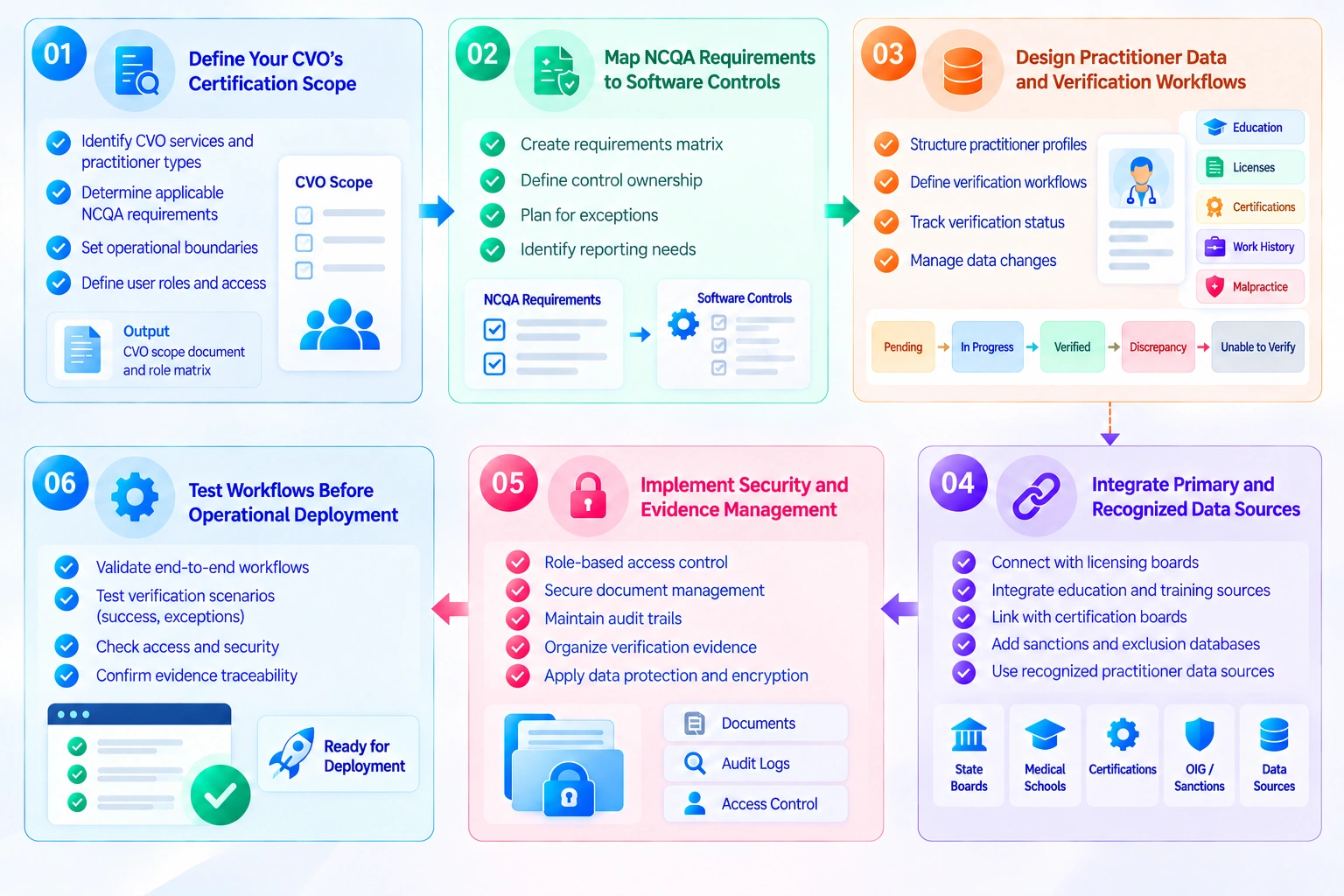
A structured approach helps define the certification scope, identify the software requirements and validate the workflows before deployment. The following steps outline how to move from requirements mapping to operational readiness.
1. Define Your CVO’s Certification Scope
Start by identifying the services the Credentials Verification Organization (CVO) will provide and the credentialing activities the software must support. The scope determines which workflows, verification requirements, user roles and evidence records need to be included.
- Define CVO Services: Identify the practitioner types and credentialing services covered by the organization.
- Identify Applicable Requirements: Determine the NCQA standards and requirements relevant to the intended certification scope.
- Establish Operational Boundaries: Clarify which activities the CVO performs and which responsibilities remain with client organizations.
- Identify User Roles: Define access and responsibilities for verification staff, quality reviewers, administrators and client representatives.
The expected output is a CVO scope document and role matrix that establish the services, responsibilities and software capabilities required for the project.
2. Map NCQA Requirements to Software Controls
Translate the applicable NCQA requirements into specific software functions, workflow rules and evidence records. This creates a clear connection between each requirement and the operational process used to address it.
- Create a Requirements Matrix: Map each applicable requirement to the workflow, control, responsible role and supporting evidence.
- Define Control Ownership: Identify who performs, reviews and approves each required activity.
- Document Exceptions: Establish how incomplete verification, discrepancies, missing documentation and overdue tasks are handled.
- Identify Reporting Needs: Determine which records and reports are needed to demonstrate that required processes were followed.
The deliverable should be an NCQA requirements-to-controls matrix that guides system design, development priorities and later validation.
3. Design Practitioner Data and Verification Workflows
Design the practitioner data model around the information the CVO needs to collect, verify, review and maintain. Each credential should have a defined verification process, status and supporting evidence.
- Structure Practitioner Profiles: Organize demographic details, education, training, licenses, certifications, work history and other required credentialing information.
- Define Verification Workflows: Map how each credential moves from data collection to source verification, discrepancy resolution and review.
- Track Verification Status: Use clear statuses such as pending, in progress, verified, discrepancy identified and unable to verify.
- Manage Data Changes: Maintain a record of updates, corrections and relevant changes to practitioner information.
The expected output is a practitioner data model and verification workflow map that define required fields, credential-specific checks, status transitions and exception handling.
4. Integrate Primary and Recognized Data Sources
Integrate the sources needed to verify practitioner credentials and retrieve relevant information. Integration decisions should account for source coverage, access methods, data quality and applicable requirements for the CVO’s scope.
| Data Source | Verification Purpose |
| State Licensing Boards | Confirm professional license details and status. |
| Medical Schools and Training Institutions | Verify education and training history. |
| Specialty Certification Boards | Validate applicable board certifications. |
| Sanctions and Exclusion Databases | Identify relevant sanctions or exclusion records. |
| Recognized Practitioner Data Sources | Retrieve available practitioner information for credentialing workflows. |
These integrations of CVO software development establish the foundation for reliable credential verification; the following controls ensure each source is connected, documented and managed consistently throughout the workflow.
- Select Integration Methods: Determine whether each source supports an API, secure data exchange, portal-based checks or manual verification.
- Normalize Source Responses: Map incoming information to consistent practitioner and credential fields.
- Record Verification Evidence: Capture source details, verification dates, results and supporting documentation.
- Handle Source Exceptions: Route unavailable records, mismatches and conflicting information for additional review.
The deliverable should be a tested integration layer that connects verification sources with practitioner records and preserves traceable verification results.
5. Implement Security and Evidence Management
Design security and evidence management into the platform so sensitive practitioner information is protected and credentialing activities can be reviewed. Access controls and evidence records should reflect the organization’s documented procedures and applicable requirements.
- Role-Based Access: Restrict practitioner data and administrative functions according to assigned responsibilities.
- Secure Document Management: Store credentialing documents with controlled access, version tracking and clear document status.
- Audit Trails: Record relevant user actions, verification updates, approvals and changes to practitioner records.
- Evidence Organization: Link source responses, verification notes and supporting documents to the relevant credential and workflow.
- Data Protection: Apply appropriate encryption, access management, backup and retention controls.
The expected output is a secure evidence management system with defined permissions, traceable activity records and organized verification documentation.
6. Test Workflows Before Operational Deployment
Validate the complete credentialing process after CVO software development against the documented requirements before the platform enters operational use. Testing should confirm that verification workflows function correctly, evidence remains traceable and exceptions are routed to the appropriate users.
- Workflow Testing: Validate practitioner onboarding, credential verification, discrepancy handling, review and approval processes.
- Verification Testing: Test successful checks, unavailable sources, conflicting information and incomplete records.
- Access and Security Testing: Confirm that users can access only the information and functions permitted by their roles.
- Evidence Validation: Check that verification records, supporting documents, timestamps and relevant actions are captured correctly.
The final output should be a validated platform ready for operational deployment, supported by test results, documented workflows, verified integrations and an implementation plan.
How Much Does CVO Software Development Cost?
CVO software sits at the more complex end of credentialing technology, since it has to support NCQA’s actual certification standards, not just internal workflow tracking. CVO software development cost typically runs $100,000 to $550,000 or more, with enterprise-grade integrations being the single biggest factor separating the low end from the high end.
A. CVO Software Cost Breakdown by Development Phase
CVO software development costs vary by verification scope, integration complexity, security requirements, and deployment needs. The following breakdown shows how a typical project budget may be distributed across major phases.
| Phase | Estimated Cost | What Happens Here |
| 1. Define Certification Scope | $8,000 – $25,000 | Scoping which NCQA certification elements the software needs to support based on your CVO’s actual services |
| 2. Map NCQA Requirements | $12,000 – $45,000 | Translating NCQA’s certification standards into specific system controls, audit logic, and documentation requirements |
| 3. Design Data & Verification Workflows | $15,000 – $55,000 | Structuring practitioner data models and the verification workflow itself, including discrepancy and exception handling |
| 4. Integrate Data Sources | $30,000 – $150,000 | Connecting to primary and recognized verification sources; consistently the most expensive and complex phase |
| 5. Security & Evidence Management | $20,000 – $100,000 | Building audit trails, role-based access, and evidence retention needed to pass an NCQA survey |
| 6. Test & Deploy | $15,000 – $175,000 | Validating workflows end to end before going live with real practitioner files |
| Total | $100,000 – $550,000 | Reflects a functional, NCQA-aligned build; enterprise multi-tenant and delegated features extend this further |
Note: This range covers the software build itself. NCQA CVO Certification carries separate fees, with published standards and tools costing $285–$3,420+, plus customized application and survey fees scoped per organization. These apply regardless of the vendor. Multi-tenant architecture and committee-based privileging can extend Phases 3 and 4, pushing credential development costs toward $550,000+.
B. CVO Software Cost by Platform Tier
CVO platforms range from foundational verification tools to enterprise systems supporting multiple clients and complex workflows. These tiers illustrate how feature scope and implementation requirements can influence overall development budgets.
| Tier | Estimated Cost | Typical Timeline | What It Includes |
| Foundational | $100,000 – $180,000 | 3 to 5 months | Practitioner records, document storage, expiration alerts, and NCQA-aligned primary source verification built into the core data model |
| Mid-level | $180,000 – $320,000 | 4 to 7 months, often set by EHR integration testing | Broader source coverage, verification status tracking, discrepancy management, and workflow automation on top of the foundational tier |
| Enterprise | $220,000 – $550,000+ | 8+ months | Delegated credentialing, committee-based privileging, multi-tenant architecture, and partner-facing APIs for verified data access |
Note: These tier-based CVO software development cost figures are indicative planning estimates, not published industry averages or standardized vendor prices. Actual costs should be validated against features, integrations, security controls and implementation scope. Enterprise features may increase costs depending on architecture and requirements.
C. How Do Enterprise Integrations Affect Development Costs?
Integrations are where CVO software development cost diverges most sharply from standard credentialing software, since a certified CVO has to prove its verification actually reaches primary sources, not just store the results.
- Primary and recognized source integrations (NPDB, ABMS, state licensing boards, OIG and SAM.gov exclusion lists) require either direct API relationships or licensed data access, and this is typically the single most expensive line item in the build, often adding $15,000–$60,000+.
- API layers for delegated clients add real cost when health plans or healthcare organizations need programmatic access to verification status and completed reports, rather than manual report delivery. These client-facing APIs can add $8,000–$30,000+ depending on access controls and data requirements.
- Multi-tenant architecture for CVOs serving multiple clients requires separating data, workflows, and reporting per client, a structural decision that’s expensive to retrofit if the platform wasn’t built for it from the start, potentially adding $20,000–$50,000+.
- EHR integration testing is frequently what determines final timeline, not the integration build itself; validating that data syncs correctly across systems commonly adds $10,000–$30,000 and weeks beyond the core development schedule.
- Committee-based privileging and delegated credentialing workflows push cost toward the $220,000–$550,000+ enterprise range, since these require configurable approval logic well beyond a standard verification pipeline.
D. The Full Cost of Running an NCQA-Certified CVO (Beyond Software)
Software is only one line item in what it actually costs to operate a certified CVO. This table covers what a founder needs to budget for beyond CVO software development, since skipping these easily leads to a launch that’s software-ready but not certification-ready.
| Cost Category | Estimated Cost | Notes |
| NCQA Standards and Guidelines documentation | $285+ | The published framework defining all 11 CVO certification elements and scoring criteria |
| NCQA application and survey fees | Customized, not publicly scheduled | NCQA scopes these per organization based on size and complexity; budget for a direct quote, not a fixed number |
| Errors and omissions insurance | $1M – $2M in coverage | A hard eligibility requirement for NCQA CVO Certification, not optional |
| Internal credentialing staff | Roughly 1 FTE per 125–250 providers, with automation | Staffing ratio improves significantly with well-built software; poorly automated systems require more headcount per provider |
| Certification consulting (optional but common) | Scoped per engagement, not publicly priced | Most organizations use specialized NCQA consultants for the initial certification push, priced individually per scope |
Note: CVO software development gets a platform ready to operate. NCQA Certification is a separate organizational achievement requiring documented policies, procedures, insurance and a live operating history, typically six months of verification activity, before NCQA will survey the organization.
What Security Architecture Does NCQA-Aligned CVO Software Need?
CVO regulatory certification relies directly on data security. Under NCQA’s Protecting Credentialing Information standard, evaluators verify that software maintains strict system controls, data confidentiality, and verifiable data integrity.
NCQA-aligned security architectures must treat credentialing data as sensitive, multi-tenant assets. Platforms must prevent unauthorized changes, safeguard practitioner records (SSNs, birth dates, peer reviews), and provide audit-proof evidence.
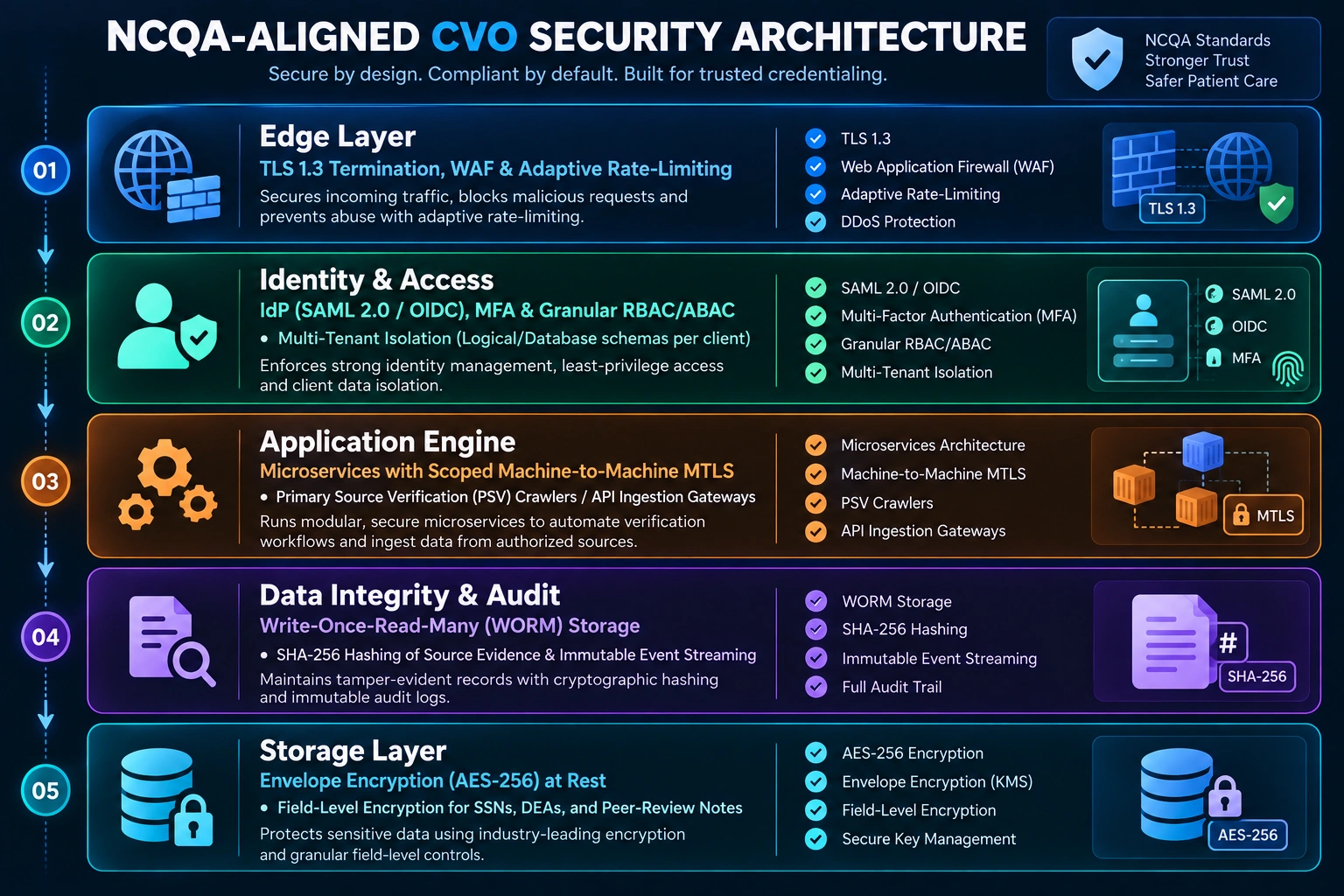
A. Role-Based Access for Verification Teams and Reviewers
Enforce least-privilege Role-Based Access Control (RBAC). Credentialing specialists get scoped read/write access for intake and verification, while review committees and medical directors access sanitized, read-only dossiers. Sensitive clinician data, including health evaluations, substance testing and malpractice claims, remains segregated from administrative staff.
B. Encryption, Authentication and Secure API Integrations
Because credentialing platforms bridge internal workflows with hundreds of external third-party sources (e.g., state medical boards, the DEA, the NPDB), network security and transit controls must be absolute:
- Authentication: Mandate multi-factor authentication (MFA) and Single Sign-On (SSO) via SAML 2.0 or OIDC with strict session timeouts.
- Encryption Standards: Enforce TLS 1.3 for all data in transit and AES-256 for data at rest, utilizing envelope encryption for sensitive fields (SSNs, DEA numbers, and bank details).
- API Security: Machine-to-machine integrations with registries (NPDB, CAQH) require scoped OAuth 2.0 tokens, mutual TLS (mTLS), and strict IP allowlisting.
C. Audit Logging, Data Integrity and Record Retention
NCQA’s information integrity standards mandate that credentialing data cannot be forged, manipulated, or deleted without a trace. A compliant system must demonstrate uncompromised data lineage:
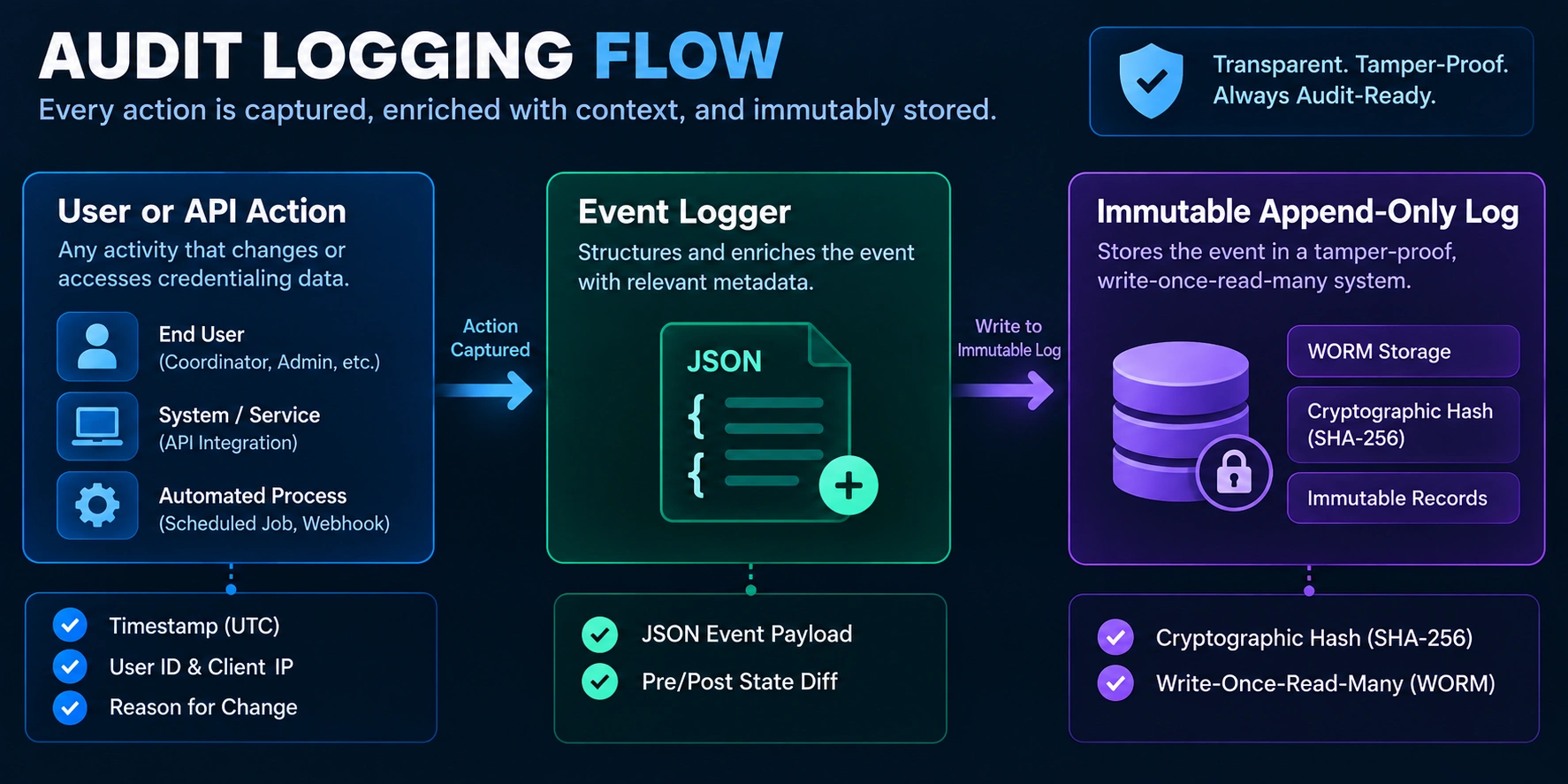
The system should preserve complete, traceable records across every credentialing action, ensuring auditors can verify data integrity, user activity, source evidence and retention compliance throughout the credentialing lifecycle.
Comprehensive Audit Trail Metadata: Every creation, view, export, edit, or status change on a credentialing file must log an immutable entry:
- Exact UTC timestamp.
- Unique Actor ID and originating IP address.
- The exact attribute modified (e.g., license_status: “Pending” ➔ “Active”).
- A recorded business justification for manual field overrides.
Write-Once-Read-Many (WORM) Storage: Store audit records and primary source snapshots in tamper-evident, append-only storage such as AWS S3 Object Lock, preventing users and administrators from altering or deleting logs before retention expiration.
Record Retention Lifecycles: Configure programmatic retention schedules for audit histories and source verifications through the active credentialing cycle and binding 3-year NCQA look-back window, followed by secure automated destruction.
D. Backup, Recovery, and Controlled Evidence Access
Maintain immutable, encrypted cloud backups across geographically isolated regions with automated failover testing to support low RPO (Recovery Point Objective) and RTO (Recovery Time Objective) targets. For delegation audits, the platform generates time-limited, read-only evidence rooms, allowing health plans or NCQA surveyors to inspect primary source artifacts without accessing the live production database.
How Should CVO Software Handle Primary Source Verification?
Primary Source Verification (PSV) is the core operational function of a Credentials Verification Organization (CVO). The software must bridge external authoritative registries and internal review pipelines to produce indisputable, audit-ready verification files.
A. Which Practitioner Credentials Must the Platform Verify?
A CVO platform must verify key practitioner credentials across licensing, prescribing authority, education, specialty certification, sanctions and exclusions to establish reliable records and support compliant credentialing decisions.
Accreditation frameworks (NCQA, The Joint Commission, URAC) mandate independent verification across core practitioner attributes:
- State Medical Licenses: Current active status, expiration dates, and historical board sanctions across all active jurisdictions.
- Federal & State Prescriptive Authority: Active DEA registrations and state-specific Controlled Dangerous Substance (CDS) certificates.
- Education & Post-Graduate Training: Medical school completion, residencies, and fellowships (via primary institutions, AMA/AOA Masterfiles, or ECFMG).
- Specialty Board Certifications: Current status verified via the ABMS or AOA.
- Sanctions & Exclusions: Direct queries to the National Practitioner Data Bank (NPDB), OIG-LEIE, SAM.gov and state Medicaid exclusion lists.
B. How Can APIs Support Documented Source Verification?
APIs support documented source verification by capturing authoritative responses, preserving evidence, recording execution details, and creating traceable records that help CVOs demonstrate consistent verification practices during audits and compliance reviews.
Modern CVO platforms replace manual portal lookups with automated machine-to-machine integrations.
- Automated Evidence Bundling: APIs ingest structured JSON data and programmatically generate a timestamped snapshot (PDF/image) of the source output.
- Cryptographic Attestation: Software applies a cryptographic SHA-256 hash to the response body and stores it in Write-Once-Read-Many (WORM) storage.
- Audit Metadata Logging: The system records exact execution times, source endpoints, status codes, and the executing user or service ID, satisfying strict NCQA time-window rules without manual data entry.
C. What Happens When Sources Return Incomplete or Conflicting Data?
Incomplete or conflicting source data can interrupt automated verification and create uncertainty around provider records. CVO software should identify discrepancies, separate routine variations, and route unresolved issues appropriately for review.
External government sources frequently present naming variations, transposed digits, or temporary downtime.
- Fuzzy Matching & Alias Registers: Discrepancies (e.g., maiden names or missing middle initials) trigger fuzzy-matching confidence scoring. Exact matches on verified SSN and NPI pairings resolve benign naming variations.
- Exception Queues: True conflicts such as mismatched license numbers or unexplained work gaps, automatically pause the automated pipeline and route the file to a specialized resolution queue.
- Downtime Retries: Registries returning 5xx errors or timeouts enter an exponential backoff retry queue with administrator alerts if downtime breaches service-level agreements (SLAs).
D. How Should Staff Review and Approve Verification Results?
Staff review remains essential when verification results contain exceptions, adverse findings, or unresolved discrepancies. CVO software should focus analyst attention on higher-risk records while preserving documented approvals and evidence throughout.
Software automates data collection, but credentialing analysts must validate and clear the final dossier:
- Exception-First Dashboards: Analysts are directed to red-flagged anomalies (such as adverse NPDB reports or license encumbrances) rather than manually checking green-lit verified items.
- Two-Way Attestation: Analysts electronically sign off on reviewed files using multi-factor credentials, creating a permanent audit trail entry.
- Audit Packaging: The platform compiles the finalized, locked dossier containing all raw evidence receipts, ready for direct transmission to the client’s Credentialing Committee.
How Do You Prepare CVO Software for an NCQA Evaluation?
Prepare CVO software for an NCQA evaluation by validating credentialing workflows, primary source verification, audit trails, data security, evidence retention and reporting against applicable NCQA requirements.
A. Map Each Software Control to Documented Procedures
Align every system capability directly with written Standard Operating Procedures (SOPs). Ensure automated triggers, look-back clocks (90–120 days) and escalation pathways execute exactly as stated in your credentialing policies.
B. Validate Verification Records and Audit Evidence
During the survey, NCQA auditors pull randomized batches of credentialing files to inspect the evidence backing every verified credential. Software systems must generate self-contained, indisputable proof:
Metadata-Rich Evidence: Ensure every automated Primary Source Verification (PSV) job captures and permanently stores essential audit metadata:
- Full source URI/endpoint.
- Query execution timestamp in UTC.
- Unique system service token or human reviewer ID.
- Raw API payload or captured time-stamped web snapshot.
Look-Back Window Compliance: Audit verification timestamps to ensure no client-bound file exceeds the 90-day credentialing limit.
Gapless Monthly Sanctions Logs: Verify continuous monthly screening against OIG-LEIE, SAM.gov and state Medicaid exclusion lists.
C. Test Access Permissions and Information Protection
Conduct end-to-end security audits of Role-Based Access Controls (RBAC). Verify that client data partitions prevent cross-tenant exposure, idle sessions terminate promptly, MFA is enforced and field-level encryption protects high-risk PII like SSNs and DEA numbers.
D. Review Quality Metrics and Corrective Action Workflows
Extract quarterly Quality Improvement (QI) dashboards tracking turnaround times and verification accuracy rates. Validate that process regressions automatically trigger documented Corrective Action Plans (CAPs) with auditable resolution histories.
E. Why Software Readiness Does Not Guarantee Certification
NCQA certifies your operational entity, not just the code. Even flawless software will fail if staff bypass SOPs, documentation trails lapse, client delegation agreements are missing or internal quarterly file audits are not rigorously executed.
How Can IdeaUsher Help You Develop CVO Software?
IdeaUsher operates as an enterprise product engineering partner, backed by 11+ years of software expertise, 250+ technical specialists and a 4.9/5 Clutch rating across 1,000+ delivered builds.
We engineer custom, cloud-native Credentials Verification Organization (CVO) software designed to automate multi-source credentialing, eliminate administrative bottlenecks and accelerate provider turnaround times.
A. Turn NCQA-Aligned CVO Requirements Into Custom Software
We deconstruct complex credentialing standards into structured technical workflows. Our architects design digital audit trails, strict verification time-limit tracking, committee review portals, and multi-facility data isolation modules configured to support stringent institutional governance.
B. Build Secure PSV Workflows With Integrated Verification Sources
We build automated Primary Source Verification (PSV) pipelines that replace manual data entry:
- API connectors and automated web crawlers targeting state licensing boards, the NPDB, OIG/SAM exclusion lists, and DEA registries.
- OCR-driven document ingestion for automated license, certification, and CV parsing.
- End-to-end AES-256 encryption, role-based access control, and immutable logging to safeguard provider data.
C. Launch a Scalable CVO Platform Through Phased Development
We structure development around a high-ROI MVP, delivering core provider intake, automated primary verification, and status tracking first. We then scale into bulk re-credentialing engines and payer enrollment modules, backed by 100% clean source code delivery and zero vendor lock-in.
Planning to build custom CVO software? Connect with IdeaUsher’s software architects today to evaluate your verification workflows, integration endpoints, and custom technical roadmap.
Conclusion
A reliable CVO platform needs more than digital verification workflows. It requires clear compliance controls, secure evidence management and processes that support consistent, auditable decisions. CVO software development for NCQA compliance brings these elements together, helping organizations manage verification activities while preparing for certification requirements. The right approach starts with a defined scope, practical feature priorities and a realistic investment plan. With the right technology partner, your organization can build a scalable foundation for dependable verification and long-term operational growth.
FAQs
A.1. CVO software development typically costs $100,000 to $550,000 or more, depending on platform complexity, integrations, security requirements, workflow automation and enterprise features.
A.2. Essential features of CVO software development include practitioner profiles, primary source verification, document management, verification tracking, discrepancy handling, reviewer workflows, audit trails and role-based access control.
A.3. No. CVO software supports verification workflows, security controls and evidence management, but certification also depends on meeting NCQA requirements, documented procedures and operational practices.
A.4. CVO software supports NCQA compliance through standardized verification workflows, secure information handling, documented reviewer decisions, audit trails and quality improvement tracking.