

Key Takeaways
- Coins are a good choice when viewers want to pay only for the episodes they really want to watch.
- Ads let you keep some content free while earning money from the people who watch it.
- Subscriptions can work well for regular viewers who want easy access to premium drama content.
- A hybrid model gives users more ways to watch and pay without depending on one income source.
The best drama app revenue model depends on how people watch your content. Coins are useful when viewers want to unlock episodes as they go. Ads can help you keep more content free while still making money. Subscriptions work better for viewers who watch regularly and want premium access. You can also combine these models to give viewers more ways to pay.
A drama app can attract a large audience, but turning those viewers into steady revenue depends on how you choose to monetize the content. We have built numerous drama app solutions using AI-powered recommendations and adaptive video streaming and in this guide, we’ll explain how coins, ads, and subscriptions work and when each model makes the most sense.
How Big Is the Business Opportunity for Drama Apps?
The business opportunity for drama apps is strong because viewers are spending more time on mobile entertainment and are also willing to pay for short episodes. According to Mordor Intelligence, the wider media streaming market was valued at $140.80 billion in 2025 and is expected to reach $215.61 billion by 2031. Short-drama apps are creating an even more focused opportunity by combining quick viewing with coins, subscriptions, and ads.
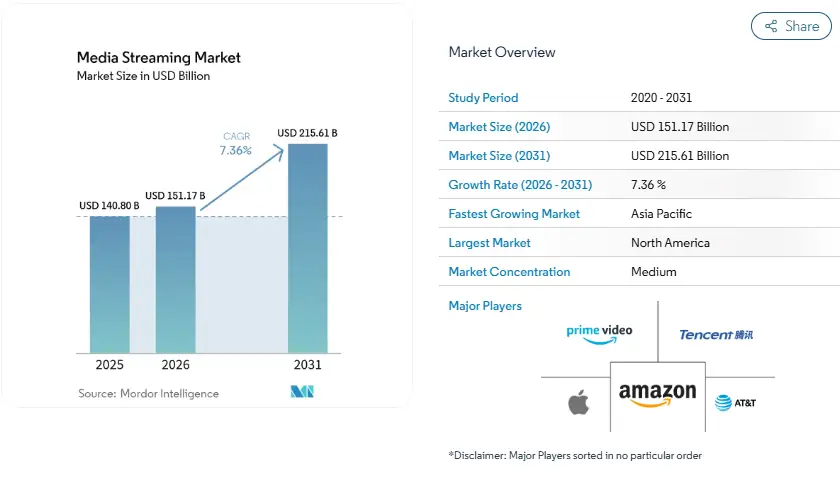
Source: Mordor Intelligence
Why Short Dramas Are Growing
Short dramas fit the way many people use their phones today. Episodes are short and easy to watch during small breaks. Strong cliffhangers then encourage viewers to keep watching instead of leaving after one episode. Global short-drama app downloads reached more than 370 million in Q1 2025, showing how quickly this format is finding new audiences.
What makes the format attractive:
| Viewer Behavior | Business Benefit |
| Short episodes | More frequent sessions |
| Cliffhangers | Higher episode completion |
| Vertical viewing | Designed for mobile users |
| Personalized feeds | Better content discovery |
| Frequent releases | More reasons to return |
MoboReels is a good example of this approach. Its current app focuses on daily episode updates, weekly new series, subtitles, adjustable playback speed, and ad-free viewing options. The platform generated an estimated $19 million in in-app revenue during Q1 2025, according to Sensor Tower.
How Drama Apps Make Money
The strongest drama apps do not make users pay from the first episode. They usually let viewers start watching for free and then introduce coins, ads, subscriptions, or locked episodes when the story becomes more engaging. This makes the payment feel connected to the content rather than simply asking users to buy a subscription upfront.
Where Revenue Opportunities Lie
New drama platforms have several ways to make money. Coins can work well for viewers who want to unlock individual episodes while subscriptions can appeal to heavy users. Ads can then monetize viewers who prefer watching without paying.
| Revenue Model | Best Use |
| Coin unlocks | Pay-per-episode viewing |
| Subscriptions | Frequent viewers |
| Rewarded ads | Free users |
| Premium releases | High-demand dramas |
| Advertising | Large free audience |
The opportunity is already large enough to support different business models. Short-drama apps generated about $700 million in global in-app revenue in Q1 2025, nearly four times the amount recorded a year earlier. For a new platform, the bigger question is not whether people will pay. It is which content and payment model will make them want to keep watching.

What Makes Drama App Monetization Different From Traditional Streaming?
Drama apps monetize the moment a viewer wants to know what happens next. Traditional streaming mostly sells access to a large content library through a subscription. Short-drama apps can place free episodes, ads, coins, and paid unlocks around the story itself. This makes storytelling and monetization much more closely connected
1. Short Episodes Create Opportunities
Short episodes give platforms more chances to bring viewers back and introduce a payment option. An episode may end in one or two minutes with a major reveal. The next episode can then be unlocked with coins, an ad, or a subscription. This creates several natural points where the platform can monetize an engaged viewer.
A common viewing flow looks like this:
Free Episode → Cliffhanger → Locked Episode → Coin / Ad → Next Episode
MoboReels follows this short-episode approach with daily episode updates and weekly new series. Its current app also supports subtitles, adjustable playback speed, and ad-free viewing. These features show how the platform can keep the viewing experience simple while giving users reasons to continue watching.
2. Cliffhangers Drive Paid Unlocks
A cliffhanger can do more than keep a viewer interested. It can create the exact moment when a viewer is willing to pay for the next episode. If the story has built enough curiosity, unlocking one more episode can feel easier than paying for an entire streaming service. This is where drama apps differ from traditional streaming. Netflix-style services mainly sell continued access to a library. A drama app can sell access to the next part of a specific story. That makes episode pacing and paywall placement important parts of the product itself.
3. Free Viewing Meets Paid Access
A good drama app does not need to make every episode paid. It can let viewers watch the beginning for free and then give them different ways to continue. Some may watch an ad while others may use coins or choose a subscription.
| Viewer Type | Possible Access |
| New viewer | Free episodes |
| Casual viewer | Rewarded ads |
| Engaged viewer | Coin unlocks |
| Frequent viewer | Subscription |
| Heavy viewer | Series or VIP access |
LimeShorts is a recent example of this model. TikTok’s micro-drama app gives viewers some episodes for free before introducing a paywall. Users can then choose a subscription or buy coins to unlock individual episodes. TikTok has also been testing other micro-drama initiatives including PineDrama and partnerships with Hoorae Digital and the Sundance Institute.
4. Why Multiple Revenue Streams Matter
Not every viewer wants to pay in the same way. Some users may prefer watching an ad while others want to unlock one episode with coins. Heavy viewers may find a subscription more convenient. Giving users these choices can help a drama platform monetize different viewing habits without forcing everyone into one payment model.
A flexible monetization mix can include:
- Coins for individual episodes
- Rewarded ads for free access
- Subscriptions for regular viewers
- Series passes for complete stories
- Premium releases for high-demand content
The important part is how these options are placed. If viewers constantly feel like they are being stopped by payment screens, they may leave. The better approach is to let the story create the reason to pay and then give viewers a simple way to continue.
How Does a Drama App Revenue Model Turn Viewers Into Revenue?
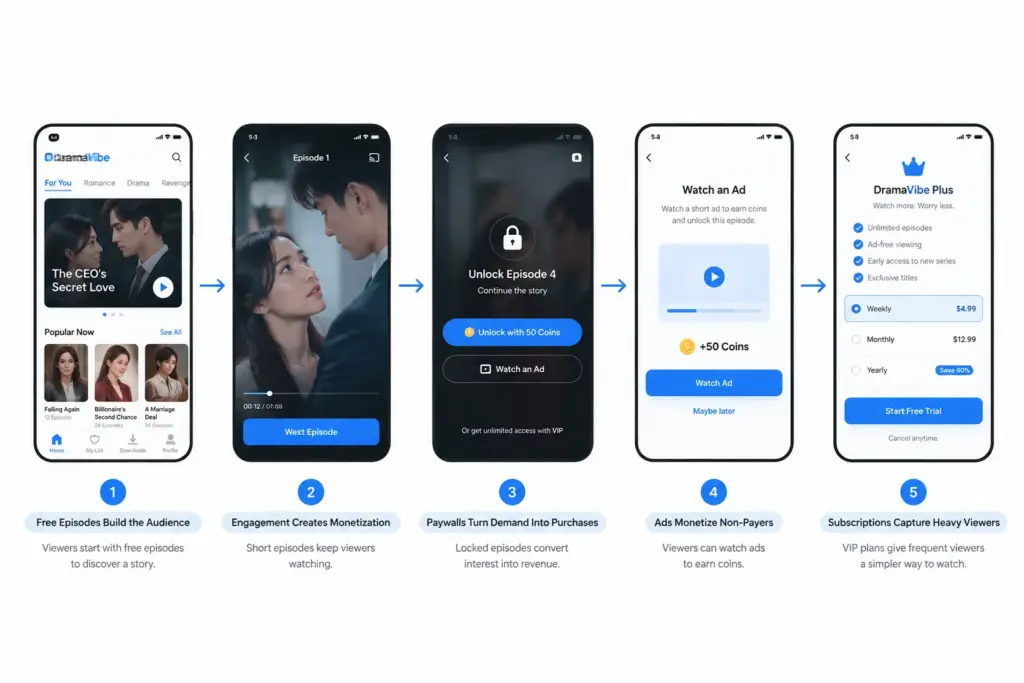
A drama app turns viewers into revenue through a simple journey: attract them with free content, build interest, and then offer different ways to keep watching. The first few episodes help users decide if they like a story. Once they are invested, coins, ads, or subscriptions can turn that interest into revenue without making the whole catalog paywalled from the start.
1. Free Episodes Build the Audience
Free episodes give viewers a reason to download the app and start watching without thinking about payment. Short-drama platforms commonly allow several opening episodes before asking viewers to unlock more. This works because the viewer gets enough of the story to understand the characters and decide whether the series is worth continuing.
The early journey can look like this:
Install → Free Episodes → Find a Favorite → Keep Watching
DramaVibe uses a similar approach by giving viewers the opening episodes of every series for free. Its current product also offers 60–90 second chapters, daily free coins, and rewarded ads. This makes the first part of the viewing journey easy while still creating a path toward paid access.
2. Engagement Creates Monetization
Getting a viewer to watch one episode is not enough. The app needs to make them want the next one. Short episodes help here because a story can move quickly from one reveal to another and encourage viewers to keep watching several episodes in one session.
Engagement signals can include:
| Viewer Action | What It Shows |
| Finishes an episode | Story interest |
| Watches several episodes | Strong engagement |
| Saves a series | Future viewing intent |
| Returns daily | Habit formation |
| Unlocks an episode | Purchase intent |
FlexTV is a useful example of this continuous engagement model. Its recent updates repeatedly highlight new episode releases and user-experience improvements, while one recent update also introduced a Limited Free feature. The product is therefore not only adding content but also experimenting with how viewers move between free and paid viewing.
3. Paywalls Turn Demand Into Purchases
A paywall works best when it appears after the viewer has already developed interest in the story. Instead of asking someone to subscribe before they know what the app offers, the platform can lock selected episodes and let the viewer choose how to continue. This is where coins become useful. Viewers can buy coins or earn them through ads and other rewards. Some platforms also offer VIP or subscription access for users who do not want to unlock episodes one at a time.
A simple model is:
Free Episodes → Locked Episode → Coins or Ad → Episode Unlock → Continue Watching
The key is not simply putting up a paywall. The platform needs to place it at a point where the viewer has enough interest to want the next episode.
4. Ads Monetize Non-Payers
Not every viewer will buy coins or a subscription. Ads give these users another way to stay engaged while still creating value for the platform. A viewer might watch a rewarded video to earn coins and then use those coins to unlock another episode. This makes ads part of the viewing journey rather than just an interruption.
Current short-drama monetization models commonly combine rewarded video ads with virtual currency, giving free users a way to continue while paid users can skip the process by purchasing coins.
A simple ad-based flow:
Watch Ad → Earn Coins → Unlock Episode → Continue Story
5. Subscriptions Capture Heavy Viewers
Subscriptions work best for viewers who watch frequently and do not want to keep buying individual unlocks. A VIP plan can remove ads, unlock premium episodes, or give users broader access to the catalog. This creates a simpler option for people who already spend a lot of time inside the app.
For example, DramaVibe currently offers weekly, monthly, and yearly Plus plans alongside its coin system. Users can also buy coins separately, which lets the platform serve both frequent viewers and occasional viewers without forcing them into the same payment model.
The goal is to move viewers through different levels of value:
Free Viewer → Engaged Viewer → Occasional Payer → Regular Subscriber
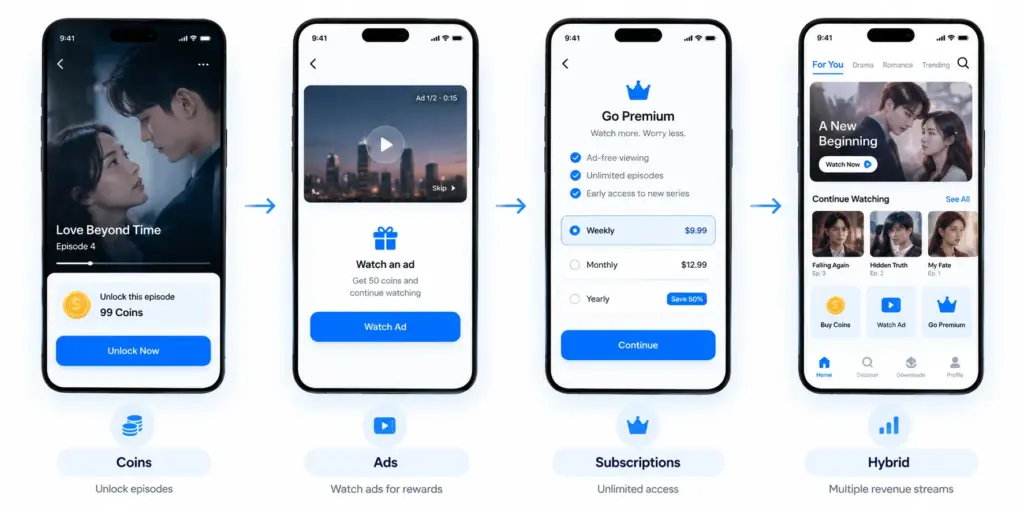
Coins, Ads or Subscriptions: Which Revenue Model Fits Your Platform?
The right revenue model depends on how your viewers watch and what you want the app to achieve. Coins work well when viewers regularly unlock individual episodes. Ads can help grow a larger free audience, while subscriptions suit users who watch across many shows. For most serious drama platforms, a hybrid model can provide the most flexibility.
| Revenue Model | Best For | Revenue Pattern | User Friction | Best Use |
| Coins | Episodic drama | Transactional | Low after top-up | Episode unlocks |
| Ads | Free viewers | Volume-based | Low payment friction | Free viewing |
| Subscriptions | Loyal viewers | Recurring | Higher commitment | VIP access |
| Hybrid | Scaled platforms | Multiple streams | Medium | Full monetization |
Choose Coins for Frequent Unlocks
Coins are a natural fit for vertical drama because viewers often make a decision one episode at a time. Many platforms give the opening episodes for free and then ask users to spend coins on later episodes. This works especially well when stories have strong cliffhangers and viewers want to know what happens next.
Choose coins when:
- Your dramas have many short episodes
- Viewers regularly binge individual series
- You want payment tied directly to content
- You plan to use rewarded ads for free coins
Choose Ads for Audience Growth
Ads make more sense when your main goal is to let as many people watch as possible. Instead of asking every viewer to pay, you can offer rewarded ads that give users coins or access to another episode. This reduces payment friction and can make the app more attractive to casual viewers.
Story TV shows why this model can be useful for an India-focused drama platform. Sensor Tower reported that Story TV became the No. 1 short-drama app in India by downloads and increased its revenue by more than 50% quarter over quarter. Its advertising strategy also expanded sharply, with digital ad spending nearly tripling in the first half of the year.
This approach is especially useful when you are still building an audience. A viewer who is not ready to spend money can still create value by watching an ad.
Free viewer → Watch ad → Earn reward → Unlock episode
Choose Subscriptions for Loyal Viewers
Subscriptions are a better fit when users watch several shows rather than following just one series. A VIP plan can give them ad-free viewing, premium episodes, bonus content, or recurring coin benefits. This also gives the business a more predictable revenue stream. Short-drama apps are already leaning heavily toward this model.
RevenueCat found that weekly plans accounted for 88.5% of recurring revenue among the median short-drama app in its analysis, with $9.99 being the most common weekly price.
A subscription model works best when your platform has:
| Platform Condition | Why It Matters |
| Large content library | Users have more reasons to stay |
| Frequent new releases | Subscription value keeps growing |
| Multiple popular shows | Viewers use the app beyond one series |
| Premium benefits | Gives users a reason to upgrade |
Choose Hybrid for Multiple Streams
A hybrid model is often the strongest option once a drama platform has enough content and users. You can let new viewers watch for free, give them rewarded ads, sell coins to active users, and offer subscriptions to your heaviest viewers. This creates different revenue paths without forcing every user into the same model.
A practical hybrid journey can look like:
Free Episodes → Rewarded Ads → Coins → VIP Subscription
Where Should You Place the First Drama App Paywall?
The first paywall should appear after viewers understand the story but before their interest starts to fade. For most drama apps, that means giving enough episodes free to build curiosity and then placing the first unlock around a strong story moment. The goal is to make payment feel like a way to continue a story the viewer already wants rather than an interruption.
How Many Episodes Should Be Free?
There is no single number that works for every drama app. A useful starting point is around 5 to 10 free episodes, then testing where viewers drop off or start paying. Current short-drama platforms commonly use a free opening stretch before introducing coins, ads, or subscriptions.
The important part is what happens during those free episodes. If the first five episodes are slow, the paywall may arrive before the viewer cares. If the story becomes exciting by episode three, waiting until episode twelve could leave money on the table.
A simple testing range:
| Free Episodes | Best For |
| 3–5 | Fast-moving stories |
| 6–8 | General drama |
| 9–12 | Longer story setup |
| 12+ | Building deeper commitment |
DramaVibe takes a more generous approach by keeping the opening episodes of every series free and then using coins or Plus for later episodes. That gives viewers a clear chance to test the story before spending anything.
Should Paywalls Follow Cliffhangers?
Yes. A paywall usually works better when the viewer has just reached a moment that creates a strong need to continue. The cliffhanger gives the viewer a reason to unlock the next episode instead of seeing the payment screen as a random obstacle. RevenueCat’s research describes this as a highly personalized paywall appearing at the moment of maximum curiosity. That is an important difference from traditional streaming, where payment usually happens before the viewing experience begins.
The ideal sequence is:
Story Setup → Rising Tension → Cliffhanger → Paywall → Episode Unlock
The mistake is putting the paywall before the emotional payoff. If viewers have not become curious yet, even a low-priced unlock can feel expensive.
Episode Paywall vs Series Paywall
For vertical drama, an episode-level paywall usually gives you more flexibility. Viewers can pay for exactly what they want to watch, while the platform can adjust pricing and free access based on the performance of each series. A series-level paywall is simpler but can create more friction because users have to commit before knowing how the story develops. This is why many short-drama platforms use coins or episode unlocks alongside broader VIP or subscription options.
| Model | Viewer Commitment | Best Use |
| Episode paywall | Low | Strong cliffhangers |
| Series paywall | High | Premium originals |
| VIP access | Medium | Frequent viewers |
| Hybrid | Flexible | Large catalogs |
ShortMax continues to update its catalog with new dramas, localized content, and genre-focused releases such as werewolf and family dramas. For a catalog like this, episode-level access lets the platform monetize different stories without treating every title in exactly the same way.
How Much Should Premium Episodes Cost?
Pricing should be based on viewer behavior rather than simply choosing a high coin value. A premium episode needs to feel affordable enough for an impulse decision while still creating meaningful revenue when viewers unlock several episodes in one session. Omdia found that more than 60% of microdrama revenue comes from subscriptions or transactional payments.
Its research also found that ARPU can reach around $20 per week or $80 per month in strong markets. That suggests viewers can spend meaningfully when the content keeps them engaged.
A better approach is to test:
Episode Price → Unlock Rate → Completion Rate → Repeat Purchase
If a higher price sharply reduces unlocks, lowering the price may actually produce more total revenue. The right number is the one that keeps the viewer moving through the story without making every episode feel like a major purchase.
When Should Users See Coins, Ads or Subscriptions?
These options should appear at different levels of engagement. Coins are useful when someone wants to unlock one or two episodes. Rewarded ads work well for users who want to continue for free. Subscriptions make more sense when someone is watching several series and has become a regular user.
A practical journey could be:
Free Viewer → Rewarded Ad → Coin User → VIP Subscriber
This also gives the platform room to personalize offers. A casual viewer does not need to see a subscription immediately, while a user who has watched dozens of episodes may be ready for a better-value VIP option.
What Happens at Zero Coins?
Running out of coins should not feel like the end of the viewing journey. Instead, the app should immediately offer another way forward. The user could watch a rewarded ad, claim a daily bonus, buy a small coin pack, or start a subscription. DramaVibe follows this type of flexible system by allowing viewers to earn coins through daily rewards and rewarded ads while also offering paid coin packs and Plus access. This keeps free users active while giving paying users a faster route back to the story.
| User Situation | Best Next Action |
| Few coins left | Daily reward |
| Wants one episode | Small coin pack |
| Does not want to pay | Rewarded ad |
| Watches every day | Subscription |
| Heavy binge viewer | VIP offer |
How Should You Price Coins in a Drama App?
Coin pricing should make the next episode feel affordable while still giving your platform enough room to earn from frequent viewers. The best setup is usually a simple coin economy with small and large packs, bonus offers, and prices that can change by market. You should also test the numbers instead of assuming one price will work for every viewer.
1. Set Episode Unlock Costs
Start by deciding how much an individual episode should cost in coins. The price should match the importance of the episode and the viewer’s willingness to continue. A normal episode can use a lower price while a major reveal or premium release can justify a higher unlock. Current short-drama platforms show how widely this can vary, so there is no universal coin value.
For example, My Drama currently lists a typical episode at 99 coins. Users can also earn coins through daily rewards and ads, giving them a free path before they decide to purchase more.
A simple starting structure could be:
| Episode Type | Suggested Approach |
| Regular episode | Lower coin cost |
| Important episode | Standard cost |
| Major cliffhanger | Higher value |
| Premium finale | Highest cost |
2. Create Flexible Coin Packs
Coin packs should give users an easy choice rather than forcing everyone to buy the same amount. A small pack can work for someone who only wants one or two episodes. Larger packs should offer better value and suit viewers who are already deep into a series. MoboReels is a useful example. Its current iOS listing offers several coin packages alongside weekly VIP plans, showing how coin purchases and subscriptions can sit together in the same product.
A simple pack structure could be:
Starter → Popular → Premium → Mega
The middle pack can be positioned as the best-value option. This makes the choice easier for users while encouraging larger purchases from viewers who are already highly engaged.
3. Use Bonus Coins Strategically
Bonus coins can make a larger purchase feel more valuable without reducing the listed price of the core coin pack. You could offer extra coins during a first purchase, weekend promotion, daily streak, or limited-time event. This can also encourage viewers to top up before they completely run out.
The important thing is to make the bonus easy to understand. A viewer should immediately know how many coins they receive and what those coins can unlock. If the pricing becomes confusing, the bonus can create more friction instead of increasing purchases.
Example:
| Pack | Base Coins | Bonus | Total |
| Starter | 100 | 0 | 100 |
| Popular | 500 | 75 | 575 |
| Premium | 1,000 | 200 | 1,200 |
| Mega | 2,500 | 700 | 3,200 |
4. Balance Conversion and Revenue
A higher coin price does not automatically mean higher revenue. If the price becomes too high, fewer viewers may purchase. A lower price may increase the number of buyers but reduce the amount earned from each one. RevenueCat found that the median short-drama app converted 5.5% of installs into paying customers within 35 days, compared with 1.6% for other entertainment apps. It also found $23.85 in first-month realized revenue per paying customer.
This means you should watch both sides of the equation:
More Buyers × Average Spend = Revenue
If a pricing change increases purchases but lowers average spend too much, it may not improve the business. The goal is to find the point where viewers keep buying without feeling that every episode is too expensive.
5. Test Prices by Audience
Not every viewer has the same willingness to pay. Someone watching one series casually may react differently to pricing than a user who watches 30 episodes every day. Your app can use viewing behavior to test different offers and identify which groups are most likely to buy.
Useful segments can include:
- New users who have not purchased yet
- Occasional buyers who unlock a few episodes
- Binge viewers who unlock many episodes
- High-value users with repeated purchases
- Inactive users who need a stronger offer
This approach also gives you room to test limited-time discounts, starter bundles, or larger bonuses without changing the entire coin economy for everyone.
6. Use Regional Coin Pricing
Global drama apps should not assume that one coin price will work everywhere. Purchasing power, payment habits, app-store pricing, and willingness to pay can vary significantly between markets. A $10 purchase may feel reasonable in one country but create much more friction in another.
The opportunity is especially important because short-drama consumption is spreading across regions such as India, Southeast Asia, and Latin America. Sensor Tower reported that these markets were among the strongest sources of download growth for short-drama apps.
A platform can therefore test:
| Market | Pricing Consideration |
| United States | Higher willingness to pay |
| India | Smaller packs and local payment options |
| Southeast Asia | Localized offers |
| Latin America | Regional price testing |
| Japan | Premium pricing potential |
Japan is a good example of why regional pricing matters. Users there generated $13.22 million in short-drama app spending during one measured period despite accounting for only 2.16% of global downloads. Its revenue per download reached $4.13, showing that a smaller audience can still have strong spending potential.
Which Drama App Metrics Actually Measure Monetization Success?
The best way to measure drama app monetization is to follow the viewer from the first free episode to their first payment and beyond. Total revenue matters, but it does not show which episode or action created that revenue. Your analytics should track viewers, payers, episodes, coins, ads, subscriptions, and individual series.
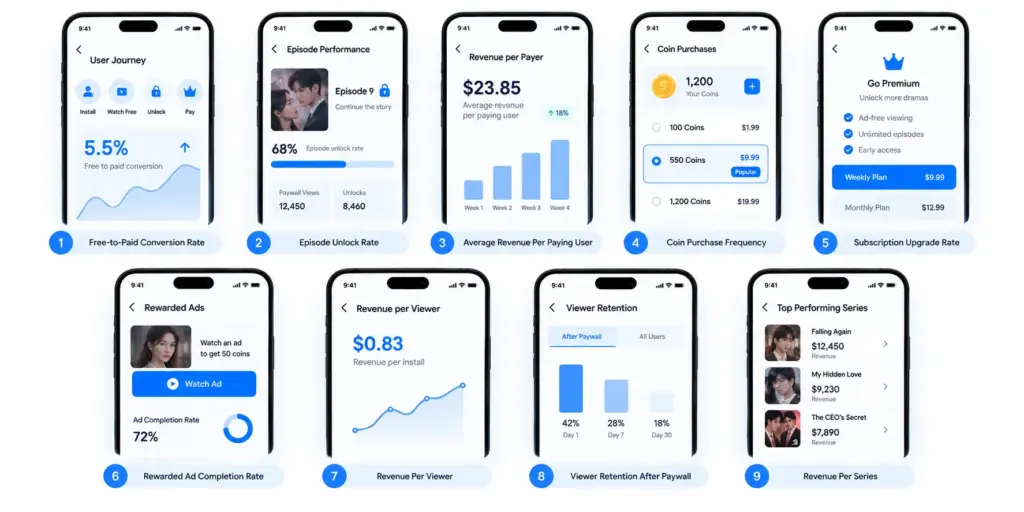
1. Free-to-Paid Conversion Rate
This shows how many free viewers become paying customers. A low rate can mean viewers enjoy the content but do not see enough value in paying. It can also point to problems with your content, pricing, or paywall. RevenueCat found that 5.5% of short-drama installs became paying customers within 35 days, compared with 1.6% for other Entertainment apps. Short-drama apps also generated $0.83 per install within 14 days.
Paying Viewers ÷ Total New Viewers × 100
2. Episode Unlock Rate
Episode unlock rate shows how many viewers actually unlock a paid episode after reaching the paywall. This tells you whether the episode and paywall are creating enough demand. If many viewers reach episode 8 but few unlock episode 9, you may need to test the coin price or paywall placement. Tracking each episode can show exactly where viewers stop paying.
| Metric | What It Shows |
| Paywall views | Who reached the lock |
| Unlocks | Who continued |
| Unlock rate | Paywall performance |
| Episode number | Best conversion point |
3. Average Revenue Per Paying User
ARPPU shows how much revenue comes from your paying users. It helps you understand whether you have many low-value buyers or fewer users who spend more. RevenueCat found that short-drama apps generated $23.85 in realized revenue per paying customer during the first month, compared with $13.09 for other Entertainment apps.
Track the journey from:
New Payer → Repeat Payer → High-Value Payer
4. Coin Purchase Frequency
One coin purchase is not enough to understand user value. You also need to know how often viewers return to buy more coins. Track purchases across 7, 30, and 90 days. Compare this with episodes unlocked to see whether users are repeatedly buying because they are deeply engaged with your content.
Useful metrics include:
| Metric | What It Shows |
| Purchases per payer | Repeat behavior |
| Coins purchased | Top-up value |
| Coins spent | Actual usage |
| Repeat purchase rate | Long-term demand |
5. Subscription Upgrade Rate
This measures how many active viewers move from free or transactional viewing to a recurring plan. It becomes especially useful when users watch several series rather than just one. RevenueCat found that 86% of short-drama apps had subscriptions. Weekly plans generated 88.5% of recurring revenue, with $9.99 being the most common weekly price. Use this metric to see which viewers are most ready for VIP access.
6. Rewarded Ad Completion Rate
Rewarded ads give viewers a way to keep watching without paying. Completion rate tells you whether users are actually willing to watch the full ad in exchange for coins or access. RevenueCat found that 67% of short-drama apps included advertising, compared with 37% across the wider Entertainment category.
FreeReels is a useful example. Its current app has 100M+ downloads and offers short dramas across 19+ languages. Recent updates have added more drama shorts and improved performance.
7. Revenue Per Viewer
Revenue per viewer includes both paying and non-paying users. This makes it useful for comparing different marketing campaigns, markets, and content types. RevenueCat reported $0.83 median revenue per install within 14 days for short-drama apps. A smaller audience with stronger spending behavior may be more valuable than a large audience that rarely pays.
8. Viewer Retention After Paywall
A first payment does not automatically make a viewer valuable. You need to know whether they return after reaching the first paywall. RevenueCat found a 31.1% median first-renewal rate for short-drama subscriptions, compared with 44.3% for other Entertainment apps. Six-month retention was 1.8% versus 8%. This shows why you should measure what happens after the first purchase, not just the purchase itself.
9. Revenue Per Series
Series-level revenue shows which stories actually make money. A drama can get millions of views but still perform poorly if viewers rarely unlock later episodes. RapidTV uses personalized recommendations, vertical episodes, HD playback, and ad-supported viewing. Its recent update also focused on stability and performance.
MeloShort has recently focused on faster loading, smoother playback, personalized playlists, recommendations, search, and watch history. These features can help viewers discover and continue more series.
How Can You Increase Revenue From a Drama App Without Raising Prices?
A drama app can increase revenue without charging viewers more by getting more value from the audience it already has. Better paywall timing can turn more free viewers into buyers. Recommendations can encourage people to start another series, while smarter coin bundles and VIP offers can increase repeat purchases. The goal is to improve how viewers move through the app rather than simply making episodes more expensive.
1. Improve Free-to-Paid Conversion
The first opportunity is getting more free viewers to make their first purchase. This can come from giving users enough free episodes to become interested, then showing the right unlock offer when they want to continue. Short-drama apps are already strong at this. RevenueCat found that 5.5% of installs converted into paying customers within 35 days, compared with 1.6% for other Entertainment apps. Improving even this conversion point can create more revenue without changing the price viewers pay.
Free Viewer → Story Interest → First Paywall → First Purchase
2. Optimize Paywall Timing
A paywall should appear when curiosity is high, not simply after a fixed number of episodes. Testing different paywall positions can show where viewers are most willing to unlock the next episode. CandyJar shows why engagement matters. Its dramas normally run for 50–75 episodes, with new romance titles released roughly once a week. The platform is on track for more than $100 million in annual sales, showing how a focused catalog can turn continued story demand into a large business.
3. Use Strategic Ad Rewards
Rewarded ads can create value from viewers who are not ready to spend money. Instead of blocking these users, the app can let them watch an ad for coins or another episode. This keeps them inside the story and creates another monetization path.
| Viewer Situation | Offer |
| No coins | Watch an ad |
| New viewer | Free episode |
| Regular viewer | Bonus coins |
| Frequent viewer | VIP offer |
Shortical is taking this broader approach with coins, subscriptions, and advertising opportunities. It also raised $100 million in user-acquisition financing, with the financing tied to revenue generated from acquired users. Its AI series Bound by Fire performed comparably with its live-action content, and the company plans to scale AI production to 20 hours per month.
4. Personalize Episode Recommendations
Recommendations can increase revenue by helping viewers find their next drama before they leave the app. If someone finishes a billionaire romance, for example, the platform can immediately suggest another story with similar characters or themes.
This creates a simple revenue loop:
Finish Series → Personalized Recommendation → Start New Series → Reach Paywall
FlareFlow shows how platforms are expanding this idea through differentiated content. It recently launched AI-assisted microdramas featuring Neymar Jr. through a collaboration involving COL Group. The app also has around 33 million users worldwide, showing the scale that content discovery and a broad catalog can support.
5. Create Premium Viewer Tiers
Some viewers watch far more than others. Instead of increasing prices for everyone, the platform can give these high-value users a premium tier with benefits such as ad-free viewing, bonus coins, early episodes, or unlimited access. RevenueCat found $9.99 to be the most common weekly subscription price among short-drama apps.
The important part is not simply copying that number. Premium tiers should offer enough extra value that frequent viewers naturally prefer them over repeated individual purchases.
6. Test Coin Bundle Offers
Coin bundles can increase spending without raising the price of individual episodes. A platform might keep its normal episode price but give users extra coins when they choose a larger pack or make their first purchase.
Example:
- 100 Coins → Standard Pack
- 550 Coins → 500 + 50 Bonus
- 1,200 Coins → 1,000 + 200 Bonus
Limited offers can also create urgency. FlareFlow’s current Google Play listing, for example, is promoting a 50% off “Back to School” offer, showing how drama platforms can use temporary promotions rather than permanent price increases.
7. Reduce Paying User Churn
Revenue can also grow when existing payers simply stay longer. A viewer who finishes one series and leaves has limited lifetime value. Giving them another relevant story immediately can create another viewing and payment cycle. GammaTime takes a data-driven approach to this problem. The platform launched with 20+ original vertical series and uses predictive AI and testing to decide which stories move into production. It also works with CSI creator Anthony E. Zuiker and raised $14 million to build its platform and content strategy.
What Is the Revenue Potential of a Drama App?
A drama app can generate revenue through several connected streams rather than relying on one payment method. Coins can monetize individual episode demand, ads can generate income from free viewers, and subscriptions can bring recurring revenue from loyal users. The real opportunity depends on how well the platform turns viewers into repeat users and paying customers.
1. Revenue From Coin Purchases
Coins can be a strong revenue source when viewers regularly unlock episodes. This works especially well with short episodes and cliffhangers because users can make several small purchases while following a story. Omdia estimates that more than 60% of global microdrama revenue comes from subscriptions or transactional payments.
Melolo combines free viewing with in-app purchases and short original dramas. Sensor Tower estimated around $400,000 in worldwide revenue during its latest measured month, alongside about 14 million downloads during that period.
Example calculation: 100,000 active viewers × 5% payers × $20 average spend = $100,000
2. Revenue From Advertising
Ads help monetize viewers who do not want to pay. Rewarded ads are especially useful because viewers receive coins or access in return. This keeps free users engaged while creating another revenue stream.
Example: 100,000 viewers × 3 ads × $0.02 = $6,000
FreeReels shows the potential of a large free audience. Sensor Tower reported 34 million worldwide downloads and estimated monthly in-app revenue of $6,000 in one recent measurement period. Its current product offers 70,000+ short dramas across 19+ languages.
3. Revenue From Subscriptions
Subscriptions create recurring revenue from viewers who watch several dramas. VIP plans can offer ad-free viewing, premium access, or extra content instead of charging for every episode. RevenueCat found that 86% of short-drama apps included subscriptions. Weekly plans generated 88.5% of recurring revenue, with $9.99 as the most common weekly price.
Story TV is another example. Sensor Tower reported that its revenue grew by more than 50% quarter over quarter, while its digital advertising spend nearly tripled during the measured period. It also became India’s leading short-drama app by downloads.
4. Revenue Per Viewer Across Models
Total revenue does not show which model performs best. Compare revenue per viewer, revenue per payer, and repeat spending across coins, ads, and subscriptions.
| Model | Example Metric | Main Advantage |
| Coins | $20 average spend | Frequent purchases |
| Ads | $0.02 example value | Free-user revenue |
| Subscription | $9.99 weekly price | Recurring revenue |
| Hybrid | Multiple streams | Wider monetization |
RevenueCat found $0.83 per install within 14 days for short-drama apps, compared with $0.15 for other Entertainment apps. First-month realized revenue per paying customer reached $23.85, compared with $13.09 for other Entertainment apps.
This is why a hybrid model can work well. One viewer may generate ad revenue, while another buys coins and later upgrades to a subscription.
5. Why Retention Beats Downloads
Downloads create reach, but retention creates ongoing revenue. A viewer who leaves after one episode has far less value than someone who returns daily and keeps unlocking content. DramaBox is a useful benchmark. Sensor Tower found 17% of users were retained after six months and 15% after 12 months in its 2024 analysis.
Example: 100,000 downloads → 10,000 active viewers → 5,000 repeat viewers → 500 payers
Suppose those 500 users spend $20 each; that produces $10,000. Improving retention can therefore be more valuable than simply acquiring more downloads.
Contact IdeaUsher to Develop a Drama App
If you are planning to launch a vertical drama app, IdeaUsher can help you turn the idea into a working product. We bring 500,000+ hours of coding experience and a team that includes ex-MAANG and FAANG developers. Our focus is on building a drama platform that is easy to use and ready to grow.
Drama App Development Expertise
We understand the features that make short-drama apps engaging. From vertical video and episode unlocks to content management and recommendations, we can build the core viewing experience around your audience. Whether you want a white-label foundation or a more customized platform, we can shape the product around your content and business goals.
Build Your Revenue Model
Your drama app can earn in different ways depending on how your viewers watch. We can build coin purchases, subscriptions, rewarded ads, or a hybrid model into the platform. The payment flow can be designed around your content strategy. This makes it easier to test what works best for your audience without rebuilding the entire app.
Scale Beyond the MVP
Your first version does not have to include everything. We can start with the features you need to launch and then add capabilities as your audience grows. You can later expand into AI recommendations, AI dubbing, Smart TV apps, creator tools, advanced analytics, and stronger streaming infrastructure. This gives your drama platform room to grow without starting over.
Conclusion
Coins, ads, and subscriptions can all work for a drama app, but the right choice depends on how your viewers watch. Coins fit episode-based viewing, ads work well for free users, and subscriptions suit loyal viewers. For many platforms, a hybrid model can be the better choice because it gives viewers more ways to watch and pay.
FAQs
A1: There is no single best model for every drama app. Coins work well for episode-based viewing, while subscriptions suit viewers who watch many shows. Ads can help monetize free users, so a hybrid model is often a strong choice for platforms with a growing content library.
A2: Drama apps sell coins that viewers use to unlock premium episodes. Users can often earn a small number of coins through rewards or ads and then buy more when they want to keep watching. This creates revenue each time an engaged viewer decides to unlock another part of a story.
A3: Coins can be better when viewers mainly follow individual dramas and want to pay only for the episodes they choose. Subscriptions are more suitable for frequent viewers who watch several series. Many drama apps combine both so users can choose between individual unlocks and broader VIP access.
A4: Drama apps earn advertising revenue by showing ads during the free viewing experience. Rewarded ads are especially useful because viewers can watch an ad to receive coins or unlock another episode. This lets the platform earn from users who do not want to make a direct purchase.