

Key Takeaways
- The requirements of your app should help you to select the blockchain, depending on scalability, transaction costs, security, liquidity, user experience and long-term company goals.
- Ethereum is suitable for applications that value security, deep liquidity, institutional acceptance and advanced smart contract architecture.
- Solana’s high transaction throughput and ultra-low costs make it a good fit for high frequency Web3 applications.
- Polygon provides Ethereum compatibility with low-cost transactions that makes it ideal for gaming, NFTs, customer loyalty programs and enterprise use cases.
- Base combines the Ethereum security with the low-cost transactions and fast execution required for consumer apps, SocialFi, payments and high-volume dApps.
- Developers can reuse Solidity code, development tools, wallets and infrastructure for EVM Compatibility of Ethereum, Polygon and Base to minimize the complexity during any web3 app development.
Blockchain selection is no longer a backend decision that developers can change without affecting the product. The network determines how users experience transactions, how much each interaction costs and how easily a product can scale, making which blockchain to choose for Web3 development a critical decision for product strategy, economics and long-term growth.
Ethereum, Solana, Polygon and Base each solve different infrastructure challenges. Ethereum provides deep liquidity and ecosystem maturity, Solana promotes speed and low-cost transactions, Polygon supports Ethereum compatibility and Base provides an accessible Layer 2 environment with increasing ecosystem adoption. The right network depends on the application’s users, transaction volume, functionality, business model and choosing the right chain means matching infrastructure capabilities with product goals rather than simply following market popularity.
In this blog, we will talk about Ethereum vs Solana vs Polygon vs Base, their features, costs, scalability, developer ecosystems, use cases and how to choose the right blockchain for your Web3 app, helping you make an informed decision based on your project’s technical and business requirements.
Web3 Market Growth Is Increasing Demand for Scalable Apps
The shift to enterprise-grade Web3 ecosystems requires architectures that scale for high volume, low latency, and predictable gas costs. In Q1 2025, DappRadar reported 24 million daily unique active dApp wallets, proving blockchain infrastructure already operates at global scale.
A. Global Web3 Market Is Set for Rapid Expansion
The Web3 ecosystem is experiencing accelerating commercial expansion as enterprises integrate decentralized protocols into core business operations.
According to market research from The Precedence Research Company, the global Web3 market is estimated at $4.62 billion in 2025 and is predicted to increase from $6.75 billion in 2026 to approximately $116.55 billion by 2035, expanding at a CAGR of 38.10% from 2026 to 2035.
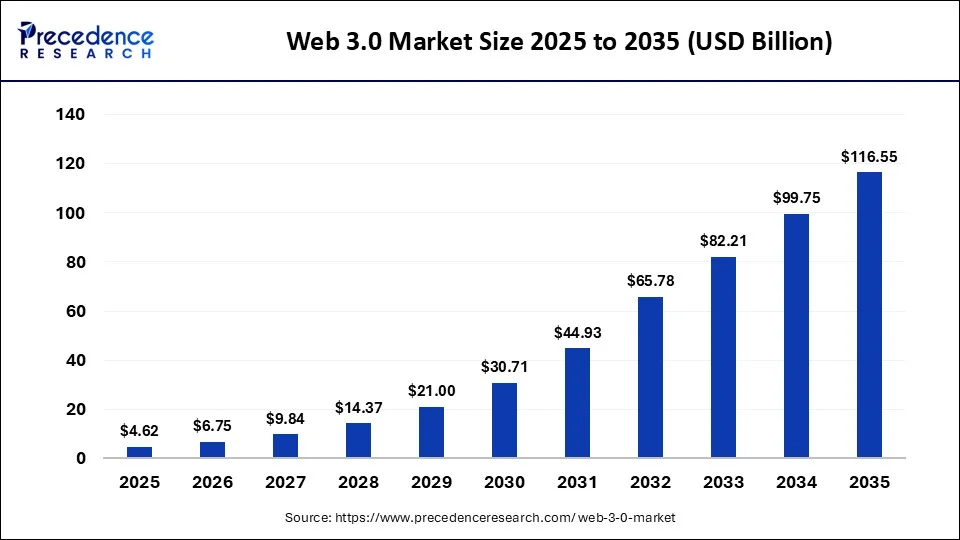
The projected 4.1× market expansion (2026–2030) underlines rising demand for scalable blockchain infrastructure. Fueled by institutional asset tokenization, DePIN, and RWA integration, growing capital investment is driving the need for enterprise-grade uptime, scalability, and throughput.
B. dApp Adoption Is Driving Demand for Blockchain Infrastructure
Market expansion is fueled by growing dApp adoption across financial services, digital entertainment, SocialFi, and gaming. The sector processes almost 18 millions of daily unique active wallets (dApp UAW), with gaming accounting for roughly 25%–30% of engagement and SocialFi seeing growth spikes above 300%.
Users demand transparent execution with Web2-like speed and UX. Over 70% of digital consumers abandon dApps if latency exceeds 3–5 seconds or fees spike, driving the need for fast, reliable infrastructure.
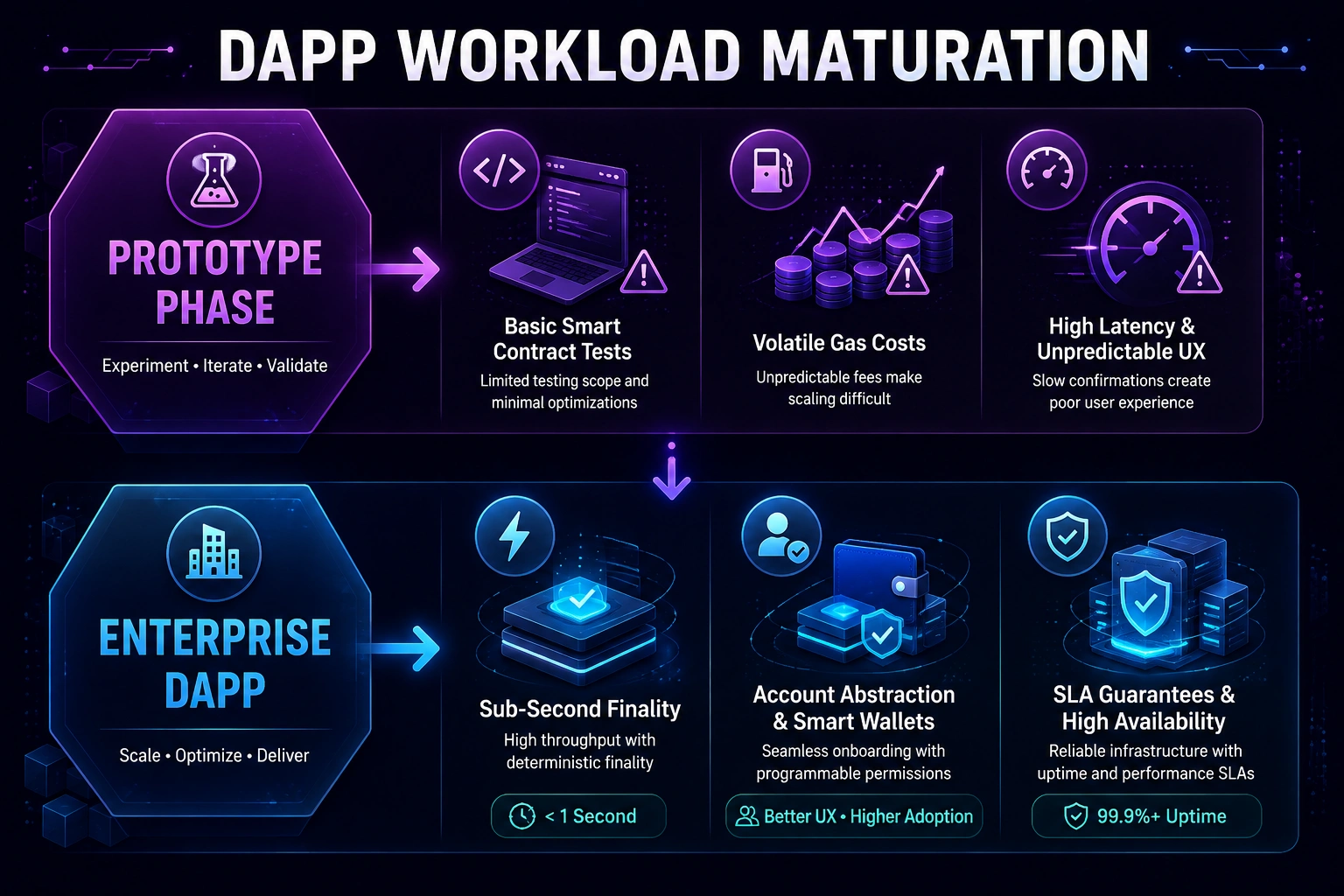
As more businesses move from experimenting with blockchain to building production-grade dApps, blockchain selection becomes an architectural decision, not simply a matter of choosing the network with the lowest fees.
Building enterprise software on an incompatible chain risks vendor lock-in, liquidity fragmentation, network congestion outages during peak hours, and unsustainable operational overhead.
C. Blockchain Choice Can Shape Web3 App Growth
The blockchain you choose can significantly influence how your Web3 app handles user growth, onboarding, liquidity, transaction demand, and cross-chain activity. Understanding these factors early helps align network capabilities with your application’s evolving performance and scalability needs.
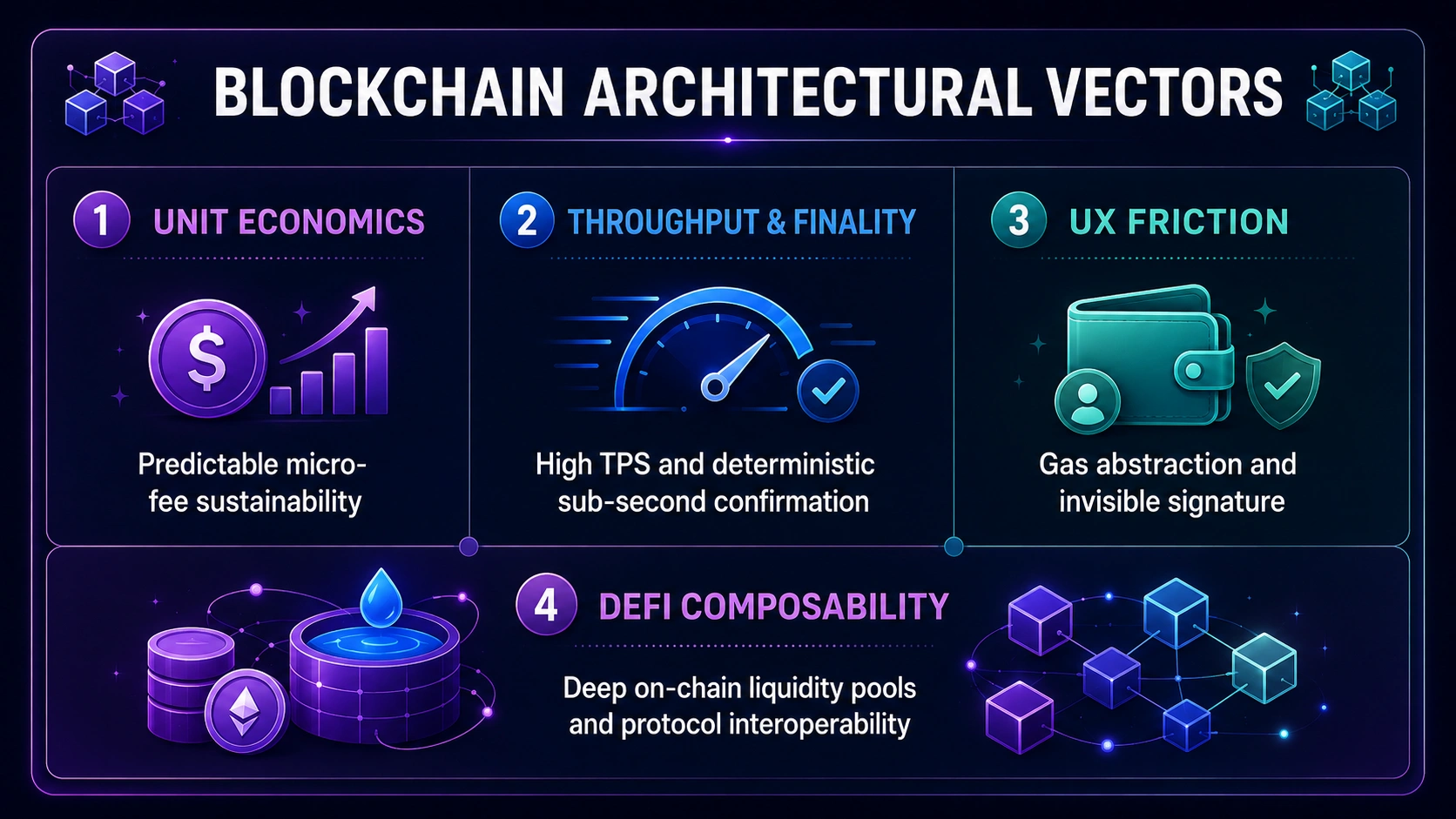
The underlying network layer directly establishes the performance ceiling, unit economics, and user retention profile of a decentralized application:
- Impact of User Volume on Transaction Costs: Scaling matters because DappRadar measured 18.7 million daily active wallets across dApps during Q3 2025, demonstrating how network demand can translate into substantial transaction workloads.
- Frictionless Consumer Onboarding: Account abstraction is moving beyond experimentation, with Ethereum.org reporting more than 26 million smart wallets and 170 million UserOperations processed through ERC-4337.
- DeFi Liquidity and Composability: DeFi remains a major application category, with DappRadar reporting $156 billion in total value locked across DeFi at the end of Q1 2025, despite a 27% quarterly decline.
- High-Frequency State Demands in Gaming and SocialFi: Blockchain gaming reached 7.3 million daily unique active wallets in January 2025, representing a 386% increase from January 2024 and highlighting the transaction demands of interactive Web3 applications.
- Multi-Chain Infrastructure & Security Considerations: Cross-chain finance is already operating at significant scale, with Visa’s adjusted methodology estimating $10.2 trillion in organic stablecoin transaction volume over the previous 12 months, up 63% year over year.
The Practical Takeaway: Blockchain selection should happen before development begins, not after an application faces scale-related constraints. Ethereum, Solana, Polygon, and Base make different architectural trade-offs in execution, fees, scalability, developer tooling, liquidity, and ecosystem access, which can materially affect an application’s long-term economics.
Ethereum vs Solana vs Polygon vs Base: Quick Comparison
Choosing the right blockchain foundation determines your application’s speed, operating costs, security profile, and access to capital. While Ethereum remains the primary settlement layer for high-value decentralized finance, Layer 2 networks like Polygon and Base alongside high-performance Layer 1s like Solana offer scalable alternatives tailored for distinct user experiences and transaction volumes.
Ethereum vs Solana vs Polygon vs Base at a Glance
Each network brings different strengths across fees, transaction speed, EVM compatibility, wallet support, and practical use cases, making a side-by-side view useful for narrowing down which blockchain to choose for web3 development. Compare the essentials below to identify the best-fit blockchain for your app’s requirements.
| Feature / Metric | Ethereum (L1) | Solana (L1) | Polygon (PoS / AggLayer) | Base (L2) |
| Transaction Fees | High ($1.00 – $30.00+ depending on network congestion) | Ultra-low (< $0.001) | Very low ($0.01 – $0.05) | Ultra-low ($0.01 – $0.05 post-Dencun blob scaling) |
| Throughput (Real/Target) | ~15 – 30 TPS | 2,500 – 4,000+ real TPS (65,000 theoretical) | ~50 – 100+ TPS (PoS); higher via rollup rollouts | ~50 – 150+ TPS (scales with L2 upgrades) |
| Finality | ~12 – 15 minutes (deterministic finality) | ~400 – 800 ms (optimistic / slot confirmation) | ~2 – 5 seconds (PoS checkpointing) | ~1 – 2 seconds (instant soft finality on L2; Ethereum L1 settlement batching) |
| EVM Compatibility | Native | Non-EVM (requires Neon EVM or similar wrappers) | 100% EVM equivalent / compatible | 100% EVM equivalent (built on OP Stack) |
| Wallet Support | Universal across Web3 (MetaMask, Rainbow, Ledger, etc.) | Phantom, Solflare, Backpack (ecosystem-specific) | Universal EVM wallet support | Universal EVM wallet support + Coinbase Smart Wallet (passkeys, gasless flows) |
| Best Use Cases | High-value settlement, institutional vaults, sovereign DeFi | High-frequency trading, real-time social platforms, DePIN | Enterprise pilots, multi-chain gaming, retail rewards, mid-cost dApps | Consumer Web3, social applications (SocialFi), mass-market payments |
Which Blockchain Is Best for Web3 Apps?
There is no single “best” blockchain across all Web3 applications. The right network architecture depends entirely on your product’s trade-offs:
- Transaction Frequency & Cost Sensitivity: High-throughput consumer apps, games, or social feeds require the negligible fees of Solana, Base, or Polygon. High-value treasuries and institutional protocols remain best served by Ethereum L1.
- Target Audience & Onboarding: Applications targeting mainstream retail benefit from the passkey-friendly, fiat-integrated onboarding of Base or the snappy mobile UX of Solana.
- Asset Model & Security Requirements: High-assurance digital collateral requires Ethereum’s decentralized settlement, whereas high-volume, dynamic gaming assets benefit from Solana’s compressed NFTs or L2 execution.
- Contract Complexity & Tech Stack: If your engineering team relies on Solidity/Vyper and EVM tooling, Base or Polygon provide drop-in compatibility without the steep learning curve of Rust and Solana’s account model.
- Ecosystem Budget & Subsidies: Projects planning to sponsor gas fees via Account Abstraction (ERC-4337) will find running paymasters dramatically more economical on Base or Polygon than on Ethereum mainnet.
What Actually Matters When Choosing a Web3 Blockchain
Choosing a blockchain impacts costs, user acquisition, development speed, and operational risk. Instead of focusing on theoretical TPS or marketing claims, evaluate networks based on practical factors such as fees, scalability, security, developer tools, and ecosystem strength for which blockchain to choose for web3 development.
1. Transaction Fees and Cost Per User Action
Gas fees directly determine whether an application’s business model is sustainable. For products with frequent on-chain interactions such as social apps, decentralized exchanges, on-chain games, and automated yield strategies, high or volatile transaction costs destroy user retention.
- User Drop-Off: If a user must pay $5 to like a post, vote on a poll, or claim a daily reward, engagement collapses. Retail users expect frictionless, near-zero-cost interactions.
- Gas Sponsorship Feasibility: When sponsoring user transactions via Account Abstraction (ERC-4337) or meta-transactions, gas costs become a direct operational expenditure for the development team. A difference between $0.001 and $0.50 per transaction helps you for which blockchain to choose for web3 development for viable business and unsustainable burn.
- Fee Predictability: Spikes in network demand can make transactions unpredictably expensive, pricing everyday users out during high-traffic market events.
2. Throughput, Latency and Transaction Finality
Raw Transactions Per Second (TPS) is frequently overstated. A high theoretical TPS figure is meaningless if transactions sit in mempools waiting for block production or take minutes to reach irreversible settlement.
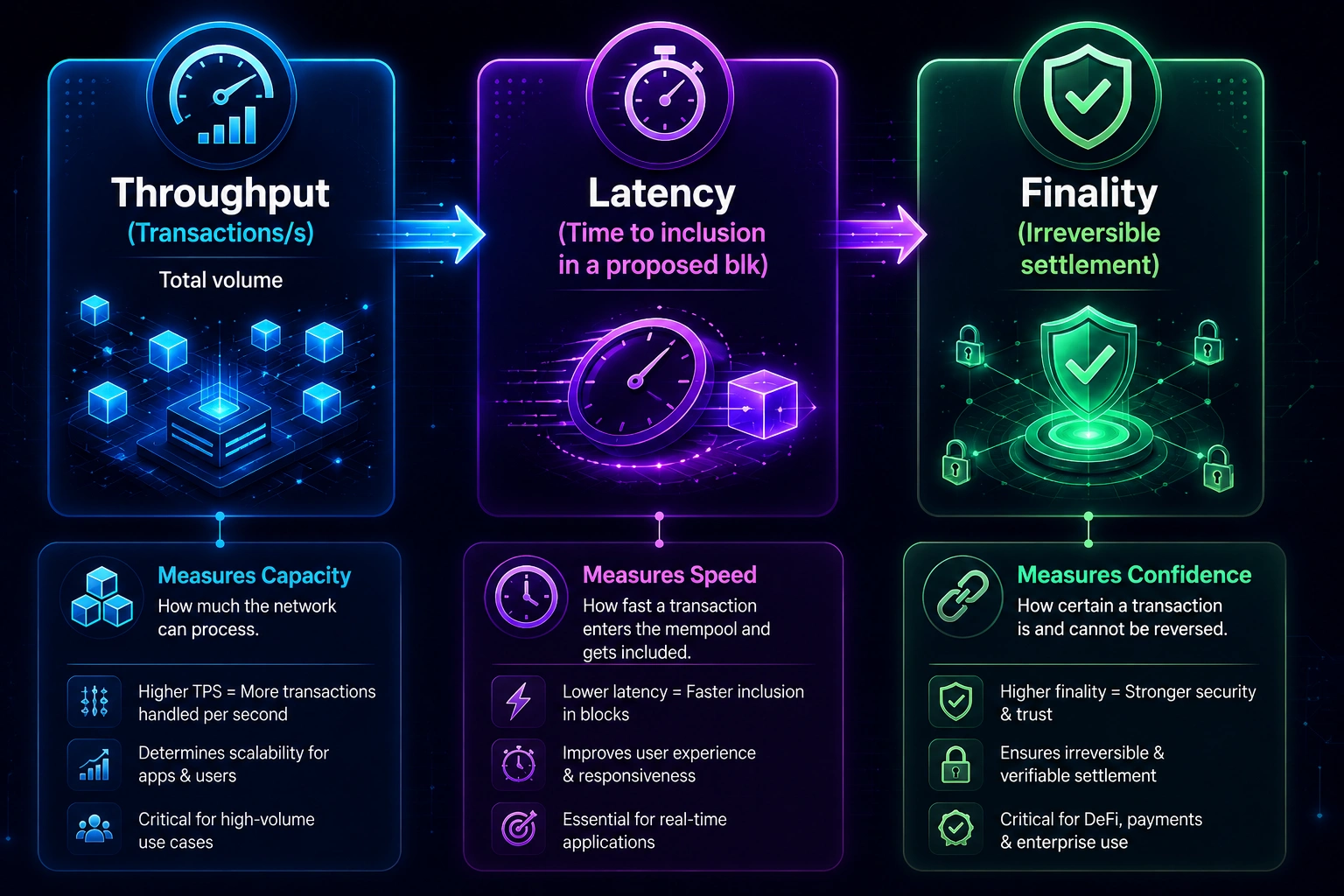
Blockchain performance is also another character for which blockchain to choose for web3 development. Throughput, latency, and finality together determine how reliably transactions execute, how quickly users receive feedback, and when on-chain actions become irreversible.
- Throughput (Real vs. Theoretical): Measures how many valid state transitions a network executes per second under production conditions, rather than synthetic stress tests.
- Latency (Block Time): The duration it takes for a user’s transaction to be processed and included in a block. Low latency provides immediate feedback in the UI, which is vital for consumer apps.
- Deterministic vs. Probabilistic Finality: Finality is the point at which a transaction cannot be altered, rolled back, or canceled:
- Optimistic / Soft Finality: Instant transaction confirmation at the execution layer (typical of L2s and fast L1s), sufficient for low-risk user interactions.
- Hard Settlement Finality: Multi-block or multi-validator verification (e.g., Ethereum L1’s ~12–15 minute Casper FFG checkpointing) required before releasing high-value physical or financial assets.
3. Smart Contracts and Programming Languages
The programming environment is a key factor in which blockchain to choose for Web3 development, as smart contract languages directly influence security, performance, developer availability, and hiring flexibility.
- EVM Model (Solidity / Vyper):
- Smart contracts combine code and state within the same on-chain account.
- Sequential execution by default (with emerging parallel EVMs).
- Highly standardized, with over a decade of production security patterns, open-source template libraries (e.g., OpenZeppelin), and established security tooling.
- Solana Program Model (Rust / C / Anchor):
- Programs are stateless logic containers; state is stored in separate, explicitly passed data accounts.
- Enables parallel transaction processing (via the Sealevel runtime) because the runtime knows ahead of time which accounts will be read or modified.
- Offers raw execution performance, but requires developers to manage manual memory, rent exemption, and account-validation security checks.
4. EVM Compatibility and Developer Tooling
EVM compatibility is an important consideration when deciding which blockchain to choose for Web3 development, offering access to a mature developer ecosystem, established tools, and widely adopted smart contract standards.
- Development Frameworks: Tools like Foundry (blazing-fast, Rust-based Solidity testing and fuzzing) and Hardhat (extensible JavaScript/TypeScript automation) drastically shorten testing and deployment cycles.
- Client Libraries: Modern frontend stacks rely on viem (lightweight, modular TypeScript interface) and Wagmi (React hooks for Web3) alongside legacy standards like ethers.js.
- Composability and Reusability: EVM equivalence allows teams to fork, deploy, or interface with battle-tested standards (ERC-20, ERC-721, ERC-1155, ERC-4337) without rewriting core business logic.
5. Liquidity, Users, Wallets, and Ecosystem Depth
A technically superior network without users, capital, and tooling will stall an application’s growth. Ecosystem depth represents the network effects that reduce go-to-market friction.
- Liquidity and Capital Efficiency: DeFi and marketplace applications require deep native stablecoin pools (USDC, USDT) and Automated Market Makers (AMMs) to minimize trading slippage and support collateralization.
- Wallet Ecosystem & Distribution: Instant accessibility through ubiquitous browser extensions, mobile wallets (MetaMask, Phantom, Coinbase Wallet), and embedded passkey solutions directly reduces onboarding drop-off.
- Composability: The ability to plug into existing protocols such as Aave for lending, Uniswap for swaps or Chainlink for price feeds eliminates the need to build core infrastructure from scratch.
Ethereum for Web3 Apps: When Does It Make Sense?
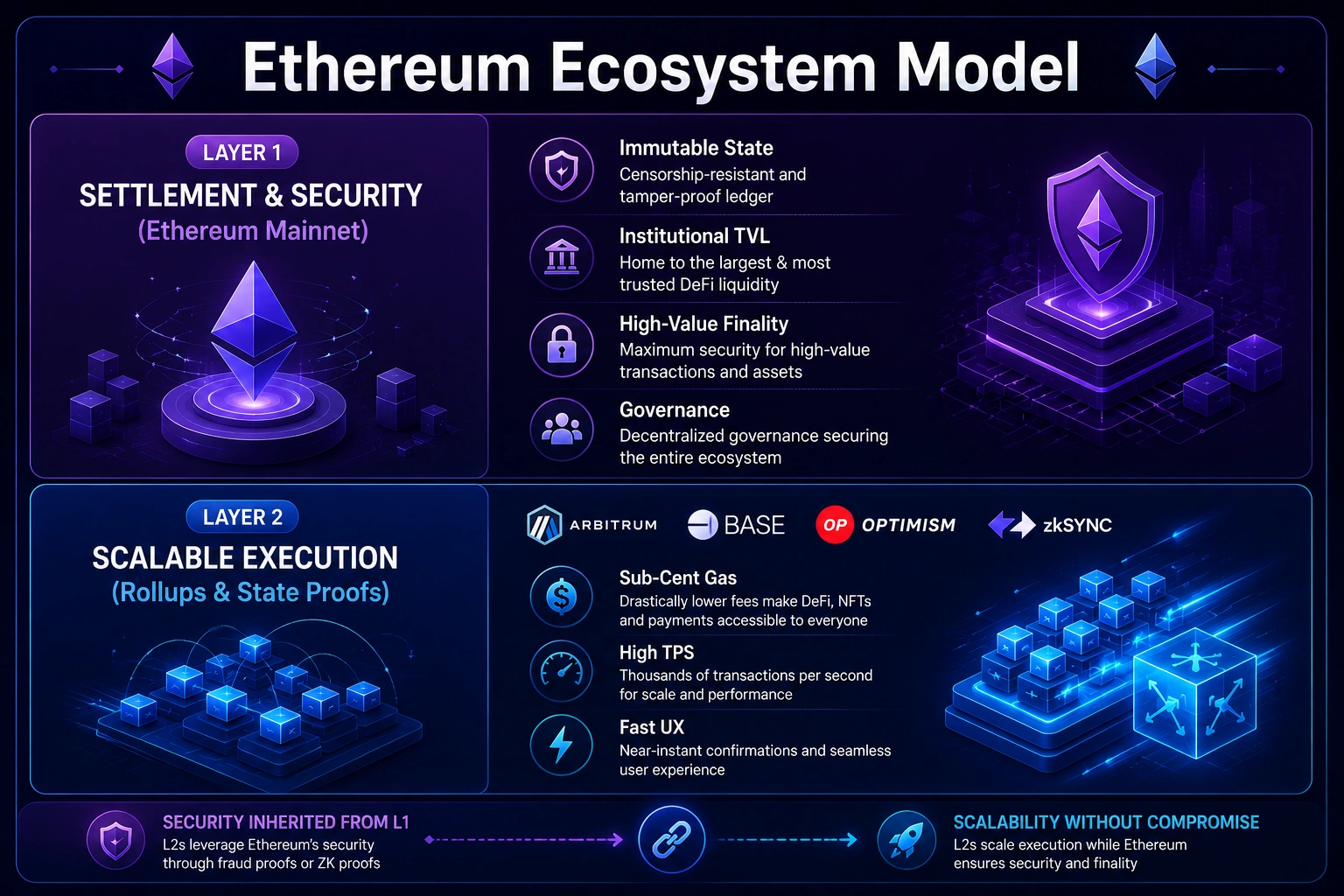
Ethereum is not universally superior for every Web3 use case, but it remains the industry’s default economic and security anchor. Deciding whether to build on Ethereum requires understanding where its security and liquidity justify its trade-offs, and where execution should be delegated to scaling layers.
A. What Makes Ethereum Strong for Web3 Development?
Ethereum’s strength lies in its network effects and structural maturity. For applications where security, trust, and access to capital outweigh raw transaction speed, Ethereum remains the industry standard.
- EVM & Smart Contract Standards: The Ethereum Virtual Machine (EVM) is the industry-standard runtime, with ERC-20, ERC-721, ERC-1155, and ERC-4337 enabling broad tooling compatibility.
- Solidity & Vyper Maturity: Solidity and Vyper offer mature static analysis tools like Slither and Mythril, testing frameworks such as Foundry and Hardhat, and formal verification capabilities.
- Composability (“Money Legos”): Smart contracts can interact atomically, allowing applications to integrate established protocols like Uniswap, Aave, and MakerDAO without rebuilding core primitives.
- Deep Capital Liquidity: Ethereum maintains significant TVL and institutional stablecoin activity, supporting deeper liquidity and potentially lower slippage for high-volume transactions.
- Developer Tooling & Infrastructure: Ecosystems including Viem, Wagmi, Ethers.js, The Graph, Goldsky, and major RPC providers offer strong first-class Ethereum support.
B. Where Ethereum Mainnet Becomes Expensive
While Ethereum Mainnet provides unmatched security, its execution constraints make it impractical for high-frequency consumer interactions:
- Gas Price Volatility: Gas fees fluctuate with network demand, with EIP-1559 base-fee spikes potentially pushing complex transactions from $2 to $40+ during congestion.
- Computational Cost Scaling: Every SSTORE operation, storage byte, and computational opcode consumes gas, making workflows like dynamic NFT minting, leaderboard updates, and frequent governance voting costly on Mainnet.
- Consumer UX Friction: Requiring users to pay fluctuating $5–$20 fees for low-value actions such as $10 microtransactions or game-item crafting can cause significant onboarding drop-off.
C. Ethereum Layer 2s Change the Cost Equation
Building on Ethereum no longer requires executing every transaction on Layer 1 Mainnet. Layer-2 Rollups (Optimistic Rollups like Arbitrum, Base, and OP Mainnet; ZK-Rollups like Linea and Starknet) bundle transactions off-chain and post compressed state proofs back to Ethereum L1 for final settlement.
- Sub-Cent Fees: The data blobs (EIP-4844), Layer-2 execution costs often average less than $0.01 per transaction, making gas sponsorship (Paymasters) commercially viable for consumer dApps.
- Inherited L1 Security: Unlike standalone alt-L1 chains that rely on separate, smaller validator sets, rollups inherit Ethereum’s economic security and data availability guarantees.
- Modular Deployment: Developers can write EVM code once and deploy across both L1 and L2s, reserving L1 for settlement and using L2s for daily user interactions.
D. Best Web3 Apps to Build on Ethereum (L1 + L2)
Ethereum offers a strong foundation for applications when evaluating which blockchain to choose for Web3 development that require deep liquidity, security, composability, and institutional-grade infrastructure, supporting use cases across DeFi, RWAs, NFTs, DAOs, and cross-chain settlement.
| App Category | Deployment Tier | Why Ethereum Fits Best | Industry Example |
| DeFi Protocols & Lending Markets | Ethereum L1 + Major L2s (Base, Arbitrum) | Requires deep capital pools, high liquidity and atomic composability. | Uniswap v3/v4, Aave v3, MakerDAO / Sky and Lido. |
| RWA & Institutional Assets | Ethereum L1 Mainnet | Institutional investors require decentralization, regulatory neutrality and proof-of-stake finality. | BlackRock BUIDL Fund, Franklin Templeton (FOBXX / BENJI), and Ondo Finance (USDY / OUSG). |
| NFT & Blue-Chip Collections | Ethereum L1 (Mint/Settle) + L2 (Trading) | High-ticket collectors prioritize provenance and maximum security. | CryptoPunks, Bored Ape Yacht Club (BAYC) and Art Blocks curated generative art. |
| DAOs & Governance Treasuries | Ethereum L1 / L2 Voting Bridges | Multi-million-dollar treasuries require multi-sig security (Safe) and immutable contract logic. | Safe{Wallet} multi-sig treasuries and Snapshot + Zodiac governance modules. |
| Cross-Protocol Settlement Layers | Ethereum L1 | Serves as a trusted dispute resolution and liquidity settlement layer for cross-chain bridges. | Chainlink CCIP / Data Feeds, LayerZero, and EigenLayer / Symbiotic restaking networks. |
Ethereum Mainnet makes sense when security, capital liquidity, and trust minimization outweigh transaction costs. For consumer-facing applications, social platforms, and gaming, deploying on Ethereum Layer 2s delivers high throughput while retaining full compatibility with the Ethereum ecosystem.
Solana for Web3 Apps: Is High Throughput Enough?
Evaluating Solana purely through the lens of raw Transactions Per Second (TPS) overlooks the true architectural trade-offs of the network. While Solana delivers sub-second settlement and fractions-of-a-cent execution, high throughput alone is not a silver bullet.
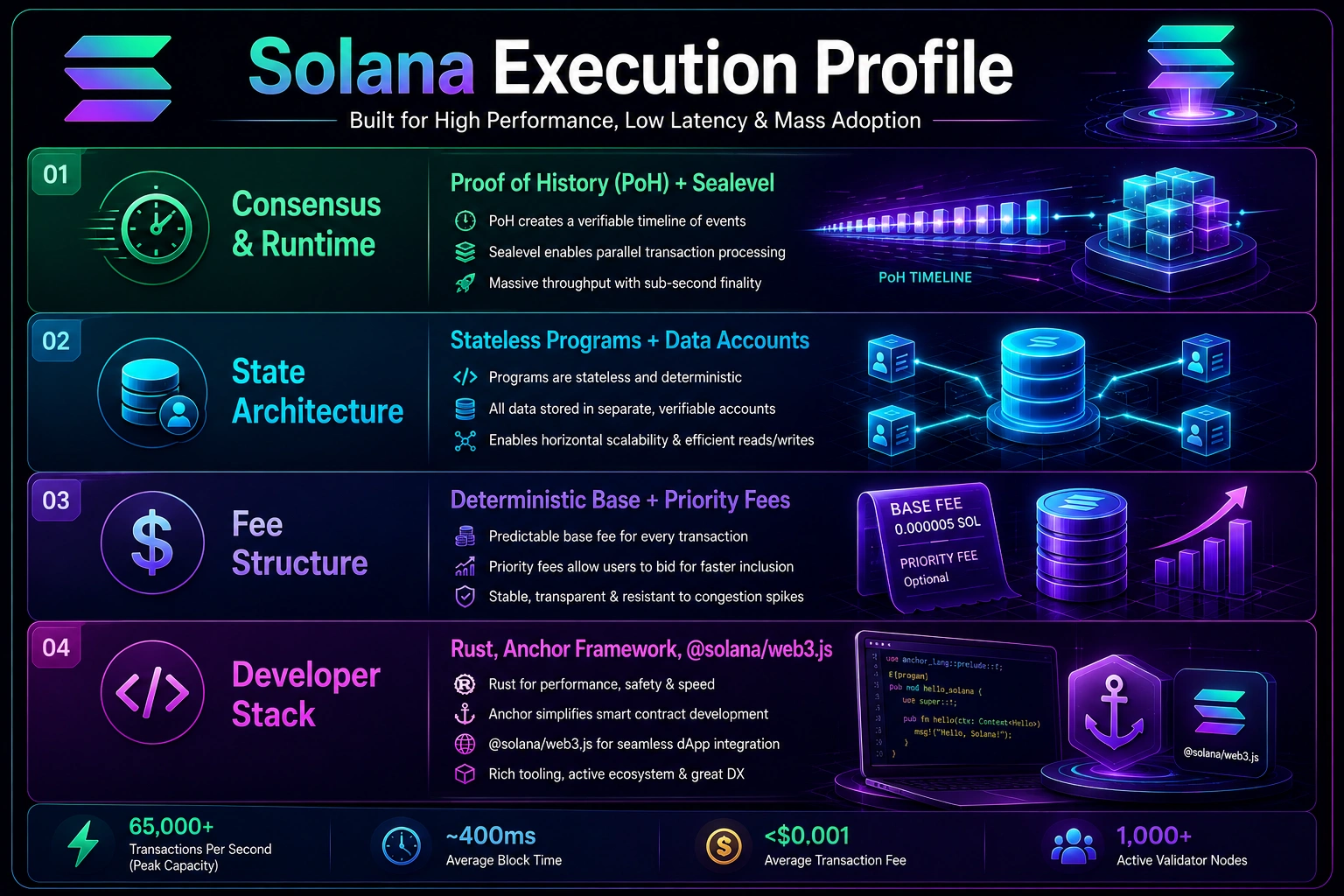
Choosing Solana requires understanding its unique state model, Rust-centric development ecosystem and how its localized fee markets handle high-demand events compared to traditional EVM architectures.
A. Why Solana Works for High-Frequency Applications
Solana stands out for applications where speed and cost directly impact the user experience. Its architecture supports fast finality, low fees, and high-frequency transactions, making it ideal for real-time applications.
- Sub-Second Finality: With ~400ms slot times and Proof of History (PoH)-based block generation, transactions confirm almost instantly without lengthy multi-block waits.
- Ultra-Low Micro-Fees: Base transaction costs average roughly $0.0005–$0.001, making high-volume actions like order cancellations, social interactions, and game moves economically viable.
- Parallel Transaction Execution: Solana’s Sealevel runtime processes non-overlapping transactions concurrently across CPU and GPU cores, reducing bottlenecks when individual smart contracts face heavy traffic.
- Web2-Like Latency: Fast on-chain execution enables responsive interfaces where blockchain state updates can feel closer to centralized cloud applications.
B. Solana Programs, Accounts, and Rust Development
Solana departs fundamentally from EVM’s contract-centric architecture by enforcing a strict separation between executable code and stored data.
- Stateless Programs vs. EVM Smart Contracts: On Ethereum, smart contracts store both logic and state variables within the same deployed address. On Solana, Programs are purely executable and stateless; they read and mutate data stored in separate Accounts passed into each transaction.
- Program Derived Addresses (PDAs): PDAs enable programs to sign transactions and manage state programmatically without exposing private keys, acting as deterministic key-value data stores.
- The Rust & Anchor Stack:
- Rust: Provides memory safety, strict concurrency guarantees, and bare-metal performance, eliminating common EVM attack vectors like reentrancy.
- Anchor Framework: The standard DSL and framework for Solana development, providing IDL (Interface Definition Language) generation, automated account deserialization, and standard security checks.
- Solana Web3.js: The primary client-side library for serializing instructions, requesting cryptographic signatures, and communicating with RPC nodes.
C. Solana Fees and Transaction Prioritization
Unlike Ethereum’s global gas auction (where an NFT mint can cause network-wide gas spikes for all users), Solana employs an isolated fee model.
| Fee Component | Economic Model | Distribution |
| Base Fee | Fixed at 5,000 lamports (0.000005 SOL) per signature | 50% burned, 50% paid to the block leader |
| Prioritization Fee | Variable bid priced in micro-lamports per Compute Unit (CU) | 100% paid to the validator to expedite scheduling |
| Storage Rent | Refundable deposit required to keep state accounts active | 100% returned when the data account is closed |
A clear fee structure can influence which blockchain to choose for Web3 development and Solana offers predictable base costs with targeted prioritization. This model helps developers control expenses while supporting applications built around frequent, high-volume transactions.
- Local Fee Markets: Because Solana transactions explicitly declare which accounts they modify, congestion on one specific account (e.g., a single token mint) raises priority fees only for transactions touching that account, leaving the rest of the network unimpeded.
- Compute Unit (CU) Metering: Transactions are bounded by strict compute budgets (default 200,000 CUs), requiring developers to optimize computational logic to avoid execution failures.
D. Best Web3 Apps to Build on Solana
Solana is a strong option for applications that demand high throughput and low transaction costs considering which blockchain is best for Web3 development, including trading, payments, gaming, social platforms, NFTs, and DePIN.
| App Category | Primary Advantage on Solana | Core Mechanism / Examples |
| High-Frequency Trading (DEXs) | Central Limit Order Books (CLOBs) | On-chain order matching and low-latency liquidity updates (Phoenix, Raydium, Orca). |
| Micro-Payments & Point-of-Sale | Instant finality with near-zero gas | Real-world retail settlement and merchant checkouts (Solana Pay, Shopify integrations). |
| Web3 Gaming & GameFi | Microsecond action state updates | Real-time session state settlement and frictionless inventory crafting without high gas sponsorship costs. |
| Consumer & Social Platforms | Frictionless Web2 onboarding | High-volume content tipping, dynamic user profiles, and social graphs (Dialect, DRiP). |
| High-Volume NFT Ecosystems | State Compression (cNFTs) | Minting millions of digital assets for fractions of a cent using Merkle tree storage. |
| DePIN (Decentralized Physical Infra) | High-density telemetry ingestion | Continuous device validation, heartbeat pings, and micropayment reward distribution (Helium, Render). |
Solana is the ideal choice when throughput, deterministic low costs, and user-facing responsiveness are critical to your product’s core loop. For applications that require deep institutional DeFi composability or where complex Solidity legacy codebases dominate, Ethereum and its L2s remain relevant but for consumer-scale performance, Solana stands apart.
Polygon for Web3 Apps: Is Ethereum Compatibility the Advantage?
Polygon is no longer just a cheap sidechain; it is a modular Ethereum aggregation ecosystem. Connected via the AggLayer, it provides unified liquidity and scaling options from its PoS chain to zkEVM and custom AppChains.
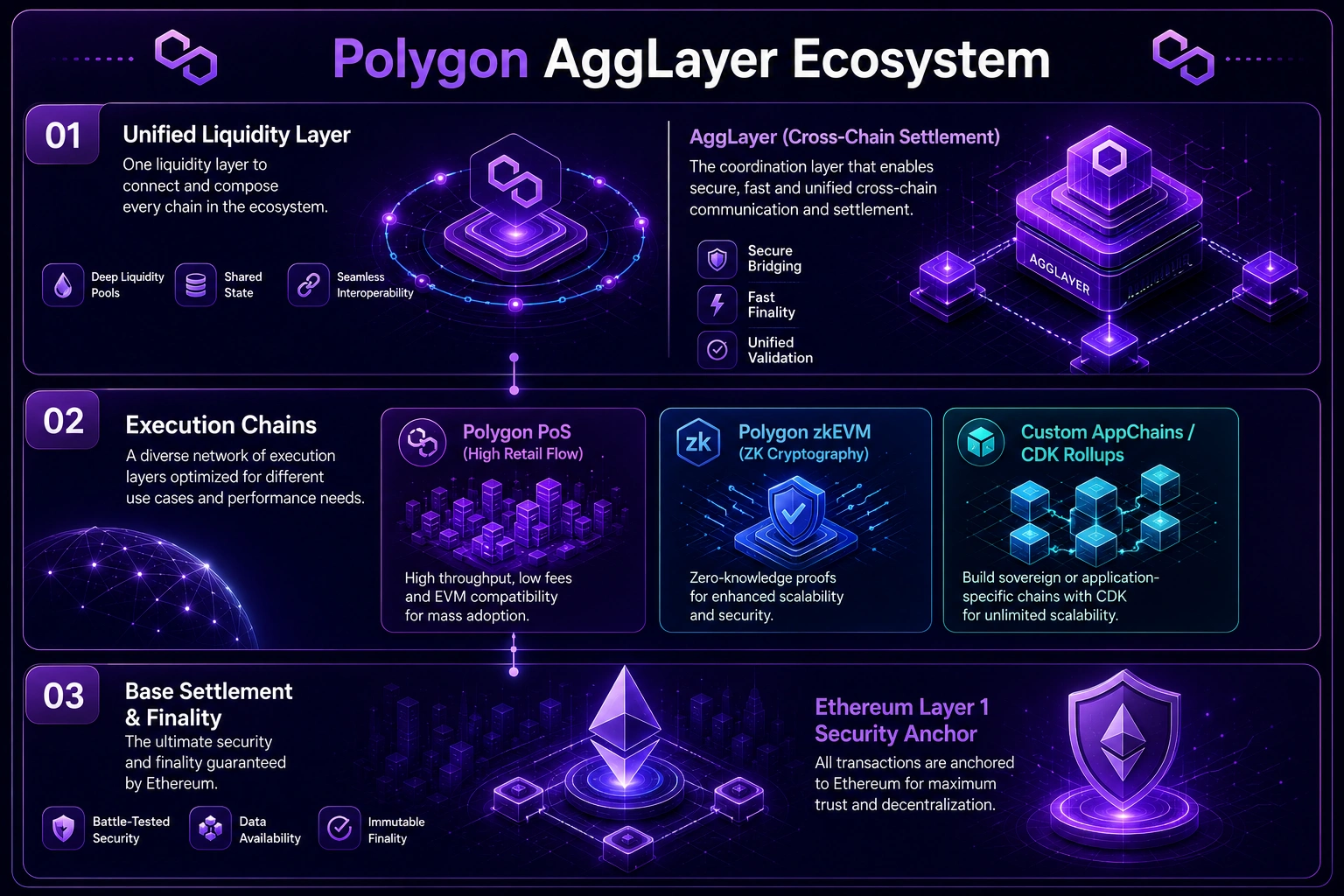
Polygon’s defining advantage is not just lower fees, it is the ability to achieve high-throughput scaling while remaining 100% aligned with Ethereum’s security, liquidity, and developer standards.
A. Why Developers Choose Polygon for Scalable Apps
Polygon bridges the gap between Ethereum’s enterprise-grade security and consumer-scale transactional throughput:
- Ultra-Low Transaction Costs: Transactions typically cost less than $0.01, making gas sponsorship through Paymasters (ERC-4337) practical for consumer applications.
- Native Ethereum Compatibility: Ethereum-compatible code can run on Polygon with minimal changes, preserving smart-contract composability and established standards.
- Established Institutional Ecosystem: Strong adoption across consumer brands, payment processors, and gaming studios provides access to mature tooling and retail liquidity.
- Mass Consumer Scalability: ~2-second transaction times and rapid finality support high-frequency interactions such as reward claims, in-game crafting, and social actions.
B. Polygon’s EVM Stack and Development Workflow
Building on Polygon requires zero unlearning for Ethereum developers. Because Polygon is fundamentally EVM-equivalent, existing developer workflows and tooling translate directly.
- Smart Contract Portability: Developers use Solidity or Vyper with standard OpenZeppelin libraries for secure ERC-20, ERC-721, ERC-1155, and ERC-6551 implementations.
- Tooling Consistency: Standard pipelines like Foundry for fast testing/deployment and Hardhat for plugin-heavy architectures connect to Polygon RPCs by updating the network chainId.
- Universal Wallet Support: Existing wallets such as MetaMask, Rainbow, Coinbase Wallet, and Phantom connect without new keypairs, while Privy and Dynamic SDKs enable frictionless social logins.
- Turnkey Infrastructure: Leading node operators, IPFS/Arweave storage, and Chainlink Data Feeds & VRF provide out-of-the-box support across the Polygon stack.
C. Which Polygon Network Should Your App Use?
Choosing the right Polygon deployment target depends on your project’s balance between transaction volume, execution cost, cryptographic security, and ecosystem maturity.
| Architecture Option | Underlying Tech | Core Advantage | Best Use Case |
| Polygon PoS | Proof-of-Stake commit-chain checkpointed to Ethereum | Lowest transaction friction, mature dApp ecosystem, deepest retail liquidity | Mass-market consumer dApps, Web3 games, loyalty rewards, digital tickets |
| Polygon zkEVM | Zero-Knowledge Rollup (ZK-SNARKs) | Inherits direct Ethereum L1 security, zero-compromise cryptographic proofs | High-value DeFi protocols, institutional asset settlement, tokenized debt |
| Polygon CDK (Custom AppChains) | Modular Layer 2 / Layer 3 dedicated rollups | Dedicated execution environment, custom gas tokens, zero noisy-neighbor risk | Enterprise consortia, AAA game studios with millions of daily transactions |
C. Best Web3 Apps to Build on Polygon
Polygon offers a practical foundation for enterprise applications when deciding which blockchain to choose for Web3 development that requires low costs, scalability, fast transactions, and Ethereum compatibility across gaming, NFTs, loyalty, social dApps, ticketing, and digital ownership.
| App Category | Why Polygon Fits Best | Industry Example / Use Case |
| Web3 Games & GameFi | Low gas costs support thousands of daily player actions without significantly reducing margins. | Ubisoft Champions Tactics, The Sandbox for trading, crafting and territory mechanics. |
| NFT Platforms & Marketplaces | High throughput enables high-volume, low-cost minting while supporting secondary-market liquidity. | DraftKings Marketplace supports sports collectibles. |
| Enterprise Loyalty Programs | Predictable costs support distributing digital rewards to millions of customers. | Starbucks Odyssey, Nike .SWOOSH, and Lufthansa Uptrip for gamified loyalty |
| Consumer & Social dApps | Fast blocks and account abstraction enable Web2-like experiences with social logins. | Lens Protocol, Courtyard.io, and Polygon ID for social graphs and verifiable credentials. |
| Brand Experiences & Ticketing | On-chain provenance helps prevent counterfeits and enables automated secondary royalty splits. | Ticketmaster NFT-gated tickets and Mastercard music pass drops. |
| Digital Ownership Platforms | Provides a low-cost, immutable registry for physical goods linked to digital twins. | Franklin Templeton Benji & JPMorgan Onyx/Aave |
Base for Web3 Apps: Why Choose an Ethereum L2?
Base, incubated by Coinbase and built on the open-source OP Stack, has emerged as a leading Layer-2 (L2) ecosystem for consumer applications. Unlike standalone Layer-1 networks or sidechains, Base operates as an optimistic rollup anchored to Ethereum. It combines Ethereum’s security and liquidity with sub-cent gas fees and native fiat-onramp distribution.
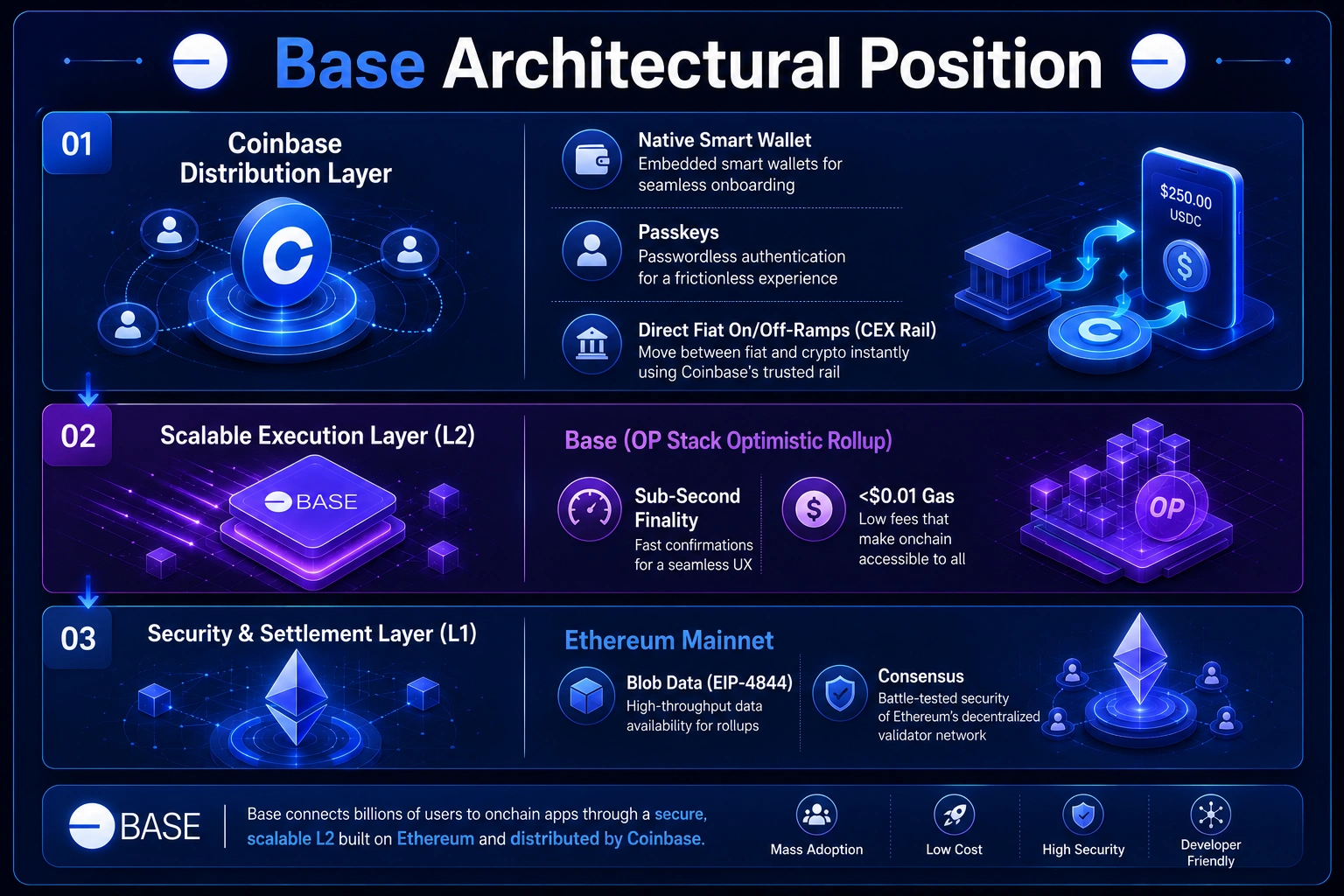
Choosing Base is not merely about finding lower gas prices; it is about leveraging a seamless bridge from centralized consumer finance directly into on-chain applications.
A. How Base Reduces Ethereum Transaction Friction
Base scales Ethereum by decoupling execution from settlement and data availability:
- Off-Chain Execution & Batching: Base processes transactions through its sequencer, batches execution data, and posts compressed state data back to Ethereum L1.
- EIP-4844 Blob Cost Efficiency: Base uses Proto-Danksharding data blobs instead of permanent L1 calldata, reducing data-posting costs and helping keep average transactions around $0.005–$0.01.
- Sub-Second Transaction Times: Sub-second block times and near-instant confirmations provide faster transaction experiences than Ethereum L1.
- Commercial Gas Sponsorship: Low gas costs allow applications to use Paymasters (ERC-4337) to sponsor user transactions at relatively low cost.
B. Base’s EVM Compatibility for Web3 Developers
Base offers full EVM equivalence, meaning development teams can deploy Ethereum-native codebases without rewriting contracts, altering logic, or learning new smart contract languages.
- Identical Smart Contract Logic: Existing Solidity or Vyper contracts can be deployed directly, with libraries like OpenZeppelin working out of the box.
- Streamlined Tooling Integration: Foundry and Hardhat deployments require only the Base RPC URL and chain ID changes, using 8453 for Mainnet and 84532 for Sepolia.
- Native Passkey & Smart Wallet SDKs: Coinbase Smart Wallet and OnchainKit enable biometric Face ID/Touch ID transaction signing without browser extensions or seed phrases.
- Universal Connector Support: Wagmi and viem natively support Base, providing compatibility with MetaMask, Coinbase Wallet, Rainbow, and WalletConnect.
C. Base vs. Ethereum Mainnet for Consumer Apps
The choice between Ethereum Mainnet and Base depends on cost, speed, onboarding, and user accessibility during deciding which blockchain is best for Web3 development, especially for consumer applications built around frequent transactions and seamless experiences.
| Comparison Metric | Ethereum Mainnet (L1) | Base (Layer 2) |
| Average Transaction Fee | $1.50 – $20.00+ (Demand-volatile) | Sub-cent (<$0.01 typical) |
| Execution Latency | ~12 seconds per block | ~2 seconds (sub-second soft finality) |
| Onboarding UX | High friction (requires ETH for gas) | Low friction (Paymaster gas sponsorship, Passkeys) |
| Cost Sensitivity | Optimized for high-value settlement | Optimized for high-frequency microtransactions |
| Retail User Accessibility | Prohibitive for casual consumers | High conversion due to integrated fiat on-ramps |
For consumer applications, forcing users to pay $5+ in network gas to like a post, claim a reward, or trade a $2 game item destroys user retention. Base eliminates this barrier, allowing high-frequency interactions while maintaining Ethereum L1 settlement security.
D. Best Web3 Apps to Build on Base
Base offers a compelling option for consumer-focused applications when deciding which blockchain to choose for web3 development. Its low fees, fast transactions, and accessible onboarding support web3 apps like social apps, DeFi, payments, NFTs, gaming and digital marketplaces.
| Application Type | Primary Advantage on Base | Industry Example |
| Consumer Web3 & Social Apps | Passkey onboarding and negligible gas for frequent social interactions. | Farcaster/Warpcast, friend.tech, and AlfaFrens for on-chain social experiences and subscriptions. |
| High-Volume DeFi & Lending | Low transaction costs with deep liquidity from Coinbase-linked capital. | Aerodrome Finance, Uniswap v3/v4, Aave v3, and Morpho Blue. |
| Global Payment Applications | Fast settlement and frictionless native USDC transfers. | Coinbase Commerce, Base Pay, Beam, and Slice for payments and merchant invoicing. |
| NFT Platforms & Creator Tools | Affordable multi-asset minting and low-fee secondary trading. | Zora, Rarible, and Highlight.xyz for creator mints, media coins, and digital art. |
| On-Chain Gaming & Marketplaces | High-throughput updates and gasless micro-actions through session keys. | Pirate Nation, Fren Pet, OpenSea, and Magic Eden on Base. |
Which Blockchain To Choose For Web3 Development?
Choosing the right blockchain stack is a foundational engineering decision that dictates your development velocity, testing rigor, infrastructure costs, and client performance.
Building a production-ready Web3 application requires more than deploying an on-chain program; it demands a coordinated architecture spanning smart contract development environments, client-side cryptographic connection layers, dedicated RPC nodes, and real-time indexing pipelines.
A. Recommended Stack for Ethereum, Polygon, and Base
Ethereum, Polygon, and Base are fundamentally EVM-compatible and that’s why they share a unified, battle-tested tooling ecosystem. Developers can write code once and deploy across all three networks simply by changing target RPC endpoints and chain IDs.
| Stack Layer | Recommended Technologies | Primary Role |
| Smart Contracts | Solidity, OpenZeppelin | Write and secure EVM smart contracts |
| Development & Testing | Foundry, Hardhat | Testing, deployment, scripting, and contract development |
| Client Interaction | viem, ethers.js | Connect applications with contracts and blockchain networks |
| Frontend Web3 | Wagmi | Wallet states, balances, signing, and contract interactions |
| Wallet Connectivity | MetaMask, WalletConnect, AppKit | Connect user wallets across web and mobile |
| Embedded Wallets | Privy, Dynamic, Coinbase Smart Wallet | Simplify onboarding with social login and smart-wallet experiences |
| RPC Infrastructure | Alchemy, Infura, QuickNode, Chainstack | Provide reliable blockchain network access |
| Indexing | The Graph, Goldsky | Query blockchain events and application data efficiently |
This shared EVM stack is one of the biggest practical advantages of choosing Ethereum, Polygon or Base. Existing Ethereum development expertise and tooling can generally be reused across the three ecosystems, reducing unnecessary changes in the application architecture.
B. Recommended Stack for Solana Development
Solana requires a distinct development approach because its architecture differs from EVM-based networks. Programs handle executable logic while accounts hold application state, making the development stack more specialized.
| Stack Layer | Recommended Technologies | Primary Role |
| Program Development | Rust | Build high-performance Solana programs |
| Development Framework | Anchor | Simplify program development, testing, serialization, and IDL generation |
| Program Architecture | Programs, Accounts, PDAs | Separate executable logic from application state |
| Client Interaction | @solana/web3.js | Build transactions and interact with Solana programs and RPCs |
| Digital Assets | Metaplex Umi, DAS | Work with NFTs and digital asset infrastructure |
| Wallet Connectivity | Solana Wallet Adapter | Connect supported Solana wallets |
| Native Wallets | Phantom, Solflare, Backpack | Provide user wallet access and transaction signing |
| Embedded Wallets | Privy, Web3Auth | Enable simplified onboarding and embedded wallet experiences |
| RPC & Data Infrastructure | Helius, Triton One | Support high-throughput RPC access and real-time blockchain data |
The main architectural distinction is therefore not simply Solidity versus Rust. EVM development and Solana development differ in their underlying execution models, state management, tooling, wallet ecosystems, and infrastructure requirements.
C. Wallets, RPCs, APIs and Indexing Infrastructure
Smart contracts represent only a small fraction of a Web3 app’s total codebase. Production applications depend heavily on off-chain infrastructure to deliver smooth, low-latency user experiences:
RPC Nodes (The Communication Gateway): Raw blockchain nodes are unsuitable for direct consumer traffic due to rate limits and latency. Production apps use load-balanced RPC clusters with automated fallbacks, priority fee estimation, and MEV protection.
Indexing Pipelines (The Data Aggregation Layer): Direct RPC queries for historical state or nested user activities, such as “Show all NFTs owned by User X across 5 contracts,” are notoriously slow and compute-heavy. Indexers like The Graph, Goldsky, SubQuery, and SQD capture on-chain event logs in real time, transform raw calldata, and store it in indexed PostgreSQL databases accessible through fast GraphQL endpoints.
Specialized Web3 APIs: Specialized Web3 APIs simplify blockchain development by providing token data, NFT metadata, transaction simulation, and security checks, helping developers improve reliability, user experience, and protection without building infrastructure from scratch.
- Token & Price Metadata: CoinGecko, Moralis, or SimpleHash APIs to serve live fiat valuations, token logos, and floor prices.
- NFT Metadata Resolvers: Decentralized IPFS/Arweave gateways with CDN caching layers to prevent broken image links and slow client rendering.
- Transaction Simulation & Security APIs: Engines like Blowfish and Blockaid to simulate transactions and warn users of phishing threats or drainer contracts before signing.
How to Choose the Right Blockchain for Your Web3 App
Selecting a blockchain network is not a purely technical preference but it is a core business decision that directly dictates your development timeline, unit economics, infrastructure budget, and user retention.
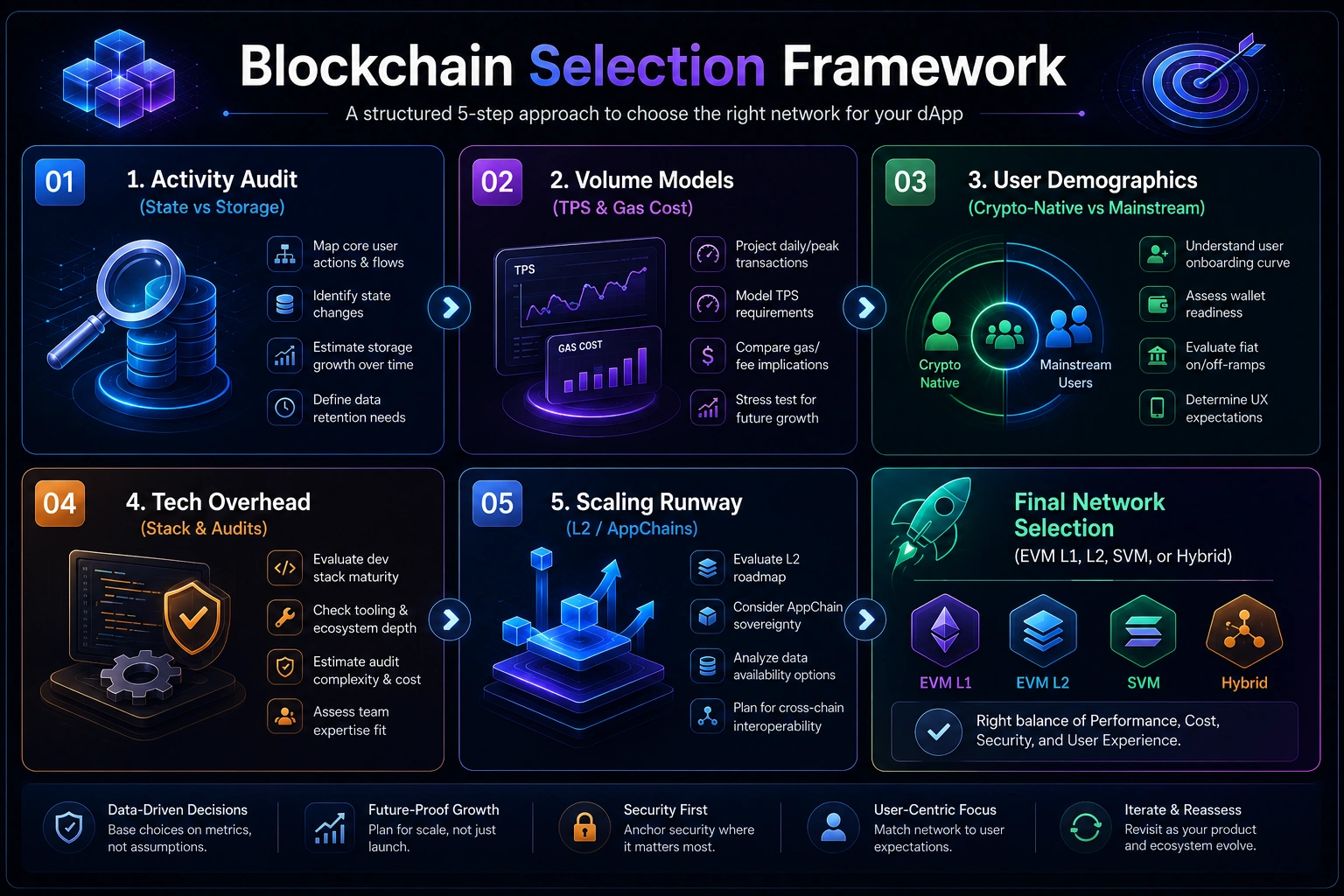
To choose the optimal network, enterprises must systematically evaluate five architectural dimensions before writing smart contracts.
Step 1: Define Your App’s On-Chain Activities
Smart contracts should be reserved for high-trust, financial, or verifiable state changes. Auditing which interactions must live on-chain versus off-chain determines your required throughput and storage model:
| Activity / Use Case | Execution Nature | Core Technical Requirements | Best-Fit Networks / Protocols |
| Asset Ownership & Provenance | On-Chain | Immutable ledger permanence, universal token standards (ERC-721/1155, SPL), and secondary market liquidity. | Ethereum L1, Polygon, Base, Solana |
| Payments & Microtransactions | On-Chain / Hybrid | Sub-second finality, zero slippage, and predictable sub-cent fees. | Solana, Base, Polygon PoS |
| Financial Settlement & Escrow | On-Chain | Maximum validator security, battle-tested smart contract safety, and deep capital pools. | Ethereum L1, Arbitrum One |
| Trading & Order Books | On-Chain / Hybrid | High parallel throughput for CLOBs (on-chain) or standard AMM rollup liquidity. | Solana, Sei, Arbitrum, Base |
| Decentralized Identity (DID) | On-Chain / Hybrid | Low-cost issuance, soulbound credentials, and Account Abstraction (ERC-4337) compatibility. | Polygon ID, Base, Ethereum L2s |
Step 2: Estimate Transaction Frequency
Your projected transaction volume dictates whether network gas fees are sustainable for your business model and end users:
- Low-Frequency, High-Value (<10,000 Tx/Day): Institutional asset platforms, private wealth registries, and treasury vaults can absorb Ethereum L1 gas variability in exchange for maximum security.
- Medium-Frequency (10,000–500,000 Tx/Day): Consumer apps, creator platforms, and NFT ecosystems suit Ethereum L2s such as Base, Polygon, and Arbitrum, where sub-cent fees enable viable Paymaster gas sponsorship.
- High-Frequency (500,000+ Tx/Day): Real-time social networks, DePIN telemetry, and GameFi require Solana or dedicated Layer-3 AppChains for parallel processing, congestion control, and predictable costs.
Step 3: Match Users to the Right Ecosystem
A technically sound architecture will still fail if it isolates your target audience from their existing assets and habits:
| Target Audience | Primary Characteristics | Recommended Network Profile |
| Crypto-Native Power Users | Comfortable with MetaMask/Phantom, seed phrases, bridging, and self-custody. | Ethereum L1, Arbitrum, Solana (places liquidity and composability first). |
| Mainstream Consumers (Web2.5) | Zero crypto familiarity; expects email/social login, credit card on-ramps, and gasless UX. | Base or Polygon (paired with ERC-4337 Account Abstraction and Passkeys). |
| Enterprise & Brand Audiences | Corporate compliance concerns, zero tolerance for failed transactions, stable fiat billing. | Polygon CDK, Avalanche Subnets, or permissioned EVM rollups. |
| Geographic / Emerging Markets | Mobile-first users with high sensitivity to micro-fees and local fiat off-ramps. | BNB Chain, Solana, or Polygon PoS (broad mobile penetration and retail exchange support). |
Step 4: Compare Development and Infrastructure Requirements
Development requirements vary across blockchain ecosystems, making programming languages, developer availability, tooling, infrastructure, and operational costs important factors when evaluating the technical resources needed to build and maintain a Web3 application.
EVM Ecosystem (Solidity / Vyper): EVM offers a mature developer ecosystem, extensive audited libraries, established testing frameworks, strong indexing support, and competitive infrastructure providers.
- Advantage: Largest developer pool, thousands of audited OpenZeppelin libraries, commoditized testing frameworks (Foundry, Hardhat), and extensive indexer support (The Graph).
- Infrastructure: Highly competitive, low-cost node providers (Alchemy, QuickNode, Infura).
Solana Ecosystem (Rust / Anchor): Solana delivers high throughput and fast execution with memory-safe architecture, but requires specialized Rust developers and dedicated high-performance infrastructure.
- Advantage: Maximum throughput, sub-second execution, and memory-safe architecture.
- Trade-off: Requires specialized Rust engineers, custom account serialization logic, and dedicated high-throughput RPC nodes (Helius, Triton).
Step 5: Plan for Scaling Before Launch
Designing for scale means ensuring your application can accommodate a 100x increase in users without requiring a total codebase rewrite:
- EVM Portability: Deploying on an EVM Layer 2 such as Base or Polygon allows migration to a dedicated Layer 3 rollup or Polygon CDK AppChain with minimal smart-contract refactoring as activity grows.
- Modular Multi-Chain Architecture: Use cross-chain layers such as Chainlink CCIP or LayerZero to separate state logic from liquidity hubs, enabling deployment across new networks as demand shifts.
- State Compression & Batching: Implement off-chain proofs, session keys, and Merkle tree state compression early so transaction costs scale sub-linearly with user growth.
How IdeaUsher Will Help You Build Your Web3 App
IdeaUsher is a product engineering partner also expert in Web3 with 11+ years of experience, 1,000+ completed projects, operations across 50+ countries, and 250+ specialists. With a 4.9/5 Clutch rating, we build custom, high-concurrency dApps and decentralized ecosystems from the ground up.
Rather than relying on generic templates, we engineer scalable, cloud-native Web3 platforms with custom smart contracts, multi-chain architecture, decentralized indexing, wallet infrastructure, and gasless account abstraction tailored to your business model.
- Multi-Chain Smart Contract Engineering: We architect audited, gas-optimized smart contracts across EVM and non-EVM chains including Ethereum, Solana, Polygon, Base, and Arbitrum, supporting tokenomics, governance, and dynamic staking pools.
- Frictionless ERC-4337 Account Abstraction: We build smart contract wallets with gasless transactions through paymasters, social logins, biometric authentication, and automated session keys for seamless non-crypto onboarding.
- Dedicated RPC & High-Speed Data Indexing: We build fault-tolerant RPC networks with automated failover, paired with custom subgraphs and event indexers such as The Graph for sub-second blockchain data queries.
- Decentralized Storage & Tamper-Proof Oracles: We integrate IPFS, Arweave, Filecoin for persistent media storage, alongside Chainlink and Pyth for real-time off-chain price data.
- Institutional-Grade Security & Smart Contract Audits: We apply static analysis, dynamic fuzzing, and formal verification within isolated, AES-256-encrypted cloud microservices to protect capital and TVL.
- Zero Vendor Lock-In Asset Delivery: We deliver clean, well-documented, open-source code, providing complete platform, protocol, and intellectual property ownership from day one.
Ready to build a secure, scalable Web3 application? Partner with Idea Usher’s blockchain and Web3 engineering team to architect and launch your custom Web3 App.
Conclusion
The right blockchain ultimately depends on what your Web3 app needs to achieve. Ethereum stands out for ecosystem depth and composability, while Solana suits high-frequency applications where speed and low fees matter. Polygon offers Ethereum compatibility with scalable infrastructure, and Base provides a cost-efficient Layer 2 route into the Ethereum ecosystem. A careful evaluation of transaction volume, user experience, smart-contract requirements, liquidity, security, and long-term scalability can help you select the network that best supports your product and growth strategy.
FAQs
A.1. There is no universal or fixed choice when deciding which blockchain to choose for web3 development. Ethereum suits composability and liquidity, Solana fits high-frequency apps, Polygon supports EVM-compatible scaling, and Base suits lower-cost Ethereum applications.
A.2. Solana is generally suited to applications requiring frequent transactions and fast execution, while Ethereum offers deeper composability, mature tooling, and broader smart-contract infrastructure for complex applications.
A.3. Both provide EVM-compatible environments, allowing Ethereum-oriented development workflows and tooling. The choice depends on ecosystem integrations, application requirements, transaction economics, and the preferred scaling architecture.
A.4. A single blockchain simplifies contracts, testing, security, and liquidity management, while multi-chain architecture expands ecosystem reach but introduces additional bridging, messaging, liquidity, and security complexity.