

Key Takeaways
- SocialFi apps blend networking with blockchain technology and let users hold control over their identity, their posts, digital goods and how much money creators can earn.
- There are different types of SocialFi apps in the market including decentralized social networks, creator platforms, tokenized communities, social gaming and decentralized messaging apps.
- The focused MVP should include fundamental social functionality like wallet connectivity, creator monetisation, content management and decentralised identity and moderation.
- Decentralized social media development can range from $50,000 to $500,000+ and the cost is based on platform complexity, blockchain infrastructure, standardised connectors and security requirements.
- The biggest factors that can raise the price are support for blockchains, custom token rules, audits of smart contracts, use of decentralized protocols and advanced features in wallets.
Social platforms have grown audiences by keeping user identities, followers and content inside closed ecosystems but that model however limits what users can own or carry away. This movement is gaining pace for decentralized social media development, where identity, social connections and creator value can travel between compatible applications instead of being bound to one platform.
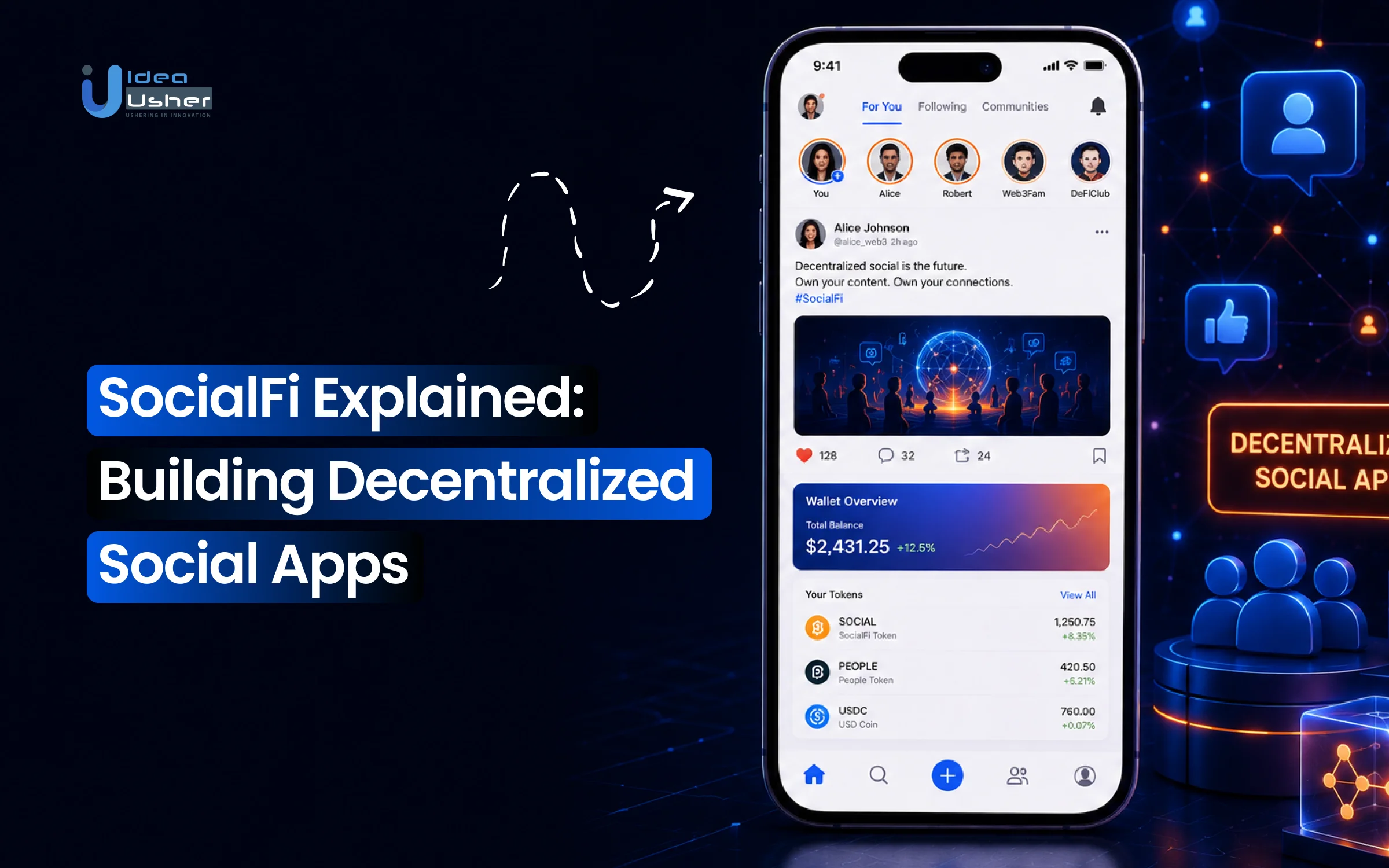
SocialFi apps allow users to participate more in the networks they help establish through decentralised identities, portable social graphs, crypto payments, NFTs, social tokens, creator monetisation and community governance. For enterprises, it’s not just about adding social features to a blockchain, but building experiences where ownership and interoperability are essential product advantages.
In this blog, we will talk about how to build SocialFi app, their key features, blockchain infrastructure, monetization models, development cost & affecting factors and how IdeaUsher can help you build a scalable decentralized social media app that gives users greater ownership, privacy and control over their social interactions and digital assets.
What Are SocialFi and Decentralized Social Apps?
SocialFi (Social Finance) and decentralized social apps (DeSo) merge social media, DeFi and blockchain into user-owned networks. These dApps tokenize social influence and replace centralized platforms with open, decentralized media ecosystems.
Unlike conventional platforms like X, Instagram, or TikTok where central servers control algorithms, data and ad revenues. By anchoring data to Decentralized Identifiers (DIDs) and on-chain social graphs, SocialFi apps operate on public blockchains, enabling creators and users to own their digital identities, relies on four integrated layers working together:
- Social Networking Layer: Front-end user experiences (feeds, messaging, profiles, micro-blogging) built using open protocols.
- Blockchain Settlement Layer: Public ledgers (e.g., Ethereum Layer-2s, Solana, Optimism) storing user identity assets, smart contracts and token transactions.
- Crypto Payments Infrastructure: Built-in non-custodial wallets enabling peer-to-peer micro-tipping, tokenized subscriptions and gasless micro-transactions.
- Decentralized Storage & Indexing: Distributed data protocols (such as IPFS, Arweave and decentralized relays like Farcaster Hubs) that keep posts, media and social graphs independent of any single corporate database.
A. How SocialFi Differs From Traditional Social Media
SocialFi reimagines social media by shifting control from centralized platforms to users and open protocols. Here are the key principles that define how SocialFi is transforming ownership, monetization, governance and interoperability across digital communities.
| Dimension | Traditional Social Media (Web2) | SocialFi & Decentralized Social (Web3) |
| Account Ownership | Custodial: Platform owns the account; can suspend, shadowban, or delete at will. | Non-Custodial: User owns the account via a private key / wallet (DID). |
| Social Graph Portability | Walled Garden: Followers/data are locked into one platform; cannot be migrated. | Portable: Followers and relationships exist on open protocols, usable across multiple apps. |
| Monetization Engine | Ad-revenue extraction; platform takes 30%–100% of creator monetization. | Direct peer-to-peer tipping, token mints, key sales and direct smart contract fee splits. |
| Governance | Centralized Corporate Control: Platforms determine algorithms, feeds, moderation and policies internally. | Decentralized Governance: DAOs and token holders can participate in protocol upgrades, fees and moderation decisions. |
| Data & Hosting | Centralized cloud databases (AWS, GCP, proprietary servers). | Hybrid on-chain state updates + decentralized storage networks (IPFS, Arweave, Hubs). |
| Platform Interoperability | Limited Interoperability: Social graphs and content generally remain isolated across platforms. | Protocol-First Composability: Multiple front-end apps can operate on the same underlying protocol and social graph. |
B. How Blockchain Changes Social App Ownership
Blockchain transforms social app ownership by separating users’ digital identities, relationships and data from individual platforms, giving people greater control, privacy, continuity and freedom to move between compatible applications.
The primary shift in SocialFi is decoupling identity and relationships from the application UI:
- De-Risking Platform De-platforming: If a specific front-end application shuts down or censors a creator, the user retains their cryptographic handle, content history and follower connections. They can simply plug their wallet into a different front-end client operating on the same social graph.
- User Data Rights: Instead of platforms harvesting personal interaction data for proprietary ad targeting, users choose what data to store on-chain or off-chain, leveraging zero-knowledge proofs to verify traits without surrendering privacy.
C. How SocialFi Apps Separate Identity and Social Graphs
The core breakthrough of decentralized social applications is the architectural split between the protocol layer (identity/graph) and the application layer (client/UI).
In traditional Web2 social networks, the interface (the app you see), the database (where your posts live) and the identity system (your login) are hardcoded together into a single monolith. If a platform changes its algorithm or closes your account, you lose your identity, content and audience overnight.
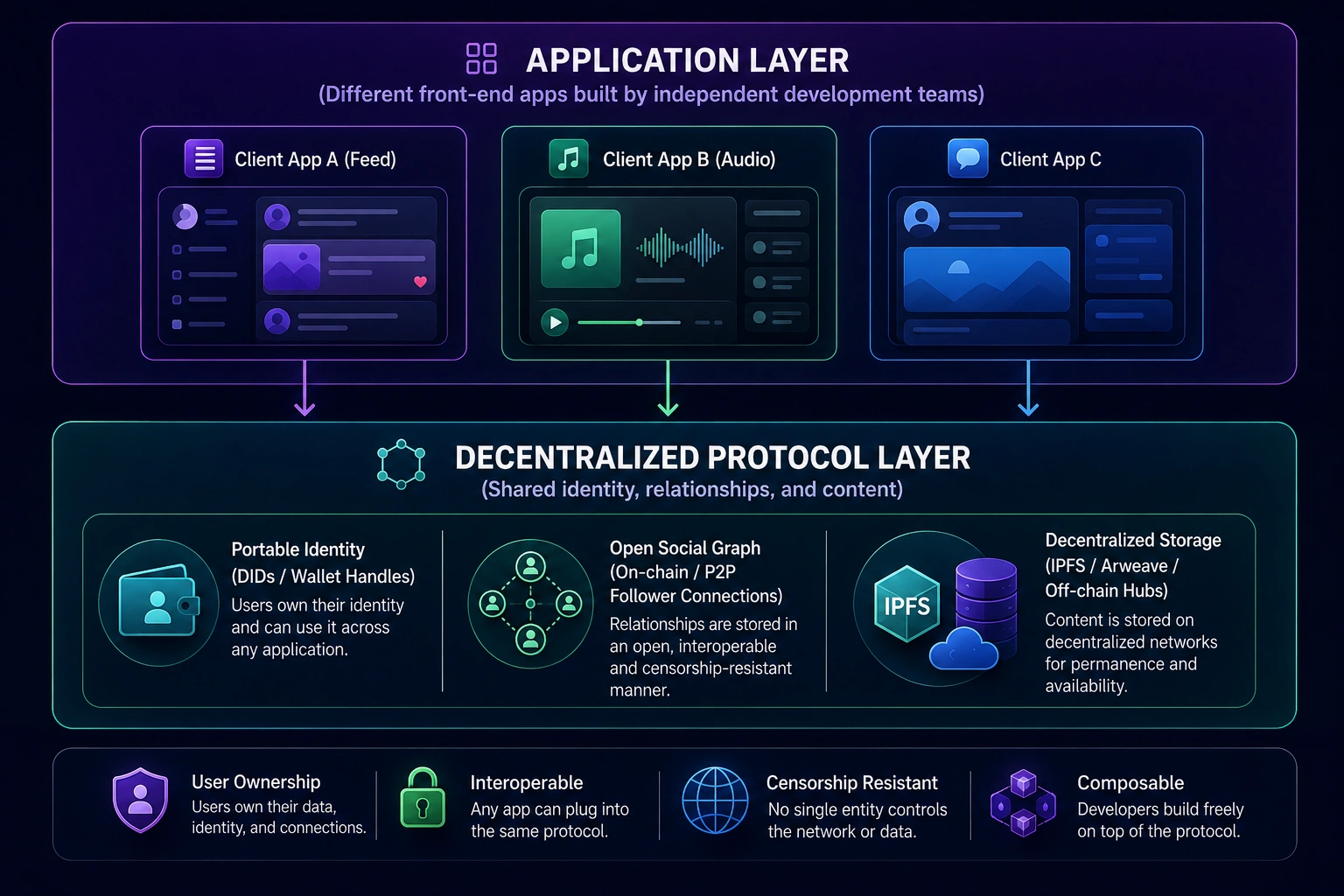
Decentralized social apps invert this structure by treating Identity and Social Graphs as open, shared protocols:
- Portable Identity: Your digital profile (username, bio, avatar, verified credentials) is stored on-chain or across decentralized identity networks. You own it independently of any single app.
- Portable Social Graphs: Your follower list is not held hostage by a single database. If you build an audience on a protocol like Lens or Farcaster, every independent developer who builds an app on top of that protocol instantly displays your existing followers and posts.
- App Switching Without Network Loss: If Client App A implements an aggressive feed algorithm or adds unwanted ads, you can simply open Client App B, plug in your wallet and immediately pick up your exact social network, messages and audience without missing a beat.
Why Are SocialFi Apps Gaining Market Attention?
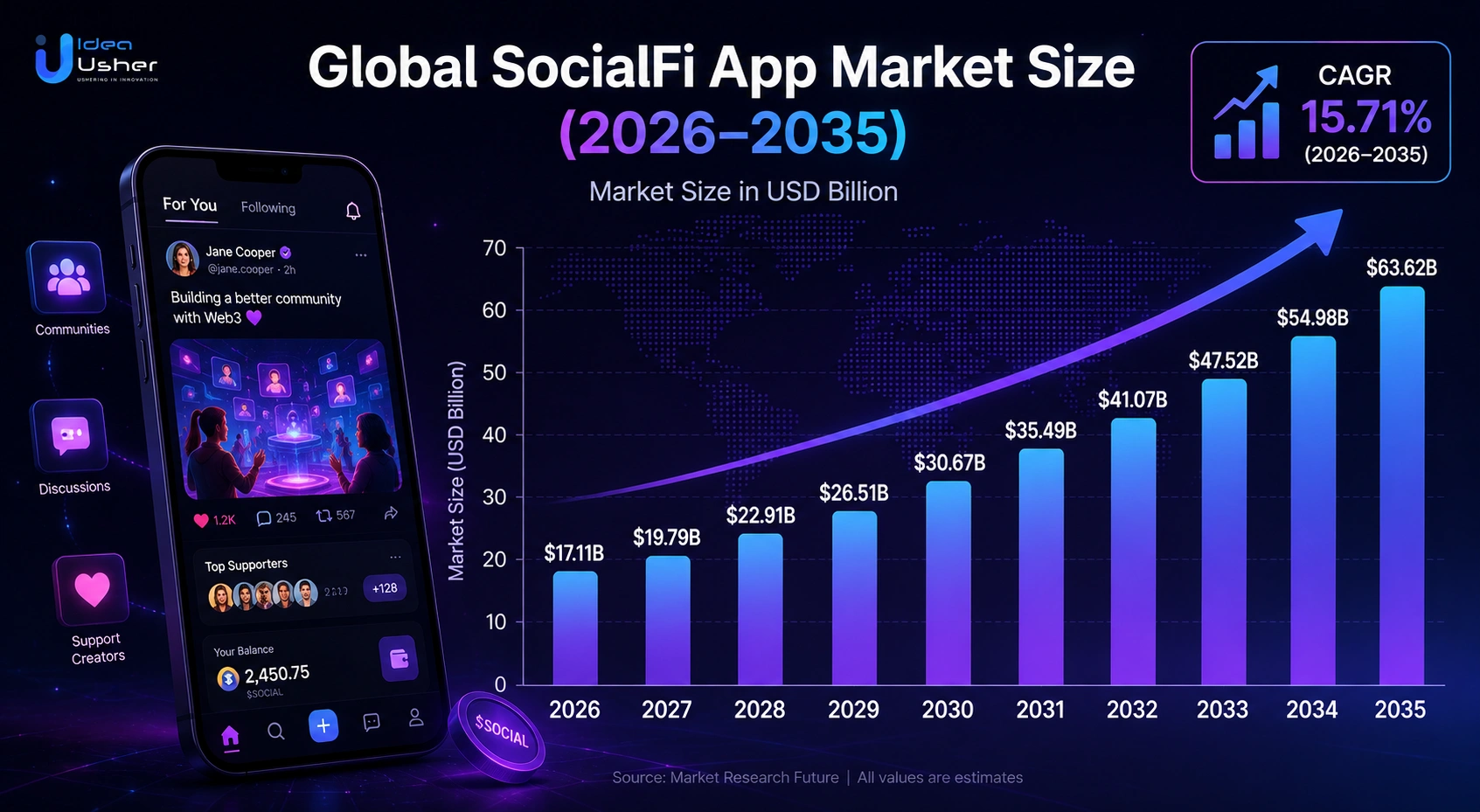
The SocialFi market is moving beyond experimental token-based communities toward platforms that combine social interaction, creator monetization, digital ownership and decentralized infrastructure. The global SocialFi market is projected to grow from $17.11 billion in 2026 to $19.79 billion in 2027, reaching $63.62 billion by 2035 at a CAGR of 15.71%.
Lens provides a useful indicator of decentralized social activity at protocol level. In February 2025, Lens reported 647,000 profiles, 640,000 handles, 45,000 weekly active users, and 31 million publications, showing meaningful usage beyond purely speculative token activity.
A. How SocialFi Apps Benefit Creators in 2026
Creator monetization remains one of the strongest reasons for SocialFi adoption, particularly where platforms can connect content, ownership, and payments directly.
- Direct On-Chain Monetization: Lens reported $3.2M in direct creator earnings through on-chain collections by May 2025, showing demand for content monetization beyond traditional advertising.
- More Ways to Monetize Content: SocialFi platforms can combine collectibles, subscriptions, tips, tokenized access, NFTs, and community memberships to create multiple revenue streams.
- Greater Digital Asset Control: Blockchain ownership enables creators to issue collectible content, programmable access rights, and digital assets connected to their communities.
- Community Participation: Tokenized memberships and rewards can turn passive followers into active participants, supporting loyalty, engagement, and community-driven experiences.
B. Why Businesses Are Investing in SocialFi Apps
Businesses and technology companies are exploring SocialFi because decentralized social infrastructure can combine audience engagement with payments, digital ownership, and new application ecosystems.
- Major Venture Capital Interest: Farcaster raised $150 million in 2024, led by Paradigm with investors including a16z crypto, Haun Ventures, USV, Variant, and Standard Crypto, signaling strong investor interest in decentralized social infrastructure.
- Social and Financial Features Are Converging: SocialFi combines social feeds, digital assets, payments, creator monetization, and community participation within connected product ecosystems.
- Open Protocols Create New Product Opportunities: Ecosystems such as Lens and Farcaster provide shared social infrastructure for specialized clients, creator tools, communities, and financial applications.
- Creator Economy Creates Commercial Demand: Global creator marketing reached an estimated $32.6 billion in 2025, with creator compensation up 59% YoY, highlighting demand for alternative SocialFi monetization models.
Types of SocialFi Apps You Can Build
SocialFi apps can take different forms depending on how they combine social interaction, digital ownership and blockchain-based incentives. The following are the key decentralized social media development shaping social experiences and Web3 communities.
| Type | How It Works | Examples |
| Decentralized Social Networks | Give users decentralized profiles, content ownership and social interactions without relying entirely on a centralized platform. | Lens, Farcaster |
| Web3 Creator Platforms | Let creators publish content, build communities and monetize through tokens, NFTs, subscriptions, or other blockchain-based mechanisms. | Friend.tech, Zora |
| Tokenized Social Platforms | Integrate tokens into social interactions, allowing users to earn, tip, reward, or participate in community economies. | Friend.tech |
| Decentralized Community Platforms | Enable Web3 communities, DAOs and interest groups to communicate, coordinate and manage community participation on decentralized infrastructure. | Guild.xyz, Coordinape |
| Social Gaming Platforms | Combine social networking with blockchain-based gaming, digital assets and player-driven economies. | The Sandbox, Decentraland |
Note: The right SocialFi app model depends on the target audience, monetization strategy, ownership requirements, community structure, and blockchain architecture. These models can also be combined to create a differentiated SocialFi ecosystem.
How to Build a SocialFi App From Concept to Launch
The decentralized social media development involves more than developing social features and connecting a blockchain. Our developers follow a structured process covering product strategy, UX, architecture, smart contracts, backend systems, security, deployment, and continuous optimization.
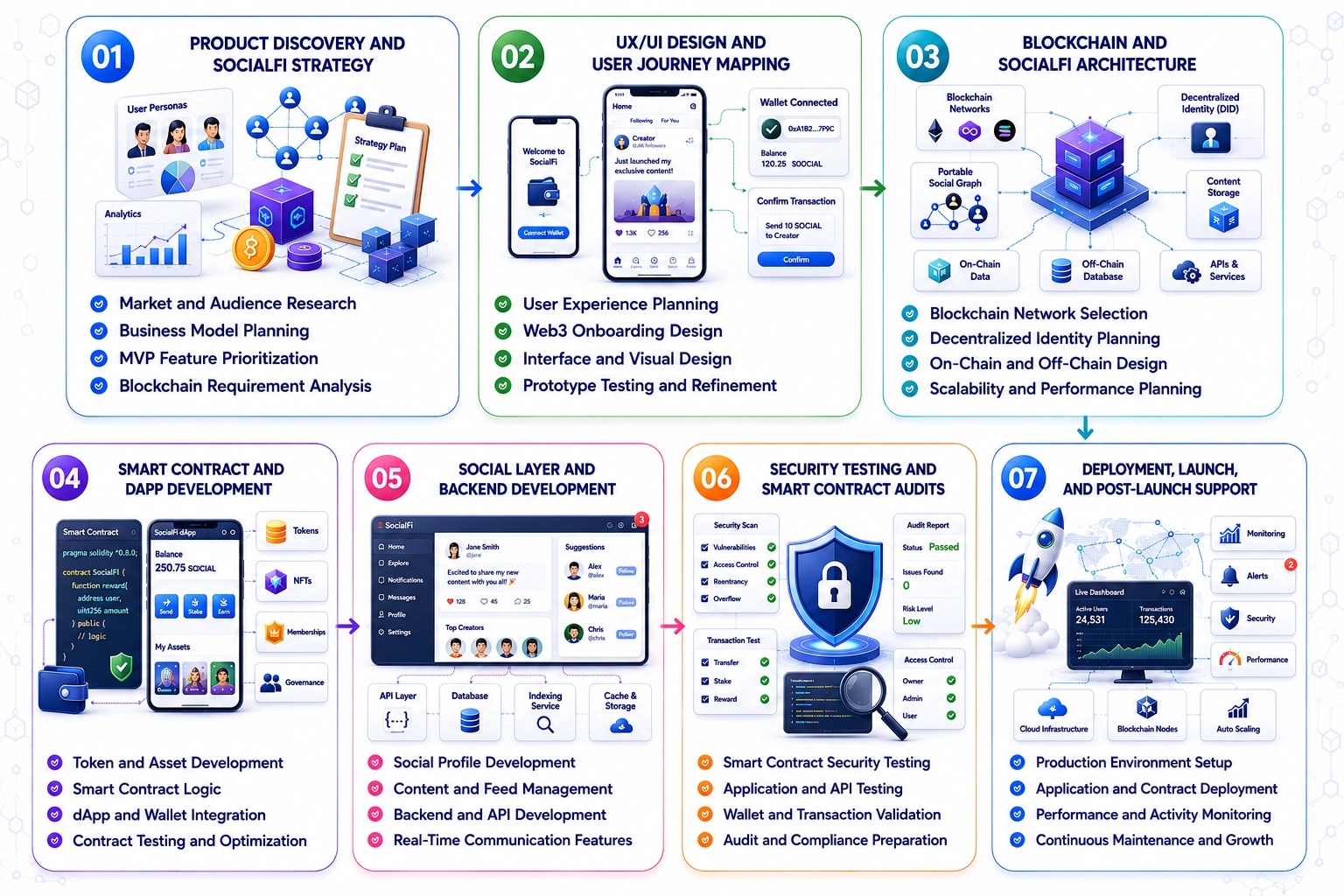
1. Product Discovery and SocialFi Strategy
Our team defines your target users, social model, ownership structure, monetization strategy, governance approach, MVP scope, and blockchain requirements to create a practical roadmap aligned with your business goals.
- Market and Audience Research: Identifies user needs, industry trends, competitor offerings, and opportunities for creating a differentiated SocialFi platform.
- Business Model Planning: Defines revenue streams, token utility, creator incentives, membership options, transaction fees, and long-term platform sustainability.
- MVP Feature Prioritization: Selects essential features for the initial release while organizing advanced capabilities for future development phases.
- Blockchain Requirement Analysis: Assesses transaction needs, scalability, compatibility, wallet support and integrations prior to technical planning.
2. UX/UI Design and User Journey Mapping
Our designers create intuitive social experiences and simplify Web3 interactions, mapping onboarding, wallet connection, profile creation, content sharing, creator monetization, transactions, and community participation across key user journeys.
- User Experience Planning: Structures simple navigation, clear workflows, and familiar social interactions to reduce complexity for Web3 and mainstream users.
- Web3 Onboarding Design: Simplifies wallet creation, connection, authentication, transaction approvals, and recovery processes for first-time blockchain users.
- Interface and Visual Design: Develops consistent layouts, interactive components, branding elements, and responsive screens across supported devices.
- Prototype Testing and Refinement: Validates user flows through prototypes, gathers feedback, identifies usability issues, and improves designs before development begins.
3. Blockchain and SocialFi Architecture
Our web3 developers select the appropriate blockchain for decentralized social media development and design how decentralized identity, social graphs, content, assets, transactions, and off-chain services work together while keeping high-frequency social activity scalable.
- Blockchain Network Selection: Compares supported networks based on transaction costs, processing speed, ecosystem maturity, developer tools, and community adoption.
- Decentralized Identity Planning: Defines how users manage profiles, ownership records, authentication, reputation, and portable identities across connected applications.
- On-Chain and Off-Chain Design: Determines which data requires blockchain storage and which information should use scalable centralized or decentralized infrastructure.
- Scalability and Performance Planning: Prepares architecture for growing users, content activity, transactions, integrations, and community participation without reducing platform performance.
4. Smart Contract and dApp Development
Our blockchain developers build and integrate smart contracts for tokens, NFTs, payments, memberships, rewards, and governance, connecting them with the dApp through secure and reliable Web3 functionality.
- Token and Asset Development: Creates tokens, NFTs, membership assets, and ownership mechanisms supporting platform participation and creator-focused economic models.
- Smart Contract Logic: Implements rules for rewards, payments, staking, governance, royalties, access control, and automated blockchain-based transactions.
- dApp and Wallet Integration: Connects smart contracts with application interfaces, wallets, blockchain networks, transaction services, and user account systems.
- Contract Testing and Optimization: Tests contract behavior, improves gas efficiency, verifies transaction handling, and prepares code for secure production deployment.
5. Social Layer and Backend Development
Our development team builds profiles, feeds, follows, content management, discovery, notifications, messaging, creator tools, APIs, databases, and indexing systems that support fast and scalable social interactions.
- Social Profile Development: Builds user profiles, creator pages, follower systems, reputation features, privacy settings, and blockchain-linked identity components.
- Content and Feed Management: Supports publishing, organizing, discovering, ranking, moderating, and distributing text, media, and tokenized content.
- Backend and API Development: Creates secure APIs, business logic, databases, authentication services, integrations, and administrative tools for platform operations.
- Real-Time Communication Features: Enables notifications, messaging, activity updates, engagement alerts, and community interactions across the SocialFi application.
6. Security Testing and Smart Contract Audits
Our team tests smart contracts, wallet flows, APIs, authentication, transactions, and access controls while identifying vulnerabilities and coordinating appropriate smart contract audits before production deployment.
- Smart Contract Security Testing: Reviews contract logic, permissions, transaction handling, upgrade mechanisms, and potential vulnerabilities before public release.
- Application and API Testing: Examines authentication, authorization, data validation, API endpoints, integrations, and backend services for security weaknesses.
- Wallet and Transaction Validation: Tests signing requests, transaction confirmations, failed payments, incorrect addresses and user protection across supported wallets.
- Audit and Compliance Preparation: Organizes audit documentation, resolves identified issues, improves security controls, and supports applicable regulatory requirements.
7. Deployment, Launch, and Post-Launch Support
Our developers deploy the application and smart contracts, configure production infrastructure, monitor performance and blockchain activity, resolve issues, and provide ongoing maintenance and improvements as the platform grows.
- Production Environment Setup: Configures servers, databases, blockchain connections, storage systems, monitoring tools, domains, and deployment pipelines for launch.
- Application and Contract Deployment: Releases tested application builds and verified smart contracts across selected networks and supported production environments.
- Performance and Activity Monitoring: Tracks uptime, transaction activity, user behavior, system performance, errors, security events, and infrastructure health.
- Continuous Maintenance and Growth: Provides updates, bug fixes, feature enhancements, scalability improvements, technical support, and optimization based on platform needs.
Decentralized Social Media Development Tech Stack
A SocialFi tech stack must support both high-frequency social interactions and blockchain-based ownership. The right architecture separates social activity from on-chain settlement while connecting identity, social graphs, content, wallets, smart contracts, and decentralized infrastructure.
| Development Layer | Recommended Technologies | Purpose |
| Social Identity & Accounts | Sign-In with Ethereum (SIWE), decentralized identifiers (DIDs), Ethereum Name Service (ENS) | Enables portable user identities, wallet-based authentication, human-readable names, and decentralized account ownership. |
| Social Graph & Protocols | Farcaster, Lens Protocol, ActivityPub, custom social graph infrastructure | Connects users, profiles, followers, posts, communities, and interactions across decentralized social ecosystems. |
| Blockchain & Settlement | Ethereum, Base, Polygon, Arbitrum | Provides blockchain networks for asset ownership, transaction settlement, token transfers, and decentralized application operations. |
| Smart Contracts | Solidity, OpenZeppelin, Foundry, Hardhat | Builds, tests, deploys, and secures programmable agreements governing tokens, rewards, memberships, and transactions. |
| Decentralized Storage & Content | IPFS, Arweave, Filecoin | Stores social content, media, metadata, and digital assets with decentralized access and long-term availability. |
| Wallet & Transaction Layer | WalletConnect, MetaMask, Coinbase Wallet, account abstraction | Supports wallet connections, transaction approvals, gas management, and simplified blockchain interactions for users. |
| Indexing & Data Access | The Graph, blockchain indexers, GraphQL, event-driven data pipelines | Organizes blockchain activity into searchable data for efficient feeds, profiles, analytics, and application queries. |
| Security & Monitoring | OpenZeppelin Defender, contract monitoring, transaction monitoring, vulnerability testing | Detects threats, monitors contracts and transactions, identifies vulnerabilities, and strengthens platform security continuously. |
Note: The final technology selection depends on the decentralized social media development like social model, blockchain needs, transaction volume, content architecture, interoperability, and security. Protocol-focused platforms prioritize portable social graphs and decentralized identity, whereas creator-focused apps emphasize smart contracts, wallets, NFTs, and payments.
How to Choose the Right Blockchain for SocialFi
Selecting the underlying blockchain for a decentralized social media development directly influences user retention, operational viability, and developer velocity. Evaluate prospective networks across these six core criteria:
- Transaction Costs (Gas Economics): SocialFi involves frequent micro-actions such as tipping, liking, creator-key trading, and claiming royalties. High gas fees can hurt adoption, so choose Layer-2 rollups like Base or Polygon zkEVM or low-cost execution layers where fees remain consistently under $0.01.
- Scalability & Throughput (TPS): Social interactions occur at massive scale, especially during viral events. The network should handle sustained transaction volumes and high traffic bursts without latency spikes, failed transactions, or dropped social interactions.
- Ecosystem Maturity & Liquidity Depth: Choose networks with strong USDC/USDT liquidity and active token marketplaces, allowing creators and users to easily trade, convert, or cash out earnings without significant price slippage.
- Wallet Support & Onboarding UX: Select networks compatible with embedded wallets, social logins, and Account Abstraction (ERC-4337). These capabilities support gasless transactions through paymasters while removing seed-phrase friction for mainstream Web2 users.
- Developer Tooling & Infrastructure: Prioritize ecosystems with reliable RPC providers such as Alchemy and QuickNode, indexing services like The Graph and Goldsky, and mature SDKs to avoid building critical blockchain infrastructure from scratch.
- Interoperability & Cross-Chain Reach: Favor EVM-compatible networks and established cross-chain messaging bridges so social graphs, tokens, and digital collectibles can move across broader Web3 platforms without creating ecosystem lock-in.
Core Features to Build in a Decentralized Social App
A successful decentralized social media development needs more than blockchain integration. It must deliver the familiar social experiences users expect while adding ownership, financial and governance capabilities that differentiate decentralized platforms from traditional social networks.
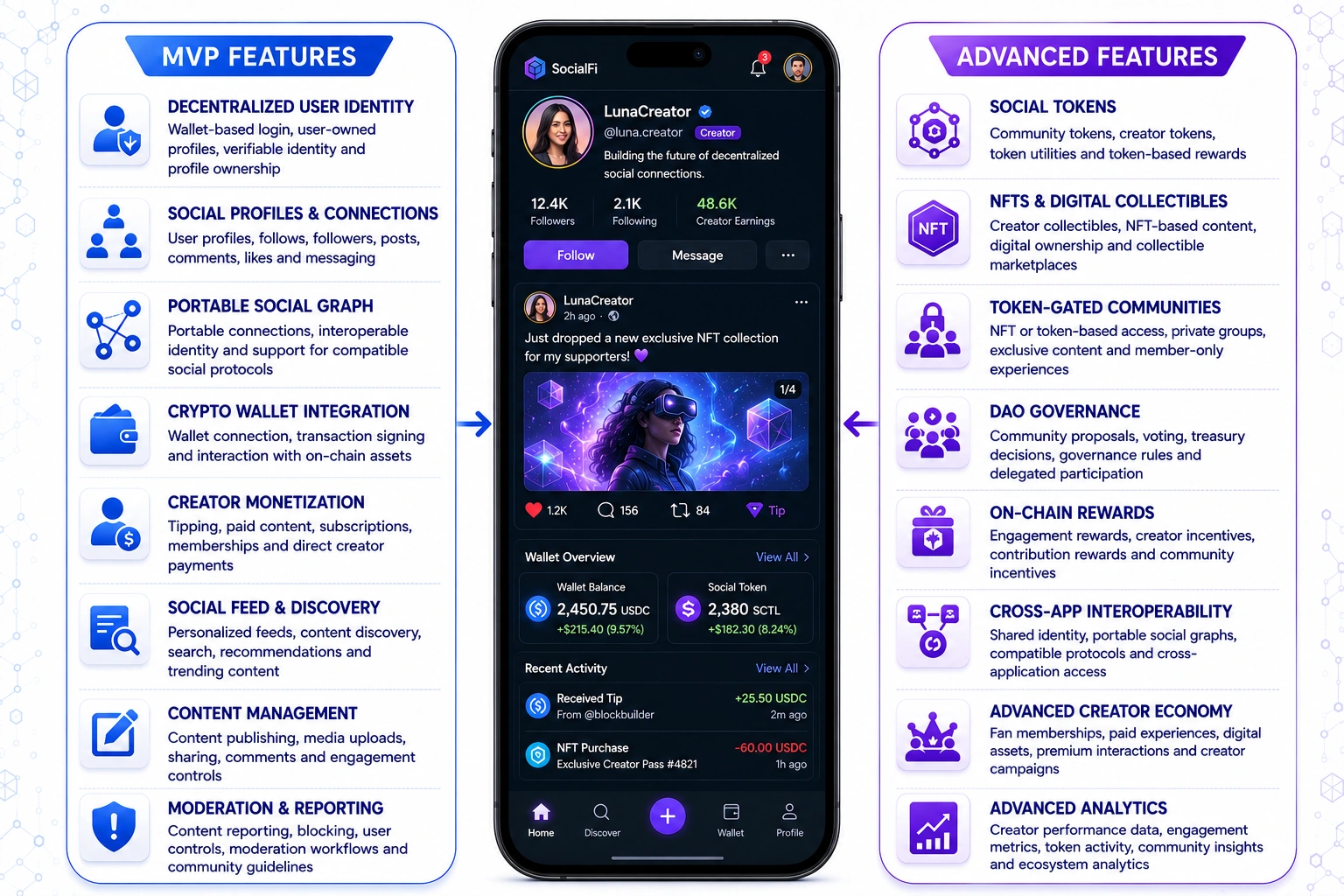
A phased rollout works best, for example, A SocialFi MVP should focus on core social and Web3 infrastructure to validate the product, engage early users and test monetization. Advanced features like social tokens, DAO governance and cross-app interoperability can follow as the platform grows.
A. SocialFi MVP Features to Launch With
A MVP decentralized social media development should establish three foundations: a functional social experience, user-controlled identity and the ability to exchange value. The following features provide the core infrastructure needed to launch and validate a decentralized social product.
| Feature | What It Includes | Business Value |
| Decentralized User Identity | Wallet-based login, user-owned profiles, verifiable identity and profile ownership | Gives users greater control over their identity while reducing dependence on a centralized account system |
| Social Profiles & Connections | User profiles, follows, followers, posts, comments, likes and messaging | Establishes the core social experience needed to attract and retain users |
| Portable Social Graph | Portable connections, interoperable identity and support for compatible social protocols | Reduces platform lock-in and creates opportunities for users to carry their social relationships across supported applications |
| Crypto Wallet Integration | Wallet connection, transaction signing and interaction with on-chain assets | Enables Web3-native payments, asset ownership and blockchain interactions |
| Creator Monetization | Tipping, paid content, subscriptions, memberships and direct creator payments | Gives creators direct monetization channels beyond traditional advertising models |
| Social Feed & Discovery | Personalized feeds, content discovery, search, recommendations and trending content | Drives engagement, content consumption and user retention |
| Content Management | Content publishing, media uploads, sharing, comments and engagement controls | Provides the foundation for user-generated content and everyday social interactions |
| Moderation & Reporting | Content reporting, blocking, user controls, moderation workflows and community guidelines | Helps maintain platform quality, user trust and a safer social environment |
The SocialFi MVP should not attempt to replicate every feature of a mature Web3 ecosystem. Instead, development should prioritize the features that directly support the platform’s core social loop: users create identities, connect with others, publish or consume content, interact with communities and exchange value.
This approach also helps control initial development costs while giving the product team enough functionality to validate user behavior before introducing more complex blockchain mechanisms.
B. Advanced SocialFi Features for Scale
Once the core product has established user engagement and a viable business model, advanced Web3 capabilities can expand the platform’s creator economy, community participation and interoperability.
| Feature | What It Includes | Business Value |
| Social Tokens | Community tokens, creator tokens, token utilities and token-based rewards | Creates new engagement, loyalty and monetization mechanisms for creators and communities |
| NFTs & Digital Collectibles | Creator collectibles, NFT-based content, digital ownership and collectible marketplaces | Creates additional revenue opportunities while giving users verifiable ownership of digital assets |
| Token-Gated Communities | NFT or token-based access, private groups, exclusive content and member-only experiences | Enables premium communities, memberships and exclusive creator experiences |
| DAO Governance | Community proposals, voting, treasury decisions, governance rules and delegated participation | Gives communities a structured role in platform or ecosystem decisions |
| On-Chain Rewards | Engagement rewards, creator incentives, contribution rewards and community incentives | Encourages meaningful participation and can strengthen user and creator retention |
| Cross-App Interoperability | Shared identity, portable social graphs, compatible protocols and cross-application access | Allows the ecosystem to extend beyond a single interface and reduces dependence on one application |
| Advanced Creator Economy | Fan memberships, paid experiences, digital assets, premium interactions and creator campaigns | Expands monetization opportunities as the creator base and user community grow |
| Advanced Analytics | Creator performance data, engagement metrics, token activity, community insights and ecosystem analytics | Helps creators and platform operators understand behavior and make better product and monetization decisions |
These advanced features should be introduced based on actual platform needs rather than Web3 trends. For instance, professional SocialFi platforms gain more value from token-gated memberships and reputation systems than speculative social tokens.
Likewise, DAO governance becomes more valuable when a platform has an active community that can meaningfully participate in decisions. Decentralized social media development should therefore prioritize utility over unnecessary tokenization.
Ultimately, the right feature set depends on the platform’s target audience, business model, blockchain architecture and long-term ecosystem strategy. Starting with a focused MVP and expanding into advanced functionality allows businesses to validate the product while keeping the architecture flexible enough for future SocialFi capabilities.
How Much Does It Cost to Build a SocialFi App?
The decentralized social media development cost depends on its feature scope, blockchain architecture, smart contract complexity, supported platforms, security requirements, and development team. A focused MVP costs considerably less than an enterprise-grade SocialFi ecosystem.
A. Development Phase-Wise Cost Table
A phase-wise breakdown helps businesses understand how the decentralized social media development budget is distributed across planning, design, blockchain integration, smart contracts, backend development, security, and deployment.
| Development Phase | MVP Estimation | Enterprise Estimation | What the Phase Covers |
| Discovery & Planning | $3,000 – $7,000 | $10,000 – $20,000 | Market research, product strategy, feature planning, business model, technical requirements, and roadmap |
| UI/UX Design | $5,000 – $10,000 | $15,000 – $30,000 | User flows, wireframes, prototypes, design system, responsive interfaces, and Web3 onboarding |
| Blockchain Architecture | $5,000 – $10,000 | $20,000 – $40,000 | Blockchain selection, on-chain/off-chain architecture, identity, social graph, storage, scalability, and integrations |
| Smart Contract Development | $8,000 – $20,000 | $30,000 – $70,000 | Tokens, NFTs, payments, memberships, rewards, governance, contract testing, and optimization |
| Social & Backend Development | $20,000 – $40,000 | $55,000 – $120,000 | Profiles, feeds, follows, content, discovery, APIs, databases, messaging, creator tools, and indexing |
| Testing & Security | $6,000 – $15,000 | $30,000 – $70,000 | Functional testing, API testing, wallet flows, smart contract testing, vulnerability assessment, and security audits |
| Deployment & Launch | $3,000 – $8,000 | $10,000 – $20,000 | Production setup, deployment, monitoring, blockchain configuration, release management, and launch support |
| Estimated Development Total | $50,000 – $110,000 | $200,000 – $500,000 | Overall development investment based on the scope and complexity of the SocialFi platform |
Note: These figures are indicative development ranges, not fixed quotes. Actual costs depend on the final product scope, technology choices, integrations, security requirements, and development team.
B. Development Cost Table by Platform Complexity
SocialFi development costs increase with platform complexity, feature depth, and infrastructure requirements. This comparison shows how decentralized social media development budgets differ between a basic MVP, advanced platform, and enterprise ecosystem.
| Development Tier | Estimated Cost | Typical Features Included |
| Basic SocialFi MVP | $50,000 – $110,000+ | User profiles, social feeds, wallet integration, follows, content publishing, basic creator monetization, and essential Web3 functionality |
| Advanced SocialFi Platform | $110,000 – $200,000 | Advanced creator economy, NFTs, token-gated communities, social payments, rewards, richer discovery, analytics, and multiple integrations |
| Enterprise SocialFi Ecosystem | $200,000 – $500,000+ | Advanced tokenomics, DAO governance, cross-app interoperability, sophisticated social graphs, extensive smart contracts, multi-chain support, and enterprise-level security & infrastructure |
Note: The development tier should be selected according to the platform’s business model and user requirements, rather than the number of blockchain features it can include. A well-scoped MVP can validate the social experience and monetization model before the business invests in advanced tokenomics, governance, or multi-chain functionality.
C. What Factors Increase SocialFi App Development Cost?
The decentralized social media development costs can rise quickly when the product moves beyond basic social features into blockchain infrastructure, asset ownership, and decentralized protocols. The following factors have the most direct impact on engineering effort and overall budget:
- Multi-Chain Deployment & Cross-Chain Communication: Supporting Ethereum, Polygon, Base, Solana and other networks requires separate contracts, wallets, RPCs, indexing, testing, and monitoring, adding $20,000–$100,000+ to development and audits.
- Custom Tokenomics & Economic Logic: Staking, vesting, referral rewards, creator incentives, token-gated access, governance, treasury mechanisms and simulations can add $15,000–$75,000+ beyond basic token development.
- Smart Contract Audit Scope: Simple token/NFT audits cost $5,000–$15,000, DeFi audits $25,000–$100,000, while complex multi-chain systems can reach $150,000–$500,000+, excluding remediation and re-audits.
- Decentralized Social Protocol Integration: Farcaster integration requires identity, messaging, storage, indexing, and interoperability work, while custom portable social graphs can add $30,000–$150,000+ in backend engineering.
- On-Chain vs. Off-Chain Data Strategy: Hybrid architectures combining blockchain records, databases, decentralized storage, indexing, caching and APIs can add $20,000–$100,000+, depending on verification, portability, and transaction volume.
- Wallet, Account Abstraction & Transaction UX: Multiple wallets, embedded accounts, social logins, gas sponsorship, account abstraction, recovery and chain switching can add $15,000–$75,000+ over conventional authentication.
How Users and Creators Earn on SocialFi Apps
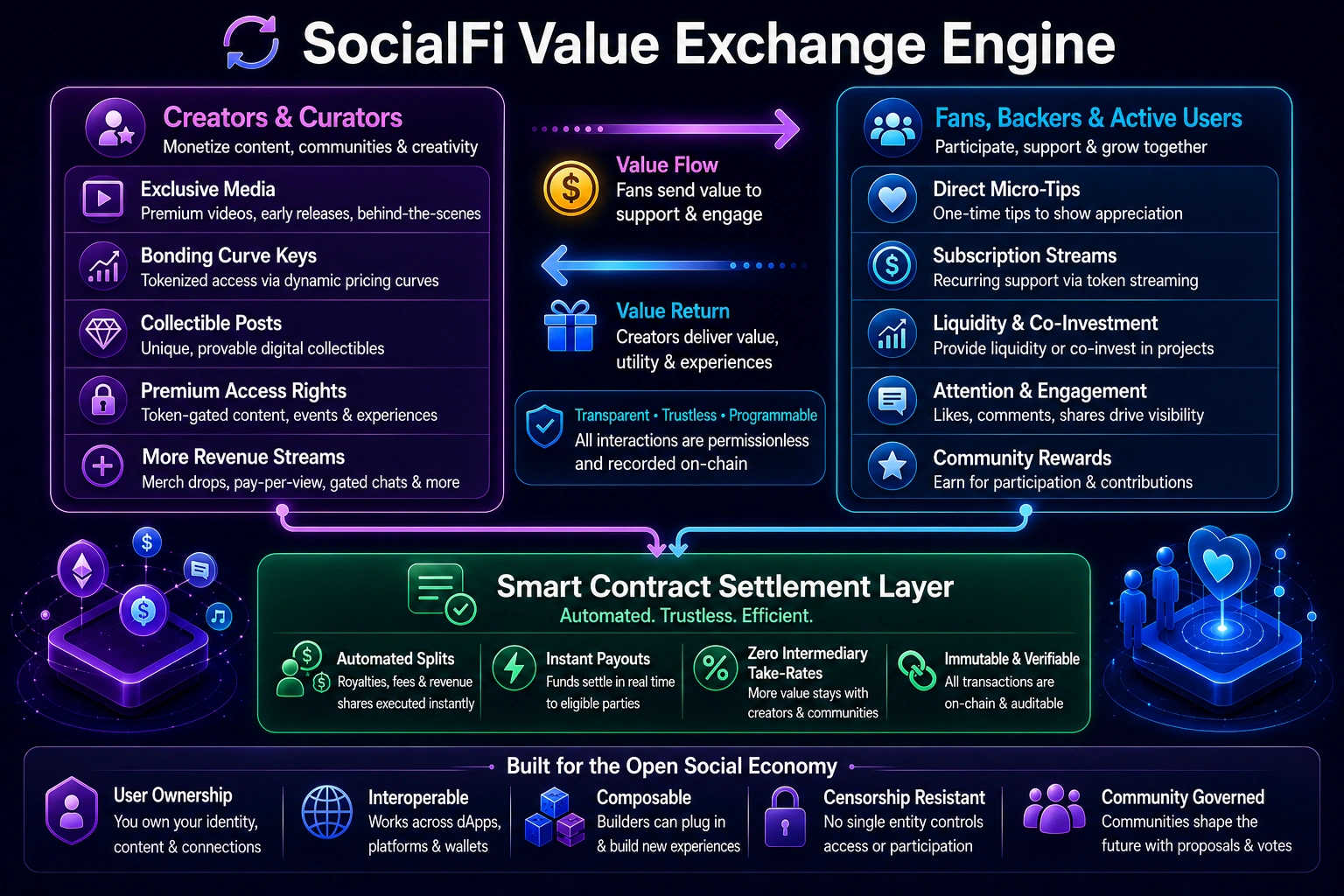
SocialFi combines decentralized finance and social media to convert online engagement and content into direct value. Unlike Web2 platforms that take 30%–55% of ad revenue and require $50–$100 payout minimums, SocialFi uses smart contracts, tokens, and public ledgers to enable non-custodial, peer-to-peer monetization for creators and users.
1. Creator Subscriptions and Paid Communities
Traditional recurring subscriptions rely on centralized payment processors and app store gateways that charge up to 30% in platform fees alongside 2.9% + $0.30 credit card processing fees. SocialFi replaces these intermediaries with automated, smart-contract-managed subscription primitives:
- Streaming Micro-Subscriptions: Protocols such as Superfluid and Sablier enable continuous fractional payments, such as $0.0001/second or ~$5–$20/month. Users can pause, cancel, or modify streams without fixed 30-day billing cycles.
- On-Chain Recurring Memberships: Smart contracts automate recurring billing through USDC, USDT, or native tokens, routing 95%–100% of proceeds directly to creators without chargeback risks or delayed payouts.
- Decentralized Community Hubs: Paid subscriptions automatically provide cryptographic access to private discussion groups, Discord channels through Guild.xyz or Collab.Land, or decentralized chat channels without manual administration.
2. Social Tokens and Tokenized Access
Social tokens and bonding-curve-driven access passes (popularized by platforms like Friend.tech and custom DAO frameworks) financialize personal influence and community alignment:
- Automated Market Makers & Bonding Curves: Creators issue personal “Keys,” “Passes,” or custom ERC-20 tokens priced through mathematical bonding curves. As supply increases, prices scale deterministically, allowing early supporters to participate in creator-driven value growth.
- Automated Royalties on Secondary Trades: When users buy or sell creator keys or tokens, smart contracts automatically deduct a 10% total fee, typically 5% creator royalty + 5% protocol fee, with the creator share settling directly to the creator’s wallet.
- Shared Financial Incentives: Social-token holders gain potential speculative upside and governance voting rights on creator initiatives, turning passive followers into active ecosystem stakeholders.
3. NFT-Based Content and Digital Collectibles
Rather than letting viral posts generate zero direct income, SocialFi allows individual media items to be published directly as non-fungible or semi-fungible digital assets:
- “Collect” Modules: Users can collect or mint text posts, artwork, or audio directly from the feed, with creator-defined mint fees typically ranging from $1 to $50+ per edition.
- Open Edition Content Drops: Creators can launch time-limited (24–72 hours) or volume-capped (500–1,000 copies) media editions, giving superfans provable ownership of digital first editions.
- Programmable Split Revenue: Smart contracts can automatically distribute mint revenue among collaborators, such as 70% to the writer, 20% to the artist, and 10% to the community treasury.
- Referral and Curator Rewards: Users who share or amplify posts that generate mints can automatically receive 5%–15% of downstream mint sales as on-chain curator fees.
4. Crypto Tipping and Direct Social Payments
Frictionless micro-transactions eliminate traditional banking payment thresholds (such as minimum transfer sizes of $1 to $5), making instant recognition of digital content economically viable:
- Layer-2 Gasless/Sub-Cent Tipping: Low-fee L2 networks such as Base, Arbitrum, and Optimism can enable $0.10–$1.00 micro-tips with transaction fees below $0.01.
- In-Feed Social Tipping (Farcaster Frames & Actions): Interactive feed modules let users send $DEGEN tips or stablecoins, claim community airdrops, or tip creators directly from their timeline.
- Automated Engagement Bounties: Creators and protocols can offer $5–$50 micro-token bounties for high-signal replies, thread translations, and curated community roundups.
5. Token-Gated Content and Experiences
Token gating leverages wallet-based authentication to deliver tiered, exclusive content and digital experiences based on a user’s on-chain holdings:
- Exclusive Multimedia & Feeds: Premium newsletters, behind-the-scenes videos, and unreleased tracks unlock when a connected wallet holds qualifying token balances or NFT passes.
- Tiered VIP Access Levels: Creators can offer tiers based on token holdings, such as 50 tokens for Discord access, 500 for strategy calls, or 2,500 for 1-on-1 advisory sessions.
- Decentralized Access Protocols: Integrations such as Lit Protocol keep gated media cryptographically encrypted, decrypting content only when users meet on-chain access-control requirements.
- Physical-to-Digital Hybrid Perks: Creator tokens can unlock backstage passes, event tickets, and 15%–30% merchandise discounts, connecting digital ownership with real-world benefits.
Security Challenges in SocialFi App Development
Decentralized social apps combine social interactions with blockchain assets and financial transactions, creating security risks across smart contracts, user wallets, identity systems and community activity. These challenges require particular attention during decentralized social media development.
1. Smart Contract Vulnerabilities
Challenge: Smart contract flaws can enable unauthorized transactions, asset manipulation, access-control failures, reentrancy exploits, or incorrect reward and payment distribution across SocialFi applications.
Solution: Our developers apply secure coding practices, automated testing, vulnerability analysis, access controls, contract simulations, and independent audits to identify and resolve vulnerabilities before production deployment.
2. Wallet and Private Key Security
Challenge: Compromised wallets, malicious transaction requests, poor signing flows, and exposed private keys can result in unauthorized access, asset loss, or fraudulent transactions.
Solution: Our developers implement secure wallet integrations, transaction validation, permission controls, clear signing interfaces, secure authentication, and protective mechanisms that reduce phishing and unauthorized transaction risks.
3. Spam, Bots, and Sybil Attacks
Challenge: Automated accounts and Sybil identities can manipulate engagement, farm rewards, inflate social activity, abuse incentives, and distort creator or community metrics.
Solution: Our team implements identity verification signals, rate limits, behavioral monitoring, anomaly detection, reputation mechanisms, wallet activity analysis, and anti-abuse controls to identify coordinated manipulation.
Build Your Decentralized Social App With Idea Usher
IdeaUsher is a product engineering partner also an expert of Web3 with 11+ years of experience across 50+ countries. Backed by 250+ experts, 1,000+ completed projects and a 4.9/5 Clutch rating, we build custom decentralized social (DeSo) applications from scratch.
Instead of template-based builds, we engineer custom, scalable social architectures featuring decentralized identity (DID), open social graphs, decentralized storage, and tokenized monetization to establish your Web3 market leadership.
Why Enterprises Partner With Us
Media brands, Web3 startups, and enterprise communities partner with us because we transform complex decentralized protocols and sovereign user data models into frictionless, engaging, and high-retention social applications.
- Decentralized Social Graph & Protocol Engineering: We build on-chain/hybrid social graphs using Lens Protocol, Farcaster, and AT Protocol for portable, censorship-resistant profiles and follower networks.
- Self-Sovereign Identity (DID) & Wallet Integration: We implement W3C-compliant DIDs, verifiable credentials, and ERC-4337 account abstraction for social logins, biometric authentication, and gasless onboarding.
- Decentralized Storage & Media Distribution: We connect IPFS, Filecoin, and Arweave with edge CDN caching for permanent, tamper-resistant media storage and low-latency streaming.
- Tokenized Creator Monetization & SocialFi Mechanics: We develop smart contracts for tip jars, subscription-gated NFTs, creator coin economies, and DAO-based governance voting.
- Decentralized Moderation & Anti-Sybil Architecture: We build community moderation, zk-SNARK reputation scoring, and Gitcoin Passport integrations to reduce spam, bot attacks, and Sybil activity.
- Zero Vendor Lock-In Asset Delivery: We deliver clean, well-documented, open-source code, providing complete platform, smart contract, and IP ownership from day one.
Ready to build a high-performance, censorship-resistant decentralized social platform? Partner with Idea Usher’s principal Web3 and social tech software architects to map out your custom product build today.
Conclusion
The next generation of social platforms will likely depend less on centralized control and more on user ownership, portable identities, creator economics, and interoperable communities. SocialFi brings these elements together through blockchain, smart contracts, wallets, decentralized infrastructure, and programmable monetization. For businesses exploring this opportunity, the right architecture and feature strategy matter as much as the technology itself. IdeaUsher can help turn a SocialFi concept into a scalable product with the right Web3 infrastructure, social features, security, and monetization model.
FAQs
A.1. The decentralized social media development can cost $50,000–$500,000+, depending on its complexity. Costs vary based on blockchain selection, smart contracts, security, integrations, scalability, and whether you’re developing an MVP or enterprise-level platform.
A.2. A SocialFi app typically needs decentralized identity, social profiles, portable social graphs, wallet integration, creator monetization, content feeds, and moderation, with advanced tokens, NFTs, and governance added later.
A.3. The right blockchain for decentralized social media development depends on transaction costs, scalability, ecosystem maturity, wallet compatibility, interoperability requirements, and application needs. Ethereum, Base, Polygon, and Arbitrum can support different SocialFi architectures.
A,4. The decentralized social media apps can generate revenue through transaction fees, creator subscriptions, tokenized memberships, NFT sales, premium communities, digital collectibles, and other services built around genuine social utility.