


Key Takeaways
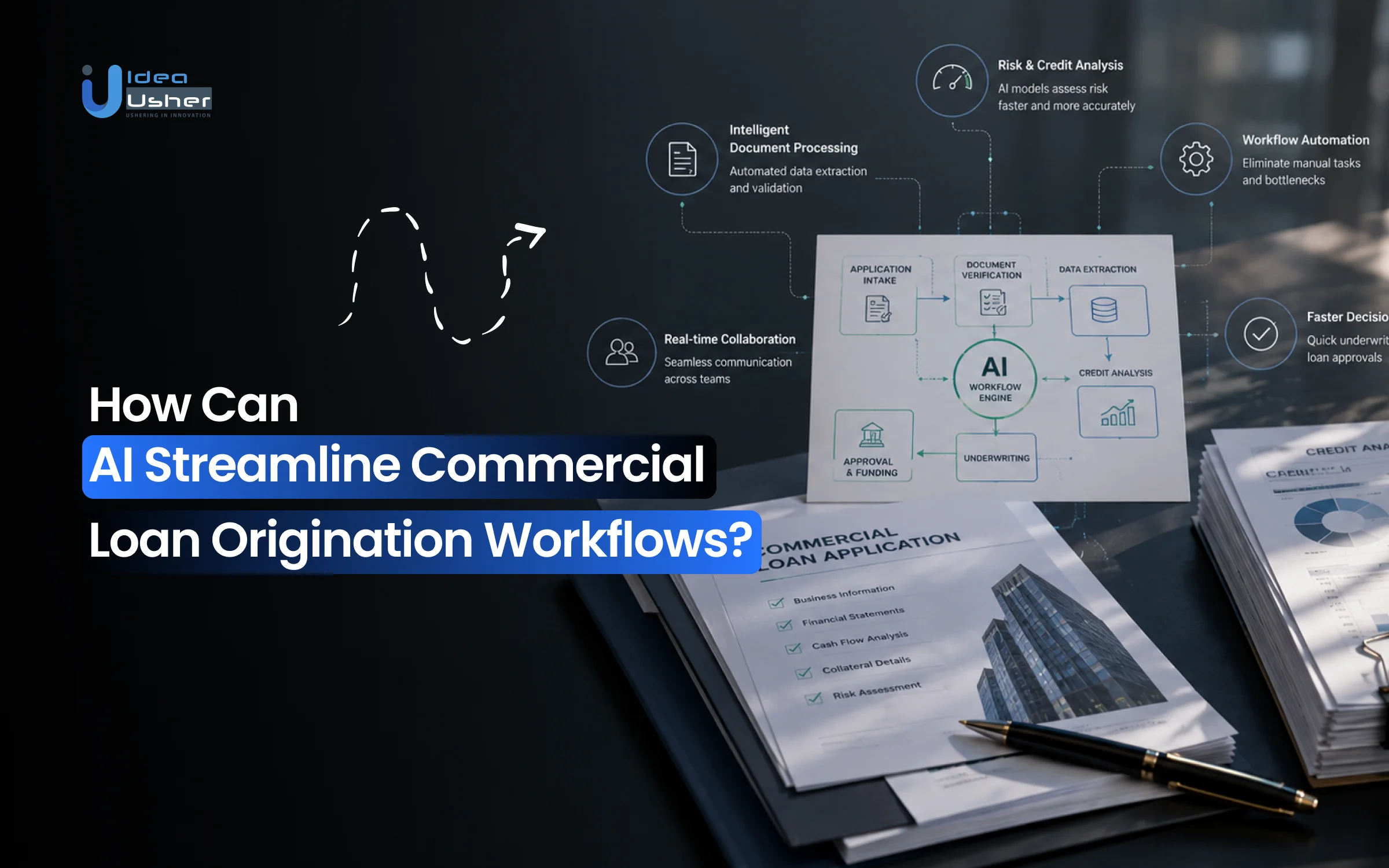
- Commercial lenders are adopting AI-powered loan origination workflows to automate underwriting, reduce manual work, and accelerate business loan approvals.
- Modern platforms combine AI document intelligence, predictive risk modeling, fraud detection, and automated credit analysis to improve lending decisions.
- Building a successful solution requires secure integrations, explainable AI, regulatory compliance, scalable infrastructure, and real-time data connectivity.
- These platforms improve underwriting speed, decision accuracy, operational efficiency, and borrower experience, creating strong growth opportunities for lenders.
Commercial lending has never been just about approving loans. It’s about understanding how a business operates and whether it can realistically repay the money. Every application brings different financials, business models, and risk factors, making commercial lending far more complex than consumer lending. As application volumes continue to grow, financial institutions are realizing that hiring more underwriters isn’t enough to keep up. This is why AI is becoming a key part of modern commercial lending. It helps lenders analyze business data much faster, uncover valuable insights that are often missed during manual reviews, and make underwriting decisions with greater speed and consistency.
Commercial loan origination is becoming more complex as lenders process more applications and work to deliver faster approvals. From our experience in building AI-powered lending platforms, we’ve seen how automation makes lending more efficient. In this blog, we’ll discuss how AI streamlines commercial loan origination and why more financial institutions are adopting it.
Market Opportunity for AI-Powered Commercial Lending Solutions
According to MarketUS, the global AI in lending market is expected to grow from USD 7.0 billion in 2023 to USD 58.1 billion by 2033, expanding at a CAGR of 23.5%. This rapid growth shows how quickly lenders are adopting AI to modernize commercial lending. Instead of relying on slow manual reviews, financial institutions are using intelligent automation to speed up approvals, improve risk decisions, and deliver a better borrowing experience for businesses.

Source: MarketUS
Market Shift Toward AI
The global commercial loan market continues to expand, but traditional legacy infrastructure is struggling to keep pace. Commercial loans require complex analysis, from evaluating cash flow and tax returns to assessing industry risk. Automated underwriting engines handle these manual steps in minutes rather than weeks.
Banks and fintechs are pouring capital into specialized lending software to modernize their operations. A primary beneficiary of this shift is nCino, a cloud banking and AI lending platform that generates over $590 million in annual revenue by automating enterprise commercial loans.
Core Drivers of AI Adoption
- Real-time data access: Direct connections to bank accounts, accounting platforms, and tax registries eliminate manual document uploads.
- Continuous monitoring: AI tracks borrower financial health throughout the loan lifecycle, flagging default risks early.
- Portfolio expansion: Precise risk scoring allows lenders to safely approve loans for small and medium businesses that lack traditional credit histories.
Why Lenders Invest in AI Origination
Financial institutions face shrinking interest margins and strict regulatory requirements. Manual underwriting eats into profit margins, while slow approval times drive borrowers toward digital-first competitors.
| Operational Challenge | How AI Solves It | Measured Impact |
| High Processing Costs | Automates data extraction and spreading | Cuts origination expense by up to 40% |
| Slow Time-to-Decision | Runs real-time risk models | Drops decision windows from weeks to hours |
| Credit Risk Exposure | Analyzes thousands of alternative datapoints | Lowers default rates through early warnings |
Regulators also demand transparent, audit-ready decision trails. AI lending platforms generate clear explanations for every credit decision, helping institutions meet compliance standards without slowing down operations.
Another clear market success story is OakNorth, an AI-powered credit intelligence and lending platform that serves middle-market businesses. OakNorth generated over $780 million in annual gross revenue by using machine learning models to analyze granular company metrics and deliver custom loan structures.
Business Opportunity for AI Platforms
Building or integrating an AI commercial lending platform creates strong commercial upside across the entire financial ecosystem.
Opportunities by Institution Type
- Traditional Banks: Speed up legacy commercial desks to protect market share against digital disruptors.
- Credit Unions & Community Lenders: Lower cost-to-serve so they can profitably issue smaller commercial loans.
- Non-Banking Financial Companies (NBFCs): Launch specialized revenue-based or asset-backed lending products without ballooning headcount.
- Fintech Startups: Capture market share by offering embedded commercial credit directly inside business software tools.
The Hidden Costs of Manual Commercial Loan Processing
Manual loan processing increases costs long before a lender earns revenue from a loan. Teams spend too much time reviewing documents and moving information between systems instead of making lending decisions. An AI-powered lending platform removes these bottlenecks, helping financial institutions reduce operational costs, process loans faster, and build a more scalable lending business.

1. Slow Decisions Limit Growth
Every additional day spent in underwriting directly lowers deal capacity and burns through operational budgets.
- Spreadsheet dependence creates bottlenecks: Credit analysts manually copy data from tax returns and balance sheets into offline files. This step alone adds days to the initial review and leaves no clear digital paper trail.
- Redundant review loops slow momentum: Deals often move through three or four layers of approval. Each decision-maker re-reviews raw documentation from scratch because earlier notes lack standardized formatting.
- Capacity caps limit portfolio growth: Underwriters spend up to 70% of their time on mechanical administrative work rather than evaluating risk. Scaling loan volume ends up requiring linear headcount growth, destroying operating leverage.
Slow decisions do not just cost payroll dollars. They cost high-value deals. Commercial borrowers with strong credit profiles simply walk away to faster lenders when approvals take weeks instead of days.
2. Fragmented Tech Drives Up Costs
Many commercial lenders still rely on disconnected systems that were never designed to work together. Borrower information moves between CRMs, loan origination software, and core banking platforms through manual updates, making the entire process slower than it needs to be.
As a result, teams spend valuable time entering the same data multiple times, tracking missing documents, and managing different software tools. An AI-powered, unified loan origination platform brings everything into one workflow, reducing operational costs while helping lenders process more loans with greater efficiency.
3, Document Workflows Increase Risk
Manual data extraction inevitably leads to costly operational mistakes.
- Financial spreading errors: Copying figures from complex financial statements into legacy databases creates silent data errors that distort key leverage ratios.
- Verification gaps: Missing trailing documents or outdated tax filings often slip past tired eyes, exposing the lender to unhedged credit risks.
- Audit vulnerability: Loose files saved in local desktop folders or internal messaging apps make regulatory compliance reviews stressful and expensive.
Beyond credit risk, a clunky document process destroys the borrower experience. Sophisticated business owners expect a modern digital interface. Forcing them to scan, email, and re-submit papers repeatedly damages your brand before the loan even closes. Building an intelligent loan management platform turns this widespread industry pain point into high-margin revenue.
Where AI Creates the Biggest Impact in Commercial Lending?
Artificial intelligence targets the exact points where commercial lending loses momentum and profit. By automating data extraction and risk analysis, software platforms transform slow legacy workflows into high-margin digital operations. Investors who fund AI-driven lending infrastructure position themselves to capture market share from traditional institutions still relying on manual labor.
1. Automating Borrower Onboarding
The first step of loan origination is typically the messiest. AI instantly changes this experience for borrowers and lenders alike.
- Smart Classification: Machine learning models identify tax returns, bank statements, and corporate balance sheets the moment they are uploaded.
- Instant Data Extraction: Systems read unstructured financial documents and extract key numbers directly into loan files with high accuracy.
- Real-time Validation: Algorithms automatically check uploaded files for missing pages or mismatched information before a human reviewer even opens the deal.
Platforms like Ocrolus demonstrate the commercial value of this exact workflow. By using AI to automate financial document analysis for business lenders, Ocrolus surpassed $50 million in annual recurring revenue. Automating document intake slashes intake processing from days to minutes, giving lenders an immediate advantage in closing deals.
2. Accelerating Underwriting Risk Analysis
Underwriting requires intense financial analysis, but much of that effort is mechanical. AI automates financial spreading and ratio calculations instantly. Software parses years of tax returns to model cash flow, debt service coverage, and profit trends in seconds. Once the data is processed, generative models assemble draft credit memos and populate preliminary risk scores.
Underwriters no longer waste hours copying figures into spreadsheets. Instead, they step in as final decision-makers who review pre-analyzed risk profiles. This shifts the team’s focus from data entry to strategic risk management.
3. Improving Compliance and Fraud Detection
Manual fraud checks rely heavily on human visual inspection, which frequently misses sophisticated document alterations. AI models scan incoming files at the pixel level to detect manipulated bank statements, fake invoices, or mismatched tax IDs. Automated systems also streamline KYC and AML checks against global databases in real time.
Every calculation, data source, and approval step gets recorded automatically. This creates a clean, searchable audit trail that keeps lenders fully compliant with regulatory standards without adding extra administrative work.
4. Scaling Capacity Without Extra Headcount
Growing a commercial lending business traditionally means hiring more credit analysts as loan volumes increase. AI changes this by automating repetitive tasks, allowing existing teams to process far more applications without expanding headcount. This helps lenders scale faster while keeping operating costs under control.
A strong example is OakNorth, whose AI-powered commercial credit platform has generated over $100 million in annual revenue while helping banks assess business cash flows and credit risk more efficiently. With faster underwriting and shorter approval times, lenders can focus on high-value lending decisions and support more businesses without sacrificing quality.
How Does AI Improve Commercial Credit Decision-Making?
Traditional commercial credit decisions rely heavily on historical debt metrics and static balance sheets. This backward-looking approach fails to capture sudden market shifts or real-time business performance. AI replaces static scorecards with dynamic models that process live operational data, allowing lenders to underwrite credit risk with far greater precision.
1. Predictive Analytics for Credit Risk
Predictive analytics changes credit evaluation from historical reporting into forward-looking forecasting. Machine learning models analyze cash flow trends, market fluctuations, and industry indicators alongside standard financial statements.
- Dynamic Probability of Default: Models calculate default risk dynamically using live transaction velocity rather than stale annual audits.
- Macro Environment Stress Testing: Algorithms simulate how interest rate shifts or supply chain bottlenecks impact a borrower’s specific revenue model.
- Early Warning Indicators: Systems flag subtle declines in working capital months before a loan defaults.
Commercial risk platforms like Upstart demonstrate how predictive scoring unlocks massive enterprise value, driving over $600 million in annual revenue by providing AI-driven credit risk models to institutional lenders.
2. Borrower Profiling Beyond Scores
Legacy underwriting heavily overweights traditional credit scores, often penalizing healthy mid-market businesses with complex balance sheets. AI expands the borrower profile by evaluating broader transactional and operational data sets. By connecting directly to a borrower’s ERP system, bank accounts, and payment gateways, the platform tracks real revenue health.
This multi-dimensional analysis gives credit officers a complete view of operational stability. Lenders can confidently extend credit to high-potential commercial borrowers that traditional scorecards routinely reject.
3. Explainable AI for Compliance
A major concern for commercial lenders adopting AI is the black box problem. Regulators demand clear justifications for loan denials, credit limits, and risk-based pricing. Explainable AI addresses this directly by making every algorithmic recommendation fully auditable. Frameworks like SHAP and LIME break down credit decision outputs into plain language.
Audit Insight: Explainable AI identifies the exact factors driving a credit decision, such as debt service coverage ratio or customer concentration risk, giving underwriters clear evidence to support approvals or denials.
Another strong proof point in this space is Zest AI, which generates over $30 million in annual revenue by supplying fully explainable AI underwriting models to financial institutions. These tools ensure every automated decision complies with fair lending laws while giving credit committees complete transparency.
Using Generative AI to Prepare Credit Memos and Loan Summaries
Preparing credit memos and loan summaries takes a significant amount of time in commercial lending. Generative AI can handle the first draft by pulling key details from borrower documents, giving analysts a strong starting point. This allows lending teams to move applications forward more quickly while spending more time on reviewing risks and making better credit decisions.
1. Automating Memos with LLMs
Credit analysts historically had to manually open dozens of files to build a single memo. Generative AI alters this process by pulling data automatically across all deal sources.
- Multi-Source Aggregation: LLMs read tax returns, audited balance sheets, credit reports, and CRM notes simultaneously.
- Structured Template Population: The engine automatically populates standardized bank templates with required financial metrics and borrower background details.
- Instant Gap Analysis: The model flags missing documents or incomplete financial disclosures before the analyst begins writing.
Commercial origination leader Numerated demonstrates the high market demand for automated loan processing, generating over $40 million in annual recurring revenue by streamlining document intake and deal preparation for financial institutions.
2. Generating Narratives for Faster Decisions
Beyond raw data extraction, Generative AI excels at transforming complex quantitative spreads into clear narrative context. It explains the story behind the balance sheet figures for credit committees. The system generates concise summaries covering key deal factors:
- Cash Flow Drivers: Explains annual revenue growth trends and primary operating expense changes.
- Risk Factors: Highlights customer concentration risks or upcoming debt maturities.
- Collateral Quality: Outlines appraisal values and coverage ratios relative to requested loan amounts.
This initial automated pass gives underwriters a complete draft in minutes rather than hours, allowing them to refine findings instead of starting from a blank page.
3. Accuracy, Transparency, and Oversight
Generative AI can improve commercial lending, but it must operate within strict compliance requirements. That’s why modern lending platforms use Retrieval-Augmented Generation, which grounds every AI-generated response in verified borrower documents. This gives underwriters clear references to the original source and creates a transparent, audit-ready decision process.
A good example is Biz2Credit, whose automated commercial lending platform has generated over $100 million in annual revenue. Its success highlights how AI-powered underwriting can improve efficiency while maintaining the accuracy and traceability that regulated lenders require.
Revenue Growth Opportunities Enabled by AI Commercial Lending
Automating commercial lending does more than improve operational efficiency. Faster approvals create a better experience for business borrowers and help lenders win more deals. AI also uncovers new lending opportunities throughout the customer journey, allowing financial institutions to grow revenue while competing more effectively with traditional banks.
1. Faster Approvals Boost Acquisition
Speed is the primary competitive moat in commercial credit. Qualified borrowers with strong financial profiles prioritize fast capital deployment over minor interest rate differences.
- Lower Drop-Off Rates: Streamlined digital application flows keep business owners engaged, preventing abandonment mid-process.
- First-Mover Advantage: Automated initial screening allows lenders to issue binding terms within hours rather than weeks.
- Higher Conversion Ratios: Quicker turnaround times directly increase the percentage of submitted applications that turn into funded loans.
Banking technology enterprise nCino highlights the immense market opportunity here, generating over $590 million in annual revenue by providing AI-powered loan origination and digital workflows to financial institutions.
2. Personalized Offers Drive Retention
AI doesn’t stop working after a loan is approved. It continuously monitors borrower data to identify changes that may signal new financing needs. This helps lenders reach out with relevant loan offers at the right time instead of waiting for businesses to apply again.
For example, AI can detect signs of business growth such as higher inventory levels or upcoming equipment purchases and prompt lenders to offer working capital or equipment financing. This proactive approach strengthens customer relationships and increases the long-term value of every borrower.
3. Scalable Operations Fuel Growth
Traditional lending often requires hiring more underwriters and operations staff as loan volumes increase. AI changes this by automating document processing, data extraction, and initial risk analysis. That allows existing teams to handle more applications without a proportional increase in staffing.
A good example is Blend, which generates over $150 million in annual platform revenue by helping lenders automate consumer and commercial loan origination. As more of the lending workflow becomes automated, financial institutions can scale efficiently, improve margins, and grow their portfolios without significantly increasing operating costs.
Top 5 AI Commercial Loan Origination Platforms in the USA
Before choosing a commercial loan origination platform, it’s helpful to see what the leading solutions offer. We looked at some of the top platforms used by banks and commercial lenders across the U.S. to understand what makes them successful. Each one brings its own strengths, from AI-powered underwriting to faster approvals and smarter workflow automation.
1. nCino

Built on Salesforce, nCino is one of the most widely adopted commercial lending platforms among U.S. banks. It combines loan origination, credit analysis, underwriting, document management, and portfolio monitoring in a single cloud platform. Its AI capabilities help automate workflows, improve decision-making, and reduce manual processing for commercial lenders.
2. Abrigo

Abrigo specializes in commercial loan origination for community and regional banks, with a strong focus on credit risk management and regulatory compliance. The platform leverages AI to automate financial spreading, risk rating, credit memo preparation, and underwriting workflows, enabling lenders to make faster and more consistent credit decisions.
3. Blend

Blend offers an AI-powered origination platform that streamlines borrower onboarding, document verification, compliance reviews, and loan processing. Its Intelligent Origination platform and AI agents automate repetitive tasks, allowing lenders to accelerate approvals while maintaining transparency and auditability throughout the lending process.
4. Finastra

Finastra provides enterprise-grade commercial lending solutions used by banks worldwide. Its platform supports complex commercial loan origination, syndicated lending, underwriting, and portfolio management, while incorporating AI and analytics to improve credit assessments, workflow automation, and regulatory compliance.
5. Aloan

Aloan is an AI-native commercial lending platform designed to automate the most time-consuming parts of underwriting. It uses AI to extract financial data from documents, perform financial spreading, identify risk factors, and generate credit memos, making it an attractive option for banks looking to add AI capabilities without replacing their existing loan origination systems.
Build an AI Commercial Loan Origination Platform with IdeaUsher
Transforming commercial credit operations requires an engineering team that understands complex financial software. IdeaUsher builds custom AI platforms designed to eliminate underwriting friction and accelerate deal flow. We help investors and institutions turn tech ideas into high-margin SaaS products built for enterprise scale.

End-to-End Engineering
Launching an enterprise fintech solution demands end-to-end expertise across architecture, security, and user design.
- Full-Cycle Execution: We handle strategic planning, UX design, custom AI integration, cloud setup, and production deployment under one roof.
- Modern Enterprise Tech: Architectures are engineered to scale seamlessly as loan origination volumes expand.
- Legacy Modernization: We build modern cloud platforms from scratch or rebuild outdated legacy architectures.
Our end-to-end approach means you avoid managing multiple contractors. You get a fully unified software build delivered ready for market entry.
Tailored AI Workflows
Off-the-shelf lending software often forces financial institutions to change the way they work. We take a different approach by building AI solutions around your existing credit policies, approval workflows, and risk requirements. From document processing to automated underwriting, every component is designed to fit naturally into your operations, helping your teams work faster without disrupting established lending processes.
Why Choose IdeaUsher
IdeaUsher brings proven technical expertise to high-stakes fintech builds. With over 1,000 successful projects, a dedicated team of 250+ niche experts, and over 500,000 hours of coding experience, our team of ex-MAANG/FAANG developers builds secure, production-ready AI software tailored to your commercial vision.
We act as long-term technology partners, providing continuous support and system evolution beyond the initial product launch. Partnering with our engineering team gives platform investors a faster path to market, reliable compliance standards, and software engineered for long-term venture profitability.
Conclusion
AI is making commercial loan origination simpler and more efficient. It reduces manual work, speeds up underwriting, and helps lenders make better decisions with greater confidence. As customer expectations continue to rise, financial institutions that invest in AI will be better equipped to scale their lending operations and deliver a faster, more reliable borrowing experience.
Things to Know About AI Commercial Loan Origination Platforms
A1: An AI commercial loan origination platform helps lenders manage the entire lending journey more efficiently. It collects borrower documents, extracts financial data, supports underwriting, and prepares loan summaries with minimal manual work. Instead of replacing existing lending systems, it works alongside them to speed up decisions, reduce errors, and make the process easier for both lenders and borrowers.
A2: Not completely. AI takes over repetitive work like reviewing documents, extracting financial information, and highlighting potential risks. This gives underwriters more time to focus on complex cases and make informed lending decisions. The final approval still remains with experienced credit professionals, making AI a productivity tool rather than a replacement.
A3: AI can dramatically reduce the time spent on loan processing by automating tasks that usually take hours or even days. Instead of manually reviewing documents and preparing credit files, lenders receive organized data and decision-ready insights much faster. The exact improvement depends on the institution, but most lenders see noticeable gains in turnaround time and operational efficiency.
A4: Yes. Most AI lending platforms are built to integrate with existing loan origination systems, core banking software, CRMs, and third-party services through APIs. This means lenders can introduce AI into their workflows without replacing the systems they already use. It is a practical way to modernize lending while protecting previous technology investments.


