

Key Takeaways
- Lenders are adopting AI-powered document verification to automate loan origination, reduce fraud, and accelerate lending decisions.
- Modern platforms combine OCR, computer vision, machine learning, biometric verification, and intelligent document processing to validate borrower information.
- Building a successful solution requires AI models, secure integrations, regulatory compliance, fraud detection, and scalable cloud infrastructure.
- These platforms improve verification accuracy, approval speed, operational efficiency, and borrower experience, creating strong opportunities for fintech innovation.
Fraud in digital lending is becoming harder to detect. Fake documents now look more convincing than ever, and manual verification often struggles to keep up. Even experienced reviewers can miss subtle signs that something is wrong, especially when they have to process hundreds of loan applications every day. This growing challenge is why many lenders are moving to AI-powered document verification. Instead of simply checking whether a document looks valid, AI can quickly spot inconsistencies, flag suspicious applications, and help teams make lending decisions with greater confidence.
Document verification has become one of the most critical stages in modern loan origination, with AI helping lenders process applications faster while improving accuracy and fraud detection. Based on our experience building AI solutions for financial services, this blog explores how AI automates document verification, the technologies behind it, and what it takes to implement it in a loan origination workflow.
Market Potential for AI Loan Origination Solutions
According to Market Intelo, the global AI loan origination market was valued at $3.2 billion in 2025 and is expected to reach $28.6 billion by 2034, growing at a 22.4% CAGR. This rapid growth reflects how lenders are moving away from manual loan processing and investing in AI-powered automation. Faster approvals, lower operating costs, and a smoother borrower experience are making intelligent loan origination platforms a major opportunity for fintech startups and financial institutions alike.
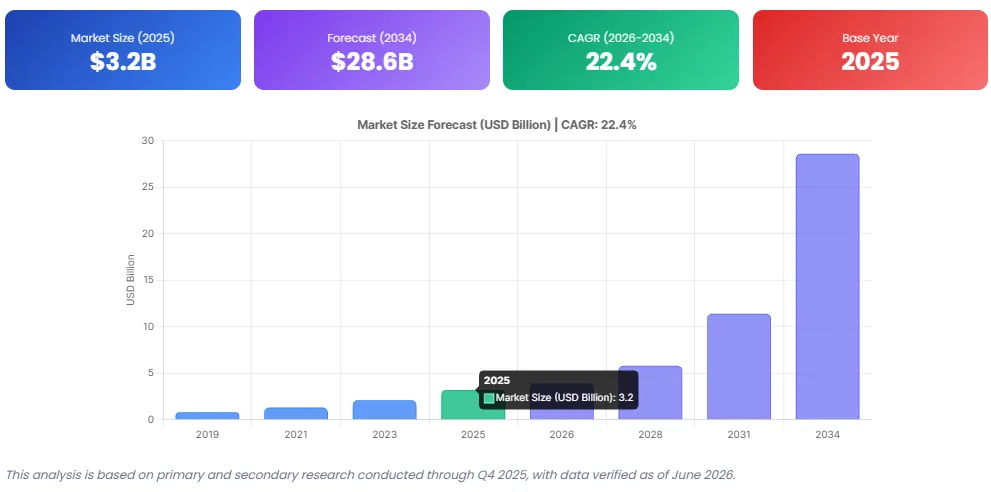
Source: Market Intelo
Consider how enterprise platforms like nCino have captured market share. By digitizing commercial and retail loan origination workflows for financial institutions globally, nCino generates over $600 million in annual revenue. Their platform proves that enterprise banks are eager to pay top dollar for automated origination stacks that replace manual back-office processing.
Core growth factors fueling market expansion:
- Cost Reduction: Processing costs per loan drop significantly when AI agents parse financial statements and verify identities automatically.
- Scalable Volume: Digital origination rails process thousands of concurrent applications without requiring extra operations staff.
- Broader Reach: Automated decision engines analyze cash-flow data to safely underwrite thin-file and underbanked borrowers.
AI Is Becoming a Competitive Advantage
Lenders are moving far beyond simple rule-based automation. Modern origination platforms deploy computer vision, optical character recognition and machine learning to analyze bank statements, verify employment, and flag synthetic identities before loan documents are generated.
Look at specialized mortgage origination solutions like LendingPad. By streamlining cloud-based loan origination for independent mortgage brokers and lenders, LendingPad has scaled to over $4.3 million in annual recurring revenue with a lean operational team. Lenders using these intelligent origination pipelines close loans days faster than competitors who rely on manual underwriting queues.
| Processing Capability | Legacy Origination | AI-Native Origination |
| Document Extraction | Manual review by loan officers | Automated OCR & real-time validation |
| Fraud Screening | Sample-based manual audits | 100% automated anomaly detection |
| Approval Timeline | 5 to 15 business days | Instant or under 24 hours |
Why Now Is the Right Time to Build
A unique convergence of market forces makes this the ideal moment to build and deploy AI loan origination solutions:
- Rising Expectations for Instant Approvals: Today’s borrowers expect real-time loan offers directly on their phones. Slow manual workflows lead to high application drop-off rates.
- Maturity of AI Document Extraction: Modern optical character recognition and generative AI models parse unstructured tax returns, bank statements, and pay stubs with over 99% accuracy.
- Strict Regulatory & Audit Pressures: Machine learning engines provide transparent, explainable decision trails that simplify compliance reporting for risk officers.
- Rise of Embedded Lending: E-commerce portals and B2B SaaS platforms are embedding credit offers directly into checkout flows, creating massive demand for white-label origination APIs.

How AI Automates Document Verification During Loan Origination?
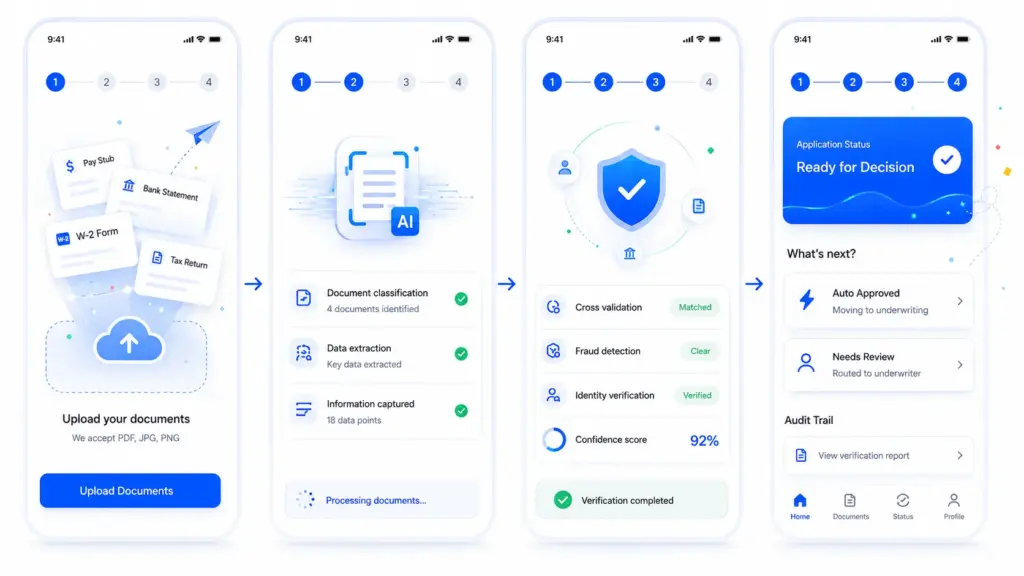
Manual document review is one of the biggest bottlenecks in traditional loan origination. Ingesting pay stubs, bank statements, and tax forms manually slows down approvals and opens the door to human error. AI-powered intelligent document processing solves this by turning unstructured files into verified, actionable data in real time.
Collecting, Classifying, and Extracting Data
Borrowers upload their documents directly through a web or mobile portal during the application process. The platform instantly analyzes the uploaded files using computer vision and natural language processing to identify document types automatically. Platforms like Instabase lead the way in unstructured data processing for financial services.
By automating document ingestion and data extraction for major enterprise banks, Instabase has reached an estimated revenue exceeding $50 million annually.
How data flows into the system:
- Document Ingestion: The platform accepts multiple file formats including PDFs, JPEGs, and scanned images.
- Auto-Classification: Intelligent vision models categorize files into IDs, pay stubs, bank statements, W-2s, or tax returns without manual tag input.
- Data Extraction: Optical character recognition extracts key fields like monthly net income, employer name, account balance, and recurring transaction history.
Validating Data and Detecting Document Fraud
Extracted data must be verified before moving deeper into the origination pipeline. The AI engine cross-checks values from the documents against self-reported application details, credit bureau feeds, and government databases. Specialized verification engines like Incode focus heavily on real-time identity fraud prevention.
Incode uses advanced biometric verification and document liveness checks to prevent synthetic identity fraud, helping the company generate around $30 million in annual revenue while serving digital lenders and enterprise clients.
| Verification Layer | Check Performed | Fraud Prevention Impact |
| Forensic Analysis | Inspects PDF metadata for software edits or altered fonts | Prevents modified income statements |
| Cross-Validation | Matches pay stub employer details against tax returns | Flags falsified employment claims |
| Biometric Match | Compares selfie data to government ID photos | Blocks identity theft attempts |
| Confidence Scoring | Calculates an overall verification score for each applicant | Automates clear approvals vs flags |
Routing Verified Files to Underwriting Decisions
Once documents are classified, extracted, and verified, the structured output routes directly into the loan origination system. The platform generates a full digital audit trail detailing every data point pulled, confidence score calculated, and validation rule checked.
- Clean Applications: High confidence scores bypass human queues and move straight to automated underwriting and instant loan offer generation.
- Exception Handling: Edge cases, low confidence scores, or mismatched data automatically route to human underwriters with highlighted fields for quick review.
- Regulatory Audit Readiness: Detailed execution logs store every verification step, ensuring total transparency during compliance reviews.
What Documents Can AI Verify During Loan Origination?
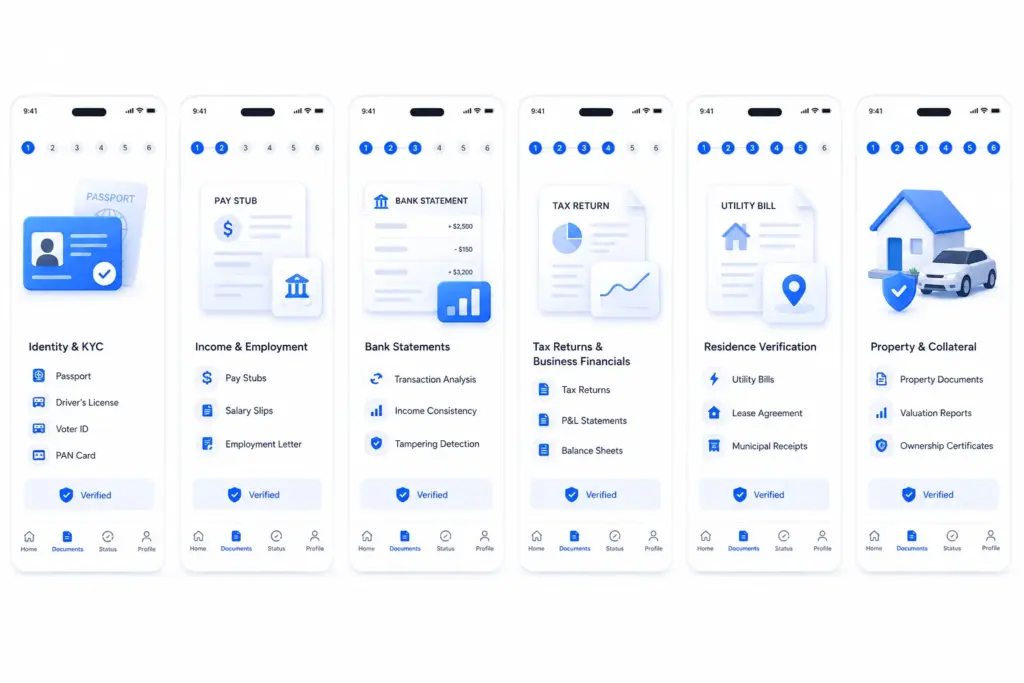
Modern loan origination engines process diverse borrower documentation automatically. By converting unstructured paper and digital files into validated data points, AI accelerates time-to-decision while reducing risk. This enables lenders to approve more applications with greater accuracy while significantly reducing manual verification efforts.
1. Identity and KYC Documents
AI models extract demographic data from official identity documents including passports, driver’s licenses, tax cards, voter IDs, and government records. Computer vision verifies security features like holograms and microprinting while matching liveness selfies against photo IDs to confirm identity.
Identity verification platforms like Socure lead this category. Socure uses predictive machine learning to validate government IDs and analyze fraud risk in real time, generating over $315 million in annual recurring revenue while serving major banks and lenders.
2. Income and Employment Records
Automated extraction tools parse salary slips, pay stubs, tax deduction forms, and official employment letters. Algorithms cross-check monthly net pay against reported income to detect inconsistencies or falsified records. An example of automated verification infrastructure is Persona.
Persona provides flexible identity and document verification workflows for financial institutions, pulling in over $100 million in annual revenue by automating compliance and document verification across 200+ countries.
- Gross vs Net Pay: Calculates actual disposable income after tax deductions.
- Employer Validation: Cross-checks company names against business registries.
- Pay Frequency: Detects regular salary deposits versus irregular payouts.
3. Bank Statements and Financial Transactions
AI parses bank account statements to evaluate cash flow health, existing debt commitments, and spending patterns. OCR engines read multi-page PDF statements, flag suspicious edits, and calculate real-time debt-to-income ratios. Identity orchestration engines like Alloy connect lenders directly to bank statement aggregation tools and credit bureaus.
Generating roughly $55 million in annual recurring revenue, Alloy allows financial institutions to build customized decisioning workflows.
| Verification Task | Legacy Manual Method | AI-Driven Automated Method |
| Transaction Analysis | Manual line-item review | Instant algorithmic transaction tagging |
| Tampering Detection | Visual inspection | Forensic PDF font & layer metadata checks |
| Income Consistency | Approximate estimation | Precise recurring deposit detection |
4. Tax Returns and Business Financials
For commercial and self-employed borrowers, AI models evaluate balance sheets, profit and loss statements, audited financials, tax returns, and sales tax filings. Algorithms pull key metrics to assess long-term business liquidity and debt coverage. Platforms like Taktile specialize in automated underwriting logic for complex financial data. Taktile allows lenders to build and adjust credit policies dynamically, generating over $12.5 million in annual revenue by streamlining business decisioning.
Key takeaway for lenders: Automating business financial analysis cuts commercial underwriting turnaround times from weeks to under 24 hours.
5. Residence Verification Documents
Platforms verify utility bills, lease agreements, municipal tax receipts, and bank statements to confirm applicant residency. Computer vision verifies document dates to ensure proof of address meets regulatory freshness requirements.
- Name & Address Matching: Confirms applicant details match utility account records.
- Document Age Check: Rejects address proofs older than 90 days automatically.
- Utility Issuer Validation: Checks bill layout against known provider templates.
6. Property and Collateral Documents
For secured loans like mortgages and auto financing, AI processes property title deeds, valuation reports, ownership certificates, and asset registration records. The system verifies property ownership history, checks for existing legal encumbrances, and validates appraisal figures against regional real estate benchmarks before final loan approval.
AI Technologies That Power Automated Document Verification
Modern document verification engines combine multiple artificial intelligence layers to process applicant files without human intervention. Combining computer vision, language models, and biometric checks allows digital lenders to verify complex financial documents while preventing identity fraud.
1. OCR and Document Intelligence
Optical character recognition converts scanned paper and images into machine-readable text. Intelligent document processing goes further by understanding page layouts, form fields, and table structures. This allows the system to accurately map raw text into structured data fields like net income, tax deductions, and employer details.
Key extraction capabilities:
- Handwritten Text Extraction: Reads handwritten notes on forms and application signatures.
- Multi-Page Table Analysis: Reconstructs financial tables across multi-page bank statements.
- Document Classification: Identifies file types automatically before running extraction rules.
2. Computer Vision and Fraud Detection AI
Computer vision models inspect visual elements across applicant files to spot sophisticated forgeries. Algorithms analyze document fonts, pixel alignments, and background patterns to detect visual tampering. Computer vision also detects duplicate file submissions across different applicant accounts to prevent coordinated syndicate fraud.
| Inspection Layer | Technical Method | Fraud Prevention Target |
| Pixel Metadata | Analyzes image compression and font consistency | Catches edited text on pay stubs |
| Security Feature Scan | Validates holograms, watermarks, and microprinting | Blocks fake identity cards |
| Template Matching | Compares uploaded file structure to official layouts | Identifies counterfeit forms |
3. NLP, LLMs, and Machine Learning Models
Natural language processing and large language models read unstructured narrative sections within financial forms, legal disclosures, and employment letters. Machine learning models evaluate contextual relationships between fields to verify that extracted data aligns logically.
- Contextual Understanding: Reads ambiguous descriptions on bank statements to identify recurring salary deposits.
- Cross-Field Validation: Verifies that tax form income matches reported pay stub amounts.
- Confidence Scoring: Assigns accuracy scores to extracted fields so low-confidence data routes to human reviewers.
- Continuous Model Training: Learns from human underwriting overrides to improve extraction precision over time.
4. Biometric Verification and NFC
Biometric verification confirms that the person submitting the application actually owns the uploaded document. Facial matching algorithms compare a live applicant selfie against the photo on a government-issued identity card. Liveness detection forces applicants to complete quick actions like blinking or smiling to stop static photo spoofing.
Meanwhile, near-field communication reads encrypted chip data directly from e-passports and modern smart IDs to verify cryptographic signatures issued by governments, completely neutralizing forged printed credentials.
How AI Detects Fake, Tampered, and Forged Loan Documents?
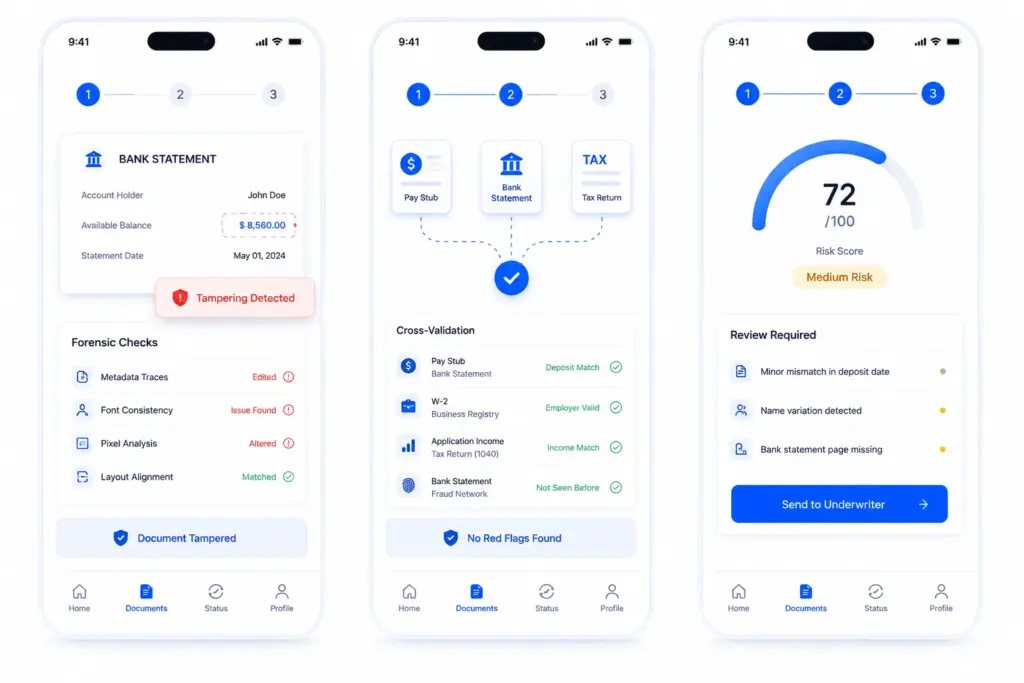
Fraudsters increasingly use digital editing tools to create convincing fake pay stubs, altered bank statements, and forged tax forms that easily bypass manual checks. AI document fraud detection analyzes pixel metadata, font layers, and cross-document transaction patterns in real time, catching altered files before they reach underwriting queues.
1. Detecting Document Tampering
Digital document editing tools make it easy for fraudsters to alter income, bank balances, and names on PDFs. Human reviewers often miss these changes because the visual output looks authentic. AI document forensics inspects the digital file structure behind the visual layer to spot tampering instantly.
Forensic Signal Alert: A single modified cell in an edited PDF bank statement leaves hidden metadata traces, including mismatched software creation tags, modified font streams, and inconsistent pixel compression artifacts.
AI algorithms analyze document files at a microscopic level using multiple automated checks:
- Metadata traces: Identifies editing tools like Adobe Acrobat or Photoshop used after the original document was generated.
- Font inconsistencies: Detects mixed font families, uneven character spacing, or slightly altered text alignment.
- Pixel compression artifacts: Scans image layers around edited numbers to reveal altered pixels and mismatched background noise.
- Layout alignment: Verifies line spacing, border margins, and logo proportions against authentic bank templates.
Solutions like Ocrolus specialize in automated financial document analysis for lenders. Ocrolus extracts data from pay stubs and bank statements with over 99% accuracy while detecting hidden document edits before applications reach underwriting.
2. Exposing Borrower Misrepresentation
Single-document tampering is only one part of loan fraud. Borrowers frequently submit fabricated pay slips, altered tax returns, or inflated bank balances that appear legitimate when viewed alone. AI fraud detection systems run multi-document cross-validation to cross-reference data points across the entire application packet.
| Document Source A | Document Source B | Cross-Validation Check | Red Flag Detected |
| Pay Stub Direct Deposit | Bank Statement Credits | Match deposit dates and amounts | Deposit missing or mismatched on bank statement |
| W-2 Employer Name | State Business Registry | Verify active business status | Non-existent or dissolved employer |
| Loan Application Income | Tax Returns (1040) | Compare gross stated income | Income inflated on application |
| Bank Statement PDF | Historical Fraud Network | Check file fingerprint across network | Duplicate document used across multiple lenders |
Platforms like Resistant AI, which recently raised $25 million in Series B funding, specialize in catching sophisticated document fraud across global financial networks. The platform cross-checks document structures and transaction patterns across thousands of applications, stopping fraudsters who reuse modified templates across different loan originators.
3. Risk Scoring and Human Review
AI does not replace underwriters. It evaluates hundreds of forensic, cross-validation, and behavioral signals in real time to generate a unified risk score. Low-risk applications move straight through for instant approval, while high-risk applications are flagged for manual review with clear explanations.
- Low Risk (Auto-Approve): Documents pass all forensic checks and data points match across sources.
- Medium Risk (Underwriter Queue): Minor discrepancies detected, such as missing bank statement pages or minor name variations.
- High Risk (Decline or Fraud Investigation): Clear indicators of document alteration, duplicate submission, or unverified income sources.
Underwriters receive targeted visual callouts that highlight exactly where a document was edited, along with plain-language explanations. This eliminates hours of manual checking and ensures full auditability for regulatory compliance.
How Does AI Cross-Check Data Across Multiple Financial Documents?
Modern AI loan origination engines process diverse borrower documentation automatically. By converting unstructured paper and digital files into validated data points, AI accelerates time-to-decision while reducing risk. This enables lenders to approve more applications with greater accuracy while significantly reducing manual verification efforts.
1. Unified Borrower Profiles
AI ingests every document uploaded during origination and normalizes raw text into a central data structure. The system maps distinct naming conventions, varied date formats, and different address styles into a single borrower profile. Platforms like Informed.IQ focus on this automated cross-referencing process.
By verifying auto loan documentation and parsing pay stubs, W-2s, and bank statements in real time, Informed.IQ helps major lenders process billions in credit volume annually. What normalization handles automatically:
- Name Variations: Reconciles middle initials, nicknames, or maiden names across identity documents.
- Income Standardizing: Converts hourly, bi-weekly, or monthly pay figures into a single annual metric.
- Address Uniformity: Standardizes street abbreviations and postal formats across utility bills and IDs.
2. Intelligent Data Triangulation
Once data is organized, the AI triangulates key financial metrics by cross-checking values from different sources. If an applicant claims a higher monthly salary than what actually lands in their bank account, the system catches the gap immediately.
| Data Source A | Data Source B | Triangulation Logic | Automated Outcome |
| Pay Stub Net Income | Bank Account Credits | Verifies direct deposit dates and exact payroll amounts match | Flags hidden payroll adjustments or fabricated stubs |
| Declared Business Income | Tax Returns | Matches reported gross earnings against tax authority filings | Identifies over-stated revenue claims |
| Payroll Employer Name | Corporate Registry | Confirms employer exists and maintains active registration | Flags shell companies or ghost employment |
Another solution targeting automated verification is Blender, an enterprise loan origination and document intelligence system built by Blend. Blend’s automated data ingestion powers consumer lending for major financial institutions, generating over $150 million in annual revenue.
3. Automated Risk Scoring
The AI synthesizes all cross-validation checks, transaction patterns, and fraud signals into a single confidence score. Clean applications pass through without delays, while flagged files give underwriters clear context on what needs a human eyes.
- Confidence Assessment: Calculates a composite score based on document integrity, identity validation, and income consistency.
- Straight-Through Processing: Low-risk applications route straight to automated underwriting for fast loan generation.
- Exception Routing: Files with data discrepancies route to human underwriters accompanied by clear visual callouts and audit trails.
Top 5 AI Document Verification Platforms For Loan Origination
We researched several AI document verification platforms that are helping lenders automate loan origination. While each platform has its own strengths, they all focus on reducing manual document reviews, detecting fraud earlier, and accelerating loan approvals. Here are five leading solutions that stand out for their AI capabilities, enterprise adoption, and lending-focused features.
1. Ocrolus

Ocrolus is one of the leading AI document intelligence platforms built specifically for lenders. It automates document classification, data extraction, cash flow analysis, and fraud detection in a single workflow. The platform processes over 750,000 loan applications every month, supports 1,700+ document types, and delivers 99%+ extraction accuracy. It is widely used by consumer lenders, mortgage providers, and fintech companies to reduce manual reviews and accelerate underwriting.
2. Informed
Informed (formerly Informed.IQ) uses AI to automate income, employment, asset, and document verification for banks, credit unions, and auto lenders. Its platform reviews borrower files in real time, checks them against lending policies, and automatically flags missing or inconsistent information. The company has automated millions of document reviews and helps financial institutions reduce verification times from hours to just minutes while maintaining compliance.
3. Alloy
Alloy is a leading identity verification and fraud prevention platform used by hundreds of financial institutions. It connects lenders to 200+ data sources through a single API, enabling identity verification, KYC, AML screening, and fraud detection within one workflow. By consolidating multiple verification providers, Alloy helps lenders reduce onboarding friction while making faster and more accurate lending decisions.
4. Truework
Truework specializes in AI-powered income and employment verification for lending. Instead of relying on manual employer outreach, it connects to payroll providers and employment data sources to verify borrower information almost instantly. The platform provides access to employment and income data covering 100 million+ U.S. workers, helping lenders shorten approval timelines and improve verification accuracy.
5. Persona
Persona offers a flexible identity verification platform that combines document verification, biometric authentication, liveness detection, and fraud prevention. Its platform supports verification in 200+ countries and territories, handles thousands of government-issued ID types, and allows businesses to build customized verification workflows based on their compliance needs. This makes it a popular choice for fintech companies and digital lenders operating across multiple regions.
Build an AI Loan Origination Solution with IdeaUsher
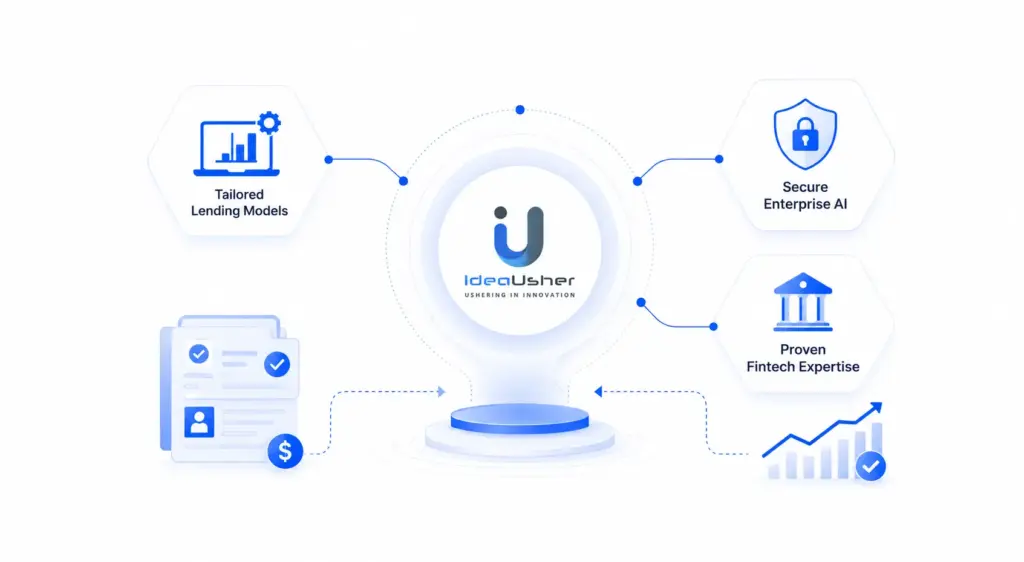
Launching a custom loan origination platform means balancing regulatory requirements with a seamless digital lending experience. At IdeaUsher, we build AI-powered origination systems that simplify borrower onboarding, automate document verification, and help lenders make faster, more accurate lending decisions.
Tailored Lending Models
We build AI-powered loan origination platforms around your lending model instead of relying on generic software. Whether you’re launching a consumer lending app, SME financing platform, mortgage solution, or BNPL product, we customize every workflow to match your operations, automate document verification and underwriting, and create a system that can scale as your business grows.
Secure Enterprise AI
Our team develops enterprise-grade lending platforms with intelligent document processing, fraud detection, explainable AI, automated compliance, and seamless integrations with LOS, core banking systems, payment gateways, eKYC providers, and credit bureaus. The architecture is designed to handle high application volumes while maintaining security, auditability, and regulatory compliance.
| System Layer | Core Technical Capabilities |
| Document Processing | AI-driven OCR for pay stubs, bank statements, and tax forms |
| Fraud Prevention | Pixel-level forensic analysis and biometric identity checks |
| Integrations | Pre-built API connections to credit bureaus, banking rails, and eKYC services |
Proven Fintech Expertise
IdeaUsher supports the complete product journey, guiding your team from discovery and MVP development to enterprise deployment, AI optimization, and continuous platform evolution. With over 500,000 hours of coding experience, our team of ex-MAANG/FAANG developers brings top-tier software architecture and fintech practices to every project.
- Discovery & Architecture Design: We map your risk criteria, credit policies, and compliance constraints into custom technical specs.
- Agile Build & API Integration: Developers construct modular microservices that connect directly to your core banking engines.
- Deployment & Continuous Optimization: We launch your platform on cloud infrastructure and continuously refine your AI models based on real-world portfolio performance.
Conclusion
AI is changing document verification from a slow manual task into a fast and reliable process. By automatically extracting, validating, and checking borrower information, lenders can reduce processing time, improve accuracy, and detect fraud earlier. As digital lending continues to grow, AI-powered document verification is becoming an essential capability for delivering faster loan approvals and a better borrower experience.
Things to Know About AI Loan Origination Solutions
A1: Not completely. AI is excellent at handling repetitive verification work, so it can review documents much faster than a human team. It extracts information, checks whether documents are genuine, and flags anything unusual. When an application looks suspicious or doesn’t meet internal policies, it is simply sent to an underwriter for review. This gives lenders the speed of automation without losing human oversight where it matters most.
A2: AI verification is much more than OCR. Instead of only reading the text on a document, it understands the document itself and checks whether the information makes sense. It can compare details across multiple files, identify missing or inconsistent data, and assign confidence scores to every verification. This helps lenders focus their attention only on applications that genuinely need manual review.
A3: Yes. Modern AI models are trained to spot signs that are easy for people to miss. They can identify edited PDFs, manipulated bank statements, fake IDs, altered salary slips, and even AI-generated documents by analyzing metadata, document structure, and visual inconsistencies. This gives lenders an additional layer of protection against increasingly sophisticated fraud.
A4: Yes. Most AI verification platforms are designed to work alongside your existing lending software rather than replace it. They can connect with Loan Origination Systems (LOS), eKYC providers, core banking platforms, credit bureaus, and underwriting tools through APIs. This allows lenders to automate document verification while keeping their current workflows largely unchanged.