


Key Takeaways
- European KYC faces challenges in meeting regulatory requirements, increasing demand for configurable KYC AML software.
- Businesses are transitioning from legacy compliance tools to AI-driven risk management platforms, with the regtech industry projected to grow at a CAGR of 15.3%.
- AI-powered compliance solutions are becoming essential for financial institutions to reduce costs and improve efficiency in KYC and AML processes.
- KYC/AML software development costs in Europe range from €45,000 to €450,000+, influenced by factors like compliance scope and technology integration.
- Investing in modern KYC/AML software helps businesses lower acquisition costs, eliminate false positives, and create agile compliance frameworks.
The real challenge in European KYC is no longer simply verifying who a customer is; it is demonstrating that every onboarding decision meets the specific regulatory requirements governing that customer. This shift is accelerating demand for a KYC AML software development company capable of building configurable compliance infrastructure for cross-border financial services.
Traditional KYC and AML systems relied on isolated verification tools and manual compliance reviews. Today, platforms combine AI-powered identity verification, biometric onboarding, sanctions and PEP screening, adverse media monitoring, transaction monitoring, risk scoring, ongoing due diligence, case management, eIDAS integration, GDPR compliance, AMLD requirements, FIU reporting, audit trails, and API-driven orchestration to streamline onboarding, strengthen fraud detection, and improve regulatory resilience across European markets.
In this blog, we will talk about what KYC/AML software development costs in Europe, the factors that influence your investment, key compliance features, technology decisions and how IdeaUsher can help you build an enterprise-grade KYC/AML compliance platform such as fintech, lending platforms, wealth management platform.
Why European Businesses Are Investing in Custom KYC/AML Software
The European businesses are phasing out legacy compliance methods. The regtech industry is expected to grow steadily over the forecast period, recording a CAGR of 15.3% during 2024-2029. The regtech in the country will increase from $3.73 billion in 2023 to reach $9.38 billion by 2029.
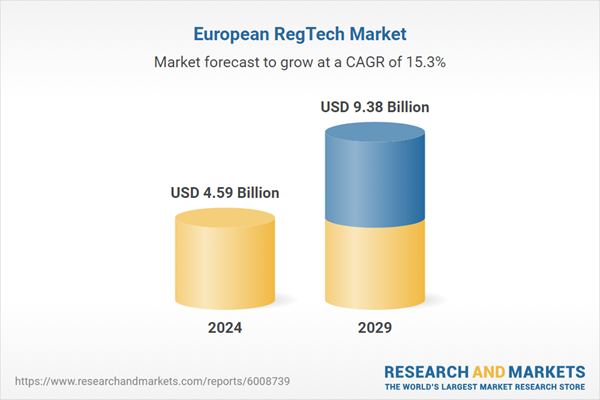
European firms are shifting from treating KYC and AML as back-office compliance functions to AI-driven risk management platforms that accelerate onboarding and strengthen regulatory resilience. This trend is reflected by 87% of organizations expecting higher KYC due diligence budgets and 90% reporting increased compliance requests in recent years.
A. Growing AML Regulations Across Europe
The primary catalyst accelerating software adoption across the European Union and the UK is the rapid transition from fragmented national frameworks to harmonized, strict regulatory enforcement.
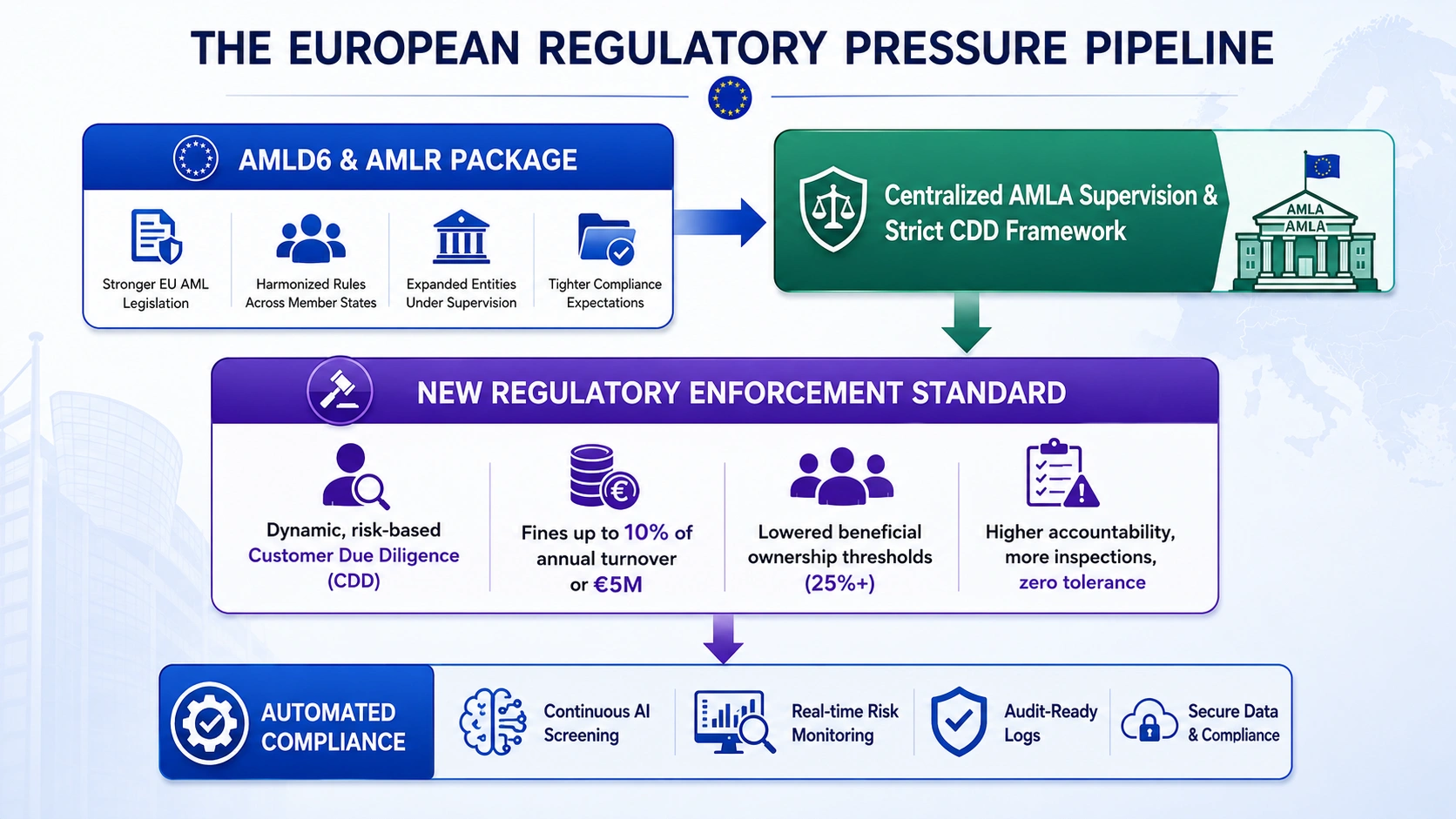
Several landmark regulatory initiatives are reshaping compliance expectations across Europe, requiring financial institutions to modernize KYC and AML capabilities accordingly.
- EU AML Package & Single Rulebook: The Anti-Money Laundering Regulation (AMLR) introduces a directly applicable Single Rulebook across all 27 EU Member States, standardizing CDD, UBO transparency, and reporting requirements.
- Launch of AMLA: Headquartered in Frankfurt, the Authority for Anti-Money Laundering and Countering the Financing of Terrorism (AMLA) directly supervises high-risk cross-border financial entities, eliminating regulatory arbitrage and inconsistent local enforcement.
- The Single Rulebook (AMLR & AMLD6): The 6th Anti-Money Laundering Directive (6AMLD) and Anti-Money Laundering Regulation (AMLR) extends criminal liability to legal entities and executives, making inadequate AML supervision a punishable offense for corporate leadership.
- Travel Rule Expansion for Crypto: Under MiCA and the revised Transfer of Funds Regulation (TFR), the FATF Travel Rule requires crypto firms to collect and share originator and beneficiary information for virtual asset transfers.
B. Rising Compliance Costs of Manual Verification
Relying on manual compliance teams to perform document checks, risk scoring, and PEP/sanctions screening is no longer economically sustainable for scaling European enterprises.
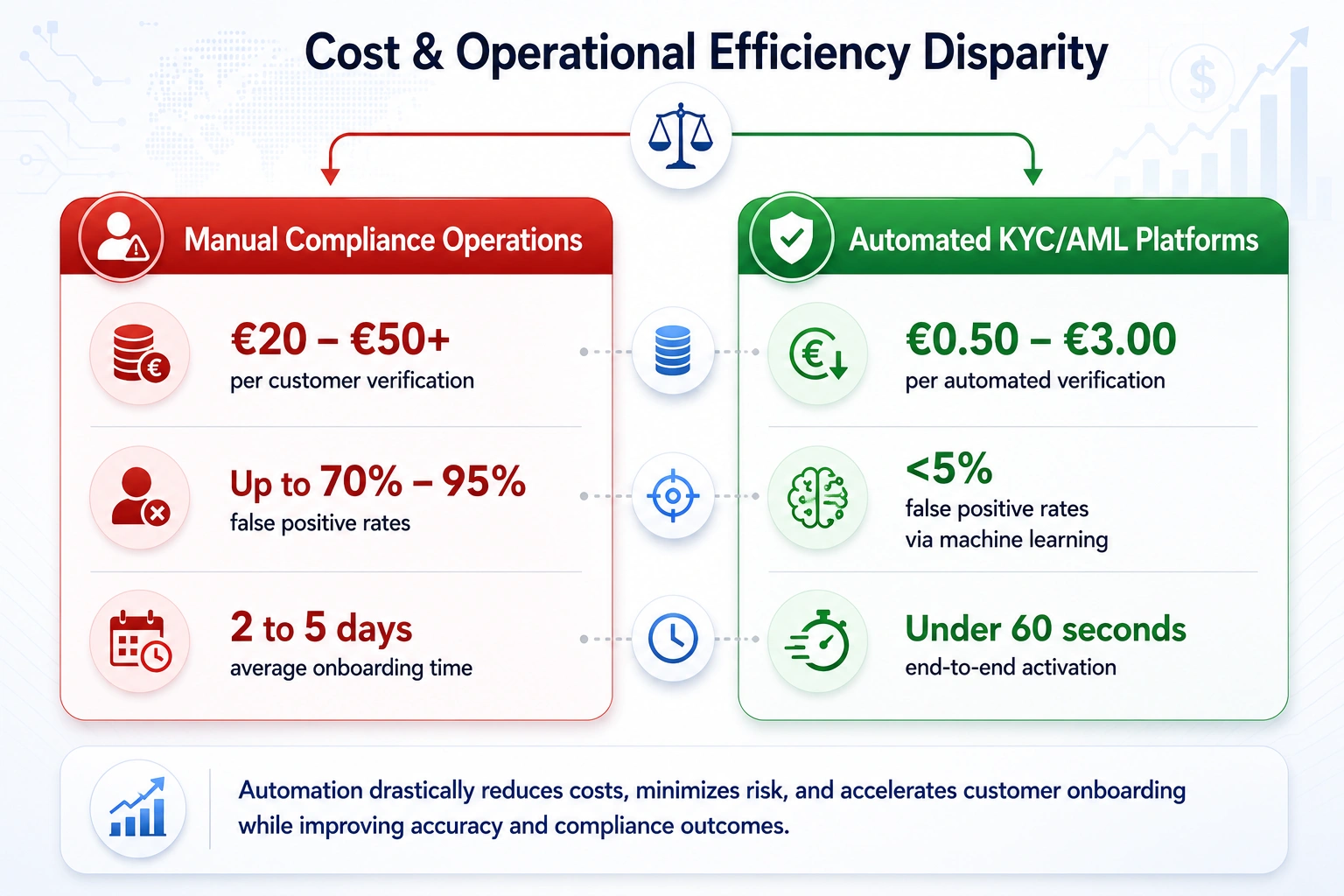
These inefficiencies compound across onboarding, monitoring, and customer conversion, creating significant financial pressure and operational friction for European financial institutions.
- High Operational Overhead: European financial institutions spend tens of billions of Euros annually on compliance headcount alone. Manual document review costs organizations between €20 and €50+ per onboarding case, severely impacting unit economics.
- The “False Positive” Drain: Legacy, rules-based transaction monitoring systems suffer from false-positive rates exceeding 80% to 90%. Human analysts waste hundreds of thousands of hours manually investigating benign transactions that trigger rigid, outdated system rules.
- Severe Drop-Off Rates: In a digital-first economy, customer patience is minimal. Complex, manual KYC checks cause up to 40% to 68% of European digital banking applicants to abandon onboarding before completing their application.
C. AI-Powered Compliance Becoming the New Standard
Modern KYC/AML platforms utilize artificial intelligence and machine learning to replace static, point-in-time checks with dynamic risk engine architectures:
| AI Compliance Vector | Traditional Manual Framework | AI-Powered Platform Architecture | Commercial Business Value |
| Document & Liveness Check | Manual optical inspection of physical IDs. | Biometric liveness detection and deepfake/document spoofing analysis. | Prevents synthetic identity fraud instantly with <30-second user flow. |
| Sanctions & PEP Screening | Daily or weekly static database exports. | Real-time API screening against global PEP, sanctions, and adverse media feeds. | Ensures instant compliance during sanctions shifts and geopolitical events. |
| Transaction Monitoring | Static rule triggers (e.g., flag any transfer > €10,000). | Behavioral anomaly detection evaluating historical velocity and network graphs. | Cuts false positives by 70–85%, freeing compliance teams for high-risk cases. |
| Continuous Risk Scoring | Periodic reviews conducted every 1 to 5 years. | Dynamic risk recalculation triggered by real-time data or status changes. | Fully aligns with AMLD6/AMLA risk-based mandates automatically. |
D. Industries Investing in KYC/AML Platforms
While banks were historically the primary consumers of compliance technology, regulatory expansion (including the EU’s MiCA framework for crypto and extended AML mandates) has made automated verification essential across diverse digital sectors:
| Industry Sector | Primary Compliance Driver | Key Software Capability Required |
| Fintech | Fast scaling across EU borders while maintaining low unit economics. | Automated friction-free onboarding & international ID coverage. |
| Digital Banks | Regulatory audits, anti-mule account detection, and high applicant volume. | Real-time biometric liveness checks & continuous risk scoring. |
| Crypto Exchanges | Strict MiCA compliance, Travel Rule enforcement, and cross-border transfers. | On-chain wallet analytics, blockchain screening, and VASP-to-VASP data exchange. |
| Lending Platforms | Anti-fraud verification, synthetic identity detection, and credit-loss prevention. | Instant KYB corporate verification & bank account ownership verification. |
| Insurance | Fraudulent claims prevention, anti-money laundering in life insurance policies. | Sanctions/PEP screening & suspicious activity report (SAR) auto-generation. |
| Payment Providers | Merchant onboarding (KYB), high transaction volumes, multi-currency flows. | High-throughput API transaction monitoring & chargeback prevention. |
| Wealth Management | Strict Source of Funds (SoF) & Source of Wealth (SoW) validation for high-net-worth clients. | Deep UBO registry mapping & enhanced due diligence (EDD) workflows. |
The Enterprise Takeaway: Investing in modern KYC/AML software is no longer just about avoiding regulatory fines under AMLD6. By replacing slow, costly manual reviews with AI-driven verification engines, European businesses lower acquisition costs, eliminate false positives, and build an agile compliance infrastructure capable of expanding across borders.
What Does KYC/AML Software Development Cost in Europe?
Building a custom Know Your Customer (KYC) and Anti-Money Laundering (AML) platform in Europe typically ranges from €45,000 to €450,000+, depending on the platform’s architectural complexity, functional scope, integration depth, and regulatory requirements (such as EU 5AMLD/6AMLD, GDPR, and MiCA).
Software development rates across Europe vary by region: Eastern European hubs (Poland, Romania, Ukraine) average €40–€65/hour, Central Europe (Czech Republic, Baltics) averages €50–€85/hour, while Western and Northern European software firms (Germany, UK, Netherlands) charge €90–€150+/hour.
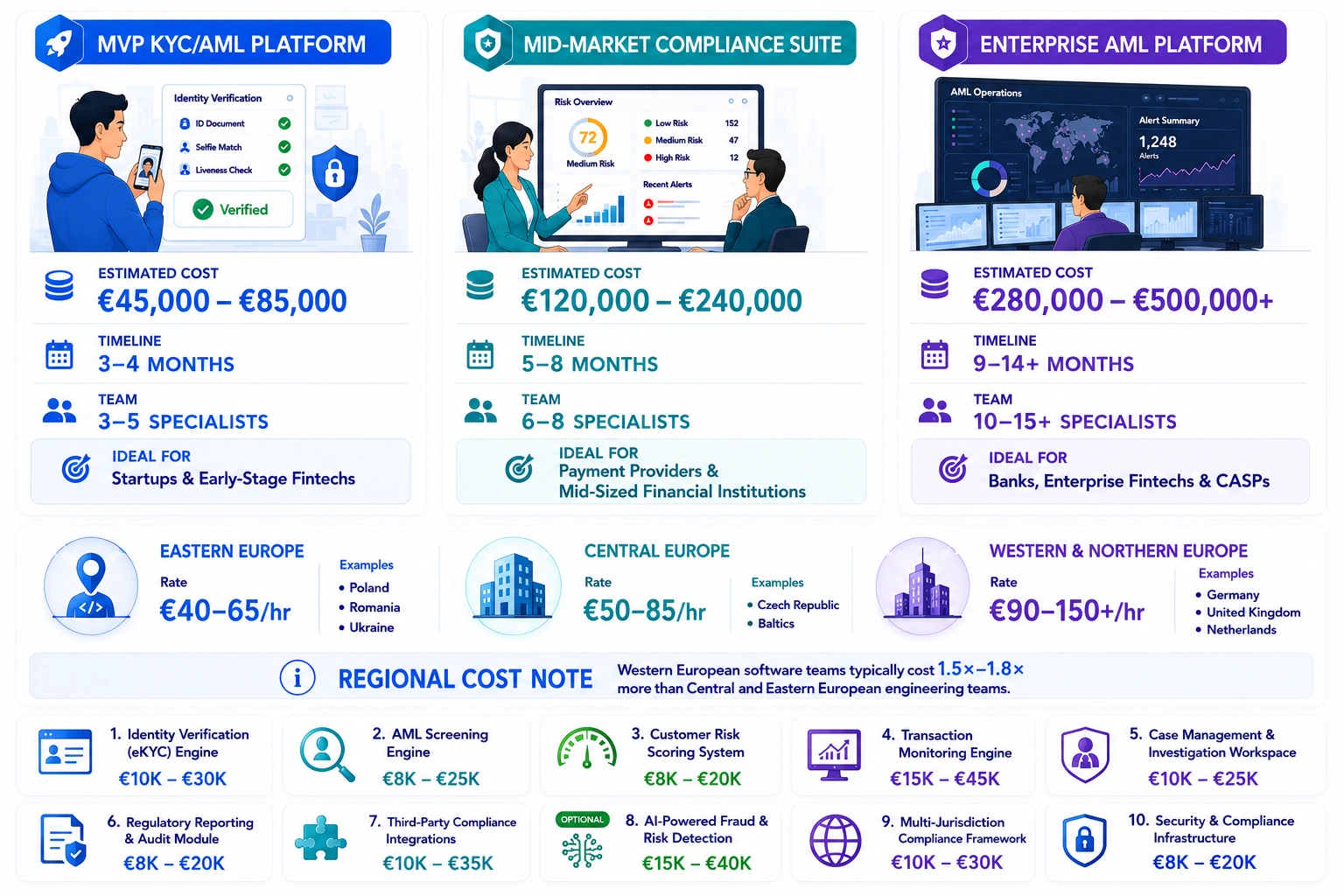
To provide precise budgetary expectations for fintechs, neobanks, payment institutions, and crypto asset service providers (CASPs), the cost structure is categorized into three distinct product tiers: MVP Platform, Mid-Market Compliance Suite, and Enterprise AML Platform.
A. MVP KYC/AML Software Cost
A Minimum Viable Product (MVP) is tailored for early-stage fintech startups or small regulated entities needing fast, compliant customer onboarding and basic background verification without heavy custom automation.
Estimated Cost Range: €45,000 – €85,000 (Central/Eastern Europe) | €70,000 – €110,000 (Western Europe)
Development Timeline: 3 – 4 Months
Core Team: 1 PM, 2 Full-Stack Developers, 1 QA Engineer, UI/UX Designer.
- Basic Onboarding: Responsive digital registration forms with web and mobile document capture, user consent management for GDPR compliance, and basic account creation workflows.
- Identity Verification (IDV): Integration with third-party verification APIs (e.g., Sumsub, Onfido, or Jumio) for automated government-issued ID checks, selfie comparison, and basic liveness detection.
- Sanctions Screening: Automated initial check of customer names against international sanctions databases (UN, EU, OFAC, UK HMT) using third-party data providers.
- Admin Dashboard: Centralized interface for compliance officers to view applicant status, manually approve or reject flagged profiles, and upload supplementary documents.
- Simple Reporting: Standard data export (CSV/PDF) summarizing onboarding volumes, pass/fail ratios, and pending verification queues for internal oversight.
B. Mid-Market Compliance Platform Cost
Designed for growing payment providers, digital brokers, and mid-sized financial institutions requiring automated risk management, deeper document analysis, and granular operational controls.
Estimated Cost Range: €120,000 – €240,000 (Central/Eastern Europe) | €180,000 – €320,000 (Western Europe)
Development Timeline: 5 – 8 Months
Core Team: 1 PM, 1 Tech Lead, 3 Senior Developers, 1 DevOps Engineer, 1 QA Lead, 1 UI/UX Designer.
- Risk Scoring Engine: Dynamic customer risk rating models (Low, Medium, High) based on nationality, residency, product type, transaction volumes, and political exposure.
- Document OCR & MRZ Parsing: Advanced Optical Character Recognition (OCR) and Machine Readable Zone (MRZ) extraction for automated identity data intake and document fraud detection.
- PEP & Adverse Media Screening: Real-time and scheduled screening against Politically Exposed Persons (PEP) registries, watchlists, and global negative news/adverse media databases.
- Workflow Automation: Configurable decision rules and conditional routing (e.g., auto-approving low-risk profiles while triggering Enhanced Due Diligence (EDD) for high-risk profiles).
- Multi-User Roles & RBAC: Granular Role-Based Access Control allowing compliance managers, analysts, and auditors distinct access permissions.
- Comprehensive Audit Logs: Immutable timestamped logging of every automated action, analyst decision, and profile modification required for regulatory audits.
C. Enterprise AML Compliance Platform Cost
A high-capacity, enterprise-grade architecture built by a KYC AML software development company for retail banks, multinational fintechs, and tier-1 institutions managing high transaction volumes and complex multi-jurisdictional compliance frameworks.
Estimated Cost Range: €280,000 – €500,000+ (Central/Eastern Europe) | €450,000 – €850,000+ (Western Europe)
Development Timeline: 9 – 14+ Months
Core Team: 1 Solution Architect, 1 Project Manager, 5–8 Senior Developers, 1 Data/ML Engineer, 2 DevOps/Security Engineers, 2 QA Specialists.
- Transaction Monitoring: Real-time rule evaluation engine tracking incoming/outgoing payments against velocity thresholds, structuring patterns, and unusual behavioral baselines.
- AI/ML Fraud Detection: Machine learning models detecting complex money laundering schemes, mule networks, and anomaly patterns with low false-positive rates.
- Case Management Suite: Comprehensive investigation workspace with timeline visualization, suspicious activity report (SAR/STR) auto-generation, and team workload allocation.
- Continuous Monitoring & Re-Screening: Automated daily re-screening of active customer databases against updated sanctions, PEP lists, and law enforcement watchlists.
- Multi-Country Regulatory Compliance: Localization for diverse jurisdictional rules across EU member states (BaFin, ACPR, FINMA, FCA), handling localized data residency (GDPR).
- API Ecosystem & Core Banking Integration: Robust REST/gRPC API ecosystem seamlessly linking with legacy core banking systems (Temenos, Mambu, Thought Machine) and payment gateways.
- Advanced Analytics & Regulatory Reporting: Business intelligence dashboards and automated regulatory reporting feeds directly formatted for national Financial Intelligence Units (FIUs).
D. Estimated Development Timeline by Project Size
Mid-market compliance platforms balance automation, scalability, and regulatory control, enabling financial institutions to streamline onboarding, enhance risk management, and maintain efficient AML operations across Europe.
The table below provides a side-by-side comparison of development timelines, team configurations, and cost ranges across project scopes in Europe.
| PRODUCT TYPE | DEVELOPMENT TIMELINE | TEAM SIZE & COMPOSITION | ESTIMATED COST RANGE (EUR) |
| MVP KYC/AML Software | 3 – 4 Months | 3 – 5 Specialists (1 PM, 2 Devs, 1 QA, 1 UI/UX) | €45,000 – €85,000 |
| Mid-Market Compliance Suite | 5 – 8 Months | 6 – 8 Specialists (1 PM, 1 Tech Lead, 3 Devs, 1 DevOps, 1 QA, 1 Designer) | €120,000 – €240,000 |
| Enterprise AML Platform | 9 – 14+ Months | 10 – 15+ Specialists (Arch, 6+ Devs, ML Eng, SecOps, 2 QA, PM) | €280,000 – €500,000+ |
Regional Cost Variation Note: Estimates reflect Eastern & Central European engineering rates (€45–€70/hr). For Western European or Nordic development teams (€95–€140/hr), apply a multiplier of 1.5x to 1.8x.
E. Development Cost Breakdown by KYC/AML Module
The cost of KYC/AML software depends on required compliance features. Advanced verification, real-time risk analysis, regulatory reporting, and third-party integrations increase technical complexity, with each module directly raising overall development costs.
The table below provides an estimated cost range for the core compliance modules typically included in a modern KYC/AML platform built for the European market.
| Compliance Module | Estimated Development Cost (EUR) | Why It Impacts Development Cost |
| Identity Verification (eKYC) Engine | €10,000–€30,000 | Requires OCR, biometrics, liveness checks, and secure onboarding workflows. |
| AML Screening Engine | €8,000–€25,000 | Integrates sanctions lists, PEP data, watchlists, and real-time screening logic. |
| Customer Risk Scoring System | €8,000–€20,000 | Builds risk models, behavioral rules, and configurable compliance scoring logic. |
| Transaction Monitoring Engine | €15,000–€45,000 | Implements real-time monitoring, anomaly detection, and complex rule-based analysis. |
| Case Management & Investigation Workspace | €10,000–€25,000 | Supports alert handling, investigation workflows, and full audit documentation. |
| Regulatory Reporting & Audit Module | €8,000–€20,000 | Generates SAR/STR reports, audit logs, and regulatory submission formats. |
| Third-Party Compliance Integrations | €10,000–€35,000 | Requires API integrations, external data providers, and secure data exchange layers. |
| AI-Powered Fraud & Risk Detection (Optional) | €15,000–€40,000 | Uses machine learning models, fraud detection, and adaptive risk scoring systems. |
| Multi-Jurisdiction Compliance Framework | €10,000–€30,000 | Handles regional regulations, rule customization, and cross-border compliance logic. |
| Security & Compliance Infrastructure | €8,000–€20,000 | Implements encryption, access control, GDPR compliance, and secure system architecture. |
The final cost depends on selected modules. Single-country fintechs need basic KYC, AML, and risk scoring, while cross-border banks require advanced monitoring, AI fraud detection, reporting, and integrations, increasing costs.
Many companies reduce initial spend by starting with a compliance MVP covering core KYC and AML features. Additional capabilities like AI fraud & risk analytics, cross-border compliance, and advanced case management can be added later as the platform scales.
What Factors Influence KYC/AML Software Development Costs?
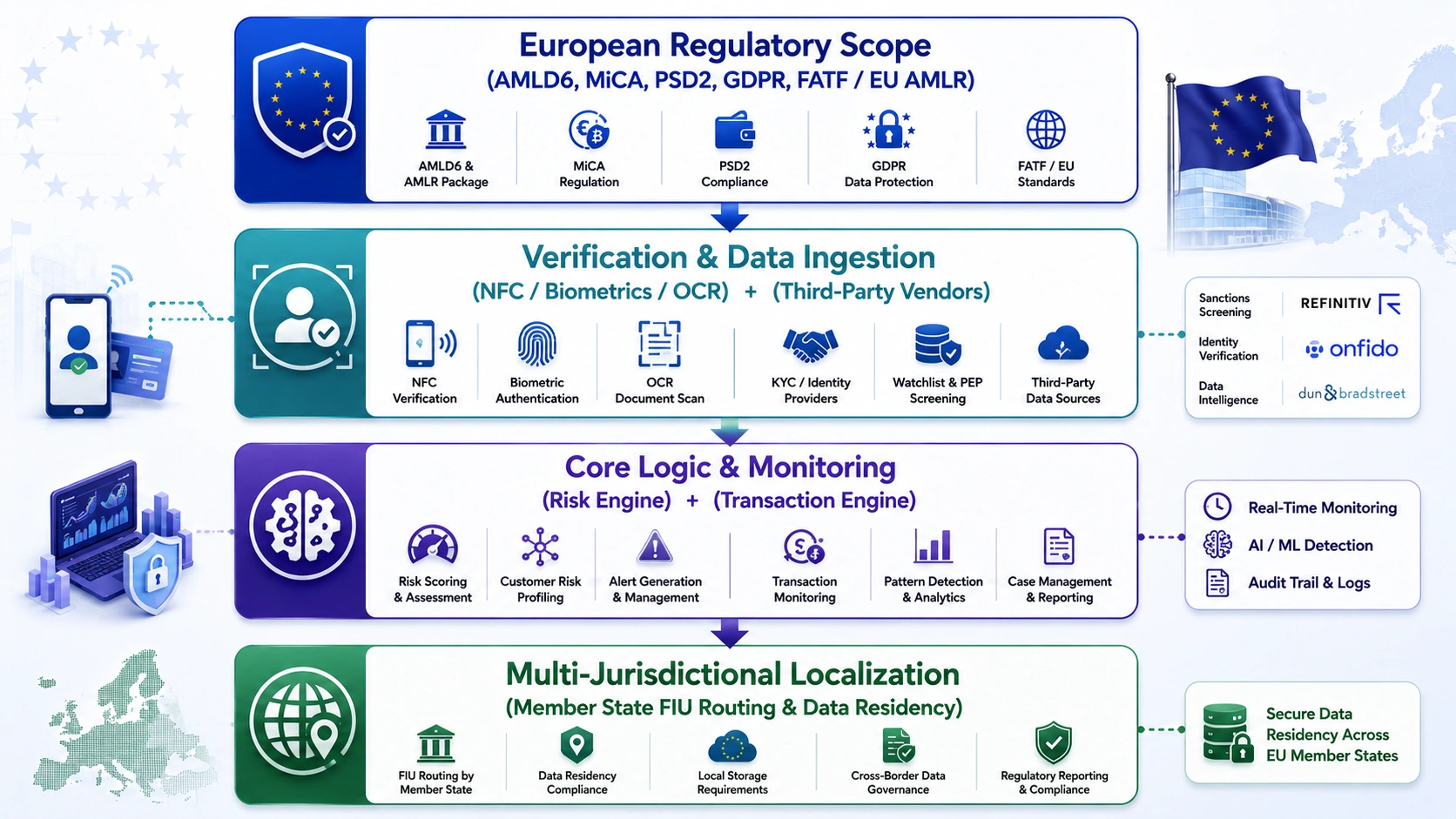
The total investment required for custom KYC/AML software depends heavily on regulatory requirements, data integration depth, algorithmic sophistication, and user verification workflows. A KYC AML software development company helps manage these variables, with costs scaling dynamically based on the complexity of six critical technical layers.
1. Compliance Scope You Need to Support
The breadth of regulatory directives your system must support directly dictates software architecture, audit trail retention, and data encryption design.
- AMLD6 (6th Anti-Money Laundering Directive / EU AMLR): Requires expanded corporate liability, UBO tracing (25% threshold), FIU cooperation, and 5–10-year immutable audit logs. Implementing compliant data models and automated reporting typically adds €15,000–€35,000.
- MiCA (Markets in Crypto-Assets): Requires Transfer of Funds Rule (TFR) compliance, KYT integrations, unhosted wallet verification, and real-time ledger monitoring for Crypto-Asset Service Providers (CASPs), adding €20,000–€40,000 in blockchain development.
- PSD2 / PSD3: Mandates Strong Customer Authentication (SCA) with dynamic transaction linking. Integrating step-up authentication workflows typically adds €10,000–€20,000.
- GDPR: Requires Right to be Forgotten, data minimization, zero-knowledge proofs (ZKP), and PII encryption. Building consent management, automated data deletion, and field-level encryption generally costs €12,000–€25,000.
- FATF Recommendations: Implementing Travel Rule compliance, peer-to-peer transaction monitoring, and jurisdiction-based risk scoring establishes the foundation for global AML compliance.
2. Identity Verification Complexity
The engineering effort behind front-end and biometric onboarding varies with identity proofing complexity, making a KYC AML software development company key to designing scalable verification workflows.
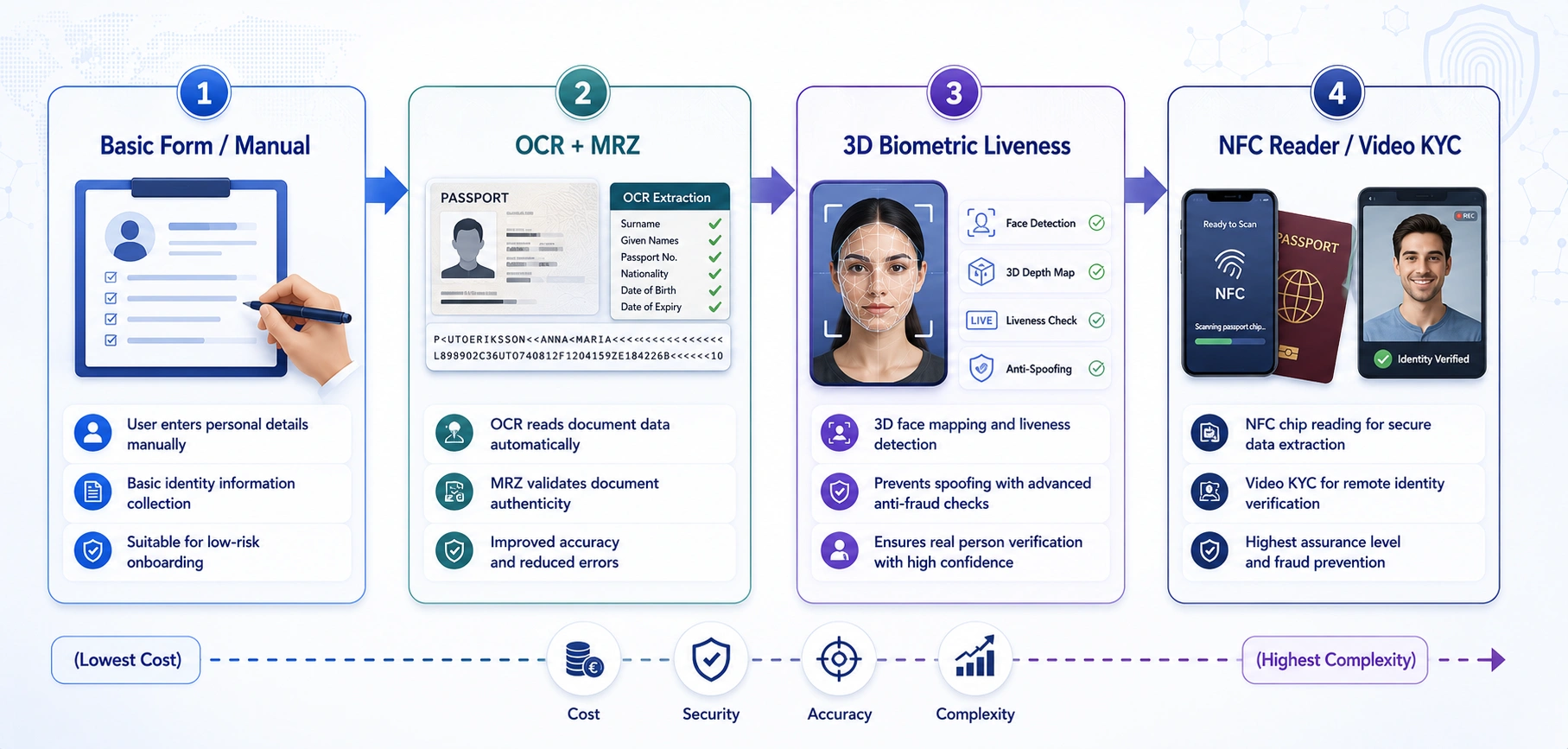
These requirements introduce varying levels of technical complexity, with each identity verification layer adding distinct development effort, infrastructure needs, and compliance considerations.
- OCR & MRZ Parsing: Extracts and validates identity data from passports, IDs, and driver’s licenses using OCR and MRZ scanning via SDKs like Microblink or Regula, typically costs €8,000–€15,000.
- NFC Passport Reading: Reads encrypted e-passport chip data with ICAO 9303 compliance, supporting Passive/Active Authentication and PKD certificate validation with costs typically €15,000–€28,000 due to cryptographic complexity.
- Face Verification & Liveness Detection: Matches user selfies with ID photos while detecting photos, masks, and deepfakes using 1:1 biometric matching and passive/active liveness, typically costs €12,000–€22,000.
- Video KYC (Agent-Assisted or AI): Enables secure WebRTC identity verification with video recording, snapshot capture, agent routing, regulatory compliance (e.g., BaFin) and typically ranges €30,000–€60,000+, depending on infrastructure and compliance requirements
3. Risk Engine Sophistication
The risk scoring engine determines how incoming applicant profiles are processed, auto-approved, or flagged for manual compliance review.
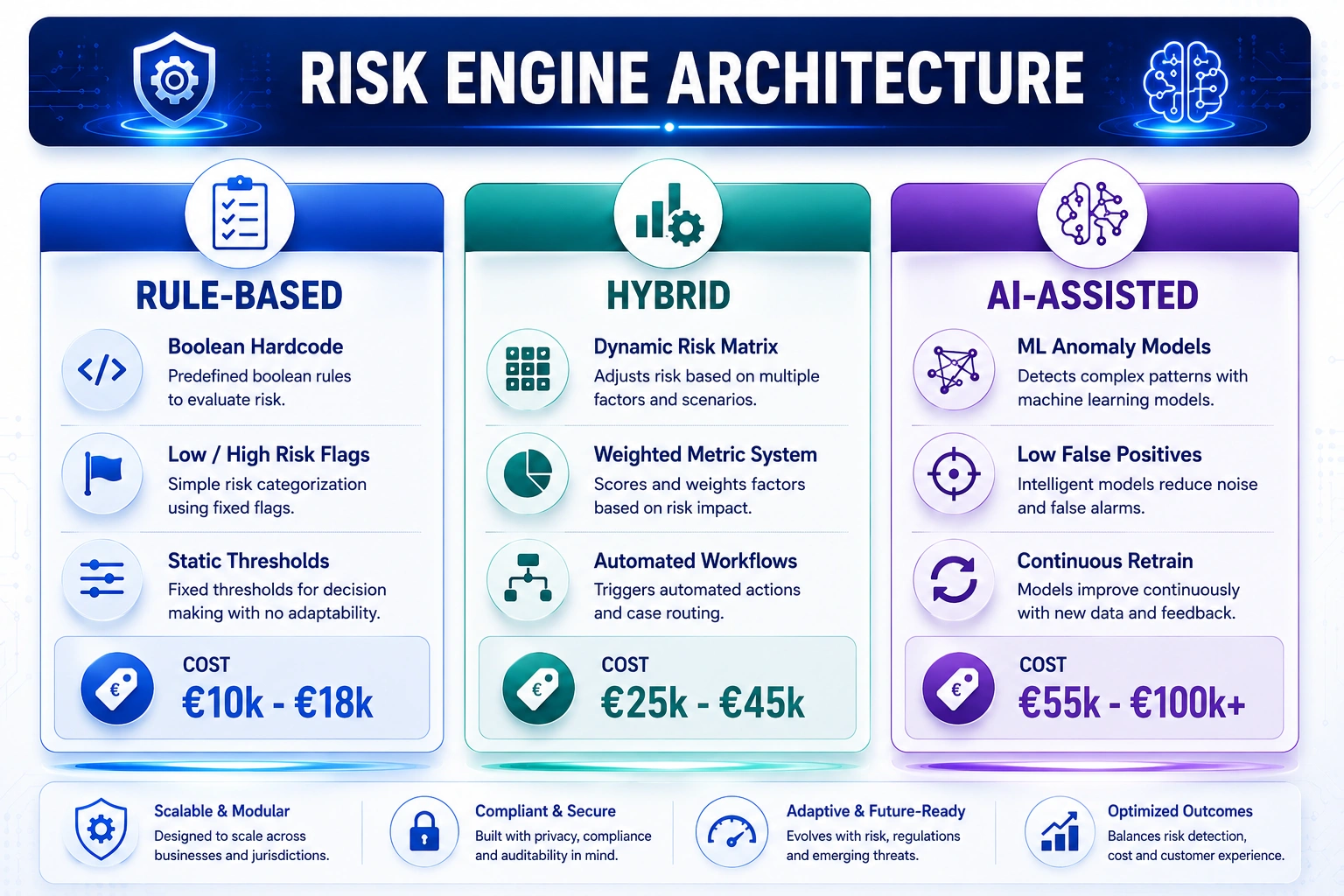
The level of sophistication directly impacts development costs, operational efficiency, false-positive rates, and manual compliance intervention, making a KYC AML software development company crucial for building efficient, scalable solutions.
- Rule-Based Engine: Uses static Boolean logic (e.g., If Country = High Risk THEN Flag). Simple to build but produces high false-positive rates that increase ongoing compliance officer headcount costs. Cost: €10,000 – €18,000.
- Hybrid Dynamic Engine: Features a configurable GUI rule builder allowing compliance managers to weigh dozens of risk factors (geography, politically exposed status, transaction intent, business structure) without developer intervention. Cost: €25,000 – €45,000.
- AI-Assisted Risk Scoring: Utilizes machine learning classification models trained on historical customer datasets to identify non-linear risk factors and continuously reduce false positives. Cost: €55,000 – €100,000+.
4. Transaction Monitoring Requirements
Post-onboarding ongoing monitoring requires processing continuous streams of financial data to detect money laundering attempts in progress.
- Real-Time Monitoring: Screens payment events against velocity thresholds and fund movement rules in <200 ms using high-throughput streaming platforms like Apache Kafka, Redis, or RabbitMQ. Development typically costs €35,000–€70,000.
- Batch Monitoring: Runs scheduled scans of historical transaction data to detect recurring low-value transfers, cumulative threshold breaches, and suspicious patterns. Development typically costs €15,000–€28,000.
- Behavioral Analytics: Establishes baseline customer behavior models to flag anomalies, such as unusually large transactions that deviate from normal account activity. Development typically costs €30,000–€55,000.
- Suspicious Activity & Case Management: Provides entity graphs, alert queues, and automated FIU Suspicious Activity Report (SAR) generation for AML investigations. Development typically costs €25,000–€45,000.
5. Multi-Country Regulatory Support
Expanding across European borders impacts system architecture due to regional fragmentation within EU directives, making a KYC AML software development company essential for building scalable, compliant systems across markets.
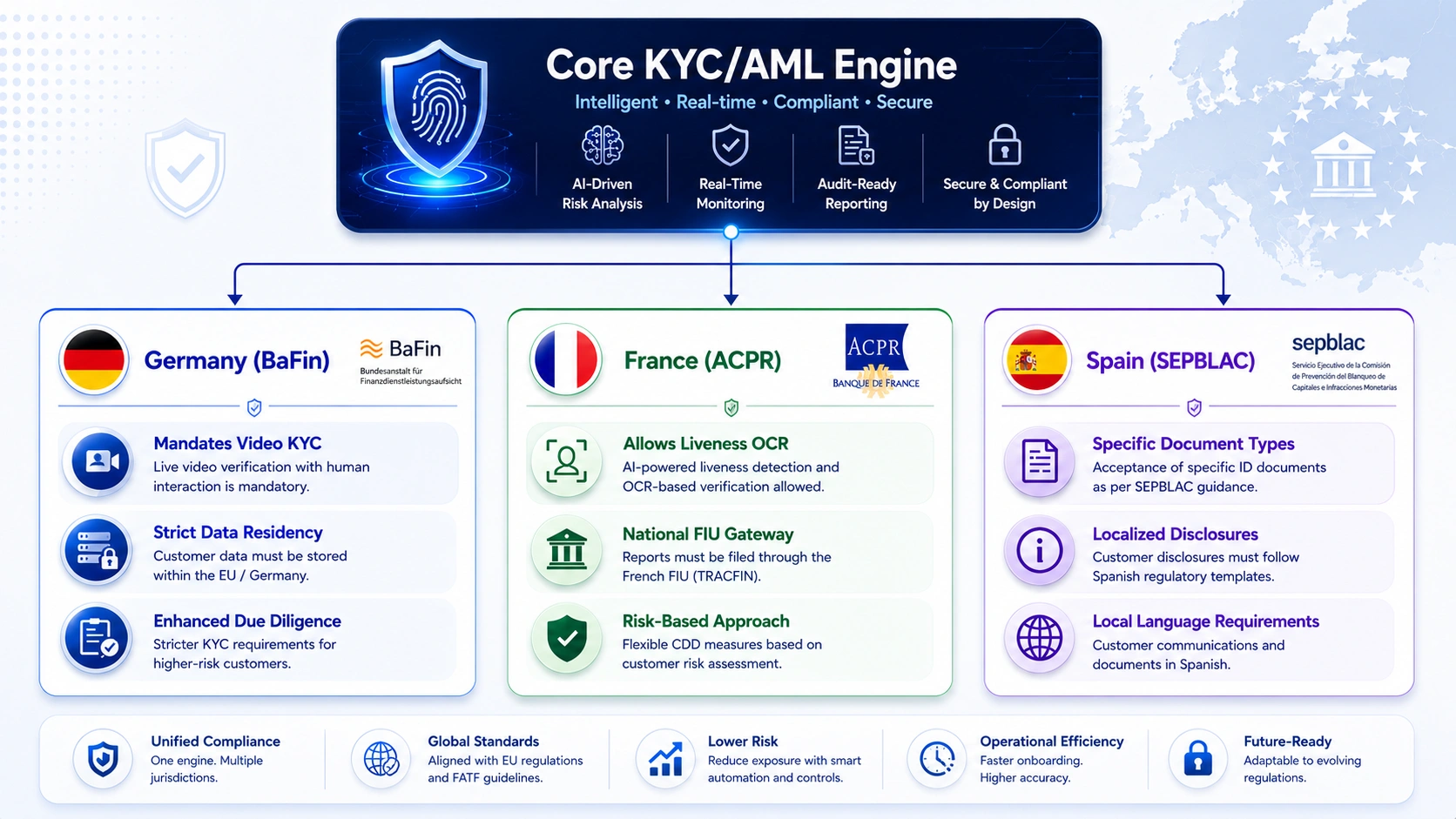
While AML directives provide an overall blueprint, individual national competent authorities (NCAs) enforce unique national transpositions:
- Diverse Verification Standards: Compliance workflows vary by regulator. Germany’s BaFin requires live video verification for many financial onboarding flows, while France’s ACPR and Spain’s SEPBLAC permit AI-based biometric verification under defined security levels, requiring region-specific onboarding logic.
- Local FIU Reporting Connectors: Automated suspicious transaction reporting requires connecting to localized country-specific FIU portals (e.g., goAML in Austria/Germany/Netherlands, SAR in the UK). Distinct XML schemas and encryption formats add €8,000 – €15,000 per additional national connector.
- Data Sovereignty & Localized Storage: Some jurisdictions require local cloud hosting or regional database deployments to satisfy GDPR data sovereignty requirements, increasing multi-region AWS/Azure infrastructure complexity.
Adding multi-country operational capabilities across 3+ European nations typically increases core software development costs by 30% to 50%.
Third-Party Integrations That Impact Development Cost
Modern KYC/AML platforms depend on third-party services for identity verification, compliance screening, payment validation, and regulatory reporting. Each integration adds API development, authentication, data mapping, error handling, and maintenance, making integrations a major driver of overall development cost significantly higher.
| Integration Category | Popular Providers | Estimated Cost Impact | Primary Purpose |
| Identity Verification Providers | Sumsub, Onfido, Persona, Trulioo, Veriff | €8,000–€25,000 | Verify customer identity using OCR, biometrics, liveness detection, and document authentication. |
| Banking & Open Banking APIs | Plaid, Tink, Yapily, TrueLayer, Salt Edge | €8,000–€20,000 | Access customer banking data for account verification, ownership validation, and transaction analysis. |
| AML Screening Databases | ComplyAdvantage, Dow Jones, Refinitiv World-Check, LexisNexis | €10,000–€30,000 | Screen customers against sanctions lists, PEP databases, watchlists, and adverse media sources. |
| Payment Processors | Stripe, Adyen, Checkout.com, Worldpay | €5,000–€15,000 | Validate payment methods, monitor payment activity, and support transaction-based AML monitoring. |
| Government Identity Registries | National eID systems, eIDAS-compatible services, Business Registers | €10,000–€30,000 | Cross-check official identity records and support jurisdiction-specific verification requirements. |
| CRM & Core Banking Systems | Salesforce, HubSpot, Temenos, Mambu, Finastra | €8,000–€20,000 | Synchronize customer profiles, onboarding status, compliance decisions, and account lifecycle data. |
| Document Management Platforms | SharePoint, Box, DocuWare, OpenText | €5,000–€15,000 | Securely store, retrieve, version, and manage compliance documents, audit evidence, and customer records. |
Note: These estimates represent integration development costs and exclude recurring subscription fees or usage-based pricing charged by third-party providers. Projects requiring multiple integrations with intelligent routing, fallback logic, and centralized orchestration will typically incur higher implementation costs.
Why Businesses Choose IdeaUsher for KYC/AML Software Development
European financial institutions, fintechs, and regulated entities navigate one of the world’s most stringent compliance environments. IdeaUsher serves as an KYC AML software development company, backing global compliance transformations with 11+ years of software expertise across 50+ countries. Supported by 250+ dedicated engineers, a portfolio of 1,000+ custom builds and a top-tier 4.9/5 Clutch rating, we design custom KYC and AML software that replaces manual friction with high-precision, automated risk infrastructure.
A. Experience Building Regulated Financial Software
Navigating European financial frameworks requires architectural precision rather than generic, off-the-shelf software modules.
- Multi-Jurisdiction Compliance Mapping: We build compliance layers aligned with AMLD6, MiCA, and regional regulations including BaFin, ACPR, and the FCA.
- Risk-Based Customer Due Diligence (CDD/EDD): Our engineers develop configurable rules engines that automate customer risk scoring and trigger Enhanced Due Diligence (EDD) for PEPs and high-risk entities.
- Automated Audit Logging & Regulatory Reporting: We implement immutable audit logs and automated reporting workflows, enabling tamper-proof activity tracking, regulatory audits, and Suspicious Activity Report (SAR) submissions.
B. End-to-End KYC & Identity Verification Development
We build full-stack compliance pipelines that keep user onboarding swift while maintaining rigorous screening standards.
- Biometric & Liveness Verification Pipelines: We build OCR, facial recognition, and active liveness detection modules to verify identities and prevent spoofing and fraud during user onboarding.
- Real-Time Transaction Monitoring Engines: Our engineers develop high-throughput monitoring engines that continuously analyze transaction flows, detecting risk patterns, structural anomalies, and velocity shifts in real time.
- Automated PEP, Sanctions & Adverse Media Screening: We integrate continuous screening against PEP databases, global sanctions lists, watchlists, and adverse media to automate compliance and risk detection.
C. Expertise Integrating Leading Compliance Providers
Building custom software does not mean reinventing verified compliance databases, it means orchestrating them into a unified engine.
- Unified Compliance API Aggregation: We build API gateway architectures that integrate providers such as Sumsub, Onfido, ComplyAdvantage, and Trulioo into a unified compliance dashboard.
- Fallback & Multi-Vendor Routing Logic: Our developers implement dynamic routing that automatically switches to secondary verification providers during downtime or low match rates across EU regions.
- Legacy Core Banking Data Bridges: We develop secure middleware connectors that synchronize real-time KYC/AML verification status with core banking, CRM, and transaction systems without disrupting existing workflows.
D. Secure & GDPR-Compliant Architecture
Data privacy and system performance must coexist to ensure both regulatory compliance and software reliability.
- GDPR-Compliant Data Architecture: We build data architectures with data minimization, role-based access control (RBAC), and automated Right to be Forgotten workflows while preserving relational data integrity.
- Encrypted Isolated Runtime Environments: We secure identity documents and financial data using AES-256 encryption at rest, TLS 1.3 in transit, and containerized cloud infrastructure.
- Scalable Microservices Topology: We develop cloud-native microservices that efficiently handle seasonal onboarding spikes and high transaction volumes without performance degradation.
E. Dedicated KYC/AML Development Teams
We as expert KYC AML software development company, combine deep domain understanding with specialized engineering teams to accelerate production timelines.
- Pre-Audited Modular Frameworks: We use pre-tested compliance modules to accelerate backend development while maintaining enterprise-grade security and regulatory standards.
- Cross-Functional Agile Squads: Our product managers, backend engineers, and security specialists work closely with your compliance teams to deliver features through rapid development sprints.
- Zero Vendor Lock-In Delivery: We provide clean, fully documented, and auditable source code, ensuring complete platform ownership and long-term technology independence.
Planning to build or modernize your KYC/AML compliance engine? Contact Idea Usher’s financial software engineers to discuss your target markets, operational goals, and platform vision for a tailored development roadmap and cost estimate.
Conclusion
Every KYC/AML software project follows a different investment path because regulatory obligations, integration requirements, and platform capabilities vary across industries and European markets. A clear understanding of these cost drivers helps businesses allocate budgets wisely while avoiding expensive compliance gaps later. Whether your goal is MVP for a fintech startup or an enterprise-grade compliance platform, partnering with an experienced KYC AML software development company can simplify your journey. At IdeaUsher, help businesses design secure, scalable, regulation-ready KYC/AML solutions tailored to operational and compliance objectives.
FAQs
A.1. The cost to build KYC/AML software in Europe typically ranges from €50,000 to €300,000+, depending on complexity and part of Europe. Factors like compliance requirements, identity verification, AML screening, transaction monitoring, and third-party integrations significantly influence the final development cost.
A.2. Yes. Many businesses launch with essential KYC, AML screening, and customer risk assessment features before expanding into advanced transaction monitoring, AI-powered fraud detection, and multi-jurisdiction compliance capabilities.
A.3. Each integration requires API development, authentication, data mapping, error handling, testing, and long-term maintenance. Multiple providers also demand orchestration logic, increasing both engineering effort and overall project cost.
A.4. Digital banks, fintech companies, crypto platforms, payment providers, lending businesses, wealth management firms, and insurance companies benefit from custom KYC/AML software tailored to their regulatory obligations and operational workflows.