

| Key takeaways: AI adoption has hit 88% of organizations, but only a third have moved past pilots. Agentic AI, multimodal AI, and small language models are the trends actually driving budget in 2026. The businesses winning aren’t the ones chasing every trend — they’re the ones picking two or three and executing well. |
Here’s the uncomfortable truth about most “AI trends” articles: they list fourteen buzzwords, wish you luck, and move on. That’s not particularly useful if you’re the one who has to decide where to actually spend budget this year.
This guide takes a different approach. We’ll walk through the AI trends that are genuinely changing how businesses operate in 2026, back each one with real data, and then get specific about what it means for your roadmap. No filler, no hype for hype’s sake.
We put this together because we build AI products for a living. IdeaUsher’s engineering teams have shipped AI and app development work for startups and Fortune 500 companies alike, and we see which trends translate into real products versus which ones stay stuck in slide decks. Let’s get into it.
AI Adoption in 2026: The Numbers Business Leaders Can’t Ignore
Adoption numbers tell you where the herd is moving. According to McKinsey’s State of AI research, 88% of organizations now use AI regularly in at least one business function, up from 78% the year before and just 55% two years earlier. That’s not a slow creep — that’s a curve going almost vertical.
AI adoption among organizations has climbed from 55% in 2023 to 88% in 2025. Source: McKinsey, The State of AI.
But adoption isn’t the same as impact, and this is the part most trend round-ups skip. McKinsey’s same research found that roughly two-thirds of companies are still stuck in what researchers call “pilot purgatory” — running AI experiments that never make it to production. Only about a third have scaled AI at the enterprise level, and just 5.5% qualify as “AI high performers” seeing more than 5% EBIT impact from their AI investments.
The gap matters more than the headline. If you’re evaluating AI trends for your own business, the real question isn’t “is everyone doing this?” It’s “who’s actually getting value from it, and what did they do differently?”
Budgets tell the same story from a different angle. Industry surveys of enterprise leaders found that 88% of executives now plan to increase their AI budgets specifically because of agentic AI initiatives, and year-over-year AI spending is projected to grow by roughly 32% between 2025 and 2029. Money is moving toward execution, not just experimentation.
Where is that value actually showing up today? Forbes Advisor’s survey of business owners found the heaviest AI usage clustered in a handful of functions.
Customer service, cybersecurity, and virtual assistants top the list of where businesses are deploying AI today. Source: Forbes Advisor.
Two more numbers worth sitting with. Private investment in generative AI alone hit $33.9 billion in 2024, and the World Trade Organization estimates AI could lift global trade value by 34–37% by 2040 by reshaping manufacturing, logistics, and services. Whatever industry you’re in, that’s not a rounding error.
14 AI Trends Actually Reshaping Business Right Now
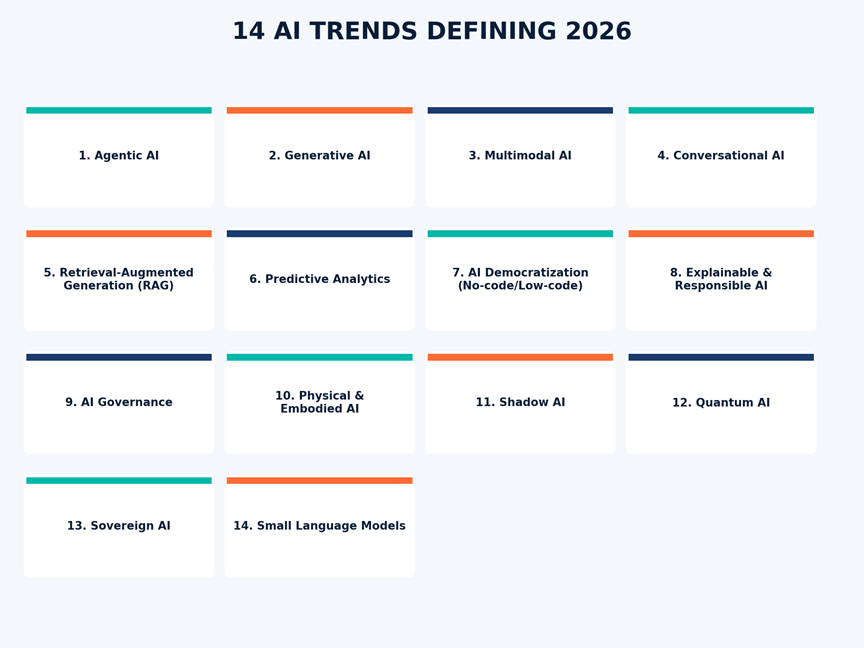
Some of these trends are mature enough to build on today. Others are early enough that betting on them means accepting real risk. We’ve grouped them so you can tell the difference at a glance, then broken each one down below.
1. Agentic AI
Agentic AI refers to systems that don’t just answer a question — they plan a sequence of steps, take actions across tools, and adjust when something doesn’t go as expected. Think of it as the difference between a chatbot that drafts an email and an assistant that reads your calendar, drafts the email, checks it against your CRM, and sends a follow-up if there’s no reply in three days.
This is arguably the single biggest story in enterprise AI heading into 2026. Gartner projects that by the end of this year, 40% of enterprise applications will include task-specific AI agents, up from less than 5% in 2025. And it’s not just theoretical: recent industry surveys report that 79% of companies already have AI agents doing real work somewhere in the business, even if only a small fraction run in full production.
It’s also where the money is going. Recent industry data shows 88% of executives plan to increase AI budgets specifically because of agentic initiatives, and the agentic AI software market itself is projected to grow from roughly $7.6 billion today to $236 billion by 2034 — a compound annual growth rate above 40%. That’s the kind of number that turns a trend into a line item on next year’s budget.
The catch is governance. Multiple 2026 industry reports point to a widening gap between how fast agentic AI is being adopted and how well companies actually monitor what their agents are doing — one analysis put the gap between production adoption and proper oversight at roughly 60 percentage points. If you’re building agentic workflows, treat permissions, audit logs, and human checkpoints as part of the product, not an afterthought.
If agentic AI is on your roadmap, it’s worth scoping the workflow before the model — IdeaUsher’s AI agent development services team spends most early conversations mapping exactly which tasks are worth automating first.
2. Generative AI, Still Rewriting the Rules
Generative AI isn’t new anymore, but it hasn’t plateaued either. What’s changed in 2026 is where it’s being applied: less “write me a blog post,” more embedded generation inside actual software — code completion, synthetic training data, product design variations, and personalized marketing at a scale no human team could match.
For businesses, the practical shift is from generative AI as a novelty feature to generative AI as infrastructure. It sits quietly inside your support tool, your design software, and your internal search, doing work rather than performing a demo.
The cost curve is doing a lot of the work here, too. Running a genuinely capable generative model is dramatically cheaper than it was two years ago, which is exactly why it’s showing up inside ordinary, mid-market software rather than staying a premium, stand-alone product reserved for companies with enterprise-sized AI budgets. IdeaUsher’s generative AI development services team builds exactly this kind of embedded, production-grade generative feature rather than a stand-alone demo.
3. Multimodal AI
Multimodal models process more than just text — they can reason across images, audio, video, and text in a single conversation. Upload a photo of a broken part and get a diagnosis. Show a model a screenshot of a bug and get a fix. Feed it a video walkthrough and get a written summary.
This matters commercially because most real business problems aren’t text-only. Insurance claims involve photos. Manufacturing defects involve video. Customer support tickets involve screenshots. Multimodal AI closes the gap between how customers actually communicate and how software has historically understood them.
The practical upside is speed. A claims adjuster who used to type a written description of damage before a model could process it can now just forward the customer’s photo directly — cutting a manual data-entry step out of a workflow that used to depend on it.
4. Conversational AI 2.0
Conversational AI has moved well past scripted chatbots. Modern systems track context across an entire conversation, pick up on tone and intent, and hand off to a human only when it’s genuinely necessary rather than after every third message.
It’s no accident customer service tops the list of business AI use cases at 56%, according to Forbes Advisor — most of that is conversational AI quietly doing the first-line work so human agents can focus on the conversations that actually need a person. IdeaUsher builds these systems as part of its chatbot and conversational AI development work, usually starting with the highest-volume, lowest-complexity queries first.
The business case is straightforward: faster response times, lower support costs, and — when done well — a customer experience that doesn’t feel like fighting a phone tree. The businesses getting this right treat conversational AI as an extension of their brand voice, not a bolted-on widget.
5. Retrieval-Augmented Generation (RAG)
RAG connects a language model to your actual company data — your documents, your product catalog, your support history — so answers are grounded in facts you control instead of whatever the model happened to learn during training.
This is the trend quietly solving AI’s biggest credibility problem: hallucination. A support bot built on RAG answers from your actual refund policy, not a plausible-sounding guess. The same approach powers internal search tools that let employees ask a question in plain English and get an answer pulled straight from company wikis, tickets, and policy documents, instead of digging through folders themselves.
For any business planning to deploy AI on top of proprietary data, RAG isn’t optional — it’s the foundation. Nearly every other trend on this list, from agentic AI to conversational AI, works better and more safely once it’s grounded in a solid RAG layer.
6. Predictive Analytics
Predictive analytics uses historical data to forecast what happens next — which customers are about to churn, which machines are about to fail, which products will sell out. It’s one of the oldest applications of AI and still one of the most reliably profitable.
What’s new in 2026 is accessibility. Predictive models that used to require a dedicated data science team can now run on off-the-shelf platforms, which means mid-sized retailers, lenders, and manufacturers are finally competing with enterprises on forecasting accuracy rather than watching from the sidelines.
A retailer using it well doesn’t just react to a stockout after it happens — the model flags the SKU trending toward zero inventory two weeks out, while there’s still time to reorder.
7. AI Democratization (No-Code/Low-Code)
No-code and low-code AI platforms let non-technical teams build and deploy models without writing a line of Python. Marketing can build a lead-scoring model. Operations can automate document processing. IT doesn’t become the bottleneck for every AI idea in the building.
Turnkey platforms like Salesforce Agentforce and Microsoft Copilot Studio are a big part of why this trend has accelerated — they package agentic and generative capability into tools business users already know how to open, no engineering ticket required.
This is a double-edged trend, though — it’s also the reason “shadow AI” (more on that below) has become such a headache for IT and security teams. Democratization without guardrails just moves the risk somewhere less visible.
8. Explainable and Responsible AI
Explainable AI (XAI) makes a model’s decisions interpretable — not just “the algorithm said no,” but why it said no, in terms a human can evaluate and challenge. Responsible AI is the broader practice of building systems that are fair, safe, and accountable by design.
This trend is being pulled forward by regulation as much as ethics. Frameworks like the EU AI Act are turning explainability from an ethical nice-to-have into a legal requirement for high-risk use cases, and US financial and employment regulators are moving in the same direction.
If your AI touches a regulated decision — credit, employment, insurance, healthcare — explainability isn’t optional anymore. Build it in during design, because retrofitting it into a model that’s already in production is far more expensive.
9. AI Governance
AI governance is the operational layer underneath responsible AI: who approves a new model before it ships, how it’s monitored once it’s live, and what happens when it misbehaves. Think of it as the rulebook that keeps agentic AI, generative AI, and predictive models from running loose.
The numbers make the urgency clear. One 2026 industry analysis found that while agentic AI has reached roughly 72% production adoption among enterprises, there’s still an estimated 60-percentage-point gap between how widely agents are deployed and how well they’re actually governed.
Expect this to be one of the fastest-growing AI priorities of the next few years, simply because so few companies have caught up to it. The organizations building governance frameworks now will move faster later, not slower — they won’t have to pause deployments to retrofit oversight after something goes wrong.
10. Physical and Embodied AI
Embodied AI puts intelligence into physical systems — warehouse robots, autonomous inspection drones, robotic arms on a factory floor — that perceive their environment and act in it, not just process text on a screen.
This trend moves slower than software-only AI because hardware, safety testing, and physical deployment take real time. But in manufacturing, logistics, and agriculture, it’s already reshaping how physical work gets done — a warehouse robot that re-routes itself around a spilled pallet is a very different proposition than a chatbot that answers a question wrong.
For businesses with physical operations, the practical entry point usually isn’t a humanoid robot — it’s a narrower application like automated quality inspection or warehouse navigation, where the return on investment is easier to measure.
11. Shadow AI
Shadow AI is the unsanctioned use of AI tools by employees without IT’s knowledge — someone pasting confidential data into a public chatbot to draft a report, for instance. It’s less a “trend to adopt” and more a risk every business now has to actively manage.
It tends to grow exactly where AI democratization succeeds without a policy attached: the easier it is for any employee to reach for a free AI tool, the more likely sensitive data ends up somewhere the company can’t see or control.
The fix isn’t banning AI tools outright — that just pushes usage further underground. It’s giving employees sanctioned, secure alternatives that are actually as convenient as the public tools they’d otherwise reach for, paired with a clear, simple policy on what data can and can’t go into them.
12. Quantum AI
Quantum AI combines quantum computing with machine learning to tackle problems classical computers handle poorly — certain optimization and simulation tasks in particular. It’s still early: usable quantum hardware at scale remains a few years out for most industries.
For most businesses, quantum AI in 2026 is a “watch closely, don’t bet the roadmap on it” trend. Pharmaceutical, materials science, and finance companies are the exceptions already running real pilots, mostly around molecule simulation and portfolio optimization problems that are a poor fit for classical computing.
13. Sovereign AI
Sovereign AI refers to nations and regions building their own AI infrastructure, models, and data governance rather than depending entirely on a handful of foreign providers. It’s driven as much by geopolitics as by technology — data residency laws, export controls, and national security concerns are all pushing this forward.
For global businesses, this trend means paying closer attention to where your AI vendor’s models are trained, hosted, and governed, especially if you operate in regulated markets across multiple countries. A vendor contract that worked fine last year may need a second look if a new data-residency rule has since taken effect in one of your markets.
14. Small Language Models
While the headlines chase ever-larger frontier models, a quieter trend is gaining real commercial traction: small language models (SLMs) that run cheaper, faster, and often on-device, tuned tightly for a specific task instead of trying to know everything.
For businesses watching their AI compute bill, SLMs are often the more practical choice — a fine-tuned small model for customer support routing will usually beat a giant general-purpose model on cost, latency, and even accuracy for that narrow job.
On-device deployment is the added bonus: an SLM running locally on a phone or a piece of factory equipment doesn’t need a live internet connection or a round-trip to the cloud, which matters a great deal for latency-sensitive or offline use cases.
Where AI Trends Collide With Other Emerging Tech
AI rarely creates value in isolation. Its biggest business impact usually shows up where it intersects with another technology already in your stack.
AI + Internet of Things (IoT)
Sensors generate the raw data; AI turns it into predictions. A temperature sensor on its own just reports a number — pair it with a predictive model and it flags equipment about to fail before it actually breaks down, turning a maintenance schedule from calendar-based guesswork into a data-driven one. IdeaUsher’s IoT development work usually starts exactly here, wiring sensor data into a model that can actually act on it.
AI + Blockchain
Blockchain provides a tamper-proof record; AI analyzes it for fraud detection, smart-contract automation, and provenance tracking in supply chains. This pairing is central to a lot of the Web3 and blockchain development work we build at IdeaUsher, where a client needs both an auditable record and a system smart enough to flag when something in that record looks wrong.
AI + Augmented Reality
AI-powered object recognition makes AR genuinely useful rather than a novelty filter. Point a phone camera at a shelf and get real-time stock and pricing data overlaid on it, or point it at a piece of equipment and get an AI-guided repair walkthrough overlaid step by step.
AI + Edge Computing
Running AI models directly on local devices instead of routing everything through the cloud cuts latency to near-zero. That matters enormously for anything safety-critical — autonomous vehicles, medical devices, industrial safety systems — where a half-second network delay isn’t just inconvenient, it’s dangerous.
AI + 5G
Faster, lower-latency networks are what make real-time AI applications actually feasible outside a lab — remote surgery assistance, live video analytics on a factory floor, or a fleet of delivery robots coordinating with each other in real time all depend on network speed AI alone can’t provide.
If you’re evaluating where to invest, look at your existing tech stack first. The AI trend that pairs with something you already have is usually a faster path to ROI than a bet at the frontier.
How These AI Trends Show Up Across Industries
Trends are abstract until you see them applied. Here’s where each one is doing real, measurable work right now.
AI in Healthcare
Multimodal AI reads medical scans alongside patient history to flag early-stage disease risk that a single data source might miss, while predictive analytics helps hospitals forecast bed demand and staffing needs before a surge hits. Explainable AI is especially critical here — a clinician needs to understand why a model flagged a risk, not just that it did.
AI in Retail and eCommerce
Conversational AI handles product questions and order status around the clock, while predictive analytics drives personalized recommendations and demand forecasting that keeps popular items in stock without overordering the slow movers. Multimodal AI is increasingly used for visual search — customers photograph an item and get matching products instantly.
AI in Finance
Explainable AI and agentic AI work together here: agents can flag suspicious transactions and initiate a hold in real time, while explainability ensures the decision can be justified to a regulator or a customer who disputes it. Predictive models also underpin credit scoring and portfolio risk assessment at a scale human analysts couldn’t match alone.
AI in Manufacturing
Physical AI and IoT are the dominant pairing — sensors on production equipment feed predictive models that catch machine failure before it happens, cutting unplanned downtime. Embodied AI, in the form of warehouse and assembly-line robots, is extending this from prediction into action.
AI in Education
Generative AI powers adaptive tutoring that adjusts to how an individual student learns, while small language models increasingly run these tools directly on school-issued devices without relying on a constant cloud connection — a meaningful advantage for districts with inconsistent internet access.
AI in Logistics and Transportation
Agentic AI paired with IoT sensor data lets shipping and delivery networks replan routes autonomously the moment a shipment is delayed, rather than waiting for a human dispatcher to notice and react. Predictive analytics also forecasts demand spikes so fleets can be repositioned ahead of time.
AI in Cybersecurity
Predictive analytics detects anomalies in network traffic in real time, often catching a breach attempt long before a human analyst would notice unusual behavior. Ironically, cybersecurity teams are also the ones most focused on shadow AI monitoring — flagging unsanctioned AI tool usage before it becomes a data leak.
AI in Real Estate and PropTech
Multimodal AI enables instant property valuation from photos, floor plans, and market data combined, cutting what used to be a multi-day appraisal process down to minutes. Predictive analytics also helps investors model rental yield and price trends across neighborhoods.
AI in Gaming
Generative AI is behind a growing share of procedurally generated content — levels, dialogue, and quests — while embedded AI models create non-player characters that adapt their behavior based on how a specific player plays, rather than following a fixed script.
| Industry | Leading Trend | Real-World Application |
| Healthcare | Multimodal AI + Predictive Analytics | Reading scans alongside patient history to flag early-stage disease risk |
| Retail & eCommerce | Conversational AI + Predictive Analytics | Personalized product recommendations and demand forecasting |
| Finance | Explainable AI + Agentic AI | Automated fraud detection with decisions regulators can actually audit |
| Manufacturing | Physical AI + IoT | Predictive maintenance that catches machine failure before it happens |
| Education | Generative AI + Small Language Models | Adaptive tutoring and on-device tools that work without constant cloud calls |
| Logistics | Agentic AI + IoT | Autonomous route replanning when a shipment is delayed mid-transit |
| Cybersecurity | Predictive Analytics + Shadow AI Monitoring | Detecting anomalies in real time and flagging unsanctioned AI tool usage |
| Real Estate & PropTech | Multimodal AI | Instant property valuation from photos, floor plans, and market data |
| Gaming | Generative AI | Procedurally generated content and NPCs that adapt to player behavior |
5 Mistakes Businesses Make When Chasing AI Trends
We’ve reviewed enough AI projects — our own and others’ — to see the same mistakes recur. Here’s what trips businesses up most often.
1. Chasing the Trend Instead of the Use Case
Adopting agentic AI because it’s the hot topic, without a specific workflow it’s meant to fix, is how pilots end up nowhere. Start from the business problem — a slow invoice process, a support queue that’s always backed up, a forecasting gap that keeps causing stockouts — then pick the trend that solves it. The trend should follow the problem, not the other way around.
2. Skipping Data Readiness
RAG, predictive analytics, and personalization all depend on clean, accessible data. If your customer records live in three disconnected systems with inconsistent formatting, that’s the actual first project — not the AI model. Businesses that skip this step usually find out the hard way, three months into a model build, that the data can’t actually support what they asked for.
3. No Governance Plan Until Something Goes Wrong
Teams ship an AI agent into production, then scramble to add oversight after it makes a bad call — approves a refund it shouldn’t have, or sends a message it shouldn’t have sent. Build monitoring, audit logs, and human checkpoints in from day one, rather than treating governance as a fire you’ll put out later.
4. Underestimating Change Management
The best AI model in the world fails if the team using it doesn’t trust it or wasn’t trained on how to work alongside it. Budget real time for adoption — walkthroughs, feedback loops, a way for staff to flag when the model gets something wrong — not just for development.
5. Trying to Build Everything In-House Without the Right Talent
AI engineering, especially agentic systems and fine-tuned models, is a specialized skill set that takes most companies far longer to hire for than they expect. Plenty of businesses lose six to twelve months trying to build an internal team from scratch for a project an experienced development partner could have staffed and shipped in weeks.
What Happens After 2026
A few directional bets are safe to make about where AI goes from here.
AI Becomes Invisible Infrastructure
The standalone “AI feature” era is fading. AI is increasingly embedded so deeply into ordinary software that customers stop noticing it’s there at all — the way electricity or the internet became invisible once they were simply everywhere, rather than something a product had to advertise.
Investment Keeps Accelerating
Industry forecasts put AI spending growth at roughly 32% year-over-year through 2029, and the agentic AI market alone is projected to grow more than thirtyfold by 2034. Whatever skepticism remains about AI hype, the capital allocation says the bet is only getting bigger.
Reasoning and Multi-Step Planning Improve
Models keep getting better at multi-step reasoning, narrowing the gap between an impressive demo and a reliable production system. This is precisely what’s fueling the rise of agentic AI — an agent is only as useful as the model’s ability to correctly plan and sequence its own actions.
Regulation and Governance Mature Globally
Frameworks like the EU AI Act are just the beginning. Expect governance requirements to tighten across the US, EU, and Asia-Pacific simultaneously, which means a governance plan built for one market increasingly needs to hold up in several others too.
Small, Efficient Models Go Mainstream
As small language models keep closing the accuracy gap with giant general-purpose ones, expect more businesses to default to a fine-tuned small model for narrow tasks and reserve frontier models for the handful of problems that genuinely need them.
None of that requires a crystal ball. It just requires paying attention to where the money, the research, and the regulators are all pointing at once — which, right now, is agentic AI, governance, and small, efficient models built for specific jobs.
How IdeaUsher Helps You Put These AI Trends to Work
Reading about AI trends is the easy part. Building something that actually ships on budget, on time, and without a six-month detour into “why doesn’t this work in production” is where most projects stall.
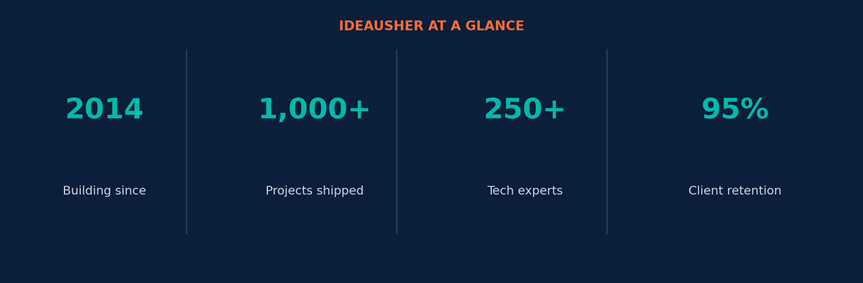
That’s the gap IdeaUsher fills. Since 2014, we’ve been building AI, blockchain, and mobile/web products for startups and Fortune 500 companies, and our AI/ML development team has shipped agentic workflows, generative AI features, RAG-based knowledge systems, and predictive models across healthcare, fintech, retail, and wellness.
A few of the businesses we’ve built for: Gold’s Gym, Allayya (a mental wellness app), Deluxe, ElecGlide, and Stelinovas, alongside dozens of startups you haven’t heard of yet but probably will — see more in our portfolio.
- 250+ engineers, including ex-MAANG talent, so you’re not waiting on a single specialist to become available.
- AI/ML and generative AI development built around your actual data and workflows, not a generic off-the-shelf model.
- Blockchain and Web3 expertise for businesses combining AI with tamper-proof data and smart contracts.
- 95% client retention, because we build for the second project, not just the first invoice.
- 1,000+ shipped projects, so the mistakes above are ones we’ve already made — and fixed — on someone else’s dime, not yours.
Whether you’re exploring your first AI pilot or trying to get an existing one out of “pilot purgatory” and into production, we’re happy to talk through what’s realistic for your timeline and budget. No pressure, no hard sell — just a straight conversation about what agentic AI, RAG, or predictive analytics would actually look like inside your product.
Ready to explore what AI trends mean for your business? Get in touch with IdeaUsher’s team for a free consultation.
FAQs
What are the biggest AI trends in 2026?
The trends with the most real-world traction right now are agentic AI, multimodal AI, retrieval-augmented generation (RAG), AI governance, and small language models. Generative AI and conversational AI remain foundational, but they’ve matured from novelty features into embedded infrastructure.
What’s the difference between generative AI and agentic AI?
Generative AI creates content — text, images, code — in response to a prompt. Agentic AI goes further: it plans a sequence of actions, uses tools, and adjusts based on results, more like an assistant completing a task than a model answering a question.
Is agentic AI actually being used in production, or is it still hype?
Both, depending on the company. Industry surveys show a large majority of businesses have started using AI agents somewhere in their operations, but a much smaller share run them in full production with proper monitoring. The technology is real; the governance around it is still catching up.
How much does it cost to build an AI feature for my business?
It depends heavily on scope — a RAG-based support assistant costs far less than a custom-trained predictive model integrated across multiple systems. The most reliable way to get an accurate number is a scoping conversation with a development partner who can map your specific use case, data situation, and timeline.
What’s the biggest risk businesses face when adopting new AI trends?
Two, really: chasing a trend without a clear use case, and skipping governance until after something breaks. Both are avoidable with a clear-eyed pilot plan and monitoring built in from day one, rather than bolted on afterward.
How can I tell if my business is ready for AI, or if I need to fix data issues first?
A quick gut check: if your customer, product, or operational data lives in scattered spreadsheets or disconnected systems, that’s your real first project. Most AI trends — RAG, predictive analytics, personalization — depend on clean, centralized, accessible data to work well.
Does IdeaUsher only work with large enterprises, or does it help startups too?
Both. IdeaUsher has shipped AI and app projects for Fortune 500 companies and early-stage startups alike, which is part of why the team can scope a project realistically whether you’re testing a first MVP or scaling AI across an existing enterprise platform.
Which AI trend should a small or mid-sized business adopt first?
Usually predictive analytics or a RAG-based support assistant — both have a clear, measurable ROI and don’t require the governance overhead that agentic AI or physical AI demand. Start narrow, prove the value, then expand into more ambitious trends once the foundation — clean data, a working pilot, a bit of internal trust — is in place.