


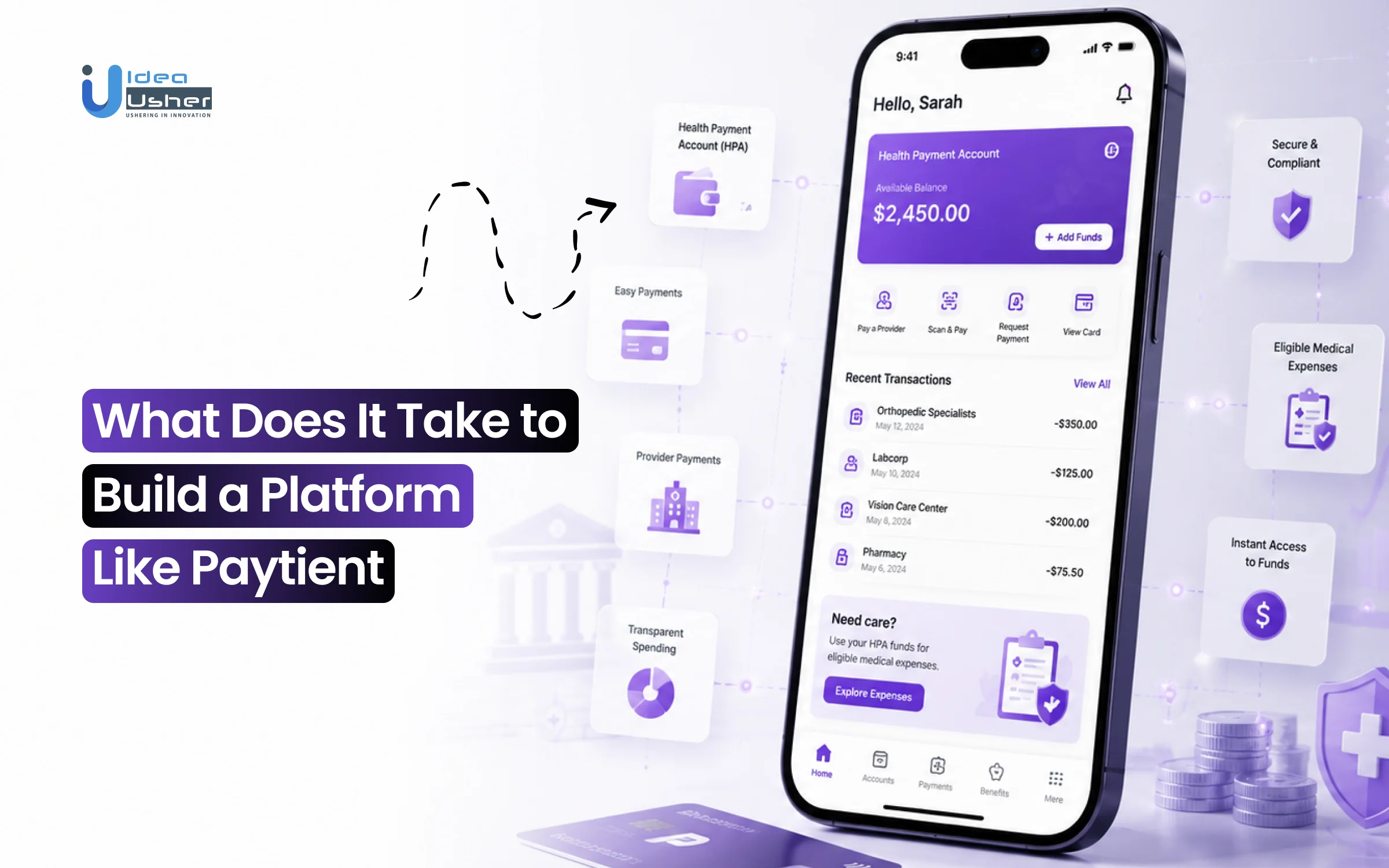
Key Takeaways
- Paytient removes healthcare payment barriers through employer-sponsored financing and interest-free repayment plans.
- Core features include Health Payment Accounts, healthcare payment cards, payroll integrations and flexible installments.
- The platform helps employees access care sooner while reducing financial stress and treatment delays.
- Success depends on secure payment infrastructure, compliance and seamless employer, insurer and provider integrations.
- How Idea Usher can help you build a healthcare payment platform with financing workflows, payroll integrations and healthcare-compliant infrastructure.
The healthcare industry has spent years optimizing access to care while often overlooking a more immediate barrier: the ability to pay for it. This shift is fueling interest in Paytient platform development as employers, health plans and healthcare organizations seek new ways to reduce financial stress and help patients access treatment without delaying care.
Traditional healthcare financing relied on credit-based approvals, high-interest payment options, and fragmented reimbursement processes. Today, consumers expect interest-free installment plans, employer-sponsored healthcare benefits, flexible repayment options, digital payment experiences, healthcare spending visibility, and integrated affordability tools. The focus has shifted beyond financing medical expenses to improving care access and reducing financial friction through modern healthcare payment infrastructure.
In this blog, we explore how to build a Paytient-like platform, covering core features, payment workflows, compliance, and how Idea Usher creates scalable healthcare affordability solutions connecting patients, employers, insurers, and providers through a unified financial experience.
Why Healthcare Affordability Platforms Are Growing Fast
The healthcare affordability market is growing rapidly, expanding from $7.94 billion to an estimated $28.15 billion by 2035 at a 13.8% CAGR. Rising healthcare costs, growing patient financial responsibility, and demand for flexible payment options are accelerating adoption across the healthcare ecosystem.

As traditional financing models face growing consumer resistance and regulatory scrutiny, healthcare affordability platforms are becoming essential healthcare infrastructure.
A Cedar survey found that 45% of patients would delay or avoid care when costs are unclear. By integrating with hospital billing systems and EHR platforms, these solutions enable real-time eligibility checks, personalized payment plans, and seamless point-of-care financing.
A. The Dynamic Affordability Index
The matrix below highlights the core microeconomic data points and operational shifts fueling the accelerated deployment of dedicated health affordability systems.
| Affordability Driver | Key Market Metric / Statistical Trend | Systemic Impact on Care Delivery |
| Employer Squeeze | 10% median cost increase projected for medical plans. | Forces employers to shift cost burdens onto worker deductibles. |
| Out-of-Pocket Escalation | Individual expenditures rising 3.7% annually. | Expands the self-pay gap and increases the risk of bad-debt defaults. |
| Financing Growth | Point-of-care payment volume grew from $10M to $230M. | Demonstrates a massive consumer shift toward embedded digital options. |
| Provider Churn Multiplier | 33% of patients would switch clinics for flexible payment plans. | Turns point-of-care financing into a critical tool for competitive retention. |
| Bad-Debt Velocity | Provider bad-debt and charity expenses spiked 11% year-over-year. | Requires platforms to run automated, pre-service financial screening. |
B. The Rising Cost of Care and Payment Challenges
The acceleration of healthcare cost inflation has pushed consumer wallet capacities past their breaking points, creating severe operational friction for clinical providers.
- The 2026 Price Surge: Hospital and clinical service inflation has reached 7.59% year over year, driven in part by growing utilization of high-cost specialty drugs and GLP-1 medications, with prescriptions doubling annually.
- Growing Patient Financial Burden: As medical cost trends approach 9.0%, out-of-pocket healthcare spending is projected to increase by 3.7% annually, contributing to higher levels of bad debt and charity care expenses, which have risen by 11%.
- The Price Transparency Vacuum: Traditional insurance and billing processes often leave patients uncertain about their financial responsibility. Healthcare affordability platforms address this gap by providing upfront cost estimates, payment options, and predictable monthly repayment plans before treatment begins.
C. Why Employers and Health Plans Are Funding Care Access
Employers and health plans are increasingly investing in healthcare affordability platforms to control escalating medical costs, improve workforce health outcomes, and reduce the financial barriers that prevent timely access to care.

Several cost pressures are accelerating this shift, from rising premiums and growing deductible burdens to delayed treatment patterns that ultimately increase long-term healthcare spending.
- Absorbing the 10% Premium Squeeze: U.S. employers are facing a median 10% increase in healthcare costs, driven by catastrophic claims and projected pharmacy cost increases of up to 12%.
- The Growing Deductible Burden: To manage rising healthcare expenses, 27% of employers are expanding cost-sharing programs. As a result, average employee family contributions have reached $6,850, up 23% since 2020, while 34% of employees are enrolled in plans with deductibles of $2,000 or more.
- Reducing High-Cost Clinical Churn: When employees delay surgeries, specialist care, or chronic disease management due to high deductibles, conditions worsen and drive the catastrophic claims responsible for 31% of employer cost increases. Healthcare affordability platforms help break this cycle through interest-free payment options, cost transparency, and access to lower-cost care pathways.
D. How Healthcare Financing Is Evolving Beyond Credit
The modern healthcare financing sector is experiencing an architectural evolution, moving rapidly away from legacy, high-APR medical credit cards and toward hyper-personalized, non-credit-based fintech models.
- The Rise of Point-of-Care Installments: Growing adoption of BNPL-style healthcare financing has reshaped patient expectations. Point-of-care payment plans have expanded rapidly, increasing from $10 million to $230 million in short-term financing originations.
- Moving Beyond Traditional Credit Models: Conventional financing often relies on hard credit inquiries that can limit access for patients with lower credit scores. Modern platforms use soft-credit checks and AI-driven underwriting to assess a patient’s propensity to pay, with 63% of patients expressing interest in flexible installment options that do not impact their credit profile.
- Direct-to-Provider Funding: Unlike personal loans that disburse funds directly to consumers, healthcare financing platforms route approved funds directly to the provider or clinical ledger. This helps prevent fund misuse, supports compliance requirements, reduces billing complexity, and creates a more controlled repayment process.

What Is Paytient and How Does It Work?
Paytient is a healthcare affordability and payment platform that helps patients pay for medical expenses over time through employer-sponsored and health plan-sponsored Health Payment Accounts (HPAs). Unlike traditional healthcare financing solutions, it enables members to access care immediately and repay costs through interest-free installment plans, reducing financial barriers that often lead to delayed treatment.
Operating as a “healthcare affordability ecosystem,” the platform provides a Paytient card for diverse medical costs. Its standout 0% interest, no-fee, and no-credit-check model ensures financing is more accessible than traditional credit options.

A. The Shift from Traditional Credit to Sponsored HPAs
The matrix below illustrates how Paytient’s sponsored model fundamentally restructures the mechanics of out-of-pocket medical payments compared to traditional healthcare lending options.
| Operational Attribute | Traditional Healthcare Credit Cards | Paytient Health Payment Account (HPA) |
| Financial Instrument | Traditional consumer revolving credit line. | Employer/Insurer-sponsored specialized credit benefit. |
| Underwriting Baseline | Hard FICO credit score check (can damage profiles). | No credit check; identity verification and self-reported income. |
| Interest & Fee Structure | Up to 32.99% standard APR or retroactive deferred spikes. | Strictly 0% APR; zero late fees, transaction fees, or hidden costs. |
| Primary Funding Source | Funded entirely by the individual patient. | Funded upfront by Paytient; sustained by business subscriptions. |
| Repayment Channels | Post-care bank transfers or external bill pay. | Automated payroll deductions, HSA/FSA funds, or ACH bank links. |
B. Understanding Health Payment Accounts (HPAs)
Paytient’s Health Payment Account (HPA) is an employer-sponsored, interest-free line of credit designed to help employees manage healthcare expenses and bridge the gap between high deductibles and personal cash flow. By positioning financing as a workplace benefit rather than a traditional lending product, HPAs improve healthcare affordability while reducing common borrowing barriers.
- Employer-Sponsored Benefit: HPAs are integrated into employer benefits programs and offered alongside health insurance, creating a unified employee healthcare experience.
- Pre-Loaded Healthcare Spending Power: Eligible employees receive immediate access to a healthcare spending limit, typically between $1,000 and $2,000, for qualified medical expenses.
- No Credit Score Impact: Accessing an HPA does not require traditional credit checks or hard FICO inquiries, allowing employees to use funds without affecting their credit scores.
- Alternative Underwriting Model: Instead of relying solely on credit history, HPAs can utilize income-based and affordability-focused evaluation methods to support responsible access to healthcare financing.
C. How Members Access Care Before Paying
The user journey is designed to replicate a seamless, frictionless retail checkout experience, eliminating financial anxiety at the clinic desk.

The process simplifies healthcare payments into a few intuitive steps, allowing members to access care first and repay later.
- Instant Account Activation: Employees activate their HPA via the mobile app, immediately receiving a virtual and physical Paytient Visa card issued by Commerce Bank.
- Point-of-Care Transaction: The member swipes the card at checkout to cover co-pays, prescriptions, or deductible balances for themselves, their dependents, or even their pets.
- Flexible Split Configuration: Once a charge clears, the app prompts the user to split that specific balance into manageable, custom installments over a timeline of up to 12 months.
- ACI-Compliant Repayment Loops: Deductions are automatically pulled on a predictable cadence from the user’s preferred repayment channel, matching their personal cash flow cycles.
The Tax-Advantaged Repayment Loop: Members can link their tax-free Health Savings Account (HSA) or Flexible Spending Account (FSA) cards directly inside the Paytient app. This allows them to repay active HPA installment plans using pre-tax dollars for all IRS-qualifying medical, dental, and vision procedures.
D. The Role of Employers, Insurers, and Providers
Paytient functions as a collaborative ecosystem where three major healthcare stakeholders share the burden of care access to optimize macroeconomic outcomes.
1. Employers as Plan Sponsors
Employers pay a flat, cost-effective subscription fee typically $4 per employee per month (PEPM) to unlock the platform for their entire workforce. By removing upfront cost barriers, businesses experience a massive surge in talent retention, with 64% of users stating the benefit makes them more likely to keep their jobs.
2. Insurers as Strategic Partners
Health plans and insurance carriers integrate Paytient directly into their high-deductible product designs. Encouraging members to seek early, proactive clinical intervention prevents minor symptoms from cascading into expensive, catastrophic claims downstream, lowering the insurer’s long-term total cost of care.
3. Providers as Frictionless Acceptors
Because Paytient operates on the standard Visa network, healthcare providers do not need to sign custom merchant contracts or install proprietary hardware. The clinic processes the card exactly like a standard credit transaction, receiving 100% of their funds upfront within 48 hours while Paytient assumes all patient default risks.
E. How Interest-Free Healthcare Financing Works
The core financial architecture of Paytient eliminates the extractive interest-bearing models common to consumer lending, operating strictly on a 0% APR, zero-fee framework.
- Subsidized Capital Sourcing: The interest costs that would normally be charged to the consumer are entirely subsidized by the employer’s monthly PEPM subscription fee.
- Merchant Category Code (MCC) Restrictions: To protect the integrity of the line of credit, the Paytient Visa card features built-in programmatic blocks. The card will fail instantly if swiped at non-healthcare registers (like gas stations or clothing stores), authorizing transactions exclusively at venues coded under approved medical, dental, pharmacy, ophthalmic, or veterinary MCCs.
- Non-Recourse Protection: If an employee leaves while carrying an outstanding HPA balance, new spending is suspended and repayments continue directly with the individual. The employer remains insulated from repayment obligations and default-related credit risk.
Platform Architecture Behind a Paytient-Like Solution
A successful healthcare affordability solution requires a robust technical foundation that can manage payments, financing workflows, employer-sponsored benefits, compliance, and data security at scale. The table below highlights the key architectural layers involved in Paytient platform development and their respective functions.
| Architecture Layer | Purpose | Core Components |
| Member Experience Layer | Enables members to access financing, manage accounts, and track repayments. | Onboarding, account dashboard, card management, transaction history, repayment tracking, notifications |
| Healthcare Payment Processing Layer | Processes healthcare transactions and payment settlements. | Payment gateway, card management, transaction authorization, merchant validation, ACH processing |
| Financing & Repayment Engine | Manages HPAs, spending limits, and repayment workflows. | HPA management, financing rules, repayment scheduler, installment plans, payroll deductions |
| Benefits Administration Layer | Supports employer-sponsored benefit and eligibility management. | Employer dashboard, member enrollment, eligibility management, benefit configuration |
| Analytics & Reporting Infrastructure | Tracks platform performance, utilization, and repayment trends. | Utilization analytics, affordability insights, reporting dashboards, data warehouse |
| Security, Compliance & Data Protection Layer | Ensures security, compliance, and fraud prevention. | HIPAA, PCI DSS, encryption, IAM, audit logs, fraud monitoring |
Note: Although users primarily interact with the Member Experience Layer, all six layers work together to support healthcare financing, payment processing, benefits management, compliance, and platform operations at scale.
Core Features Needed in a Platform Like Paytient
Paytient platform development focuses on combining healthcare affordability, employer-sponsored financing, and flexible repayment systems into one ecosystem. It enables immediate access to care while equipping employers and health plans with tools to enhance affordability, streamline payments, and improve overall healthcare utilization.
1. Health Payment Accounts (HPAs)
Health Payment Accounts (HPAs) form the foundation of a Paytient-like platform by giving members immediate access to healthcare funds without upfront payment. They reduce care delays while creating a structured framework for managing healthcare affordability.
- Frictionless Account Creation: Allows qualifying enterprise members to activate their dedicated health line of credit through a simple mobile sign-up process.
- Dynamic Spending Limit Allocation: Grants immediate visibility into available spending balances based on the employer’s pre-configured benefits package.
- Real-Time Balance Tracking: Monitors account drawdowns, outstanding installment balances, and remaining transaction limits instantly after every medical swipe.
- Healthcare-Specific Funding Rules: Enforces specialized transaction parameters to ensure funds are spent exclusively on authorized clinical, pharmacy, or diagnostic costs.
2. Employer-Sponsored Healthcare Credit
Employer-sponsored healthcare credit enables organizations to provide financial assistance for medical expenses as part of their benefits strategy. This feature improves healthcare accessibility, strengthens employee retention, and reduces financial stress associated with care.
- Affordability Program Customization: Enables corporate administrators to set up customized employer-funded subsidy programs and lines of credit.
- Automated Member Enrollment: Synchronizes with enterprise HR systems to automatically activate or deactivate employee lines of credit based on active payroll rosters.
- Flexible Employer Contribution Models: Supports hybrid funding structures where employers can choose to subsidize a portion of transactional fees or employee repayments directly.
- Streamlined Benefit Administration Workflows: Provides corporate HR departments with centralized tools to manage staff limits, process onboarding classes, and review macro-enrollment numbers.
3. 0% Interest and No-Fee Financing
Interest-free healthcare financing is one of the strongest differentiators of a Paytient-like platform. By eliminating interest charges and hidden fees, it makes healthcare expenses more manageable and encourages members to seek timely treatment.
- True Interest-Free Healthcare Financing: Guarantees that every medical swipe is split over long periods at an absolute 0% annual percentage rate (APR).
- Fee-Free Repayment Structures: Eliminates compounding interest traps, late fees, activation surcharges, and annual membership costs entirely.
- Built-In Affordability Safeguards: Analyzes a member’s ongoing installment load to prevent over-extension and ensure monthly payments fit comfortably within their paycheck size.
- Automated Financing Logic: Automatically translates a single high-value hospital invoice into equal, predictable installment amounts without manual math.
4. No-Credit-Check Eligibility Verification
Removing traditional credit checks expands access to healthcare financing for a broader population. This feature allows eligible members to receive support based on employer sponsorship rather than personal creditworthiness or borrowing history.
- No-Credit-Check Approvals: Bypasses legacy credit-bureau scoring entirely to qualify users based on active corporate workplace enrollment.
- Employment Validation Loops: Runs automated background checks against corporate HR databases to confirm a steady income during user registration.
- Instant Credit Activation: Opens the member’s customized spending limit the exact millisecond their workplace status is verified during signup.
- Low-Risk Underwriting Controls: Utilizes verified employer roster histories to eliminate consumer onboarding barriers while maintaining exceptionally low platform default rates.
5. Healthcare Payment Card Management
A healthcare payment card enables members to pay for eligible medical expenses seamlessly at the point of care. It provides a familiar payment experience while ensuring transactions align with approved healthcare spending categories.
- Instant Virtual Card Issuance: Pushes a live, digital card number straight to the patient’s Apple Pay or Google Wallet the exact second their account is approved.
- On-Demand Physical Card Delivery: Automates the manufacturing and fulfillment of branded physical debit cards directly to the employee’s residential address.
- Smart Transaction Authorizations: Runs rapid background checks during a card swipe to cross-reference transactions against verified medical classification codes.
- Healthcare Merchant Restrictions: Hardcodes strict merchant acceptance rules that instantly block non-healthcare swipes at retail, entertainment, or restaurant registers.
6. Flexible Pay-Over-Time Plans
Healthcare expenses vary significantly, making repayment flexibility essential for members. This feature allows users to choose repayment schedules that match their financial situation while maintaining access to necessary healthcare services.
- Customizable Repayment Durations: Lets users choose exactly how many paychecks they want to spread an invoice across, such as 3, 6, or 12 installments.
- Instant Schedule Generation: Displays a clear, scannable matrix showing the precise dollar amount that will be deducted from each upcoming paycheck before the user finalizes their plan.
- Centralized Installment Tracking: Combines multiple active payment schedules into a single, beautiful mobile chart showing total monthly outlays.
- Self-Service Plan Modifications: Allows users to log in and adjust their repayment speeds or extend matching payment timelines if their household budgets suddenly change.
7. Payroll Deduction and Bank Repayments
Automated repayment mechanisms simplify the repayment process while improving collection efficiency. By integrating payroll deductions and banking systems, the platform minimizes administrative effort and creates a more predictable repayment experience.
- Direct Payroll Integrations: Links smoothly with enterprise payroll software to automatically pull scheduled installments directly from gross or net wages.
- Automated Bank Pulls (ACH): Provides automated electronic fund transfers for members who prefer linking standard checking accounts or debit cards.
- Synchronized Repayment Collections: Coordinates automated collections to hit exactly on the employee’s specific weekly, bi-weekly, or monthly paydays.
- Automated Payment Reconciliation: Matches incoming payroll and ACH deposits against active user balances to keep platform loan ledgers perfectly balanced.
8. Multi-Category Healthcare Expense Coverage
A comprehensive healthcare affordability platform should support a wide range of medical and wellness expenses. Broad spending coverage ensures members can use available funds across diverse healthcare needs without unnecessary restrictions.
- Universal Clinical Support: Authorizes instant payment coverage at primary care offices, hospitals, emergency rooms, and urgent care clinics.
- Dental and Vision Inclusion: Permits card utilization for routine dental checkups, orthodontic procedures, standard eye exams, and prescription eyewear.
- Pharmacy and Wellness Access: Approves point-of-sale swipes for retail prescription pickups, medical equipment needs, and behavioral health therapy sessions.
- Adjacent Specialty Processing: Extends credit line utility smoothly to specialized family categories, including fertility procedures and local veterinary clinic care.
9. Member Self-Service Payment Management
Providing members with direct access to financial information improves transparency and user satisfaction. A self-service management experience reduces support dependency while giving users greater control over healthcare spending and repayments.
- Granular Transaction Histories: Lists every medical office swipe with transparent data showing the provider name, date, and original transaction value.
- Visual Repayment Dashboards: Graphs out past payments alongside upcoming scheduled paycheck deductions in a highly clean mobile interface.
- Remaining Balance Trackers: Displays exactly how much money has been paid off and how much credit is left open for incoming healthcare needs.
- Mobile Account Maintenance: Allows users to quickly update linked bank routing codes, change personal addresses, or report cards as lost or stolen.
10. Employer and Health Plan Affordability Insights
Employers and health plans require visibility into how affordability programs impact healthcare access and utilization. Analytics and reporting tools help stakeholders measure engagement, evaluate outcomes, and optimize long-term benefit strategies.
- Aggregated Utilization Reporting: Provides corporate HR leaders with high-level summaries showing overall adoption rates and employee enrollment percentages.
- Care-Access Analytics: Tracks how early funding access prevents employees from delaying critical preventive doctor visits and prescription fills.
- Macro Repayment Trend Metrics: Monitors overall repayment health across the company roster, illustrating steady repayment consistency.
- Healthcare Visibility Tools: Displays anonymous spending data by category, showing employers whether staff are spending credits primarily on dental, vision, or urgent care.
How to Build Healthcare Payment Platform Like Paytient
Building a healthcare payment platform like Paytient requires a strategic, step-by-step approach that combines healthcare financing, payment systems, compliance, and employer integrations. During the Paytient platform development process, Idea Usher’s specialized team collaborates to build scalable, secure, and business-ready solutions tailored for healthcare affordability programs and sustainable long-term growth.
1. Define the Healthcare Financing Model
Before any technical development begins, it’s critical to define how money flow, funding structure, and repayment models will operate within the system. This includes determining how healthcare expenses are funded, how repayments are structured, and how employers or insurers participate in the model.
- Health Payment Account (HPA) Structuring: Design a flexible account framework that defines how funds are allocated, accessed, and managed for healthcare expenses across different user groups.
- Funding and Repayment Models: Establish clear funding sources and repayment mechanisms, including employer contributions and installment plans, to ensure financial sustainability.
- Employer and Insurer Participation: Define how employers and insurers contribute to funding, eligibility, and benefit structures to align with organizational goals.
- Eligibility and Enrollment Rules: Create structured criteria and onboarding processes that determine who qualifies and how users are enrolled into the program.
- Healthcare Spending Categories: Identify and categorize eligible healthcare services and expenses to ensure controlled and compliant usage of funds.
2. Seamless Experiences for Every Stakeholder
A platform like Paytient serves multiple user groups, requiring user-centric design, multi-role interfaces, and intuitive workflows to ensure adoption and engagement across all stakeholders.
- Member Onboarding Journeys: Design smooth onboarding flows that guide users through registration, eligibility checks, and account activation with minimal friction.
- Employer Administration Dashboards: Build centralized dashboards that allow employers to manage benefits, track usage, and monitor employee participation.
- Health Plan Management Interfaces: Develop interfaces for insurers and administrators to manage plans, eligibility, and integrations efficiently.
- Repayment Management Workflows: Create clear repayment tracking and scheduling systems that help users stay informed and on track with payments.
- Mobile and Web Optimization: Ensure responsive and user-friendly experiences across devices to maximize accessibility and engagement.
3. Healthcare Payment Backbone
A critical component of Paytient platform development is a robust payment infrastructure with real-time transaction processing and secure authorization systems that support seamless, compliant healthcare payments.
- Healthcare Payment Card Functionality: Develop virtual and physical card systems that allow users to pay for eligible healthcare services seamlessly.
- Transaction Authorization Workflows: Enable real-time approval systems that validate transactions based on eligibility and account balance.
- Healthcare Merchant Restrictions: Configure controls to ensure payments are only processed with approved healthcare providers and services.
- Payment Processing Systems: Implement secure systems that handle transactions, settlements, and integrations with payment gateways.
- Payment Reconciliation Mechanisms: Build systems that track and reconcile transactions to maintain financial accuracy and transparency.
4. Building Core Health Payment Account Engine
The Health Payment Account system acts as the operational heart of the platform, requiring account management logic, balance tracking, and repayment control systems to ensure transparency and efficiency.
- Account Management Architecture: Create a scalable backend system that manages user accounts, balances, and transaction histories efficiently.
- Spending Limit Allocation Systems: Build mechanisms to assign and adjust spending limits based on employer policies or user eligibility.
- Real-Time Balance Tracking: Enable instant updates on available funds and usage to provide users with accurate financial visibility.
- Funding and Disbursement Controls: Implement systems that manage how funds are added, distributed, and utilized within the platform.
- Account Lifecycle Management: Configure processes for account creation, updates, suspension, and closure based on user activity and policies.
5. Connecting Payroll and Financial Networks System
A key aspect of Paytient platform development is automated repayment management through payroll integrations, banking connectivity, and streamlined workflows that improve efficiency and reduce administrative burden.
- Payroll System Integration: Connect with employer payroll systems to enable automatic deductions for repayment without manual intervention.
- ACH Payment Processing: Enable secure bank transfers for repayments and funding through automated ACH workflows.
- Repayment Scheduling Automation: Build systems that schedule and execute repayments based on predefined timelines and user agreements.
- Payment Reconciliation Workflows: Ensure accurate tracking and matching of incoming payments with user accounts and balances.
- Repayment Monitoring Tools: Develop dashboards and alerts that track repayment status and flag any delays or issues.
6. Compliance and Risk Controls from Day One
Operating in regulated industries requires strong compliance frameworks, data security protocols, and risk management systems to ensure legal and operational integrity.
- HIPAA-Compliant Data Handling: Implement secure data storage and transmission practices to protect sensitive healthcare information.
- PCI DSS Payment Security Controls: Ensure all payment processes meet industry standards for secure card transactions and data protection.
- Employer-Based Eligibility Checks: Configure systems that validate user eligibility based on employer-provided data and policies.
- Fraud Detection and Prevention Systems: Build monitoring tools that identify suspicious activities and prevent unauthorized transactions.
- Audit Logging and Regulatory Reporting: Establish detailed logging and reporting systems to maintain transparency and meet compliance requirements.
7. Launch, Scale & Continuous Optimization
The final stage of Paytient platform development involves ongoing optimization, scalability improvements, and feature expansion to ensure long-term growth and adaptability to changing healthcare needs.
- Pilot Testing and Validation: Conduct controlled testing phases to identify issues and validate platform functionality before full-scale launch.
- Platform Performance Monitoring: Track system performance, uptime, and user activity to ensure a smooth and reliable experience.
- User Feedback and Insights: Collect and analyze user feedback to identify improvement areas and enhance platform usability.
- Infrastructure and Integration Scaling: Expand system capacity and integrations to support growing user bases and additional partners.
- New Affordability Feature Development: Continuously introduce new features that improve healthcare access and financial flexibility for users.
Cost to Build a Healthcare Payment Platform Like Paytient
The cost of Paytient platform development depends on factors such as feature complexity, healthcare payment infrastructure, compliance requirements, third-party integrations, and scalability goals. Budgets vary based on whether you’re building an MVP, mid-market solution, or enterprise-grade healthcare affordability platform.
A healthcare payment platform is typically developed in multiple phases, with each stage contributing to product strategy, platform functionality, integrations, compliance readiness, and long-term scalability.
| Development Phase | Estimated Cost (MVP → Enterprise) | What the Phase Covers |
| Product Discovery & Planning | $5,000 – $25,000 | Business model validation, requirement gathering, user flows, healthcare financing strategy, roadmap creation, and technical planning. |
| UI/UX Design | $8,000 – $40,000 | Wireframes, user journeys, dashboard design, mobile interfaces, prototypes, and stakeholder experience optimization. |
| Backend Development | $20,000 – $150,000 | Health Payment Accounts, financing engine, repayment logic, APIs, databases, and business workflows. |
| Frontend Development | $15,000 – $120,000 | Member portal, employer dashboard, admin panel, mobile app interfaces, and user interactions. |
| Payment Infrastructure Integration | $10,000 – $100,000 | Card issuance, payment gateways, transaction processing, ACH payments, and reconciliation systems. |
| Payroll & Employer Integrations | $8,000 – $80,000 | Payroll connectivity, employer enrollment systems, benefit administration tools, and workforce data synchronization. |
| Compliance & Security Implementation | $10,000 – $120,000 | HIPAA controls, PCI DSS requirements, encryption, audit logs, identity management, and monitoring. |
| Quality Assurance & Testing | $7,000 – $60,000 | Functional testing, security validation, performance testing, bug fixing, and deployment readiness. |
| Deployment & Launch | $5,000 – $50,000 | Cloud infrastructure setup, production deployment, monitoring systems, and launch support. |
| Total Estimated Cost | $70,000 – $520,000 | Complete development cost across all phases |
Note: Actual paytient platform development costs vary based on customization requirements, integration complexity, regulatory obligations, supported user volume, and geographic expansion plans. Enterprise deployments typically require significantly higher investments than MVP launches due to advanced security and scalability needs.
Development Cost According to Platform Level
The paytient platform development budgets increase as additional features, integrations, automation capabilities, compliance controls, and enterprise-grade infrastructure are introduced. Selecting the right platform scope depends on business objectives, launch strategy, and target customer segments.
| Platform Level | Estimated Cost | Features Included |
| MVP | $70,000 – $150,000 | Health Payment Accounts, member portal, basic repayment plans, payment card support, limited integrations, essential analytics, and core compliance controls. |
| Mid-Level Platform | $150,000 – $255,000 | Advanced repayment automation, payroll integrations, employer dashboards, affordability analytics, enhanced reporting, multi-category healthcare support, and expanded security controls. |
| Enterprise Platform | $255,000 – $520,000 | Full healthcare payment ecosystem, insurer integrations, advanced analytics, AI-driven insights, enterprise compliance, custom workflows, large-scale infrastructure, and white-label capabilities. |
Note: Most startups begin with an MVP to validate market demand and gradually expand functionality. Large employers, insurers, and healthcare networks generally require enterprise-grade platforms capable of supporting extensive integrations and regulatory requirements.
Factors That Influence Development Budget
Several technical, operational, and compliance-related decisions directly impact the total cost of building a healthcare affordability platform. Understanding these factors helps businesses prioritize investments and establish realistic paytient platform development budgets.
- Platform Complexity: Supporting multiple user roles, financing workflows, automation rules, and payment models can add $10,000–$50,000 to development costs.
- Healthcare Payment Infrastructure: Features such as payment card issuance, transaction processing, ACH transfers, and reconciliation systems typically increase costs by $15,000–$60,000.
- Third-Party Integrations: Integrating payroll providers, insurers, healthcare systems, payment gateways, and banking networks can add $10,000–$40,000 depending on integration scope.
- Compliance & Regulatory Requirements: Implementing HIPAA, PCI DSS, privacy controls, audit trails, and security measures may contribute $15,000–$70,000 to the project budget.
- Scalability & Infrastructure: Supporting large employer networks and member volumes often requires additional cloud infrastructure, performance optimization, and architecture investments of $20,000–$80,000.
- Security & Risk Management: Fraud prevention, identity verification, encryption, and monitoring systems can increase development costs by $15,000–$65,000.
Key Integrations for Healthcare Payment Platform like Paytient
Healthcare payment platforms rely on multiple third-party integrations to facilitate financing, payment processing, eligibility verification, and benefits administration. These integrations enable seamless data exchange between employers, insurers, healthcare providers, financial institutions, and platform users.
| Integration Category | Purpose | Core Integrations |
| Health Insurance & Benefits Platforms | Synchronizes eligibility, coverage, benefits, and affordability program data. | Health plans, benefits platforms, eligibility databases, HSA/FSA providers, insurance carriers |
| Payroll & Employer Systems | Supports employee enrollment, eligibility validation, payroll deductions, and employer-sponsored financing. | Payroll software, HRIS platforms, workforce management systems, employee directories, benefits portals |
| Banking & Payment Networks | Enables healthcare payments, repayment collection, ACH transfers, and financial reconciliation. | Payment gateways, ACH networks, banking APIs, card issuers, payment processors, settlement systems |
| Healthcare Provider & EHR Systems | Supports healthcare transaction validation, patient billing, and provider connectivity. | EHRs, hospital systems, provider networks, billing platforms, practice management software |
| Identity Verification & Fraud Prevention | Verifies identities, detects fraud, and strengthens security and compliance controls. | KYC providers, identity verification services, fraud detection tools, risk monitoring systems |
Note: Seamless integration across healthcare, employer, and financial systems is essential for delivering secure payments, accurate eligibility verification, operational efficiency, and scalable healthcare affordability programs.
How AI Can Improve Healthcare Affordability Platforms
As the healthcare financing market approaches $28.15 billion by 2035, AI enables automation, personalized payment options, reduced default risk, and improved financial outcomes across financing, payment, and revenue workflows.
AI-powered affordability platforms replace manual, rule-based processes with intelligent systems that optimize financing approvals, payment experiences, and revenue collection while supporting long-term operational efficiency.
A. The Intelligent Affordability Architecture
Artificial intelligence is becoming a core differentiator in healthcare affordability platforms, enabling faster decisions, smarter risk assessment, and streamlined operations. The table below illustrates how AI capabilities enhance performance outcomes within a modern Paytient platform development framework.
| Platform Performance Metric | Legacy Rules-Based Payment Systems | Next-Generation AI-Driven Platforms |
| Lending Decision Velocity | 24 to 48 hours for manual document verification. | Sub-3-second real-time underwriting. |
| Transaction Risk Evaluation | Pre-set dollar caps and rigid regional blocks. | Multi-factor neural network anomaly tracking. |
| False-Positive Decline Rate | High; disrupts legitimate care events at checkout. | Reduced by up to 50% via deep behavior logs. |
| Corporate Enrollment Servicing | Manual spreadsheet auditing across departments. | 47% of firms automating via agentic AI pipelines. |
| Account Validation Errors | 5% to 8% processing rejection and correction drag. | Compressed by 15% to 20% via dynamic screening. |
B. Personalized Repayment Recommendations
Traditional consumer lending relies on rigid underwriting templates that frequently penalize individuals facing sudden medical events. AI-powered affordability platforms eliminate this systemic friction through hyper-personalized financial tailoring.
- Adaptive Affordability Assessment: Instead of relying solely on hard credit inquiries, AI models analyze transaction behavior, payment patterns, and financial signals to assess a patient’s ability to repay and expand financing access.
- Dynamic Installment Planning: AI-powered engines generate personalized repayment plans based on cash flow and budget constraints, making large out-of-pocket expenses more manageable.
- Conversion & Treatment Acceptance: By reducing checkout friction and financial uncertainty, AI-driven affordability tools improve financing adoption, increase treatment acceptance, and reduce care abandonment.
C. Healthcare Cost Prediction Models
A major driver of patient collections leakage is the complete lack of upfront financial transparency surrounding complex medical events. AI estimation engines resolve this visibility deficit prior to clinical intake.
- Real-Time Cost Estimation: AI can analyze payer contracts, claims history, and EHR data to generate accurate out-of-pocket cost estimates within seconds.
- Predictive Expense Forecasting: Machine learning models identify potential ancillary costs, including medical devices, medications, laboratory services, and other treatment-related expenses before billing occurs.
- Reducing High-Cost Care Events: By providing financial clarity upfront, affordability platforms encourage preventive care and chronic disease management, helping reduce costly emergency interventions and downstream claims.
D. Fraud Detection and Risk Monitoring
With sophisticated identity theft and synthetic documentation costs projected to drive global banking fraud losses to $58.3 billion by 2030, medical financing platforms require advanced defensive infrastructure.
- Real-Time Fraud Detection: AI models analyze device fingerprints, geolocation data, login behavior, and transaction activity in real time to identify suspicious activity before funds are disbursed.
- Synthetic Identity Prevention: Advanced AI systems detect synthetic identity fraud by identifying inconsistencies across user profiles, application data, and behavioral patterns, helping prevent fraudulent account creation.
- Reducing False Positives: Unlike rigid rule-based systems, behavioral AI improves fraud accuracy by minimizing false declines, protecting legitimate healthcare transactions while reducing financial losses.
E. Employer Utilization Intelligence
As corporate health benefit spending climbs with average employee family plan contributions reaching $6,850, enterprises rely on automated intelligence to manage benefit expenses efficiently.
- Automated Benefits Administration: Agentic AI can automate benefit management, invoice reconciliation, and member servicing workflows, reducing administrative effort across healthcare and HR operations.
- Predictive Utilization Analytics: Machine learning models analyze workforce healthcare utilization patterns to identify high-cost categories such as orthopedic care, fertility treatments, and pharmaceutical spending.
- Smarter Benefits Optimization: These insights help employers refine benefit structures, improve healthcare spending efficiency, and make more informed decisions about workforce wellness investments.
Challenges in Building a Healthcare Financing Platform
Building a healthcare financing platform like Paytient involves far more complexity than a standard fintech application. Developers must balance healthcare regulations, payment infrastructure, affordability models, and enterprise integrations while maintaining security, scalability, and a seamless user experience across all stakeholders.
1. Healthcare Affordability and Financial Risk Management
Challenge: Designing financing models that keep healthcare affordable for members while preventing excessive risk exposure and repayment defaults.
Solution: Our fintech architects build configurable affordability engines, spending controls, repayment safeguards, and employer-sponsored funding models that balance user accessibility with sustainable financial operations and long-term platform profitability.
2. Payroll, Banking, and Payment System Integration
Challenge: Connecting multiple payroll providers, banking networks, payment gateways, and repayment workflows without creating transaction failures or data inconsistencies.
Solution: Our integration specialists develop secure API architectures, automated reconciliation systems, and fault-tolerant payment workflows that ensure seamless data synchronization, reliable collections, and accurate transaction processing across ecosystems.
3. HIPAA and Financial Compliance Requirements
Challenge: Managing sensitive healthcare and financial information while complying with HIPAA, PCI DSS, privacy regulations, and security standards.
Solution: Our compliance and security engineers implement encryption, role-based access controls, audit trails, secure infrastructure, and continuous monitoring frameworks that help platforms maintain regulatory compliance and protect sensitive user data.
4. Platform Scalability Across Employers and Health Plans
Challenge: Supporting thousands of members, multiple employer groups, and growing transaction volumes without affecting platform performance or reliability.
Solution: Our cloud architects design scalable microservices, high-performance databases, distributed processing systems, and auto-scaling infrastructure that enable healthcare financing platforms to grow efficiently while maintaining stability and responsiveness.
Partner With Idea Usher for Healthcare Payment Platform Development
IdeaUsher is an elite global technology solutions and product engineering firm with 11+ years of industry experience launching cutting-edge mobile and web applications across 50+ countries. Backed by 250+ niche experts, over 1,000+ completed projects, and a flawless 4.9/5 Clutch rating, we specialize in building highly secure, compliant fintech and healthcare payment systems.
By combining user-focused mobile interfaces with automated payroll links, real-time banking APIs, and secure HPA frameworks, we develop custom employer-sponsored credit lines that remove medical cost barriers and encourage corporate adoption.
Why Enterprises Partner With Us
Forward-thinking insurance networks and enterprise employers choose IdeaUsher because we seamlessly blend zero-interest consumer line of credit features with heavy corporate financial infrastructure and strict compliance rules.
- Frictionless HPA Card Program Management: Our engineers design advanced fintech pipelines to deploy virtual and physical Visa/Mastercard payment structures, allowing users to swipe instantly at any healthcare, dental, or pharmacy point-of-sale.
- Automated Repayment and Payroll Bridging: We write high-throughput banking API connections that allow users to split bills over custom intervals, linking smoothly with employer payroll deduction tools, bank accounts, or tax-advantaged HSA/FSA funds.
- Enterprise-Grade Compliance and Security: We build secure backend storage solutions that rigidly follow HIPAA, HITECH, and PCI-DSS data privacy frameworks, shielding sensitive employee healthcare and transaction information from leaks.
- Risk-Insulated Financial Underwriting Modules: Our development teams build real-time income self-reporting and financial validation portals that seamlessly assess applicant affordability parameters without running credit checks or impacting credit scores.
Ready to introduce a game-changing, interest-free Health Payment Account platform that redefines employee financial wellness? Schedule a strategic discovery session with IdeaUsher’s principal fintech software architects to engineer your product build now
Conclusion
As healthcare costs continue to rise, platforms like Paytient are transforming how patients access and pay for care by combining affordability, flexibility, and employer-sponsored support. Successful Paytient platform development requires a careful balance of healthcare financing, payment infrastructure, compliance, integrations, and user experience. From Health Payment Accounts to repayment automation and analytics, every component plays a critical role. Partnering with an experienced development team can help businesses build scalable, secure, and market-ready healthcare financing solutions that drive long-term value.
FAQs
A.1. The cost of developing a health payment platform ranges from $70,000 to $520,000 depending on features, integrations, compliance needs, and scalability. MVPs cost less than enterprise-grade solutions with advanced capabilities.
A.2. Core features typically include Health Payment Accounts, healthcare payment cards, interest-free repayment plans, payroll integrations, employer-sponsored financing, member dashboards, affordability analytics, and compliance controls that support secure healthcare payment and financing operations.
A.3. Healthcare payment platforms commonly integrate with payroll systems, health insurance providers, payment gateways, banking networks, EHR systems, and identity verification tools to automate payments, eligibility checks, repayment processing, and healthcare-related transactions.
A.4. Healthcare financing platforms generally require HIPAA compliance for healthcare data protection, PCI DSS compliance for payment security, strong access controls, audit logging, encryption mechanisms, and fraud prevention systems to safeguard sensitive information.


