

Key Takeaways
- By automating screening, GLP-1 eligibility software evaluates medical history, BMI, and insurance requirements.
- It reduces administrative workload through automated insurance verification and prior authorization workflows.
- Advanced features such as AI-powered approval predictions and dynamic payer rule updates improve approval rates and efficiency.
- As demand for GLP-1 treatments grows, these platforms help providers scale operations while improving patient access to care.
- How Idea Usher can help businesses build custom GLP-1 eligibility software with EHR integrations, insurance verification, and scalable infrastructure.
Most discussions around GLP-1 focus on patient demand and treatment outcomes. The bigger operational challenge is often eligibility itself. As programs scale, providers need a consistent way to determine who qualifies for treatment and who doesn’t. That’s one reason GLP-1 eligibility software is seeing increased adoption. What was once a manual decision is quickly becoming a workflow that requires structure, accuracy, and scalability.
We’ve built numerous GLP-1 eligibility software solutions that integrate patient intake automation and clinical decision support systems to help providers assess eligibility faster. Based on this experience, we’re writing this blog to break down the essential features of GLP-1 eligibility software and the capabilities healthcare organizations should prioritize as patient demand continues to grow.
Market Demand for GLP-1 Eligibility Softwares
According to Polaris Market Research, the global GLP-1 market was valued at USD 52.82 billion in 2025 and is projected to grow at a CAGR of 10.9% through 2034. This growth is being fueled by the expanding use of GLP-1 medications not only for type 2 diabetes but also for weight management and cardiovascular health. As demand continues to rise, healthcare providers and telehealth platforms are seeing a sharp increase in the number of patients seeking access to these therapies.
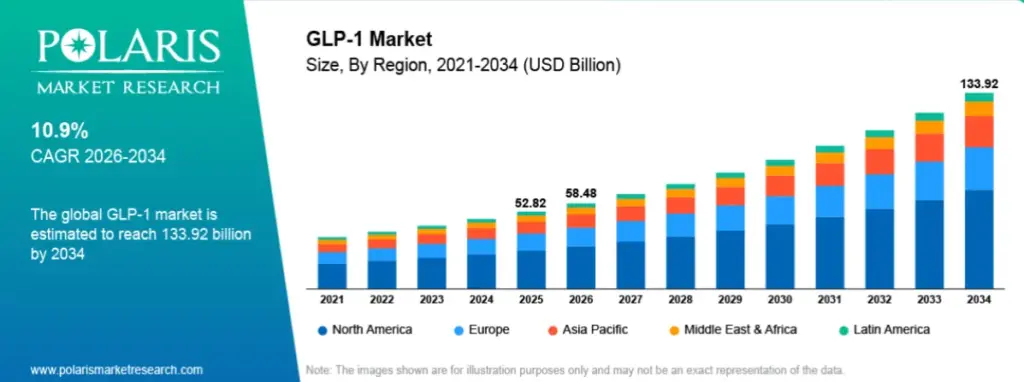
Source: Polaris Market Research
This surge has made manual eligibility screening increasingly difficult to manage. GLP-1 eligibility software helps solve this challenge by automating patient assessments and identifying qualified candidates before clinician review. By streamlining intake workflows and reducing administrative burden, these solutions enable providers to scale operations more efficiently while improving the patient experience.
Rising Prior Auth Hurdles
Securing a GLP-1 prescription is only half the battle. The real hurdle is getting insurance approval. Because these medications are expensive, insurance companies constantly change their coverage rules and introduce stricter criteria to protect their bottom lines. This shifting landscape creates an administrative nightmare for clinics. A single prescription often requires extensive documentation, step therapy verification, and multi-step prior authorization workflows.
The Cost of Manual Processing:
- Clinician Burnout: Staff spend hours on the phone with payers instead of treating patients.
- High Rejection Rates: Simple data entry mistakes lead to immediate insurance denials.
- Patient Abandonment: When approvals take weeks, frustrated patients leave for competitors.
An advanced eligibility platform handles these complexities by integrating real-time payer data. For example, specialized digital health infrastructure platforms like CareValidate automate the intake and eligibility process for metabolic health programs, while dedicated patient platforms like Fridays Health seamlessly embed insurance and prior authorization routing into their virtual care delivery.
The software automatically checks specific insurance rules against the patient’s medical history, ensuring that submitted claims are accurate. Building a platform that solves this friction point creates an incredibly sticky B2B product, as healthcare networks rarely abandon software that directly protects their revenue.
Expanding Patient Access
The landscape of GLP-1 access is shifting. Employers are realizing that covering these medications helps retain top talent, while government programs face growing pressure to expand coverage. At the same time, pharmaceutical companies are developing oral alternatives to injections, making treatment less invasive and appealing to a much broader audience.
As access opens up, eligibility rules will become more fragmented rather than standardized. A patient might qualify under an employer-sponsored plan but face completely different restrictions under a standard commercial policy.
| Driver of Access | Operational Impact | Software Solution |
| New Oral Formulations | Sudden spikes in patient inquiries | Scalable intake engines that process high volume without lag |
| Diverse Payer Rules | Constantly shifting approval criteria | Dynamic rule engines updated instantly via cloud architecture |
| Employer-Sponsored Plans | Custom, localized coverage models | Multi-tenant platforms that support bespoke corporate plans |
What Is GLP-1 Eligibility Software?
At its core, GLP-1 eligibility software acts as an automated digital triage system. It cross-references patient data against clinical guidelines and insurance policies to determine if a patient qualifies for treatment. Instead of relying on a clinician to manually dig through a patient file, the platform collects data directly through structured intake forms and connected medical records.
The system processes specific data points during evaluation:
- Clinical Metrics: The system checks body mass index thresholds alongside related conditions like hypertension, high cholesterol, or cardiovascular disease.
- Contraindications: It instantly screens out patients with a personal or family history of medullary thyroid carcinoma or multiple endocrine neoplasia.
- Medication History: The rules engine verifies if the patient has already tried alternative step therapies required by insurance plans.
- Payer Criteria: The platform cross-checks the patient’s specific insurance policy to see if GLP-1 drugs are covered under their plan design.
By evaluating these factors simultaneously, the software provides an immediate qualification score. This ensures that clinical teams only spend time reviewing patients who meet both medical safety standards and insurance coverage baselines.
Why Providers Adopt Platforms
The administrative burden of managing weight loss and diabetes therapies is overwhelming traditional clinics. Prior authorizations for these drugs are notorious for extensive documentation requirements. When clinic staff handles these forms manually, the process is incredibly slow and highly prone to clerical errors. Providers are migrating to automation because it transforms their daily workflows.
| Step | Manual Flow | Automated Flow |
| 1 | Intake Form Submission | Intake Form Submission |
| 2 | Manual Chart Review | Instant Eligibility & Rule Check |
| 3 | Phone Calls and Verification with Payers | Automated Coverage Verification |
| 4 | Prior Authorization Preparation | Clean Claim Submission |
| 5 | Higher Risk of Errors and Denials | Faster Approval with Fewer Denials |
| Outcome | Slower Patient Access and Increased Administrative Burden | Faster Patient Access and Scalable Operations |
Automated screening fixes the structural inefficiencies that drain clinic profits. By pulling insurance rules directly into the intake workflow, the software flags missing details or conflicting data before submission. This minimizes simple processing errors, accelerates insurance approvals, and allows clinics to onboard thousands of new patients without hiring an army of administrative staff.
The Role of Prior Authorization in GLP-1 Access
Prior authorization is the primary friction point between a patient and their prescribed weight management treatment. For digital health platforms and clinics, navigating these insurance mandates manually creates an expensive bottleneck, which is why the market is turning to automated GLP-1 eligibility software to eliminate delays and streamline patient intake.
Why Is Prior Auth Required?
Insurers use prior authorization as a gatekeeping mechanism to manage the massive financial impact of these medications. Because GLP-1 drugs are expensive long-term therapies, insurance companies want to verify that a patient absolutely needs the treatment before paying for it. They do this by setting up strict medical necessity baselines.
To get over this hurdle, providers must prove a patient meets exact criteria. This usually means submitting documented body mass index histories and lab results showing related conditions like prediabetes. Insurers also check for step therapy, meaning they want proof the patient tried cheaper, traditional weight loss options or older medications first and did not see results.
Provider Prior Auth Challenges
Handling this process manually creates an administrative crisis for healthcare clinics. Every insurance company has its own set of rules, forms, and submission portals. Staff spend hours filling out repetitive paperwork, searching through old medical charts, and waiting on hold with insurance companies to track claims.
The Operational Impacts:
- Documentation Errors: Missing a single lab report or checking the wrong box causes an instant insurance rejection.
- Delayed Treatment: Patients often wait weeks for a decision, leading to frustration and dropped care.
- Drained Revenue: Clinics waste expensive staff hours on administrative tasks rather than patient care.
Software Simplifies Workflows
Eligibility software solves this by converting messy insurance rules into a clear digital checklist. Major platforms like CoverMyMeds have long pioneered this space by connecting providers and pharmacies directly to insurance networks, while newer, specialized platforms like PriorAuth Online build automated workflows specifically tailored to the unique criteria of weight management drugs.
The platform instantly scans the patient profile against current payer requirements before any paperwork is sent. This proactive check ensures every submission is clinically accurate from the start.
| Automated Feature | Impact on Clinic Operations |
| Instant Rule Validation | Catches conflicting data and missing records before submission |
| Smart Form Generation | Populates payer-specific documentation automatically using intake data |
| Direct Payer Routing | Submits files digitally to accelerate response times from insurance companies |
By taking over these repetitive tasks, the software turns a clunky administrative burden into a streamlined, predictable workflow. For investors, this is the core value proposition. The platform protects clinic margins, slashes insurance turnaround times, and provides a smooth onboarding experience that keeps patients retained.
Key Features of a GLP-1 Eligibility Software
To build a highly competitive telehealth network or enterprise healthcare solution, the underlying tech stack must solve real operational bottlenecks. High-performing GLP-1 eligibility software relies on a core suite of advanced clinical and administrative features engineered to automate complex decision-making and protect clinic margins at scale.
1. Rule-Based Eligibility Engine
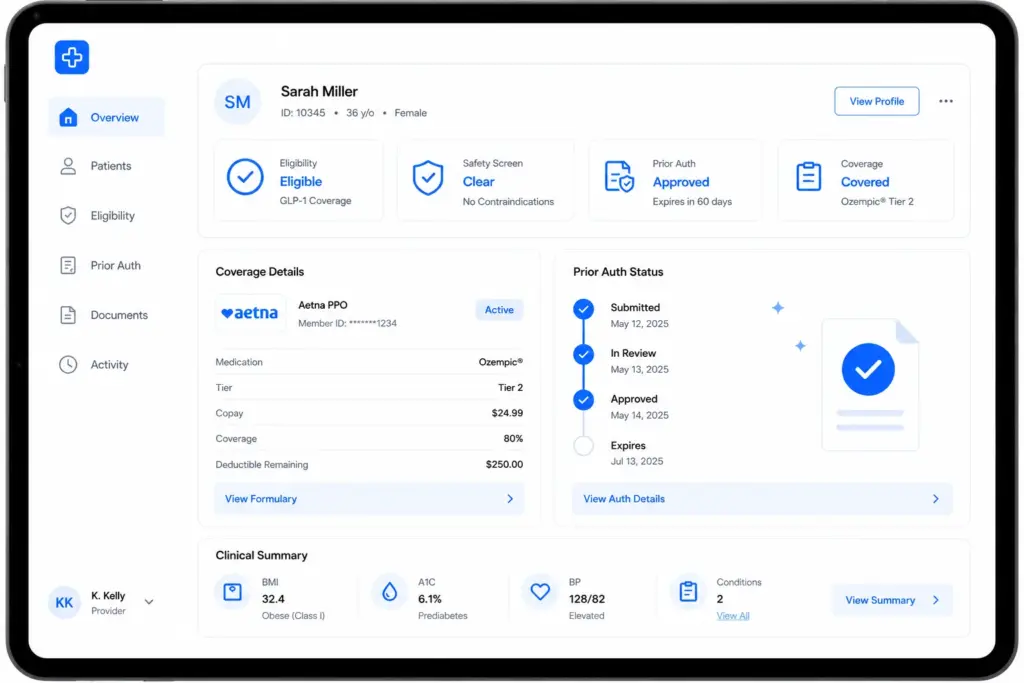
This core engine evaluates patient data against clinical guidelines and insurance criteria to see if a patient qualifies for treatment. Users input patient health profiles during intake, and the software instantly flags whether they meet specific prescribing rules. For instance, platforms like Mojo Health utilize this setup to cross-reference metabolic markers against localized commercial policies.
By running these background checks instantly, care teams know exactly which treatment path to pursue without manually reading through hundreds of pages of insurance booklets.
2. Automated Safety Screening
Safety is a massive priority when prescribing high-impact medications. Clinicians use this feature to run patient medical histories against a database of known drug interactions and health risks. The system flags dangerous red flags like thyroid cancer risks or pregnancy status before a script is even written.
- Risk Detection: Systems like Ro Mind automatically scan electronic charts for hidden contraindications.
- Provider Alert: The software triggers a warning if a patient has conflicting prescriptions.
- Safety Audit: It saves a digital record proving that a complete safety review occurred prior to approval.
3. Multi-Payer Coverage Verification
Billing teams use this tool to verify insurance benefits in real time. Instead of calling insurance companies to check formulary tiers, users run an automated query to see if a specific GLP-1 brand is covered under the patient’s plan design. This transparency helps providers choose the exact medication variant that gives the patient the highest chance of insurance coverage, preventing abandoned prescriptions down the line.
| Platform Example | Real-Time Action | Operational Benefit |
| Surescripts | Pulls up-to-date formulary data | Eliminates surprise costs at the pharmacy counter |
4. Smart Prior Auth Automation
This feature transforms how administrative teams handle paperwork. When an insurance company requires a formal review, users activate the automated submission sequence to compile and deliver the packet digitally. Platforms like Rhino Health specialize in this automation by mapping out payer requirements dynamically.
The software populates the required fields using data from the patient intake form, runs a quick validation check to ensure no fields are blank, and routes the completed application directly to the insurance portal.
5. Dynamic Documentation Generator
Insurers require explicit proof of medical necessity before paying for care. Care coordinators use this tool to instantly build formatted appeals and clinical summaries without typing them from scratch. For example, Form Health utilizes integrated document builders that pull clinical data straight from the patient chart to draft customized medical necessity letters.
This ensures that every piece of supporting documentation matches the exact wording and layout that claims adjusters look for, drastically lowering the chance of a structural denial.
6. Provider Decision Dashboard
Clinicians use this centralized control center to monitor their entire patient pipeline at a glance. Instead of clicking through individual charts, medical staff see a clean list showing who is cleared for care, who is pending insurance review, and who needs follow-up tasks. Platforms like Alfie Health focus heavily on this interface design, giving multi-state clinical operations a clear way to track workflow steps and assign tasks to administrative staff efficiently.
7. Real-Time Approval Analytics
Executive teams and investors use this analytics suite to track macro performance across the entire platform. The system compiles data on which insurance companies approve claims quickly and which ones frequently deny coverage. These insights help organizations optimize payer strategies, improve approval rates, and identify operational bottlenecks before they impact growth.
Key Metrics Tracked:
- Approval Rates: Shows the percentage of clean claims passed on the first attempt.
- Denial Trends: Groups rejections by specific reasons to find flaws in the intake questions.
- Throughput Speed: Tracks how many hours it takes to move a patient from intake to an approved prescription.
By leveraging platforms like Calibrate, operations managers can spot bottlenecks in their clinical workflows, tweak their screening rules, and continuously improve the financial performance of their medical programs.
Advanced Features to Improve a GLP-1 Eligibility Software
To build a dominant enterprise solution, a platform must look beyond basic data entry forms. Next-generation GLP-1 eligibility softwares integrate advanced, data-driven automation modules that transform raw medical intake records into predictive, highly optimized clinical workflows.
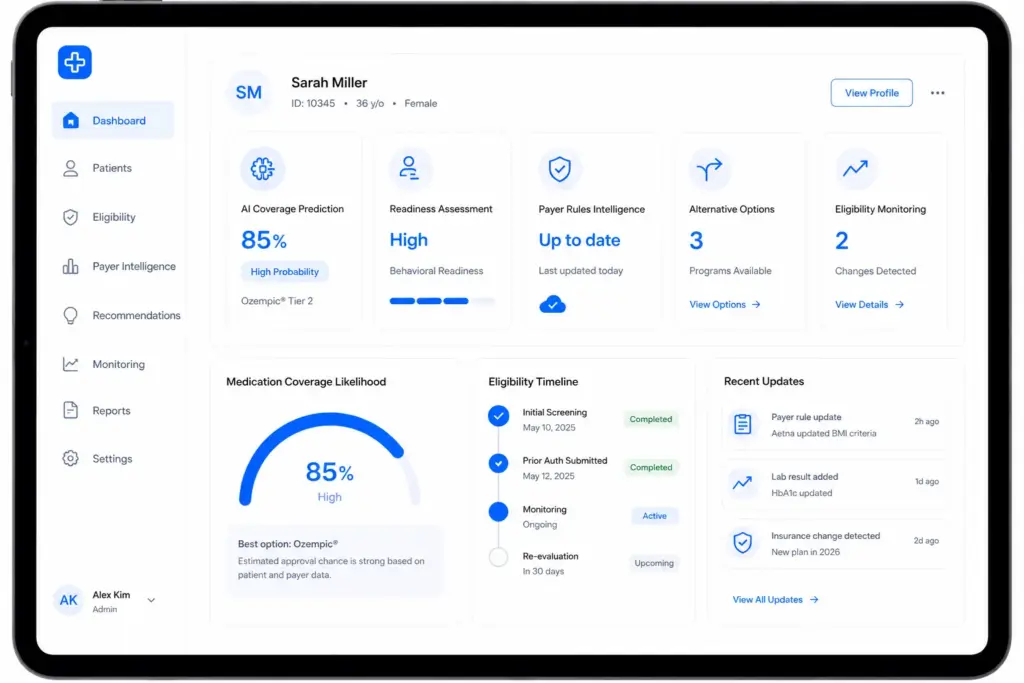
1. AI-Powered Coverage Prediction
Leading platforms are shifting from simple checklist processing to advanced statistical modeling to predict the likelihood of an insurance approval before a prior authorization form is submitted. The system analyzes local payer response histories and patient diagnostic files to calculate an instant probability score for specific medications.
Clinical intake specialists use this prediction data to steer patients toward the path of least resistance from day one. For instance, Found leverages integrated historical claim analysis to choose the medication variant with the highest baseline likelihood of payer acceptance. This prevents the clinic from wasting weeks tracking down an authorization that was mathematically doomed to fail.
2. Personalized Readiness Assessment
A long-term treatment plan requires substantial structural changes from the patient to be effective. Instead of evaluating physical health metrics alone, the platform runs qualitative assessments to determine if a patient possesses the behavioral readiness required to maintain treatment over time.
- Behavioral Tracking: Platforms like Vida Health utilize structured psychological intake screens directly inside the patient mobile application.
- Clinician Visibility: Medical staff use these insights to pinpoint which applicants require additional health coaching alongside their prescriptions.
- Patient Selection: The engine flags patients with high-risk profiles, allowing providers to address lifestyle foundations first.
3. Adaptive Payer Rules Intelligence
Insurance coverage criteria are anything but permanent. Payers adjust their body mass index thresholds and step therapy rules frequently to manage costs, turning traditional static software architecture into a massive liability. Advanced platforms bypass this by utilizing cloud-based rule scrapers that dynamically modify intake logic whenever an insurance network publishes a policy update.
Operations managers at platforms like NextMed rely on this self-updating framework to process thousands of applications across multiple states without manual software code updates. The software automatically shifts its entry barriers in real time, keeping claims compliant with current corporate policies.
4. Alternative Therapy Recommendations
When an applicant fails to clear the tight coverage hurdles required for an expensive injection, the software must avoid delivering a dead end that causes the patient to abandon the digital care network entirely. Care coordinators use this recommendation logic to retain non-qualifying patients by immediately routing them to secondary lifestyle management programs. This structure ensures that every marketing dollar spent on patient acquisition yields a viable clinical care path, preserving customer lifetime value for the business.
| Screening Outcome | System Action | Patient Pathway |
| GLP-1 Disqualification | Omada Health matching engine triggers alternative pathways | Routes user to clinically backed behavioral programs or non-GLP-1 medications |
5. Longitudinal Eligibility Monitoring
Eligibility is a moving target influenced by changing medical metrics or shifting insurance plan renewals. Instead of treating the evaluation as a one-time screening, the platform continuously tracks patient records in the background. Care teams use this background tracking to re-engage past applicants who initially failed screening.
For example, telehealth services like PlushCare use passive monitoring to flag when an individual’s updated lab panels or new employer insurance updates cross into the approval zone. This creates high-conversion clinical touchpoints without requiring cold sales outreach.
6. Behavioral Health Qualification
Medication is far more successful when paired with sustainable lifestyle changes. To manage this combination, advanced platforms integrate structural evaluation systems that grade emotional health, accountability levels, and diet histories alongside traditional lab reports. For example, Noom Med uses specialized clinical intake forms to evaluate psychological variables and lifestyle patterns before clearance.
Medical practitioners use this comprehensive data to ensure patients are structurally prepared for the rapid metabolic changes caused by the therapy. For investors, this dual tracking framework reduces early drop-out rates, which protects long-term subscription revenue.
7. Population Opportunity Analytics
Built explicitly for benefit managers, enterprise employers, and corporate healthcare planners, this macro data suite identifies entire groups of individuals within an organization who could benefit from metabolic health interventions. Human resource professionals use platforms like Wondr Health to evaluate aggregate corporate health claims data and project exactly how many staff members are eligible for treatment.
This allows enterprise buyers to accurately forecast upcoming medication spending, negotiate bulk pricing, and design targeted wellness incentives that optimize healthcare investments across their entire workforce.
Cost Impact of Different Features in a GLP-1 Eligibility Software
To build an institutional-grade platform, investors must look closely at development costs across various GLP-1 eligibility software. Allocating capital efficiently means distinguishing the baseline framework from advanced features that scale market valuation. A clear understanding of these cost drivers helps prioritize investments that deliver the highest long-term return and competitive advantage..
MVP Core Feature Costs
Foundational software modules account for the initial wave of development capital. This tier focuses entirely on launching a functional, compliant screening system that a clinic can deploy safely. It provides the absolute minimum structural framework needed to handle patient intake safely without manual paper forms.
| Core MVP Feature | Operational Purpose | Development Cost Range |
| Patient Intake Forms | Captures patient demographics, medical history, and current symptoms | $15,000 – $22,000 |
| Eligibility Rule Engines | Processes intake data against basic prescribing parameters | $18,000 – $28,000 |
| BMI Verification Module | Calculates and logs weight-to-height metrics for clinical validation | $8,000 – $12,000 |
| Contraindication Screening | Flags high-risk medical histories or dangerous drug interactions | $10,000 – $16,000 |
| Provider Dashboards | Gives clinicians a centralized workspace to view baseline approvals | $9,000 – $17,000 |
Developing these foundational components requires an investment of $60,000 to $95,000. This baseline deployment allows a brand to enter the market quickly, test its workflow mechanics with real users, and gather data before investing heavily in deep technical integrations.
Integration and Compliance Costs
Moving beyond a closed system requires connecting directly with the broader healthcare infrastructure. These essential integrations protect patient privacy and connect your platform to real-time clinical and insurance data streams.
Key Technical Infrastructure Investments:
- Data Liquidity: Syncing data with hospital medical records ensures that clinicians have an updated view of a patient’s long-term history.
- Coverage Transparency: Direct connections to payer insurance databases eliminate manual phone calls to verify benefits.
- Legal Protections: Hardening the core codebase satisfies federal privacy mandates regarding protected health data.
| Integration & Compliance Feature | Engineering Focus | Implementation Cost Range |
| EHR Integrations | Connecting to Epic, Cerner, or Athenahealth via secure FHIR APIs | $25,000 – $40,000 |
| Insurance Verification APIs | Hooking into networks like Change Healthcare for real-time status | $15,000 – $25,000 |
| E-Prescribing Systems | Embedding secure prescription routing via networks like DoseSpot | $12,000 – $20,000 |
| HIPAA Compliance Controls | Implementing field-level data encryption and secure key hosting | $14,000 – $22,000 |
| Audit Logging & RBAC | Tracking every data change based on custom staff permission levels | $10,000 – $18,000 |
| Prior Authorization Links | Syncing submitted intake files straight into portal submission lines | $20,000 – $35,000 |
Adding these enterprise connections increases the overall budget by $96,000 to $160,000. While these connectivity layers add noticeable development time, they are completely non-negotiable if your business plan involves selling the software directly to large hospital networks or regional healthcare clinics.
Premium AI Development Costs
Building an enterprise-grade platform with a true competitive advantage requires investing in machine learning and deep data architecture. This level elevates your tool from a passive utility into an intelligent, high-margin software asset. Developing these premium automation layers requires a dedicated investment of $155,000 to $250,000.
| Premium Advanced Feature | Data Infrastructure Focus | Premium Cost Range |
| Approval Prediction Models | Training algorithms on historical regional prior auth outcomes | $45,000 – $70,000 |
| AI Eligibility Recommendations | Smart suggestions for treatment alternatives based on failure patterns | $35,000 – $55,000 |
| Payer Rule Intelligence | Deploying dynamic web scrapers to detect sudden insurance updates | $30,000 – $50,000 |
| Population Analytics Portal | Aggregated data visualization dashboards for corporate HR buyers | $25,000 – $40,000 |
| Automated Document Generator | Compiling customized medical necessity letters from chart histories | $20,000 – $35,000 |
The higher price tag reflects the need for senior data scientists, specialized cloud data architecture, and continuous model testing. For a strategic investor, this capital expenditure creates a highly proprietary software asset that protects its market share against generic copycats.
Employer Coverage Trends Are Driving GLP-1 Software Demand
Employers are becoming major stakeholders in the healthcare software ecosystem. As self-insured organizations foot the bill for their workforce, the financial reality of weight management therapies is forcing corporate leaders to demand structural guardrails. Eligibility software helps provide that control by ensuring benefits are directed to employees who meet established coverage criteria.
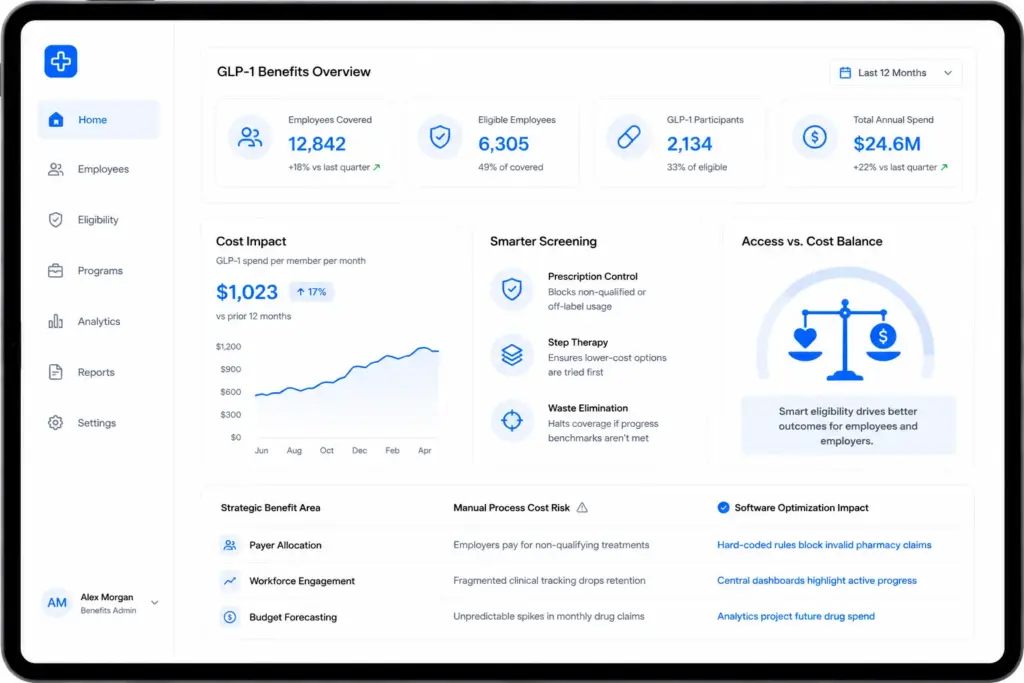
1. Expanding GLP-1 Benefits Programs
As demand for GLP-1 therapies continues to rise, more employers are adding weight management benefits to their healthcare plans. While these programs can improve employee satisfaction and retention, they also increase healthcare spending. This makes eligibility verification an important step before treatment begins.
Many organizations use platforms such as Accolade to automate screening and manage benefit costs more effectively. The opportunity is significant, with Accolade generating roughly $447M in annual revenue, highlighting the growing demand for solutions that help employers scale these programs responsibly.
2. Rising Costs Drive Smarter Screening
GLP-1 therapies represent a significant recurring expense for employer-sponsored health plans. With wholesale pricing regularly exceeding $1,000 per patient every single month, unmonitored prescribing workflows can quickly decimate a mid-sized corporation’s annual healthcare budget. This financial pressure is driving the shift toward intelligent, software-driven gatekeeping.
Corporate benefit planners are migrating away from simple, honor-system intake forms. They require software that verifies true clinical need by cross-referencing multi-month weight histories and secondary health markers before authorizing a pharmacy payout.
- Prescription Control: Platforms instantly flag and block off-label cosmetic usage.
- Step Therapy Reinforcement: The software ensures employees exhaust lower-cost metabolic options first.
- Waste Elimination: Systems automatically halt coverage if a patient fails to meet specific weight-loss benchmarks over a 90-day period.
3. Balancing Access and Cost Control
The ultimate goal for modern enterprise clients is achieving an equilibrium between employee health satisfaction and corporate cost management. Eligibility tools allow businesses to achieve this balance by translating complex medical guidelines into strict, automated software guardrails.
This optimization space has paved the way for dedicated clinical management engines like Vida Health. The platform blends automated medical eligibility checks with required virtual health coaching to ensure expensive medications are reserved for employees who actively participate in lifestyle changes.
| Strategic Benefit Area | Manual Process Cost Risk | Software Optimization Impact |
| Payer Allocation | Employers pay for non-qualifying treatments | Hard-coded rules block invalid pharmacy claims |
| Workforce Engagement | Fragmented clinical tracking drops retention | Central dashboards highlight active employee progress |
| Budget Forecasting | Unpredictable spikes in monthly drug claims | Aggregate population analytics project future expense |
Can GLP-1 Softwares Reduce Denials and Increase Approval Rates?
Navigating insurance hurdles is the single largest operational bottleneck for digital health providers. High-performance GLP-1 eligibility software directly resolves this challenge by converting complex insurance rules into an automated, error-free pre-submission workflow that maximizes authorization success.
1. Early Error Detection
Missing clinical metrics or submitting requests for patients who fall just outside insurance thresholds accounts for the vast majority of instant denials. Automated screening systems prevent these human errors by running extensive background validation before paperwork ever reaches an insurance adjuster.
By deploying advanced automation platforms like HealOS, administrative staff can instantly cross-reference a patient’s historical weight metrics, lab values, and active comorbidities against real-time payer policies. This upfront verification allows your team to catch errors early, pause incomplete files, and dedicate valuable time exclusively to cases with a high baseline probability of approval.
2. Quality Documentation
Insurance reviewers look for explicit, objective proof of clinical need before approving coverage for high-cost metabolic therapies. Eligibility tools remove the guesswork from this process by standardizing chart histories into data-dense submission packets that perfectly match insurer formats.
- Data Auto-Population: Pulls body mass index charts, diagnostic codes, and previous medication trial logs directly from integrated health records.
- Step Therapy Evidence: Automatically structures verifiable timelines proving the patient has already exhausted lower-cost weight management alternatives.
- Custom Justification: Generates customized letters of medical necessity that address the specific phrasing requirements of local commercial health plans.
Using software like CoverMyMeds to handle electronic prior authorizations allows providers to drop old manual fax methods completely. This technical approach guarantees that every required field is filled correctly on the first attempt, drastically reducing administrative delays and structural document rejections.
3. Workflow Optimization
A truly optimized eligibility platform does more than just parse standard intake forms. Advanced analytics engines continuously track active claims pipelines, grouping insurance outcomes by specific payers, geographic regions, and rejection codes. This visibility helps organizations identify approval trends, reduce denial rates, and improve operational efficiency over time.
| Monitoring Vector | Manual Process Risk | Software Optimization Impact |
| Payer Policy Shift | Outdated criteria trigger surprise waves of denials | Dynamic rules scrapers update intake fields instantly |
| Denial Pattern Analysis | Care teams repeat identical paperwork mistakes | Dashboard insights flag the exact root cause of rejections |
| Conversion Progress | Patients get lost in complex approval loops | Automated alerts show staff which cases require fast action |
Top 5 GLP-1 Eligibility Software in the USA
The demand for GLP-1 treatments has created a new wave of software solutions designed to simplify patient eligibility and access. The best platforms stand out by improving approvals, patient outcomes, or treatment adherence. Exploring these platforms helps reveal the features and strategies that are driving success in this fast-growing market.
1. Vida Health
Vida Health combines GLP-1 eligibility assessment, obesity care, behavioral coaching, and medication management into a single platform. A standout feature is its readiness-for-change evaluation, which helps determine whether patients should begin GLP-1 therapy, start with lifestyle interventions, or pursue alternative treatments. The platform is widely used by employers and health plans to manage access to weight-loss medications while improving long-term outcomes.
2. FlyteHealth (formerly Intellihealth)
FlyteHealth focuses on evidence-based obesity management and structured eligibility pathways for anti-obesity medications. Its differentiator is a comprehensive obesity treatment model that combines clinical eligibility screening, medication prescribing, and long-term patient monitoring. The platform helps organizations identify suitable GLP-1 candidates while ensuring adherence to treatment protocols.
3. Form Health
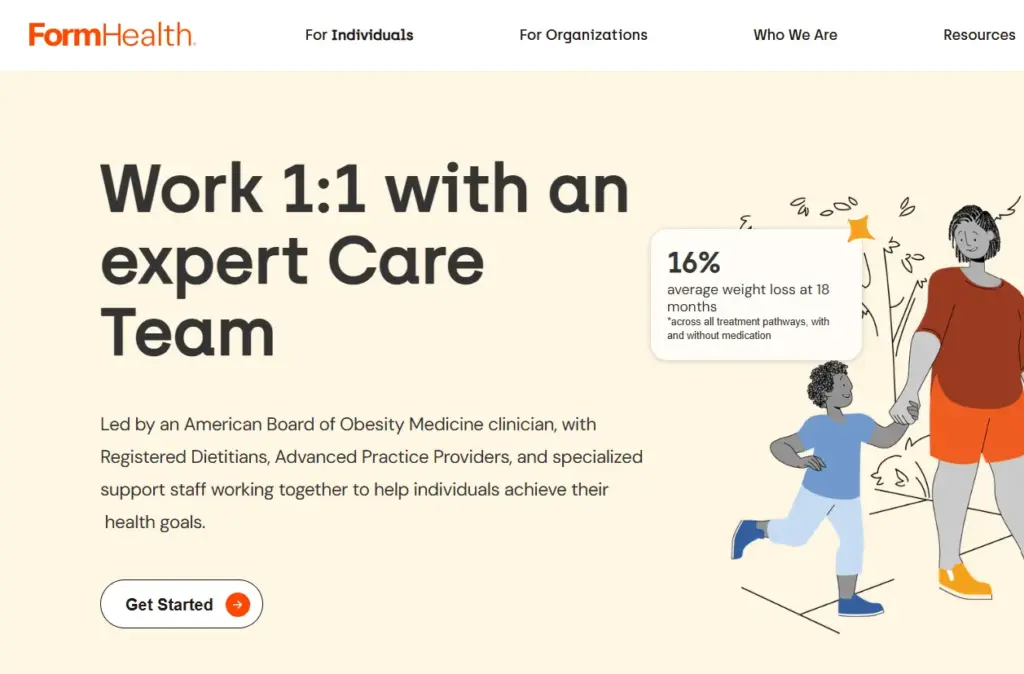
Form Health offers physician-led weight management programs that include eligibility evaluation for GLP-1 therapies. What sets it apart is its specialist-driven clinical review process, where obesity medicine physicians assess patient suitability rather than relying solely on automated screening. This approach improves clinical oversight and personalized treatment planning.
4. Omada Health
Omada Health integrates GLP-1 support within a broader cardiometabolic care ecosystem. Its unique capability is longitudinal patient engagement and adherence management, helping organizations track patients before, during, and after GLP-1 therapy. This focus on sustained outcomes makes it popular among employers seeking long-term obesity management solutions.
5. Noom Health
Noom Health combines medication eligibility workflows with its well-known behavioral change platform. Its standout feature is behavioral risk and lifestyle analysis, which helps determine whether patients are appropriate candidates for GLP-1 medications while simultaneously addressing dietary and psychological factors that influence treatment success.
Build a GLP-1 Eligibility Software with Idea Usher
To stay ahead in a fast-moving healthcare market, standard off-the-shelf templates simply are not enough. Idea Usher designs custom systems tailored specifically to your medical operations and business goals. With over 500,000 hours of coding experience, our team of ex-MAANG and FAANG developers builds reliable infrastructure engineered to optimize clinical workflows and scale with your user growth.
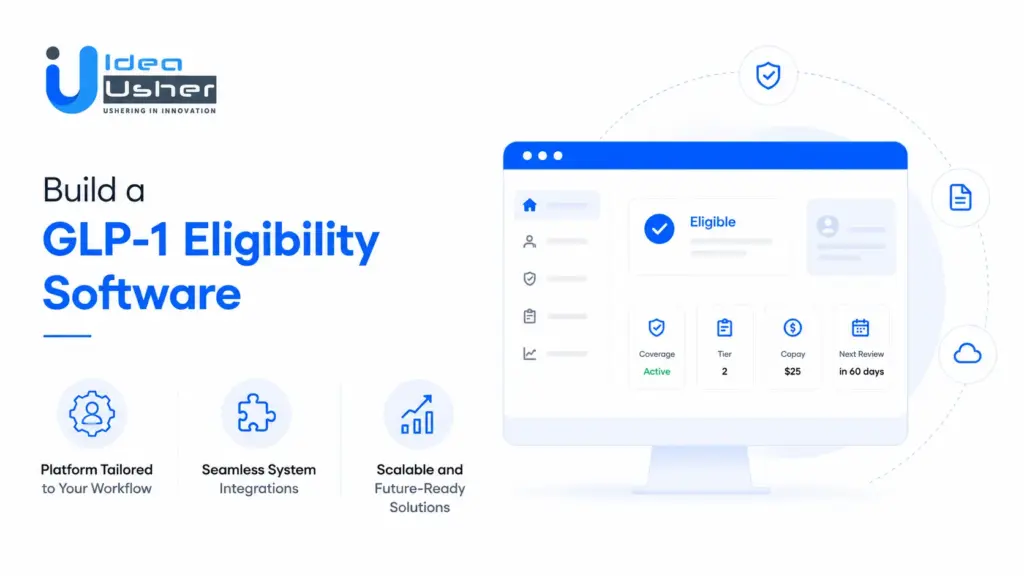
Platform Tailored to Your Workflow
Every digital health enterprise or brick-and-mortar clinic follows unique clinical pathways and internal intake protocols. A cookie-cutter software application forces your staff to alter their habits, creating operational friction and slowing down patient onboarding. We engineer custom software logic that mirrors your exact care model.
Whether you require custom multi-stage screening forms or unique risk-scoring algorithms, our developers code matching backend frameworks. This precision ensures your medical teams work efficiently without dealing with clumsy, unnecessary software steps.
Seamless System Integrations
A standalone screening form cannot survive long without connecting to the broader medical network. True automation requires a unified data pipeline that bridges the gap between active patient charts, pharmacy networks, and insurance clearinghouses.
- EHR Core Connectivity: We sync your platform with internal medical databases using secure FHIR APIs to auto-populate patient records instantly.
- Live Payer Feeds: Our team integrates real-time eligibility check APIs to verify patient formulary tiers on the spot.
- Prescription Direct Routing: We embed secure electronic prescribing interfaces to transmit approved medication requests straight to regional pharmacies.
Connecting these systems removes manual data entry mistakes, saves hours of admin work, and speeds up the time it takes for a patient to get their medication.
Scalable and Future-Ready Solutions
Clinical guidelines for weight management medications adjust frequently as new research and pharmaceutical updates enter the market. Your underlying codebase must be flexible enough to handle sudden shifts in insurance policies, body mass index requirements, or surging patient sign-ups.
| Growth Metric | Static Template Risk | Idea Usher Custom Architecture |
| Payer Rule Updates | Code crashes or requires manual rebuilds | Dynamic cloud rule updates adapt instantly |
| Spikes in User Traffic | Server slowdowns stall medical staff | Auto-scaling cloud nodes keep performance fast |
| New Medical Features | Limited by locked software ecosystems | Modular code blocks let you add features easily |
Idea Usher utilizes flexible microservices architecture to ensure your investment remains valuable long after launch. We build your platform from the ground up to handle high volumes of concurrent data requests, allowing you to scale your patient network and expand your healthcare business smoothly.
Conclusion
GLP-1 eligibility software should do more than simply determine whether a patient qualifies for treatment. The most effective platforms streamline the entire intake and approval journey, helping providers reduce administrative work while giving patients faster access to care. Features such as automated eligibility checks, insurance verification, prior authorization support, and performance analytics create a scalable foundation that can keep pace with the rapidly growing demand for GLP-1 therapies.
Things to Know About GLP-1 Eligibility Softwares
Q1: Who typically uses GLP-1 eligibility software?
A1: A wide range of organizations use these platforms, including obesity clinics, telehealth providers, hospitals, health plans, and employers that offer weight management benefits. Digital health startups are also increasingly investing in GLP-1 eligibility solutions as demand for weight-loss medications continues to grow. For these organizations, the software serves as a bridge between patient screening, insurance approval, and treatment initiation.
Q2: Can the software automate prior authorizations?
A2: Yes, and this is often one of the biggest reasons organizations adopt these platforms. Prior authorization is one of the most time-consuming parts of the GLP-1 prescribing process because insurers require extensive documentation before approving coverage. GLP-1 eligibility software can automatically collect patient information, identify missing requirements, generate supporting documents, and prepare authorization requests. This helps reduce delays and improves the chances of approval.
Q3: What integrations are important for a GLP-1 eligibility platform?
A3: Integrations play a major role in creating a seamless workflow. Most platforms connect with EHR or EMR systems to access patient records, while insurance verification services help confirm coverage in real time. Some solutions also integrate with laboratory systems, telehealth platforms, pharmacy networks, and e-prescribing tools. These connections reduce manual data entry and allow providers to manage the entire eligibility process from a single platform.
Q4: Why choose custom development over off-the-shelf software?
A4: Off-the-shelf solutions can be useful for organizations with standard workflows, but they often have limitations when it comes to customization. Custom development allows businesses to build eligibility logic, approval workflows, and reporting features that align with their specific operational needs. It also provides the flexibility to add new capabilities as payer requirements, treatment guidelines, and business goals evolve over time.