


Key Takeaways
- Businesses in 2026 are investing in custom AI applications to automate operations, improve productivity, and reduce operational costs.
- Key AI development services include generative AI, AI agents, predictive systems, computer vision, and AI integrations.
- Enterprise AI frameworks like LangChain and CrewAI help businesses build scalable and intelligent automation systems.
- Custom AI development offers stronger long-term advantages compared to relying on generic off-the-shelf AI software.
- How Idea Usher can help businesses build secure AI applications using pre-vetted developers, enterprise infrastructure, and multi-agent architectures.
For corporate decision-makers investing in custom AI application development services, the focus has shifted from proving AI can work to ensuring long-term cost predictability and strong data security. Many enterprise AI projects struggle after deployment because businesses focus too much on initial development costs while overlooking ongoing expenses tied to AI performance issues, changing data quality, and rising API usage costs.
To protect investments and build a truly scalable digital asset, companies should partner with AI development providers that offer flexible AI architectures, secure private infrastructure, and reliable systems for continuous testing and optimization.
Over the years, we’ve helped businesses build advanced AI applications powered by modern frameworks, intelligent automation, and scalable cloud infrastructure. In this guide, we’ll explore AI application development services in 2026, including frameworks, development costs, and how businesses can choose the right AI vendors.
Why Are Businesses Investing Aggressively in AI Apps?
According to Grand View Research, the global AI apps market size was estimated at USD 2,940.0 million in 2024 and is projected to reach USD 26,362.4 million by 2030, growing at a CAGR of 38.7% from 2025 to 2030. This massive capital reallocation is driven by clear economic incentives, with a landmark PwC study projecting that AI will contribute up to 15.7 trillion dollars to the global GDP by 2030 through 6.6 trillion dollars in productivity gains and 9.1 trillion dollars in consumer enhancements.
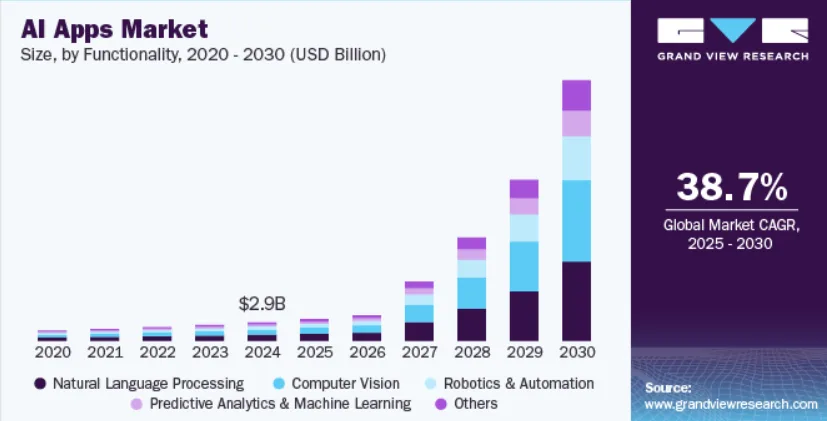
Source: Grand View Research
For capital allocators and entrepreneurs, this signals a fundamental market restructuring and a strategic race for structural alpha. Forward-thinking businesses are rapidly moving away from generic, off-the-shelf software, choosing instead to invest in bespoke, proprietary AI ecosystems that eliminate core operational friction and secure long-term market value.
Productivity Gains
The foundational metric driving enterprise AI investments is the compression of labor hours required to execute complex tasks. According to extensive research by the McKinsey Global Institute, generative AI and advanced automation architectures have the potential to automate activities that absorb 60 to 70 percent of employees’ time today.
By integrating specialized AI applications into corporate workflows, organizations augment their human capital, shifting highly compensated professionals away from low-leverage execution and toward strategic decision-making. In practice, these productivity gains manifest as a direct acceleration of operational velocity:
- Knowledge Work Augmentation: In sectors like legal, finance, and software engineering, proprietary AI apps can analyze thousands of pages of compliance documents, draft foundational contracts, or crystallize legacy codebases in seconds. These tasks previously required weeks of manual billable hours.
- Asset Optimization: Enterprise platforms use predictive models to determine optimal resource deployment, ensuring that capital assets, raw materials, and human resources are utilized at maximum capacity without friction or scheduling lag.
- Accelerated Innovation Cycles: By utilizing AI for data synthesis and predictive modeling, companies compress product development lifecycles, allowing new offerings to hit the market in quarters rather than years.
Cost Reduction
At the balance sheet level, AI applications serve as deflationary engines that permanently lower operating expenses while scaling output. Unlike traditional software that scales linearly with seat licenses, custom AI solutions scale sub-linearly to deliver substantial margin expansion and economies of scale.
According to McKinsey, these financial efficiencies stem from structural reductions in overhead across commercial operations, marketing, and supply chains. IBM data confirms this trend, showing that over 50% of deploying organizations realize immediate cost savings by replacing fragmented legacy software with centralized, intelligent workflows that require fewer third-party integrations and minimal manual oversight.
Customer Experience
In highly commoditized markets, user retention and lifetime value dictate enterprise valuations. Traditional customer experience architectures are limited by human throughput, resulting in restrictive operational hours, inconsistent service quality, and delayed resolutions. Custom AI applications eliminate these constraints by providing hyper-personalized, context-aware user interactions at a fraction of the cost.
- Predictive Personalization: Modern AI applications analyze behavioral telemetry, historical purchase patterns, and real-time intent to predict consumer needs before they are explicitly stated. This level of insight drives conversion rates up and reduces churn.
- Cognitive Customer Support: Transitioning past rigid, rule-based chatbots, businesses are investing in sophisticated natural language processing applications that handle complex, multi-turn negotiations, technical troubleshooting, and account management without human intervention. A prominent example includes Klarna’s deployment of an AI assistant that handles two-thirds of customer service chats within its first month, performing the work of 700 full-time agents while maintaining high customer satisfaction.
- Dynamic Pricing and Incentivization: In B2B and high-value B2C environments, AI engines continuously optimize pricing models, discount structures, and contract terms in real time based on systemic demand and individual risk profiles, maximizing margin capture per customer.
Operational Automation
The enterprise landscape is historically bogged down by fractured middleware and manual data pipelines, making operational automation a prime target for tech-forward investors. Deep-tier automation via AI applications transforms siloed departments into self-optimizing, closed-loop systems. IBM data reveals that nearly a third of global IT professionals report saving critical business hours through automated AI software, moving past simple robotic process automation into autonomous, end-to-end agentic workflows.
Practical enterprise deployments showcase this immense scalability. In healthcare administration, specialized applications automate patient data processing and route critical insights directly to clinicians. Similarly, in supply chain logistics, advanced AI apps track shifting weather, recalculate transit routes, renegotiate carrier contracts, and update inventory forecasting models without requiring a single manual keystroke.
Competitive Pressure
The aggressive capital flowing into AI application development is fueled by defensive necessity and competitive survival. The breakneck market growth rate, evidenced by the projected 38.7% CAGR through 2030, indicates that early adopters are rapidly compounding their advantages. Because machine learning models improve iteratively based on the data they ingest, the businesses that deploy proprietary applications today secure a structural data flywheel that lagging competitors will find mathematically impossible to replicate.
In the institutional investment arena, companies that fail to integrate AI into their core infrastructure face rapid obsolescence. An AI-enabled competitor can price services more aggressively due to lower operational costs, bring products to market faster due to compressed development cycles, and offer a superior user experience.
Core AI Development Services Enterprises Actually Need
Capital allocators must distinguish between experimental novelties and foundational enterprise infrastructure. Building an enterprise-grade AI ecosystem requires targeted development services that map directly to balance-sheet impact.
The following architectural breakdown defines the core capabilities high-growth businesses and institutional investors should target to build a sustainable, tech-driven competitive advantage.
1. Generative AI App Development
Generative AI app development has evolved past basic consumer-facing text generation. Modern enterprises require highly tailored application layers built on top of customized LLMs. These proprietary frameworks are designed to ingest secure corporate data repositories, enabling businesses to scale internal expertise, automate complex document processing, and eliminate knowledge retrieval bottlenecks.
Strategic Value Proposition: By capturing and scaling institutional knowledge, these systems ensure that critical operational intelligence remains an enterprise asset rather than tribal knowledge held by individual employees.
- Technological Architecture: Custom Retrieval-Augmented Generation (RAG) pipelines, proprietary foundational model fine-tuning, and secure enterprise data masking layers.
- Common Use Cases: Automated document processing engines, secure internal legal compliance auditors, and conversational business intelligence tools. Consider how Bloomberg developed BloombergGPT, a specialized generative system tailored specifically for financial data analysis, sentiment tracking, and risk reporting.
2. AI Agent Development
While standard applications rely on strict user prompts, AI agents operate autonomously to achieve macro-level business objectives. These systems are engineered to observe an environment, make discrete decisions, and execute multi-step workflows across fragmented software ecosystems without continuous human intervention. For investors looking to maximize operational leverage, autonomous agents represent the highest potential return on capital.
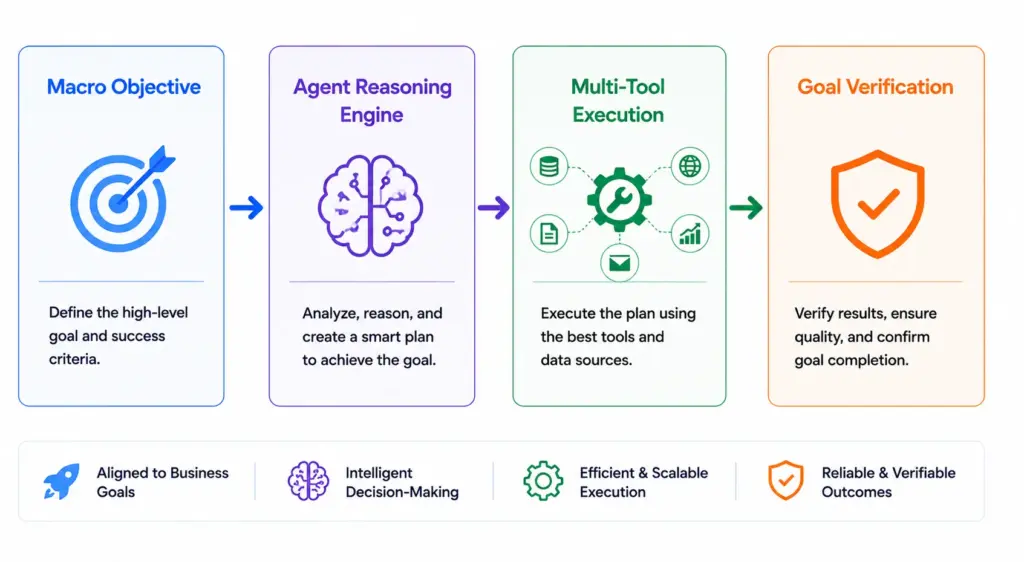
These agentic systems leverage iterative reasoning loops. When handed a complex operational goal, the agent breaks the task into logical sub-tasks, selects the appropriate enterprise software tools, executes the actions, and double-checks the output against pre-set quality metrics before finalizing the pipeline.
- Technological Architecture: Autonomous goal-seeking loops, advanced tool-use frameworks, and dynamic error-correction algorithms.
- Common Use Cases: End-to-end customer resolution systems, automated vendor negotiation pipelines, and autonomous financial reconciliation. A powerful example is Devin, an autonomous AI software engineer capable of navigating complex codebases, learning new technologies, and debugging full-stack web applications completely independently.
3. Predictive AI Systems
Predictive AI systems utilize machine learning models to identify hidden patterns within massive, historical datasets to forecast future business conditions. This is the bedrock of proactive capital allocation. Instead of reacting to market shifts after they appear in quarterly reports, enterprises use predictive engines to optimize inventory, mitigate risk, and capture margin anomalies before competitors realize they exist.
| Attribute | Legacy Analytics | Predictive AI Systems |
| Focus | Historical reporting and descriptive summaries. | Forward-looking probabilistic forecasting. |
| Data Ingestion | Structured, static database inputs. | Continuous, unstructured real-time telemetry. |
| Value | Explains what happened in the business. | Prescribes how to prepare for what happens next. |
- Technological Architecture: Deep learning time-series models, regression analysis frameworks, and real-time anomaly detection pipelines.
- Common Use Cases: Algorithmic demand forecasting, predictive equipment maintenance schedules, and systemic fraud detection. In the energy sector, companies deploy platforms like Shell’s predictive asset maintenance system, which monitors telemetry across thousands of pieces of industrial equipment to anticipate asset failures days before they occur.
4. Computer Vision Solutions
Computer vision solutions translate visual data into actionable business intelligence. By processing imagery, video feeds, and spatial data, these visual AI systems automate quality control, safety compliance, and asset tracking. This capability bridges the gap between digital software and physical enterprise operations.
[Visual Data Capture] ➔ [Neural Network Edge Processing] ➔ [Automated System Response]
- Technological Architecture: Convolutional Neural Networks (CNNs), edge-computing deployment models, and automated spatial segmentation algorithms.
- Common Use Cases: High-throughput manufacturing defect isolation, automated medical imaging diagnostic assistance, and real-time physical security analytics. Amazon Go’s “Just Walk Out” shopping technology serves as a prime deployment example, utilizing advanced visual arrays and deep learning algorithms to automatically track inventory changes as customers interact with products in real time.
5. AI Integration Services
An AI model isolated from existing data streams is an expensive science project. AI integration services focus entirely on embedding cognitive capabilities into legacy enterprise resource planning systems, customer relationship management architectures, and proprietary databases. This service ensures that intelligence flows seamlessly across the existing technology stack without disrupting day-to-day operations.
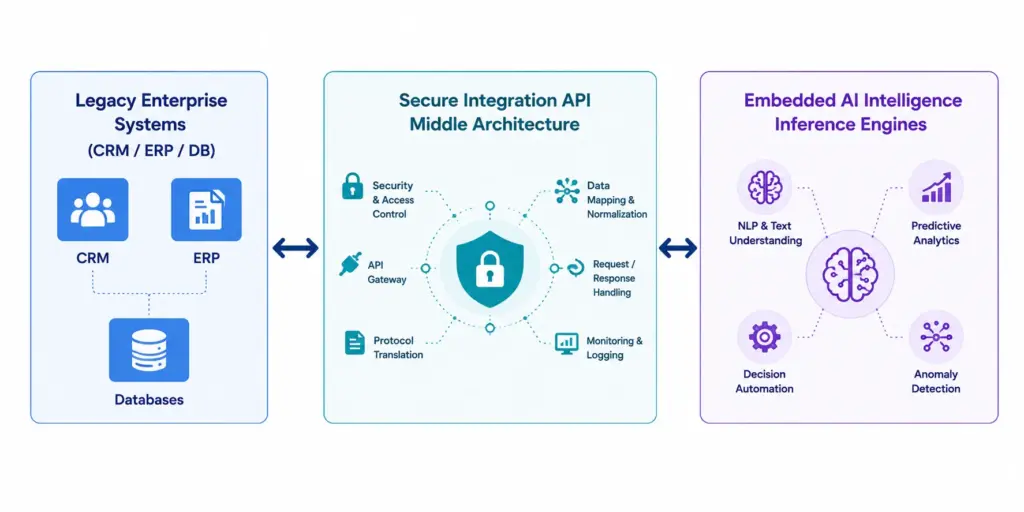
The primary engineering challenge lies in constructing robust middle architecture. These custom connection layers normalize unstructured legacy data, feed it into relevant AI inference engines, and translate the output back into standard database inputs that legacy software can execute immediately.
- Technological Architecture: Custom middleware API wrappers, secure data pipeline orchestration, and real-time event-driven messaging buses.
- Common Use Cases: Automated CRM pipeline data enrichment, intelligent ERP resource scheduling, and cross-platform data synchronization. Salesforce Einstein serves as a premier example of this service in action, acting as an intelligence layer integrated deeply within core customer databases to score leads, predict sales velocities, and automate follow-ups.
6. AI Infrastructure Engineering
AI infrastructure engineering provides the foundational layer required to deploy, scale, and maintain enterprise models securely and cost-effectively. Without rigorous infrastructure design, token costs, latency issues, and compute inefficiencies can rapidly erode project ROI. This discipline focuses on optimizing cloud or hybrid compute resources to ensure high availability and predictable operational costs.
- Technological Architecture: Machine Learning Operations (MLOps) pipelines, localized model quantization, and distributed GPU cluster orchestration.
- Common Use Cases: High-availability enterprise AI hosting platforms, automated model performance monitoring, and cost-optimized inference scaling. Meta’s LLaMA deployment ecosystem stands as a benchmark here, where engineering teams provide open-source infrastructure tools to optimize parameters, minimize GPU footprints, and efficiently run large-scale models across distributed cloud server clusters.
Top AI Frameworks Powering AI App Development in 2026
Founders and private equity investors are moving decisively past basic prompt engineering toward true AI systems engineering to build higher-performing AI apps. Winning in the enterprise market is no longer about raw token generation or writing brittle text prompts; it is about building robust software systems where Large Language Models function merely as the central processing unit within highly structured execution frameworks.
These frameworks govern memory persistence, orchestrate external tool execution, and enforce predictable business logic across complex, automated corporate workflows.
1. LangChain
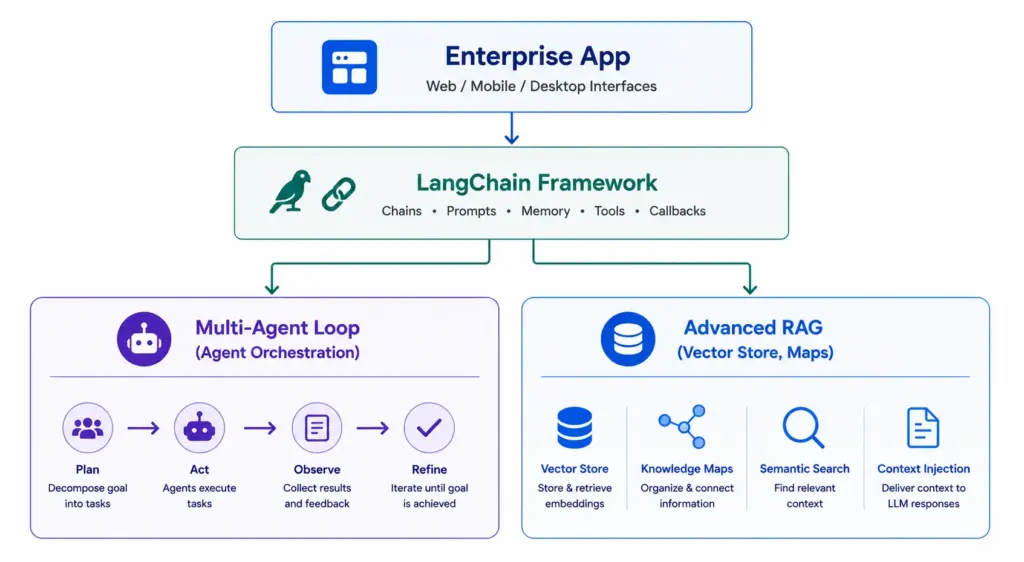
LangChain stands as the foundational plumbing for modern software-driven intelligence, serving as a highly robust ecosystem for multi-agent orchestration and advanced corporate knowledge retrieval. It enables businesses to build scalable AI workflows capable of handling complex reasoning, automation, and contextual decision-making across enterprise systems.
Architecture and Execution
- Agent Orchestration: LangChain provides structured code frameworks that allow models to loop through reasoning cycles, self-correct errors, and execute multi-step tasks across complex digital ecosystems.
- RAG Pipelines: It features a sophisticated system for advanced Retrieval-Augmented Generation (RAG). It transforms unstructured data silos into semantic vector graphs, ensuring the application delivers highly accurate, context-aware information.
- Tool Integrations: The platform offers native data connectors to thousands of external APIs, enterprise database lakes, and communication networks, turning text outputs into real-world software actions.
- Enterprise Workflow Automation: LangChain establishes deterministic conditional pathways, ensuring that autonomous sub-agents function reliably within strictly defined corporate governance parameters.
- Pros: It offers a massive open-source ecosystem alongside comprehensive tooling, enabling engineering teams to build, test, and ship functional prototypes with incredible speed.
- Cons: The extensive abstraction layers can introduce considerable complexity at enterprise scale, which sometimes leads to architectural opacity and debugging challenges during high-throughput execution traces.
- Best For: Multi-agent enterprise systems requiring deep integration across vast, diverse third-party applications and software tools.
2. Microsoft Semantic Kernel
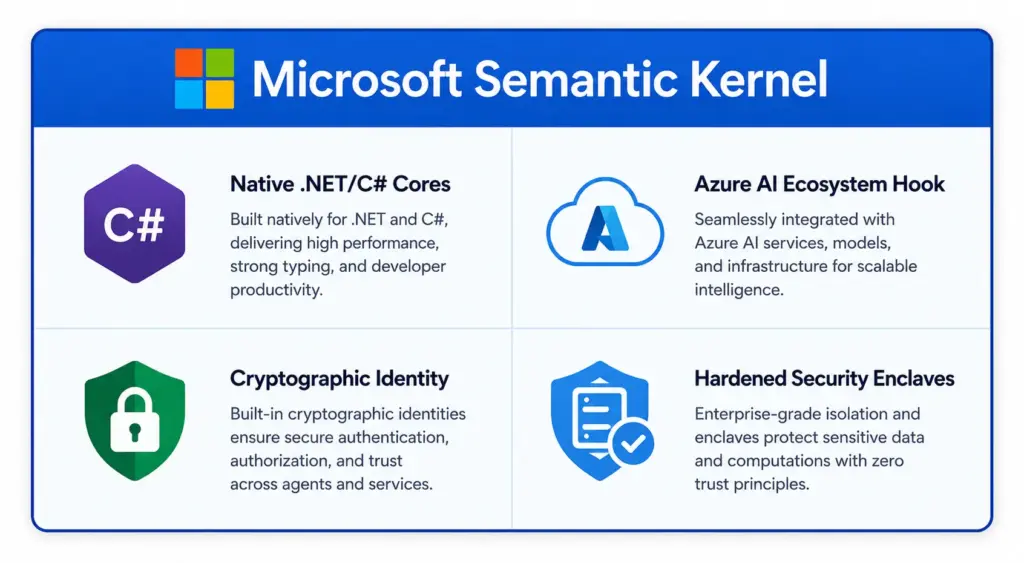
Engineered strictly for rigid corporate environments, Microsoft Semantic Kernel brings heavy-duty, type-safe software engineering principles to cognitive application orchestration. Its enterprise-first architecture helps organizations build secure, governed AI systems that align with traditional software development standards. The framework also simplifies the integration of AI capabilities into existing Microsoft-based enterprise infrastructures and workflows.
Architecture and Execution
- Enterprise Orchestration: Unlike Python-centric alternatives, Semantic Kernel introduces deep support for native compilation languages like C# and .NET, treating AI modules as structured native dependencies within traditional corporate applications.
- Native Microsoft Ecosystem Integration: The platform plugs seamlessly into the existing Microsoft technology stack, including Dynamics 365, Power Platform, and Office 365, turning internal enterprise databases into immediate training nodes.
- Secure AI Workflows: It mirrors the strict governance architecture of corporate IT departments, enforcing enterprise-grade access control, detailed data lineage tracking, and predictable code isolation across all model queries.
- Best For: Scale-focused enterprise environments operating entirely within the native Microsoft Azure cloud ecosystem.
3. CrewAI
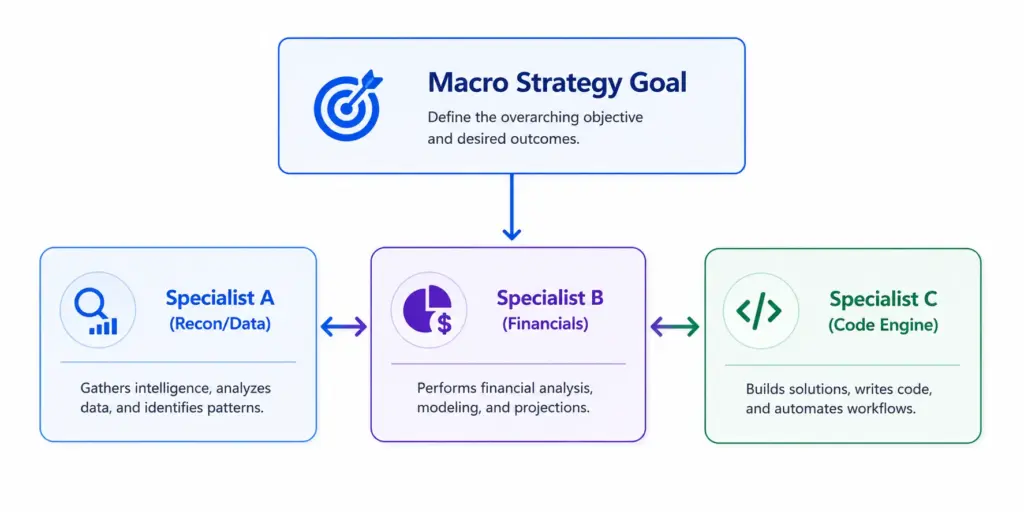
CrewAI approaches automation from an organizational design perspective, treating groups of cooperating agents as an agile, highly functional digital workforce. It enables enterprises to distribute complex workflows across specialized AI agents that collaborate in real time to improve operational efficiency. This structured multi-agent architecture also enhances scalability, task delegation, and autonomous decision-making across business processes.
Architecture and Execution
- Autonomous Multi-Agent Systems: Instead of running a single, overburdened model, CrewAI divides complex processes into small, isolated tasks managed by specialized sub-agents with clear role descriptions.
- Agent Collaboration: It creates structured cross-agent communication protocols, allowing distinct models to pass context, share operational variables, and request peer reviews without human oversight.
- Workflow Delegation: The framework automatically optimizes task distribution across the agent group, routing analytical sub-tasks to cost-efficient models while reserving complex decisions for frontier engines.
Use Cases
- AI Operations Teams: Automating continuous business analysis, legal compliance tracking, and high-frequency market intelligence gathering.
- Autonomous Enterprise Assistants: Deploying persistent digital workers to manage complex customer service flows, end-to-end employee onboarding, and cross-department scheduling pipelines.
4. LlamaIndex
When the overarching challenge is data accessibility and knowledge retrieval across vast data architecture, LlamaIndex serves as the primary intelligence framework. It helps enterprises structure, index, and retrieve information from complex data ecosystems with greater contextual accuracy and speed. The framework also strengthens advanced RAG pipelines by transforming fragmented enterprise knowledge into AI-ready intelligence layers.
| Enterprise Strategy Vector | Implementation Mechanism |
| Advanced RAG Optimization | Bypasses standard keyword search to query across complex relational knowledge graphs. |
| Document Intelligence | Parses highly fragmented enterprise files including multi-page PDFs, scanned financial tables, and legacy images. |
| Data Indexing Architecture | Structures raw corporate data into semantic data pipelines optimized for low-latency retrieval. |
Architecture and Execution
- RAG Optimization: LlamaIndex eliminates generic data lookups by constructing custom indexing architectures, including hierarchical node maps and metadata enhancement layers, minimizing hallucinations.
- Enterprise Document Intelligence: It breaks down structural data siloes, parsing out-of-date document styles, messy financial spreadsheets, and complex internal intranets into data structures models can instantly digest.
- Data Indexing: The platform establishes automated, real-time ingestion pipelines, ensuring that enterprise applications retrieve accurate context from changing production environments.
5. Vertex AI, Azure AI & Bedrock
When scaling an enterprise architecture, choosing the underlying cloud management platform dictates long-term operating costs, system reliability, and vendor lock-in. Modern AI cloud ecosystems now play a critical role in managing model deployment, governance, security, and large-scale agent orchestration. The right infrastructure platform also determines how efficiently enterprises can scale AI workloads while maintaining compliance and operational flexibility..
| Platform | Best For | Strengths | Weaknesses |
| Google Gemini Enterprise Agent Platform (Formerly Vertex AI) | Comprehensive MLOps and autonomous, cross-platform agent networks. | Seamless scalability via advanced TPU infrastructure, end-to-end Agent Studio workspace, and native cross-vendor Agent2Agent (A2A) protocol support. | High architectural complexity requiring specialized cloud data engineers to manage advanced multi-agent graphs. |
| Azure AI | Enterprise integration and hybrid cloud compliance architectures. | Deeply rooted within the Microsoft enterprise stack, exceptional governance guardrails, and turnkey OpenAI model access. | Premium licensing overhead can quickly inflate operational token costs during high-throughput workloads. |
| AWS Bedrock | Multi-model flexibility and serverless infrastructure scaling. | Zero infrastructure management, access to diverse model families, and native support for Managed Agents and AgentCore platforms. | Abstracted development paths present a steep learning curve for teams custom-tuning proprietary models. |
Hyperscale platforms are evolving rapidly based on major cloud provider developments. Google Cloud Next unveiled the complete transformation of its infrastructure into the Gemini Enterprise Agent Platform, focusing heavily on decentralized agent management via its new Agent Development Kit (ADK) and secure Agent Gateway control centers.
Concurrently, Amazon Web Services has fundamentally expanded AWS Bedrock by integrating frontier OpenAI models alongside its native AgentCore engine, allowing businesses to run secure cross-platform workflows directly inside their cloud perimeter.
The “AI Stack Consolidation” Trend
The market is undergoing a major structural shift: the rapid consolidation of the enterprise AI software stack. Savvy enterprise decision-makers and technology investors are actively moving away from highly fragmented, single-feature AI developer tools and brittle open-source experiments. The early approach of duct-taping individual vector databases, separate monitoring tools, and distinct hosting platforms together is being abandoned due to security risks and soaring maintenance overhead.
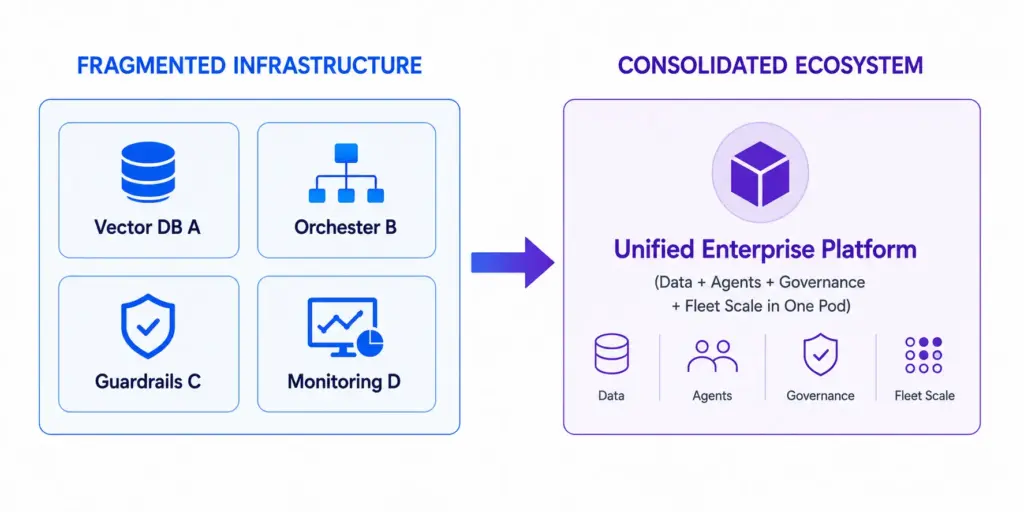
Enterprises are prioritizing unified AI engineering ecosystems that deliver data ingestion, model hosting, agent orchestration, and operational governance inside a single security perimeter. Vendors no longer compete solely on the raw intelligence of their underlying models. Instead, market valuation is captured by platforms that maximize orchestration security, institutional governance, and real-world deployment speed. For capital allocators, this consolidation drastically reduces development risk, protects data privacy, and ensures that custom AI investments yield scalable, highly defensive assets that build measurable enterprise value.
AI Application Development Cost Breakdown
Most companies underestimate development costs for AI apps by 40–60%. Traditional application budgets rely on predictable seat-based licensing, but AI architecture introduces variable runtime mechanics, heavy data computation layers, and non-linear maintenance scaling. We engineer our deployment strategies around mitigating these cost overruns, providing businesses with pre-vetted developers who specialize in eliminating structural tech waste right from day one.
Key Cost Variables
A high-performing AI ecosystem relies on a stack of interdependent infrastructure components. Each component introduces unique operational and capital expenditure variables that engineers must manage. When you build with our development teams, we optimize each layer of this stack to protect your margins:
- Model Usage: Ongoing API and inference costs fluctuate based on token volume, context window depth, and query frequency. Our architects implement aggressive caching layers to minimize unnecessary token burn.
- Infrastructure: High-performance specialized compute nodes (such as distributed GPU server arrays) generate substantial baseline hosting expenses. We configure dynamic scaling to ensure you only pay for compute when it is actively running.
- Vector Databases: Managing complex semantic indexing for enterprise knowledge retrieval requires low-latency vector databases, where pricing scales with vector dimensions and query concurrency.
- Data Pipelines: Building and running ETL (Extract, Transform, Load) pipelines to continuously ingest, clean, and mask unstructured corporate data requires dedicated compute resources.
- AI Governance: Enforcing systemic guardrails to audit data privacy, monitor bias, and prevent unauthorized model leakage.
- Security & Compliance: Maintaining institutional data security boundaries, including SOC 2 Type II, HIPAA, or specialized sovereignty configurations.
- DevOps & MLOps: Ongoing engineering pipelines for model deployment, automated load balancing, continuous integration, and systematic registry monitoring.
Typical AI Development Pricing
Enterprise AI projects require distinct allocations of capital and timeline depth depending on operational complexity and architecture type. By scaling your technical operations with our targeted engineering squads, we map development timelines to strict milestone delivery frameworks to keep costs highly predictable.
| Project Type | Estimated Cost | Timeline |
| AI MVP | $25K–$75K | 6–10 weeks |
| AI SaaS Platform | $100K–$500K | 4–8 months |
| Enterprise AI Automation System | $500K–$2M+ | 6–18 months |
| Multi-Agent AI Infrastructure | $1M+ | 12–24 months |
Hidden Costs Most Businesses Ignore
A major point of friction for capital allocators is the long-tail operational expense required to keep an intelligent application production-ready. Stanford AI Index data notes that while initial model training captures headlines, the post-deployment infrastructure, alignment engineering, and performance optimization eat up the vast majority of long-term corporate enterprise tech budgets. Our pre-vetted engineers design clean codebases out of the gate to minimize this ongoing technical debt.
Investor Risk Note: Treat AI as a living system. Budgets that fail to account for drift, compliance, and regression mitigation will experience rapid structural depreciation.
Post-Deployment Cost Overhead
- AI Hallucination Mitigation: Implementing multi-layered validation logic, deep evaluation frameworks, and context verification loops to ensure deterministic outputs.
- Fine-Tuning: Periodic optimization of open or closed model parameters using proprietary data slices to capture highly granular domain expertise.
- AI Monitoring: Running continuous logging infrastructure to track real-time token anomalies, degradation spikes, and latency lag.
- Human Review Layers: Structuring RLHF (Reinforcement Learning from Human Feedback) workflows or human-in-the-loop exception queues for edge-case resolutions.
- Compliance Audits: Conducting mandatory third-party system assessments as emerging algorithmic transparency regulations tighten globally.
- Model Retraining: Re-indexing and re-weighting production models as operational data drifts away from original training baselines.
Cost Comparison: Build vs Buy AI
Gartner research indicates that over 40% of ambitious agentic AI and enterprise automation initiatives face structural roadblocks or budget abandonment due to a failure to properly balance infrastructure control against deployment speed. We eliminate this friction point by allowing you to hire specialized development talent on demand, giving you the control of a custom build with the rapid setup of an external team.
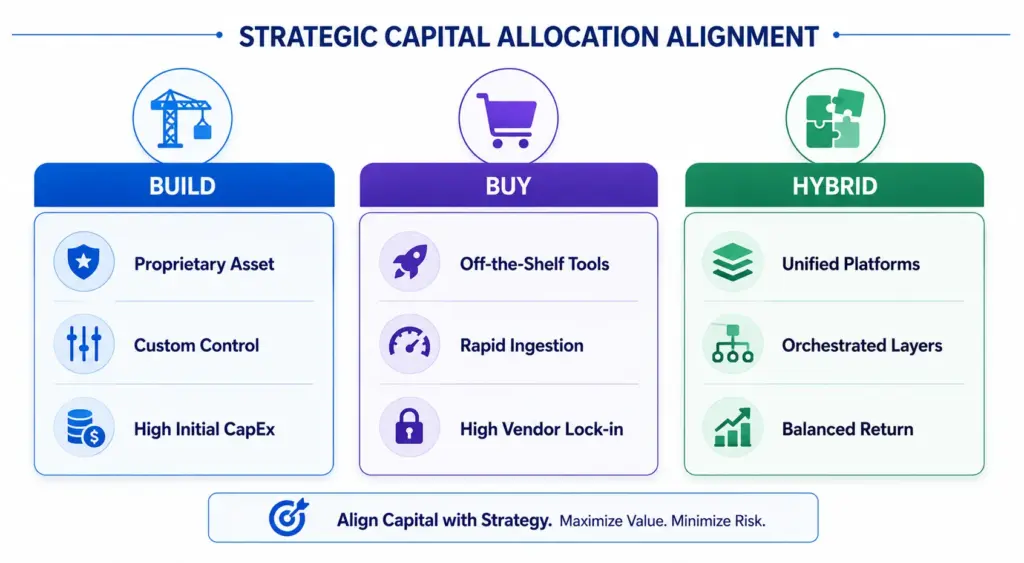
- Custom AI Development (Build): High upfront cost, very high long-term flexibility, and medium deployment speed. This approach yields completely proprietary intellectual property, allowing founders to erect a defensive moat around custom datasets and tailored workflows.
- Off-the-Shelf AI Tools (Buy): Low upfront cost, limited flexibility, and fast deployment speed. This choice reduces time-to-market but forces dependence on third-party vendor feature roads, creating systemic vendor lock-in and eliminating competitive differentiation.
- Hybrid AI Strategy (Orchestrate): Medium upfront cost, high flexibility, and medium deployment speed. We frequently deploy this balanced framework for our clients, leveraging hyperscale foundational platforms for raw model inference while building custom, proprietary agent orchestration and data injection layers internally.
The AI Cost Maturity Curve
As an enterprise successfully transitions from initial technology pilots to scaled, intelligent operations, the underlying capital structure scales across four distinct financial and operational phases. Our goal is to guide your business seamlessly along this trajectory while keeping resource overhead highly optimized.
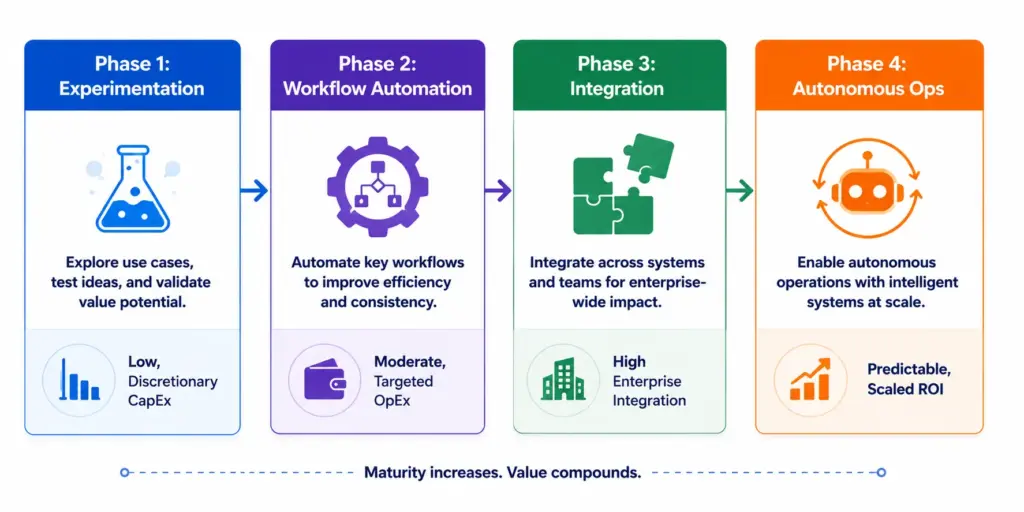
Phase 1: Experimentation
Capital outlay is small, discretionary, and isolated to basic API sandboxes, manual prototyping, and prompt engineering. Expenses are highly unpredictable but easily contained within single-department RAG exploration teams. At this stage, businesses primarily focus on validating feasibility, testing workflows, and identifying high-impact AI use cases before scaling infrastructure investments.
Phase 2: AI Workflow Automation
Budgets shift toward targeted operational automation. Costs scale linearly as multi-agent frameworks are deployed to replace manual, high-frequency internal administrative processes. Capital focuses on pipeline orchestration and custom middleware development. Organizations at this stage begin prioritizing workflow efficiency, scalability, and measurable productivity gains across core business operations.
Phase 3: Enterprise Integration
Expenditures expand considerably to cover deep data infrastructure modernizations. According to Deloitte maturity frameworks, this level requires significant planning, long-term capital allocation, and structural system changes. We step in here to manage the complex heavy lifting, shifting investments toward secure, cross-department data warehousing, zero-trust identity layers, and core ERP integrations.
Phase 4: Autonomous AI Operations
The enterprise achieves full technological maturity, transforming into a self-optimizing system where hundreds of autonomous agents run end-to-end processing pipelines. Total cost of ownership stabilizes into a predictable utility metric. Token consumption surges, but operating margins widen significantly as the platform delivers compounding, non-linear returns on invested capital.
Top AI Application Development Vendors & Companies
Selecting the right engineering partner dictates whether your AI apps transform into high-yielding corporate assets or finish as abandoned prototypes. For high-net-worth individuals, institutional founders, and venture capital allocators, navigating the vendor landscape requires looking past superficial marketing pitches.
The market has segmented into distinct archetypes: established deployment giants, specialized technical consulting networks, and agile, hyper-focused boutique agencies that launched over the last few years within the United States.
1. Idea Usher

Idea Usher functions as a premium AI application development and technical consulting partner, explicitly built to bridge the gap between high-level business strategy and deep software execution. By operating a robust model of specialized, pre-vetted AI developers, we eliminate the structural execution risks that traditionally plague major corporate enterprise technology rollouts.
- Core Competencies: End-to-end proprietary product engineering, advanced multi-agent systems orchestration, custom Retrieval-Augmented Generation (RAG) mapping, and secure enterprise workflow automation.
- Why Capital Allocators Choose Us: We treat software code as a direct driver of corporate balance-sheet value. Instead of utilizing generic, low-leverage software templates, our engineering squads construct tailored, highly scalable code architectures designed to protect corporate data privacy and achieve immediate operational efficiency.
- Strategic Alignment: Highly optimized for private equity firms, ambitious venture-backed founders, and corporate entities looking to deploy scalable, functional products with predictable timelines and clear cost structures.
2. Intellivon
Intellivon operates as an authoritative, high-tier AI solutions and technology consultation firm with deep domain expertise in highly regulated industries like Healthcare and FinTech. The company focuses heavily on building secure, compliance-driven AI ecosystems capable of handling sensitive enterprise data at scale. Its engineering approach also emphasizes governance, reliability, and seamless integration with legacy corporate infrastructure.
- Core Competencies: Private Large Language Model fine-tuning, automated medical and financial document parsing pipelines, autonomous KYC/fraud analytics agents, and enterprise MLOps governance platforms.
- Strategic Value: Intellivon eliminates risk for businesses dealing with highly sensitive data silos. Their engineering teams focus entirely on building type-safe, deeply secure, and compliant architectures that integrate directly into old legacy databases.
3. Markovate
Launched as an agile, AI-first engineering outfit in the United States, Markovate focuses extensively on moving enterprise operations from initial Proof of Concept into stable, high-volume production environments. The company emphasizes rapid AI deployment strategies that help businesses transition from experimentation to scalable operational systems with reduced implementation friction.
Core Competencies: LLM Copilots, custom AutoGen multi-agent configurations, and rapid semantic data transformation.
4. Azumo
Operating out of San Francisco with highly skilled nearshore technical teams, Azumo specializes in embedding smart cognitive layers directly into scalable cloud and mobile structures. The company helps businesses integrate AI capabilities into modern digital products while maintaining flexibility, scalability, and deployment speed.
Core Competencies: API-driven generative tool integrations, specialized data pipeline construction, and serverless container deployments.
5. HatchWorks AI
A tech-forward boutique firm designed around accelerating data transformations, HatchWorks AI bridges data science and secure software engineering to unlock hidden corporate value pools. The company enables enterprises to modernize legacy data ecosystems while building scalable and governance-driven AI infrastructures.
Core Competencies: Secure MLOps infrastructure setup, enterprise-grade AI governance models, and SageMaker model optimization.
The SCALE Framework
To ensure rigorous capital protection and objective partner evaluation, institutional decision-makers can deploy this original framework before signing a tech development contract. The framework helps businesses assess long-term scalability, operational reliability, and infrastructure maturity before committing major capital investments.
| Factor | Strategic Focus | Operational Metric |
| S | Security & Compliance Readiness | Verification of SOC 2 Type II, HIPAA, or GDPR compliance alongside hard network boundaries for internal company data. |
| C | Customization Capabilities | Moving past basic API wraps to deliver true proprietary IP via customized fine-tuning and unique agent orchestration loops. |
| A | AI Infrastructure Maturity | Demonstrated proficiency in automated cost management, model quantization, and low-latency MLOps execution trees. |
| L | Long-Term Support | Structured post-deployment agreements covering data drift monitoring, prompt optimization, and model regression audits. |
| E | Enterprise Deployment Expertise | Proven historical capability connecting complex modern intelligence models into old legacy corporate ERP and CRM databases. |
The cheapest AI vendor usually becomes the most expensive long-term migration problem. Cutting corners on early architecture creates fragile software systems that collapse under high data throughput, exposing your business to massive technical debt and severe operational liabilities.
Enterprise AI Architecture Trends Reshaping Development Services
The architectural paradigm for building enterprise software is undergoing a fundamental shift. For institutional asset allocators, tech founders, and enterprise engineering teams, the priority has moved from basic model exploration to building hardened, scalable ecosystem frameworks.
As a premium AI application development partner, we design these emerging structural trends directly into our development lifecycle, providing pre-vetted engineering squads capable of converting complex technical transitions into predictable, margin-expanding corporate assets.
1. Multi-Agent Systems
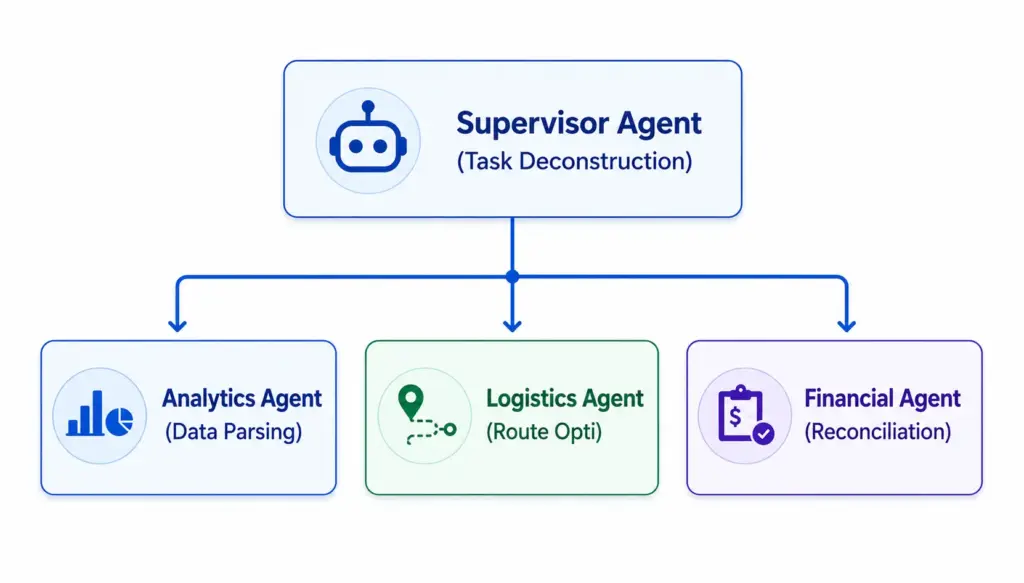
Enterprise automation has moved conclusively beyond simple, static robotic process automation. Modern software development now centers heavily on autonomous multi-agent networks capable of executing highly fluid, end-to-end corporate workflows without manual intervention.
2. Orchestration Frameworks & Execution
Instead of forcing a single model to process a massive, complex operational pipeline, modern systems engineering leverages frameworks like CrewAI and AWS AgentCore to build a decentralized network of specialized digital workers. A central “supervisor” agent receives a macro corporate objective, breaks it into logical sub-tasks, and handles task delegation across isolated sub-agents.
Each independent agent maintains unique tool-access privileges, conversational memory, and role descriptions, allowing them to collaborate, peer-review outputs, and resolve multi-step operational problems completely autonomously.
Deployment Highlight: Consider Google’s Gemini Enterprise Agent Platform, which allows decentralized, domain-specific sub-agents to share context via native cross-vendor protocols to handle fluid, multi-tier corporate procurement without human oversight.
3. RAG Infrastructure
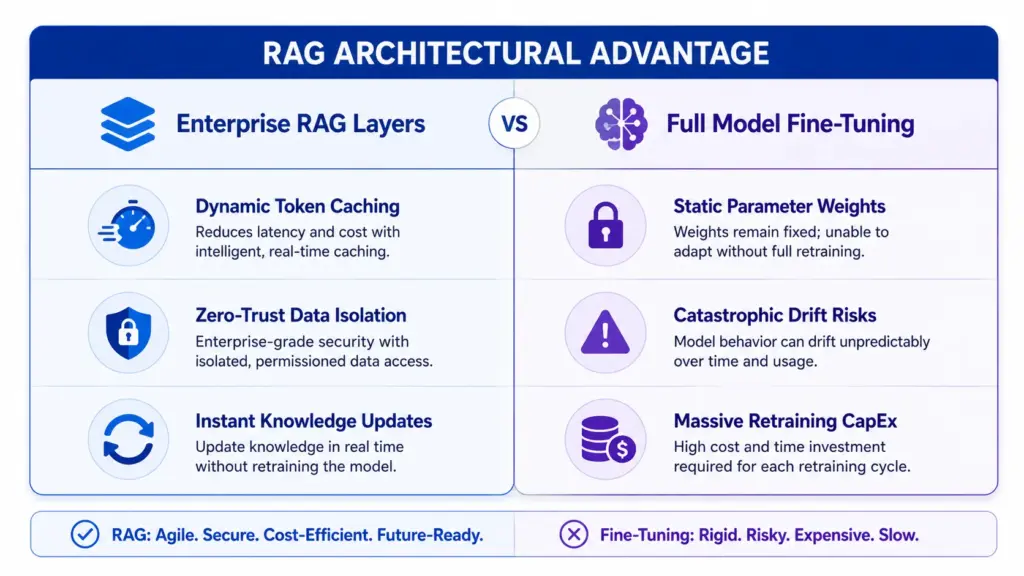
While initial industry hype focused heavily on custom fine-tuning and building foundational models from scratch, enterprises have overwhelmingly adopted Retrieval-Augmented Generation as their primary data infrastructure layer. This approach allows businesses to deliver highly contextual AI responses while maintaining greater control over enterprise knowledge and data security.
Cost, Speed, and Structural Security
Unlike costly and static model fine-tuning, which risks parameter drift, lacks row-level security, and requires constant re-training capital when data changes, RAG decouples enterprise knowledge from raw computing logic. By indexing data into low-latency vector databases, RAG injects real-time corporate context straight into the model inference window on demand, drastically reducing computational costs while ensuring strict zero-trust user permissions.
Deployment Highlight: Tech platforms like Glean have institutionalized this architecture, offering out-of-the-box, enterprise-wide search ecosystems that connect directly to disparate corporate workspaces (Slack, Jira, Drive) to serve context-aware data safely via localized RAG.
4. Governance & Compliance
As global algorithmic transparency frameworks tighten, compliance is transforming from an abstract legal box into a highly rigorous software engineering discipline. Enterprises are now required to build AI systems with embedded governance, monitoring, and accountability mechanisms from the infrastructure level itself. This shift is driving organizations to prioritize secure, explainable, and regulation-ready AI architectures across production environments.
Regulatory Risk Factor: Building AI without deterministic audit trails is an immediate balance-sheet liability. Non-compliance with international high-risk AI system mandates carries catastrophic penalties, with fines reaching up to €35 million or 7% of global annual turnover.
| Compliance Area | Description |
| GDPR & EU AI Act Guardrails | Every high-risk AI deployment requires continuous automated risk assessments, strict bias mitigation protocols, and structured data classification systems to ensure regulatory compliance. |
| Explainability & Traceability | AI systems must provide transparent reasoning pathways, enabling organizations to understand how algorithms generate decisions and operational outputs. |
| Immutable Audit Trails | Enterprises must maintain tamper-proof, time-stamped logs that record inference cycles, retraining events, prompt modifications, and human intervention activities. |
| Continuous Model Observability | Persistent monitoring systems are required to track model degradation, detect data drift, measure runtime performance, and identify operational anomalies before they impact workflows. |
Deployment Highlight: Enterprises increasingly rely on dedicated oversight apps like Credo AI, which automatically generates the continuous compliance maps, impact assessments, and regulatory audit records required to keep production systems fully verified.
5. Cloud-Native Scaling
The deployment architecture for running cognitive software has officially detached from traditional web application hosting models, standardizing around highly optimized, cloud-native orchestration systems. These modern infrastructures enable enterprises to scale AI workloads dynamically while improving performance efficiency, reliability, and operational flexibility across distributed environments.
| Infrastructure Layer | Core Technological Focus | Real-World Operational Metric |
| Kubernetes Scaling | Orchestrator container management. | Automatically balances irregular model loading, scaling compute pods based on heavy real-time user query traffic. |
| Vector Environments | High-performance memory index spaces. | Stores and queries multi-dimensional embeddings with low-latency retrieval for real-time RAG processing. |
| GPU Orchestration | Distributed hardware allocation trees. | Dynamically provisions cluster hardware resources, preventing idle server burn during off-peak operational windows. |
| Inference Optimization | Hardware token compression. | Leverages advanced compilation techniques and model quantization to minimize operational latency and cloud infrastructure costs. |
Deployment Highlight: Advanced MLOps frameworks such as Fiddler AI demonstrate this standard in action, providing high-throughput execution checking, real-time vector mathematical tracking, and edge performance optimization inside cloud-native Kubernetes grids.
Is Custom AI Development Worth the Cost?
As capital allocators and enterprise founders evaluate technology budgets, a critical question dominates the boardroom: Should we spend hundreds of thousands of dollars on custom AI application development, or can we achieve the same operational efficiency using off-the-shelf software?
With rapid market changes, the argument against expensive custom development has never looked stronger on paper. However, relying entirely on public infrastructure introduces hidden strategic risks.
The Case Against Custom AI
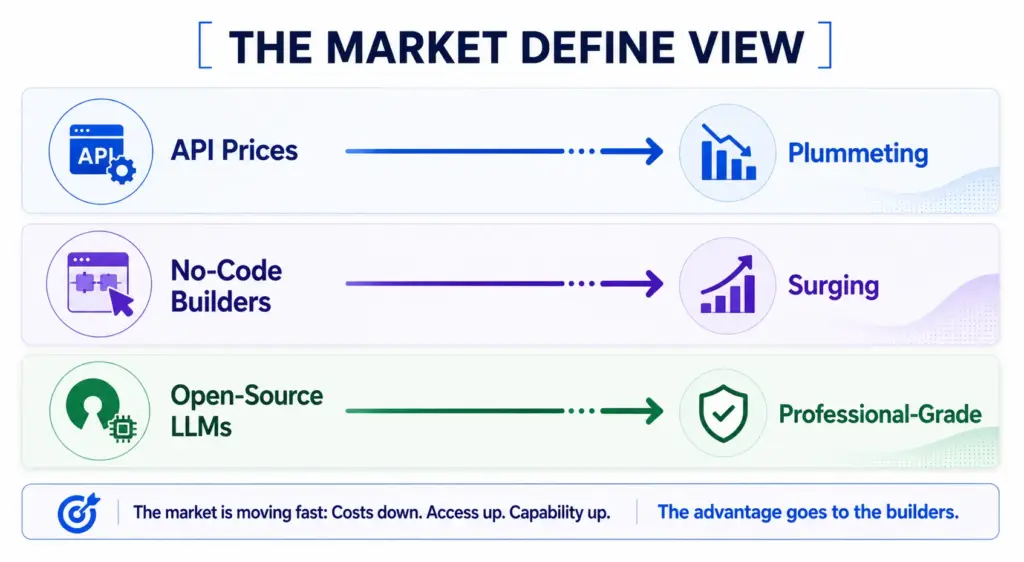
A powerful counter-narrative argues that custom development is rapidly becoming an unnecessary capital drain. The market is experiencing massive deflation across the entire AI engineering lifecycle, driven by three key macroeconomic forces. As AI tooling becomes cheaper and more accessible, many businesses now question whether heavy upfront engineering investments are still necessary for achieving operational efficiency.
1. Deflationary API Economics
Raw token intelligence has become a race to the bottom. Hyperscale model developers are aggressively cutting inference costs while expanding context windows. Standard processing tasks that used to require custom local servers can now be offloaded to public APIs for a fraction of a cent.
2. Democratized Development
No-code and low-code AI builders allow non-technical business units to deploy functional workflows in hours. These platforms feature drag-and-drop interfaces for vector indexing, prompt chaining, and API connections, eliminating the traditional engineering overhead required to build basic software utilities.
3. Open-Source Foundations
The performance gap between proprietary closed-source engines and open-source models has completely narrowed. Enterprises can download powerful, open-source baseline models and run them inside their own cloud perimeter for free, bypassing expensive vendor licensing fees.
The Case For Custom Engineering
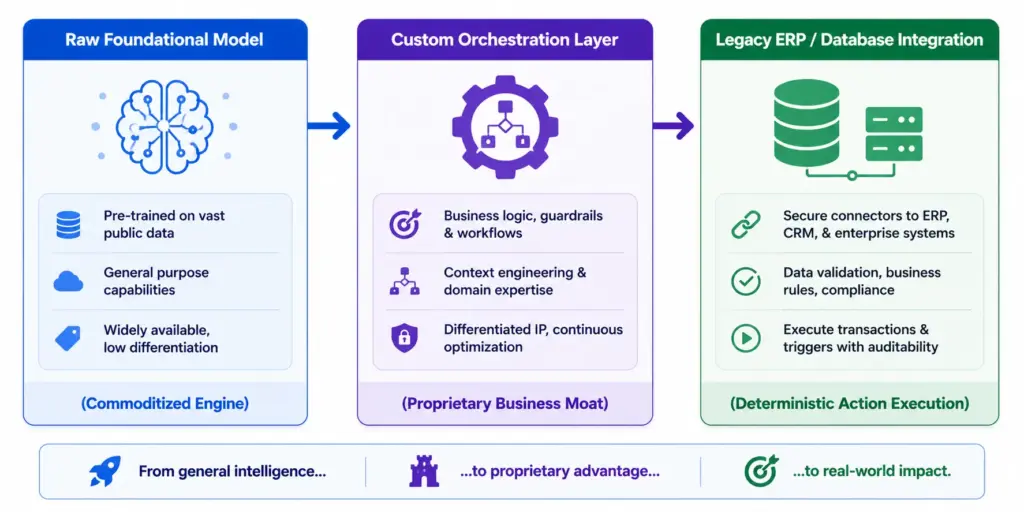
If raw intelligence is cheap and universally accessible, it ceases to be a competitive advantage. When every business buys the exact same off-the-shelf software, they achieve operational parity, not market leadership. True enterprise differentiation requires custom-engineered ecosystems for three definitive reasons.
1. Proprietary Ingestion Moats
A generic application cannot access the highly fragmented, unstructured historical data silos that define your business operations. A custom build allows you to construct proprietary ETL data pipelines, real-time vector graphs, and stateful memory synchronization layers. This infrastructure ensures that your models operate on dynamic, internal context that your competitors cannot buy or replicate.
2. Core Stack Integration
An off-the-shelf conversational bot lives in an isolated browser tab. Real enterprise value is captured when cognitive systems are deeply embedded into core, legacy corporate frameworks like ERP networks, financial ledgers, and proprietary CRM systems. Custom middleware engineering translates probabilistic model reasoning into deterministic software actions, allowing autonomous agents to execute complex, multi-system workflows safely.
3. Uncommoditized Operations
While a basic prompt loop can be commoditized, managing a high-throughput, enterprise-grade production environment cannot. Custom systems engineering is mandatory to build the infrastructure required to scale operations safely. These advanced architectures help enterprises maintain reliability, governance, and performance consistency as AI workloads expand across complex operational environments.
- Deterministic Guardrails: Hard-coded semantic interceptors that block data leaks and enforce compliance.
- Quantized Cloud Optimization: Custom compilation techniques that downscale model footprints, dropping cloud hosting bills by up to 70%.
- Automated Drift Mitigation: Continuous telemetry arrays designed to catch degradation anomalies before they corrupt production data.
Custom vs. Off-the-Shelf
Businesses evaluating AI adoption often face a critical strategic decision: whether to deploy ready-made AI software for faster implementation or invest in custom AI engineering for long-term operational control and differentiation. While off-the-shelf tools reduce initial costs and accelerate deployment, custom AI systems provide greater scalability, proprietary intelligence, and deeper integration across enterprise infrastructure.
| Strategy Vector | Off-the-Shelf AI Software | Custom AI System Engineering |
| Upfront Capital Drag | Minimal; predictable monthly software subscription fees. | Substantial; requires dedicated engineering capital. |
| Intellectual Property | Zero; your workflows are dependent on third-party roadmaps. | Absolute; builds a defensible, proprietary corporate asset. |
| Data Perimeter Safety | High risk; data often crosses external vendor firewalls. | Ironclad; data sits behind your private cloud boundaries. |
| Operational Impact | Standardizes tasks across your industry peers. | Optimizes unique, high-margin business workflows. |
Balanced Conclusion
Strategic Takeaway: Generic AI tools may automate tasks, but custom AI systems create operational advantage.
Buying off-the-shelf utilities is an excellent tactical choice to handle generic corporate functions like summarizing emails or generating basic marketing copy. But if you are deploying capital to defend core market share, optimize highly complex supply chains, or scale specialized internal workflows, custom AI development is not just worth the cost, it is the only way to build a sustainable tech-driven competitive moat.
Get a Free AI App Estimate from Idea Usher
.Transforming an ambitious artificial intelligence concept into a hardened, production-ready enterprise asset requires deep engineering precision. At Idea Usher, we remove the guesswork from software execution. With over 500,000 hours of coding experience, our team of ex-MAANG/FAANG developers stands ready to audit your technical requirements and construct a highly accurate, risk-mitigated development blueprint.
Discuss Your Vision With Experts
Enterprise-grade software cannot be built on generic, off-the-shelf templates. Your competitive advantage relies entirely on how effectively your application handles specialized data structures and complex corporate workflows. When you consult with our engineering team, we skip the surface-level marketing talk and dive straight into deep system mechanics:
- Ingestion Architecture: Mapping out private Retrieval-Augmented Generation (RAG) loops and vector database indexing strategy to unlock your fragmented internal corporate data silos.
- Agentic Workflows: Evaluating how multi-agent frameworks like CrewAI can deconstruct your macro operational objectives into decentralized, autonomous digital workers.
- Security Barriers: Defining zero-trust user permissioning, data isolation boundaries, and hard-coded semantic interceptors to eliminate corporate data leakage entirely.
Receive a Tailored Roadmap
A successful deployment is dictated by the strategic milestones established before the first line of code is ever written. We provide an end-to-end technical architectural map that shifts your project predictably from abstract proof-of-concept into a resilient, high-volume production ecosystem.
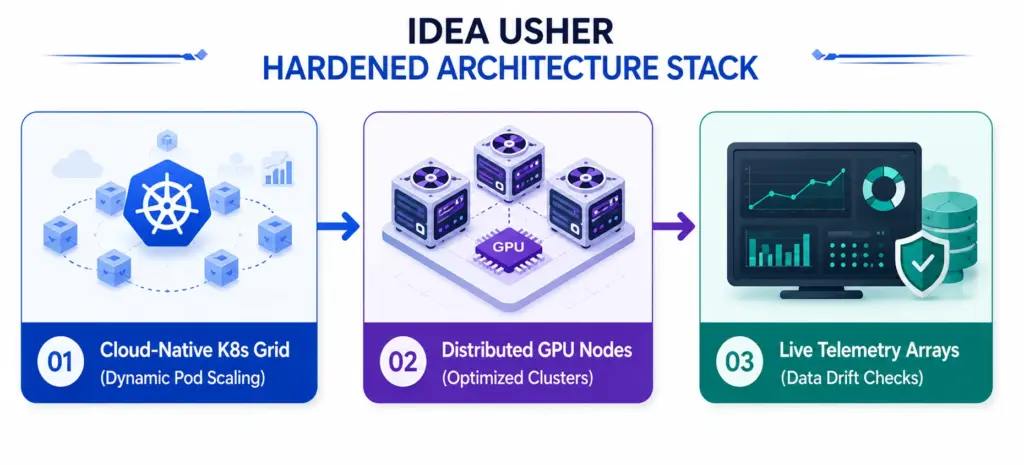
Our ex-MAANG/FAANG developers design this roadmap through the lens of long-term capital efficiency, ensuring your system architecture scales natively inside cloud-native Kubernetes grids without generating massive technical debt or skyrocketing computing costs.
Estimate Cost & Timeline
Unpredictable token costs, fragile software patches, and extended development timelines can cripple an enterprise technology rollout. We provide transparent, metric-driven projections based on your exact structural integration parameters.
The Cost Mitigation Guarantee: We don’t just wrap public APIs. Our engineering squads specialize in model quantization and dynamic token caching, allowing us to build custom platforms that systematically lower computing overhead while maximizing your proprietary intellectual property.
By examining your data readiness, legacy software dependencies, and global compliance mandates (such as GDPR or the EU AI Act), we calculate a definitive investment framework. Whether your platform requires an agile, high-impact 8-week prototype or a comprehensive, multi-system 6-month automation rollout, you receive clear milestone boundaries designed to protect your upfront capital.
Conclusion
Building high-performance AI apps requires moving past the plug-and-play simplicity of generic APIs. True operational differentiation lies in structuring a custom ecosystem that balances optimized RAG infrastructure, fluid multi-agent orchestration, and native compliance guardrails. While off-the-shelf software can successfully automate isolated, standard tasks, partnering with specialized, pre-vetted development teams ensures that upfront capital expenditures translate directly into a secure, highly integrated, and defensible competitive moat.
FAQs
Q1: What does an AI application development company do?
A1: An AI application development company bridges the gap between raw data science and commercial software engineering by designing, building, and deploying intelligent, production-ready ecosystems. Instead of just wrapping public APIs, a specialized development firm constructs proprietary data ingestion pipelines, tunes specialized machine learning models, builds multi-agent orchestration layers, and integrates vector databases into old legacy databases.
Q2: How much does AI application development cost in 2026?
A2: AI development costs span a wide range depending on architectural complexity, data readiness, and security compliance. A standard minimum viable product (MVP) or prototype typically costs between $25,000 and $75,000, whereas a robust, scalable AI SaaS platform or generative AI application ranges from $100,000 to $500,000. For large-scale enterprise automation setups, multi-agent frameworks, or custom-trained systems that require advanced MLOps pipelines and compliance engineering, total capital investment frequently exceeds $500,000 to $1,000,000+.
Q3: Which framework is best for enterprise AI applications?
A3: The best framework depends entirely on whether your application relies on orchestrating autonomous tasks or managing complex cloud-native machine learning pipelines. For agent-based automation and multi-agent workflows, orchestrators like CrewAI and LangChain are the industry standards for managing stateful memory and complex task delegation. For running large-scale, secure infrastructure, a hybrid stack pairing cloud-native Kubernetes grids for GPU scaling with localized Retrieval-Augmented Generation (RAG) frameworks provides the best architecture to enforce zero-trust data protection.
Q4: How long does it take to build an AI application?
Q4: Development timelines are directly tied to integration depth, data quality, and the scope of the app. A basic proof-of-concept or isolated AI feature can be delivered in 4 to 10 weeks, while a fully commercialized, mid-level AI SaaS platform typically requires 4 to 8 months of active engineering. Deep enterprise-grade systems that mandate custom data transformations, multi-system ERP integrations, and rigorous compliance reviews take anywhere from 6 to 18 months to achieve full production deployment.