


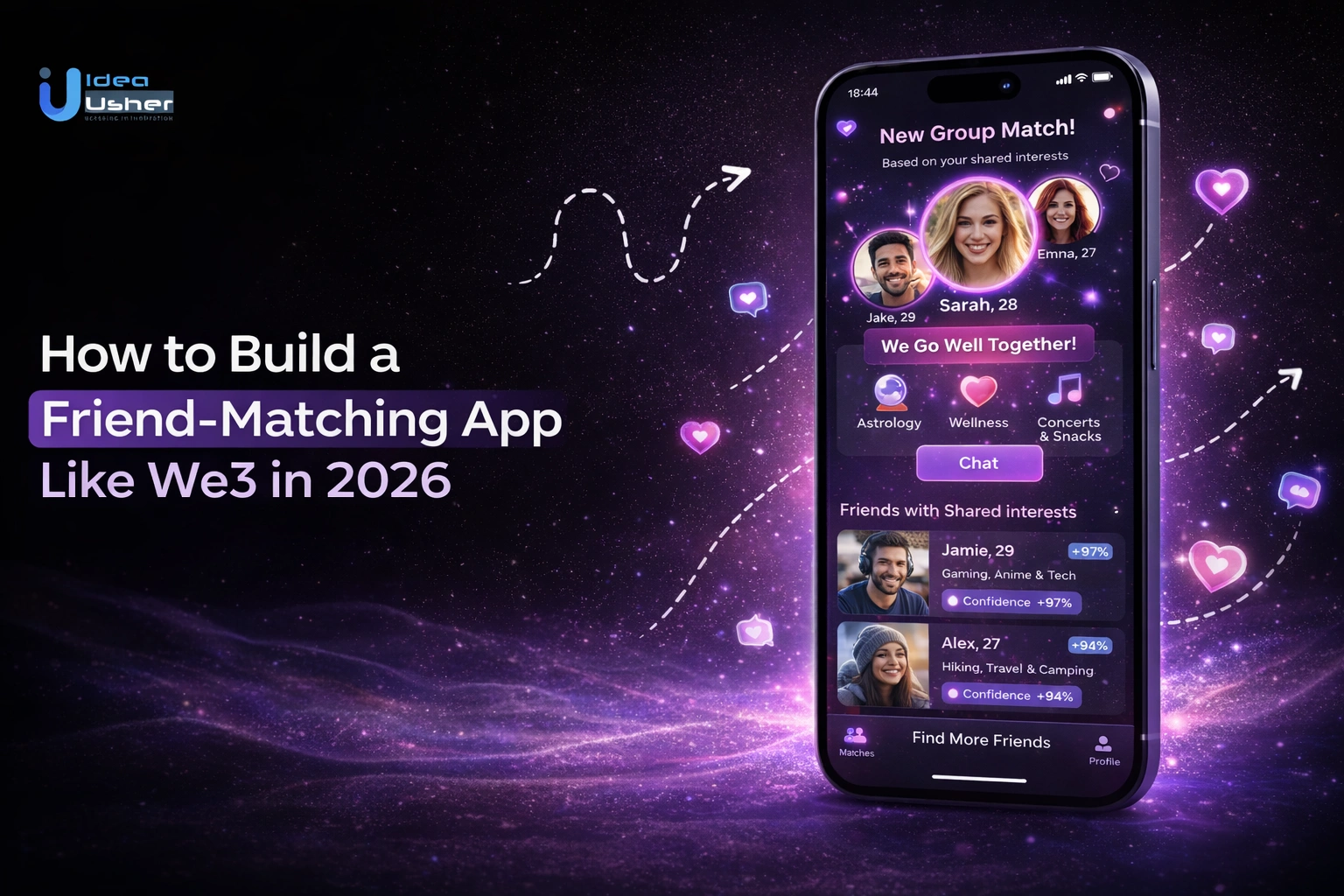
Making new friends as an adult often feels harder than expected, especially when most social platforms are designed around broad networking or dating rather than genuine friendship. As people increasingly seek intentional ways to connect over shared values without the pressure of 1:1 interactions, interest in We3-like friend matching app development is surging, leveraging compatibility algorithms and group dynamics to foster balanced, organic connections.
The core experience requires more than basic profile matching, the app must integrate compatibility algorithms, group formation logic, conversation design, onboarding flows, and engagement systems all need to work together to foster trust and reduce social friction. This framework ensures that onboarding flows and engagement systems work together seamlessly, supporting comfortable introductions while maintaining long-term user safety.
In this blog, we explain how to build a friend-matching app like We3 in 2026 by examining core features, system architecture, and practical considerations involved in designing a scalable and meaningful social connection platform.
Why Friend-Matching Apps Are Booming in 2026?
The global social networking app market is expanding rapidly, creating strong opportunities for We3 like friend matching apps. Valued at around $49.09 billion in 2022, the market is projected to reach $310.37 billion by 2030, growing at a CAGR of 26.2%.

This growth is driven by rising demand for meaningful connections, community-driven platforms, and personalized social experiences, making friendship-focused apps a high-growth niche within the broader social ecosystem.
A. Rise of Loneliness-Driven Social Platforms
Modern social platforms are evolving to address the global loneliness epidemic. Unlike earlier iterations of social media that focused on broadcasting content, the new wave of platforms is built on the foundation of facilitating real-world interactions.
- Proactive Social Curation: Platforms are moving away from passive feeds toward active discovery tools that suggest “Tribe” formations based on real-time availability and shared values.
- Life-Stage Transitions: There is a surge in demand from users navigating major life changes, such as moving to a new city, switching careers, or entering parenthood, where traditional social circles often fade.
- The Wellness Integration: Social health is now recognized as a core pillar of overall well-being. A We3 like friend matching app functions as a utility for mental health by reducing the friction of meeting new people.
- Focus on Offline Success: The primary metric for success in 2026 is the “conversion to offline,” where the app serves as a bridge rather than a destination.
B. Shift from Dating Apps to Platonic Networks
A significant portion of the user base is actively seeking environments that are explicitly non-romantic. The exhaustion associated with “swipe culture” has led to a demand for platforms where the pressure of a “date” is completely removed from the equation.
| Feature | Dating App Dynamics | Platonic Network Dynamics (We3 Style) |
| Interaction Model | Primarily 1-on-1 | Group-based (The “Tribe” of 3) |
| User Intent | Romantic/Sexual attraction | Shared values and lifestyle compatibility |
| Privacy Level | Public or semi-public profiles | Privacy-first; profiles are not searchable |
| Pressure Level | High (rejection-heavy) | Low (collaborative social setting) |
| Demographic | Primarily single individuals | Open to everyone, including those in relationships |
C. Market Gap for Meaningful Adult Friendships
While there are many ways to meet people, there is a distinct lack of tools that ensure high-quality, long-term compatibility for adults. The current market gap exists because most existing solutions rely on superficial interests rather than deep-seated behavioral traits.
- The “Proximity” Problem: Traditional friendship relies on being in the same place (work, school). As remote work dominates, a We3 like friend matching app replaces physical proximity with psychological proximity.
- Quality Over Quantity: Adult users are time-poor. They do not want 100 new “followers”; they want three people who share their core ethics and schedule.
- Psychometric Accuracy: Successful platforms in 2026 use advanced personality assessments to filter out social noise. This ensures that when a group is formed, the members already have a high probability of “clicking” without the awkward trial-and-error phase.
- Safety and Trust: By implementing strict non-dating policies and group-only interactions, these platforms create a high-trust ecosystem that appeals to high-intent users who avoid traditional social apps due to privacy or safety concerns.
What Is We3 & Why Its Model Works So Well?
We3 is a social discovery app specifically designed for making platonic friendships rather than dating. Its defining feature is its “group-of-three” model, which matches highly compatible people into small private groups called “Tribes”. This model works because it aligns with human evolutionary psychology, which favors group integration over high-stakes, one-on-one encounters.

A. The “Tribe of Three” Concept Explained
The defining feature of a We3 like friend matching app is the intentional matching of users into groups of three, known as Tribes. This specific number is chosen based on social dynamics that suggest three is the optimal minimum for a stable social unit.
- Removal of Social Pressure: In a duo, the responsibility for carrying a conversation is split 50/50. If one person stalls, the interaction becomes awkward. In a trio, the third person acts as a social buffer, allowing for a more relaxed and fluid dialogue.
- Safety and Intent: Groups of three naturally discourage romantic advances and “date-like” atmospheres. This structure reinforces the platonic mandate of the platform, making it a safer space for all genders.
- Diverse Perspectives: A three-person dynamic allows for a “majority” and “minority” opinion to shift constantly, leading to more engaging and long-lasting discussions than a simple binary exchange.
- Ease of Meeting: Transitioning from a group chat to an offline meetup feels more like a casual outing and less like a high-pressure interview, which significantly lowers the barrier to real-world interaction.
B. Psychology-Based Matching vs Swiping Models
We3 replaces the superficial “swipe” with a deep, psychometric analysis. Users engage in comprehensive quizzes that cover over 150 factors, from core values and political beliefs to “mutual quirks” and lifestyle habits.
| Feature | Swiping Models (Standard) | Psychology-Based Matching (We3) |
| Primary Factor | Physical Appearance / Photos | Behavioral and Lifestyle Compatibility |
| User Effort | Low (Low-intent browsing) | High (Deep psychographic quizzes) |
| Match Quality | High volume, low compatibility | Low volume, high compatibility |
| Algorithm Goal | Maximum time spent in-app | Maximum “chemistry” and offline success |
| Foundation | Gamified dopamine loops | Social science and Big Five personality traits |
C. Privacy-First UX and No-Public-Profile Design
Privacy is not just a feature in a We3 like friend matching app; it is the core architecture. Unlike most social platforms that encourage public broadcasting, this model thrives on invisibility and exclusivity.
- Profiles are Never Public: You cannot “search” for users or browse a directory. Your existence on the platform is only revealed to the two people you are matched with in a Tribe.
- No Endless Feeds: By removing the “infinite scroll” of videos or photos, the app eliminates the competitive, performance-based nature of social media.
- Anti-Tracking Standards: These platforms do not sell user metadata or track behavior across other sites, appealing to the privacy-conscious 2026 demographic.
- Discreet Discovery: Users can even set themselves to “Invisible” to prevent being seen by people they already know, such as coworkers or family members.
D. Key Reasons Behind We3’s User Retention
The retention of a We3 like friend matching app is driven by the quality of the connections it facilitates rather than addictive UI tricks. When a user finds a “Tribe” that actually clicks, the app becomes an indispensable part of their social life.
- The “Aha” Moment: Retention is highest when users realize the algorithm actually “gets” them. Seeing a list of “Mutual Quirks” with strangers creates an immediate sense of belonging.
- Strict Accountability: High-quality moderation and account authenticity checks ensure that the community remains free of scammers and “dating hunters,” preserving the high-trust environment.
- Group Chat Momentum: Once a Tribe is formed, the shared group chat provides a natural space for ongoing engagement. As long as the conversation is active, the user stays on the platform.
- Value-Based Notifications: Instead of generic alerts, notifications are only sent when a highly compatible match is found or when a Tribe member interacts, making every “ping” relevant and rewarding.

Core Features That Define a Web3-Like App
Building a We3 like friend matching app requires developers to prioritize collective synergy over superficial aesthetics. This strategic shift involves a robust backend and a secure interface that transforms the platform into a trusted architect for meaningful, high-quality human connections.

1. Deep Personality Quiz Engine
A Deep Personality Quiz Engine replaces superficial bios with psychometric profiles using frameworks like Big Five (OCEAN) or Myers-Briggs Type Indicator (MBTI). It moves beyond basic hobbies to uncover underlying values and cognitive styles through a gamified interface. By analyzing social boundaries and lifestyle non-negotiables, the system creates a digital twin of a user’s persona, ensuring high-compatibility matching based on true social chemistry.
2. AI-Based Compatibility Scoring System
An AI-based compatibility scoring system uses machine learning to identify latent patterns in social interaction. For any We3 like friend matching app, this performs a dynamic assessment of how different personality types, like Challengers and Observers, balance each other. This ensures the algorithm predicts group synergy, calculating the likelihood of sustained conversation while effectively resolving potential social friction.
3. Group Matching Instead of 1:1 Pairing
The Tribe concept prioritizes group matching to reduce the pressure of high-stakes, 1:1 pairings. By grouping three or more compatible individuals, the app mirrors real-life social dynamics found at parties. This approach facilitates an organic flow of conversation where the burden of engagement is shared, making initial interactions feel authentic rather than transactional.
4. Private Group Chat and Interaction Tools
The app provides a digital third space to bridge the gap between matching and meeting, featuring private group chat and interaction tools. In a We3 like friend matching app, these include structured icebreakers, shared polls, and collaborative activities designed to spark dialogue. These features help the group find common ground quickly, building a collective identity and rapport.
5. Safe Meetup and Trust-Building Features
Transitioning to the physical world is supported by safe meetup and trust-building features. The We3 like friend matching app suggests vetted public locations and provides check-in features for security. A mutual rating system maintains high community conduct standards. When users feel cleared by both an algorithm and peers, the psychological barrier to meeting is lowered, fostering accountability and safety.
6. Anonymous Onboarding and Profile Visibility
Anonymous onboarding and restricted profile visibility ensure users are judged on personality substance rather than appearance. Photos and names remain hidden until mutual interest or Tribe formation occurs. This blind approach filters out superficial hookups, attracting those seeking meaningful platonic connections and ensuring the community remains focused on high-quality, interpersonal chemistry.
Must-Have Advanced Features for 2026 Apps
Modern users expect a We3 like friend matching app to act as a proactive digital companion rather than a static tool. These advanced features leverage sophisticated machine learning to reduce social friction, creating a living architecture that fosters deeper human connections.

1. AI-Driven Behavioral Pattern Learning
The next-generation personalization in a We3 like friend matching app utilizes AI-driven behavioral pattern learning over static filters. By analyzing interaction speed, engagement triggers, and social energy levels, the system maps behavioral nuances. This allows the AI to predict group dynamics and curate matches that feel instinctively accurate.
2. Real-Time Group Compatibility Updates
Real-time group compatibility updates ensure Tribe cohesion by instantly recalculating scores when member preferences or sentiments shift. In a We3 like friend matching app, the AI provides social health checks, suggesting new topics to keep the interaction dynamic.
3. Voice and Video-Based Icebreakers
To eliminate text fatigue, voice and video-based icebreakers use asynchronous clips to humanize digital avatars. These prompted challenges build intimacy and trust through vocal cadence and micro-expressions, significantly increasing the success rate of offline social transitions.
4. Event-Based Group Engagement Modules
Event-based group engagement modules act as a social coordinator by launching collaborative quests. Whether through digital scavenger hunts or local meetups, these modules provide the social glue that transforms a static match into an active friendship.
5. Emotional Intelligence (EQ) Scoring Systems
The EQ scoring system evaluates social health by measuring empathy and conflict resolution. In a We3 like friend matching app, high scores incentivize positive behavior, rewarding active listeners with better visibility to create a self-regulating community rooted in kindness.
How the Friend-Matching Algorithm Works?
The core of a We3 like friend matching app lies in a high-dimensional algorithm that prioritizes psychological alignment and predicts long-term social compatibility. These systems translate human traits into data, enabling accurate group formation and meaningful, lasting connections.

A. The Core Logic of Connectivity
To understand how the backend facilitates these connections, we can break the process down into specific functional layers:
- The Ingestion Layer: This is where raw human complexity is converted into structured data. Beyond standard demographics, the system collects deep psychometric markers like communication styles and social battery levels.
- The Psychological Framework: Validated models like the Big Five (OCEAN) are used to predict behavior. This allows the AI to move toward “temperament matching,” ensuring a balanced mix of personalities within a group.
- The Equilibrium Strategy: The algorithm treats each group as a unique chemical compound, balancing dominant and submissive social traits to prevent friction and ensure no single member feels like an outlier.
- The Optimization Loop: The system employs adversarial testing to avoid “echo chambers” and bias, focusing on intrinsic personality markers rather than extrinsic status symbols.
B. Technical Breakdown: Data to Discovery
The following table illustrates how the algorithm processes different inputs to generate high-quality social matches:
| Component | Input Data | Matching Goal |
| Onboarding Engine | Values, Interests, Communication Style | Establishing the “Social Persona” |
| Personality Mapping | Big Five (OCEAN) Scores | Predicting Group Interactivity |
| Group Balancer | Individual Temperaments | Creating “Social Equilibrium” |
| Bias Filter | Interaction History | Ensuring Meritocratic Visibility |
| Feedback Loop | Meetup Ratings & Chat Activity | Continuous Accuracy Refinement |
C. Continuous Evolution Through Feedback
The algorithm exists in a state of constant evolution in a We3 like friend matching app that learns from every interaction. This constant refinement ensures the platform’s social intelligence scales effectively as the community grows.
- Reinforcement Learning: The system strengthens specific neural pathways whenever group chats flourish or meetups receive high ratings from members.
- Friction Analysis: If groups become dormant, the AI automatically identifies social friction points to adjust weighting for future pairings.
- Smarter Social Fabric: As the user base expands, the algorithm becomes more adept at predicting long-term compatibility and successful group dynamics.
- Improving Success Rates: Continuous feedback loops ensure that new members benefit from an ever-evolving database of successful social patterns and connection markers.
UX Design That Builds Trust & Comfort
The UX shifts from attention-grabbing to comfort-building, creating a low-pressure, psychologically safe interface that reduces digital burnout and supports user control.
The platform builds long-term trust by prioritizing human-centric design over dark patterns, offering a private lounge-like experience where users transition smoothly from anonymity to meaningful social interaction.
1. Key UX Strategies for User Retention
To achieve a balance between engagement and emotional comfort, the design must incorporate the following pillars:
- Paced Disclosure: Information is revealed gradually as trust grows within a “Tribe,” preventing the overwhelming feeling of being “exposed” to strangers.
- Contextual Icebreakers: Instead of a blank text box, the UI provides relevant prompts based on shared group interests, lowering the cognitive load for starting a conversation.
- Micro-Validation: Subtle animations and feedback loops celebrate small social wins, like completing a quiz or joined a group, without being intrusive.
- Exit Sanity: Easy-to-find options to “pause” social discovery or leave a group without social stigma, reinforcing the user’s autonomy.
2. UX Comparison: Traditional Social vs. Trust-Based Design
The following table highlights the radical differences in design philosophy between standard social apps and a “We3-like” trust-centric platform:
| Feature | Traditional Feed-Based UX | Trust & Privacy-First UX |
| First Impression | Visual-heavy (Photos first) | Value-heavy (Personality first) |
| Interaction Goal | Maximum Swipes/Scrolls | Quality Connections (Tribes) |
| Profile Visibility | Public & Searchable | Restricted & Gradual Reveal |
| Engagement Hook | FOMO (Notifications) | JOMO (Joy of Missing Out/Focused Intimacy) |
| UI Aesthetics | High-contrast, Addictive | Minimalist, Muted, Calming |
3. Privacy-First UX Patterns That Convert
Building a We3 like friend matching app requires making privacy a visible, core part of the journey. This approach converts skeptics into active users by ensuring their identity is protected.
- Visible Privacy Integration: Move security settings from hidden menus to the forefront of the user experience.
- Blurred-to-Clear Reveals: Implement photo reveals based on interaction levels to foster deep engagement.
- Security-by-Default: Reduce onboarding friction by guaranteeing that data protection is an automated, non-negotiable standard.
- Authentic Self-Expression: Create a safe environment where users feel comfortable sharing their true personalities without fear.
4. Designing for Introverts and Social Anxiety
The UX must eliminate the stress of the first move. By centering the experience on groups, the app provides a low-pressure social harbor.
- Group-Centric Interaction: Shift the focus from individuals to the Tribe to significantly reduce personal social anxiety.
- Double-Opt-In Chats: Ensure mutual comfort by requiring all members to agree before a group conversation begins.
- AI-Moderated Introductions: Use automated prompts to drive the dialogue, removing the burden of leading the conversation.
- Calming Digital Environment: Apply soft color palettes and avoid high-urgency UI elements to allow participation at any speed.
Step-by-Step Process to Build a We3-Like App
Building a successful We3 like friend matching app requires a strategic fusion of psychological principles and advanced engineering. This roadmap outlines the essential phases for transforming a conceptual “Tribe” model into a scalable, high-engagement digital ecosystem.

1. Market Research & Niche Validation
A deep analysis of current social gaps reveals where users feel most isolated by traditional “swipe” mechanics. Identification of specific demographics, such as expats or hobbyists, ensures the platform solves a concrete problem rather than just offering another generic chat tool.
2. Define User Personas and Journeys
Detailed profiles of potential users clarify how different personality types will interact with the interface. Mapping the transition from anonymous onboarding to a successful offline meetup highlights friction points that require intuitive design solutions to maintain high user retention rates.
3. Build Compatibility Logic Framework
The core algorithm must translate abstract human traits into machine-readable data points. Integration of established psychological models, like the Big Five, provides a scientific basis for matching, ensuring that group formations are rooted in genuine temperament alignment rather than superficial interests.
4. UI/UX Wireframing and Prototyping
Low-fidelity blueprints focus on a “privacy-first” flow that builds trust through progressive disclosure. Interactive prototypes allow for early testing of the “Tribe” dashboard, ensuring that group communication tools are prominent and that the overall aesthetic promotes a sense of safety.
5. Backend and AI Model Development
A robust server architecture handles the heavy lifting of real-time compatibility calculations and secure data storage. The machine learning model requires iterative training on social interaction datasets to improve the accuracy of its matching suggestions as the user base expands.
6. Testing Group Dynamics and Flows
Beta testing with small, controlled cohorts uncovers how actual humans respond to the algorithm’s group assignments. Observation of conversation patterns and “ghosting” rates provides the necessary feedback to recalibrate the matching weights before a full-scale public launch occurs.
7. Launch and User Acquisition Strategy
A multi-channel marketing plan targets specific online communities where the “loneliness epidemic” is most prevalent. Partnerships with local venues for “vetted” meetups can provide a tangible real-world value proposition that distinguishes the app from its purely digital competitors.
Cost Breakdown for a We3-Like Social Discovery App
Developing the We3 like friend matching app centered on psychological matching and group dynamics involves significant investment in both “visible” UX and “invisible” AI logic. The following cost sheet provides a comparative view of the budget required for a lean market entry (MVP) versus a high-scale, feature-complete platform (Enterprise).
| Development Phase | MVP Level | Enterprise Level | Key Deliverables |
| Discovery & Planning | $5,000 – $10,000 | $15,000 – $28,000 | Market research, SRS documentation, AI feasibility study. |
| UI/UX Design | $8,000 – $15,000 | $20,000 – $45,000 | User personas, low/high-fidelity wireframes, interactive prototypes. |
| Frontend Development | $20,000 – $40,000 | $60,000 – $110,000 | Responsive mobile interface (Flutter/React Native), core animations. |
| Backend & AI Engine | $25,000 – $50,000 | $100,000 – $220,000 | AI matching algorithm, real-time database, encrypted chat servers. |
| QA & Security Testing | $10,000 – $20,000 | $25,000 – $40,000 | Functional testing, load balancing, penetration testing, GDPR compliance. |
| Deployment & Launch | $5,000 – $10,000 | $10,000 – $25,000 | App Store/Play Store submission, cloud infrastructure setup (AWS/GCP). |
| Total Estimated Cost | $53,000 – $105,000 | $225,000 – $370,000+ | A market-ready social ecosystem. |
Cost-Affecting Factors During Development
Several variables can swing the final budget of We3 like friend matching app development by 20% to 50%. Understanding these “hidden” drivers allows for better financial planning and helps avoid the common trap of scope creep during the mid-development phase.
- AI Matching Complexity: Integrating pre-trained APIs costs $5,000–$15,000, while a custom proprietary model for deep psychometrics can exceed $100,000. Custom builds require data scientists and significant compute resources for specialized scoring.
- Infrastructure and API Fees: Initial hosting is low, but scaling a We3 like friend matching app beyond 10,000 members increases costs to $2,000–$5,000 monthly. This covers real-time sync, video processing, and high-volume notifications.
- Platform Selection: Native development for iOS and Android increases budgets by 60%–90%. Using cross-platform frameworks like Flutter or React Native saves 30%–40% in costs by using a single codebase with near-native performance.
- Compliance and Security: Handling sensitive data requires meeting 2026 privacy standards. Implementing end-to-end encryption and GDPR/SOC2 certifications adds $15,000–$40,000, which is essential for establishing legal protection and user trust.
Tech Stack Needed for Friend-Matching Apps
Selecting the right technological foundation for We3 like friend matching app is critical for ensuring that the complex psychological matching occurs instantaneously and securely. In 2026, the focus has shifted toward “Edge AI” and real-time synchronization to prevent any lag in the social experience. The following table outlines the high-performance components required to build a scalable, “We3-like” infrastructure.
| Component | Recommended Technology | Strategic Value |
| Frontend Technologies | Flutter / React Native | Cross-platform efficiency allows for a single codebase that delivers 60fps animations and a native-feel UX on both iOS and Android. |
| Backend Architecture | Node.js / Go (Golang) | High-concurrency handling ensures that thousands of real-time group chat messages and “Tribe” updates are processed with sub-100ms latency. |
| AI/ML Scoring Tools | Python (PyTorch / TensorFlow) | These libraries power the custom neural networks that analyze Big Five traits and predict social compatibility between multiple users. |
| Cloud Infrastructure | AWS (Lambda / AppSync) | Serverless architecture allows the app to scale from 1,000 to 1,000,000 users automatically, charging only for the exact compute power used. |
| Data Privacy & Encryption | AES-256 / Signal Protocol | Implementing end-to-end encryption for private chats and “Zero-Knowledge” storage for personality quizzes ensures 100% user anonymity. |
Deep Dive into Implementation
Successful implementation of a We3 like friend matching app requires a sophisticated technical foundation. This involves integrating high-performance tools and modular architectures to ensure seamless, real-time social connectivity.
- Frontend State Management: Utilizing Riverpod or Redux for state management is essential. This ensures that when a user is matched into a new “Tribe,” the UI updates instantly across all devices without requiring a manual refresh.
- AI Semantic Search: Integrating Vector Databases (like Pinecone or Weaviate) allows the algorithm to perform “semantic searches.” Instead of matching by keywords, the system finds users whose “personality vectors” are mathematically closest in a multi-dimensional space.
- Scalable Infrastructure: Using Docker and Kubernetes for containerization ensures that the backend remains modular. If the matching engine requires more power during peak evening hours, the system can spin up additional “pods” to handle the load without affecting the chat or profile services.
Monetization Models That Actually Work Here
Sustainable revenue for social discovery platforms relies on enhancing human connection rather than interrupting it with intrusive ads. The most successful strategies prioritize value-added features that deepen the user’s understanding of their social compatibility and “Tribe” dynamics.
1. Subscription-Based Premium Matching
A tiered subscription model provides users with advanced filtering capabilities and increased “Tribe” capacity. Monthly or annual members gain priority access to high-compatibility groups and “Travel Mode” features, allowing them to establish meaningful social circles in new cities before they arrive.
2. Paid Personality Insights and Reports
Users often seek deeper self-awareness, making detailed psychometric breakdowns a high-value digital product. Premium “Social DNA” reports offer exhaustive analysis of a user’s Big Five traits, providing actionable advice on communication styles and suggesting specific personality types for optimal social harmony.
3. Event-Based Monetization Strategies
Revenue is generated by facilitating real-world interactions through curated “Tribe” experiences. By partnering with local venues, the app can offer exclusive booking packages or “Social Passes” for group activities, taking a small commission for transforming digital connections into physical memories.
4. Community-Driven Revenue Streams
The platform can foster a micro-economy by allowing users to host “Verified Hangouts” or specialized interest groups. Implementing a “Tips” or “Tokens” system for high-quality community contributors encourages positive engagement while providing the platform with a percentage of every peer-to-peer transaction.
Real Challenges in Building Friend Apps
The We3 like friend matching app development involves navigating complex human behaviors and technical hurdles. Our development team focuses on creating resilient systems that prioritize authentic connection, ensuring your platform overcomes common industry pitfalls through sophisticated, data-driven architecture.
1. Cold Start Problem in Group Matching
Challenge: New applications often struggle to form cohesive groups when the initial user base is too small to satisfy specific compatibility.
Solution: Our developers implement “Simulated Annealing” algorithms and temporary interest-based clusters to maintain engagement. We leverage IdeaUsher’s rapid-scaling infrastructure to bridge the gap until organic density is achieved.
2. Ensuring Match Quality Over Quantity
Challenge: High-volume matching often leads to superficial interactions, causing user burnout and decreasing the long-term value of the social network.
Solution: We utilize multi-dimensional vector spacing to prioritize deep psychological alignment. Our team builds “Throttled Discovery” layers that focus on high-probability connections, ensuring every Tribe formed has a genuine success potential.
3. Preventing Misuse and Fake Profiles
Challenge: Social platforms are frequently targeted by bots and bad actors, which erodes community trust and compromises the user experience.
Solution: We integrate AI-powered behavioral biometrics and liveness detection during onboarding. IdeaUsher’s security experts deploy automated moderation bots that flag “low-empathy” interaction patterns to maintain a safe, high-quality environment.
4. Balancing Privacy with Engagement
Challenge: Users demand total data anonymity, yet the matching algorithm requires granular personal information to function effectively and create relevance.
Solution: Our engineers employ Zero-Knowledge Proofs and “On-Device” processing for sensitive traits. We design progressive disclosure UI patterns that reveal data only as mutual trust grows, protecting users without sacrificing chemistry.
Case Study: What Startups Can Learn from We3
The evolution of We3 offers a masterclass in shifting social paradigms from individual-centric browsing to group-based belonging. These strategic milestones provide a blueprint for building high-trust ecosystems that prioritize psychological depth over the superficiality of traditional networking platforms.
A. Product Decisions That Drove Growth
The platform’s expansion was fueled by a commitment to “friction-heavy” onboarding, which paradoxically increased user quality. By rejecting the instant-gratification model, the developers created an environment where investment leads to intimacy.
- Psychographic Gating: Requiring comprehensive personality data ensured that only high-intent users entered the ecosystem.
- The Power of Three: Utilizing the “Smallest Tribe” concept optimized for conversational chemistry while maintaining a low-pressure social environment.
- Aesthetic Neutrality: Choosing a calming, non-addictive UI design attracted a demographic tired of dopamine-chasing social feeds.
B. Features That Improved Retention Rates
Retention was achieved by transforming a utility into a community. By focusing on the “long tail” of friendship, the app moved beyond a one-time solution to become a recurring digital third space.
- Progressive Profile Reveal: Locking photos behind interaction milestones incentivized consistent, meaningful communication over quick visual judgments.
- AI-Facilitated Icebreakers: Reducing “message anxiety” through prompted group questions kept conversations flowing during the critical first 48 hours.
- Tribal Evolution: Allowing groups to merge or invite new compatible members prevented social stagnation and extended the app’s lifecycle.
C. Mistakes Avoided by We3’s Model
We3 succeeded by identifying the structural flaws in 1:1 matching apps. Their model intentionally bypassed the “interview-style” fatigue that often leads to high churn rates in the social discovery sector.
- Eliminating the “Swipe” Fatigue: Removing the binary pass/fail mechanic prevented the commoditization of users.
- Avoiding the “Dating App” Stigma: Positioning the platform strictly for platonic or social connection broadened the addressable market significantly.
- Bypassing Public Feeds: Declining to implement a public wall prevented the performative behavior and toxicity common in mainstream social media.
D. Key Takeaways for Founders in 2026
The demand for privacy and authentic connection is at an all-time high in 2026. Startups must leverage AI not just for speed, but for the nuance of human emotion and safety.
- Privacy as a Product: Treat data security and anonymity as core features that drive user conversion, not just legal requirements.
- Algorithm Transparency: Clearly communicate how matching works to build user trust in the AI’s “judgment.”
- Offline Transition Focus: Design the digital experience specifically to facilitate real-world meetups, as physical connection remains the ultimate retention metric.
Why Choose IdeaUsher for Your We3 like Friend Matching App Development?
IdeaUsher transforms complex social psychology into seamless digital experiences through a blend of advanced AI and human-centric engineering. We specialize in creating high-retention ecosystems that prioritize authentic connection and architectural scalability.
A. Our Approach to AI-Driven Matchmaking
Our ex-FAANG/MAANG developers architect proprietary algorithms that go beyond basic interest tagging. By leveraging deep learning and psychometric data, we create high-precision matching engines that ensure every group formation possesses genuine social chemistry.
B. Experience with Social and Community Apps
With over 500,000+ hours of experience, our team has mastered the nuances of digital tribes. We have successfully launched numerous community-driven platforms, perfecting the balance between automated moderation and organic user-to-user engagement.
C. Custom UX Strategies for Engagement
We design interfaces that reduce social friction and build immediate trust. Our custom UX frameworks focus on progressive disclosure and “privacy-first” patterns, ensuring that even the most introverted users feel comfortable within your ecosystem.
D. End-to-End Development and Scaling Support
Our comprehensive support covers everything from the initial MVP to global scaling. We provide robust DevOps and cloud infrastructure management, ensuring your application remains lightning-fast and secure as your community grows into the millions.
Conclusion
The landscape of social connection is shifting toward intentionality, safety, and psychological depth. Developing a We3 like friend matching app in 2026 requires a sophisticated blend of psychometric AI, group-centric UX, and privacy-first architecture. By prioritizing social chemistry over superficial metrics, founders can build platforms that effectively solve the modern loneliness epidemic. Success lies in creating a trusted social architect that transforms digital interactions into lasting, real-world friendships, ensuring users feel secure while discovering their most compatible tribes in an increasingly automated world.


FAQs
A.1. MVP development typically ranges from $53,000 to $105,000. Total costs depend on AI complexity, custom psychometric engines, and whether you choose cross-platform tools like Flutter to reduce initial engineering overhead.
A.2. Implement identity verification, end-to-end encryption, and mutual rating systems. Use AI moderators to flag toxic behavior early, ensuring the community remains a safe harbor for introverts and sensitive users alike.
A.3. The primary risks include the cold start problem and maintaining match quality during rapid growth. Scalable infrastructure must be paired with automated moderation to prevent spam and fake profiles from eroding the trust established during the early stages.
A.4. Maintain a strict platonic focus by using group-only matching and avoiding 1:1 discovery. Removing “swipe” mechanics and focusing on shared values in the onboarding quiz filters out users seeking romance, preserving the community’s social integrity.


