


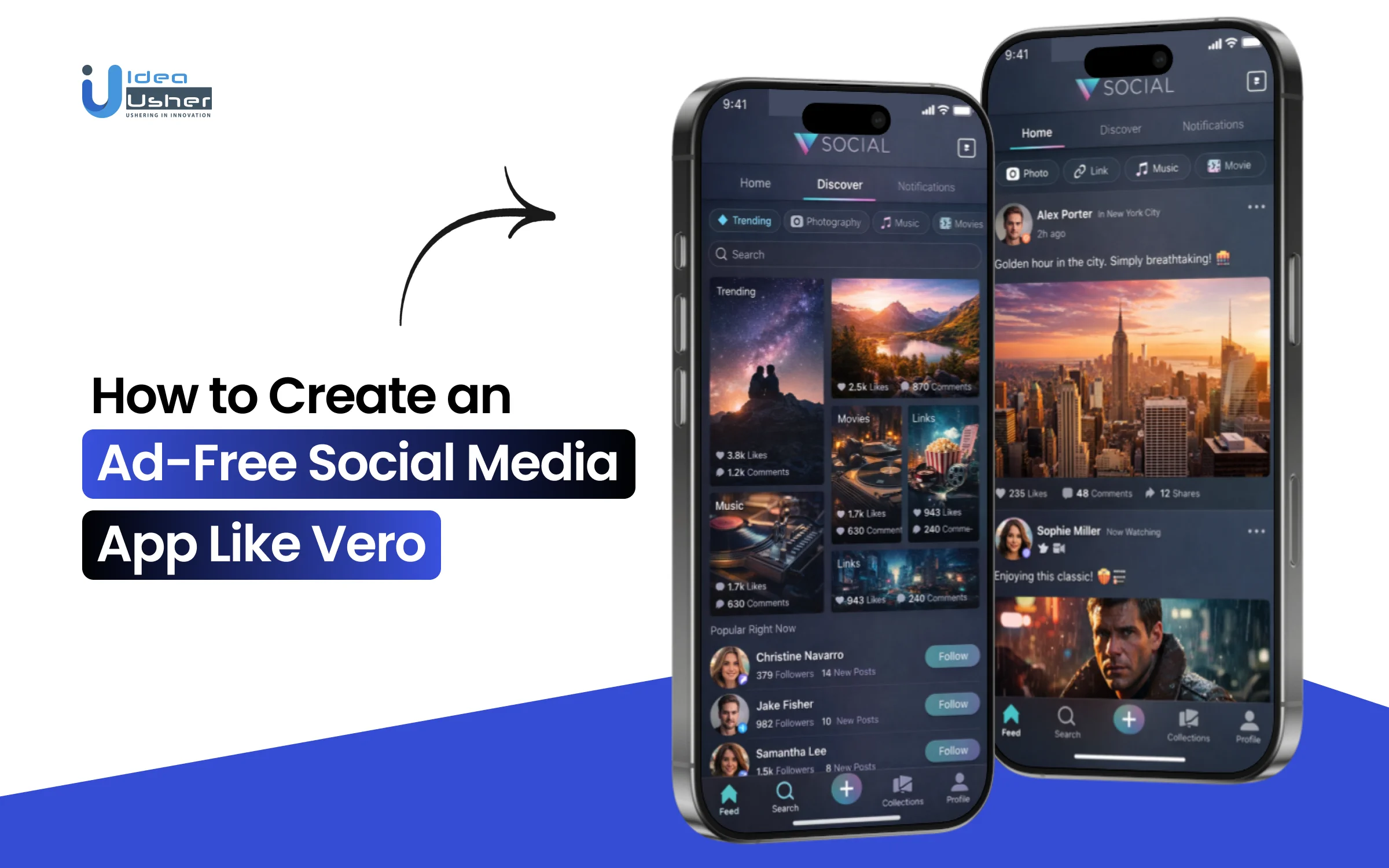
The internet once promised open communication without barriers. Over time, many platforms shifted toward an attention-driven economy where user time became the product. Feeds expanded, and notifications became frequent while advertising systems quietly dominated the experience. Many users started noticing that these networks were optimized for engagement loops instead of meaningful interaction.
The popularity of ad-free social media apps has started increasing because people want cleaner timelines and stronger privacy. Users also prefer platforms where their data is not constantly used for ad targeting. As digital fatigue grows business may seriously explore social architectures that respect user attention.
We’ve built numerous social media platforms that use technologies like decentralized identity frameworks and privacy-centric social networking architectures. As IdeaUsher has years of expertise in this domain, we’re sharing this blog to discuss the steps to create an ad-free social media app like Vero.
Why Ad-Free Social Media Apps Are Gaining Demand?
According to Grand View Research, the global social networking app market size was estimated at USD 49.09 billion in 2022 and is anticipated to reach USD 310.37 billion by 2030, growing at a CAGR of 26.2% from 2023 to 2030. This shift marks a transition from the attention economy to a value economy. Investors are now eyeing platforms where users are customers rather than products.

Source: Grand View Research
The ad-supported model is fracturing. Legacy platforms prioritize addictive loops to maximize ad impressions, often at the cost of user experience. High-value users now seek environments that respect their time. For an entrepreneur, this is a blue ocean opportunity to build a platform where business goals align with user well-being.
This demand reflects a market correction. As digital literacy grows, users recognize the hidden costs of free platforms, including data harvesting and psychological manipulation. Investing in ad-free ecosystems is a strategic bet on quality and intentionality over viral noise.
User Fatigue with Algorithm-Driven Feeds
Modern social media has shifted from chronological tools to aggressive recommendation engines. This creates a feedback loop of provocative and repetitive content, leading to “algorithmic exhaustion.” Users are now actively seeking a return to agency and control.
Strategic advantages include:
- Intentional Consumption: Users want to curate their own experience without forced suggestions.
- Mental Clarity: Professionals are removing apps that clutter their focus with intrusive ads.
- High-Signal Environments: Content creators can prioritize depth over clickbait, attracting a more sophisticated audience.
Shift Toward Privacy-First Social Experiences
Privacy is now a core consumer requirement. The legacy model relies on mapping user behavior to build advertising profiles. For high-net-worth individuals, this level of exposure is a significant deterrent.
Removing the advertising layer eliminates the need for invasive trackers and third-party cookies. This creates a “walled garden” that is inherently secure. It also mitigates risks from evolving global data regulations and builds immediate brand trust that traditional giants cannot easily replicate.
Subscription-Based Social Apps Market Outlook
The success of Discord and Telegram Premium proves that users will pay for superior, ad-free environments. This model provides a predictable revenue stream compared to volatile ad markets.
Benefits for the investor:
- Higher ARPU: A dedicated user base paying monthly is often more valuable than a massive audience generating pennies in impressions.
- Customer Alignment: Revenue comes from users, simplifying the product roadmap toward providing actual value.
- Reduced Churn: Business-minded users view these platforms as essential tools, ensuring higher retention rates.
Gaps Left by Instagram and Facebook
Meta’s legacy platforms are trapped by their own success. They cannot pivot from ads without impacting stock prices, leaving substantial gaps for new players to exploit.
- The Connection Gap: A focus on commerce and short-form video has alienated those seeking genuine social updates.
- The Integrity Gap: Misinformation and bots make these platforms unattractive for high-level discourse.
- The Utility Gap: New platforms can offer specialized tools, like high-fidelity sharing or advanced search, which broad-market giants cannot implement without disrupting their ad flow.

What Makes Vero Different From Traditional Social Media Apps?
Vero departs from standard social media architecture by prioritizing product utility over data extraction. While legacy platforms are engineered to maximize ad impressions, Vero is built for the user experience. For investors, this distinction proves that scale can be achieved by prioritizing platform integrity over advertising yield.
Removing commercial layers creates a streamlined interface that appeals to high-value demographics. This approach shifts the user dynamic from passive consumption to intentional interaction, fostering a level of engagement rarely found in the noisy environments of ad-supported media.
Chronological Feed Vs Engagement Algorithms
The core technical differentiator is the absence of a recommendation engine. Unlike traditional apps that sort content by “probability of interaction” (often promoting polarizing material) Vero utilizes a pure reverse-chronological feed. This ensures users see posts in the order they were shared.
Strategic benefits of this transparency include:
- Organic Reach: Creators do not have to “pay to play” or manipulate content to satisfy an algorithm.
- User Agency: A predictable feed reduces the psychological stress associated with hidden ranking systems.
- Authenticity: Content is delivered based on timing and relevance rather than artificial suppression.
Tiered Connections And Audience Control
Vero mirrors real-world relationships through a unique social hierarchy. Moving beyond the binary “Follower” model, it allows users to categorize connections into three distinct loops: Close Friends, Friends, and Acquaintances.
This tiered architecture enables granular privacy. A user can share personal updates with “Close Friends” while broadcasting professional insights to “Acquaintances” or the public. For high-net-worth individuals, this provides a secure environment to manage both private and public personas within a single interface.
Ad-Free UX And Its Retention Impact
The commitment to an ad-free model is a powerful retention tool. Without commercial interruptions, the interface remains fast and focused on high-quality content. This significantly reduces “app fatigue,” leading to higher long-term loyalty and longer session durations.
From a business perspective, this shifts the platform’s loyalty from the advertiser to the user. When revenue is driven by value rather than impressions, the development roadmap focuses on features users actually want. This alignment minimizes churn, as users treat the platform as a premium service rather than a disposable tool.
Multi-Format Content Sharing System
Vero functions as a digital journal rather than a simple photo app. Its “Collections” feature categorizes posts into specific types: photos, links, music, movies, books, and places. This turns a profile into a curated library of tastes and experiences.
Strategic value includes:
- Utility-Driven Socializing: The platform becomes a tool for discovery and curation, not just posting.
- Searchable Utility: Users can easily browse specific categories, such as book recommendations from their network.
- Holistic Branding: Entrepreneurs can share a wider range of intellectual content, building a more authoritative personal brand.
Core Features Your Social Media App Must Have
Building a social media app for the modern era requires moving beyond the “engagement at all costs” philosophy prevalent in current social media apps. To attract high-net-worth users and serious professionals, your app must prioritize functional utility and user autonomy. This involves investing in a robust backend that delivers data without the crutch of a manipulative algorithm.
1. Real-Time Feed Engine
The foundation of a non-toxic social experience is a transparent feed. A real-time chronological engine ensures that the most recent content from followed accounts appears first. This architecture removes the “black box” of algorithmic sorting, providing users with a predictable and honest experience.
Example: Mastodon utilizes a strictly chronological timeline, ensuring users see every post from people they follow in the exact order they were published.
2. Connection Segmentation System
To compete with legacy apps, you must solve “context collapse,” where professional colleagues and family members see the same content. A smart segmentation system allows users to categorize their network into specific tiers like “Internal Circle,” “Professional Network,” and “Public.”
Example: Vero pioneered the use of three distinct relationship loops (Close Friends, Friends, and Acquaintances) to give users granular control over post visibility.
3. Rich Media Sharing
Modern users demand more than text and low-resolution images. A competitive platform must support high-fidelity media, including 4K video and lossless audio. A “Library” feature further allows users to organize content into searchable categories like books, movies, or business resources.
Example: Glass focuses on high-fidelity, metadata-rich photography, offering a professional-grade display that attracts serious visual artists and collectors.
3. Secure Messaging Controls
The messaging suite must be more than a basic chat function. It requires robust privacy controls, such as the ability to disable read receipts and restrict contact initiation. For professional users, integrating file-sharing and threaded conversations turns the app into a collaborative tool.
Example: Signal provides the gold standard for secure, private communication with end-to-end encryption and advanced disappearing message features.
4. Clean Notification System
Mainstream apps use “phantom notifications” to lure users back into the app. To compete on a human-first level, your app must offer a notification system that is strictly functional. Users should only receive alerts for direct interactions or content from their most valued connections.
Example: Beeper aggregates multiple chat networks into one interface, allowing users to customize notification “inboxes” so only high-priority messages trigger an alert.
5. Cross-Device Sync
Users expect a seamless transition between smartphone, tablet, and desktop. A robust synchronization engine ensures that read states, drafts, and feed positions remain consistent across all devices. Furthermore, “offline readiness” allows users to browse cached content or draft posts without an active internet connection.
Example: Telegram provides flawless cloud-sync across unlimited devices, allowing a user to start a draft on their phone and finish it instantly on their desktop.
Must-Have Advanced Features To Stand Out
To distinguish a platform in a crowded market of social media apps, entrepreneurs must move beyond basic utility. Businesses should focus on features that solve structural flaws in legacy platforms, particularly regarding data sovereignty. Implementing systems that empower the user over the advertiser allows a new platform to capture high-value professionals.
1. Interest-Based Communities
True community building requires active participation over passive consumption. Advanced platforms should offer niche spaces where discovery is driven by relevance and reputation. This allows high-level discourse to thrive without being drowned out by viral, low-quality content.
Key strategic elements include:
- Human Curation: Using community-voted hierarchies to surface the best information.
- Specialized UI: Customizing the interface for specific professional groups, like financial analysts.
- Reputation Scores: Granting influence based on consistent value contribution rather than follower counts.
2. Ad-Free Monetization
Sustainability requires a path for creators to earn revenue without sponsored posts. This aligns creator incentives with audience interests, fostering an authentic environment. A direct financial model creates a self-sustaining ecosystem that attracts top-tier talent.
Effective monetization strategies involve:
- Micro-transactions: Supporting specific insights with minimal friction.
- Tiered Access: Locking specialized content or community features behind a paywall.
- Digital Commerce: Selling exclusive digital goods directly to followers.
3. Privacy-First Analytics Dashboard
Users need data to understand their impact without compromising personal privacy. Advanced platforms can offer robust analytics using anonymized, aggregated data. This provides growth insights while ensuring individual behavior is never tracked or sold.
Strategic advantages include:
- Aggregate Insights: Providing a content overview without identifying specific users.
- Actionable Metrics: Focusing on link clicks rather than invasive scroll-depth tracking.
- Regulatory Ease: Meeting global privacy standards automatically to reduce legal overhead.
4. Decentralized Storage
Moving toward decentralized or hybrid storage offers a significant competitive moat as users grow wary of data silos. Distributing data across multiple nodes provides security guarantees that centralized databases cannot match.
This approach:
- Limits Risk: Decreases sensitive data on central servers, lowering breach liabilities.
- Builds Trust: Appeals to users who prioritize technical security over marketing.
- Bolsters Uptime: Ensures platform accessibility even during localized outages.
5. Content Ownership Tools
A premium app should never trap its users. Providing tools for users to own and export their data in machine-readable formats signals platform confidence. This portable identity approach attracts professionals who require archives of their digital activity.
Key ownership features:
- Data Portability: Allowing full downloads of history and metadata at any time.
- Interoperability: Designing the platform to work with other ethical digital services.
- Absolute Deletion: Guaranteeing data is scrubbed from all backups upon account closure.
How to Create an Ad-Free Social Media App Like Vero?
Creating an ad-free social media app like Vero requires a system that uses a chronological feed and avoids algorithmic ranking while giving users clear control over data and audience. A scalable backend should support real-time content delivery and may include a subscription layer to replace ad revenue.
Our team has built several ad-free social apps inspired by Vero, and this is the approach followed in each case.

1. Defining Authentic Engagement
Authentic engagement moves the focus away from vanity metrics like “likes” or “viral counts” and toward meaningful data. We design systems where the quality of an interaction is measured by its relevance to the user’s intent. By de-emphasizing public-facing counts, we create a space where users feel comfortable sharing substantive content without the pressure of social performance.
2. Feeds Without Addictive Loops
We eliminate the addictive behavioral loops commonly found in legacy platforms by removing variable rewards and infinite scrolls. Instead, we implement “natural stop” points and intentional feed structures. This design philosophy respects the user’s time and prevents the cognitive drain associated with the endless, algorithmically-curated noise of traditional networks.
3. Giving Users Full Audience Control
A true social experience requires granular control over who sees what content. We build multi-tiered connection systems that allow users to share different aspects of their lives with specific groups. This architecture solves the problem of “context collapse,” ensuring that private family updates never overlap with professional networking unless the user explicitly chooses it.
4. Eliminating Algorithm Bias
We solve the discovery problem without relying on biased recommendation engines. By utilizing human-led curation, community tags, and searchable libraries, we allow users to find new content based on interest rather than engagement-hacking algorithms. This ensures that high-signal, niche content can be discovered without being suppressed by “trending” viral clickbait.
5. Creating Meaningful Interactions
To move beyond passive scrolling, we design features that require active participation. This includes high-fidelity sharing tools, threaded discussions, and collaborative collections. By making the platform a place for “doing” and “sharing” rather than just “watching,” we increase the platform’s utility and foster a more dedicated, loyal user base.
6. Trust Through Transparency
Trust is built through a “clean” product design that is honest about its functions. We implement transparent data policies and clear interface cues that inform users about privacy settings and data usage. By making the business model and the technology behind it fully visible, we position the platform as a premium service that users can rely on for their most sensitive interactions.
Cost Breakdown to Build a Vero-Like App
Investing in social media apps that prioritize privacy and high-fidelity media requires a capital strategy focused on infrastructure rather than advertising algorithms. For an ad-free, subscription-ready platform, the budget must account for a high-performance backend and a polished UI that justifies a premium price point.

MVP Vs Full-Scale Platform Cost Estimates
Launching an MVP allows you to validate the “True Social” concept with a core group of high-value users before scaling. A full-scale platform, however, requires deeper investment in cross-platform synchronization and advanced media handling.
| Phase | Estimated Cost (USD) | Focus Area |
| Minimum Viable Product (MVP) | $60,000 to $120,000 | Core chronological feed, basic tiered loops, and primary media sharing. |
| Full-Scale Platform | $250,000 to $500,000+ | Advanced discovery tools, multi-device sync, and high-tier security protocols. |
Strategic Insight: While an MVP is cost-effective, building a platform designed to replace a user’s primary social network often requires at least $200,000 to achieve the “polish” necessary for high retention in the professional market.
Feature-Wise Development Cost Analysis
The complexity of your feature set directly dictates the engineering hours required. Ad-free apps rely on superior UX, which commands a higher design-to-code ratio.
- Chronological Feed Engine ($15,000 – $25,000): Requires high-concurrency database architecture to ensure real-time delivery without algorithmic lag.
- Privacy-First Tiered Connections ($10,000 – $18,000): Developing the logic for granular audience visibility (Close Friends vs. Public) adds layers to the database schema.
- Media-Rich Collections ($20,000 – $35,000): Specialized modules for music, books, and 4K video require high-performance CDN integration and metadata scraping.
- Encrypted Messaging ($12,000 – $22,000): Implementing end-to-end encryption (E2EE) and secure file sharing for professional-grade privacy.
Third-Party Integrations And Infra Costs
Unlike ad-supported apps, your infrastructure must be optimized for speed and security rather than data extraction. These monthly and annual costs are the “hidden” fuel of your platform.
- Cloud Hosting (AWS/Google Cloud): Expect to spend $1,500 to $5,000 monthly during early growth, scaling as your user base expands.
- Content Delivery Network (CDN): For a media-heavy app like Vero, a high-end CDN is essential for global speed, costing $500 to $2,000 monthly.
- Security & Compliance: Audits for GDPR/CCPA and regular penetration testing can cost $10,000 to $30,000 annually.
- Specialized APIs: Music discovery (Apple Music/Spotify) or map integrations (Google Maps) for sharing “Places” often follow a pay-per-use or enterprise pricing model.
Ongoing Maintenance And Scaling Costs
The launch is merely the starting line. Maintaining a premium social app requires a dedicated team to manage updates and server stability.
The 20% Rule: Plan for an annual maintenance budget equal to roughly 20% of your initial development cost. If your app cost $300,000 to build, expect $60,000 in yearly upkeep.
This budget covers essential tasks:
- DevOps and Server Management: Ensuring 99.9% uptime for paying subscribers.
- Security Patches: Protecting user data against evolving threats.
- OS Updates: Maintaining compatibility with the latest iOS and Android releases.
- Feature Iteration: Evolving the product based on user feedback loops to prevent churn.
How To Engineer A Truly Algorithm-Free Feed For a Social Media App?
Engineering a feed that prioritizes time over “trending” inverts the standard architecture of most social media apps. Instead of funding AI to manipulate attention, resources shift toward high-performance database indexing and real-time delivery. This creates a transparent, linear experience where the backend is optimized for precision rather than prediction.

1. Chronological Feed Logic
A chronological feed relies on a “fan-out” architecture. When a user posts, the system must instantly push that content to every follower’s timeline, organized strictly by timestamps.
- Indexing: We use NoSQL databases (like Cassandra) to store posts with composite keys, enabling descending-order retrieval at scale.
- Delivery Models: We balance “push” updates for standard accounts with “pull” queries for high-follower accounts to avoid server bottlenecks.
- Consistency: The system is tuned for low latency, ensuring new posts appear globally within milliseconds of being shared.
2. Spam Control Without Algorithms
Mainstream apps use low engagement to bury spam; an algorithm-free feed requires proactive technical filters. We maintain feed integrity by blocking noise at the point of entry.
The Filter Stack:
- Rate Limiting: Stopping bots from flooding the network.
- Heuristic Analysis: Detecting spam patterns and suspicious links pre-delivery.
- Connection Tiers: Using “Circles” to naturally prioritize trusted content over unverified noise.
3. Scaling Real-Time Feeds
Scaling to millions of users requires sophisticated caching to maintain the “instant” feel premium users demand. This ensures the feed remains snappy regardless of traffic volume.
- In-Memory Caching: Using Redis to store active feeds in RAM for immediate retrieval.
- Geographic Load Balancing: Distributing traffic across global regions to minimize latency.
- Smart Pagination: Fetching content in small, efficient batches to reduce data payloads.
4. Chronological vs AI Feeds
Choosing a chronological path is a strategic pivot. While it requires different engineering focus, it builds the trust necessary for a premium, ad-free business model.
| Feature | Chronological (Vero-Like) | AI-Driven (Legacy) |
| Control | User-led; total agency over content. | Machine-led; filtered for engagement. |
| Discovery | Intentional; via search and curation. | Passive; via predictive algorithms. |
| Tech Focus | Database & DevOps optimization. | Heavy Data Science & ML investment. |
| Experience | Low-stress; a “finishable” feed. | High-stress; infinite addictive loop. |
Designing Social Graphs Like Vero From Scratch
The “social graph” is the invisible map of how users connect. While most social media apps use a flat “Follower/Following” model, a Vero-like architecture requires a multidimensional graph.
We build these systems to mirror real-world dynamics, allowing users to move between public and private personas seamlessly. For a client, this architecture is the primary defense against “context collapse” and the key to high user retention.

1. Structuring Multi-Tier Connection Models
In a tiered model, a single connection isn’t just a binary link; it carries a “weight” or “type.” We architect the graph to support distinct loops that categorize relationships.
- Close Friends: High-trust, high-privacy loop for personal updates.
- Friends: The middle tier for general social interaction.
- Acquaintances: The professional or casual outer circle.
- Followers: One-way public broadcasting.
The Design Logic: By segregating these tiers at the database level, we ensure that a user never accidentally shares a private family photo with a business acquaintance.
2. Managing Permissions At Scale
As a social graph grows to millions of nodes, checking permissions for every post can become a bottleneck. We solve this by using Access Control Lists (ACLs) attached to each piece of content.
Bitmask Permissions: We store relationship types as bitwise values, allowing the server to calculate visibility in nanoseconds.
Edge-Based Filtering: Visibility is determined at the “edge” of the graph. When a user requests their feed, the system only fetches posts where the relationship weight matches the post’s privacy level.
Encrypted Handshakes: For the highest security tier, we implement keys that only allow “Close Friends” to decrypt specific media assets.
3. Data Modeling For Relationship Layers
We move away from simple tables toward Graph Databases (like Neo4j) or highly optimized relational schemas to handle deep relationship queries.
| Relationship Entity | Data Type | Function |
| Node | User ID | Represents the individual entity. |
| Edge | Connection Type | Defines the tier (e.g., “Friend”). |
| Properties | Metadata | Stores “Date Connected” or “Mute Status.” |
| Visibility Flag | Integer (0-3) | Maps content to the specific tiered loop. |
4. UX Patterns For Intuitive Audience Selection
A complex social graph fails if the interface is confusing. We design the “Post Flow” to make audience selection a conscious but effortless choice.
- The “Loop” Selector: A simple slider or radial menu that appears before every post, defaulting to the last used setting or “Acquaintances.”
- Visual Color Coding: Using subtle color shifts in the UI (e.g., a green border for Close Friends) to provide instant feedback on who can see the current screen.
- Privacy Previews: A “View as…” feature that allows users to see exactly what their profile looks like to an acquaintance versus a close friend.
Subscription UX That Converts Free Users To Paid in Social Apps
In social media apps, shifting from a “free” mindset to a “premium” one requires a UX that treats the subscription as an elite utility. We focus on building conversion funnels that feel like an upgrade to the user’s digital lifestyle. By studying successful models like Vero, we ensure the value of the platform is felt before the payment is requested.
1. Paywall Timing Strategies
The “when” is as important as the “how.” A hard paywall at the first launch often leads to high bounce rates, so we implement a “value-first” approach.
- The Freemium Window: Much like LinkedIn, which allows basic networking while gating advanced search and “Who viewed your profile” features, we let users experience the interface before committing.
- Feature-Gating: We keep the feed free but place premium tools behind a paywall.
- The “Founding Member” Launch: Offering lifetime or discounted annual rates during the first 30 days of joining to create urgency.
2. Pricing Psychology For Social Platforms
Price is a signal of quality. For an ad-free app, the goal is to find the “sweet spot” where the cost feels low enough for daily use but high enough to maintain exclusivity.
The Tiered Strategy:
- The Monthly Micro-Sub ($2–$5): Low friction, similar to the X Premium (formerly Twitter) basic tier, perfect for casual users.
- The Professional Annual ($30–$50): Targeted at creators who want a stable, ad-free home for their brand.
- The “Patron” Tier: A higher-priced option for users who want to explicitly support ethical development.
3. Offering Value Beyond “No Ads.”
“No ads” is a relief, but it isn’t always a long-term value proposition. To maintain a paid user base, your app must offer features that improve productivity or creative output.
- Data Portability: Providing tools that allow users to easily back up and export their history.
- Exclusive Discovery: High-tier curation tools, much like the organized “Circles” in Mastodon, which save users time by filtering for relevant insights.
- Enhanced Media Support: Providing uncompressed storage for high-end portfolios, similar to the professional display standards of Glass.
4. Retention Tactics For Recurring Subscriptions
Retention in a paid social app is driven by utility. If the user feels the app is a tool they rely on daily, they won’t churn.
| Retention Driver | Actionable Tactic |
| Sunk Cost Utility | Encourage users to build archives, similar to how Pinterest users rely on their curated boards for long-term reference. |
| Exclusive Access | Provide early access to new features or private groups, a strategy used effectively by Discord Nitro. |
| Transparent Roadmap | Show users how fees improve the product, following the community-driven transparency of Bluesky. |
How to Design an Ad-Free Revenue Model for a Social Media App?
Shifting away from an ad-based model requires a strategy that treats the user as a customer rather than a product. For social media apps like Vero, revenue is generated through direct value exchange. This aligns the platform’s success with user satisfaction rather than advertiser demands, creating a sustainable ecosystem built on trust.
1. Paid Subscription Tiers
Effective subscriptions offer tangible utility or status. Users are willing to pay a small monthly fee if it removes friction or adds exclusive functionality to their daily digital habits.
- The Utility Model: Offering advanced tools for power users.
- The Example: X (Twitter) uses its Premium tier to offer “Edit” buttons and longer video uploads, giving frequent posters more control over their presence.
2. Freemium vs Paywall
Choosing between a free-to-use model with paid upgrades or a total paywall defines your growth trajectory. Many startups use a “freemium” approach to ensure the network remains populated while securing revenue from power users.
The Hybrid Balance:
Keep the core feed accessible to everyone to maintain a vibrant community, but gate specific high-value features. LinkedIn demonstrates this by keeping networking free while charging for “InMail” and deep-dive analytics.
3. Creator-First Monetization
To attract high-quality talent, your platform should empower creators to keep what they earn. By taking 0% or a very low commission, you turn influencers into your strongest advocates.
- Incentive: Creators bring their entire audience to your platform if they know their earnings are protected.
- The Example: Substack allows writers to own their subscriber lists and set their own prices, taking only a small fixed percentage to cover infrastructure.
4. Digital Goods & Microtransactions
Digital goods allow for “micro-transactions” that feel voluntary rather than mandatory. This can include anything from unique profile themes to virtual gifts that support other community members.
| Asset Type | Function | Impact |
| Custom Skins | Visual personalization. | High user self-expression. |
| Virtual Badges | Recognition within the community. | Encourages positive behavior. |
| Gifting | Supporting creators directly. | Twitch uses “Bits” to let fans tip streamers during live sessions. |
Growth Playbook For Ad-Free Social Media App Startups
Scaling social media apps without viral algorithms requires a high-signal strategy. We design growth playbooks that prioritize network quality over quantity. By focusing on organic density, we help startups build platforms where every new user increases the total value of the network.
1. Invite-Only Growth
Exclusivity maintains community standards during the early stages. Limiting access turns current users into gatekeepers, ensuring the social graph is composed of high-value contributors.
- Controlled Scaling: Clubhouse used this model to create demand while keeping social dynamics stable.
- Waitlist Logic: Queues build anticipation and signal that the platform is a premium destination.
2. Micro-Community Focus
Broad platforms feel empty at launch while micro-communities provide immediate density. We help target subcultures like photographers or founders who need private, ad-free spaces.
- Niche Domination: Discord gained its foothold by focusing on the gaming community before expanding.
- Shared Interest Gravity: Tight-knit groups move together, creating a sticky ecosystem from day one.
3. Creator-Led Growth
In an ad-free model, creators are your best marketing partners. Providing tools for audience ownership incentivizes them to migrate followers from legacy platforms.
- Incentivized Migration: Substack changed the newsletter industry by giving writers ownership of their mailing lists.
- Platform Advocacy: Creators who feel like stakeholders in a clean ecosystem offer more authentic endorsements than paid ads.
4. Organic FOMO Loops
FOMO is generated through high-quality discourse rather than “For You” pages. The desire to join meaningful conversations becomes the primary growth driver.
- Inside Look Strategy: BeReal used time-sensitive notifications to create a “you had to be there” moment.
- Visible Curation: Seeing experts engage in exclusive spaces drives peers to seek their own access to the network.
Content Moderation Without Algorithmic Bias In Social Media Apps
High-tier social media apps must redefine how they maintain order. Our approach focuses on removing the “black box” of moderation. We help clients build systems that protect users from harm without the political or commercial bias inherent in engagement-driven algorithms. For a premium platform, moderation is a service that ensures quality, not a tool for narrative control.
1. Human + AI Moderation
While legacy platforms offload judgment to opaque AI, we advocate for a “Human-in-the-Loop” architecture. AI should act as a high-speed sorter for obvious illegal content, while nuanced decisions remain with trained human moderators.
- AI Function: Rapid detection of CSAM, malware links, and known spam signatures.
- Human Function: Contextual review of satire, heated debate, and cultural nuances.
- The Difference: This prevents the “over-blocking” seen on platforms like Instagram, where benign artistic content is often flagged by overzealous automated filters.
2. Clear Policy Design
Trust is eroded when rules are vague or applied inconsistently. We help you draft “living” community standards that are easy to understand and even easier to follow.
Transparency Goal: If a post is removed, the user should receive a specific citation of the rule broken and a clear path to appeal. This mirrors the approach of Reddit, where community guidelines are clearly visible in every sidebar and enforced with public logs.
3. Abuse vs Free Speech
The challenge for any modern app is balancing safety with open dialogue. We prioritize tools that empower the user to curate their own experience rather than having the platform censor on their behalf.
- Muting and Blocking: Robust tools that allow users to disappear bullies without needing a moderator’s intervention.
- Shadow-Ban Alternatives: If a user violates rules, we use “public strikes” rather than the silent reach-reduction tactics used by X (Twitter).
- Keyword Shielding: Allowing users to create custom “Safety Lists” to automatically hide comments containing specific triggering words or phrases.
4. Community-Driven Moderation Models
The most resilient social systems are those where the community takes ownership of its own environment. This reduces the platform’s overhead and increases user buy-in.
| Model Type | Real-World Example | Impact on Culture |
| Federated Rules | Mastodon | Each “instance” sets its own rules, allowing users to find a home that matches their values. |
| Community Notes | X (Twitter) | Crowd-sourced fact-checking that provides context without deleting the original post. |
| Moderator Elections | Stack Overflow | Trusted community members are voted into positions of authority based on their helpfulness. |
Why Businesses Choose IdeaUsher for Social Media Apps
Choosing the right partner is critical for any founder. At IdeaUsher, we architect ecosystems that prioritize privacy and longevity. With over 500,000 hours of coding experience, our team of ex-MAANG/FAANG developers brings elite technical rigor to every boutique social media project.
Proven Expertise in Complex Platforms
Our portfolio features high-performance social media apps requiring intricate backend logic. With half a million hours of experience, we understand real-time data sync and secure social graphs. We leverage this deep knowledge to solve engineering challenges before they become roadblocks, ensuring your platform is built on elite-level code.
Faster Time-to-Market
Speed is a competitive advantage. Our agile squads deliver high-quality code in rapid iterations without sacrificing stability. By using pre-vetted frameworks and our extensive library of custom features, we reduce the development lifecycle, allowing you to launch your MVP and capture market interest ahead of the competition.
Transparent Pricing
We eliminate the guesswork from tech investment through total transparency. Clients receive detailed roadmaps with clear milestones and pricing aligned with their budget. There are no hidden fees; you get a clear view of how every dollar builds a scalable, high-value product that meets your exact specifications.
Long-Term Support
We act as an extension of your team. Our relationship continues past the app store launch with dedicated support to monitor server health, implement security patches, and iterate based on feedback. We are committed to a long-term partnership, scaling your infrastructure as your community grows and keeping your technology at the cutting edge.
Conclusion
Creating an ad-free platform is a strategic shift toward a more ethical digital economy. By replacing intrusive algorithms with a chronological feed and a subscription model, you provide a sanctuary for users who value privacy. This journey requires elite engineering and a commitment to distraction-free design. As the market moves away from data exploitation, your platform stands as a premium utility that respects user time and social integrity.
FAQs
A1: Yes, you can launch a platform by partnering with a specialized development team. Success depends on identifying a niche or solving a major pain point like privacy. With the right architecture and monetization strategy, independent apps can successfully compete with industry giants.
A2: AI acts as a powerful assistant but cannot build a complex app autonomously. It helps generate code snippets and automate testing. Human engineers remain essential for architecting secure databases, ensuring encryption, and designing a UX that resonates with real users.
A3: Social media is generally categorized into networking, microblogging, photo/video sharing, discussion forums, bookmarking, media hosting, and niche community platforms. Understanding these types helps you decide whether to build a broad tool or a specialized platform for specific interactions.
A4: You cannot patent a general concept, but you can patent unique technical innovations. This includes proprietary backend methods or unique interface interactions. Most founders protect their intellectual property through a mix of patents for inventions, trademarks for branding, and copyrights for code.


