


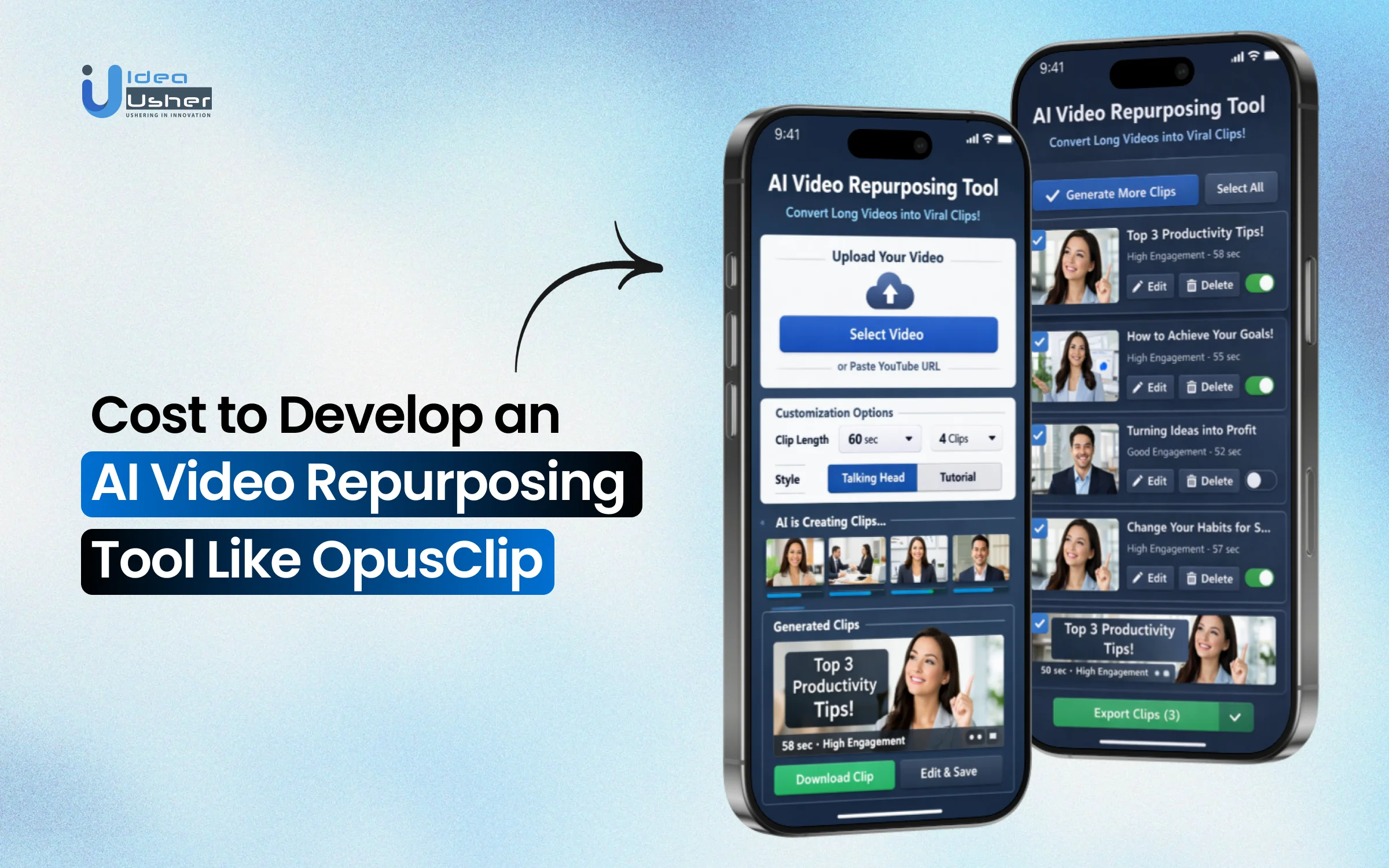
Video production no longer ends when the final cut is exported. Creators must now distribute the same video across many platforms, each requiring different formats and durations. More and more people have started using AI video repurposing tools because content teams need to publish faster and maintain a consistent posting schedule.
These systems can analyze long videos and detect the most relevant segments. The platform may then generate short clips that match the social media format. It can also automatically add captions to improve accessibility and viewer engagement.
Over the years, we’ve developed numerous AI video repurposing solutions powered by computer-vision-based video segmentation and multimodal content-understanding AI. Since IdeaUsher has this expertise, we’re sharing this blog to discuss the cost of developing an AI video repurposing tool like OpusClip.
Why AI Video Repurposing Tools Are Exploding in Demand?
According to Technavio, the AI video analytics market size is projected to increase by USD 14 billion, at a CAGR of 31.7%, from 2024 to 2029. Expanding demand for actionable intelligence beyond security will drive the AI video analytics market, shifting video from a static archive into a dynamic, mineable data source for brand growth.

Source: Technavio
The digital landscape now demands content at a volume that exceeds human capacity. Organizations are pivoting to “video-first” strategies, but the bottleneck lies in execution. Decision-makers realize that the ROI of a single high-production video is only maximized when it is atomized into dozens of cross-platform assets.
AI repurposing tools solve this scalability crisis. Platforms like Munch or OpusClip allow brands to maintain a relentless presence without increasing overhead. By identifying “golden moments” in long-form footage and reformatting them for specific platform algorithms, these tools turn a single webinar or keynote into a perpetual lead-generation engine.
Short-form Video Dominance
In 2026, short-form video is the foundational architecture of digital attention. Statistically, clips under 60 seconds command triple the engagement of long-form content. This shift is driven by a “swipe-to-skip” economy where users expect immediate value within the first three seconds of playback.
For professionals, the top of the marketing funnel is now visual and bite-sized. LinkedIn has seen a surge in professional short-form content as B2B leaders favor condensed executive summaries over whitepapers. Without a short-form strategy, brands risk becoming invisible in an ecosystem that prioritizes rapid-fire consumption.
The Need for Automated Clips
Modern creators face a paradox: they must post consistently to stay relevant, yet manual editing is a massive drain on creative energy. Automated clip generation uses NLP and computer vision to analyze transcripts and visual cues, instantly identifying the most “viral-ready” segments of any video.
This automation provides data-driven objectivity. Tools like Munch analyze pacing and sentiment to select clips statistically likely to retain viewers. This allows creators to focus on high-level storytelling while the machine handles the repetitive tasks of timestamping and formatting, turning hours of work into a five-minute process.
Solving Manual Editing Challenges
Manual editing is the primary friction point in the content lifecycle, requiring specialized skills and significant time. Tasks like reframing horizontal footage into vertical 9:16 or balancing audio levels are tedious. AI addresses these hurdles by automating the technical “heavy lifting” of post-production.
For example, the intelligent “active speaker” tracking found in OpusClip keeps the focus on the presenter without manual keyframing. Furthermore, AI-driven captioning now includes dynamic styling that increases watch time in sound-off environments. By solving these granular challenges, AI democratizes high-end production for teams of all sizes.

What Makes OpusClip Different From Typical Clipping Tools?
While basic tools merely trim video, OpusClip operates as a sophisticated decision-making engine. It leverages Large Language Models to understand context, humor, and narrative structure. This transition from “trimming” to “curating” is what separates legacy software from modern AI-driven repurposing.
For enterprise teams, the platform acts as a digital creative director. It selects segments that align with specific platform psychology, ensuring the output feels native to the feed rather than a recycled broadcast.
AI Detects the Most Engaging Moments
Traditional tools require manual review to find highlights. OpusClip automates discovery by analyzing transcripts and visual cues to identify high-impact hooks. It targets “aha” moments and punchlines that naturally stop users’ scrolling.
Using sentiment analysis, the AI distinguishes filler from compelling story arcs. This ensures every generated clip has a coherent beginning, middle, and end, maintaining message integrity while optimizing for rapid-fire consumption.
Clips Optimized for Reels, Shorts, TikTok
Platform optimization involves more than a 9:16 aspect ratio. OpusClip handles technical nuances, from safe-zone margins to optimal lengths. This prevents UI elements like “Like” buttons from obscuring faces or text.
The tool provides auto-captions styled for high retention. Since over 80% of mobile users watch with the sound off, these dynamic, synchronized captions are critical. The AI ensures text is legible and visually engaging, mirroring top-tier creator styles.
The Role of AI-generated Virality Score
A standout feature is the proprietary Virality Score. This metric provides an objective assessment of a clip’s potential performance based on thousands of data points. It evaluates hook strength, content flow, and value proposition clarity.
For decision-makers, this score acts as a prioritization tool. Instead of guessing which segment will perform, teams can focus distribution on high-scoring clips. This data-backed approach reduces trial-and-error in social media marketing.
Why Creators Prefer AI-driven Workflows
The preference for AI stems from radical time recovery. A workflow that once took a full workday now takes minutes. This allows creators to shift focus from mechanical editing to high-level content strategy and audience engagement.
These workflows eliminate the need for expensive hardware and complex software suites. By moving processing to the cloud, OpusClip enables an agile content cycle. Creators can maintain a dominant digital footprint across multiple platforms with minimal effort.
Key Features of an AI Video Repurposing Platform
The transition from raw footage to viral content requires a sophisticated tech stack. An AI video repurposing platform synthesizes multiple machine learning models into a single, cohesive workflow. These features are designed to eliminate post-production friction while maximizing the distribution potential of every frame.
By integrating these capabilities, teams can scale content output by 10x or more. This is not just about speed; it is about the precision of content delivery in a hyper-competitive digital attention economy.

1. Highlight Detection and Segmentation
Advanced platforms use NLP to parse transcripts for semantic meaning. Instead of looking for simple visual changes, the AI identifies logical “hooks,” core arguments, and emotional climaxes. This ensures segmented clips are contextually complete and retain their original impact.
2. Multi-platform Optimization Engine
Different social networks have unique algorithmic preferences. A robust optimization engine automatically adjusts clip duration, metadata, and export settings for TikTok, YouTube Shorts, and Instagram Reels. This ensures a single long-form video is perfectly tailored for maximum reach across the entire ecosystem.
3. AI Captions and Emoji Generation
With most mobile users scrolling in “sound-off” mode, dynamic captioning is mandatory. Modern AI generates precise, time-synced subtitles and suggests context-aware emojis to emphasize key points. This visual layer is critical for maintaining high retention rates and accessibility.
4. Virality and Engagement Scoring
Strategic decision-making is powered by predictive analytics. By comparing new clips against a database of high-performing content, the AI assigns a “Virality Score.” This allows marketing teams to prioritize high-potential assets and focus distribution efforts on content most likely to drive organic growth.
5. Smart Framing and Reframing AI
Converting 16:9 cinematic footage to a 9:16 vertical format often results in the subject being lost. Smart reframing uses computer vision to track faces and movements in real time. The AI dynamically crops the frame to keep the speaker centered, maintaining professional quality in a mobile-first format.
6. Dashboard and Publishing Workflow
A centralized dashboard serves as the mission control for content distribution. It allows teams to review AI-generated clips, make final manual tweaks, and schedule posts across multiple accounts. This integrated workflow creates a seamless, efficient path from raw upload to live social post.
AI Technologies Behind Video Repurposing Tools Like OpusClip
The “magic” of modern repurposing isn’t just a single script; it is a sophisticated orchestration of diverse AI disciplines. To transform a static 16:9 lecture into a high-octane 9:16 vertical clip, the system must “see,” “listen,” and “understand” content simultaneously. This requires a stack that processes petabytes of visual and auditory data in seconds to find the needle in the haystack.

1. Multimodal AI Video Models
Modern tools use Multimodal AI, which processes different data types (video, audio, text) as a single cohesive unit. Unlike older systems that only “read” a transcript, these models observe visual cues such as a speaker’s gestures or changes in camera angle.
- Holistic Context: The AI recognizes that a loud laugh combined with a specific facial expression signals a “highlight.”
- Cross-Reference: It matches spoken word with on-screen visuals to ensure the clip captures the full context of a presentation.
2. Speech-to-Text for Discovery
The foundation of any clipping tool is its ability to convert spoken dialogue into searchable, actionable data. High-accuracy Automatic Speech Recognition (ASR) engines do more than just transcribe; they timestamp every syllable to ensure cuts are frame-accurate.
Professional Insight: “Precision in ASR is the difference between a clip that cuts off mid-sentence and one that ends on a perfect, punchy cliffhanger.”
By creating a digital map of the audio, the AI allows the user to edit video as easily as a Word document, deleting a sentence in the text automatically removes that segment from the video timeline.
3. NLP for viral detection
Natural Language Processing acts as the “Editor-in-Chief.” It doesn’t just look for words; it looks for intent and impact. By comparing the transcript against millions of successful social media posts, the NLP model identifies:
- Hooks: Sentences that present a problem or a bold claim.
- Transitions: Logical breaks that signal the beginning of a new topic.
- Value Bombs: Dense segments of information that provide immediate utility to the viewer.
This semantic understanding allows the AI to rank segments by their “shareability,” effectively predicting human interest before a clip is even published.
4. Computer Vision for Framing
When you crop a horizontal TikTok video, the speaker is often left out of the frame. Computer Vision solves this through “Active Speaker Detection.”
| Feature | Manual Process | AI-Driven Process (CV) |
| Tracking | Keyframing every head movement. | Real-time facial landmark tracking. |
| Framing | Static center-cropping. | Dynamic re-centering based on movement. |
| Multi-Speaker | Constant manual cutting between faces. | Auto-switching to the person currently talking. |
This ensures that the “visual weight” of the video remains balanced, keeping the viewer’s eye exactly where it needs to be without any manual intervention.
Cost to Develop an AI Video Repurposing Tool Like OpusClip
Building a video repurposing tool is a capital-intensive venture that sits at the intersection of high-end software engineering and expensive AI infrastructure. Unlike standard SaaS products, the primary cost drivers here are the massive compute requirements for video rendering and the complexity of training multimodal models to “understand” content.

While a simple API wrapper can be launched relatively cheaply, a competitive platform with proprietary intelligence requires a significant investment in both talent and silicon.
MVP Development Cost Breakdown
A Minimum Viable Product or MVP for an AI clipping tool focuses on core functionality: uploading a video, generating a transcript, and using an LLM to identify 3–5 highlights.
| Phase | Estimated Cost (USD) | Key Deliverables |
| Discovery & Architecture | $5,000 – $15,000 | Tech stack selection, API mapping, prompt engineering. |
| UI/UX Design | $7,000 – $12,000 | Interactive video player, clip editor, dashboard. |
| Core AI Integration | $25,000 – $50,000 | Connecting to Whisper (ASR) and GPT-4o for logic. |
| Frontend/Backend | $30,000 – $60,000 | Secure uploads, user auth, and cloud storage. |
| Total MVP Estimate | $67,000 – $137,000 | Timeline: 3–5 months |
At this stage, most founders use “API-first” strategies, leveraging third-party models rather than building their own to keep initial costs manageable.
Full-scale AI Platform Development
Scaling beyond an MVP into a market leader involves moving from “using AI” to “owning AI.” This stage requires a dedicated team of machine learning engineers, senior full-stack developers, and DevOps specialists.
- Engineering Salaries: Expect to spend $250,000 – $500,000+ annually on a core team.
- Custom Feature Set: Building proprietary “Virality Scores,” multi-speaker tracking, and advanced B-roll insertion adds $150,000 – $300,000 in specialized development.
- Enterprise Features: Adding an API for third parties, SSO for teams, and advanced security compliance can double the backend complexity.
AI Infrastructure and GPU Costs
This is the “hidden” cost that sinks many AI startups. Video processing is computationally expensive, requiring powerful GPUs (Graphics Processing Units) to handle rendering and inference.
Operational Reality: In a production environment, GPU compute often consumes 40% to 60% of the total technical budget.
- Development/Testing: Using specialized cloud providers such as RunPod or Lambda Labs, expect to spend $2,000–$5,000/month during the build phase.
- Production Inference: Once you have active users, renting NVIDIA H100 or A100 clusters can scale quickly to $15,000 – $40,000/month, depending on the volume of video minutes processed.
Cost of Training and Optimizing Models
If you choose to fine-tune your own models to achieve higher accuracy than generic APIs, the costs shift from operational to R&D.
- Data Curation: Collecting and labeling thousands of hours of “viral” vs. “non-viral” video to train your logic. Cost: $10,000 – $50,000.
- Fine-tuning Runs: Running training cycles on high-end GPU clusters. Each major training run can cost $5,000 – $25,000 in rental fees alone.
- Inference Optimization: Spending engineering time to make the model smaller and faster (Quantization), which reduces long-term server costs but requires high-paid expertise upfront.
Factors That Affect the Development Cost
Beyond the initial build, an AI video repurposing platform‘s financial trajectory depends on its architectural depth. Costs fluctuate based on reliance on third-party APIs versus custom-engineered logic. The true multipliers are hidden background tasks that optimize speed, accuracy, and massive data throughput for video assets.
Complexity of AI Highlight Detection
Not all detection is equal. Basic systems look for audio spikes, but sophisticated tools use semantic understanding to find narrative arcs.
- Rule-Based Logic: Cheaper ($20k to $40k) but often misses the “vibe.”
- Contextual Deep Learning: Requires custom models to identify sarcasm and emotional peaks. This pushes R&D toward $150,000 plus for specialized data science.
Real-time Video Processing Requirements
In the creator economy, latency is a dealbreaker. Users expect a one-hour video to be clipped in under 10 minutes. High-speed processing requires parallelization, in which video is split among multiple GPUs.
This infrastructure is more expensive to architect than sequential processing. Building a system for hundreds of concurrent 4K uploads requires senior DevOps expertise, adding $50,000 to $80,000 to the budget for reliability.
AI Virality Prediction Capabilities
Building a virality score is building a predictive engine. To ensure accuracy, developers must analyze millions of data points from trending social media content.
- Data Acquisition: Scraping and cleaning social metadata ($15k to $30k).
- Model Training: Correlating video features with view counts using neural networks.
- Calibration: Recurring engineering costs of $5,000 per month as social algorithms shift.
Multi-Platform Export Integrations
TikTok, YouTube, and LinkedIn each have unique APIs and “safe zones.” Developing one-click exports is a continuous integration challenge, not a one-time task.
| Platform | Complexity | Maintenance |
| TikTok | High | Frequent API updates |
| YouTube | Moderate | Low (Stable) |
| High | Frequent algorithm shifts |
A robust engine for these nuances adds $5,000 to $10,000 per platform initially, plus ongoing monitoring costs.
Scalability for Creator Workloads
A platform for 10 users fails at 10,000 without elastic scaling. The system must automatically rent server power during spikes and release it during lulls.
- Load Balancing: Prevents servers from crashing under 4K file loads.
- Queue Management: Prioritizes “Pro” users over free-tier accounts.
- Guardrails: Essential architecture to prevent a viral surge from creating a six-figure cloud bill overnight.
Real Use Cases of AI Video Repurposing Tools
The shift from manual editing to AI workflows has created tangible competitive advantages. By automating the extraction of high-value segments, organizations transform single recordings into multi-channel campaigns. These AI video repurposing tools are the primary engine for digital-first distribution strategies.
1. Podcasts and Long Episodes
Podcasters face a “discoverability gap” because long audio is difficult for new listeners to sample. AI tools bridge this by identifying emotional peaks within 60-minute recordings.
- Workflow Transformation: Instead of scrubbing waveforms for hours, creators use transcript-based editing to select highlights.
- Result: One episode yields 5 to 10 vertical clips for YouTube Shorts and Reels, acting as trailers that drive traffic back to the full podcast.
2. Influencers Scaling Short-form Content
For individual creators, posting frequency predicts algorithmic success. AI repurposing allows them to maintain a daily schedule across TikTok, Reels, and Shorts without burnout.
Influencers use these platforms to test different hooks from existing YouTube videos. By analyzing the Virality Score of AI-generated variations, they deploy only the top-performing segments. This data-backed approach ensures high-quality feeds while increasing total output volume.
3. Marketing Teams Producing Viral Clips
Corporate marketing departments turn webinars, town halls, and product demos into high-impact social assets. The goal is to maximize the ROI of expensive video shoots by ensuring every minute of footage is utilized.
Strategic Note: The objective is to move from one-off projects to a content factory model where long-form assets are atomized into dozens of touchpoints.
By using smart framing and auto-captioning, teams produce brand-aligned clips in minutes. This agility allows brands to respond to market trends in real-time using existing footage, bypassing new production costs.
4. Media Companies Automating Distribution
For large-scale media entities, repurposing is an enterprise logistics challenge. They utilize systems that not only clip video but also manage metadata and distribution across hundreds of accounts.
| Sector | Primary AI Use Case | Impact |
| News | Rapid extraction of soundbites from live feeds. | Real-time social reporting. |
| Sports | Auto-generating highlights from game broadcasts. | Instant fan engagement. |
| Education | Turning lectures into micro-learning modules. | Improved knowledge retention. |
These companies leverage AI to mine vast archives, bringing older content back to life by reformatting it for mobile audiences. This automation turns massive libraries into active, revenue-generating assets.
AI Data Requirements for Viral Clip Detection
Building an AI that reliably detects which moments in a long-form video will perform well on short-form platforms is not a feature; it is the entire product. The intelligence behind clip detection determines whether a tool earns genuine loyalty or gets abandoned after a trial, and that intelligence is only as strong as the data used to train it.

1. Training Datasets
At the heart of any viral clip detection engine is a supervised learning model trained to recognize patterns correlated with high engagement. Engagement prediction is a multi-signal problem that requires training data drawn from diverse, high-quality sources.
What that data looks like:
- Short-form video performance data: Clips paired with behavioral engagement metrics including watch-through rate, shares, comments, and saves. Raw view counts alone are insufficient.
- Long-form source content: Original videos from which successful clips were derived, allowing the model to learn what source characteristics predict downstream performance.
- Cross-platform variance data: The same clip performs differently on LinkedIn versus TikTok. Training data must account for platform-specific audience behavior.
- Metadata and contextual signals: Posting time, niche category, caption structure, and hashtag patterns all influence performance and should be represented in training data.
The challenge is not just volume; it is labeling quality. Engagement data is easy to scrape, but understanding why a particular clip outperformed its source requires human annotation layers that are expensive and time-consuming to produce.
A realistic training dataset requires hundreds of thousands of labeled clip-performance pairs across multiple niches, platforms, and content formats. Proprietary datasets built through partnerships with creators or platforms provide a competitive moat that open-source alternatives cannot replicate.
2. Video and Speech Data
A competitive AI repurposing tool must simultaneously process visual content, spoken language, acoustic signals, and narrative structure. Each requires its own data stream and often its own specialized model.
1. Speech and Transcript Data
The model needs to understand not just what is being said, but how it is being said. This requires transcribed video content across accents, languages, and speaking styles, along with labeled examples of rhetorical moments, such as questions, punchlines, and emotional peaks.
2. Visual and Scene Data
The visual layer requires labeled datasets for face detection, speaker identification, and emotional expression recognition. Scene changes and motion data are also necessary to train models to capture pacing and visual rhythm across different production formats.
3. Audio Signal Data
Tone, pitch variation, speaking cadence, and audience reaction audio, such as laughter or applause often mark high-engagement moments and must be well-represented in training data.
Publicly available datasets provide a starting foundation but fall short for a production-grade tool. Content niches that matter most to paying customers, including business podcasts, fitness coaching, and online courses, are underrepresented in public corpora.
A staged approach works best: begin with public datasets to establish baseline performance, then layer in licensed or partner-sourced data as the product approaches production.
Improving AI Accuracy
Even the best-trained model degrades without ongoing calibration. Content trends shift, platform algorithms evolve, and creator styles fragment across niches. User feedback loops are the mechanism by which the AI stays relevant, and designing them well is as important as any initial training decision.
The Feedback Flywheel:
- User receives AI-generated clips
- User selects, edits, or discards clips
- Decisions are logged as implicit feedback signals
- High-performing published clips return engagement data
- Model is retrained on enriched, real-world signal
- Next clip generation is more accurate
Explicit vs. Implicit Feedback:
| Feedback Type | Example | Signal Strength |
| Explicit | User rates a clip positively or negatively | High intent, low volume |
| Implicit (behavioral) | User publishes clip without editing | Strong positive signal |
| Implicit (behavioral) | User deletes clip immediately | Strong negative signal |
| Implicit (engagement) | Published clip achieves high watch-through | Delayed but highly valuable |
| Explicit | User adjusts clip start and end points | Reveals model misalignment |
When a user publishes a clip exactly as the AI generated it, the model has performed precisely. When users consistently shift the start point of AI-selected clips by several seconds within a particular content category, that is a systematic signal that the model is misjudging where compelling moments begin.
Feedback loop infrastructure cannot be bolted on after launch. It must be designed into the data pipeline from the beginning, with event tracking, clip-level identifiers, and a retraining cadence built into the engineering roadmap from day one.
Why Businesses Choose IdeaUsher for AI Video Tools?
Choosing a partner for AI video tools requires deep technical knowledge and an understanding of content psychology. IdeaUsher provides the engineering backbone to turn complex video processing into seamless platforms. We build intelligent ecosystems that handle the heavy lifting of modern content creation.
Generative AI and Automation Expertise
Our team specializes in the intersection of generative AI and video workflows. We integrate multimodal models that allow platforms to understand video content semantically. This ensures your tool identifies impactful narrative moments with human precision rather than just making random cuts.
Experience with Creator Platforms
We understand the unique demands of the creator economy. Having built high-traffic content platforms, we know how to optimize for user retention. Our experience ensures your tool provides the specific features like dynamic captions and viral hooks that influencers demand.
Elite engineers and Product Teams
With over 500,000 hours of coding experience, our team of ex-MAANG/FAANG developers brings world-class standards to every project. This elite pedigree ensures your AI video tool is built on the same rigorous engineering principles used by the world’s largest tech companies.
Scalable Architecture Built for Growth
Video processing is resource-intensive and requires an architecture that scales on demand. We build elastic backends that handle massive 4K uploads and high-concurrency traffic without performance drops. This design ensures your platform remains stable as your user base grows.
Conclusion
Building an AI video repurposing tool requires balancing machine learning with robust cloud infrastructure. While an initial launch involves significant capital for core logic, scaling to a market leader demands elite engineering and substantial GPU resources. Success depends on a partner capable of navigating multimodal AI and high-concurrency video processing to deliver a technically superior and commercially viable product.
Looking to Develop an AI Video Repurposing Tool Like OpusClip?
IdeaUsher can help you develop an AI video repurposing tool like OpusClip with intelligent video analysis systems. Our team can build pipelines that integrate computer vision and natural language processing, enabling the platform to automatically generate clips.
Why Partner with Idea Usher?
- Elite Engineering: Our team consists of ex-MAANG/FAANG developers who bring deep technical rigor to every line of code.
- Proven Mastery: We offer over 500,000 hours of coding experience in building complex, high-scale digital ecosystems.
- Cutting-Edge AI: We specialize in multimodal models and computer vision for smart framing and viral moment detection.
- Scalable Architecture: We build “elastic” backends designed to handle massive video processing loads without breaking a sweat.
Check out our latest projects to see the kind of work we can do for you. Let’s build the next generation of video automation together.


FAQs
A1: The 3:2:1 rule is a backup strategy for protecting footage. It involves keeping three copies of your data on two different media, with one copy stored off-site. This ensures that even if hardware fails or a site disaster occurs, your video project remains safe.
A2: A video repurposing tool is software that transforms long-form content into multiple short-form assets. It automates resizing horizontal video for vertical platforms and extracts key highlights. This allows creators to maximize their reach across TikTok, Reels, and Shorts using a single original recording.
A3: AI video tools use machine learning to analyze audio, visuals, and text simultaneously. The system uses speech-to-text to map dialogue and computer vision to track faces for active framing. By identifying emotional peaks and logical segments, the AI makes creative editing decisions without manual input.
A4: Building these tools requires integrating a cloud backend with specialized AI models for transcription and visual recognition. You must architect a system capable of heavy GPU processing and elastic scaling for large video files. Working with expert developers ensures the platform can handle the massive data throughput required for real-time editing.


