


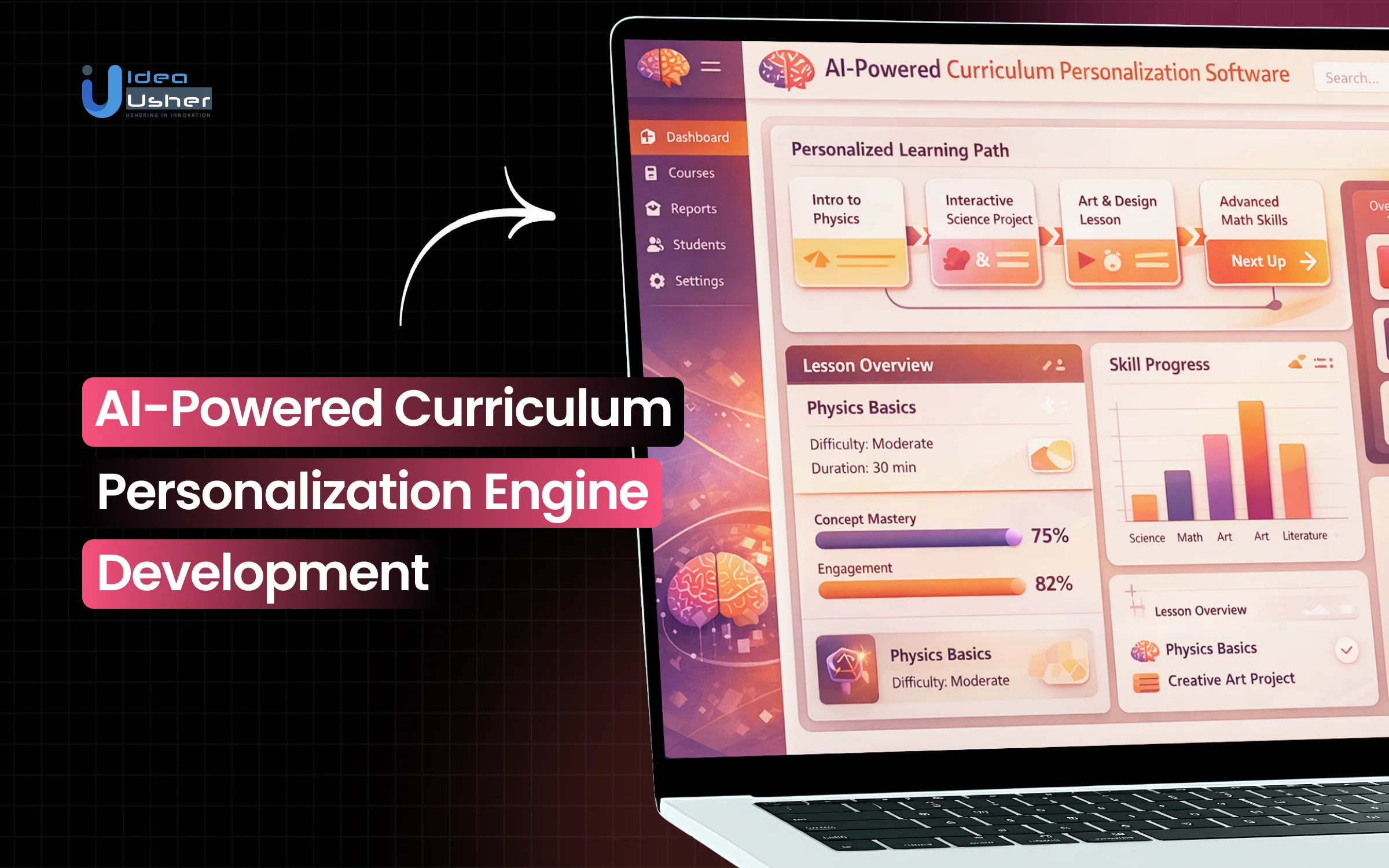
Digital education has expanded quickly, yet many online courses still follow a fixed syllabus that treats every learner the same. When thousands of students join a platform, their learning pace and understanding naturally begin to differ. Several ed tech businesses have therefore started using AI-powered curriculum personalization engines because platforms must now respond to learners’ performance rather than deliver static lessons.
These systems may carefully analyze quiz results, engagement behavior, and knowledge gaps to understand how each student progresses. The platform can then automatically adjust lesson difficulty and learning order based on that insight. Students may therefore receive guidance that matches their real learning needs rather than a rigid course path.
We have built several AI-powered curriculum personalization engines that use technologies such as knowledge-tracing algorithms and educational data science frameworks. As IdeaUsher has this expertise, we are sharing this blog to discuss the practical steps involved in developing an AI-powered curriculum personalization engine.
Market Demand for AI Curriculum Personalization Platforms
According to Grand View Research, the global AI-based personalization engines market size was estimated at USD 455.40 billion in 2024 and is projected to reach USD 717.79 billion by 2033, growing at a CAGR of 5.3% from 2025 to 2033. This surge reflects a fundamental shift in educational strategy. Organizations are abandoning linear models in favor of responsive ecosystems that account for neurodiversity and varied prior knowledge. As the global skills gap widens, AI that adapts to the learner has transitioned from a competitive advantage to a critical infrastructure requirement.

Source: Grand View Research
Why EdTech Platforms Are Shifting to Adaptive Learning
The pivot to adaptive learning addresses the chronic engagement crisis in digital education. Traditional platforms often lack the responsiveness of a human tutor, leading to high attrition. By integrating personalization engines, EdTech providers can now mimic 1:1 instruction at scale.
These engines detect cognitive friction in real-time and pivot delivery methods, such as swapping a technical manual for an interactive simulation, to maintain learner persistence and ensure mastery.
Growth of AI-Driven Learning Personalization Solutions
Growth in this sector is driven by the move from simple recommendation logic to deep generative personalization. Modern systems no longer just suggest the next module; they utilize Large Language Models (LLMs) to perform semantic analysis on open-ended responses. This allows the engine to identify subtle misconceptions that traditional testing misses, creating a more nuanced and effective feedback loop for the user.
Demand From Schools, Universities, and Corporations
The demand for these engines spans the entire academic and professional spectrum:
- Higher Education: Universities use these engines to improve retention in high-stakes STEM courses by providing automated remedial paths for at-risk students.
- K-12 Education: Schools adopt platforms that support differentiated instruction, allowing a single teacher to manage a classroom where students progress at thirty different speeds simultaneously.
- Corporate Training: Enterprises seek engines that integrate with performance data to identify specific skill gaps and automatically push the relevant curriculum to mitigate business risk.
Why Startups Are Building AI Curriculum Engines Now
Startups are leveraging a perfect storm of mature cloud infrastructure and the democratization of AI via APIs. Unburdened by technical debt, these agile teams are building AI-native architectures that rival legacy systems. They are capturing market share by focusing on high-performance, niche applications that larger providers struggle to implement quickly.
Two prominent examples of platforms utilizing these engines include:
- Duolingo: Its Birdbrain AI engine analyzes billions of daily exercises to predict the probability of a correct answer, keeping users in the Goldilocks Zone of difficulty.
- Coursera: Features like Coursera Coach use generative AI to act as a virtual tutor, helping students navigate complex material through personalized Socratic questioning.

Why Traditional Curriculum Design Is Failing Modern Learners?
The legacy model of curriculum design assumes a uniform baseline of knowledge and a synchronized pace of absorption. This linear structure creates a “frozen middle” where advanced learners disengage due to a lack of challenge, while others are left behind as the course moves forward regardless of mastery. In a professional landscape defined by rapid change, these rigid frameworks are increasingly incompatible with the cognitive demands of the modern workforce.
One Curriculum Cannot Fit Every Learning Style
Standardized curricula are built on the fallacy of the “average” learner. Cognitive load theory confirms that individuals process information through vastly different mental models. The mismatch between delivery and internal processing often manifests in three distinct ways:
- The Abstraction Gap: High-level conceptual learners struggle with curricula that are overly procedural and granular.
- The Contextual Void: Practical learners fail to retain information when it is presented without immediate, real-world application.
- The Modality Conflict: Visual learners are throttled by text-heavy modules, while auditory learners miss nuances in silent, interactive labs.
When a single curriculum is forced upon a diverse group, it fails to align with these varying instructional needs. This lack of structural flexibility leads to wasted time, cognitive friction, and poor long-term skill retention.
The Engagement Gap in Standardized Learning Paths
Engagement is closely tied to the perceived value and just-in-time utility of content. In standardized paths, a lack of relevance to a user’s specific goals causes the engagement gap to widen. Without the ability to adjust the narrative arc or difficulty based on real-time feedback, traditional paths cannot maintain a “state of flow.”
Expert Insight: In professional development, the “Engagement Gap” is often the leading indicator of “Churn.” If a learner does not see a direct correlation between the module and their daily KPIs within the first 10 minutes, cognitive abandonment occurs.
The result is a passive consumption experience characterized by low completion rates and a failure to translate learning into actionable performance.
Why EdTech Platforms Need AI Personalization
To remain competitive, EdTech platforms must evolve from content repositories into intelligent agents. AI personalization is the only mechanism capable of analyzing massive volumes of interaction data to make micro-adjustments at scale.
| Feature | Traditional LMS | AI Personalization Engine |
| Content Delivery | Static, Pre-defined | Dynamic, Generative |
| Feedback Loop | Periodic Assessments | Continuous Real-time Monitoring |
| Pacing | Fixed by Course Length | Dictated by Learner Mastery |
| Support | Manual Instructor Intervention | Automated Pedagogical Scaffolding |
By integrating AI, platforms offer dynamic scaffolding, providing extra support during difficult concepts and removing it as confidence grows. This shift from delivering content to engineering outcomes is what defines high-growth, modern educational ecosystems.
What Is an AI Curriculum Personalization Engine?
An AI curriculum personalization engine is a sophisticated algorithmic framework that acts as a “live” intermediary between a repository of educational content and the individual learner.
Unlike a static database, this engine functions as a continuous optimization loop, ingesting learner data to output a uniquely tailored educational experience. It is the intelligence layer that transforms a digital library into an active, responsive tutor.
How AI Reshapes Learning Path Design
In traditional design, the path is a straight line. In an AI-powered engine, the path is a dynamic graph. AI reshapes the curriculum by treating it as a collection of “Lego-like” micro-units that can be reassembled in infinite combinations.
- Predictive Sequencing: The engine uses historical data to predict which content format (video, quiz, or text) will most likely lead to mastery for a specific user.
- Dynamic Difficulty Adjustment (DDA): If a learner answers three consecutive questions correctly in record time, the engine automatically skips “introductory” content to maintain high engagement.
- Contextual Pivoting: If a user fails a module on “Data Structures,” the AI analyzes whether the failure was due to a lack of “Logic Fundamentals” and pivots the path to address the root cause.
This ensures that the curriculum evolves with the learner, rather than forcing the learner to adapt to a rigid structure.
Core Difference From Traditional LMS Systems
The distinction between a standard Learning Management System (LMS) and an AI Personalization Engine is the difference between a map and a GPS.
| Feature | Standard LMS | AI Personalization Engine |
| Logic Type | Branching (If X, then Y) | Probabilistic (Machine Learning) |
| Content Units | Long-form courses/chapters | Atomic “Knowledge Nuggets” |
| User Agency | Fixed progression | Non-linear exploration |
| Role of Instructor | Manual grading/intervention | Strategic oversight/mentorship |
While an LMS tracks that a student completed a video, the AI Engine analyzes how they watched it (where they paused, what they re-watched, and where they sped up) to infer their level of comprehension.
Role of Data in Adaptive Curriculum Engines
Data is the fuel for the engine, but not all data is created equal. To function effectively, these engines rely on a “Data Triad”:
- Behavioral Data: Clicks, dwell time, navigation patterns, and interaction frequency. This tells the engine about the learner’s engagement levels.
- Performance Data: Assessment scores, time-to-completion, and error patterns. This tells the engine about the learner’s competency level.
- Psychometric Data: Self-reported interests, learning preferences, and cognitive load indicators. This tells the engine about the learner’s optimal delivery style.
By synthesizing these streams, the engine moves beyond simple “recommendations” and begins to perform Instructional Scaffolding. It builds a mental model of the user, allowing it to provide the right information at the exact moment of need.
How AI Personalizes Curriculum in Real Time?
Real-time personalization is the “active” phase of the engine, where data processing meets pedagogical execution.
It requires a system that can process high-velocity data streams and make split-second adjustments to the learner’s experience. This process transforms the learning environment from a passive screen into a responsive, intelligent tutor that anticipates friction before it leads to disengagement.

Tracking Student Learning Behavior
The engine begins by capturing granular telemetry data. This is not limited to simple “pass/fail” metrics; it involves monitoring the subtle nuances of how users interact with the interface. Key data points tracked in real-time include:
- Dwell Time and Latency: Measuring how long a student stays on a specific paragraph or how long they hesitate before answering a question.
- Navigation Heatmaps: Tracking if a student frequently revisits a previous module, signaling a possible gap in foundational understanding.
- Engagement Decay: Detecting patterns such as rapid clicking or “skimming” behavior, which often indicates that the material is either too easy or too difficult.
This continuous stream of behavioral data allows the engine to calculate a “Current Cognitive Load” score, ensuring the learner is neither bored nor overwhelmed.
AI Models That Predict Learning Needs
Behind the interface, specialized machine learning models interpret the data to forecast future performance. These models do not just react to what has happened; they predict what the learner will need next.
Bayesian Knowledge Tracing (BKT):
This model estimates the probability that a student has mastered a specific skill based on their sequence of correct and incorrect responses.
Neural Collaborative Filtering:
Similar to how streaming services suggest movies, this model identifies patterns among thousands of learners to predict which specific resource (e.g., a 3D diagram versus a textual summary) will be most effective for a user with a similar profile.
Large Language Model Diagnostics:
When a student provides an open-ended answer, an LLM analyzes the semantic structure to identify specific misconceptions rather than just grading the answer as “wrong.”
Dynamic Learning Path Adjustments
Once a prediction is made, the engine executes a Dynamic Learning Path Adjustment. This is the moment the curriculum “mutates” to fit the user. Unlike traditional branching logic which is limited to a few pre-set paths, AI can generate thousands of permutations.
- Scaffolding Injection: If the model predicts a 70% chance of failure on a complex task, it automatically injects a “hint” or a preparatory micro-lesson to build confidence.
- Accelerated Tracks: For high-performers, the engine collapses redundant modules, enabling a direct transition to high-complexity simulations or case studies.
- Modality Switching: If a student shows higher retention after watching video content than after reading text, the engine re-prioritizes the remaining curriculum to lead with video-based assets.
Continuous Feedback and Improvement Loops
The engine operates on the principle of Reinforcement Learning (RL). Every adjustment made is treated as an experiment. If a curriculum pivot leads to a higher assessment score, the engine “rewards” that path and strengthens the logic for future learners with similar needs.
Strategic Note: This creates a virtuous cycle. As more students use the platform, the engine becomes more precise. The “feedback loop” exists at two levels: the Micro-Loop (adjusting for the current student in seconds) and the Macro-Loop (optimizing the global curriculum structure for all students over months).
Key Features of an AI Curriculum Personalization Engine
An AI-driven curriculum personalization engine moves beyond static delivery into a state of continuous adaptation. It integrates high-order technical modules that work in concert to diagnose, predict, and deliver tailored experiences. These features represent the transition from traditional management systems to intelligent instructional agents.
1. AI Learning Path Generator
The path generator utilizes Generative AI and Graph Theory to construct custom trajectories. Rather than following a fixed sequence, it treats the curriculum as a collection of atomic nodes.
- Logic: It maps prerequisite dependencies across thousands of content pieces.
- Action: For a goal like “Python for Data Science,” the generator synthesizes a sequence of specific labs and modules, bypassing irrelevant content to save time and increase focus.
For example, Degreed uses this technology to map internal content and external resources into “Pathways” that automatically update based on a user’s evolving career goals and current skill level.
2. Real-Time Skill Gap Detection
This feature acts as a diagnostic radar, identifying cognitive blind spots as they occur. By analyzing interaction data, the engine pinpoints exactly where a learner’s mental model is fracturing.
Technical Insight: Using Predictive Modeling, the engine calculates the Probability of Mastery. If a learner fails a task, the detection module analyzes past performance to determine if the gap is conceptual or procedural, allowing for immediate intervention.
3. Adaptive Assessments and Smart Quizzes
Standardized testing is replaced by Computerized Adaptive Testing. The difficulty of the assessment is a moving target that responds to the test-taker’s proficiency in real time.
- Performance Scaling: Correct answers trigger more complex problems, while errors prompt scaffolding questions to test foundational knowledge.
- Smart Feedback: Quizzes provide generative feedback that explains why an error occurred based on the specific logic the student utilized.
ALEKS (by McGraw Hill) uses Knowledge Space Theory to determine exactly what a student knows and doesn’t know, ensuring every quiz question provides maximum information about the student’s state of learning.
4. Intelligent Content Recommendation
Leveraging Hybrid Filtering, this module ensures learners receive the most effective resource for their current state.
| Recommendation Factor | Data Source | Objective |
| Cognitive Fit | Performance History | Match difficulty to current skill level. |
| Modality Preference | Engagement Telemetry | Prioritize video or text based on retention. |
| Peer Success | Global User Data | Surface resources that helped similar learners. |
For example, Coursera employs these recommendation algorithms to suggest “Guided Projects” or specific course clips if a learner is struggling with a graded assignment, mirroring the “People also watched” logic of Netflix but for pedagogical success.
5. Learning Progress Prediction Dashboard
For educators, the engine provides a glass-box view of the journey. These dashboards use Prescriptive Analytics to flag at-risk learners before they fail. By monitoring early warning signals like increased latency or drop-offs in active engagement, the system provides a visual heat map of workforce or student readiness.
Brightspace, for instance, offers a “Student Success System” that uses predictive modeling to visualize which students are likely to drop out or fail based on their interaction patterns, allowing teachers to intervene early.
6. Multi-Subject Personalization Support
Modern engines are domain-agnostic. Through Transfer Learning, the AI applies personalization strategies developed in one subject to others. This allows a single engine to be deployed across diverse departments, ensuring a consistent experience whether the user is studying Compliance Law or Back-End Engineering.
Benefits of AI Curriculum Personalization for EdTech
Integrating an AI-powered personalization engine provides a quantifiable edge by aligning educational delivery with individual cognitive limits. For institutions and EdTech providers, this results in a shift from mere content hosting to becoming a high-performance outcome factory.
1. Higher Student Engagement Rates
Personalization engines eliminate the friction of irrelevant content, which is the primary driver of student drop-off. By maintaining a state of flow where the difficulty of the material perfectly matches the learner’s current ability, platforms see a marked increase in daily active usage and course completion rates.
2. Faster Skill Development
By identifying and bypassing already-mastered concepts, AI-driven paths significantly reduce the “time to competency.” This efficiency allows corporate learners to return to their roles faster with higher proficiency and enables students to focus their cognitive energy on new, challenging material rather than redundant reviews.
3. Improved Learning Outcomes
Adaptive systems ensure that a learner does not move to a complex topic until foundational mastery is statistically proven. This data-backed scaffolding results in higher retention rates and better performance on summative assessments, as the engine essentially “proofreads” the learner’s understanding in real-time.
4. Scalable Personalized Education
The most significant benefit is the democratization of the 1:1 tutoring experience. Historically, high-touch personalization required expensive human intervention; an AI engine allows an institution to provide a custom-tailored journey for 10,000 students as easily as for 10, without increasing instructional overhead.
AI Technologies Powering Curriculum Personalization
The efficacy of a personalization engine depends on the sophistication of its underlying tech stack. Rather than relying on a single algorithm, modern engines utilize a multi-layered approach that combines data processing, semantic understanding, and predictive modeling. This orchestration allows the system to transition from basic automation to true machine intelligence.

1. Machine Learning for Student Pattern Analysis
Machine Learning serves as the central nervous system, identifying patterns in learner behavior invisible to human instructors. By processing high-dimensional datasets, ML models categorize learners into distinct archetypes based on cognitive pace and interaction styles.
- Clustering Algorithms: These group learners with similar struggle patterns to deploy remedial strategies that worked for their peers.
- Deep Knowledge Tracing: Utilizing Recurrent Neural Networks or RNNs, the engine tracks the evolution of mastery over time, identifying when a concept moves from memorization to long-term retention.
2. NLP for Understanding Learning Content
Natural Language Processing is critical for organizing vast content libraries. Without NLP, an engine cannot understand the semantic relationship between different media types or complex subjects.
- Semantic Tagging: Models automatically tag content with metadata regarding concepts, difficulty, and prerequisites.
- Automated Summarization: The engine generates concise summaries or flashcards from long-form content, tailored to the learner’s current cognitive load.
- Sentiment Analysis: NLP monitors open-ended responses or forum posts to detect frustration, triggering automated pedagogical interventions.
3. Recommendation Algorithms for Course Mapping
The logic of the learning path is driven by recommendation engines optimized for pedagogical outcomes rather than mere consumption.
- Collaborative Filtering: Identifies successful paths by analyzing resources used by high-performing students.
- Content-Based Filtering: Ensures the next module is semantically aligned with the current learning objective to prevent distractions.
- Hybrid Graph Models: Maps recommendations onto a Knowledge Graph to ensure the path remains logically sound and respects prerequisite scaffolding.
4. Predictive Analytics for Learning Outcomes
Predictive analytics moves the engine from a reactive state to a proactive one. By analyzing historical and real-time data, the engine forecasts future performance with high accuracy.
| Predictive Model | Function | Impact |
| Early Warning Systems | Identifies students likely to drop out. | Increases retention rates. |
| Time-to-Mastery | Estimates completion time for a module. | Optimizes resource planning. |
| Intervention Modeling | Predicts the most effective support type. | Maximizes remedial efficiency. |
AI-Powered Curriculum Personalization Engine Development
Developing an AI-powered curriculum personalization engine for our clients is an exercise in precision engineering. We transform static content into a living system that anticipates user needs and guarantees a return on human capital. We follow an “intelligence-first” roadmap to build engines that move beyond automation into predictive pedagogy.
1. Strategic Alignment
We audit your academic or business goals to ensure the AI solves the right variables. Whether the objective is slashing training time or increasing retention, we define these KPIs early. This alignment dictates the technical architecture, from model selection to data taxonomy.
2. Data Infrastructure
Our teams construct a high-concurrency pipeline to ingest millions of real-time telemetry points. We implement a specialized Learning Record Store (LRS) to track micro-behaviors like hesitation and review patterns. Using xAPI standards, we ensure your ecosystem is secure and ready for high-scale processing.
3. Model Training
We train sophisticated models on your historical data to decode your learners’ DNA. By deploying Deep Knowledge Tracing, we identify hidden patterns of mastery and struggle. This allows the engine to create digital twins of your learner archetypes and predict roadblocks before they lead to failure.
4. Logic Layer Development
The recommendation engine we build is a hybrid powerhouse. We combine content-based filtering with peer-success data, all anchored by a custom Knowledge Graph. The AI strategically navigates the learner through a logical progression of skills tailored to their real-time performance.
5. Platform Integration
We specialize in frictionless integration. Our engines sit behind your existing LMS, communicating via high-speed APIs. We inject dynamic UI elements, such as automated scaffolding and smart hints, into your current interface without requiring a disruptive platform migration.
6. Validation and Testing
We never launch into a vacuum. We conduct controlled A/B testing to measure the “personalization lift.” By analyzing the delta between the AI-driven path and the legacy curriculum, we fine-tune the system to ensure it delivers superior engagement and verifiable mastery.
Cost to Develop an AI Curriculum Personalization Engine
The investment required to engineer a proprietary AI curriculum engine is significant, reflecting the complexity of integrating machine learning with high-concurrency data architectures.
For our clients, we treat this not as a sunk cost, but as a strategic asset that scales intellectual capital. The total expenditure typically ranges from $80,000 to $350,000+, depending on whether the engine is a modular integration or a ground-up, enterprise-grade ecosystem.

Estimated Development Budget Breakdown
Building a personalization engine requires a multi-disciplinary team of data scientists, DevOps engineers, and UI/UX specialists. We typically categorize the budget into four primary pillars:
- Architecture & Data Engineering (30%): Establishing the Learning Record Store (LRS) and the xAPI-compliant data pipelines.
- AI Model Development & Training (35%): Developing Knowledge Tracing models, NLP for content tagging, and recommendation logic.
- Integration & Backend (20%): Connecting the engine to existing LMS/CMS platforms via robust API layers.
- Testing & Optimization (15%): A/B testing, refinement of reinforcement learning loops, and performance scaling.
| Development Tier | Estimated Cost Range | Best For |
| MVP / Modular Plugin | $80,000 – $120,000 | Small EdTech startups or specific department pilots. |
| Mid-Range Custom Engine | $150,000 – $250,000 | Established EdTech platforms and mid-market enterprises. |
| Enterprise AI Ecosystem | $300,000 – $500,000+ | Large universities and global corporations with massive datasets. |
Key Factors That Affect Development Cost
Several technical and operational variables can shift the budget significantly:
Data Readiness: If your current data is “dirty” or fragmented across multiple legacy systems, the cost for Data Cleaning and ETL (Extract, Transform, Load) processes will increase.
- Model Complexity: Utilizing pre-trained LLMs via APIs is cost-effective, while training custom, domain-specific models from scratch increases the “Compute” and “Expertise” costs.
- Scale of Content: The number of “atomic units” in your curriculum affects the complexity of the Knowledge Graph and the automated tagging requirements.
- Regulatory Compliance: For clients in the EU or healthcare, implementing strict GDPR or HIPAA-compliant data handling adds layers of security engineering.
- Real-Time Requirements: Processing telemetry in real time (sub-second latency) requires more expensive cloud infrastructure (AWS/Azure/GCP) than batch processing.
By understanding these levers, we help our clients prioritize features that deliver the highest pedagogical impact while remaining within a manageable capital expenditure framework.
How AI Personalization Improves Course Completion Rates?
Personalization is the primary catalyst for overcoming digital learning stagnation. While traditional online courses often have single-digit completion rates, AI-integrated platforms can boost them by up to 70%. By transitioning from passive delivery to active pedagogical agents, AI ensures curricula remain aligned with evolving learner competency.

1. Identifying Drop-Off Points
Predictive analytics identifies “at-risk” behaviors long before a student withdraws. By analyzing high-velocity telemetry data, AI models detect subtle patterns signaling impending disengagement.
- Behavioral Red Flags: Monitoring sudden decreases in login frequency or increased latency in responding to prompts.
- Performance Decay: Flagging sequences of low scores on micro-assessments as leading indicators of future failure.
- Early Intervention: Triggering automated nudges or supplemental review materials exactly when engagement metrics dip.
2. Adaptive Lesson Sequencing
Friction occurs when the gap between current knowledge and lesson complexity is too wide. AI eliminates this by treating the curriculum as a dynamic, non-linear graph.
Instead of a fixed sequence, the engine uses Intelligent Sequencing to create individualized progressions. If a learner struggles with “Statistical Probability,” the AI dynamically inserts a foundational lesson on “Basic Ratios.” This ensures learners only face challenges they are equipped to solve, maintaining “flow” and reducing the frustration that leads to drop-outs.
3. Personalized Microlearning Paths
Microlearning breaks complex subjects into 3-to-10-minute bursts. AI optimizes these paths by delivering content at the exact moment of need and using Spaced Repetition algorithms to prevent the “forgetting curve.”
By tailoring micro-content to a user’s specific professional role, the engine ensures every minute spent learning feels immediately applicable, significantly boosting long-term retention.
4. Real-Time Difficulty Adjustment
DDA acts as an automated tutor that senses when a student is bored or overwhelmed. AI models manage the challenge level in real-time based on performance telemetry.
| User Performance | AI Adjustment Action | Pedagogical Outcome |
| High Mastery | Skip basics; increase complexity. | Prevents boredom; accelerates growth. |
| Moderate Struggle | Provide hints; simplify language. | Maintains confidence; manages load. |
| Critical Failure | Pivot to remedial sub-path. | Fixes gaps; reduces frustration. |
By measuring response times and error types, the engine maintains an “Optimal Challenge Zone.” This calibration ensures material is difficult enough to promote growth but achievable enough to sustain motivation.
How to Integrate AI Personalization With Existing LMS?
Most organizations cannot afford to replace their entire infrastructure to adopt AI. Integration allows companies to layer intelligence on top of existing investments, transforming a static LMS into a dynamic engine. This process focuses on creating a seamless data bridge between the legacy database and the AI’s real-time processing layer.
1. API Integration With LMS Platforms
The most efficient way to add intelligence to a legacy LMS is through a high-speed API layer. Rather than rewriting the platform code, the AI engine acts as a sidecar service.
- Request/Response Cycle: When a student logs in, the LMS sends a request to the AI API with the user’s ID.
- Intelligence Injection: The AI returns a set of instructions telling the LMS which module to display next or which hint to reveal.
- Standards Compliance: Using protocols like LTI (Learning Tools Interoperability) or RESTful APIs ensures that the AI can communicate with popular platforms like Moodle, Canvas, or Blackboard without custom middleware.
2. Syncing Learning Data Across Systems
Personalization is only as good as the data feeding it. To build a complete profile of a learner, data must be synchronized across disparate silos.
This requires a Learning Record Store that aggregates data using xAPI (Experience API). Unlike traditional SCORM tracking, which only records completion, xAPI captures granular experiences. These include a student pausing a video, failing a specific quiz question, or reading an external PDF. This synchronized stream ensures the AI has a 360-degree view of learner behavior across all integrated platforms.
3. Embedding AI Recommendations
Integration must be invisible to the learner to avoid toggle fatigue. AI recommendations are embedded directly into the existing user interface via dynamic widgets or modified navigation menus.
- Smart Sidebars: Surfacing Recommended for You resources based on current module performance.
- Inline Scaffolding: Automatically appearing Help buttons that trigger AI-generated explanations when the system detects a student is stuck.
- Adaptive Pre-tests: Assessments at the start of a legacy course that allow the AI to hide modules the student already knows, effectively shortening the path within the existing LMS UI.
4. Migrating Legacy Curriculum
Transitioning from flat, linear courses to an adaptive model is a resource-intensive step. It involves atomizing content by breaking 60-minute videos or 50-page PDFs into small, searchable Knowledge Nuggets.
- Tagging: Using NLP to automatically assign metadata regarding difficulty, topic, and prerequisites to every content atom.
- Mapping: Organizing these atoms into a Knowledge Graph so the AI understands the logical relationships between them.
- Validation: Running automated scripts to ensure that as the curriculum becomes non-linear, there are no dead ends where a student could get stuck without a logical next step.
Future of AI-Powered Curriculum Personalization
The trajectory of educational technology is moving toward a post-linear era. As AI models become more multimodal, the focus shifts from digitizing content to creating autonomous, self-optimizing ecosystems. The goal is true individualization, where the curriculum is uniquely generated for a single human mind.
AI Tutors and Autonomous Learning Systems
Every student will soon have a 24/7 intelligent mentor. These systems facilitate Socratic dialogue to ensure deep conceptual understanding rather than just providing answers.
- Khan Academy (Khanmigo): Uses GPT-4 to act as a personal tutor. It mimics a human by asking probing questions and identifying misconceptions in real-time without giving away the answer.
- Duolingo (Max): Leverages Roleplay and Explain My Answer features to simulate natural conversations and provide granular linguistic feedback.
Hyper-Personalized Learning Experiences
Future systems will incorporate emotional and environmental context. This hyper-personalization uses sentiment analysis to adjust the experience based on a student’s psychological state.
- Synthesis: Originally developed at SpaceX, this platform uses AI to create simulations where difficulty and team dynamics shift based on how students collaborate.
- Emotive Tracking: Emerging startups use computer vision to detect boredom or confusion via facial expressions. If cognitive fatigue is detected, the AI suggests a break or switches to a more interactive modality.
Global Access to Adaptive Education
AI personalization democratizes high-quality instruction. Autonomous systems provide elite, individualized attention to students regardless of their geographic location or socioeconomic status.
- Century Tech: Uses AI to identify knowledge gaps and memory decay across global school systems. It provides teachers with automated interventions to manage large classrooms as if providing one-on-one instruction.
- Instant Localization: AI models allow for the immediate localization of complex curricula. Courses are re-contextualized with local idioms and languages in seconds, ensuring cultural barriers do not hinder the personalized path.
Conclusion
Implementing an AI-Powered curriculum personalization engine represents a shift from static content delivery to dynamic, data-driven mastery. By integrating predictive modeling and real-time adaptation, organizations can eliminate learning plateaus and significantly increase engagement. This technology ensures that every learner follows the most efficient path to competency, future-proofing educational infrastructure for a rapidly evolving digital landscape.
Looking to Develop an AI Curriculum Personalization Engine?
IdeaUsher can carefully design and develop an AI powered curriculum personalization engine that adapts learning paths based on student performance and engagement data. Our team can efficiently implement adaptive learning models and knowledge tracing algorithms so your platform may intelligently adjust course difficulty and content delivery.
With over 500,000 hours of coding experience, our team of ex-MAANG/FAANG developers brings the same architectural precision used by the world’s tech giants to your EdTech vision. We build the engines that turn data into mastery.
Why Partner With Us?
- Elite Engineering Talent: Leverage the expertise of developers who have built at scale for the world’s most sophisticated tech companies.
- Hyper-Adaptive Logic: Our engines go beyond simple branching, using predictive modeling to eliminate learner friction before it happens.
- Seamless Legacy Integration: We specialize in layering AI onto your existing LMS, ensuring a 10x upgrade without the “rip and replace” headache.
- Data-Driven Mastery: We transform raw telemetry into actionable insights, boosting completion rates and proving ROI for your organization.
Check out our latest projects to see the kind of work we can do for you.


FAQs
A1: AI acts as an intelligent intermediary that adjusts content based on real-time data. It analyzes a student’s pace, accuracy, and engagement to skip mastered material or inject “scaffolding” hints when it detects a struggle. This ensures that every learner follows a unique path while maintaining an optimal level of challenge.
A2: The most common technique is Hybrid Recommendation Filtering. This combines Collaborative Filtering (analyzing what worked for similar students) and Content-Based Filtering (matching lessons to specific skill gaps). Modern systems bolster this with Knowledge Graphs to ensure the logical progression of concepts.
A3: Implementation starts with “atomizing” your curriculum into small, tagged Knowledge Nuggets. You then establish a Learning Record Store to collect granular data via xAPI. Finally, you integrate an AI engine with your LMS to trigger dynamic changes, such as hiding redundant modules based on a user’s unique performance.
A4: Modern examples include Khan Academy’s Khanmigo, which uses a Socratic AI tutor to guide students, and Duolingo Max, which generates personalized “Explain My Answer” sessions. In corporate settings, platforms like Docebo map employee skills to specific roles, generating custom upskilling paths that adapt as new competencies are demonstrated.


