


In many classrooms and online learning platforms, the biggest challenge is not delivering lessons but understanding whether students truly absorb them. A student may perform well in one test and struggle in the next which often leaves teachers unsure about what changed in the learning process. Without continuous visibility into learning behavior, educators usually notice problems only after performance has already declined.
Modern education platforms quietly collect large volumes of data from quizzes, assignments, and course interactions. That is why the popularity of AI-driven student progress analytics systems is increasing, because institutions can finally convert raw learning data into practical academic insights. These systems may intelligently analyze engagement patterns, learning speed, and knowledge retention.
Over the years, we’ve built several AI-powered student progress-tracking solutions, powered by learning analytics and educational data science frameworks. Given our expertise, we are sharing this blog to discuss the steps for developing an AI-driven student progress analytics system.
Market Demand for AI-Driven Student Analytics Systems
According to Dimension Market Research, the global AI-driven education platform market is projected to reach USD 7.2 billion in 2025 and grow to USD 87.4 billion by 2034, registering a CAGR of 32.0%, driven by rising demand for personalized learning, adaptive education systems, intelligent tutoring solutions, and data-driven learning analytics across K-12, higher education, and corporate training sectors. This trajectory represents a shift where data is the primary engine of academic success.
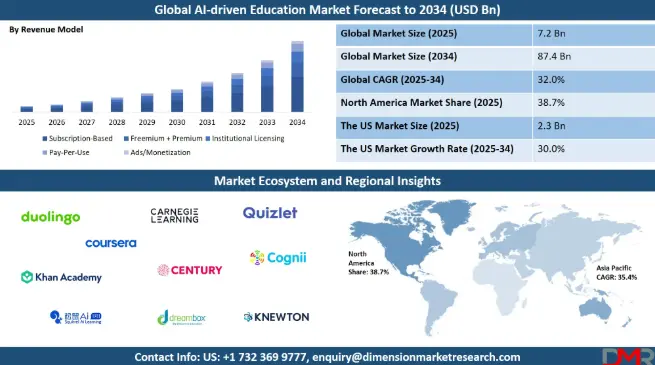
Source: Dimension Market Research
Institutions are adopting these platforms to replace anecdotal evidence with empirical validation. By capturing granular data such as time spent on specific tasks or content interaction patterns, administrators can identify pedagogical bottlenecks and optimize curriculum delivery in real-time.
Growth of Data-Driven Decision Making
Data-driven decision-making has ended the “black box” classroom. By synthesizing behavioral data from SIS and LMS platforms, decision-makers gain a 360-degree view of student health, allowing them to allocate resources like targeted tutoring to specific cohorts exactly when historical data suggests a performance dip.
Retention is the ultimate metric for EdTech sustainability. Platforms use AI to identify disengagement patterns before they lead to churn.
For example, Coursera uses machine learning to provide personalized nudges based on learner persistence, while Duolingo leverages its “Birdbrain” AI to calibrate exercise difficulty, ensuring users remain in a state of flow.
Rising Demand for Predictive Insights
Predictive insights act as an early-warning system in asynchronous environments. These models forecast future outcomes by comparing current student behaviors against historical failure patterns, triggering autonomous interventions that bridge the feedback gap inherent in remote education.
The adoption curve has reached critical mass, with institutions moving toward “Assessment 4.0.” This model replaces high-stakes summative testing with continuous, AI-verified tracking of skills. Major university systems are now integrating these predictive models into academic advising to handle routine diagnostics at scale.
Why Investors Are Backing Learning Analytics Startups
Venture capital flows into this space because AI solves the “scalability vs. personalization” paradox. These systems enable hyper-personalized learning at marginal cost, creating valuable intellectual property that demonstrably improves graduation rates and workforce readiness in a global economy.
What Is an AI Student Progress Analytics System?
An AI-powered student progress analytics system is a sophisticated data ecosystem that transforms raw educational interactions into actionable intelligence. Unlike traditional record-keeping, these systems function as a continuous feedback loop using ML and NLP to interpret student trajectories.
By aggregating data from diverse touchpoints such as engagement levels, assessment results, and social-emotional indicators, the system creates a dynamic digital twin of a student’s academic journey.
How AI Analyzes Learning Behavior and Performance Data
The intelligence in these systems stems from their ability to process non-linear data patterns that are often invisible to the human eye. While a teacher sees a student who failed a quiz, the AI sees a student who paused three times during a specific video segment, skipped the supplementary reading, and attempted the practice problems at 2:00 AM.
The analytical process generally follows these specific stages:
- Data Ingestion: Harvesting logs from Virtual Learning Environments (VLEs), digital textbooks, and participation tools.
- Pattern Recognition: Clustering algorithms identify behavioral archetypes such as students at risk of burnout versus those who are under-challenged.
- Correlation Analysis: Determining the relationship between specific behaviors like forum participation and final outcomes.
- Predictive Modeling: Using regression analysis to forecast future performance based on current velocity.
Difference Between LMS Reporting and AI Analytics
It is a common misconception that a standard Learning Management System provides true analytics. In reality, most LMS platforms offer basic reporting, which is fundamentally different from AI-driven analytics.
| Feature | Standard LMS Reporting | AI-Driven Analytics |
| Data Nature | Descriptive (What happened?) | Predictive and Prescriptive (What will happen and why?) |
| Perspective | Retrospective or Lagging | Real-time or Leading |
| Context | Isolated data points like Grades | Holistic behavior patterns |
| Action | Manual intervention required | Automated triggers and nudges |
| Complexity | Simple arithmetic or Averages | Deep learning and Neural networks |
While an LMS tells you a student missed an assignment, an AI analytics system explains that the student is likely to miss the next three assignments because their time-on-task metrics have plummeted by 40% over the last week.
Key Stakeholders Who Benefit From Learning Analytics
The utility of these systems extends far beyond the classroom, providing unique value propositions across the entire educational hierarchy:
1. Educators and Instructors
Teachers can move away from teaching to the middle. Analytics allow them to identify specific students who need high-touch support, enabling more effective small-group instruction. It also provides a mirror for their own teaching by showing which resources are being ignored and which are driving comprehension.
2. Institutional Administrators
For deans and provosts, these systems are risk management tools. By monitoring aggregate data, they can identify failing programs, optimize course scheduling, and significantly improve institutional retention rates, which directly impacts the financial health of the organization.
3. The Students
Perhaps the most overlooked stakeholder, the student benefits from increased self-regulation. Access to their own data dashboards allows them to see how their study habits correlate with their grades, fostering a growth mindset through transparent and objective feedback.
4. IT and Data Architects
Technical teams benefit from a centralized and interoperable data layer that reduces data silos. A well-architected AI system simplifies the tech stack by providing a single source of truth for student information, making reporting and compliance much more efficient.
Types of Student Data Used in AI Learning Analytics
A robust AI-driven student progress analytics system relies on the quality and diversity of its data inputs. To provide a truly holistic view of a student, these systems must move beyond traditional grade-based metrics and integrate a wide array of behavioral and engagement indicators.
This multi-layered data approach allows the AI to differentiate between a student who is struggling due to a lack of effort and one who is working hard but failing to grasp specific concepts.
1. Assessment and Quiz Performance Data
Assessment data serves as the baseline for performance tracking. However, AI goes deeper than simply recording a final score. By analyzing item-level performance, the system can pinpoint specific knowledge gaps. For instance, if a student consistently misses questions related to linear equations but excels at geometric proofs, the AI identifies a precise pedagogical need.
Furthermore, the system tracks variables such as:
- Time per question: Identifying where a student may be guessing versus where they are over-analyzing.
- Attempt history: Analyzing how a student’s performance evolves across multiple retakes of the same concept.
- Common distractor analysis: Recognizing if a student is falling for specific trap answers, which often indicates a common conceptual misconception rather than a lack of study.
2. Learning Behavior & Engagement Metrics
Engagement metrics provide the necessary context to explain performance outcomes. These metrics are often extracted from digital textbooks and interactive modules. By monitoring clickstream data, the AI can map the student’s learning path.
Key metrics in this category include:
- Reading velocity: Tracking how long a student spends on each page of digital material.
- Video interaction: Monitoring when a student pauses, rewinds, or skips forward in instructional videos.
- Resource utilization: Determining which supplementary materials like PDFs, external links, or practice sets are most frequently accessed by high-performing students.
3. Activity Logs
Consistency is one of the strongest predictors of academic success. AI systems aggregate activity logs to establish a baseline of normal behavior for each student. When a student deviates from this baseline, such as a sudden drop in LMS logins or missed synchronous sessions, the system flags it as a high-risk behavior.
Beyond mere presence, these logs track the velocity of completion. A student who finishes all assignments in a single 12-hour burst often exhibits different long-term retention patterns than one who distributes their work evenly throughout the week.
AI models use this temporal data to predict burnout or procrastination risks before they manifest in failing grades.
4. Interaction Data From AI Tutors and Chatbots
With the rise of Generative AI, interaction data from AI tutors has become a goldmine for analytics. Every prompt a student enters into a chatbot provides direct insight into their thought process and current level of confusion.
- Sentiment Analysis: NLP algorithms analyze the tone of student queries to detect frustration, anxiety, or confidence.
- Semantic Analysis: The AI evaluates the complexity of the questions. Are they asking “What is X?” for recall or “How does X affect Y?” for application?
- Feedback Loops: Data from these interactions can be fed back into the main analytics engine to adjust the student’s learning path in real-time, ensuring the difficulty level remains optimized for their current Zone of Proximal Development.
Core Features of an AI Student Progress Analytics System
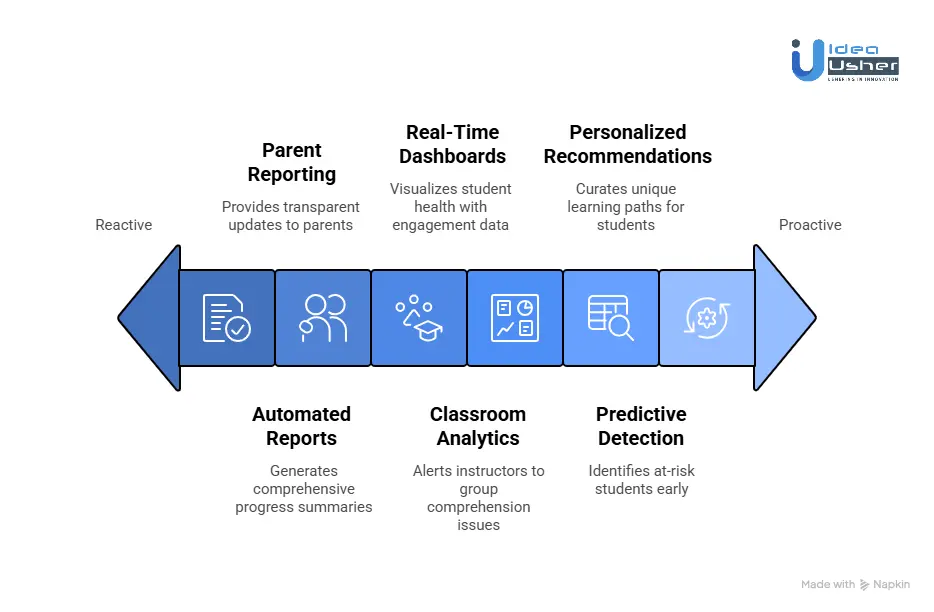
The modern student progress analytics system has transitioned from a passive grade repository into an active digital nervous system. By shifting from reactive reporting to proactive orchestration, these platforms ensure that no student’s struggle goes unnoticed and no achievement remains unrecognized.
1. Real-Time Dashboards
The real-time dashboard serves as a living visualization of student health. Unlike static spreadsheets, these interfaces integrate quantitative scores with qualitative engagement data, such as forum participation and time-on-task.
Example: Platforms like Bold BI and Canvas offer integrated dashboards that aggregate attendance and grades into heat maps, allowing for an immediate overview of cohort health with the ability to drill down into individual profiles instantly.
2. Predictive Risk Detection
Predictive modeling identifies at-risk students during the first few weeks of a term. Systems scan for micro-behaviors like declining login consistency or increased assignment latency.
Example: Brightspace Insights uses machine learning to compare current student behavior against historical patterns to flag high-risk individuals weeks before disengagement occurs, creating a critical window for human intervention.
3. Personalized Recommendations
Adaptive engines curate unique learning paths for every individual. If a student struggles with a specific concept, the AI identifies the specific roadblock and recommends targeted resources, calibrated to the student’s current mastery level.
Example: Knewton Alta and DreamBox Learning use real-time response data to dynamically adjust lesson difficulty and content types, ensuring every student masters concepts at their own speed.
4. Automated Progress Reports
AI-driven systems generate comprehensive, natural-language progress reports without manual input. These reports use competency mapping and sentiment analysis to describe growth trajectories beyond simple numerical grades.
Example: Amira Learning provides automated oral reading fluency reports for teachers and parents, while MagicSchool AI enables educators to generate personalized student growth summaries in seconds.
5. Instructor & Classroom Analytics
AI serves as a force multiplier for educators by providing heat maps of group comprehension. If a large percentage of the class struggles with a specific quiz question, the system alerts the instructor to revisit that concept.
Example: GoIT utilized an AI Tutor Assistant that improved instructor efficiency by 45%, while Schoolytics provides teachers with unified classroom analytics to track engagement across multiple digital platforms simultaneously.
6. Parent & Admin Reporting
Strategic oversight is managed through specialized portals. Administrators use governance dashboards to monitor institutional ROI, while parents receive transparent updates via dedicated apps.
Example: Remind and Mainstay use AI to streamline parent-teacher communication, providing automated progress alerts and deadline reminders that make parents active partners in the educational process.
Advanced AI Capabilities Transforming Student Progress Analytics
Modern student analytics systems have moved beyond simple grading. AI-driven systems now serve as a proactive early-warning and support layer, using high-dimensional data to ensure every student stays on track.
1. Predictive Dropout Risk Models
Advanced algorithms identify at-risk students by analyzing behavioral micro-signals. Instead of waiting for a failed exam, the system monitors patterns such as declining login frequency, late submissions, or fragmented engagement.
Industry Example: Brightspace (D2L) uses predictive modeling to create a visual risk heat map for instructors, allowing them to provide support weeks before a student considers leaving.
2. Learning Style Detection
AI uses Clustering Algorithms and Neural Networks to observe how a student interacts with content. If a student excels at video-based labs but struggles with text-heavy PDFs, the engine identifies a visual or kinesthetic preference.
Industry Example: Disco, a generative AI LMS, adapts lesson delivery in real-time by analyzing multimedia interaction patterns to suit individual cognitive strengths.
3. Skill Gap Identification
This capability bridges the gap between a learner’s current profile and their target goal. By using Natural Language Processing to parse resumes and assessment answers, the AI maps competencies against industry frameworks.
Deep Insight: The engine identifies adjacent skills, which are competencies the student almost possesses, to suggest the most efficient path to mastery.
4. AI Intervention Plans
Once a gap or risk is detected, the AI doesn’t just flag it; it solves it. The engine uses Generative AI to draft personalized intervention plans that include specific goals, curated remedial resources, and a revised timeline.
Efficiency: Tasks that previously took counselors’ hours now happen in seconds, allowing for just-in-time support.
How AI Student Analytics Improves Learning Outcomes?
AI in education shifts focus from historical reporting to real-time operational intelligence. By using complex algorithms, institutions move beyond post-mortem analysis of final grades. This allows for immediate instructional adjustments while the term is active, ensuring no student becomes a statistical outlier due to lack of visibility.
1. Early Detection of Struggling Students
Traditional risk identification often occurs too late. AI-driven systems use Predictive Behavioral Modeling to catch early indicators of disengagement before grades are affected. The system flags specific anomalies:
- LMS Latency: Gaps between resource posting and student access.
- Engagement Decay: Declines in forum participation or tool usage.
- Knowledge Gaps: Struggles with foundational concepts for upcoming modules.
By establishing individual baselines, the AI triggers Early Warning Systems. This allows advisors to intervene with precision through automated or personal outreach.
2. Data-Driven Teaching Strategies
Analytics provide a feedback loop for instructional design. If a cohort struggles with an assessment, the system identifies if the issue is student effort or the material itself.
| Analytical Insight | Strategic Action |
| Concept Clusters | Curricular adjustment for specific sub-topics |
| Resource Utility | Redesigning or retiring low-engagement content |
| Peak Activity | Scheduling support during high-traffic windows |
This granular detail allows faculty to pivot strategies mid-course, aligning delivery with actual student consumption patterns.
3. Personalized Learning Path Optimization
AI Student Analytics enables Adaptive Learning Paths that treat curricula as dynamic maps. Using recommendation engines, the system suggests remediation for specific skill weaknesses.
Strategic Example: A student excelling in Python but struggling with statistics receives targeted probability modules while accelerating through programming tasks.
This approach maintains optimal cognitive flow by adjusting difficulty and content type to match current mastery levels.
4. Improving Course Completion Rates
AI addresses the leaky pipeline by identifying psychological and logistical barriers to completion. Sentiment Analysis of communications can detect burnout or external stressors early.
Predictive modeling also forecasts completion probability based on early milestones. When the system detects a low probability of finishing, it recommends administrative support like tutoring or counseling. This proactive foresight significantly increases graduation rates.
AI-Driven Student Progress Analytics System Development
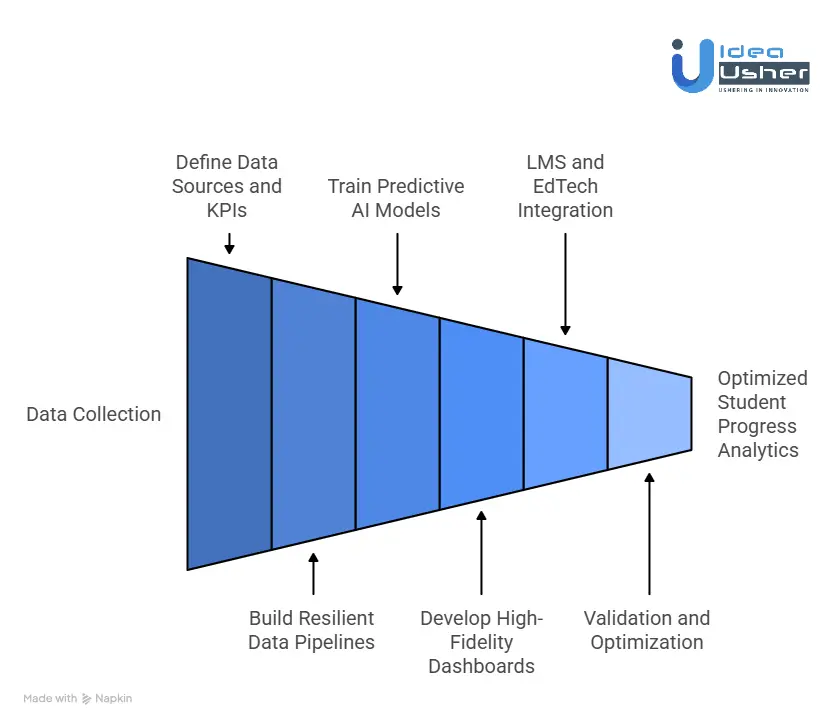
Developing an AI-driven student progress analytics system begins with building a data pipeline that collects quiz results, attendance, and course interactions across the learning platform. Machine learning models can then carefully analyze performance patterns and predict learning gaps, generating actionable academic insights.
We have developed several AI-driven student progress analytics systems for clients, and this is how our team approaches the process.
1. Defining Data Sources and KPIs
We audit your ecosystem to identify variables predictive of success. Our team maps custom KPIs, such as engagement velocity and cognitive load, to your institutional goals. This ensures the AI architecture is grounded in metrics that drive your ROI and academic outcomes.
2. Building Resilient Data Pipelines
Our engineers develop enterprise-grade pipelines to aggregate data from SIS, LMS, and third-party tools. We use high-speed ETL processes to normalize disparate formats into a clean, single source of truth. These low-latency pipelines allow your staff to monitor student behavior in real-time.
3. Training Predictive AI Models
We deploy machine learning models, such as Neural Networks and Gradient Boosting, to uncover hidden patterns in student trajectories. These models provide high-accuracy forecasts for attrition risks and mastery plateaus. We prioritize explainability so your educators can trust and act on every prediction.
4. Developing High-Fidelity Dashboards
We design intuitive, role-based dashboards that translate complex datasets into visual intelligence. Our interfaces use heatmaps and automated alerts to highlight at-risk students, reducing cognitive overhead. Administrators can move from macro institutional trends to individual student micro-behaviors with a single click.
5. LMS and EdTech Integration
To ensure seamless adoption, we engineer deep integrations using LTI standards and custom APIs. Whether you use Canvas, Moodle, or a proprietary platform, our analytics engine sits natively within your workflow. This bi-directional sync enables the AI to trigger personalized notifications or content adjustments automatically.
6. Validation and Optimization
Post-launch, we enter a rigorous cycle of algorithmic refinement to ensure peak performance. We conduct continuous testing to verify accuracy against real-world outcomes and eliminate bias. Our team remains a long-term partner, optimizing the system as your student demographics evolve to maintain precision-grade reliability.
Cost to Develop an AI Student Progress Analytics System
Investing in an AI-driven student analytics system is a strategic expenditure that scales with the predictive engine’s depth. We balance upfront development with long-term operational efficiency to ensure a clear return on investment. Our approach focuses on engineering a high-performance architecture that justifies its cost through improved retention and student success rates.
AI Model Development Cost Breakdown
The predictive engine is the core cost driver. Development requires data scientists and pedagogical experts to ensure results are statistically valid and educationally relevant.
- Data Discovery & Cleaning: $15,000 to $30,000. Normalizing fragmented data from various sources is critical for accuracy.
- Algorithm Engineering: $40,000 to $85,000. This includes training and tuning models, such as neural networks, to achieve specific outcomes.
- NLP & Sentiment Analysis: $20,000 to $45,000. This covers the analysis of discussion forums and open-ended feedback.
Infrastructure and Data Processing Costs
System infrastructure requires a scalable cloud environment to process real-time student data streams. These recurring costs scale with your user base and are architected for high availability and security compliance.
| Component | Estimated Monthly Cost | Notes |
| Cloud Hosting | $1,500 – $5,000 | Based on instance size and auto-scaling. |
| Data Storage | $500 – $2,000 | For high-volume historical and real-time logs. |
| API Management | $300 – $1,200 | For high-frequency pings from LMS and SIS. |
| Security & Compliance | $1,000 – $3,000 | Includes encryption and regular audits. |
Estimated Cost for MVP vs Enterprise Platforms
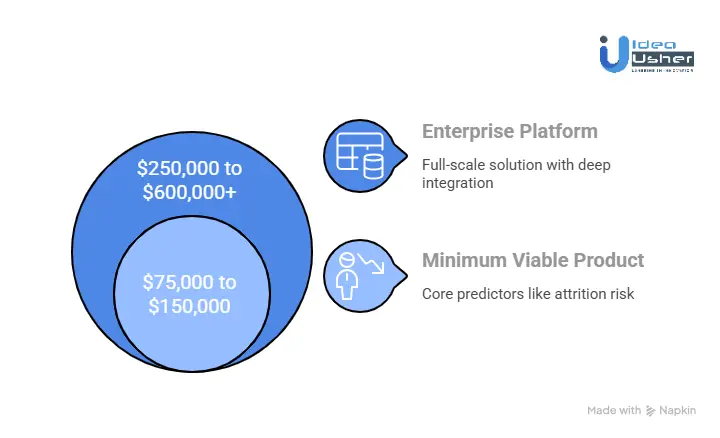
Total project costs depend on whether you are launching a proof of concept or a full scale institutional deployment. We recommend a phased approach to manage risk and validate impact before scaling.
Minimum Viable Product (MVP)
Estimated Range: $75,000 to $150,000
An MVP focuses on core predictors like attrition risk based on LMS logins. It includes a simplified dashboard and basic integration with a single platform. This is ideal for pilot programs looking to prove efficacy.
Enterprise Platform
Estimated Range: $250,000 to $600,000+
A full-scale solution provides a 360-degree view of the student lifecycle. It features deep integration with SIS and LMS, advanced modeling across multiple cohorts, and custom dashboards for all administrative roles.
Key Integrations Required for Student Analytics Systems
For AI to provide a 360-degree view of the student journey, it must function as a centralized intelligence hub that pulls data from every touchpoint in the digital campus. We focus on building deep, bidirectional integrations that ensure data flows seamlessly between your core platforms and our analytical engine.
This connectivity allows for real-time intervention and a unified data strategy across your entire organization.
1. LMS Integrations
The LMS is the primary source of behavioral data. We integrate with platforms like Canvas, Moodle, and Blackboard using LTI (Learning Tools Interoperability) and REST APIs to capture granular engagement metrics.
- Activity Streams: Tracking time spent on specific pages and resource download patterns.
- Submission Latency: Monitoring how close to deadlines students submit their work.
- Discussion Analysis: Using NLP to evaluate the quality and sentiment of peer-to-peer interactions.
These integrations allow our AI to trigger automated, personalized feedback loops directly within the LMS interface, keeping students engaged without requiring manual instructor input.
2. Student Information System Integrations
While the LMS tracks current behavior, the SIS provides the historical and demographic context necessary for long-term trend analysis. By syncing with systems like Ellucian or Oracle Student Cloud, we enrich our models with foundational data.
Technical Insight: Integrating SIS data allows the AI to correlate current performance with historical academic standing and enrollment status.
This helps distinguish between a high-performing student having a bad week and a chronically at-risk student who requires immediate administrative intervention.
4. Assessment Platform Integration
High-stakes testing data is often locked in specialized third-party platforms. We bridge this gap by integrating with digital proctoring and assessment tools to feed raw score data and psychometric metadata into the central engine.
| Data Point | Analytical Value |
| Item Response Time | Identifies specific concepts where the student lacks confidence. |
| Attempt Patterns | Distinguishes between procedural errors and conceptual misunderstandings. |
| Proctoring Logs | Flags potential anxiety or environmental stressors during exams. |
5. Video and Engagement Tools
With the rise of asynchronous learning, video engagement has become a critical predictor of success. We integrate with tools like Kaltura, Panopto, or Zoom to move beyond simple “view count” metrics. Our system tracks heatmaps of video re-watches, skip rates, and engagement with embedded quizzes.
This data reveals exactly where students lose interest or struggle with complex explanations, allowing for rapid curricular refinement.
Key KPIs to Track With AI Student Progress Analytics Systems
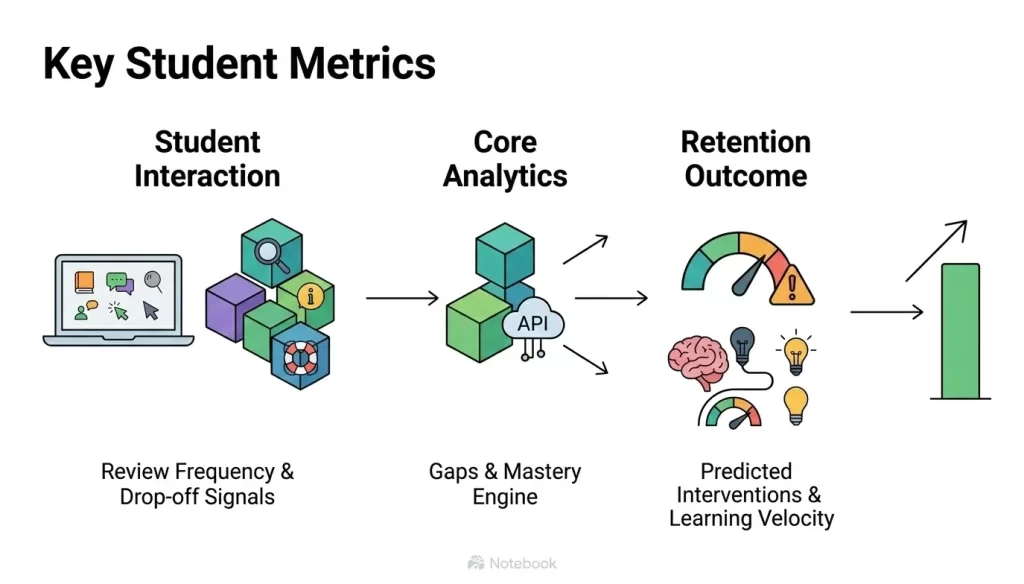
To derive true value from AI, institutions must move beyond surface metrics like attendance. High-fidelity KPIs capture the cognitive journey, providing a granular view of academic health. By tracking these metrics in real time, the system enables timely, evidence-based interventions.
1. Learning Velocity and Retention
Learning velocity measures the rate of mastery relative to the curriculum timeline. Unlike static grades, velocity reveals how quickly a student moves through foundational versus complex topics.
- Mastery Speed: Time elapsed between topic introduction and assessment completion.
- Retention Decay: Performance tracking on cumulative reviews to identify when a student is likely to forget material.
- Review Frequency: Monitoring how often a student returns to specific modules, signaling a lack of initial comprehension.
These metrics allow the system to predict future performance based on current momentum, identifying students who are slow tracking before they fall behind.
2. Engagement and Interaction Scores
Engagement is quantified by analyzing interactions with digital assets. The AI generates a weighted engagement score that goes deeper than simple click-through rates.
| Interaction Type | Weighting Factor | Analytical Insight |
| Active Video Interaction | High | Tracking pauses, re-watches, and in-video quiz responses. |
| Resource Dwell Time | Medium | Measuring meaningful reading time versus idle page open time. |
| Peer Collaboration | High | Analyzing frequency and quality of contributions to group discussions. |
3. Skill Mastery Indicators
Modern education is shifting toward competency-based models. The AI system tracks progress across a customized Skill Taxonomy for each course rather than just total scores.
Strategic Example: In a nursing program, the AI tracks clinical reasoning and pharmacology math separately. If a student excels in reasoning but drops in math accuracy, the system flags a specific competency gap rather than a general academic failure.
This ensures graduation is backed by verified proficiency in every required domain, providing transparency for students and employers.
4. Drop-Off and Friction Signals
Identifying where students leak out of the academic pipeline is critical for institutional success. The AI detects friction signals, which are subtle behavioral shifts that precede formal withdrawal.
- Procrastination Trends: A steady increase in the time between assignment release and student start date indicates burnout.
- Navigation Circularity: Detecting when students toggle repeatedly between help pages and assessments, signaling a lack of content clarity.
- Sentiment Analysis: Monitoring the tone of support tickets to detect rising frustration or disillusionment.
By flagging these signals early, retention teams can reach out with personalized support, significantly reducing course abandonment.
Why Do Businesses Choose Idea Usher for AI Learning Analytics Systems?
Partnering with Idea Usher means gaining a technical ally that understands the high stakes of EdTech. We don’t just deliver a product; we engineer a long-term competitive advantage. By merging elite software craftsmanship with deep pedagogical insights, we help you transform raw data into a powerful engine for institutional growth.
AI and EdTech Expertise
We bring an unparalleled level of technical sophistication to every project. With over 500,000 hours of coding experience, our team of ex-MAANG/FAANG developers applies the same rigorous standards found at the world’s leading tech giants to your analytics system.
- Elite Talent: Our developers have built systems at scale for millions of users.
- Domain Mastery: We possess deep knowledge of LTI standards, xAPI, and Caliper Analytics.
- Algorithmic Precision: We fine-tune predictive models to minimize bias and maximize accuracy.
End-to-End Development
We manage the entire project lifecycle so you can focus on your mission. Our comprehensive approach ensures every technical decision aligns with your ultimate business objectives.
- Strategic Auditing: Identifying your most valuable data touchpoints.
- Architecture Design: Building the blueprint for a high-concurrency engine.
- Model Training: Developing custom AI for your specific student demographics.
- Integration & Launch: Ensuring a flawless rollout into your existing ecosystem.
Scalable and Secure Solutions
We recognize that “one size fits all” fails in complex educational environments. Every line of code is optimized for your specific scale and security requirements, ensuring your data remains protected and your system remains fast.
Security First: We build with a focus on FERPA and GDPR compliance from day one. Your institutional data is encrypted at rest and in transit using enterprise-grade cloud security protocols.
Conclusion
An AI-driven student progress analytics system helps institutions understand how students actually learn rather than relying only on final grades. By analyzing learning behavior, performance patterns, and engagement signals, the system can generate insights that support timely academic intervention. When developed carefully, these platforms allow educators to monitor progress continuously and improve learning outcomes through accurate data driven decisions.
Looking to Develop an AI Student Progress Analytics System?
IdeaUsher can help develop an AI-driven student progress analytics system that carefully tracks learning behavior and academic performance across the platform. Our team can design data pipelines and machine learning models that accurately detect learning gaps and performance trends.
With over 500,000 hours of coding experience, a team of ex-MAANG/FAANG developers brings elite-level technical rigor to your project, ensuring scalable and secure machine learning architectures.
- Elite Engineering: Access to developers with experience from the world’s leading tech giants.
- Massive Technical Depth: Over 500,000 hours of refined coding expertise applied to your unique challenges.
- Scalable Architectures: Systems designed to handle millions of data points without compromising on latency or security.
- End-to-End Delivery: From initial data auditing and model training to full-scale LMS integration and optimization.
Check out our latest projects to see the kind of work we can do for you.


FAQs
A1: Supervised learning algorithms usually dominate this space because they accurately classify student performance against historical benchmarks. Automated scoring engines specifically utilize natural language processing to evaluate open-ended responses with remarkable consistency. These systems must essentially analyze structural patterns and semantic meaning to provide immediate feedback.
A2: Large Language Models like GPT-4 certainly represent the most versatile tool for personalized tutoring today. These transformer architectures can quickly synthesize vast amounts of information into digestible summaries for learners. Students might also benefit from specialized knowledge graphs that visually map the relationships among academic concepts.
A3: Collaborative filtering remains the primary technique for delivering targeted learning resources within modern platforms. This approach successfully predicts what a student will find useful by comparing their behavior with similar peer groups. Matrix factorization might also be employed to uncover hidden preferences in a learner’s interaction history.
A4: Adaptive testing likely offers the most precise measurement of a student’s true intellectual capacity. These dynamic assessments intentionally adjust the difficulty of each question based on the previous answer provided. This iterative process can rapidly pinpoint the exact boundaries of a learner’s knowledge without causing undue frustration.