


Training once depended on physical rooms and fixed schedules, but that model gradually stopped working when teams became hybrid and distributed. A lot of businesses have started using AI corporate training video tools because they need consistent messaging across regions, faster onboarding cycles, and measurable compliance tracking without relying on live instructors.
These systems can generate avatar-led sessions with neural voice synthesis and structured scripts that remain uniform across offices. Content may be updated quickly and deployed globally within hours. This approach can significantly reduce operational costs while delivering controlled, technically reliable learning experiences at scale.
Over the years, we’ve developed many AI corporate training video solutions, powered by multimodal generative AI frameworks and neural rendering pipelines. Since IdeaUsher has this expertise, we’re sharing this blog to discuss the cost of developing an AI-powered corporate training video tool.
What Is an AI Corporate Training Video Tool?
At its core, an AI corporate training video Tool is a software ecosystem that leverages generative AI and machine learning to automate the production, localization, and personalization of educational content.
Unlike traditional video production, which requires cameras, actors, and weeks of editing, these tools use text-to-video technology to create professional-grade training modules in minutes.
How AI Transforms Traditional Corporate Training
The shift from traditional methods to AI-driven video is not just about speed; it is about scalability and relevance.
Traditionally, updating a training video meant a total reshoot, which was often a logistical nightmare. With AI, you simply edit the script’s text, and the video regenerates instantly. This allows companies to keep pace with rapid industry changes. Furthermore, AI enables hyper-personalization.
A salesperson in Tokyo and a technician in Berlin can receive the same training at the same time, each watching a video where the avatar speaks their native language and references local compliance standards, all generated from a single master file.
Difference Between Standard LMS & AI Training Video Tools
While they often work together, it is important to distinguish the Learning Management System from the AI Video Tool:
| Feature | Standard LMS | AI Training Video Tool |
| Primary Purpose | Hosting, tracking, and managing courses. | Creating and generating the actual content. |
| Content Creation | Requires external uploads (MP4s, PDFs). | Native text to video generation. |
| Flexibility | Static content; hard to update. | Dynamic content; updated via text edits. |
| Engagement | Mostly passive (reading/watching). | High engagement (AI-driven interactivity). |
Market Demand & Industry Growth of AI-Based Training Solutions
According to Knowledge Sourcing, the AI solutions market is projected to reach US$1,790.700 billion by 2030, growing at a CAGR of 31.81% from US$450.070 billion in 2025. This explosive growth is not limited to automation or analytics platforms alone. AI-based corporate training solutions are emerging as one of the fastest scaling segments within this ecosystem.
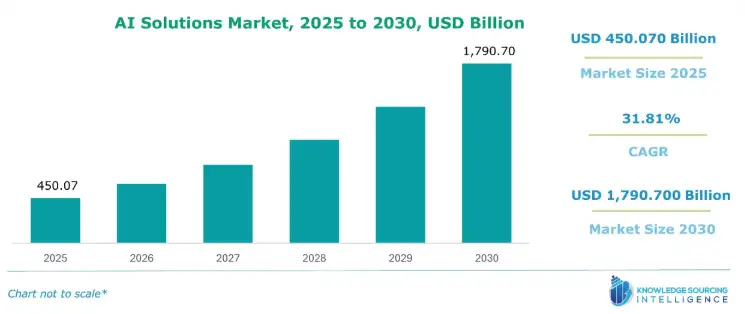
Source: Knowledge Sourcing
Organizations are steadily moving away from static content libraries toward agile AI-generated video tools that can be updated in real time. The urgency to reskill workforces as AI reshapes job roles across industries is accelerating this transition.
Rising Enterprise Adoption of AI in L&D
Enterprise adoption of AI within Learning and Development (L&D) departments has reached a tipping point. Recent data indicates that over 74% of businesses now prioritize AI and Generative AI in their technology budgets, a significant jump from previous years.
Companies are shifting their focus from simple content consumption metrics to “skill readiness” and “proficiency growth.” This means leaders are investing in AI video tools not just to provide content, but to build custom, interactive learning pathways that adapt to an employee’s specific needs. The goal in 2026 is “change fitness,” the ability of a workforce to pivot and learn new skills as fast as the technology evolves.
Key Industries Investing in AI Training Video Platforms
While AI adoption is widespread, certain high-stakes industries are leading the investment charge:
- Healthcare: Rapidly adopting AI video for simulations in predictive diagnostics and patient care, where visual accuracy and up-to-date compliance are matters of life and death.
- Finance & Banking (BFSI): Using AI platforms to scale training for fraud detection and risk management, often requiring content that must be updated weekly to counter new digital threats.
- Retail & Manufacturing: These sectors utilize AI video for hyper-personalized customer service training and “digital twin” simulations to help workers master complex machinery without pausing production lines.
- Technology & Software: With an estimated 80% of the engineering workforce needing upskilling by 2027, tech firms are the heaviest users of AI video to bridge the “skills earthquake.”
Future Trends Shaping AI Corporate Learning
As we look toward the end of 2026 and into 2027, several trends are redefining the landscape:
Agentic AI Learning:
We are moving from simple prompts to “AI Agents” that can manage entire training workflows, including checking for comprehension and handing off complex questions to human mentors.
Multimodal Mastery:
Future platforms will not just generate video; they will simultaneously interpret audio, text, and user gestures to provide a 360-degree feedback loop for the learner.
The “AI-Free” Skills Assessment:
Interestingly, as AI-generated content becomes the norm, 50% of organizations are expected to implement “AI-free” zones for critical-thinking assessments to ensure that human employees retain foundational problem-solving skills.
Localization at Scale:
Real-time translation is becoming so advanced that a single video can be “globalized” instantly, maintaining the same emotional resonance and cultural nuance across dozens of different regions.
Cost to Develop an AI Corporate Training Video Tool
Building an AI corporate training video tool in 2026 involves a complex blend of traditional software engineering and high-intensity machine learning operations. Because video generation is one of the most resource-intensive AI tasks, the financial commitment is higher than for standard text-based AI.
Below is the pricing breakdown based on project complexity and the specific development stages required to bring the tool to life.
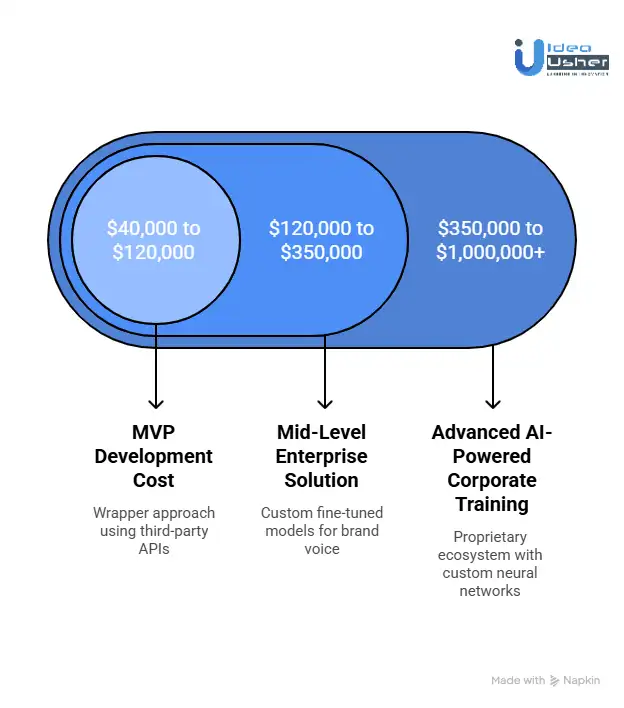
MVP Development Cost (Basic AI Video Generator)
Estimated Cost: $40,000 to $120,000
An MVP focuses on proving the core value proposition. In 2026, this usually involves a “wrapper” approach: using established third-party APIs (like OpenAI’s Sora, Google’s Veo 3, or Runway’s Gen-4.5) to handle the video generation while you build the custom training workflow on top.
- Primary Features: Text-to-video generation, a small selection of pre-set avatars, basic script editing, and standard MP4 exports.
- Target: Startups or internal innovation labs testing a specific training use case.
Mid-Level Enterprise Solution Cost
Estimated Cost: $120,000 to $350,000
This tier moves away from pure third-party reliance toward custom fine-tuned models. It offers more control over the brand voice and visual style of the training content.
- Primary Features: Custom avatar creation (brand-specific), high-fidelity voice cloning for executives, automated multi-language dubbing, and integration with existing Learning Management Systems (LMS).
- Target: Mid-market companies or large departments seeking to standardize their global training content.
Advanced AI-Powered Corporate Training Platform Cost
Estimated Cost: $350,000 to $1,000,000+
At this level, you are building a proprietary ecosystem. This often involves training custom neural networks or significantly modifying open-source video models to handle specific industry jargon or highly complex visual simulations.
- Primary Features: Interactive branching (AI-led scenarios), real-time video feedback (analyzing the learner’s response), proprietary security layers for sensitive data, and full-scale GPU infrastructure management.
- Target: Fortune 500 companies in high-compliance sectors like Healthcare, Aerospace, or Finance.
Cost by Development Stage
To give you a clearer picture of where the budget goes, here is the breakdown of the 2026 development lifecycle:
Research & Planning
Cost: $5,000 to $20,000.
This involves feasibility studies, selecting the right AI models, and defining the “prompt architecture.” In 2026, a significant portion of this phase is dedicated to ensuring ethical AI compliance and data privacy standards, such as GDPR or the EU AI Act.
UI/UX Design
Cost: $15,000 to $60,000.
The interface for an AI tool must be intuitive. Users need to easily input scripts, adjust avatar gestures, and manage video timelines. A poor UX in an AI tool leads to “prompt fatigue,” making this stage critical for adoption.
AI Model Integration
Cost: $50,000 to $200,000.
This is the heart of the project. It includes the cost of fine-tuning models on specific corporate datasets, setting up RAG (Retrieval-Augmented Generation) to improve scriptwriting accuracy, and optimizing the “inference” (the process of actually generating the video) to reduce per-minute costs.
Backend Development
Cost: $30,000 to $100,000.
Building a robust backend is essential for handling large video files, managing user roles, and ensuring the platform can handle hundreds of simultaneous generation requests without crashing.
Cloud Infrastructure Setup
Cost: $10,000 to $50,000 (Initial Setup).
AI video generation requires massive GPU power. In 2026, infrastructure costs are split between the initial setup (server clusters or cloud instances like AWS P5 or Azure ND-series) and the recurring monthly compute bills which scale with usage.
QA & Deployment
Cost: $15,000 to $40,000.
Quality Assurance in AI is unique; you are not just looking for bugs, but for hallucinations or visual glitches in the video. Extensive testing is required to ensure the avatars look natural and the voice-to-lip sync remains perfect across all generated clips.
Factors Affecting the Cost of an AI Corporate Training Video Tool
The final cost of developing an AI corporate training video tool is rarely fixed because several technical and strategic variables directly influence engineering effort and infrastructure requirements. Below are the most important cost drivers that typically shift the budget upward or downward.
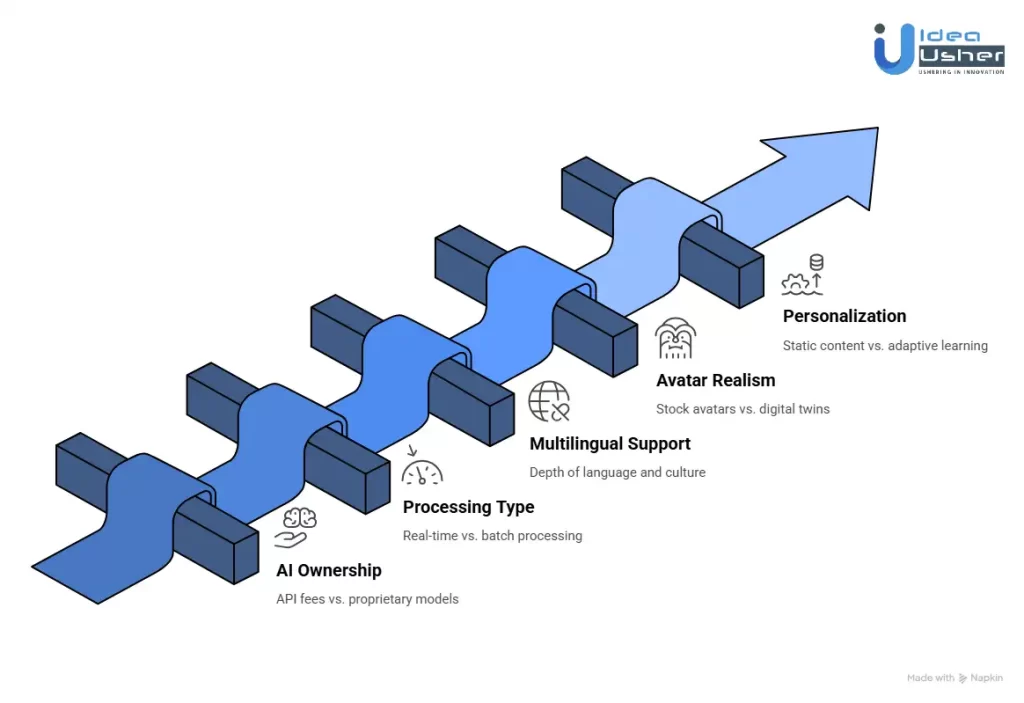
1. Level of AI Ownership
The first fork in the road is whether you lease someone else’s brain or build your own.
Most tools you see today are wrappers around OpenAI or ElevenLabs. You pay them per token, per minute, and per render. It is cheap to start, maybe $40,000 to $60,000 for a polished MVP. But here is the catch: every video you generate pays tribute. Scale to 10,000 employees creating content monthly, and those API fees start looking suspiciously like a second mortgage.
Cost Fluctuations: $40,000 (API-wrapper) to $450,000+ (proprietary models)
2. Real-Time vs. Batch Processing
This is the difference between Netflix and a live Zoom call.
Batch processing is straightforward. You upload a script, the servers process it for twenty minutes, and an MP4 lands in your inbox. It is cost-effective and predictable. We have built batch systems for under $80,000 that handle hundreds of videos daily.
Real-time is a different beast entirely. When an employee asks a question and expects the AI avatar to answer, your infrastructure must render video frames at 30 frames per second while the user waits. That requires GPU clusters optimized for ultra-low latency specialized streaming protocols and fallback mechanisms when demand spikes.
Cost Fluctuations: $80,000 (batch) to $200,000+ (real-time capable)
3. Multilingual Support Depth
English plus Spanish is table stakes. Everyone does that.
The cost increases significantly when you need an avatar that sounds equally authoritative in Mandarin, handles Arabic right-to-left text rendering, and understands that saving face in Japanese training requires completely different phrasing than the German version.
True multilingual depth means:
- Voice models that retain emotional tone across languages so angry in English should sound angry in French
- Lip sync models that adjust for different phoneme sets
- Cultural review layers because direct translations often offend
Cost Fluctuations: $20,000 (2-3 languages) to $100,000+ (20+ languages with cultural adaptation)
4. Custom Avatar Realism
Stock avatars are fine for internal memos. But when the CEO needs to address the company about a sensitive merger, a generic face will not suffice.
Hyper-realistic digital twins require hours of studio capture, custom facial rigging, and model training to capture microexpressions. The difference between a good enough avatar and one that passes the uncanny valley is measured in weeks of GPU training time.
Cost Fluctuations: $15,000 (stock avatars) to $80,000+ (studio-grade digital twins)
5. Personalization and Adaptive Learning
This is where training tools evolve from video players into intelligent tutors.
Basic tools show the same video to everyone. Adaptive systems monitor how the learner responds, identify knowledge gaps, and dynamically adjust the content. If someone aces the pre-quiz on data privacy, the AI skips the basics and moves to advanced scenarios.
This requires:
User profiling pipelines
- Real-time decision engines
- Behavioral analytics dashboards
- Model retraining cycles based on aggregate performance
Cost Fluctuations: $50,000 (static content) to $300,000+ (adaptive learning engine)
Feature-Wise Cost Estimation of an AI Corporate Training Video Tool
While a total project estimate provides a high-level view, the actual budget is constructed from individual modules. The cost of AI development is primarily influenced by the depth of customization and the computational resources needed for real-time video rendering.
Below is a detailed breakdown of the estimated costs for each core component of an AI-powered corporate training video tool.
1. AI Avatar Development Cost
Estimated Cost: $10,000 to $45,000 per custom avatar
The price of an AI avatar depends on its visual realism and range of motion.
- Basic 2D/3D Avatars: $10,000 to $18,000. These are typically used for simple explainer videos where complex emotional expression is not a priority.
- Hyper-Realistic Custom Avatars: $25,000 to $45,000+. These are digital twins of actual company employees or executives. They require advanced motion capture and high-fidelity skin texturing to ensure natural movement in high-resolution video.
2. Text-to-Speech & Voice Cloning Cost
Estimated Cost: $5,000 to $25,000
While standard text-to-speech is widely available, high-quality voice cloning for enterprise use requires a focus on security and emotional intelligence.
- API Integration: $5,000 to $10,000. Utilizing established services has a lower entry cost but involves recurring monthly fees based on usage.
- Custom Professional Voice Cloning: $15,000 to $25,000. This investment covers the legal framework for voice ownership, high-quality data sampling, and fine-tuning to capture the specific authority and tone of a corporate leader.
2. AI Script Generator Integration Cost
Estimated Cost: $8,000 to $20,000
This module leverages Large Language Models to transform raw technical documents or training manuals into structured video scripts.
- Development Focus: Costs are directed toward prompt engineering and Retrieval-Augmented Generation. These technologies allow the AI to access private corporate databases while maintaining accuracy and avoiding generic or inaccurate information.
3. Video Rendering Engine Development Cost
Estimated Cost: $30,000 to $80,000
This is the platform’s technical core. Rendering video is a computationally intensive process that requires a robust architecture.
- Core Tasks: Development involves building a pipeline that synchronizes avatar lip movements with audio, overlays on-screen graphics, and processes the final high-definition file.
- Strategic Optimization: Many organizations choose serverless rendering architectures to keep ongoing GPU costs manageable, though this increases the initial build complexity.
4. Multilingual Translation Engine Cost
Estimated Cost: $12,000 to $35,000
Global organizations need to deliver consistent training across diverse regions.
- Key Features: This component handles automated translation, cultural localization to adjust idioms, and automated dubbing where the AI adjusts the avatar’s lip-syncing to match the new language.
- Cost Factor: Projects involving rare languages or specialized industry terminology, such as medical or engineering jargon, will sit at the higher end of this price range.
5. LMS & HRMS Integration Cost
Estimated Cost: $10,000 to $45,000
For a training tool to be effective, it must function within the company’s existing ecosystem.
- Standard Integration: $10,000 to $15,000. This covers basic compatibility with common Learning Management Systems (LMS).
- Enterprise Deep-Sync: $25,000 to $45,000. This allows for full integration with Human Resource Management Systems (HRMS), enabling automated course assignment based on job role and real-time tracking of employee progress.
6. Admin Panel & Analytics Dashboard Cost
Estimated Cost: $12,000 to $40,000
Leadership teams require data to measure the success of their training initiatives.
- Capabilities: The dashboard provides tools for user management and video library organization. Advanced versions include predictive analytics, which analyze how employees interact with videos to identify potential skill gaps within the workforce.
How Much Does It Cost to Integrate Generative AI Models?
Integrating generative AI models like GPT for scriptwriting and Computer Vision for avatar movement is a primary cost driver. The financial commitment varies significantly between using pre-built APIs and developing custom-trained models.
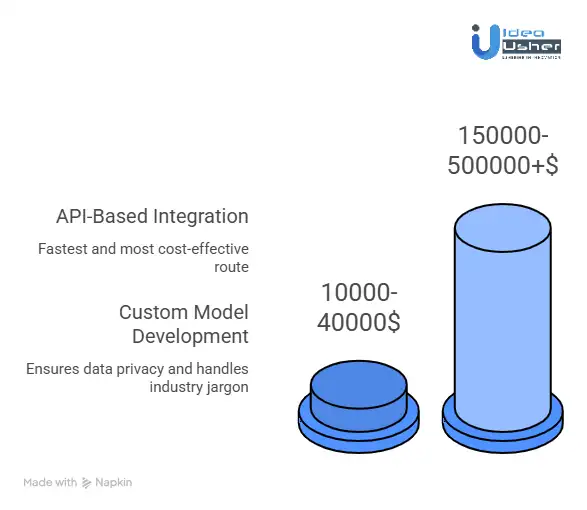
1. API-Based AI Model Integration Cost
Estimated Cost: $10,000 to $40,000 (Initial Setup)
For most companies, the fastest and most cost-effective route is to integrate existing APIs. This involves “plugging in” powerful models developed by specialized providers.
Development Effort:
The cost is largely spent on engineering the “middleware” that enables your platform to interact with these APIs, as well as on prompt engineering to ensure high-quality, consistent output.
Recurring Usage Fees:
Unlike a one-time development fee, APIs operate on a usage-based model.
- Text APIs (e.g., GPT-5): Typically priced between $1.25 and $2.00 per 1 million input tokens.
- Video & Vision APIs: These are more expensive, often ranging from $0.05 to $0.20 per generated frame or per high-resolution image processed.
Total Maintenance: Expect to spend $1,000 to $5,000 per month on API usage for a medium-sized workforce.
2. Custom AI Model Development Cost
Estimated Cost: $150,000 to $500,000+
Large enterprises often choose to build or fine-tune their own models to ensure complete data privacy and to handle industry-specific technical jargon that generic models might miss.
- Data Engineering ($50,000 to $150,000): This covers the costs of collecting, cleaning, and labeling proprietary training data (such as internal safety manuals or technical blueprints).
- Model Training ($50,000 to $200,000): Training a moderately complex neural network requires massive GPU power. Cloud compute costs for training a custom vision model can easily exceed $100,000 in a single cycle.
- Specialized Talent: You will need a dedicated team of Machine Learning Engineers and Data Scientists, with hourly rates typically between $120 and $250.
Open-Source vs Licensed AI Framework
Choosing between an open-source framework and a licensed proprietary tool is a strategic decision that impacts both upfront and long-term costs.
| Cost Category | Open-Source Frameworks (e.g., PyTorch, Llama) | Licensed Proprietary Models (e.g., OpenAI, Anthropic) |
| Upfront License Fee | $0 (Free to download) | $0 to $10,000 (Varies by plan) |
| Development Cost | High: Requires an expert team to configure and optimize. | Low: Ready-to-use with standard documentation. |
| Infrastructure Cost | High: You must pay for your own GPU servers. | Medium: Included in the per-usage API fee. |
| Data Privacy | Maximum: Data stays on your private servers. | Variable: Data is usually processed on the provider’s cloud. |
| Maintenance | Ongoing: You handle all updates and security patches. | Hands-off: The provider manages all backend updates. |
Monthly Maintenance & Ongoing Operational Costs
Launching an AI training tool is the first step, but sustaining it requires a dedicated monthly budget. Unlike traditional software, AI systems require high-intensity computing and ongoing model refinement, making operational expenses a significant part of total cost of ownership.
1. Cloud Hosting (AWS, Azure, GCP) Cost
Estimated Cost: $1,000 to $12,000+ per month
Hosting an AI platform is more expensive than standard web hosting because it requires high-performance GPU instances for video processing.
- Basic Cloud Run: $1,000 to $3,000. Suitable for platforms with a smaller user base or those using serverless functions to trigger video generation.
- Enterprise High-Throughput: $5,000 to $12,000+. This covers dedicated GPU clusters (such as AWS P-series or Azure N-series) needed to render dozens of high-definition videos simultaneously without long wait times for users.
- Storage Fees: Expect to pay $200 to $1,000 per month to store large high-definition video assets and training datasets.
2. AI API Usage & Model Retraining Cost
Estimated Cost: $2,000 to $15,000 per month
If your tool relies on third-party APIs (such as GPT for scripts or specialized video models), you will incur monthly usage fees.
- Variable Usage: Costs scale with the number of videos generated. A mid-sized company producing 100 modules a month may spend $2,000 to $5,000 on API tokens and processing credits.
- Model Retraining: AI models can suffer from “drift” where their performance declines over time. Setting aside $5,000 to $10,000 for periodic retraining or fine-tuning ensures the AI remains accurate and up-to-date with new corporate information or industry regulations.
3. Platform Scaling Cost
Estimated Cost: $3,000 to $10,000 per month (during growth phases)
As your user base grows from 100 to 10,000 employees, the infrastructure must scale horizontally to prevent lag.
- Load Balancing: Implementing advanced load balancers and auto-scaling groups helps keep the platform stable during peak training periods (such as annual compliance cycles).
- Content Delivery Network (CDN): To ensure smooth video playback for global teams, a CDN is required to cache video content closer to the users, adding roughly $500 to $2,000 to the monthly bill, depending on traffic volume.
4. Security & Compliance Maintenance Cost
Estimated Cost: $1,500 to $5,000 per month
In the corporate world, data security is non-negotiable. Ongoing maintenance is required to protect sensitive employee data and proprietary training content.
- Security Monitoring: This covers automated threat detection, periodic penetration testing, and vulnerability scans.
- Compliance Updates: Regulations on AI and data privacy (such as GDPR and specialized industry standards) are constantly evolving. This budget ensures that the platform’s encryption protocols and data-handling policies are updated to meet the latest legal requirements.
I have revised the section to remove all em dashes, replacing them with colons and commas to maintain a clean and professional flow.
Hidden Costs Businesses Often Overlook
When budgeting for an AI corporate training tool, the initial development and hosting fees are only part of the story. Several “invisible” expenses can quickly inflate a project’s budget if they are not accounted for during the planning phase.
1. Licensing Fees
Estimated Cost: $2,000 to $20,000 annually
Beyond the cost of building the software, you may encounter various licensing requirements that carry recurring fees.
Commercial AI Licenses:
Some open source models are free for research but require a paid commercial license if your company exceeds a certain revenue threshold or user count.
Stock Media and Asset Libraries:
If your AI tool integrates background music, stock footage, or specialized fonts to enhance the generated videos, these often require enterprise-level licenses.
Software Patents and Frameworks:
Using certain proprietary video compression codecs or specialized UI components can sometimes trigger additional royalty payments.
2. Data Storage and Bandwidth
Estimated Cost: $500 to $4,000 per month
While hosting costs cover the servers, the sheer volume of data generated by video AI can lead to skyrocketing storage and transfer fees.
High-Definition Archiving:
AI-generated training videos are often rendered in 4K. Storing thousands of these files, along with the “raw” AI project files, requires massive amounts of high-speed cloud storage.
Egress Charges:
Every time an employee watches a video, data is transferred out of the cloud. If you have a global workforce of thousands streaming high-bitrate video, these bandwidth fees, or egress costs, can become a significant monthly expense.
3. Model Fine-Tuning and Retraining
Estimated Cost: $10,000 to $30,000 per cycle
An AI model is not a set-and-forget asset. To remain effective, it requires periodic maintenance.
- Knowledge Updates: As company policies, products, or industry regulations change, the AI script generator and avatars must be retrained on new data to prevent the delivery of outdated information.
- Performance Optimization: Over time, you may find that the AI’s lip-syncing or tone accuracy lags behind newer standards, requiring a technical refresh to maintain a professional look and feel.
4. Third-Party API Rate Limits
Estimated Cost: Variable (Impacts Productivity)
If your tool relies on external APIs, such as those from OpenAI or Google, you are subject to rate limits: the maximum number of requests you can make per minute or hour.
- The Success Tax: If your platform becomes highly popular internally, you may hit these limits, causing the tool to stop working for employees.
- Tier Upgrades: To bypass these limits, companies are often forced to move from standard to enterprise API tiers, which typically entail much higher minimum monthly commitments and premium pricing.
How IdeaUsher Reduces AI Training Video Development Costs?
We at IdeaUsher understand that developing an AI corporate training video tool is a significant investment, which is why we use a specialized “Lean AI” framework to ensure you get enterprise-grade quality without the enterprise-level price tag.
Here is how we strategically reduce costs for our clients while maintaining a competitive edge:
1. The “Model Orchestration” Strategy
Focus: Avoiding the Million-Dollar Training Cycle
Building a custom video generation model from scratch can cost millions of GPU-hours. At Idea Usher, we utilize a Multi-Model Abstraction Layer. Instead of one massive, expensive model, we orchestrate a symphony of specialized, pre-trained engines.
Smart Routing:
We route simple tasks (such as script generation) to lightweight, low-cost models and reserve high-end engines (such as Sora or specialized diffusion transformers) for the final video rendering. This “Tiered Inference” approach can reduce your monthly operational costs by up to 70%.
2. Rapid Prototyping with Our MCP Framework
Focus: Modular Development Speed
We use the Model Context Protocol, a modern architectural framework that makes our AI components modular and interoperable.
Plug-and-Play Components:
Because our avatars, voice synthesis, and translation modules are built as independent “blocks,” we spend less time on foundational coding and more time on customizing the tool for your specific brand. This significantly shortens the development lifecycle and lowers the total hours billed.
3. Quantization and Infrastructure Optimization
Focus: Running High-End AI on Standard Hardware
One of the highest hidden costs of AI is the high-end GPU requirement. Idea Usher engineers employ Model Quantization and Pruning techniques.
- Efficiency: By optimizing the AI models to be “lighter,” we can often run sophisticated inference on standard, cheaper hardware rather than expensive NVIDIA A100 clusters.
- Spot Instance Orchestration: We design our rendering pipelines to use “Spot Instances” on AWS or Google Cloud, which are essentially spare server capacities offered at a fraction of the normal price. If a server is reclaimed, our system automatically pauses and resumes on the next available instance without losing data.
4. Hybrid AI Data Strategy
Focus: Reducing Data Labeling Expenses
Data is the lifeblood of AI, but cleaning and labeling it is a major expense. We utilize a Hybrid Data Approach:
- Synthetic Data Generation: We use AI to generate the initial training datasets needed for your custom avatars or industry-specific scripts, filling in gaps where real-world data is scarce or expensive to acquire.
- Human-in-the-Loop QA: Instead of hiring a large team for manual data entry, we use lean, AI-assisted tools that let a single expert oversee thousands of data points, ensuring accuracy while keeping labor costs low.
5. Future-Proofing with Scalable Architecture
Focus: Eliminating Technical Debt
Many low-cost developers build “locked-in” systems that require a total rewrite as you scale. We build with Horizontal Scalability in mind from day one.
Zero-Waste Scaling:
As your team grows from 50 to 5,000 users, our cloud-native architecture expands automatically. You only pay for what you use, ensuring that your costs grow only when your business value does.
Conclusion
The cost to develop an AI corporate training video tool will vary based on scope, infrastructure depth, and enterprise customization requirements. The deeper value, however, lies in converting traditional training into a scalable digital infrastructure that can generate recurring revenue and replace slow production workflows. When engineered with modular AI pipelines, secure cloud architecture, and LMS integration, it should become a proprietary training ecosystem that serves as a long-term digital asset rather than a short-term expense.
Looking to Develop an AI Corporate Training Video Tool?
IdeaUsher can help you design and engineer an AI corporate training video tool with a scalable multimodal architecture and secure cloud infrastructure.
The team can carefully build optimized rendering pipelines, workflow automation engines, and LMS integration layers so the platform performs reliably under enterprise load.
- 500,000+ Hours of Coding Excellence – Our ex-MAANG/FAANG developers have architected solutions for companies you know and trust.
- Zero Hallucination Architecture – Every video frame fact-checked against your internal SOPs and compliance docs.
- Digital Twins of Your Executives – Not stock avatars. Your leadership. Your voice. Your brand. Perfectly replicated.
- SCORM/xAPI Native – Seamless integration with your existing LMS. Track completion, quiz scores, and engagement in real-time.


FAQs
A1: The development cost typically ranges from $40,000 for a basic MVP to over $500,000 for an enterprise-grade platform. The final price depends on whether you use third-party APIs or build proprietary models, the number of custom avatars required, and the complexity of the rendering engine.
A2: Training an AI model can cost anywhere from $10,000 for simple fine-tuning on existing corporate data to $200,000 or more for training custom vision or language models from scratch. This includes expenses for data collection, cleaning, and the massive GPU compute power required to process the information.
A3: Using traditional production methods, a single high-quality corporate video can cost between $2,000 and $10,000 per finished minute. However, with an AI tool, once the initial platform is built, the cost to generate a video drops significantly, often costing only a few dollars in API credits and server time per module.
A4: An AI-powered tool offers unmatched scalability, allowing companies to produce and update content in minutes rather than weeks. It provides hyper-personalization through instant multi-language translation and localized avatars, ensuring global teams receive consistent, engaging, and cost-effective training that is easy to keep current.