



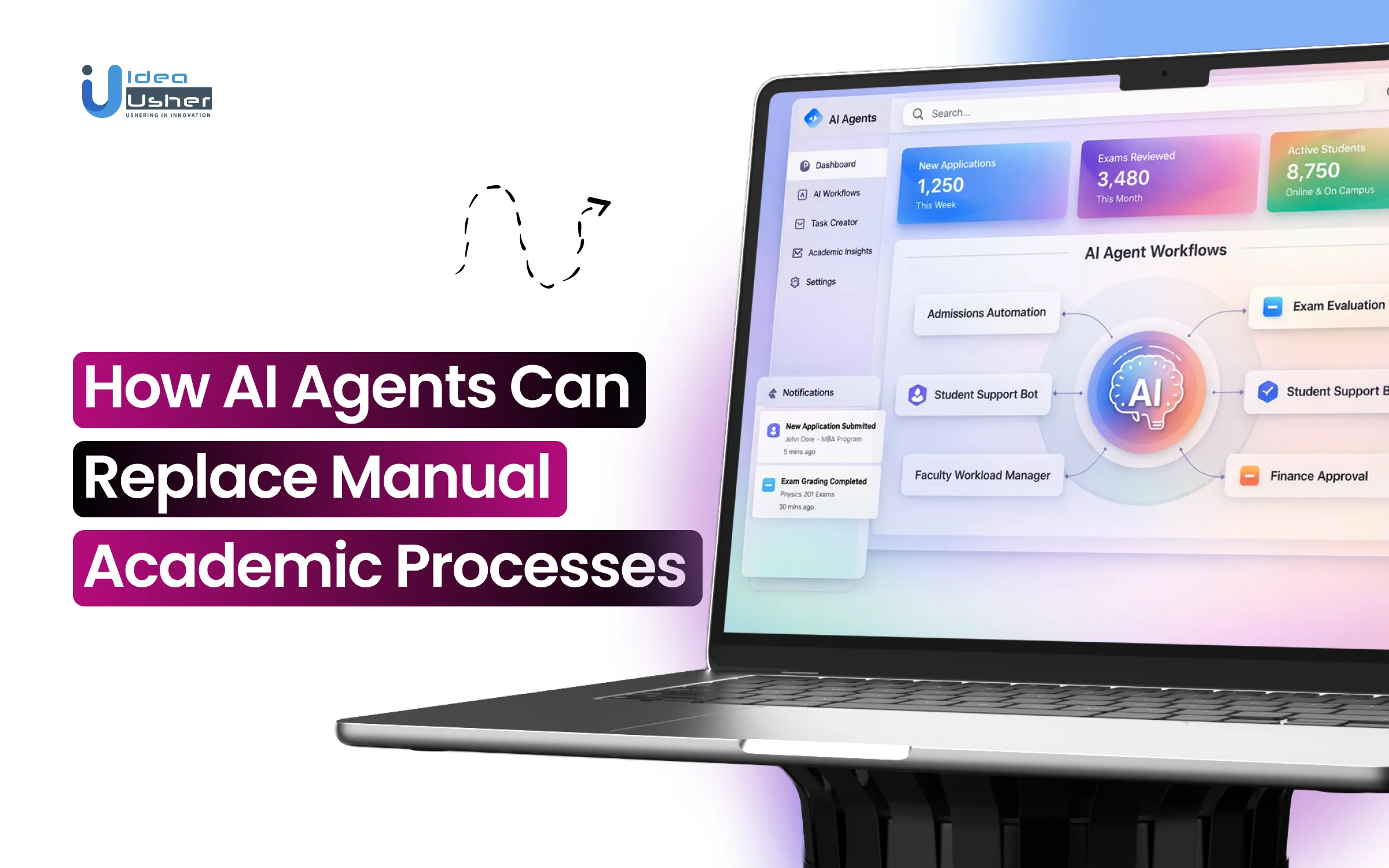
Academic institutions still rely heavily on manual processes like course approvals, eligibility checks, document verification, scheduling and student queries often happen through emails and spreadsheets, which slows operations and increases errors. As workloads and expectations grow, more institutions are exploring LLM academic process automation to reduce repetitive work while maintaining academic oversight.
AI agents improve these workflows by interpreting policies, handling diverse requests, routing cases, and supporting staff with contextual decision assistance. These agents help standardize outcomes while preserving flexibility when integrated properly, letting institutions replace manual handoffs with responsive, auditable systems.
In this blog, we explain how AI agents can replace manual academic processes by examining where automation delivers the most value, how LLM-based agents operate within institutional workflows, and the design considerations required to deploy them responsibly in academic environments.

Overview of the AI Agent in the Academic Process
An AI agent for academic process automation is an intelligent software system that autonomously performs tasks and workflows on behalf of a university or educator by reasoning, planning, and acting on data, rather than just responding to prompts.
These agents connect with systems like LMS, SIS, and CRM to handle tasks such as answering student queries, scheduling, tracking performance, or grading, which reduces manual workload and improves efficiency. They go beyond simple tools by pursuing defined goals, adapting to context, and taking actions that support academic operations.
Key Characteristics
These agents are distinguished from basic AI tools by several “agentic” properties:
- Autonomy: They can execute complex plans (e.g., “Onboard this new student”) without constant human intervention.
- Proactivity: They don’t just react; they might “nudge” a student to finish a task or alert a professor about a class-wide misunderstanding of a topic.
- Multi-step Reasoning: Using a “think-act-observe” loop, they break down large goals into sub-tasks and adjust their strategy if they encounter an error.
- Tool Integration: They can “use” other software, such as logging into a Student Information System (SIS) via API or searching the web for the latest research.
Why Manual Academic Processes Break at Scale?
Manual academic processes quickly reach their limits as institutional demands increase. Growth exposes structural weaknesses, not just inefficiencies that lead to breakdowns. Here are the most common ways these systems fail at scale.
1. Fragmented Systems
Data trapped in siloed systems forces manual exports and transfers. At scale, this brittle chain breaks instantly. There is no connective tissue, causing operational paralysis the moment data fails to sync between core platforms.
2. Rule-Heavy Processes
Accreditation and transfer rules live in staff minds, not system logic. Volume spikes force humans to perform database work. When knowledge leaves or is overloaded, the entire approval infrastructure collapses due to embedded institutional amnesia.
3. Approval Bottlenecks
Linear sign-offs create a structural dam effect during admissions and graduation. Thousands of requests queue behind a single approver, locking students out. Throughput cannot scale because manual workflows lack parallel processing capabilities.
4. No Real-Time Visibility
Manual workflows operate as black boxes. Leadership cannot see bottlenecks forming, and exceptions require bespoke interventions. This reactive structure causes cascading delays for all students, not just the edge cases.
5. Versioning Chaos
Policy updates spread via email PDFs create multiple conflicting truths across departments. Without a centralized authoritative system, advisors follow different handbooks, causing inconsistent enforcement and administrative holds due to fractured governance.
The Global Shift Toward Agent-Driven Academic Operations
The workflow automation market was valued at USD 9.38 billion in 2024 and is projected to reach USD 78.26 billion by 2035, growing at 21% CAGR from 2025 to 2035. This rapid growth highlights how AI agents can replace manual academic processes by delivering scalable, intelligent automation that improves efficiency, accuracy, and compliance across institutions.

Automated admissions systems have saved universities around 160,000 minutes of staff time by handling routine inquiries. At Fordham University, AI chatbots answered 38,708 questions with 91% accuracy, providing always-on student support without increasing staff.
Institutions like Georgia State University reported a 3.3% increase in enrollment and a 21.4% reduction in “summer melt” (students who commit but don’t show up) after deploying an AI assistant.
AI-powered grading tools such as Gradescope can cut assessment time by up to 70%, reducing faculty workload and allowing instructors to focus more on teaching and student engagement.
Benefits of AI Agents in Academic Workflow Automation
An AI agent in academia autonomously manages academic and administrative tasks using institutional data and LLM academic process automation to streamline workflows and improve operational efficiency.

1. Agent vs. Chatbot
A chatbot answers questions while an AI agent executes academic actions. Instead of merely informing a student about a missing prerequisite, the agent verifies the transcript, places a temporary registration hold, notifies the advisor, and resumes enrollment once the override is approved.
Real-World Example:
Mainstay (formerly AdmitHub) uses behavioral intelligence to move beyond simple Q&A, proactively guiding students through the enrollment funnel and reducing “summer melt” through persistent, action-oriented engagement.
2. Persistent, Policy-Bound Systems
AI agents function as digital academic workers bound by institutional rules. If graduation requires 30 residency credits, the agent continuously validates transfer credits against that policy until compliance is achieved or an authorized academic override is issued.
Real-World Example:
Ocelot integrates deeply with Student Information Systems (SIS) like Ellucian to ensure all student interactions and automated actions remain strictly within the bounds of university policy and regulatory requirements.
3. Data Access & Escalation
Agents simultaneously analyze SIS records, LMS performance, and financial aid status. They resolve routine blocks autonomously, but when integrity, compliance, or disciplinary risks appear, they escalate cases instantly to the appropriate academic authority.
Real-World Example:
Element451 utilizes specialized “digital workers” for functions like application reading and fraud detection, automatically flagging suspicious activities for immediate human review while processing standard applications autonomously.
4. Cross-Department Execution
Unlike siloed academic software, AI agents operate across departments. They verify fee clearance in the ERP, remove financial holds in the SIS, and complete enrollment automatically, eliminating manual emails between the Registrar and Bursar.
Real-World Example:
Proctur is an AI-powered College Management System that automates the entire student lifecycle, from fee collection in the finance department to automated attendance logging and timetable scheduling in the academic department.
5. 24/7 Academic Operations
AI agents work continuously during peak cycles. They process prerequisite checks, waitlists, and eligibility audits overnight, preventing the “Monday-morning bottlenecks” that delay thousands of student actions due to manual intervention.
Real-World Example:
Supervity deploys “University AI Agents” that handle 24/7 self-service for course registration, scholarship support, and academic purchases, eliminating the traditional delays caused by manual administrative office hours.
AI Agents & Traditional Academic Workflow Automation Differences
AI agents adapt to changing academic contexts, whereas traditional automation relies on fixed, rule-based processes. The table below compares LLM academic process automation with traditional academic workflow automation across flexibility, decision-making, adaptability, and error handling.
| Comparison Area | Traditional Academic Workflow | AI Agents for Academic Processes |
| Operating Model | Executes predefined steps when triggered, relying on humans to monitor, intervene, and complete workflows. | Owns the academic workflow end-to-end, from trigger to resolution, without continuous human involvement. |
| Policy Handling | Encodes limited rules that must be manually interpreted, updated, and reconfigured by staff. | Translates academic policies into executable, version-controlled logic enforced consistently by the system. |
| System Integration | Operates inside a single platform or loosely connects systems through brittle integrations. | Orchestrates actions across SIS, LMS, ERP, and document systems as a unified academic process. |
| Triggering Mechanism | Initiated through manual actions, form submissions, or scheduled batch jobs. | Responds instantly to real-time academic events such as student actions, deadlines, or policy violations. |
| Exception Handling | Stops or fails when rules break, requiring staff to investigate and resume manually. | Detects exceptions automatically and escalates complete, context-rich cases to the right academic authority. |
| Workflow State Management | Relies on staff memory, notes, or emails to track progress and follow-ups. | Maintains persistent workflow state until the academic outcome is fully achieved. |
| Human Involvement | Humans are required at multiple operational steps throughout the process. | Humans intervene only at predefined decision boundaries requiring judgment or authority. |
| Scalability Under Load | Performance and accuracy degrade during peak academic cycles. | Scales continuously without fatigue, backlogs, or process delays. |
| Auditability & Compliance | Provides limited logs that are difficult to reconstruct for audits. | Generates full, explainable audit trails for every decision and action taken. |
| Outcome Focus | Optimized for task completion within a workflow. | Optimized for academic outcome completion and institutional compliance. |
Core Academic Processes AI Agents Can Fully Replace
Core academic processes often rely on repetitive, rule-based workflows that consume significant faculty and staff time. Through LLM academic process automation, AI agents can fully replace these processes by automating execution, decision-making, and system-level actions at scale.

1. Admissions and Application Routing
The Process: Traditionally, admissions officers spend 60-70% of their time on manual data entry and checklist verification. AI agents now handle the entire front-end funnel.
Capabilities:
- Eligibility Checks: The agent parses unstructured documents (transcripts, personal statements, letters of recommendation) to verify GPA requirements, prerequisite courses, and language proficiency against institutional policy.
- Document Validation: Uses OCR and pattern recognition to flag fraudulent or incomplete documents instantly.
- Dynamic Scoring & Routing: Applies institutional weighting (e.g., 40% GPA, 30% test scores, 30% extracurriculars) to score applicants and automatically routes high-potential candidates to the honors college or specific faculty reviewers.
Audit Trail: Every decision is logged, providing a transparent, non-biased record for compliance reporting.
2. Academic and Degree Progress Audits
The Process: Instead of students waiting weeks for a 30-minute advising appointment, AI agents act as 24/7 compliance officers for degree paths.
Capabilities:
- Continuous Credit Checks: The agent monitors student records in real-time against complex program maps. It instantly detects if a student registers for a course that won’t count toward their major.
- “What-If” Analysis: Students can ask the agent, “What if I switch from Marketing to Finance?” and receive an immediate, audited breakdown of how their credits transfer and how long the degree will take.
- Automated Graduation Alerts: Proactively flags students who are off-track (e.g., missing a residency requirement or a critical capstone) and sends alerts to both the student and their advisor before the drop/add deadline.
3. Course Registration and Enrollment Management
The Process: AI eliminates the bottleneck of help desks and manual overrides during peak registration periods.
Capabilities:
- Intelligent Hold Resolution: The agent detects registration blockers (financial holds, missing immunization records, advising holds). It can guide the student to the exact form or payment portal and, once resolved, automatically clears the hold and completes the registration.
- Prerequisite & Conflict Resolution: If a student tries to register for Organic Chem II without the lab requirement, the agent explains the gap and suggests the required section that fits their schedule.
- Waitlist Management: Agents can automatically scan for open seats and re-enroll students from waitlists based on priority rules (e.g., graduating seniors first), notifying them of the change instantly.
4. Examination and Result Processing
The Process: Shifting from manual exam coordination and grade auditing to a secure, AI-managed workflow.
Capabilities:
- Rule-Based Examiner Assignment: The agent assigns exam invigilators and graders based on faculty workload, expertise, and conflict-of-interest rules (e.g., ensuring a professor doesn’t grade their own relative’s exam).
- Secure Moderation: Automatically shuffles or anonymizes digital submissions before sending them to graders to ensure blind marking.
- Anomaly Detection: The agent analyzes grading patterns across a cohort. If one TA is grading 30% harsher than the rest, or if answer sheets show statistically improbable similarities, the agent flags this for the Academic Integrity office without human intervention.
5. Faculty Workload and Timetable Allocation
The Process: Moving from spreadsheet-based scheduling that takes months to constraint-based AI that solves it in hours.
Capabilities:
- Constraint-Based Scheduling: The agent ingests data on classroom capacity, faculty preferences (e.g., “No Friday classes”), department requirements, and pedagogical needs (labs vs. lectures).
- Automated Allocation: It generates optimized timetables that maximize room utilization and balance faculty workload across semesters.
- Real-Time Conflict Resolution: If a faculty member falls ill or a room loses power, the agent instantly checks all constraints and reallocates the class to a new time/room, notifying all stakeholders before they even realize there was a problem.
How AI Agents Can Replace Manual Academic Processes?
AI agents replace manual academic processes by executing policy-driven workflows end to end, across systems. They eliminate inbox dependency, reduce human intervention, and ensure consistent, LLM academic process automation at an institutional scale.

1. Academic Triggers
The Shift: From staff manually watching shared inboxes and queues to agents reacting instantly to institutional events.
How it Works: AI agents listen continuously for system events across the institutional technology stack and instantaneously initiate workflows when triggers occur.
- Student Action: A student clicks “Declare Major.” The agent validates eligibility, checks for holds, updates the student record, and notifies the new department within seconds.
- Deadline: The clock strikes 11:59 PM on the Drop/Add day. The agent runs final eligibility checks, processes pending waitlist movements, and locks registration exactly when the calendar turns.
- Policy Breach: A student attempts to register for 21 credits. The agent intercepts the request, checks institutional credit limits, and blocks enrollment with an explanatory message.
- System Event: The LMS posts final grades. The agent triggers degree audits, updates academic standing, identifies students on probation, and notifies advisors.
Outcome: Work begins the microsecond the trigger occurs. No human opens an email, reads it, and adds it to a to-do list.
2. Policy-as-Code
The Shift: From human interpretation of academic policies to deterministic, version-controlled enforcement by systems.
How it Works: The academic catalog, faculty union contracts, and FERPA/Title IX guidelines are translated into code libraries.
Example: Instead of a human reading “A student must achieve a C- or higher in all prerequisite courses,” the agent runs a check against a lookup table of grades and associated passing booleans.
Version Control: When the Academic Senate votes to change a rule, the code is updated, and every agent instantly enforces the new policy, eliminating the lag time of human re-training.
3. Multi-System Data Ingestion
The Shift: From humans performing “swivel-chair” integration between siloed databases to agents correlating institutional records in real time.
How it Works: AI agents connect via read-only APIs to institutional systems, pulling real-time data from multiple sources simultaneously to inform decisions.
- SIS (Banner/PeopleSoft/Workday): Supplies student records, registration status, holds, and enrollment history for eligibility determinations.
- LMS (Canvas/Blackboard): Provides grade submissions, assignment completion rates, and course participation data for progress tracking.
- ERP (Finance/HR): Delivers faculty contracts, vendor payment status, and student billing information for financial clearance checks.
- Document Stores (ImageNow/OnBase): Stores scanned transcripts, residency forms, and petitions for document validation and audit trails.
Outcome: The agent correlates data in milliseconds (e.g., matching a SIS enrollment record with an LMS grade and a financial aid disbursement) to make a single decision.
4. Autonomous Academic Actions
The Shift: Routine academic updates move from manual staff execution to authorized, system-driven write-backs.
How it Works: AI agents execute state changes directly within institutional systems by applying policy logic to ingested data, completing transactions autonomously.
- Holds: Places a registration hold on a student with an overdue library book, blocking future enrollment until resolved.
- Approvals: Automatically approves a course substitution when the request matches pre-defined criteria in the academic policy database.
- Enrollments: Registers a student into a capped course when a spot opens and they are next on the priority waitlist.
- Audits: Writes a “Graduation Audit Complete” flag to the student record instantly upon final grade posting.
5. Intelligent Escalation
The Shift: Unstructured “Reply All” email chains give way to structured, data-rich exception handling.
How it Works: AI agents follow decision trees that route cases by rule, sending only exceptions to humans while handling standard cases automatically.
- Path A (Standard): Student meets all criteria. The agent executes the action, sends instant confirmation to the student, and closes the thread. No staff time required.
- Path B (Exception): Student is missing a prerequisite but has relevant work experience. The agent compiles the transcript, petition form, course syllabus, and applicable policy into a single case ticket and escalates it to an advisor. Student receives notification that their case is under review.
Outcome: The agent packages the student’s entire context (transcript, petition form, relevant policy) into a single dashboard ticket for a human advisor. The human doesn’t need to hunt for data; they only need to apply judgment.
6. Persistent Workflow State
The Shift: The workflow state is maintained by the system rather than relying on individual staff memory.
How it Works: The agent maintains a persistent state machine for every process.
Scenario: A study abroad application requires three signatures (Dept Chair, Study Abroad Office, Registrar).
The agent tracks exactly where the application is in the flow. If it sits at “Dept Chair” for 5 days, the agent sends a reminder. If the chair is on leave, the agent re-routes to the interim chair based on HR data.
Outcome: Processes never fall through the cracks. “I thought you were following up on that” becomes obsolete.
7. Human Oversight at Boundaries
The Shift: Human involvement is limited to moments requiring judgment or formal authority.
How it Works: The architecture restricts “human-in-the-loop” involvement to points requiring subjective judgment or high-risk authority. All routine steps are automated.
- Process Steps (Handled by Agent): Data entry, form filling, cross-system data lookup, standard notifications, and routine approvals that follow clear policy rules.
- Decision Boundaries (Handled by Human): Academic dismissal appeals, grade change requests due to extenuating circumstances, and complex transfer credit articulation where human judgment is required.
Outcome: Staff workload drops by 80% on routine tasks, allowing them to focus on high-value student interaction and complex case management.
8. Continuous Monitoring
The Shift: Academic compliance is monitored continuously in real time rather than through periodic reports.
How it Works: Instead of running a report at the end of the semester to see who is failing, agents monitor conditions 24/7.
Degree Progress: The agent detects that a senior just changed their major and their new required capstone is already full for next semester. It alerts them in October, not in January when they try to register.
Compliance: The agent monitors international student visa status against enrollment data daily, ensuring immediate institutional action if a student drops below full-time status, rather than finding out at the end of the term.
How AI Agents Prevent Errors Caused by Outdated Academic Policies?
AI agents minimize academic errors by continuously aligning actions with updated institutional rules. They dynamically adapt decisions in real time, reducing risks caused by outdated policies and ensuring compliance across academic processes.

1. Centralized Policy Repository
Agents pull from a single policy knowledge base where every statute, catalog entry, and ordinance is stored with effective dates and sunset clauses. This eliminates the “policy drift” caused by staff referencing old PDFs or outdated handbooks.
2. Real-Time Policy Updates
Policy changes approved by the Academic Senate are ingested within hours, not semesters. Agents enforcing registration caps, prerequisite rules, or residency requirements switch to new logic immediately, preventing the “gap period” errors common during manual implementation.
3. Policy Conflict Detection
Agents flag contradictions when new policies overlap with existing ones, such as a credit limit change conflicting with financial aid SAP requirements. These conflicts are surfaced to compliance officers before erroneous awards or denials reach students.
4. Audit Trails for Decisions
Every agent action is logged against the specific policy version and effective date used to make the decision. During program reviews or student appeals, institutions can prove exactly which rule applied and when, eliminating he-said-she-said disputes.
5. Policy-to-Code with Validation
Subject matter experts review and sign off on how policies are codified into agent logic before deployment. This governance layer ensures nuanced language like “normally requires” or “at chair’s discretion” is interpreted correctly, not lost in translation.
Conclusion
LLM academic process automation lets universities manage teaching, assessment, and administration more efficiently. Deploying AI agents reduces manual workloads, improves accuracy, and enables proactive student support. AI-driven workflows speed up grading, advising, compliance, and reporting. As universities shift from experimentation to AI-native models, adopting LLM-based agents drives operational efficiency and better academic results. Early adopters gain stronger governance, greater agility, and measurable improvements in student success and digital transformation.
Transform Academic Operations with Intelligent AI Agents
We’ve delivered multiple AI solutions and intelligent automation products for enterprise and education use cases. Powered by ex-MAANG/FAANG developers with 500,000+ hours of experience, we build AI agents that automate academic workflows, reduce manual effort, ensure policy compliance, and improve operational efficiency.
Why Work With Us?
- AI-Powered Tax Intelligence: We design AI systems that automate tax calculations, interpret complex regulations, and adapt to changing tax laws with high accuracy.
- Compliance-First Architecture: Our solutions are built with auditability, data security, and regulatory alignment at the core to support enterprise and multi-region compliance.
- Scalable & Secure Tech Stack: We implement cloud-native, scalable infrastructures that handle large tax datasets while ensuring performance, privacy, and reliability.
- End-to-End Product Delivery: From architecture design to deployment and optimization, we build AI tax software tailored to your business objectives and growth plans.
Go through our portfolio to discover how we’ve delivered AI solutions and automation products that solve complex operational challenges for enterprises and institutions.
Contact our team to discuss how AI agents can replace manual academic processes and help your institution achieve greater efficiency, accuracy, and policy compliance.


FAQs
A.1. LLM academic process automation processes by handling grading, attendance tracking, advising workflows, and compliance reporting through LLM-driven decision logic. They integrate with LMS and SIS platforms to execute tasks accurately, consistently, and at an institutional scale.
A.2. Universities should automate grading, plagiarism checks, student support, academic advising, and reporting first. These workflows consume high manual effort, follow repeatable rules, and deliver immediate efficiency gains when replaced with LLM academic process automation.
A.3. AI agents integrate through APIs and middleware connecting LMS, SIS, ERP, and CRM platforms for LLM academic process automation. This approach enables real-time data access and action execution without disrupting legacy infrastructure or requiring full system replacement.
A.4. Enterprises must address data privacy, bias control, explainability, and regulatory compliance. Designing strong governance, audit trails, and human oversight ensures AI agents operate responsibly within academic standards and institutional policies.


