


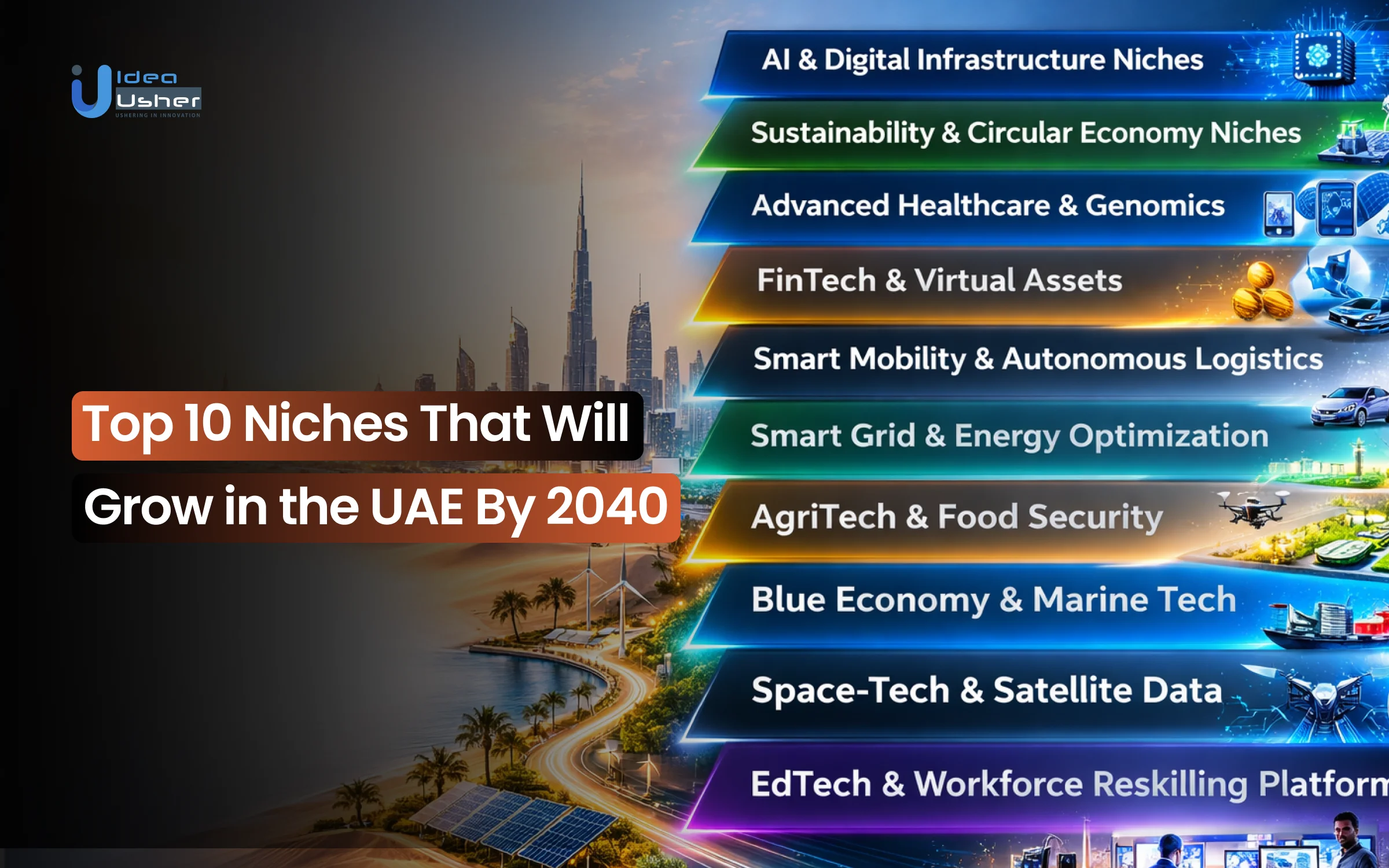
The UAE is not just expanding. It is steadily redesigning how its economy and cities function. Entire districts are being rebuilt with smarter infrastructure and long-term planning, especially in the UAE’s growing niches. You can already see how digital governance and sustainability targets are shaping new market behavior. Businesses are adopting technology because systems now demand efficiency and measurable performance.
Consumers are gradually choosing platforms that save time and integrate smoothly into regulated ecosystems. If you plan to build an app here, you should first understand which sectors will realistically scale by 2040. Market timing and regulatory alignment will ultimately decide whether your solution thrives or quietly fades away.
Over the years, we have developed solutions across multiple sectors in the UAE using AI-driven automation and blockchain-based digital infrastructure. With this hands-on experience, we are sharing this blog to discuss the top 10 niches that will grow in the UAE by 2040. Let’s start!
Overview of Growing Niches in the UAE
These niches are fueled by government incentives like 100% foreign ownership in free zones, high digital adoption (99% internet penetration), and investments in tech and sustainability.
Key Growth Drivers
Economic policies, strategic free zones, and global trade positioning are accelerating niche expansion, particularly in tech-led areas.
According to Mordor Intelligence, fintech and AI investments are surging, with the UAE fintech sector valued at $52 billion in 2026 and expected to reach $90 billion by 2031, at an 11.58% CAGR. Renewable energy and logistics benefit from megaprojects and e-commerce booms, with non-oil trade exceeding AED 3 trillion in 2025.

Source: Mordor Intelligence
- Fintech and Digital Finance: Digital payments dominate, with mobile apps, RegTech, and SME credit platforms thriving due to open banking frameworks.
- AI and Advanced Tech: Over 21% of new startups are AI-focused, supporting enterprise automation and predictive analytics; tech spending is expected to near $20 billion in 2026.
- Logistics and Supply Chain: AI-driven warehousing and last-mile delivery grow at 6%+ annually, tied to $13 billion e-commerce projections by 2029.
- Renewable Energy: Shift to solar and clean tech aligns with Net Zero 2050, creating roles in engineering and sustainability.
- E-Commerce and Healthcare: Niche marketplaces and medical tourism expand, boosted by personalization tech and post-pandemic investments.
Notable Partnerships
Strategic partnerships are reinforcing this growth. In fintech, YAP collaborates with traditional banks through API-driven models, while NymCard works with Mastercard to build virtual card infrastructure for SMEs.
On the innovation front, Hub71 and ADGM enable regulatory sandbox pilots for AI fintech startups, and DIFC’s open banking initiatives connect global players such as Revolut and Stripe with local entities.
In renewable energy, China-UAE cooperation through UECN integrates AI for solar optimization and clean hydrogen research.

Top 10 Niches That Will Grow in the UAE by 2040
As 2040 gets closer, the UAE is not just following global trends but systematically engineering its own economic architecture. The Dubai 2040 Urban Master Plan and the UAE’s “We the UAE 2031” vision clearly define priority sectors that will receive structural support for capital policy and infrastructure investment.
For investors, founders, and innovators, this isn’t speculation. It’s alignment with a trillion-dirham directive.
Here are the 10 niches that will define the UAE’s economic landscape by 2040, and exactly how they work.
1. AI & Digital Infrastructure Niches
Before you can have smart cities, you need a powerful “brain” to run them. This niche focuses on the backbone of the digital economy, the ability to process massive amounts of data locally and efficiently.
Fact & Stats:
The UAE data centre market could reach 3.3 billion dollars by 2030, clearly showing how quickly digital infrastructure is scaling. Right now, around 83 percent of Middle East internet traffic still routes through Europe, creating latency and data sovereignty issues.
This is why local hyperscale and edge facilities will likely become strategically essential for secure AI workloads and regional traffic optimization.
Types of Apps Businesses Can Build:
- AI Optimized Colocation Platforms: Apps that allow businesses to rent out server space specifically optimized for AI workloads.
- Edge Computing Management Suites: Software that helps manage data processing closer to the source, like in a retail store or factory, to reduce lag.
- Sustainability Dashboards for Data Centers: Tools that monitor and optimize the massive energy consumption of data centers in real time.
The massive investments by global players like Equinix and the focus on sustainable, high-efficiency data centers to support the Dubai 2040 plan.
Popular App in this Niche: UAE PASS

UAE PASS is the national digital identity app that enables residents to securely access government and private sector services using biometric authentication. It forms the backbone of the UAE’s digital infrastructure by enabling secure data exchange, digital signatures, and identity verification across smart city ecosystems.
2. Sustainability & Circular Economy Niches
Moving beyond “going green,” the UAE is building a “circular economy” where waste is eliminated, and resources are continuously reused.
Fact & Stats:
The UAE is aligning its circular economy policies with global standards to address nearly 45 percent of emissions linked to resource use. This strategy could gradually reduce waste intensity and improve material recovery across key sectors.
The MoU between Emirates Environmental Group and the Advancing Net Zero Volunteering Team will likely strengthen coordinated progress toward net zero targets.
Types of Apps Businesses Can Build:
- B2B Surplus Marketplace Platforms: Digital platforms that connect companies with waste, such as construction debris or food waste to those who can use it as a resource.
- Consumer Waste to Reward Apps: Apps that gamify recycling for residents, offering incentives for proper waste sorting.
- Circular Construction Material Trackers: Software for architects and contractors to source and track certified sustainable building materials.
Popular App in this Niche: DubaiNow

DubaiNow is a unified government services app that allows residents to manage utilities, waste payments, and environmental services digitally. By centralizing sustainability-related services into one platform, it reduces paperwork and supports efficient resource management.
3. Advanced Healthcare & Genomics
The UAE is shifting from sick care to preventive, precision medicine, using AI and genetic data to tailor treatments to individuals.
Fact & Stats:
The UAE digital health market could grow by more than 23 percent by 2030, reaching around 2.65 billion dollars, signaling strong structural demand.
At the same time, life expectancy is expected to reach nearly 83 years by 2025, gradually increasing the burden on long-term and post-retirement care systems. This shift will likely accelerate investment in remote monitoring, predictive diagnostics, and integrated care platforms.
Types of Apps Businesses Can Build:
- Personalized Genomic Portals: Secure apps that enable users to access and understand their genomic data for preventive health insights.
- AI-Driven Remote Patient Monitoring RPM: Platforms integrating with wearable sensors to predict health events before they happen.
- Medical Tourism Concierge Apps: End-to-end apps for international patients to book consultations, treatments, and recovery in the UAE.
Popular App in this Niche: SEHA

SEHA is the official healthcare services app in Abu Dhabi, enabling appointment booking, teleconsultations, and access to medical records. It supports preventive healthcare by digitally connecting patients with hospitals, clinics, and remote monitoring systems.
4. FinTech & Virtual Assets
As a global pioneer in crypto regulation, the UAE is building the infrastructure for the future of finance, from digital currencies to tokenized assets.
Fact & Stats:
The UAE has strategically partnered with global cloud and AI infrastructure providers to strengthen its digital backbone, which directly supports regulated FinTech expansion.
At the same time, the Dubai Chamber of Digital Economy is systematically running accelerators that could enable over 1000 startups to scale within a structured, compliance-driven ecosystem.
Types of Apps Businesses Can Build:
- Sharia Compliant Digital Asset Wallets: Crypto wallets designed specifically for compliance with Islamic finance principles.
- Tokenized Real Estate Investment Platforms: Apps allowing micro investments in prime UAE real estate through blockchain-based tokens.
- RegTech Regulatory Technology Solutions: Automated compliance software to help financial firms navigate the UAE’s complex but clear virtual asset regulations.
Popular App in this Niche: Ziina

Ziina is a UAE-based peer-to-peer payment app that lets users send and receive money instantly via mobile numbers. It simplifies digital payments and supports the country’s push toward a cashless and regulated digital finance ecosystem.
5. Smart Mobility & Autonomous Logistics
The UAE is not just testing self-driving cars; it is building a regulatory and physical infrastructure to make autonomous transport the norm by 2040.
Fact & Stats:
By 2040, Abu Dhabi aims to shift 25 percent of all trips to smart transport systems, which could significantly reduce congestion and improve traffic intelligence.
This transition is already visible through coordinated pilots with the Integrated Transport Centre K2 and EMX, including the deployment of the licensed Autogo self-driving delivery vehicle in Masdar City.
Types of Apps Businesses Can Build:
- Multi-Modal MaaS Mobility as a Service Aggregators: Apps that plan and pay for a single journey combining an e-scooter, robo taxi, and autonomous shuttle.
- Fleet Management for Autonomous Delivery Bots: Dashboards for restaurants and retailers to manage a fleet of sidewalk delivery robots.
- Last Mile Drone Delivery Platforms: Software for coordinating B2C drone deliveries within geofenced 20-minute city zones.
Popular App in this Niche: Careem

Careem functions as a multi-service mobility super app that integrates ride-hailing, bike rentals, food delivery, and digital payments. Its platform architecture supports real-time routing, fleet optimization, and urban mobility coordination across major UAE cities.
6. Smart Grid & Energy Optimization
As AI and data centers consume more power, the demand for clean, reliable, and intelligent energy grids is exploding.
Fact & Stats:
AI-driven workloads could push power demand to nearly four times current levels by 2040, which makes grid resilience strategically critical.
In response, the UAE is targeting 32 percent clean energy by 2030, and projects like Masdar 24 7 Solar PV, with 5.2 GW of capacity and 19 GWh of storage, will likely anchor this transition.
Types of Apps Businesses Can Build:
- Peer-to-Peer P2P Energy Trading Apps: Platforms allowing homes with solar panels to sell excess energy directly to neighbors on the same grid.
- AI-Powered Energy Auditing Tools: Apps for businesses to input their data and get instant recommendations for energy savings.
- EV Grid Integration Platforms: Software that manages when electric vehicles charge to prevent overwhelming the grid during peak hours.
Popular App in this Niche: ADNOC Distribution

The ADNOC Distribution app allows users to locate fuel stations, manage digital payments, and access EV charging services. It supports smarter energy consumption tracking and digital fuel management across the UAE.
7. AgriTech & Food Security
In a nation where sand meets the sea, growing food is a national security imperative. This has sparked a revolution in high-tech farming.
Fact & Stats:
Vertical farming systems can use up to 95 percent less land and nearly 90 percent less water, which makes them structurally efficient for arid climates like the UAE.
As the country aims to enter the top ten in global food security by 2051, the rapid deployment of indoor farms supplying supermarkets and Michelin-starred restaurants will likely play a central role.
Types of Apps Businesses Can Build:
- Vertical Farm Management Software: Operating systems to control lighting, nutrients, and harvesting in indoor farms.
- Farm to Fork Traceability Apps: Blockchain-based apps for consumers to see exactly where their food was grown, even if it was a vertical farm in the desert.
- AI Crop Analytics Tools: Software using drone and satellite imagery to advise traditional farms on water and soil management.
Popular App in this Niche: Instashop

Instashop is a UAE-born grocery delivery platform that connects consumers with supermarkets and local suppliers. It enhances food supply chain efficiency and supports the rapid distribution of fresh produce across urban centers.
8. Blue Economy & Marine Tech
The UAE is turning its coastline into a hub for sustainable economic activity, from eco tourism to marine biotech.
Fact & Stats:
The Blue Economy in the UAE covers sustainable desalination, marine biotechnology, and seawater agriculture, which could structurally diversify coastal revenue streams.
With algae solutions potentially replacing up to 45 percent of global fish oil and Dubai 2040 targeting a 400 percent increase in public beaches, this sector will likely expand through eco-focused marine infrastructure and biotech innovation.
Types of Apps Businesses Can Build:
- Sustainable Desalination Monitoring Apps: IoT platforms to monitor and optimize the energy and chemical use in desalination plants to protect marine life.
- Marine Biodiversity Citizen Science Apps: Apps for divers and boaters to log sightings, helping to map and protect coral reefs.
- Coastal Hospitality and Co-working Platforms: Apps for booking spaces in new waterfront blue economy zones that blend work and leisure.
Popular App in this Niche: FishTrack UAE

FishTrack UAE is a marine activity app used by fishing enthusiasts to track locations, weather, and marine data. It supports sustainable marine engagement by helping users make data-informed decisions while operating in coastal waters.
9. Space Tech & Satellite Data
The UAE is no longer just sending astronauts; it is building an entire space industry to manufacture components and analyze satellite data.
Fact & Stats:
The UAE space sector is steadily becoming a core pillar of economic diversification by generating high-value roles in engineering, satellite analytics, and data science.
Following the Hope Probe mission investment is now structurally focused on building a sustainable space economy that could support the Centennial 2071 vision of a knowledge-driven nation.
Types of Apps Businesses Can Build:
- Satellite Climate Analytics Dashboards: Platforms that sell processed satellite data to agricultural or environmental firms to track climate patterns.
- Space Component Supply Chain Software: B2B platforms for manufacturers to source and supply components for the global space supply chain.
- Space Tourism Experience Apps: Apps for booking and enhancing future zero-gravity flights or spaceport visits.
Popular App in this Niche: MBRSC

The Mohammed Bin Rashid Space Centre app provides updates on UAE space missions, satellite launches, and research initiatives. It increases public engagement with the national space program and promotes awareness of the growing space economy.
10. EdTech & Workforce Reskilling Platforms
With a workforce that needs to constantly adapt, the UAE is investing heavily in platforms that can rapidly reskill talent for the jobs of 2040.
Fact & Stats:
The UAE is steadily embedding a lifelong learning model, as workforce skills may require structured updates every 5 years in a technology-driven economy.
Through digital accelerators and initiatives like the 100,000 Coders program and Mohamed bin Zayed University of Artificial Intelligence, the country is systematically building a resilient AI-ready talent pipeline.
Types of Apps Businesses Can Build:
- VR-Based Vocational Training Simulators: Immersive apps for training in high-skilled trades like advanced manufacturing or aircraft maintenance.
- B2B Corporate Upskilling Platforms: Subscription-based platforms for companies to offer their employees nano degree programs in AI, blockchain, and green energy.
- AI Career Pathing Tools: Apps for students and professionals that use AI to map out educational paths based on future job market demands.
Popular App in this Niche: Alef Education

Alef Education is a UAE-based digital learning platform that delivers AI-powered personalized learning experiences for students. It supports workforce readiness by combining adaptive learning analytics with curriculum-aligned content.
How Regulatory Sandboxes Accelerate Go-To-Market in the UAE?
Regulatory sandboxes in the UAE can significantly shorten go-to-market timelines by enabling platforms to test live products under controlled regulatory supervision. Instead of waiting years for full licensing, companies may validate their model with real users and gradually meet compliance milestones.

What Is a Regulatory Sandbox?
A regulatory sandbox is a formal program that allows businesses to test innovative products, services, and business models in a controlled environment with real customers, while benefiting from temporary regulatory relief.
The UAE’s sandboxes are particularly powerful because they are statutory. They are written into law, with clear rules, timelines, and exit pathways. This is not regulatory forbearance. It is regulatory engineering.
The UAE’s Sandbox Ecosystem
Different sandboxes serve different sectors:
| Sandbox | Regulator | Focus Areas | Key Feature |
| Innovation Testing Licence (ITL) | DFSA (DIFC) | FinTech, InsurTech, Digital Assets, Tokenisation | World’s first dedicated crypto regulator; 18-month testing window |
| ICT Regulatory Sandbox | TDRA | OTT services, Cloud Computing, AR/VR/Metaverse, Blockchain, Digital Twin, IoT | Batch-based participation; 12-month testing |
| TradeTech Regulatory Sandbox | WEF + UAE Regulators | E-bills, Digital Identity, Stablecoin Payments, Trade Finance | Multi-regulator collaboration; synthetic datasets |
Each operates slightly differently, but they share a common DNA: controlled flexibility with a path to permanence.
How Sandboxes Accelerate Go-To-Market
1. Time Compression
The most obvious acceleration is chronological. Traditional financial services licensing can take 12-18 months, and sometimes longer. The DFSA’s Innovation Testing Licence makes decisions within 10-12 weeks of receiving a complete submission.
The Real-World Impact: The WEF TradeTech Sandbox demonstrated that proof-of-concept timelines could be reduced from 12-18 months to just 4 months, a reduction of more than 70 percent. For a startup with 18 months of runway, that is the difference between launching and dying.
2. Regulatory Relief Without Regulatory Risk
Full licensing requires full compliance: capital requirements, complex governance structures, and extensive policies. For an untested platform, this is both expensive and premature.
Sandboxes offer tailored relief. Participants receive temporary modifications to regulatory requirements, including lower capital thresholds, simplified reporting, and restricted customer limits, while remaining under supervisory oversight.
The 2024-2025 Evolution: The DFSA has extended ITL testing periods to 18 months from 12 and introduced more adaptive reporting requirements, giving platforms more time to validate models without drowning in compliance.
3. Co-Development with Regulators
This is the UAE’s secret weapon. In most jurisdictions, regulation is adversarial. Regulators, police, and businesses defend. In UAE sandboxes, regulation becomes collaborative.
Participants work directly with regulators to co-develop bespoke testing plans. The DFSA does not just supervise. It engages in constructive dialogue and helps firms understand expectations before problems arise.
The Tokenisation Example:
When the DFSA launched its Tokenisation Regulatory Sandbox in March 2025, it received 96 expressions of interest from across the UK, EU, Canada, Singapore, and Hong Kong. Selected firms now work with DFSA to develop testing protocols that will inform future regulatory policy. They are not just testing their products. They are helping write the rules.
4. Real-World Validation with Guardrails
Sandboxes allow testing with real customers, real money, and real transactions, but within defined boundaries such as customer limits, transaction caps, and risk exposure ceilings.
This generates something invaluable: real-world evidence. You are not guessing whether customers want your product. You are measuring actual adoption. You are not theorizing about risk. You are observing it under controlled conditions.
The TradeTech Breakthrough:
The WEF sandbox enabled eight global technology firms to test MLETR-compliant e-bills, decentralized identity protocols, and stablecoin payments using synthetic datasets and live regulator input. The result was fourfold faster SME financing approvals and ten times faster document processing.
5. Clear Pathways to Permanence
Sandboxes are not dead ends. Every UAE sandbox has a defined exit pathway:
- Success: Transition to full authorization under standard licensing
- Iteration: Extend testing to gather more evidence
- Pivot: Modify the model and continue testing
- Exit: Wind down operations with consumer protections intact
This clarity is invaluable for investors. A platform in a sandbox is not in regulatory limbo. It is on a known trajectory toward full licensure.
6. Multi-Jurisdictional Coordination
The UAE’s sandboxes increasingly operate across regulatory boundaries. The TradeTech Sandbox brought together the UAE Ministry of Foreign Trade, Abu Dhabi Department of Economic Development, and four UAE regulators in a single testing environment.
For platforms targeting multiple sectors or cross-border applications, this coordination eliminates the nightmare of sequential regulatory approvals. You test once and satisfy many.
7. Low-Cost Market Entry
For early-stage platforms, the cost of full compliance can be prohibitive. Sandboxes offer a low-cost compliance pathway:
- The DFSA’s Tokenisation Sandbox.
- Participants operate with reduced capital requirements
- Compliance obligations are proportionate to scale
The DFSA’s approach explicitly aims to “facilitate companies entering the market through sandbox testing to test their innovation and subsequent business scale in DIFC“.
Conclusion
Building an AI tax app in the UAE should move beyond basic automation and evolve into a legally aligned compliance engine that continuously adapts to regulatory updates and enterprise security requirements. When you architect it with policy logic and audit controls at the core, it can reliably deliver accuracy and long-term retention. Teams that invest early in UAE-focused compliance intelligence will likely establish a durable advantage in the compliance infrastructure market.
Looking to Develop an App in the UAE?
IdeaUsher can help you develop an app in the UAE that meets local compliance standards and integrates smoothly with regional payment and government systems. We carefully design scalable architectures with secure APIs and optimized cloud infrastructure so your platform can reliably handle growth and user demand.
Why UAE businesses choose us:
- 500,000+ hours of pure coding expertise
- Ex-MAANG/FAANG talent (we speak fluent tech)
- Future-proof architecture built for scale
- End-to-end development, from sketch to store
- Post-launch support so you never feel stranded
Check out our latest projects.


FAQs
A1: UAE 2040 niches are not shaped solely by consumer demand, as they are directly anchored to national policy and funded infrastructure roadmaps. When you build in these sectors, you are aligning with long-term government programs rather than short-term hype cycles. This policy backing can create stable demand and predictable enterprise adoption.
A2: FinTech, Smart Energy, and Digital Twin platforms can scale strongly because they operate on recurring SaaS and data-driven service layers. These models may generate predictable subscription revenue while integrating deeply with enterprise workflows. If designed correctly, they can expand across sectors without heavy physical expansion.
A3: In most regulated sectors, you should engage with authorities early because sandbox participation can reduce compliance risk and shorten approval timelines. Regulatory alignment must be treated as a core build phase rather than a later step. This approach can significantly protect your platform from costly restructuring.
A4: Yes, these sectors can be highly accessible to global founders because Free Zones allow full ownership and structured licensing pathways. If you structure your entity properly, you may operate with strong legal clarity and tax efficiency. This framework can make cross-border expansion more manageable and secure.


