


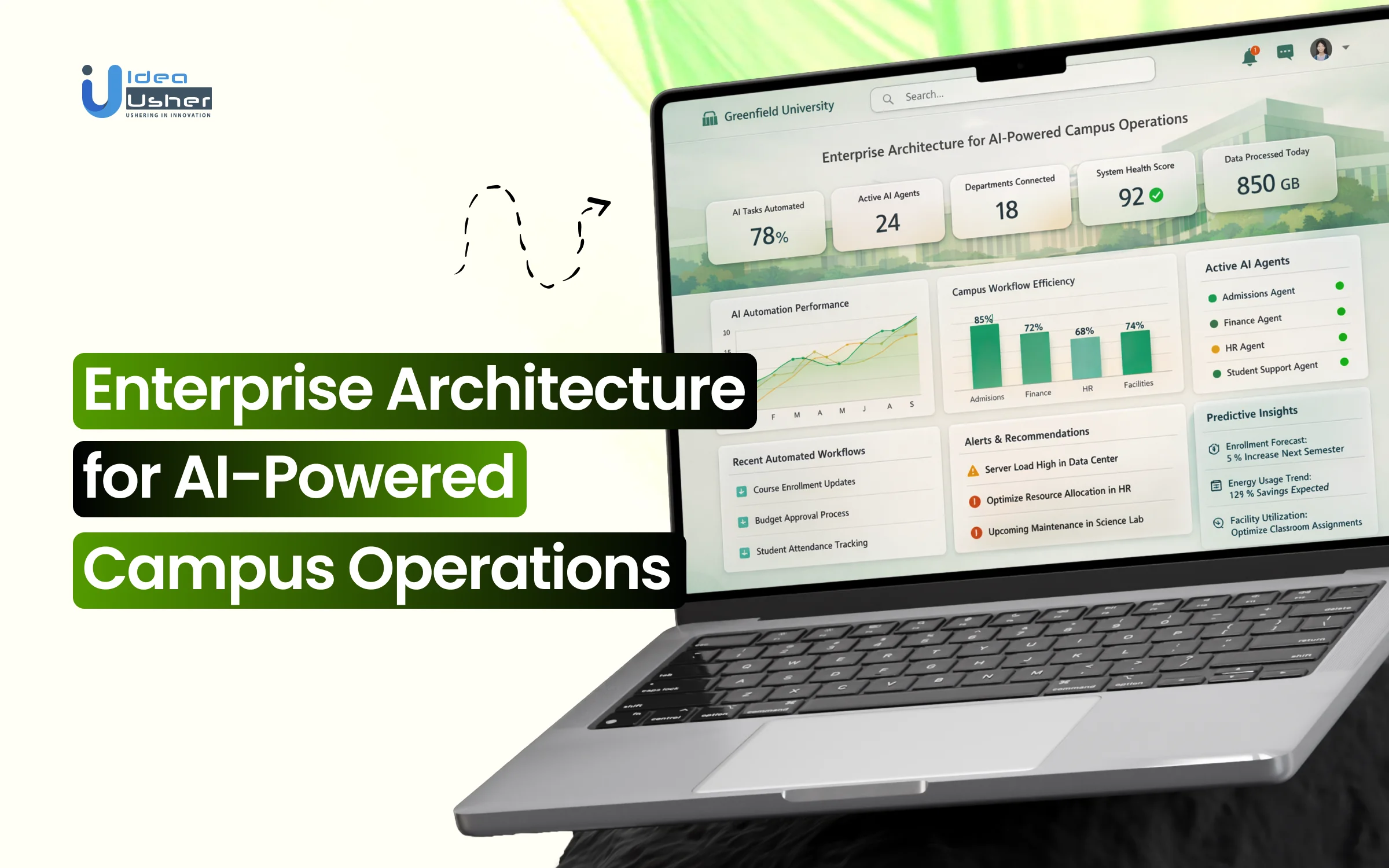
Modern campus operations cover academics, administration, facilities, security, and student services, supported by a mix of many digital systems. As universities adopt AI, the challenge becomes coordinating intelligence across the institution, not just deploying isolated tools. AI campus operations architecture addresses this by connecting data, workflows, and decision-making without fragmenting operations.
Architecturally, AI-powered campus systems must integrate with SIS, LMS, ERP, facilities, and identity platforms while maintaining data consistency and governance. Event-driven workflows, shared data layers, model orchestration, and access controls all influence whether AI improves coordination or adds complexity.
In this blog, we explore enterprise architecture for AI-powered campus operations by breaking down core architectural layers, integration patterns, and design considerations involved in building scalable, secure, and institution-ready AI systems for higher education.

What is an AI-Powered Campus Operations?
AI-Powered Campus Operations is the integration of artificial intelligence (AI) and machine learning (ML) into a campus’s administrative, academic, and facility management systems to automate routine tasks, enhance decision-making, and improve operational efficiency and service quality across the institution.
Unlike traditional management software, these AI systems analyze student records, financial logs, and scheduling data, streamline workflows, and support proactive planning to help educational institutions run more effectively and responsively.
- Unified Platform & Automation: AI connects systems like scheduling, student records, and library services, enabling seamless data sharing, automated workflows, and less admin work.
- Smart Administrative Services: AI automates routine admin tasks like scheduling, attendance, resolving timetable conflicts, and handling inquiries, reducing errors and freeing staff for higher-value work.
- Data-Driven Decisions: AI analyzes data to spot patterns and predict trends like retention risks or resource needs, enabling proactive planning and smarter resource use.
- Enhanced Student Support: AI offers 24/7 help via chatbots, personalized advising, and automated alerts, creating a more responsive student experience.
- Safety & Facility Management: AI powers real-time monitoring, threat detection, energy savings, and predictive maintenance for safer, more efficient campuses.
Why Traditional Campus IT Architectures Break Under AI Workloads?
AI success in campus operations is fundamentally an architecture problem, not a feature problem. Intelligence cannot be bolted onto fragmented legacy systems; institutions must rethink how data flows, integrates, and activates across the entire student lifecycle.
1. The Integration Fault Line
Campus systems like SIS, LMS, ERP, and CRM operate as isolated silos with incompatible data models. Without a unified data layer, AI lacks end-to-end visibility into the student journey, resulting in incomplete, unreliable intelligence.
2. When Rigid Rules Meet Dynamic Reality
Rule-based workflows rely on static if-then logic that breaks under real-world academic and financial complexity. Multi-stakeholder processes demand contextual judgment, but rigid systems create friction, delays, and poor experiences instead of adaptive resolution.
3. The Batch Processing Bottleneck
Legacy batch reporting introduces critical delays in identifying risks and opportunities. AI-driven interventions require continuous data streams, but nightly or monthly processing creates artificial latency, preventing timely action when students actually need support.
4. The Point Solution Paradox
Standalone AI tools solve isolated problems but introduce new silos. Each maintains separate data logic, limiting cross-functional visibility and preventing institutions from achieving unified operational intelligence across admissions, finance, advising, and academics.
5. The Security and Compliance Time Bomb
Legacy architectures lack granular access control and centralized governance required for AI. As integrations multiply, privacy risks increase, audit trails fragment, and compliance becomes harder to enforce, forcing institutions into a false trade-off between innovation and security.
Benefits of AI-Powered Campus Operation Platforms
AI campus operations architecture streamlines academic and administrative workflows through intelligent automation and analytics, helping universities improve efficiency, decision-making, resource utilization, and student experience at an institutional scale.

1. Faster Decision-Making
Event-driven intelligence replaces batch reports and manual coordination. Campus leaders and staff act on real-time signals, reducing delays in admissions, registration, facilities response, and student support.
Example:
Ellucian Banner SaaS uses embedded AI to provide real-time dashboards that allow administrators to adjust course offerings and faculty assignments instantly based on live enrollment spikes rather than waiting for end-of-week reports.
2. Reduced Operational Overhead
AI agents automate high-frequency, low-risk workflows across departments. This frees staff from repetitive coordination tasks while allowing institutions to scale operations without proportional staffing growth.
Real-World Example:
Camu Digital Campus automates the entire “Student Lifecycle Management,” from initial enquiry to graduation. Its AI engine handles routine document verification and transcript processing, allowing staff to manage double the student volume with the same headcount.
3. Proactive Student Experience
AI systems anticipate issues before they surface, resolving holds, delays, and service disruptions early. Students experience fewer blockers, clearer communication, and smoother academic and administrative journeys.
Real-World Example:
Mainstay (formerly AdmitHub) utilizes conversational AI to proactively nudge students through administrative hurdles. Georgia State University used this platform to reduce “summer melt” by 21.4% by answering over 200,000 student questions instantly via SMS.
4. Cross-Department Coordination
Unified orchestration eliminates siloed execution. Actions triggered in one department automatically cascade to others, ensuring consistent outcomes without emails, tickets, or duplicated effort.
Real-World Example:
Creatrix Campus offers a unified platform where a grade change in the LMS (Academic) automatically triggers an update in the Financial Aid module to reassess scholarship eligibility, ensuring the Bursar and Registrar are always in sync without manual data entry.
5. Compliance and Policy Consistency
Policy-as-code and centralized governance ensure academic, financial, and regulatory rules are applied uniformly. Continuous monitoring reduces compliance drift and simplifies audits. This minimizes manual interpretation errors and ensures consistent enforcement across departments, systems, and decision-making scenarios.
Real-World Example:
Academia ERP implements automated compliance checks for accreditation and government mandates (like FISL or GDPR). The platform flags any deviation in student record-keeping or financial reporting in real-time, ensuring the institution is always “audit-ready.”
Global Market Growth of AI-Powered Campus Operation Platforms
The global AI in education market size was estimated at USD 5.88 billion in 2024 and is projected to reach USD 32.27 billion by 2030, growing at a CAGR of 31.2% from 2025 to 2030. This rapid growth is driving institutions to invest in enterprise-grade AI campus operations architecture that can securely scale AI across campus operations, systems, and data ecosystems.

AI-enhanced security and emergency response systems are significantly improving campus safety, reducing average incident response times by 30–50% on some campuses.
At the same time, AI-powered predictive maintenance is optimizing facilities management by cutting downtime by 25% and lowering maintenance costs by up to 20%, enabling universities to operate more efficiently and proactively.
Campuses adopting AI for dining and retail operations have achieved major efficiency gains, reducing food waste by 30–50% through improved demand forecasting and inventory optimization. These systems help institutions align supply with real-time consumption patterns, minimizing excess and operational losses.
At the same time, AI-driven energy management systems have reduced campus energy consumption by 15–30%. Some institutions, such as Georgia Tech, have reported millions of dollars in annual savings by leveraging AI to optimize energy usage across buildings and infrastructure.
What “AI-Powered Campus Operations” Means at the Enterprise Level?
Enterprise AI campus operations architecture implements a secure, governed, event-driven intelligence layer that unifies departmental systems to predict needs, automate routine workflows, and deliver real-time decision support, shifting campuses from reactive operations to proactive, optimized ones.

1. The Core Capabilities
AI campus operations split interaction from execution. Generative AI manages user interfaces, whereas Operational AI handles orchestration, prediction, and automation across systems.
- Orchestration: AI functions as a systems integrator, coordinating API calls across facilities, finance, and academics to check room availability, budget, and conflicts simultaneously, instead of a staff member logging into multiple portals.
- Prediction: Machine Learning models forecast load, predicting dining hall foot traffic from class schedules and weather or identifying students needing academic support before midterms.
- Decision Automation: The system uses pre-defined parameters to make autonomous, low-risk, high-frequency decisions. For example, “if a classroom HVAC sensor fails, the AI automatically opens a work order and reroutes the class to an available room”, notifying students via the app without human intervention.
2. Cross-Department Intelligence
The AI campus operations architecture breaks down the data silos that plague higher education. It connects workflows that were previously separate.
- Admissions ↔ Housing: The AI predicts enrollment yields two weeks before the deposit deadline and triggers the Housing department to release dormitory blocks for freshmen, preventing room assignment bottlenecks.
- Finance ↔ Academics: The AI tracks student account holds and, when a student with a financial hold registers, it triggers an automated message offering a payment plan before registration is blocked, preventing the student from discovering the hold later.
- Facilities ↔ Student Affairs: The AI analyzes Wi-Fi and check-ins to predict crowd density and adjusts shuttle routes in real-time, efficiently moving students from the stadium to dorms instead of following a fixed schedule.
3. Human-in-the-Loop Intelligence
Enterprise AI cannot operate without governance. “AI-Powered” implies a partnership where the machine handles the scale and speed, and the human handles the nuance.
- Decision Support: The AI flags anomalies like a sudden 20% drop in energy usage in a science lab, presents data with a diagnosis (possible equipment failure) and recommendation (dispatch maintenance) to a facility manager, who then clicks “approve.”
- Escalation Protocols: The system recognizes its confidence levels. It acts automatically for routine tasks (like turning off lights) but pauses for high-stakes issues (like a threat detection alert from security cameras), bundling data to notify security personnel with response suggestions.
4. Event-Driven Architecture
Legacy campus operations are batch-processed (end-of-day reports). AI-native operations are event-driven.
The Shift: Instead of asking “How many students used the gym yesterday?” the system asks, “There are 200 students in the gym right now; air quality is dropping; increase HVAC airflow in Zone 4 immediately.”
Examples:
A. The Lost ID: A student reports a lost ID via the app. The AI instantly deactivates the old card for security and sends a digital temporary ID to their phone, while simultaneously notifying the card office to have a replacement ready for pickup.
B. The Broken Projector: A professor scans a QR code in a lecture hall. The AI checks the inventory in the media depot, dispatches a student worker, and automatically extends the class end-time in the scheduling system by 5 minutes to account for the swap-out.
The Outcome: AI Experiments vs. AI-Native Operations
This comparison highlights the shift from isolated AI experiments to fully AI-native operations, showing how universities move from reactive insights to automated, data-driven actions across enterprise systems.
| AI Experiments | AI-Native Operations |
| Scope: Departmental / Siloed | Scope: Cross-functional / Enterprise |
| Trigger: Manual (User asks a question) | Trigger: Event / Data Stream (System acts on data) |
| Function: Information Retrieval | Function: Orchestration & Automation |
| Output: Text / Summary | Output: Action / API Call / Workflow Trigger |
| Example: “ChatGPT, summarize the student handbook.” | Example: “The system predicts a student is at risk of failing; it schedules a tutoring session and unlocks grant funds automatically.” |
Core Design Principles for Campus AI Enterprise Architecture
Designing an AI campus operations architecture requires scale, governance, and cross-departmental complexity. These principles ensure that AI systems remain secure, adaptable, and operationally reliable as institutional demands evolve.
1. Domain-Driven, Not Monolithic
Campus operations span admissions, academics, finance, facilities, and student services. Designing AI around clear domain boundaries enables contextual intelligence while preventing tight coupling and systemic failure across departments.
2. Event-Driven, Not Request-Based
AI-powered campuses operate on real-time events rather than manual requests or batch jobs. Event-driven architecture enables immediate response, continuous prediction, and automated intervention across operational systems.
3. Central Intelligence Layer
AI should exist as a shared intelligence layer that orchestrates decisions and workflows across applications. Embedding AI inside individual tools limits reuse, governance, and cross-department visibility.
4. Human-in-the-Loop Governance
Enterprise AI must include confidence thresholds, approval flows, and escalation paths. This ensures sensitive academic, financial, and safety decisions remain explainable, auditable, and aligned with institutional accountability.
5. Privacy, Security & Compliance
AI access to student and institutional data must be governed at the architectural level. Role-based access, auditability, and policy enforcement must be native to the system, not added through post-integration controls.
AI-Powered Campus Operations Enterprise Architecture Stack
The AI campus operations architecture explains how campus operations are structured in production environments. Each layer is designed to operate independently while enabling real-time intelligence, orchestration, and governance across institutional systems.

1. Experience & Interaction Layer
Purpose: The interface where humans (students, faculty, staff, visitors) interact with the intelligence of the campus.
Omnichannel Interfaces: This is not just a single app. It includes mobile push, web portals, digital wayfinding kiosks, smart speakers in dorm rooms, and digital signage in hallways.
Proactive Push: Moving from “user asks” to “system informs.”
Example: A student’s mobile widget updates them that their laundry is done (IoT integration) and that the shuttle to their next class is delayed by 2 minutes (GPS/AVL integration).
Digital Twin Visualization: A 3D map of the campus showing real-time data (e.g., “Red” buildings are crowded, “Green” buildings have open study spaces).
2. AI Intelligence Layer
Purpose: The “brain” of AI campus operations architecture, where raw data is processed into insight. This layer is modular, allowing different AI models to be swapped in and out.
GenAI Services (LLMs): For natural language interaction, summarization (of policies), and code generation (for automation scripts). Uses RAG (Retrieval-Augmented Generation) to ground answers in institutional data.
Predictive ML (Machine Learning): Time-series forecasting and classification.
Models: Enrollment propensity, facilities maintenance failure prediction, dining consumption forecasting.
Computer Vision (CV): Anonymized analysis of video feeds.
Use Cases: Counting occupants for fire safety compliance, detecting spills in dining halls, and monitoring queue lengths at the bookstore.
3. Orchestration & Decision Layer
Purpose: The “nervous system” of the AI campus operations architecture. This layer determines if an action should be taken and how.
Workflow Engine: Manages the Human-in-the-Loop processes. If the AI recommends canceling a class due to low enrollment, this engine sends an alert to the Dean for approval before the action is taken.
Policy-as-Code: Translating institutional policies into machine-readable rules.
Example: “FERPA regulations” become code that redacts student PII before data is sent to a public LLM. “Facilities policy” dictates that room temperature can only be adjusted within a 68-74°F range.
Autonomous Agents: Small, task-specific AI programs.
Example: An agent dedicated to “Room Scheduling” that negotiates with the “Faculty Calendar” agent to find a time that works for everyone, then books it.
4. Data & Event Layer
Purpose: The “central nervous system.” The foundation that ingests, unifies, and contextualizes data.
Real-Time Event Bus: Tools like Apache Kafka or AWS Kinesis capture streams of events as they occur such as card taps, sensor triggers, or posted grades. This system enables the real-time responsiveness essential for event-driven operations.
Data Fabric / Lakehouse: A unified repository that breaks down silos. It holds structured data (grades, payroll) and unstructured data (maintenance logs, incident reports).
Semantic Layer: A metadata layer that defines the relationships between data points.
Example: It knows that User_ID: 12345(Student Record) is the same as Card_ID: ABC123 (Dining System) and MAC_Address: XX:XX (Wi-Fi). It maps the ontology of the campus.
5. Integration Layer
Purpose: The “connective tissue.” How the AI stack talks to the existing enterprise systems.
API Gateway: The secure front door for all service requests. Manages rate limiting, authentication, and routing.
ESB / iPaaS (Enterprise Service Bus / Integration Platform as a Service): The middleware that translates protocols between the modern AI stack and legacy on-premise systems (e.g., Mainframes, legacy SIS).
Connectors: Pre-built adapters for common enterprise software (Banner, Workday, Canvas, Ellucian, Blackboard).
6. Infrastructure & Security Layer
Purpose: The “foundation” of the AI campus operations architecture. It underpins everything and is non-negotiable for enterprise deployment.
Cloud / Hybrid Infrastructure: The compute power for training models and running inference. Often hybrid to keep sensitive student data on-prem while leveraging cloud GPUs for model training.
Identity & Access Management (IAM): Zero-trust architecture. Every API call, every data request, every model inference is authenticated and authorized.
Compliance & Governance: Embedded checks for FERPA (privacy), GDPR, WCAG (accessibility), and AI Ethics (bias monitoring). This includes audit logs showing why an AI made a specific recommendation.
How the Stack Works in Practice (A Scenario)
This scenario illustrates how an AI-powered campus technology stack operates in real time,
showing how connected systems, data streams, and automated workflows respond instantly to critical campus events.
Scenario: A fire alarm is triggered in a dorm at 2:00 AM.

- Layer 4 (Event Bus): The IoT sensor sends a “Smoke_Detected” event.
- Layer 2 (AI Vision): Cameras analyze the exit pathways, confirming no visible flames but detecting lingering students in a common area.
- Layer 3 (Orchestration): The Decision Engine cross-references the student roster with the real-time location data (via Wi-Fi).
- Policy-as-Code: “If students remain in a danger zone >2 mins, notify RAs.”
- Layer 5 (Integration): The system pings the mass notification system (Integration) and the Facilities work order system to unlock adjacent safe buildings for shelter.
- Layer 1 (Experience): Students receive a push notification: “Alarm in Building B. Proceed to Building A. Warm shelter is open. -RA Mike.”
What are the Operational Risks Without an Orchestration Layer?
Deploying AI campus operations architecture without an orchestration layer leaves insights disconnected from execution. Institutions face fragmented workflows, inconsistent decisions, and rising operational risk as automation scales without centralized coordination or governance.
1. Fragmented Execution
Without orchestration, AI insights remain isolated within individual systems, causing departments to act independently. This leads to duplicated efforts, conflicting actions, and broken cross-functional workflows, preventing institutions from achieving coordinated, enterprise-wide operational outcomes.
2. Decision Bottlenecks
AI generates recommendations, but without orchestration, humans must manually interpret, route, and execute actions. This reintroduces delays, increases staff workload, and negates AI’s value by turning automation into another layer of decision friction.
3. Policy and Compliance Gaps
Without a centralized orchestration layer, policies are applied differently across systems. This creates compliance gaps, inconsistent enforcement of academic or financial rules, and weak auditability, increasing regulatory risk and institutional exposure.
4. Context-Free Automation
AI models acting independently lack global context. Without orchestration, actions cannot be prioritized, sequenced, or deferred based on institutional impact, leading to suboptimal decisions, resource conflicts, and operational instability during peak periods.
5. Scalability and Complexity Issue
Point AI deployments without orchestration become increasingly brittle as systems scale. Each new model adds custom logic and integrations, increasing technical debt and making campus operations harder to adapt, govern, and optimize over time.
Conclusion
Enterprise architecture enables scalable, secure, and intelligent campus ecosystems. Well-designed AI campus operations architecture ensures seamless data flow, system interoperability, and reliable automation across academics and administration. Aligning AI with robust frameworks helps institutions improve efficiency, make better decisions, and drive innovation. As campuses evolve digitally, flexible architectures let institutions adapt to new technologies, handle more data, and deliver consistent, high-performance experiences campus-wide.
Build an AI-Powered Campus Operation Platform with IdeaUsher!
We have deep expertise in building enterprise AI architectures for large-scale institutions, including universities.
Our ex-FAANG and MAANG engineers bring 500,000+ hours of AI development experience, enabling us to design secure, scalable campus systems aligned with operational goals, compliance, and long-term digital transformation.
Why Partner with Us?
- University IT Architecture Expertise: We design AI-ready enterprise frameworks aligned with higher education governance and data standards.
- Scalable AI Infrastructure Design: Our solutions support real-time analytics, automation, and peak academic workloads without performance risk.
- Security and Compliance First: We architect systems with FERPA, GDPR, and institutional security requirements built in.
- Future-Proof Campus Systems: Our architectures are modular, interoperable, and built for long-term digital transformation.
Explore our portfolio to see how we deliver scalable, enterprise-grade AI solutions that solve real-world business challenges across industries.
Contact us for a free consultation and start building intelligent, AI-driven campus operations.


FAQs
A.1. The ideal architecture uses modular microservices, secure APIs, cloud infrastructure, and data pipelines that integrate SIS, LMS, ERP, and IoT systems, enabling scalable AI automation, real-time analytics, compliance, and seamless cross-campus operations.
A.2. Universities ensure security by implementing role-based access, encryption, audit logging, data residency controls, and compliance aligned with FERPA and GDPR, while using a zero-trust architecture to protect sensitive academic, student, and research data.
A.3. AI systems should integrate through standardized APIs and middleware that connect LMS, SIS, CRM, and finance platforms, allowing real-time data exchange without disrupting legacy systems or requiring large-scale infrastructure replacement.
A.4. Scalability requires cloud native deployment, containerization, autoscaling compute resources, and flexible data storage so AI workloads can expand during peak academic periods without performance degradation or high operational costs.


