


Universities no longer operate on fixed office hours, and student queries can arrive at any moment, while administrative teams may respond quickly, yet the volume keeps increasing each semester. The strain is not dramatic but repetitive, and over time, it can quietly reduce operational efficiency. That is why many universities have started using AI administrative agents, because enrollment cycles are continuous, hybrid programs require tighter coordination, and global applicants expect real-time responses across time zones.
These systems can intelligently process routine requests, trigger workflow approvals, and operate continuously without fatigue. Adoption has grown steadily as institutions recognized that automation can realistically stabilize operations while preserving staff focus for higher-value decisions.
We’ve developed AI-driven university workflow automation solutions, powered by agentic AI orchestration frameworks and academic data integration architectures. As IdeaUsher has this expertise, we’re sharing this blog to discuss the steps to build an AI administrative agent for a university.
Key Market Takeaways for AI Administrative Agents
According to Grand View Research, the global AI agents market is entering a high-growth phase, rising from USD 7.63 billion in 2025 to an expected USD 182.97 billion by 2033, with a projected CAGR of 49.6 percent. Universities are facing higher enrollment volumes, tighter budgets, and increasing student expectations, creating strong demand for intelligent digital infrastructure.
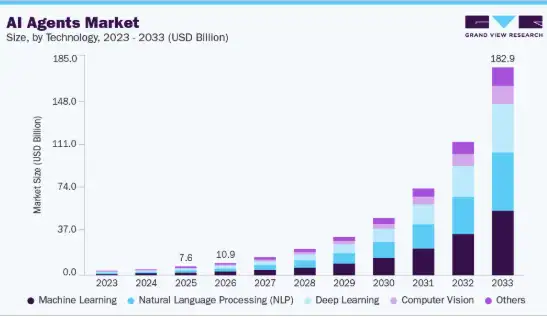
Source: Grand View Research
AI administrative agents are increasingly being deployed to streamline admissions, manage student queries, automate workflow routing, and support internal coordination across departments.
By reducing manual intervention and repetitive processing, institutions can achieve operational improvements of up to 40 percent in processing speed while significantly lowering human error rates.
Recent university initiatives demonstrate how quickly this transformation is unfolding. Arizona State University partnered with Grammarly to introduce Superhuman Go, an agentic AI system designed to integrate fragmented data and deliver contextual academic and administrative support.
In parallel, the University of Michigan Ross School of Business launched a Virtual Teaching Assistant powered by Google Gemini, providing continuous problem-solving guidance and real-time engagement insights while preserving academic integrity.
What are AI Administrative Agents for Universities?
AI administrative agents for universities are role-specific intelligent systems that automate operational tasks across advising, enrollment, finance, and advancement. They continuously analyze institutional data, execute workflows, and generate context-aware actions such as outreach drafts or risk alerts.
Instead of acting like simple chatbots, they function as digital staff members that can proactively support decision-making and reduce manual workload.
Types of AI Administrative Agents Used in Universities
Universities typically use several types of AI administrative agents that handle different levels of operations. Some may answer policy queries, others can securely process records and execute workflows, while advanced agents proactively monitor data and predict risks.
1. The FAQ Chatbot
Best for: IT Helpdesk, Library Services, Basic Admissions Questions
This is the entry-level AI agent, the digital equivalent of a friendly receptionist who has memorized the campus directory and all the basic policies.
How It Works: The FAQ chatbot is trained on a static knowledge base, such as the course catalog, the academic calendar, IT service pages, and common admissions questions. When a student asks, “What’s the deadline for housing applications?” the chatbot scans its database and returns the relevant answer, often with a link.
Key Characteristics:
- Reactive: It waits for the user to initiate contact
- Single-turn: Handles one question at a time without deep context
- Read-only: Provides information but cannot take action
- Static knowledge: Requires manual updates when policies change
2. The Task-Oriented Agent
Best for: Registrar’s Office, Bursar’s Office, Financial Aid
This agent represents a significant leap forward. It does not just answer questions, it takes action. Think of it as a virtual clerk who can process forms, update records, and complete transactions.
How It Works: The task-oriented agent is integrated with core university systems such as the Student Information System (SIS) and Learning Management System (LMS). It uses intent recognition to understand what the user wants to accomplish, then executes the necessary functions through secure API calls.
Key Characteristics:
- Action-oriented: Can read from and write to university databases
- Multi-step: Handles workflows that require several sequential actions
- Transactional: Completes tasks that previously required human intervention
- Integrated: Connected to SIS, LMS, CRM, and other core systems
3. The Proactive Agent
Best for: Student Success Programs, Advising, Retention Initiatives
This is where AI becomes truly transformative. A proactive agent does not wait for students to come with questions, it reaches out first when it detects potential issues.
How It Works: The proactive agent continuously monitors university data streams, looking for patterns and anomalies that might indicate a student needs support. When it identifies a trigger, it initiates a conversation.
Key Characteristics:
- Initiating: Starts conversations based on data rather than user queries
- Predictive: Uses rules and patterns to identify at-risk situations
- Personalized: Tailors outreach to the individual student’s context
- Supportive: Focuses on student success and retention
4. The Orchestrator Agent
Best for: Complex Student Journeys, Transfer Students, Graduation Clearance
University bureaucracy is notoriously siloed. The financial aid office does not talk to the registrar’s office, and academic advising often operates separately as well. Students become the unwilling messengers moving between departments. The orchestrator agent breaks down these silos.
How It Works: This sophisticated agent coordinates workflows that span multiple departments and systems. It acts as a central nervous system, ensuring that information flows seamlessly and that students never have to repeat themselves.
Key Characteristics:
- Cross-functional: Operates across departmental boundaries
- Stateful: Maintains context across long multi-step processes
- Hand-off capable: Knows when to escalate to human experts
- Journey-oriented: Focuses on complete student lifecycle events
5. The Predictive Agent
Best for: Enrollment Management, Institutional Research, Strategic Planning
This is the most advanced type of AI agent, one that does not just react or act, but anticipates. It identifies trends, predicts outcomes, and recommends interventions before problems materialize.
How It Works: The predictive agent combines real-time data from across the institution with historical patterns and machine learning models. It does not just answer individual student queries; it provides institutional intelligence.
Key Characteristics:
- Analytical: Identifies patterns across thousands of student journeys
- Forecasting: Predicts future outcomes based on current trajectories
- Recommendation engine: Suggests interventions at both student and institutional levels
- Strategic: Informs leadership decisions with data-driven insights
How Do AI Administrative Agents for Universities Work?
AI administrative agents understand student requests through natural language processing and securely retrieve relevant data from university systems. They evaluate rules and eligibility in real time before deciding on the appropriate action. Once approved, they automatically apply system updates and provide a clear confirmation.
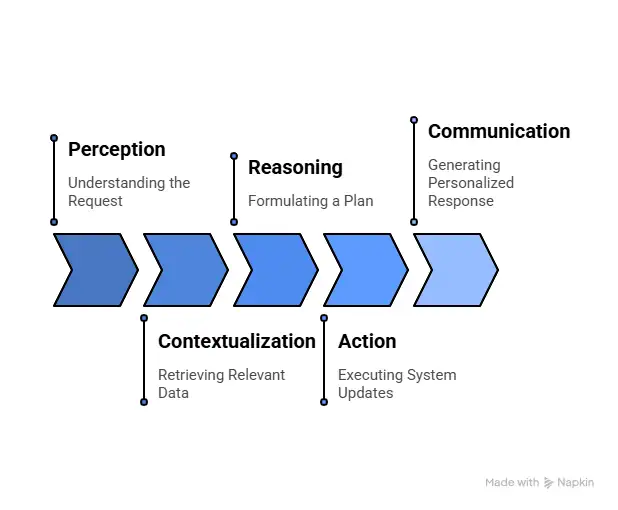
1. Perception (Understanding the Request)
The student types: “I want to switch from Biology to Computer Science.”
The agent’s first job is to understand what is being asked. This is not simple keyword matching. The agent uses Natural Language Understanding (NLU) to parse the sentence’s intent and extract key pieces of information.
Intent Recognition: The agent identifies the core goal. Here, the intent is “Change Major” or “Update Academic Program.”
Entity Extraction: The agent pulls out the specific details.
- Current Value: “Biology”
- Desired Value: “Computer Science”
- User: (Identified via the logged-in session as Student ID #12345)
At this point, the agent knows what the student wants to do. But it does not yet know if they can do it. That requires context.
2. Contextualization
Now the agent needs to apply the university’s specific rules to this student’s unique situation. It cannot rely on general knowledge. It needs to consult the official sources of truth.
This is where Retrieval-Augmented Generation or RAG comes into play.
Think of RAG as giving the AI an open-book exam. Before it answers, it quickly flips through the approved textbooks to find the relevant information. In this case, the “textbooks” are your university’s secure data sources.
The agent instantly performs a simultaneous search across multiple systems:
The Student Information System (SIS): It checks this student’s record. Are they in good academic standing? Do they have any holds (like an unpaid library fine) that would prevent a major change?
The Course Catalog (Vector Database): It looks up the requirements for Computer Science. Is the school at capacity? Are there prerequisites the student has not taken?
The Academic Calendar: It verifies that the date is still within the official “change of major” window for the semester.
All this information is retrieved in milliseconds and bundled together as “context.”
3. Reasoning (Orchestration & Planning)
Now the agent has the student’s request and the relevant context from university systems. It is time to formulate a plan.
The agent’s “brain” , the Large Language Model (LLM) takes all this information and reasons through it.
- Scenario A (Eligible): “The student is in good standing, has no holds, the CS major is open, and the deadline has not passed. The plan is to proceed with the change.”
- Scenario B (Not Eligible – Hold): “The student has a library hold. The plan is to inform them of the hold and provide a direct link to resolve it with the library.”
- Scenario C (Not Eligible – Prerequisites): “The student has not completed Intro to Programming. The plan is to explain the prerequisites and offer to connect them with an advisor to discuss a pathway.”
This step is critical. The agent is not just retrieving an answer from a FAQ. It is synthesizing information from multiple sources to make a decision, just as a human advisor would.
4. Action (Function Calling)
This is where the agent transcends the capabilities of a simple chatbot. It does not just tell the student what to do. It does it.
To take action, the agent uses a mechanism called Function Calling. It has a set of predefined “tools” or “skills,” essentially secure API calls that it is authorized to use.
For our eligible student, the agent’s internal plan might look like this:
- Call Function A: check_holds(student_id) –> Result: None.
- Call Function B: check_major_eligibility(student_id, “CS”) –> Result: Eligible.
- Call Function C: update_student_major(student_id, “CS”) -> This function sends a secure command to the SIS to update the record.
- Call Function D: log_action(student_id, action=”major_change”, details=”from Bio to CS”) –> This creates an immutable audit trail for compliance.
The agent executes these functions in the background, directly interacting with the core systems of the university. It has just completed a task that would have required a student to fill out a form, wait for processing, and possibly visit an office in person.
5. Communication (Response Generation)
Finally, the agent communicates back to the student.
“Hi Alex, I’ve successfully updated your major to Computer Science. I’ve also checked the requirements, and you’re all set. Your new academic advisor for the CS department is Dr. Chen. Would you like me to send you a link to schedule an introductory meeting with her?”
This response is:
- Personalized: It uses the student’s name.
- Confirmational: It states the action that was taken.
- Proactive: It offers the next logical step, meeting the new advisor.
The entire cycle from perception to action to response happens in just a few seconds.
How to Build an AI Administrative Agent for Universities?
An AI administrative agent for universities should start with a secure FERPA-aligned data layer connected to SIS systems. It must use retrieval-based generation to answer queries based on live policies and may execute structured API calls for real administrative tasks.
We have delivered AI-powered administrative agents across universities, and this is the framework we follow.
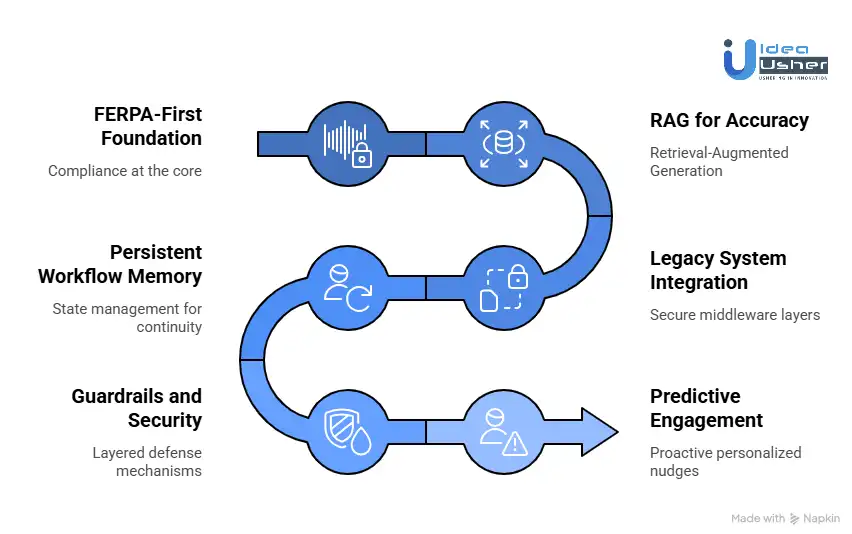
1. FERPA-First Foundation
We begin with compliance at the core. We design privacy-by-design architectures that include PII masking, tokenization, encrypted storage, and strict role-based access controls. Depending on institutional policy, we deploy local inference or secure VPC-based LLM environments. Every agent action is audit logged to meet FERPA and governance requirements.
2. RAG for Accuracy
University policies change frequently, so we implement Retrieval-Augmented Generation instead of relying on static model training. We index course catalogs, student handbooks, and financial aid documents into a vector database. During each query, the system retrieves live contextual data and generates grounded, cited responses.
3. Legacy System Integration
Most universities operate on legacy Student Information Systems. We build secure middleware layers that connect LLM outputs to structured API toolsets such as eligibility checks and registration updates. Workflow orchestration engines manage multi-step administrative processes.
4. Persistent Workflow Memory
Academic processes often span weeks. We implement persistent state management that stores conversation metadata, tracks workflow checkpoints, and maintains lifecycle memory threads. This allows session resumption and continuity across long administrative journeys.
5. Guardrails and Security
Public-facing portals require layered defense mechanisms. We deploy secondary guardrail models, detect attempts to inject prompts, and restrict unauthorized API calls. Critical actions pass through confidence scoring and policy validation layers.
6. Predictive Engagement
We design agents that go beyond reactive responses. By integrating predictive analytics, we monitor LMS activity, incomplete registrations, and missing documentation signals. When risk patterns appear, the system triggers personalized nudges via SMS, email, or portal notifications.
Can University Administrators Override AI Decisions in Real-Time?
University administrators have multiple ways to intercept, modify, or override AI decisions. These controls operate at different levels, from individual interactions to system-wide policies.
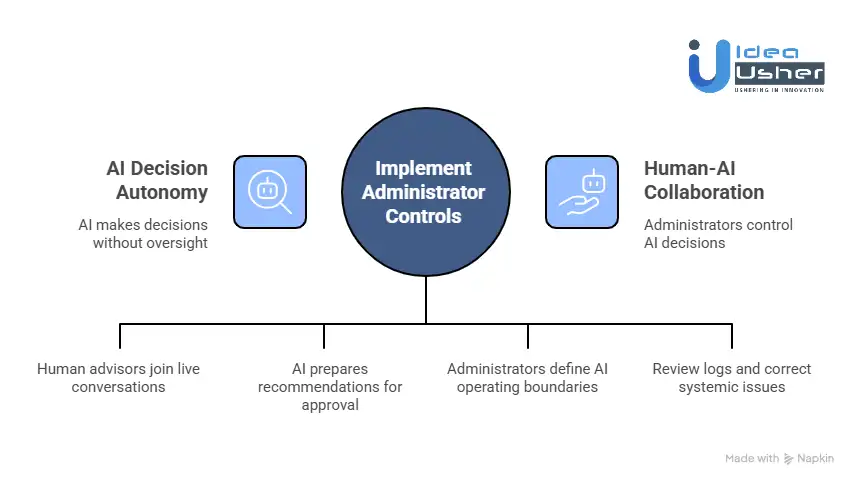
1. Real-Time Conversation Takeover
Imagine a student is interacting with the AI agent about a complex financial aid appeal. The conversation is going well until the student reveals a personal circumstance, a family emergency, or a health crisis that requires human sensitivity.
Take, for example, the University of Tasmania’s implementation with IBM WatsonX. When they developed their AI CourseMate prototype, they built explicit escalation pathways into the system. The agent is designed to recognize when a query falls outside its scope or requires human judgment, and it seamlessly routes the conversation, along with complete context, to a human advisor.
The administrator dashboard displays this live conversation with a clear indicator that the AI has detected potential distress and is recommending human escalation. With a single click, an advisor can:
- Join the conversation: The student is seamlessly transferred from AI to human, with the full conversation history visible so the student does not have to repeat themselves.
- Monitor silently: Observe the AI’s responses in real time without interrupting, ready to step in if needed.
- Take control immediately: Interrupt an AI response that is heading in the wrong direction and provide a corrected answer.
This is not theoretical. Modern AI agent platforms include live conversation monitoring dashboards where staff can see ongoing interactions, receive alerts about conversations that need attention, and intervelive-conversation monitoring dashboards that let staffne instantly.
2. Decision Approval Workflows
For high-stakes actions, the AI does not make any decision. It prepares recommendations for human approval.
Consider a request to retroactively withdraw from a course due to medical circumstances. This is not a routine transaction. It requires reviewing documentation, applying institutional policy, and often making a judgment call about what is fair and compassionate.
Take, for example, the University of Chicago’s PhoenixAI platform. Built on Microsoft Azure in partnership with Royal Cyber, this system was designed specifically to address security and governance concerns. The entire architecture was deployed within UChicago’s Azure tenant, ensuring that the university retained ownership of its data, infrastructure, and access policies.
In this scenario, the AI agent:
- Gathers information: Collects the student’s request, any uploaded documentation, and relevant policy details.
- Prepares a recommendation: Based on similar cases and policy analysis, suggests an outcome.
- Routes for approval: Places the complete case file in an administrator’s queue for review.
- Notifies upon completion: The student receives the final decision only after human approval.
The administrator retains full authority over final decisions. The AI simply streamlines the preparation work that would otherwise consume hours of staff time.
3. Policy-Based Guardrails & Data Sovereignty
Many overrides happen automatically through configurable policies. Administrators define the boundaries within which the AI can operate autonomously, and the system enforces these boundaries without requiring real-time intervention.
Take, for example, UC San Diego’s TritonGPT, which is securely housed at the San Diego Supercomputer Center, ensuring the university maintains full control over data usage and sharing. This on-site hosting means institutional data privacy policies are enforced at the infrastructure level, not just through soft guidelines.
Examples of policy-based controls:
- Monetary limits: The AI can authorize textbook vouchers up to $500; amounts above require human approval.
- Action restrictions: The AI can add students to waitlists but cannot override course capacity limits.
- Timing constraints: During the first week of registration, the AI can process all adds and drops; after the deadline, all changes route to an advisor.
- Student population rules: Graduate student record changes require advisor approval; undergraduate changes within guidelines can be automated.
These policies are set by administrators through intuitive dashboards and can be updated at any time. If a new policy takes effect tomorrow, the AI respects it immediately.
4. Audit and Retroactive Override
Sometimes the need for intervention is not immediate. An administrator reviewing weekly reports might notice an unusual pattern, perhaps the AI has been consistently misinterpreting a particular policy or providing incomplete information about a new program.
Modern AI platforms provide:
- Complete audit logs: Every interaction, every decision, every action is timestamped and attributed.
- Conversation replay: Administrators can review exactly what the student asked and how the AI responded.
- Bulk correction capabilities: If a systemic issue is identified, administrators can identify all affected students and trigger appropriate follow-up communications.
This retroactive oversight ensures that even if something slips through, it can be identified and corrected quickly.
How Does the AI Ensure Consistency in Communication Across Departments?
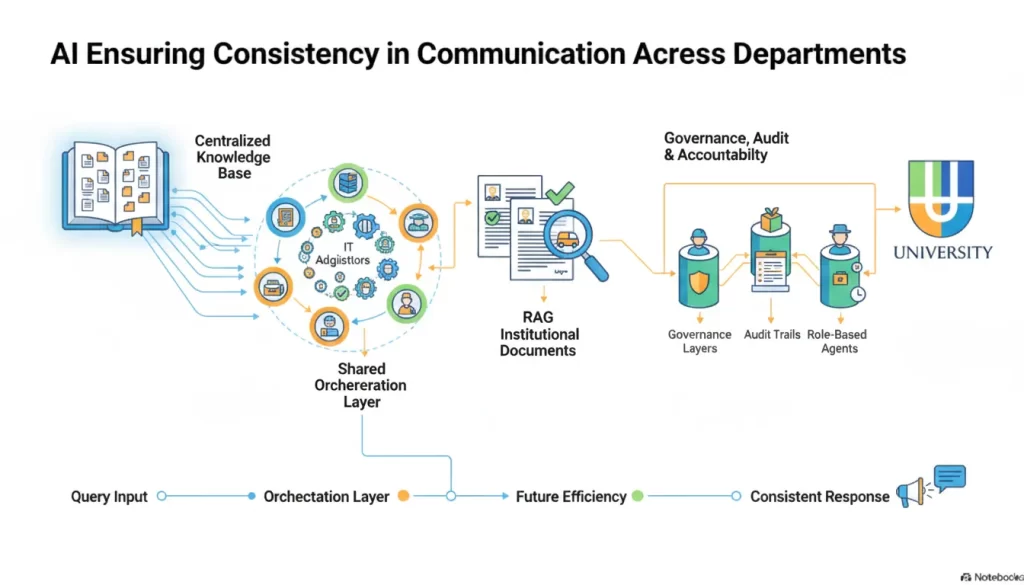
The platform maintains consistent communication by grounding every response in a centralized knowledge base that continuously syncs with institutional policies. It should route queries through a shared orchestration layer so each department responds using the same standards.
Governance rules can automatically validate outputs to ensure technically accurate and reliably aligned communication.
The “Absolute Truth Library” Approach
The concept of an “Absolute Truth Library” explains why consistency matters. Departments often conflict because they rely on different information sources. A centralized knowledge repository stores all institutional rules and policies in a structured and retrievable format.
With Retrieval-Augmented Generation RAG, the platform indexes documents like the course catalog and financial aid handbook. When a student asks a question, the agent retrieves verified passages instead of guessing. This keeps responses aligned with official records.
Institut Teknologi Sepuluh Nopember ITS applied this model in their SAKAI chatbot on WhatsApp. The system pulls answers from a centralized base and responds in under five seconds. Students receive consistent information at any time of day.
How RAG Prevents “Drift”
Without RAG, AI models can drift, generating different answers to the same question over time or across contexts. With RAG, every answer is grounded in the same source documents. The AI might phrase things differently, but the factual content remains consistent because it is always drawing from the same well of truth.
The Multi-Agent Orchestration Layer
A single AI trying to handle every possible question across every department would quickly become unwieldy. The solution is a multi-agent architecture in which specialized agents handle specific domains and coordinate through a central orchestration layer.
Role-Based Agents Working in Harmony
Consider the multi-agent framework described in HPE’s analysis of complex project management. Instead of one AI doing everything, multiple AI agents each take on defined roles. A Finance Agent tracks budgets and financial aid. A Resource Agent monitors course availability and advising capacity. A Communication Agent tailors updates for different audiences.
These agents work together like a coordinated team, sharing insights and ensuring no student falls through the cracks.
For a university context, this might look like:
- An Admissions Agent focused on application requirements, deadlines, and status checks
- A Financial Aid Agent handling FAFSA questions, scholarship applications, and billing inquiries
- A Registrar’s Agent managing course registration, transcript requests, and degree audits
- An IT Support Agent resolving password resets, Wi-Fi connectivity issues, and software access
Each agent is an expert in its domain. They share a common communication layer and escalation protocol. A student who starts with a financial aid question that reveals a registration hold gets seamlessly transitioned without having to repeat themselves.
The Orchestrator: Keeping Everyone Aligned
The key to consistency is the orchestrator component, the central brain that routes requests to the right specialized agent and ensures responses maintain a consistent tone, format, and quality standard.
The SMARTA project in Germany has implemented exactly this kind of architecture. Their framework includes an operation control component that orchestrates the entire system. It ensures high-quality data retrieval, enforces compliance through guardians, and refines response processing. The result is what they call “trust-driven AI.” These systems are not just intelligent but consistently reliable.
The Consistency Enforcement Mechanisms
Technology alone is not enough. To maintain consistency across thousands of interactions, AI platforms need built-in governance mechanisms that enforce institutional standards.
Centralized Policy Control
Take, for example, Kindo’s admin portal, which positions governance as an execution layer that every AI action must pass through. Before any tool invocation or model call executes, the governance layer checks whether the requesting identity has the required permissions. It verifies whether the action complies with institutional policy.
It also determines whether any sensitive data needs protection. Policies are defined once in the admin portal and enforced everywhere, across all agents, departments, and interactions.
This means:
- A financial aid policy updated today is reflected in every response by tomorrow
- Terminology preferences, such as whether your university says “course” or “class,” are applied consistently
- Compliance requirements such as FERPA-mandated privacy protections are enforced automatically
The Critical Content Guard
One of the most innovative components in modern AI architectures is the Critical Content Guard CCG. This guardian component filters and mitigates biased or inappropriate AI outputs before they reach students. It ensures every response meets institutional standards for accuracy, inclusivity, and professionalism.
The University of Oxford’s AI guidelines emphasize exactly this kind of oversight. Their principles state: “All AI-assisted outputs must undergo a human review for factual accuracy, appropriate tone, and ethical integrity before public release.”
The university explicitly notes that output from generative AI is “susceptible to bias, mistakes, and misinformation” and must always be checked and edited appropriately.
Audit Trails and Accountability
Consistency also requires accountability. When something goes wrong, when a student receives incorrect information, or an AI response misses the mark, institutions need to understand why.
Kindo’s platform provides complete auditability for every AI action. Every prompt, response, tool call, and model interaction is logged in structured JSON format, exportable for compliance review or incident investigation. If a question arises about what information was provided to a student three months ago, the answer is immediately available.
Top 5 AI Administrative Agent Platforms for Universities
We have done focused research and found several AI Administrative Agent Platforms for Universities that offer distinct architectural strengths and automation capabilities. As you explore these options, you may notice how they can intelligently integrate with SIS and CRM systems while reliably handling high-volume workflows.
1. Druid AI
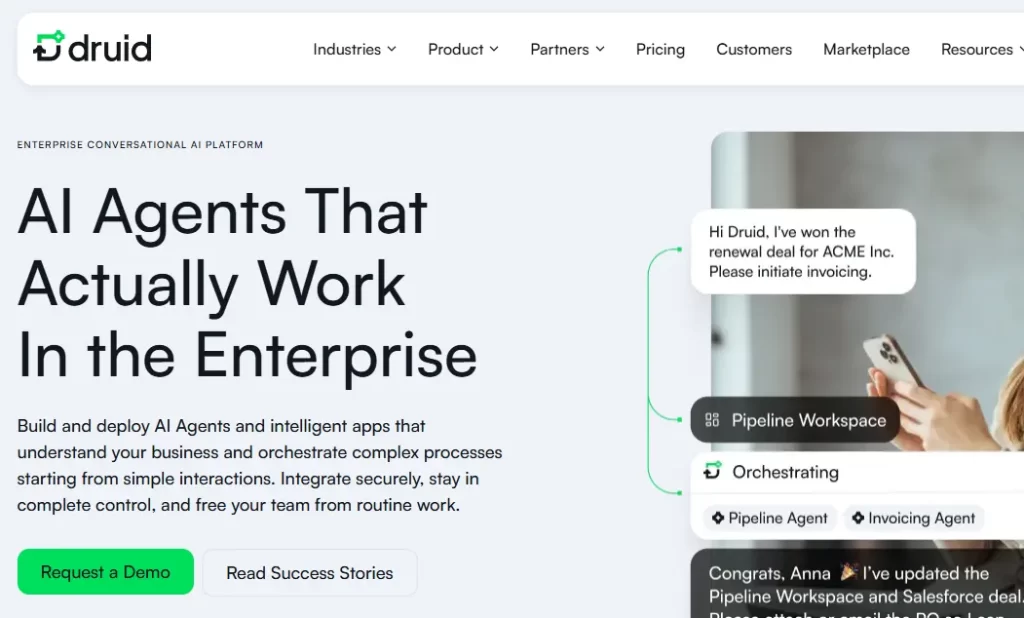
A comprehensive agentic AI platform that enables universities to deploy AI agents for admissions, student services, scheduling, billing, and faculty productivity. It offers pre-built templates and workflow automation that orchestrate tasks across departments, improving operational efficiency and response time.
2. Supervity AI
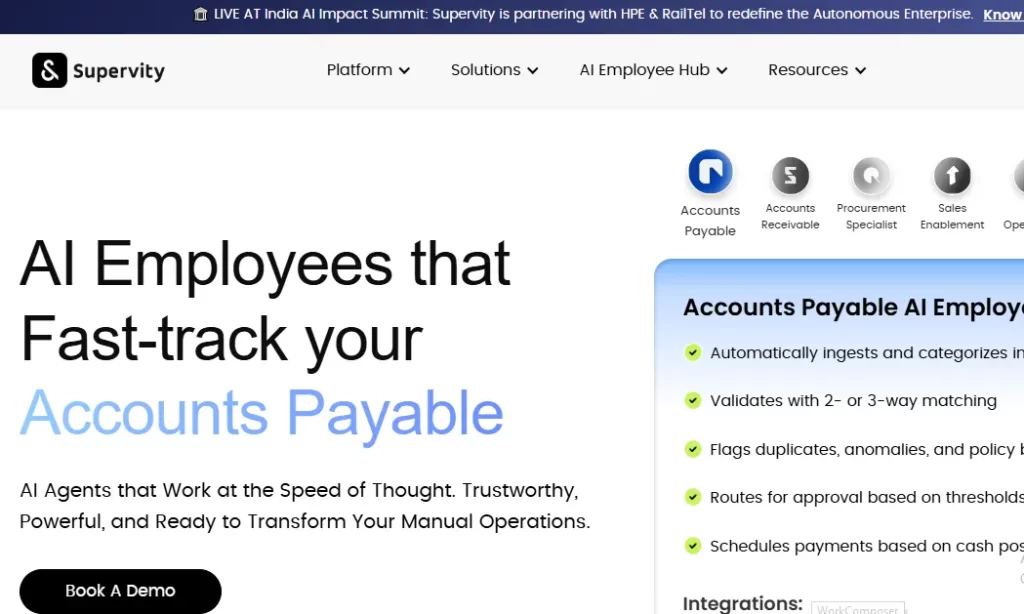
An enterprise AI agent platform built for intelligent automation. It supports student query handling, admissions processing, HR workflows, finance tasks, and reporting automation. Universities use it to manage 24/7 support while tracking performance analytics and operational ROI.
3. Element451
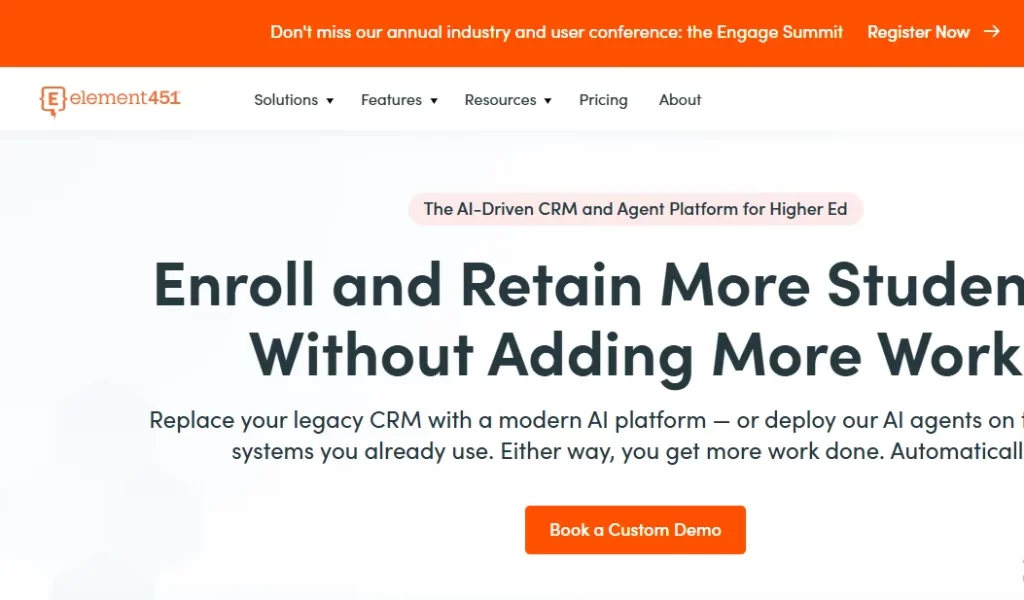
Focused on enrollment management and student engagement, this platform integrates AI to automate communication across the admissions lifecycle. It personalizes outreach, manages follow-ups, and improves conversion rates while reducing administrative workload.
4. Liaison Edu
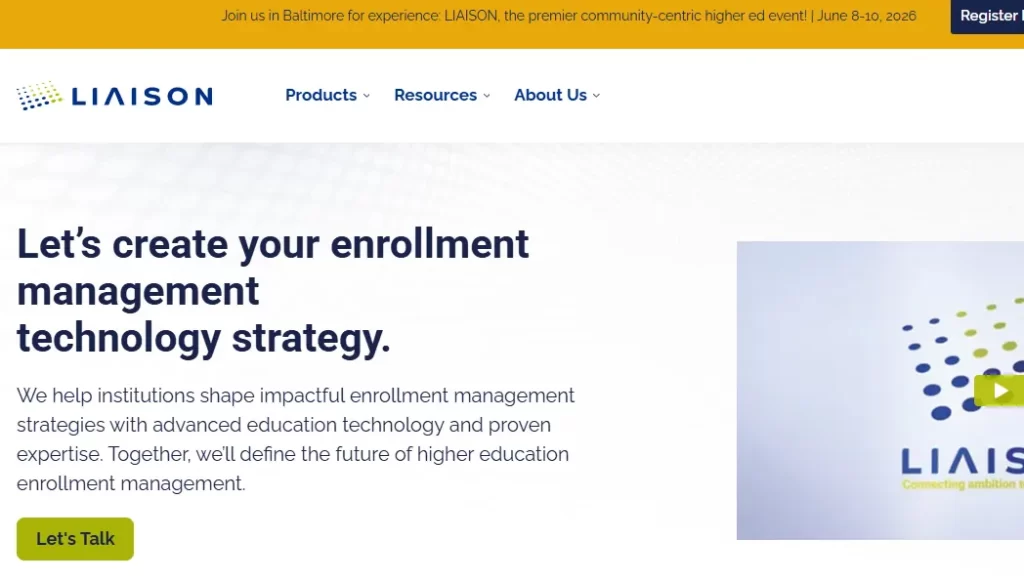
Offers AI-driven tools to streamline application processing and communication with applicants. It helps admissions teams automate document workflows, manage prospective student pipelines, and deliver structured advising support using data insights.
5. LearnWise AI
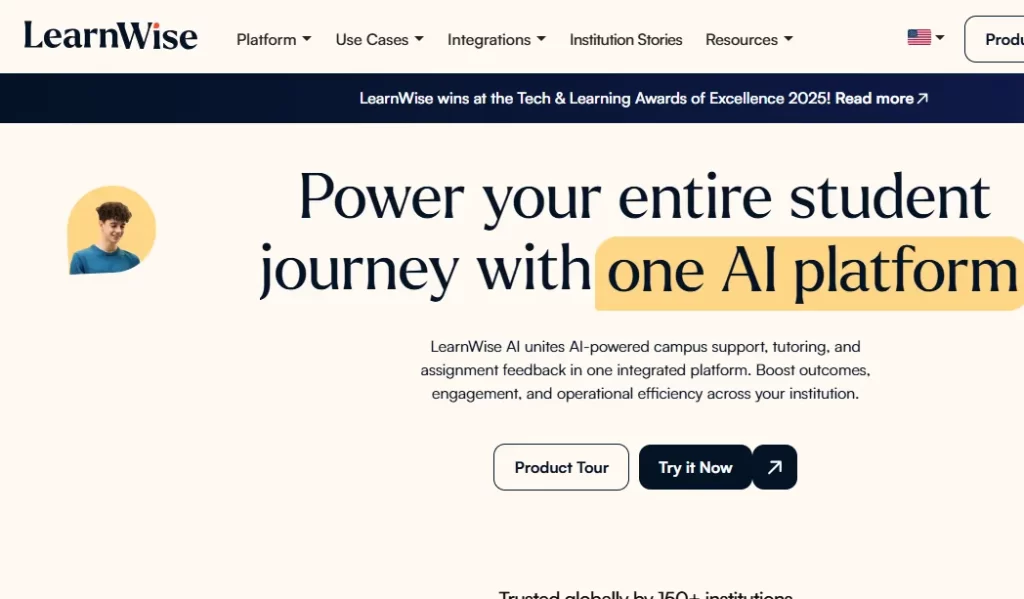
This AI assistant platform can unify enrollment support and financial aid queries with structured academic guidance into a single intelligent system. It may proactively nudge students based on real-time data signals and can continuously track interaction patterns through analytics dashboards
Conclusion
Building an AI administrative agent for universities goes far beyond adding a chatbot, as it must include a secure architecture, deep integration with campus systems, persistent memory management, and strict compliance controls. For enterprise owners and EdTech platform builders, this could become a high-impact solution that improves operational efficiency and modernizes student services at scale. Institutions that invest early in intelligent administrative agents will likely streamline workflows and steadily reshape digital support infrastructure for the next decade.
Looking to Develop an AI Administrative Agent for Universities?
IdeaUsher can architect an AI administrative agent that securely integrates with university SIS and CRM systems while maintaining policy-aware memory and workflow automation.
Our team implements retrieval pipelines and compliance controls so the platform can reliably execute tasks and scale across campus operations.
- 500,000+ hours of proven coding experience
- Ex-MAANG/FAANG developers building your solution
- Proactive agents that don’t just answer, they act
- Seamless SIS/LMS/CRM integration
- Multi-modal support—text, voice, and document uploads
Check out our latest projects to see the kind of work we can deliver for your university.


FAQs
A1: An AI administrative agent is fundamentally different from a university chatbot because it does not just respond to queries but can execute actions inside legacy systems and maintain persistent lifecycle memory across interactions. It could update records, trigger workflows, and coordinate across platforms while operating under strict compliance controls, whereas a chatbot mainly delivers predefined or retrieval-based answers.
A2: To stay aligned with changing university policies, the agent can use Retrieval Augmented Generation to pull live content from indexed institutional databases instead of relying only on static model training. This approach ensures responses are grounded in current documents and policies, thereby significantly reducing misinformation and policy drift.
A3: LLMs can be safely deployed in higher education when implemented with strong PII masking, encrypted data pipelines, local inference layers, and strict role-based access control aligned with FERPA standards. With proper governance and audit logging, the system can securely handle sensitive student data in production environments.
A4: Universities can measure ROI by tracking reductions in response latency and support ticket volumes, along with improvements in enrollment yield and reduced summer melt. Over time administrative cost savings and workflow automation metrics could clearly demonstrate operational efficiency gains.