


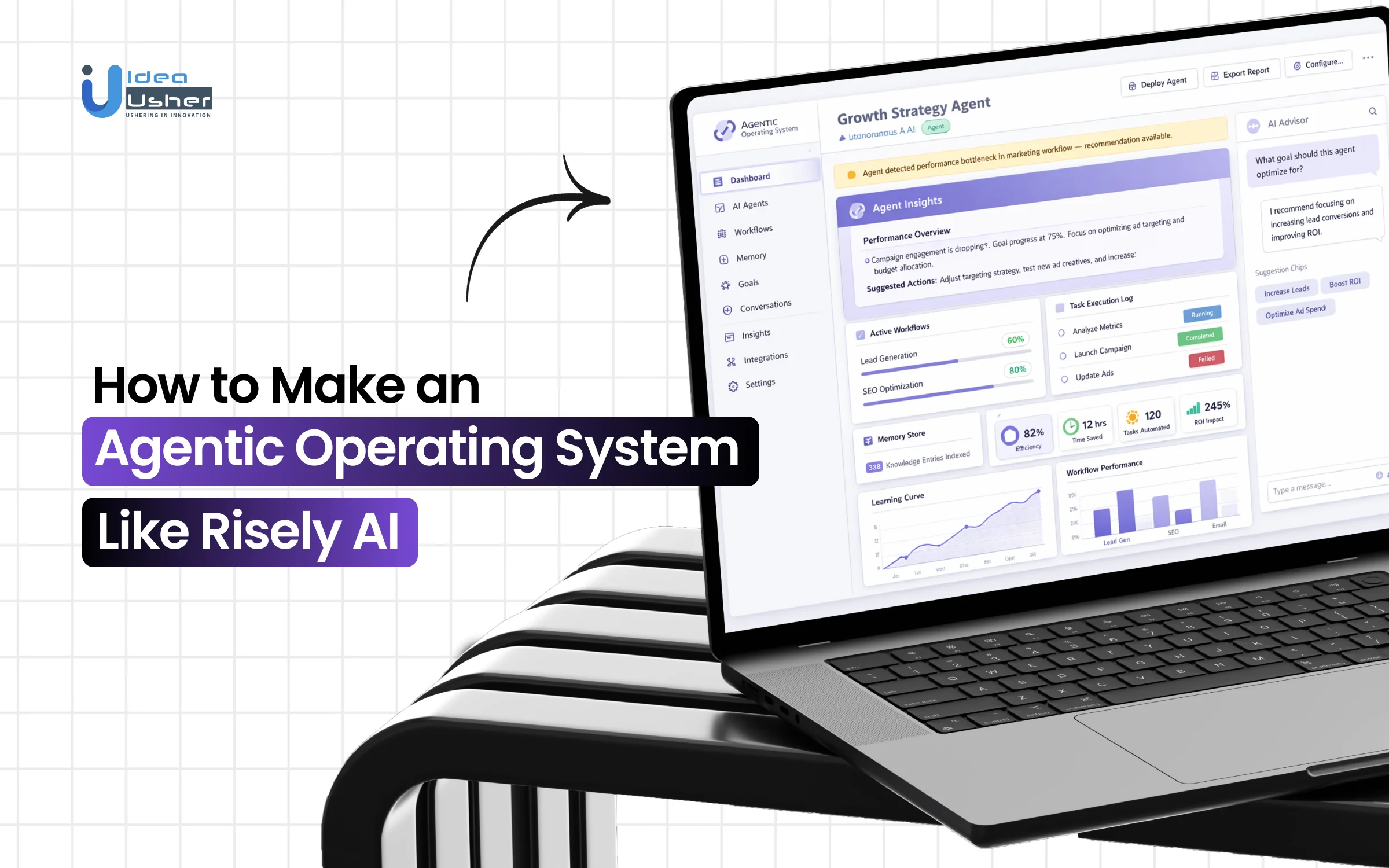
For years, universities invested in automation, and you could see automated emails grading reports and reminders everywhere, yet most systems still waited for someone to trigger them. Over time, leaders realized that efficiency alone would not solve deeper coordination gaps. They needed systems that could continuously observe academic data and intelligently interpret context.
The popularity of agentic operating systems has increased among universities because these systems can proactively detect academic risk patterns and flag compliance gaps early. They can also dynamically coordinate faculty workflows without manual escalation. As campuses became more data-driven institutions increasingly preferred platforms that could independently analyze signals and execute actions.
Over the years, we’ve developed numerous agentic operating systems powered by agentic AI architectures and organizational knowledge graph systems. As we have this expertise, we’re sharing this blog to discuss the steps to develop an agentic operating system like Risely AI.
Key Market Takeaways for Agentic Operating Systems
According to Mordor Intelligence, the agentic AI market was valued at USD 6.96 billion in 2025 and is projected to grow from USD 9.89 billion in 2026 to USD 57.42 billion by 2031, achieving a CAGR of 42.14% during the forecast period. This explosive growth underscores the rising demand for autonomous AI systems capable of independent decision-making and task execution.

Source: Mordor Intelligence
Agentic Operating Systems (Agentic OS), which orchestrate networks of these AI agents across enterprise workflows, are gaining traction as the foundational layer for this transformation.
Agentic OS popularity is surging due to its ability to shift computing from synchronous user interactions to asynchronous, self-managing processes that integrate LLMs, RPA, and tool orchestration.
Enterprises favor them for reducing app silos, enabling scalable agent collaboration, and providing governance over complex operations across legal, finance, and HR. Trends show major tech shifts, with platforms like Google’s Android XR evolving toward agent-mediated experiences.
Two prominent examples are Leah Agentic OS and Xebia Agentic OS. Leah Agentic OS, launched by ContractPodAi (now Leah), enables the building and deployment of agent networks across functions such as procurement and IT, with a modular, cloud-agnostic design and strong governance for regulated industries.
Xebia Agentic OS provides provider-agnostic orchestration on OutSystems, securely integrating enterprise knowledge bases to enable rapid AI adoption without vendor lock-in.

What is the Risely AI Platform?
Risely AI is an agentic operating system designed specifically for higher education institutions, deploying specialized AI agents to automate administrative tasks across campuses and improve operations such as student retention, enrollment, and fundraising.
It integrates with university systems such as SIS, LMS, and CRM to unify data, monitor students continuously, flag risks, and generate personalized actions without requiring extensive staff training.
Key Features of the Risely AI Platform
The platform brings SIS LMS and CRM data into a single intelligent workspace, where AI agents can proactively monitor progress and flag risk patterns. It can quickly generate outreach drafts and structured intervention plans grounded in institutional policies. Staff may ask questions in plain language, and the system will securely retrieve accurate answers while automatically logging actions.

1. The AI Advisor Dashboard
Advisors juggle three to five different systems just to understand one student’s story. Grades in the LMS, held in the SIS, emails in the CRM, it’s a fragmented mess.
The Risely Solution: A unified student profile that pulls everything into a single, scroll-stopping snapshot.
What Users Actually See:
- Instant Student DNA: When an advisor pulls up a student, they see grades, attendance patterns, financial holds, and communication history, all in one place. No tab switching. No “let me check another system.”
- Natural Language Magic: Instead of clicking through menus, advisors simply type: “Show me first-year engineering students who’ve missed three classes this month.” The AI understands context, retrieves the data, and presents it instantly.
- Prioritized Caseloads: The dashboard automatically surfaces students who need attention most, like those with GPAs above 3.0 who suddenly stopped attending, a classic “high-risk but invisible” profile.
Standout Detail: Every interaction is auto-logged. When an advisor reviews a flagged student, that action becomes part of the student’s audit trail; no manual note-taking is required.
2. Personalized Outreach Generator
Crafting empathetic, compliant outreach takes time. Advisors stare at blank screens, wondering how to phrase “you’re failing” without crushing a student’s spirit.
The Risely Solution: AI-generated drafts that sound human, because they’re built on student data.
What Users Actually Experience:
- Context-Aware Drafting: An advisor selects a student, types “remind me about tutoring resources for calculus,” and the AI generates a warm, personalized email that references the student’s specific course, professor, and available tutoring slots.
- Preview, Tweak, Send: The draft isn’t final; it is a starting point. Advisors edit tone, add personal touches, and hit send. The final message is automatically logged back to the CRM.
- Learn What Works: Built-in analytics show open rates and response patterns. Over time, the AI learns which messaging styles resonate with different student populations.
3. Intervention Plan Builder
When a student is flagged at risk, advisors scramble to piece together a success plan, tutoring referrals, academic coaching, and financial aid check-ins. It’s manual, inconsistent, and hard to track.
The Risely Solution: A drag-and-drop plan builder powered by institutional best practices.
What Users Actually Do:
- Start with the Challenge: An advisor types “student struggling with time management, working 30 hours/week,” and the AI suggests interventions: time management workshop, reduced course load consultation, work study review.
- Build Visually: Drag-and-drop modules create a timeline. Set milestones. Assign follow-ups. The plan is automatically saved and can be shared with colleagues.
- Live Updates: As the student submits assignments or meets with tutors, the plan updates in real time. Advisors see progress without having to chase down updates.
4. Risk Flagging Alerts
By the time an advisor notices a student is struggling, it’s often too late. Dropouts don’t happen overnight; they result from missed signals that compound over weeks.
The Risely Solution: Proactive alerts that surface patterns, not just isolated incidents.
What Users Actually Receive:
- Smart Notifications: An advisor gets a dashboard alert: “Three students in your caseload haven’t submitted assignments in two weeks, all are first-gen, all work off-campus.” The pattern is the story.
- Drill Down Evidence: Click the alert to see attendance records, grade trends, and communication history. No hunting for context, it is all there.
- Custom Rules, Zero Code: Flag all sophomores in STEM who miss 2 labs. Create the rule in plain English. The AI translates it into monitoring logic.
5. Natural Language Query Interface
University data is sprawling. Running a simple report often requires IT support or hours of spreadsheet gymnastics.
The Risely Solution: A conversational interface that treats data like a conversation.
What Users Actually Ask:
- “Show me transfer students in nursing who haven’t declared a minor.”
- “What’s the average GPA for students in the Excel program?”
- “Pull the attendance policy from the 2024 catalog for first-year athletes.”
The AI responds with synthesized answers, citations, and, when relevant, visualizations. Chat history means follow-up questions built on previous context.
Standout Detail: Semantic search over uploaded documents means answers are not guesses; they are grounded in your actual policies and catalogs.
6. Enrollment Officer Tools
Enrollment teams drown in inquiries. Qualifying prospects, optimizing aid packages, and following up manually leave little time for high-touch engagement.
The Risely Solution: An AI Enrollment Officer that handles the grunt work while humans build relationships.
What Users Actually Do:
- Interactive Prospect Qualification: Chat with the AI about a prospect pool, it reviews applications in real time and flags top candidates based on your historical yield data.
- Aid Package Simulation: Run “what-if” scenarios: “If we increase aid for out-of-state nursing applicants by $2,000, how does yield change?” The AI predicts outcomes based on institutional patterns.
- Automated Engagement Sequences: Upload inquiries, set parameters, and let the AI nurture prospects with personalized emails. Monitor conversions through visual pipelines you can adjust on the fly.
7. Unified Workspace Integration
Staff live in email, Slack, and Zoom, but student data lives in specialized systems. Constant context switching kills productivity.
The Risely Solution: An interface that brings your daily tools to the data, not the other way around.
What Users Actually Experience:
- Embedded Workflows: Draft an email in Risely, send it through Gmail, and have the interaction logged, all without leaving the platform.
- Slack Integration: Get alerts and respond to student queries directly in Slack. The AI handles the back-and-forth with systems you never see.
- Future Ready Design: Upcoming agents, Career Counselor, Registrar, and Bursar appear as toggleable tabs. The interface grows with your needs without becoming cluttered.
How Does the Risely AI Platform Work?
At its core, the Risely platform functions as an orchestration layer that deploys specialized AI “workers” across a university’s existing infrastructure. It is not a standalone application but a system that integrates with and acts upon your current tools and data.
Here are the key components of how it operates:

1. Unified Data Integration Layer
The platform connects to and synthesizes data from your existing SIS (Student Information System), LMS (Learning Management System), and CRM (Customer Relationship Management). It creates a unified workspace by ingesting data from these sources to uncover patterns, without requiring you to migrate data or replace your core systems.
2. Specialized “Digital Teams.”
Instead of one general-purpose chatbot, Risely deploys multiple, role-specific AI agents. Each team is designed to handle end-to-end operations in a critical area:
- AI Advisor: Monitors student progress 24/7, flags at-risk cases, and answers routine questions.
- AI Enrollment Officer: Engages prospects, reviews applications, and helps optimize financial aid packages.
- AI Advancement Officer: Researches donor prospects, manages pipelines, and drafts outreach.
- Future Agents: Includes specialized roles like an AI Registrar for degree audits, AI Bursar for billing inquiries, and AI Career Counselor.
3. Knowledge Base & Policy Ingestion
The platform allows you to upload institutional documents, such as the Academic Catalog, Financial Aid Policies, or Admissions Rubrics, into a central knowledge base. These documents are automatically processed and indexed for semantic search, enabling the AI agents to reference official policies when answering questions or performing tasks.
4. Proactive, Action-Oriented Workflows
Risely agents are designed to actively do the work, not just answer questions. They monitor data streams, identify issues such as an at risk student, and can draft interventions or success plans. The interface shows agents in action, flagging items like “Overlooked Alumni in Philanthropy Report” or “Student flagged for outreach” directly within a unified task feed.
5. Rapid, Low-Touch Implementation
A core part of the platform’s design is ease of deployment. Risely claims an average setup time of under two weeks with minimal IT resources required. They manage connections to your systems and configure agents in accordance with your institution’s specific policies, allowing staff to focus on using the agents rather than on implementing them.
6. Built-in Compliance & Security
The platform is designed with higher education’s strict requirements in mind. It is designed to be FERPA-compliant, is undergoing SOC 2 Type II certification, and has completed a HECVAT assessment to ensure sensitive student and institutional data are protected.
What is the Business Model of the Risely AI Platform?
Risely AI provides an agentic AI operating system for higher education institutions, deploying specialized AI agents to automate administrative tasks across advising, enrollment, retention, and advancement.
It integrates with university systems like SIS, LMS, and CRM to unify data, flag at-risk students, generate personalized plans, and optimize operations, targeting the $735-750 billion annual administrative spend in higher ed.
Core Value Proposition
- AI agents like Retention Team retain students worth $120,000 lifetime tuition each; 25 retained students protect $3M revenue.
- Enrollment Team boosts yield by 2%, generating millions in tuition from existing demand.
- Early customers include private colleges, public systems, and online universities.
Revenue Streams
They charge a SaaS subscription per active student so you can plan budgets clearly without worrying about per-query AI costs. Early deployments have reportedly reached about 8k MRR which shows institutions may gradually adopt the system at scale.
Their ROI models can quantify impact such as 12 hours of advisor time unlocked and retention shifts from 55% risk signals toward a 2% improvement in outcomes.
Financial Performance
The platform shows early traction at about 8k MRR, which indicates initial market validation. There is no public ARR or profitability data yet because the focus is clearly on deployments that can go live in under 2 weeks and scale usage quickly.
The system aims to reduce dropout by 40% while advisors currently spend 8+ hours each week on manual checks that could be automated intelligently.
Funding Rounds
- YC S25 batch participant (Summer 2025).
- Total raised: $500,000, with the latest funding in June 2025.
- Founders from Salesforce, DoorDash, and Bain; no other disclosed VC rounds yet.
How to Develop an Agentic Operating System Like Risely AI?
To develop an agentic operating system like Risely AI the process should begin with mapping institutional workflows and defining autonomy boundaries within governance rules. A unified data layer must then be built to continuously process academic signals and provide contextual memory to specialized agents.
We have built advanced agentic operating systems similar to Risely AI, and this is our approach.

1. Map Institutional Friction
We begin by identifying operational strain across retention monitoring, faculty workload distribution, delayed academic interventions, compliance reporting, and enrollment forecasting. This friction analysis serves as the blueprint for how autonomy is structured within the system.
2. Define Agency Boundaries
Before enabling automation, we define clear authority limits aligned with academic governance rules, FERPA compliance, faculty autonomy, and institutional policy frameworks. We categorize decisions into fully automated, approval-based, and advisory-only layers.
3. Build Institutional Memory
We architect a unified data foundation that integrates LMS, SIS, CRM, HR, and research systems through secure ingestion pipelines. This persistent memory layer enables contextual reasoning across the student and faculty lifecycle.
4. Deploy Multi-Agent Architecture
Instead of building a single general-purpose AI, we develop specialized agents for retention, faculty support, enrollment forecasting, compliance monitoring, and academic pathway management. A coordination layer orchestrates collaboration among them to ensure scalable, conflict-free decision flows.
5. Engineer Policy Alignment
We design a configurable policy engine that dynamically maps institutional rules to AI driven decisions. Rule alignment layers and structured decision trace logging ensure governance compliance and audit readiness.
6. Embed Human Oversight
We integrate approval workflows, transparent reasoning dashboards, override mechanisms, and escalation pathways into the architecture. High-impact decisions always include structured human validation.
Agentic AI OS Helping in Enrollment & Admissions Optimization
The short answer is yes, and it is already happening. Across higher education, a new generation of AI operating systems is transforming how institutions predict enrollment and optimize admissions. But to understand the full potential, we need to look beyond simple automation and explore what agentic AI actually means for these critical functions.

How Agentic AI Transforms Enrollment Forecasting?
Real Time Predictive Modeling
Enrollment forecasting has always been about identifying patterns, but agentic AI pushes it further by continuously analyzing multiple data streams and updating predictions in real time.
In one multi-model study, six machine learning models were combined to predict enrollment and academic success, and a majority voting approach across the top three models achieved 83% recall in identifying students who ultimately enrolled.
While an overall accuracy of 62% may seem modest at first glance, in enrollment strategy, an 83% recall of actual enrollees is highly impactful.
It allows admissions teams to prioritize outreach, financial aid, and engagement efforts toward the applicants most likely to convert, improving yield without expanding staff workload.
Beyond Simple Numbers: Context-Aware Predictions
What makes agentic systems different is their ability to incorporate rich context. Another research team developed an LLM augmented framework that combines:
- Structured data (grades, test scores, demographics)
- Unstructured text signals (personal statements, recommendation letters)
Context matters. Students are not data points; they are complex individuals. Agentic AI can synthesize information from multiple sources to build a more complete picture of each applicant and their likelihood of enrolling.
Simulating What-If Scenarios
Perhaps the most powerful capability for strategic planners is scenario simulation. Agentic systems can run thousands of what-if analyses to help leadership understand potential outcomes before making policy changes.
- What happens to enrollment if we:
- Increase merit aid by 10%?
- Launch a new program in data science?
- Change our SAT requirements?
- Target recruitment in a new geographic region?
Rather than guessing or waiting a year to see results, institutions can model these scenarios with reasonable accuracy and make data-informed decisions.
How Agentic AI Optimizes Admissions Operations
Automating Transcript Review
One of the most manual, error-prone tasks in admissions is transcript evaluation. Reading and interpreting transcripts from hundreds of high schools, each with different grading scales and course offerings, consumes thousands of staff hours.
Forward-looking universities are now piloting AI tools to automatically read and interpret transcripts. The technology can:
- Extract relevant course information
- Compare against the prerequisite requirements
- Identify equivalencies
- Flag unusual cases for human review
Yield Prediction and Financial Aid Optimization
Every admissions office faces the same challenge: how to allocate finite financial aid dollars to maximize enrollment of desired students. Offer too little, and the student goes elsewhere. Offer too much, and you have wasted resources that could have helped another student.
Agentic AI systems excel at this optimization problem. By analyzing historical data on which students accepted offers and what aid packages they received, these systems can recommend individualized award amounts that balance institutional priorities with likely student response.
Personalized Communication at Scale
Students today expect personalized, immediate communication. Yet admissions offices are typically understaffed and overwhelmed. Agentic AI bridges this gap.
Tools like Drift and Element451 already use predictive AI to anticipate student questions and trigger personalized communication workflows. The next generation of agentic systems will go further, autonomously managing communication sequences, answering complex questions, and guiding prospective students through the application process without human intervention for routine cases.
Matching Students to Program Pathways
Not every student belongs in every program. Agentic systems can analyze applicant profiles and match them to the programs where they are most likely to succeed, benefiting both the student and the institution.
The SmartCourse research project demonstrated this principle for course advising, showing that AI systems using full student context (transcripts, degree plans) generated substantially more relevant recommendations than context-omitted modes. The same principle applies at the program level: students matched to appropriate pathways are more likely to enroll, persist, and graduate.
Real World Implementations
Georgia State University:
Georgia State has built predictive models that trigger real-time retention outreach. While focused on current students rather than prospects, the underlying approach applies directly to admissions: identify students at risk of non-enrollment and intervene before they disappear.
Embry-Riddle Aeronautical University:
Embry-Riddle uses AI to identify students at risk of non-enrollment, prompting proactive advising interventions. This early warning system helps the university focus resources where they will have the greatest impact.
Meritto’s Mio AI:
The launch of Mio AI represents a significant step forward in agentic capabilities for education. This suite of autonomous AI agents addresses enrollment volatility, rising student expectations, and operational inefficiencies by embedding agentic intelligence directly within enrollment portals, marketing websites, and internal workflows.”
Conclusion
Agentic operating systems move enterprise software beyond dashboards into systems that can reason and act in real time. This shift is not just about AI adoption but about creating a new infrastructure layer that can automate decisions and unlock revenue. When engineered correctly with secure data flows and compliance controls, it may reliably scale and steadily drive long-term enterprise growth.
Looking to Develop an Agentic Operating System Like Risely AI?
We can architect an agentic operating system with coordinated LLM agents and memory layers that could execute tasks autonomously. Our team integrates reinforcement learning and scalable infrastructure so the system can reliably adapt and scale in production.
With 500,000+ hours of coding experience and a team of ex-MAANG/FAANG developers, we don’t just write code; we build scalable, production-ready Agentic OS platforms that sit on top of legacy data and make it work.
- Multi-Agent Orchestration – Build digital teams (Admissions, Finance, Support) that collaborate autonomously
- Legacy System Integration – Connect to old CRMs, ERPs, and databases without migration headaches
- Human-in-the-Loop Guardrails – Keep control with draft-first, audit-ready workflow
- Scalable AI Infrastructure – Built by engineers who’ve scaled systems at Google, Meta, and Amazon
Check out our latest projects to see the kind of work we can deliver for you.


FAQs
A1: To build an agentic operating system, the architecture must first define autonomous goals and task boundaries, then integrate large language models with planning engines and secure execution layers. The system should include memory stores, tool adapters, and policy controls to enable agents to reason and act safely. It may require distributed orchestration and continuous evaluation loops to ensure reliability at scale.
A2: An agentic operating system works by continuously observing inputs, reasoning over context, planning actions, and executing tasks through connected tools and APIs. It will maintain short-term and long-term memory so decisions remain consistent over time. The core loop should monitor outcomes and adapt strategies dynamically to improve performance.
A3: Key features include autonomous task planning, persistent memory, multi-agent coordination, tool integration, and real-time monitoring. The platform may support policy enforcement and access control to maintain security. It should also include feedback learning pipelines so the agents can gradually improve decision quality.
A4: The cost depends on model licensing, infrastructure, security architecture, and engineering depth. A production-grade system may require cloud GPU resources, distributed databases, and compliance layers, which can significantly increase the budget. For enterprise-scale deployment, development could range from mid six figures to several million dollars, depending on scope and complexity.


