


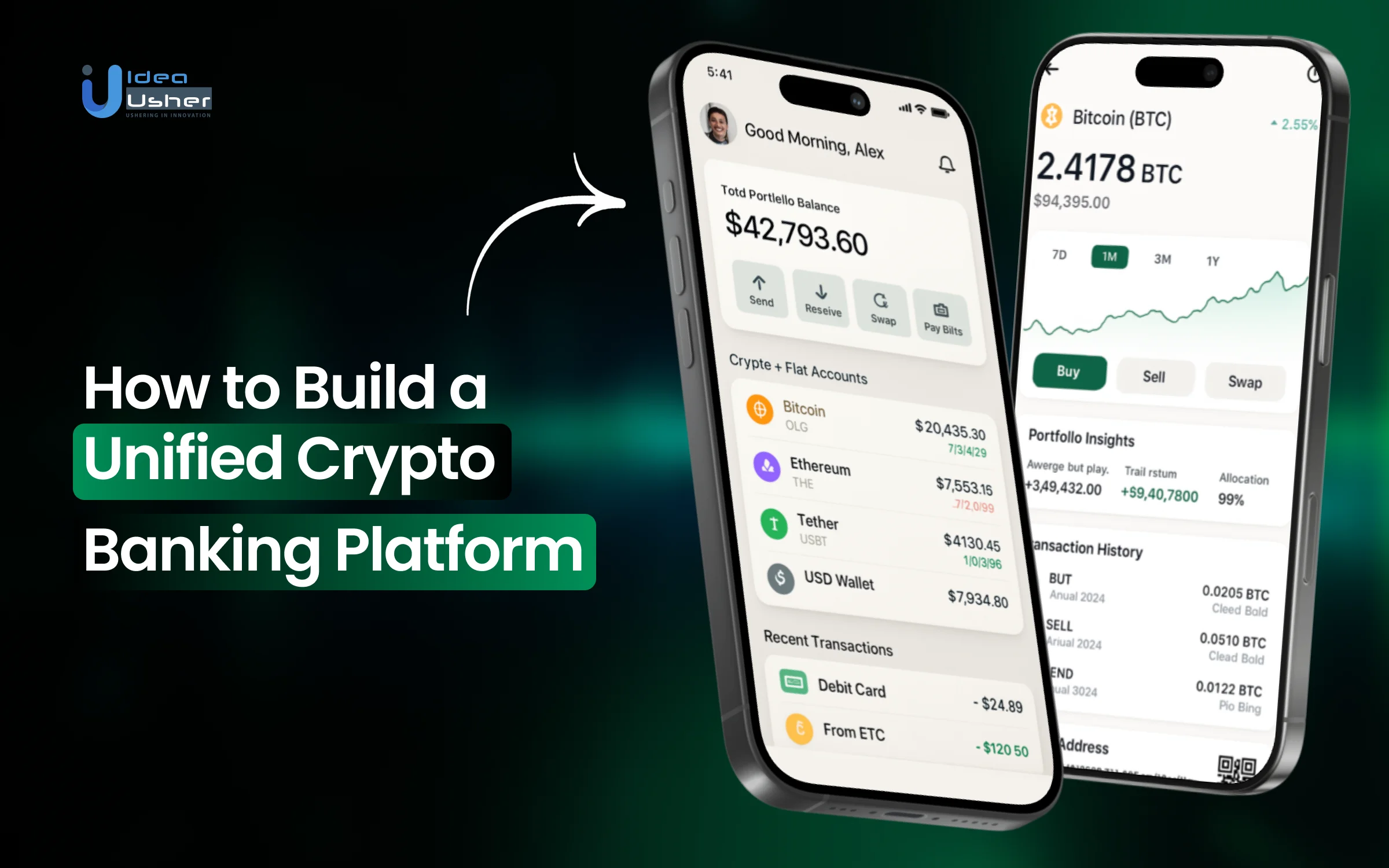
Crypto banking often struggles not because features are missing, but because services operate in isolation. Custody, payments, trading, compliance, and reporting are typically handled by separate systems, creating operational friction and fragmented experiences. These gaps are driving interest in unified crypto banking platform development, where core financial services function within a single, coordinated infrastructure instead of disconnected modules.
Bringing these functions together shifts the challenge from feature delivery to system orchestration. Data consistency, permissioning, transaction workflows, and compliance controls must remain aligned across both on-chain and off-chain components. The effectiveness of a unified platform depends on how well these layers interact without introducing risk, latency, or regulatory exposure as usage scales.
In this blog, we explain how to build a unified crypto banking platform by breaking down core components, architectural considerations, and practical design choices involved in delivering secure, scalable, and institution-ready digital banking infrastructure.

What is a Unified Crypto Banking Platform?
A Unified Crypto Banking Platform is a financial infrastructure that integrates traditional fiat banking services with digital asset management into a single, cohesive ecosystem. It eliminates the need for separate systems for traditional money and cryptocurrencies, providing a “single source of truth” for a user’s entire financial portfolio.
- Unified Ledger: A real-time, single ledger tracks both fiat (e.g., USD, EUR) and crypto (e.g., BTC, ETH) balances simultaneously to ensure accurate reconciliation.
- Hybrid Accounts: Users can hold, manage, and exchange multiple traditional and digital currencies within one account interface.
- Seamless On/Off Ramps: Built-in bridges allow users to convert fiat to crypto and vice-versa instantly without leaving the platform.
- Integrated Compliance: Automated KYC (Know Your Customer) and AML (Anti-Money Laundering) workflows are embedded to meet regulatory standards across different asset types.
Core Components of Unified Crypto Banking Platform
Unified crypto banking platforms use modular architectures to combine traditional banking, digital asset custody, payments, liquidity, and on-chain financial services in one system. The platforms typically consist of several modular layers:
- Core Banking Engine: Handles retail and corporate banking functions, interest computation, and e-statements.
- Institutional Custody: Secure storage for digital assets, often using MPC (Multi-Party Computation) or multi-signature technology to protect private keys.
- Card Issuance: Provides physical or virtual debit cards that allow users to spend their crypto balances at millions of merchants worldwide through real-time conversion.
- Liquidity Aggregation: Connects to multiple exchanges to ensure optimal pricing and instant execution for trades and conversions.
- DeFi Gateway: Integration with decentralized finance protocols for activities like staking, lending, and yield farming.
How Unified Crypto Banking Platform work?
A unified crypto banking platform integrates digital assets and traditional finance into one system, enabling seamless custody, payments, compliance, and fiat-crypto conversion through a single regulated interface.

1. The Fiat On-Ramp/Off-Ramp (The Gateway)
This layer enables users to deposit and withdraw real-world currency. It connects the platform to regulated banking rails and traditional financial infrastructure.
How it works: The platform partners with a traditional Banking-as-a-Service (BaaS) provider (like Synapse or Solid) or holds its own banking licenses.
User Experience: Users deposit USD/EUR via wire transfer, ACH (direct deposit), or debit card. The money sits in “Fiat Wallets.”
The Mechanism: Legally, these funds are often held in pooled accounts at FDIC-insured partner banks. This gives users the security of traditional banking (up to $250k) while holding cash.
2. The Exchange & Custody Engine (The Core)
This layer handles crypto conversion and secure asset storage. It ensures user funds are traded, custodied, and recorded under controlled, regulated infrastructure.
Order Book: The platform matches a buy order with a seller’s sell order (like the NYSE) or fills it from its own inventory.
Custody (The Cold Wallet): When a user buys 1 Bitcoin, the platform doesn’t usually transfer it directly. Instead, it is held in secure storage on the user’s behalf. This is called Custody.
- Hot Wallets: Connected to the internet for instant withdrawals (holds ~5% of funds).
- Cold Wallets: Offline, in vaults, on hardware not connected to any network (holds ~95% of funds). This prevents hackers from stealing everything.
The Ledger: The platform updates its internal database to show the user now owns that Bitcoin, even though the platform’s central “vault” holds it.
3. The “Unified” Account Abstraction
This is what makes it “unified.” In the real world, dollars and Bitcoin live in completely different systems. This platform creates a single view.
The Balance Sheet: When viewing an account, the user sees a single total balance. Under the hood, the platform’s database calculates:
Total Value = (Fiat Balance) + (Crypto Quantity A x Current Price of A) + (Crypto Quantity B x Current Price of B)
Settlement: If a user wants to pay for something in crypto but only has dollars, the platform silently does the swap in the background at the moment of transaction. The complexity is hidden from the user.
4. The DeFi & Yield Integrations
This is where the platform acts like a bank and an investment firm. Instead of just sitting idle, crypto can be put to work to earn interest (yield).
Staking: If a user holds a cryptocurrency like Ethereum or Solana, the platform can “stake” it on the user’s behalf to help secure the network. The platform gets rewards (like interest) and passes them along, minus a fee.
Lending: The platform takes idle crypto and lends it to institutional traders who want to short-sell the market. These borrowers pay interest. (e.g., “Earn 5% APY on USDC”).
The Risk: Unlike a bank account, this yield is not guaranteed. If the borrowers default or the DeFi protocol has a bug, funds could be lost. Reputable platforms heavily vet where they lend money.
5. The Payment Card (The Utility)
This layer allows users to spend fiat or crypto seamlessly in everyday transactions. Card payments convert digital assets into merchant-accepted fiat in real time.
The Mechanism: When a customer swipes the card at a grocery store to buy $100 worth of food:
- The merchant asks Visa for $100.
- Visa asks the platform to pay.
- The platform looks at the customer’s unified account.
- If the customer has $100 in USD: The platform sends the USD.
- If the customer has $0 in USD but $200 in Bitcoin: The platform instantly sells $100 worth of Bitcoin (often at a slight markup) and sends the USD to Visa.
- Visa pays the merchant.
Result: The customer spends Bitcoin to buy groceries without the merchant ever knowing or needing to understand crypto.
Global Market Growth of Unified Crypto Banking Platforms
The Cryptocurrency Banking Market was valued at USD 5.3 billion in 2024 and is expected to grow from USD 6.79 billion in 2025 to USD 80.92 billion by 2035, with a CAGR of 28.12% from 2025 to 2035. This expansion is fueled by regulated crypto custody, increased institutional adoption, and the integration of digital assets into mainstream banking systems.

Investor funding into crypto startups, including unified banking platforms, reached $22 billion in 2025, doubling 2024 levels and signaling strong market confidence. Platform like Plasma One, launched in 2025, offers 10%+ yields and 4% debit cashback, positioning crypto-banking hybrids as direct alternatives to traditional savings accounts.
Crypto banking platforms are onboarding users at scale. Veera alone has reached 4 million users across 108 countries, while SoFi added 1.027 million new members in a single quarter, taking its total user base to 13.7 million, up 35% year over year.
Revolut, a flagship unified crypto-banking super app, serves over 52.5 million users with a $45B+ valuation. In 2024, profits grew 149% year-over-year, while 2025 transaction volume exceeded $210B, with crypto transactions rising 50%, driven by Bitcoin, Ethereum, and stablecoins.
Industry Use Cases of a Unified Crypto Banking Platform
Unified crypto banking platforms serve fintechs, enterprises, and institutions by streamlining payments, custody, compliance, and treasury operations, enabling secure crypto–fiat integration across global markets within a single regulated infrastructure.

1. Fintech Startups and Neobanks
Unified crypto banking platforms allow fintechs to embed crypto wallets, trading, cards, and yield products into regulated fiat accounts, reducing infrastructure complexity, accelerating launches, and avoiding fragmented exchange, custody, and banking integrations.
Real-World Examples:
- Revolut embedded crypto trading directly into its neobank app under an EMI license, processing $1B+ monthly crypto volume. This proved that regulated fiat-native crypto significantly increases retention versus standalone exchanges.
- Juno delivered crypto-enabled checking accounts via a BaaS partnership with Evolve Bank, showing fintechs can launch compliant crypto banking features without holding a direct banking license.
2. Cross-Border Payments and Remittances
These platforms replace slow SWIFT corridors with stablecoin rails, enabling near-instant settlements, lower FX costs, reduced pre-funded liquidity requirements, and compliant cross-border payments across high-volume international remittance markets.
Real-World Examples:
- Ripple uses XRP for sub-5-second settlements across 45+ countries, eliminating pre-funded nostro accounts and freeing working capital for banks and PSPs.
- Stellar powers USDC-based remittances for MoneyGram and government aid programs, making it a preferred rail for underbanked corridors across Africa and Southeast Asia.
3. Corporate Treasury Management
Unified platforms enable enterprises to custody digital assets, manage stablecoin liquidity, execute OTC trades, and generate audit-ready reports within a controlled environment aligned with corporate governance and financial disclosure requirements.
Real-World Examples:
- MicroStrategy holds 190,000+ BTC, requiring institutional-grade custody, real-time valuation, and SEC-compliant reporting, highlighting the need for unified crypto treasury infrastructure.
- Tesla exposed gaps in crypto treasury tooling around volatility management, liquidity controls, and accounting when it added Bitcoin to its balance sheet.
4. Crypto-Native Lending and Borrowing
They support crypto-collateralized lending with real-time collateral monitoring, margin controls, segregated custody, and compliant loan servicing, combining blockchain-native transparency with regulated lending infrastructure and institutional risk management.
Real-World Examples:
- BlockFi originated $10B+ in crypto loans before collapsing in 2022, becoming the case study for why unified lending platforms require segregated custody, proof-of-reserves, and counterparty risk controls.
- Ledn survived the market crash by avoiding rehypothecation and maintaining transparent reserves, setting a compliance benchmark for sustainable crypto lending infrastructure.
5. Digital Asset Custody for Institutions
Institutional users benefit from segregated custody, MPC-based key management, insurance coverage, and seamless connectivity to trading and settlement desks under a single regulated custodial framework.
Real-World Examples:
- Fidelity Digital Assets launched institutional custody under a New York Trust charter, using air-gapped cold storage and multi-signature controls as the gold standard.
- BlackRock launched the BUIDL tokenized treasury fund, proving institutional custody platforms must now support both on-chain and traditional assets within one regulated framework.
6. Tokenized Asset Issuance and Management
They support end-to-end tokenization workflows including investor onboarding, compliant issuance, secondary transfers, dividend distribution, and custody for real-world assets under auditable regulatory frameworks.
Real-World Examples:
- JPMorgan processed $700B+ via its Onyx platform, proving tokenized assets at scale require unified custody, permissioned settlement, and deep bank integration.
- Franklin Templeton tokenized its FOBXX fund on public blockchains, showing that regulated funds need unified platforms for KYC, NAV calculation, custody, and transfer agency functions.
Core Features of a Unified Crypto Banking Platform
A unified crypto banking platform combines digital assets with traditional banking in a secure, compliant, and scalable infrastructure for businesses. These features enable seamless custody, payments, compliance, liquidity management, and integration through one platform.

1. Unified Fiat–Crypto Accounts
Users manage fiat balances and crypto assets from a single account, eliminating fragmented tools. Unified accounts enable real-time balance visibility, simplified reconciliation, faster settlements, and seamless movement between traditional banking rails and blockchain networks without switching platforms.
2. Secure Multi-Asset Wallets
The platform supports multiple digital assets with bank-grade security controls. Users benefit from segregated wallets, protected private key management, transaction policy enforcement, and reduced asset exposure while maintaining full operational access across supported blockchains.
3. Fiat–Crypto On-Ramps
Built-in on-ramps and off-ramps allow users to convert fiat to crypto and vice versa directly inside the platform. This removes dependency on external exchanges, improves conversion speed, ensures pricing transparency, and supports compliant movement of funds.
4. Instant Internal Transfers
Users can transfer assets instantly between internal accounts without blockchain confirmation delays. This feature enables real-time settlements, improves liquidity management, reduces transaction costs, and supports high-frequency operational workflows required by institutions and enterprises.
5. Multi-User Access Controls
Role-based access allows account owners to define permissions across teams. Users can assign viewing, transaction, or approval rights, ensuring operational security, reducing internal risk, and enabling controlled collaboration within businesses, banks, and fintech organizations.
6. KYC and Identity Verification
Integrated identity verification enables users to onboard quickly while meeting regulatory requirements. Automated KYC processes reduce manual checks, speed up account activation, and ensure compliance readiness without disrupting the user experience or operational efficiency.
7. AML and Risk Monitoring
The platform continuously monitors transactions for suspicious activity. Users benefit from automated risk scoring, flagged transaction alerts, and compliance transparency, helping them operate confidently within regulated environments and avoid unexpected account restrictions or service interruptions.
8. Payments and Payouts
Users can initiate crypto and fiat payments from a unified dashboard. The platform supports scheduled payouts, bulk transfers, and cross-border payments, improving operational efficiency while reducing reliance on multiple payment service providers.
9. Reports and Statements
Users access downloadable transaction reports and account statements at any time. Structured reporting supports audits, financial reconciliation, regulatory reviews, and internal accounting, giving users clear visibility into asset movement and account activity.
10. Approval Workflows
Transaction approval workflows allow users to enforce multi-step authorization. This reduces fraud risk, prevents unauthorized transfers, and aligns platform usage with internal governance policies required by enterprises, custodians, and regulated financial institutions.
Unified Crypto Banking Platform Development Process
A unified crypto banking platform development requires strong planning, regulatory alignment, and secure architecture to integrate crypto with traditional finance. Our developers follow best practices to ensure security, compliance, scalability, and seamless integration.

1. Consultation and Use-Case Mapping
We begin by consulting with the client to understand business objectives, target users, and expansion plans. Our developers then map jurisdictions, licensing requirements, and user roles, translating regulatory obligations into system logic that defines custody structures, transaction limits, reporting standards, and data retention rules.
2. Business Model and Platform Scope
Our team aligns platform architecture with the client’s revenue model and market strategy. Fee mechanisms, asset coverage, user segmentation, and expansion plans are locked early to avoid structural limitations during scaling or regulatory onboarding.
3. System Architecture Design
We design a modular, service-oriented architecture separating custody, ledger, payments, compliance, and identity layers. This approach allows controlled upgrades, jurisdiction-specific compliance, and independent scaling without disrupting core transaction flows.
4. Custody and Wallet Infrastructure
Our developers implement secure wallet infrastructure with strict asset segregation and controlled key management. Transaction policies, signing workflows, and recovery mechanisms are engineered to balance institutional security with operational efficiency.
5. Internal Ledger and Reconciliation Engine
We build a banking-grade internal ledger to track balances independently of blockchains. This enables instant internal transfers, accurate fiat-crypto reconciliation, audit-ready records, and consistent accounting across irreversible and reversible settlement systems.
6. Fiat Banking and Payment Integration
Our team integrates fiat rails through regulated banking and payment partners. Settlement logic accounts for delays, reversals, and failures, ensuring user balances remain accurate while maintaining compliance with traditional financial infrastructure.
7. Compliance and Risk Systems
We embed KYC, AML, and transaction monitoring as core platform services. Automated checks, risk scoring, and alert workflows are designed to meet regulatory expectations while minimizing onboarding friction and operational overhead.
8. User Access and Authorization Controls
Our developers implement role-based access, approval chains, and permission management. These controls protect against internal misuse, enforce governance policies, and support multi-user enterprise accounts with traceable authorization workflows.
9. Security Hardening and Audit Readiness
We conduct security hardening, threat modeling, and compliance testing before launch. Logging, monitoring, and incident response frameworks are configured to withstand audits, operational stress, and real-world attack scenarios.
10. Phased Launch and Platform Scaling
We deploy the platform in controlled phases, starting with core custody and ledger components. This approach reduces regulatory risk, validates infrastructure under live conditions, and enables data-driven scaling as transaction volumes grow.
Unified Crypto Banking Platform Development Cost
Unified crypto banking platform development costs vary based on features, regulatory requirements, security standards, and integration complexity. The table below helps estimate costs by breaking down key development components and implementation phases.
| Development Phase | What We Deliver | Estimated Cost |
| Regulatory & Use-Case Mapping | Jurisdiction analysis, licensing path, user roles, compliance logic mapped to platform requirements | $8,000 – $12,000 |
| Business Model & Scope Definition | Revenue model alignment, feature prioritization, scalability planning, third-party dependency identification | $6,000 – $10,000 |
| Architecture Design | Modular system architecture covering custody, ledger, payments, compliance, and identity layers | $10,000 – $15,000 |
| Custody & Wallet Setup | Secure wallet infrastructure, asset segregation, key management, transaction policy enforcement | $24,000 – $32,000 |
| Internal Ledger Development | Banking-grade ledger, balance tracking, reconciliation logic, audit-ready accounting framework | $18,000 – $22,000 |
| Fiat & Payment Integration | Bank APIs, payment rails, settlement handling, reversals, and balance synchronization | $14,000 – $18,000 |
| Compliance & Risk Systems | KYC, AML, transaction monitoring, risk scoring, alerts, and compliance workflows | $10,000 – $15,000 |
| Access & Authorization Controls | Role-based permissions, approval workflows, multi-user governance, activity traceability | $12,000 – $17,000 |
| Security & Audit Readiness | Security hardening, penetration testing, logging, monitoring, audit preparation | $8,000 – $12,000 |
| Phased Launch & Scaling | Controlled rollout, performance tuning, infrastructure scaling, post-launch optimization | $10,000 – $15,000 |
Total Estimated Cost: $62,000 – $124,000+
Note:Actual unified crypto banking platform development cost may vary based on regulatory scope, asset coverage, integrations, and security requirements.
Consult with IdeaUsher to receive a tailored cost estimate aligned with your business model and jurisdictional strategy for your unified crypto banking platform development.
Development Mistakes That Can Derail Unified Crypto Baking Platform
Common development mistakes can undermine security, compliance, and scalability in a unified crypto banking platform development. Our developers address these challenges through proven architecture, regulatory expertise, rigorous testing, and secure-by-design development practices.

1. Ledger and Blockchain Reconciliation Gaps
Challenge: Mismatch between internal balances and on-chain states leads to reconciliation errors, audit failures, disputed balances, and loss of institutional user trust.
Solution: We implement independent banking-grade ledgers with deterministic reconciliation, blockchain event indexing, exception handling, and immutable audit trails, ensuring continuous balance accuracy across fiat systems and multiple blockchain networks.
2. Fiat Settlement Delays and Failures
Challenge: Delayed or reversible fiat settlements conflict with instant crypto transfers, creating balance inconsistencies and operational risk during payment failures or chargebacks.
Solution: Our developers introduce settlement-aware balance states, pending transaction logic, rollback handling, and reconciliation checkpoints that preserve accurate user balances despite delayed fiat clearing or unexpected settlement reversals.
3. Custody Security vs Operational Flexibility
Challenge: Excessively strict custody controls slow operations, while weak controls expose assets to theft, insider misuse, or unauthorized transaction execution.
Solution: We design policy-driven custody workflows using controlled signing, role-based approvals, transaction limits, and recovery mechanisms that maintain institutional-grade security without blocking legitimate operational activity.
4. Institutional Transaction Volume
Challenge: Platforms built for MVP usage collapse under enterprise transaction volume, concurrent users, and high-frequency internal settlements.
Solution: Our developers architect horizontally scalable services, optimized ledger writes, asynchronous transaction processing, and load-isolated microservices to sustain institutional throughput without performance degradation or data inconsistency.
5. Vendor Lock-In and Integration Dependency
Challenge: Tight coupling with third-party custody or banking providers limits flexibility and increases long-term operational and regulatory risk.
Solution: We build abstraction layers around third-party services, enabling vendor replacement, hybrid integrations, and controlled migrations without disrupting user accounts, transaction workflows, or regulatory reporting continuity.
What Licenses Are Required to Launch a Unified Crypto Banking Platform?
The unified crypto banking platform development requires multiple financial, crypto, and data protection licenses across jurisdictions. These licenses ensure regulatory compliance, consumer protection, secure operations, and lawful crypto–fiat financial services.
1. Virtual Asset Service Provider (VASP) License
A VASP license enables crypto custody, transfers, and exchange-related services. Requirements vary by jurisdiction, covering AML compliance, transaction monitoring, reporting obligations, and regulatory supervision for digital asset service providers.
Example:
Coinbase operates under multiple EU VASP registrations, proving that jurisdiction-first compliance, MLRO appointment, Travel Rule readiness, and real-time transaction monitoring are mandatory before scaling.
2. Electronic Money Institution (EMI) License
An EMI license allows issuance and management of fiat-backed balances, payment services, and client funds. It supports fiat wallets, on-ramps, off-ramps, and integration with traditional payment rails under regulatory oversight.
Example:
Revolut and Wirex leverage EMI licenses to offer compliant fiat wallets. EMI safeguarding rules require segregated client funds, directly shaping banking partner selection, treasury design, and settlement architecture from launch.
3. Crypto Custody or Trustee License
Custody licenses authorize the safekeeping of digital assets on behalf of users. Regulators typically require asset segregation, secure key management, internal controls, auditability, and defined recovery procedures for institutional-grade custody operations.
Example:
Anchorage Digital set custody benchmarks after OCC approval. Germany’s BaFin custody license mandates wallet audits, while institutional platforms increasingly adopt MPC-based key management to meet regulator expectations without operational bottlenecks.
4. Payment Institution License
This license enables fiat transfers, cross-border payments, and payout processing. It covers transaction execution, settlement handling, consumer protection, and reporting obligations when offering regulated payment services alongside crypto functionality.
Example:
Stripe operates under EU payment licenses, while BitPay registers as a US MSB. Crypto platforms must license each payment corridor separately across SEPA, SWIFT, and FedACH.
5. Banking License or Partnership
Full banking licenses are rare and capital-intensive. Many platforms partner with regulated banks to access accounts, payment rails, and safeguarding services while focusing on crypto infrastructure, compliance, and user-facing platform functionality.
Example:
Kraken obtained a Wyoming SPDI charter, while Juno and Brex rely on BaaS partnerships. Bank dependencies accelerate launch but introduce audit and counterparty risk.
6. Data Protection and Privacy Compliance
Beyond financial licensing, platforms must comply with data protection regulations. This includes secure data storage, user consent management, access controls, and jurisdiction-specific data residency requirements for handling sensitive financial information.
Example:
EU crypto platforms must comply with GDPR, including erasure rights that conflict with blockchain immutability. Circle faced scrutiny over USDC data handling, while US and Singapore platforms follow CCPA and PDPA. GDPR fines can reach €20M or 4% turnover.
7. Jurisdiction-Specific Regulatory Approvals
Some regions require additional approvals, sandbox participation, or local registrations. These requirements often impact transaction limits, user eligibility, reporting frequency, and operational scope within specific markets.
Example:
In the US, state-level BitLicense rules force platforms like Coinbase and Gemini to run parallel compliance stacks. The UK’s Financial Conduct Authority sandbox lets firms such as Gemini and Ziglu test compliant products, while the EU’s MiCA enables single-license passporting, making Ireland, Lithuania, and Luxembourg strategic hubs.
Examples of Unified Crypto Banking Platform in The Market
The unified crypto banking platforms combine traditional banking services with digital asset management for businesses and institutions. These platforms enable seamless crypto–fiat operations, regulatory compliance, and scalable financial services globally.
1. Amina Bank (Formerly SEBA)

Amina Bank is a regulated Swiss crypto bank delivering unified fiat and crypto banking with accounts, custody, trading, staking, and compliance. Its key differentiator is institutional-grade security combined with seamless integration for corporates, banks, and high-net-worth clients, worldwide, scalable, trusted.
2. Anchorage Digital Bank

Anchorage Digital Bank is a U.S. federally chartered crypto bank providing unified cash and crypto services, custody, settlement, and governance. Its unique advantage is bank-level regulation purpose-built for digital assets, serving institutions with secure, compliant, large-scale operations, globally, regulated, trusted.
3. Revolut

Revolut is a global fintech super-app offering unified crypto banking through fiat accounts, cards, payments, and crypto trading. Its key strength is mass-market accessibility, real-time conversion, and a single interface for managing money and digital assets worldwide, securely, seamlessly, efficiently.
4. Nexo

Nexo is a crypto banking platform delivering unified fiat and crypto services including wallets, lending, borrowing, and yield. Its core differentiator is revenue-driven financial products like interest accounts and crypto-backed credit lines within one regulated ecosystem for global users institutions.
5. Wirex

Wirex is a crypto payments platform enabling unified crypto banking with fiat and crypto wallets, exchange, and cards. Its standout feature is everyday crypto spending through instant conversion, rewards, and global payment acceptance across merchants worldwide, securely seamlessly efficiently globally.
Conclusion
Unified crypto banking platforms are no longer experimental products; they are emerging as core financial infrastructure. By combining regulated fiat access, secure custody, internal ledgers, payments, and compliance into one system, these platforms unlock scalable, revenue-generating crypto businesses. Success depends on building compliance-first architecture, resilient custody, and seamless user experiences from day one. As adoption accelerates across fintech, enterprises, and Web3, platforms built with the right technical and regulatory foundation will define the next generation of digital finance.
Build a Unified Crypto Banking Platform with IdeaUsher!
We have built various blockchain and crypto-fintech solutions for global enterprises and startups. Backed by 500,000+ hours of development expertise, our ex-FAANG/MAANG developers deliver secure, compliant, and scalable unified crypto banking platforms tailored to regulated markets.
Why Work With Us?
- Regulatory-First Architecture: We design platforms with built-in AML/KYC, GDPR, MiCA, and jurisdiction-specific compliance to reduce legal risk and speed approvals.
- Crypto–Banking Integration: Our solutions unify custody, wallets, payments, fiat on/off-ramps, and liquidity management into a single seamless system.
- Enterprise-Grade Security: We implement multi-layer security, transaction monitoring, and risk controls to protect digital assets and user data.
- Scalable Infrastructure: Platforms are built to handle high transaction volumes, institutional users, and long-term growth without performance bottlenecks.
Explore our portfolio and book a free consultation to launch a future-ready unified crypto banking platform.


FAQs
A.1. A unified crypto banking platform manages wallets, enables fiat-to-crypto onramps, implements KYC and AML compliance, monitors transactions, provides custody solutions, and secures APIs. These features ensure regulatory readiness, deliver a smooth user experience, and support scalable financial operations across regions.
A.2. Yes, when built with the correct licenses or regulated partnerships. Legality depends on jurisdiction, requiring VASP, EMI, MSB, or bank partnerships, along with embedded KYC, AML, and transaction monitoring from day one.
A.3. Enterprises address licensing, KYC and AML compliance, data protection laws, and regional crypto regulations. Early legal planning ensures regulatory alignment, prevents launch delays, and supports sustainable growth and investor confidence.
A.4. Platforms differentiate by providing seamless user experience, faster onboarding, transparent fees, advanced analytics, and value-added services like lending or staking. Simplifying crypto finance for mainstream users drives stronger retention and organic growth.


