


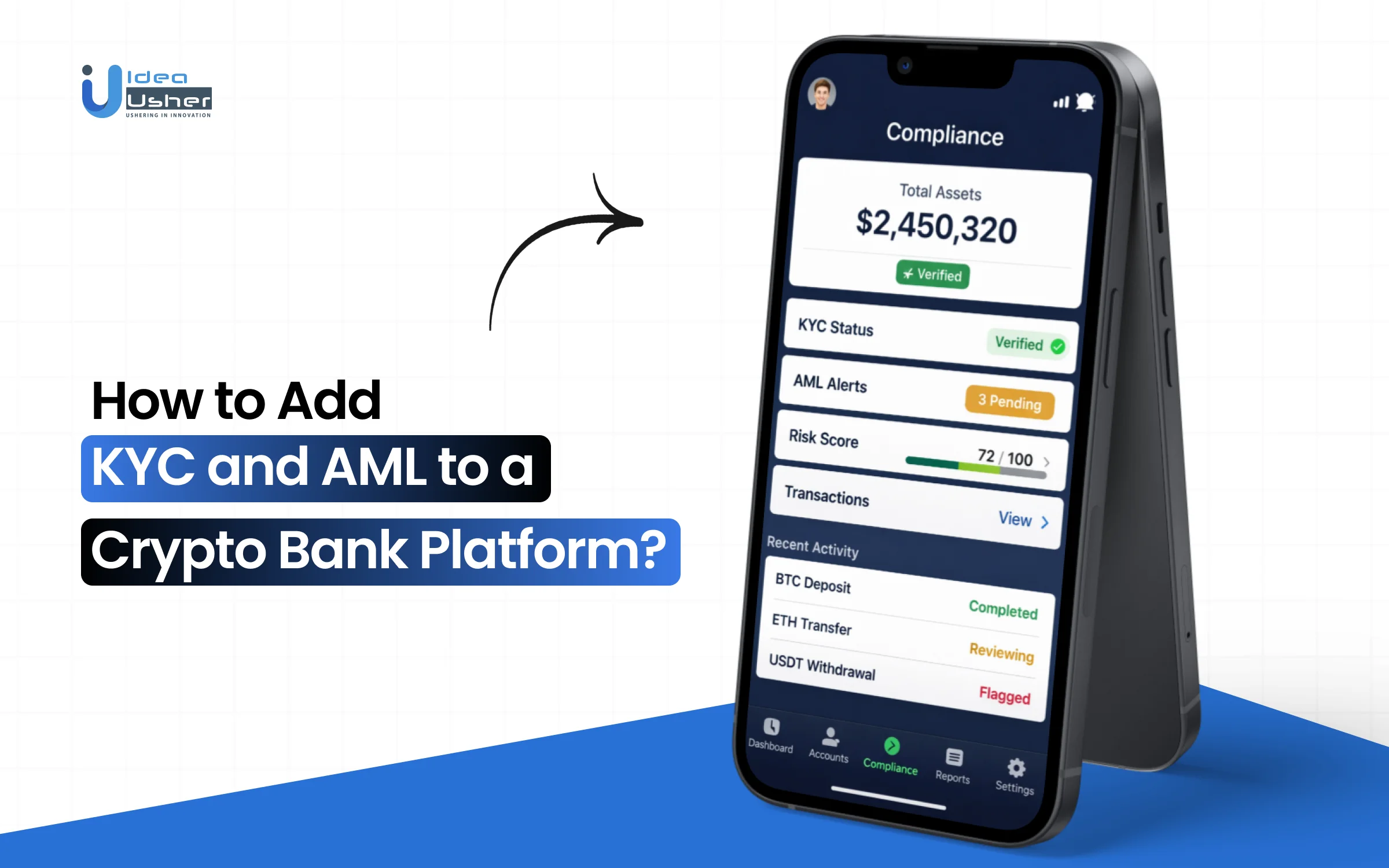
For years, anonymity was crypto’s badge of honor, representing freedom from traditional finance. As digital assets entered mainstream banking, the same anonymity began to create regulatory and operational risks. Regulators increased oversight to prevent money laundering, sanctions evasion, and systemic misuse, while users became cautious after major compliance failures.
Financial institutions will only engage with platforms that demonstrate structured identity verification and continuous monitoring. Therefore, it becomes necessary to properly embed KYC and AML into a crypto bank platform to ensure secure operations and long-term credibility.
We’ve built numerous crypto banking solutions that leverage technologies such as blockchain analytics frameworks and cryptographic access control architectures. As IdeaUsher has this expertise, we’re sharing this blog to discuss how to add KYC and AMLto a crypto bank platform.
Key Market Takeaways for Crypto Bank Platforms
According to Grand View Research, the crypto exchange and digital asset banking market is scaling at an extraordinary pace, expanding from USD 45.9 billion in 2023 to a projected USD 264.3 billion by 2030 at a 28.4 percent CAGR. As both retail and institutional participation increase, platforms that combine custody, compliance, and user-friendly banking rails are capturing the strongest momentum.

Source: Grandview Research
Crypto bank platforms are emerging as the bridge between regulated finance and programmable assets. As regulatory clarity strengthens across the United States, Europe, and parts of Asia, these platforms are increasingly positioned as digital gateways to tokenized finance and stablecoins, driving sustained user growth across multiple jurisdictions.
Leading examples highlight how quickly this segment is maturing. Revolut supports more than 30 cryptocurrencies with integrated staking and crypto-funded card payments, while Kraken introduced Krak in 2025 as a global money app supporting 300-plus assets and DeFi vaults.
In 2025, PNC Bank partnered with Coinbase to enable regulated crypto access directly within PNC’s platform through Crypto as a Service infrastructure.

Understanding Crypto Bank Platforms
Crypto bank platforms are digital financial institutions that combine traditional banking services with blockchain-based asset management. They allow users to store, transfer, trade, stake, and sometimes earn yield on cryptocurrencies while also offering fiat on and off-ramps, debit cards, lending, and regulated custody.
Unlike standard crypto exchanges, these platforms integrate compliance frameworks, including KYC and AML, custody governance, and transaction monitoring, to operate in accordance with banking and financial regulations, making them suitable for both retail users and institutional clients.
What Makes Crypto Banks Different from Traditional Banks?
Traditional banks operate within walled gardens. Crypto banks operate on open networks.
| Dimension | Traditional Bank | Crypto Bank |
| Transaction Visibility | Private ledger, internal only | Public blockchain, fully visible |
| Identity Model | Known customer (KYC at onboarding) | Pseudonymous wallet addresses |
| Asset Movement | SWIFT/ACH between known institutions | Self-custody wallets to exchanges |
| Jurisdiction | Clear geographic boundaries | Borderless by design |
| Risk Surface | Counterparty credit risk | Smart contract + wallet risk |
This fundamental difference means your KYC/AML architecture must be built differently from the ground up.
Why Add KYC and AML to a Crypto Bank Platform?
KYC and AML must be integrated into a crypto bank platform because they establish verified identities, lawful fund flows, and structured risk controls at the protocol level. Without them, the platform may face regulatory barriers, banking restrictions, and significant exposure to financial crime that could quickly limit growth.

The Evolution of Crypto
The Early Days: Code as Law
Bitcoin’s whitepaper described “an electronic payment system based on cryptographic proof instead of trust.” The early vision was one of peer-to-peer value transfer without intermediaries, without identity, without permission.
For years, the crypto industry operated in a regulatory gray area. Exchanges were unregulated. Wallets were anonymous. Transactions flowed freely across borders.
The Present Reality: Bridges to the Traditional World
Today’s crypto banking platforms differ. They:
- Connect to the traditional banking system (fiat on/off ramps require banking partners)
- Serve institutional clients who need regulatory certainty
- Hold customer assets under custody arrangements
- Issue cards that work at merchant terminals
- Offer lending products with real-world collateral
Every connection to the traditional financial system creates a compliance requirement. You cannot accept a wire transfer from a bank without the bank asking where the funds came from. You cannot issue a Visa card without Visa’s compliance program. You cannot serve institutional investors without their legal teams reviewing your AML framework.
KYC and AML are the bridge that connects crypto to the mainstream economy. Without them, you’re building on an island.
2. The Regulatory Reality
In 2026, the regulatory landscape has crystallized. Major jurisdictions have enacted comprehensive frameworks:
| Jurisdiction | Framework | Key Requirements |
| European Union | MiCA (Markets in Crypto-Assets) | Full Travel Rule, CASP licensing, consumer protection |
| United States | State-level (NY BitLicense) + Federal (BSA/AML) | Money transmitter licenses, SAR filings, OFAC screening |
| United Kingdom | FCA Cryptoasset Registration | Travel Rule compliance, financial promotions regime |
| Singapore | Payment Services Act | Licensing for DPT services, AML/CFT requirements |
| Dubai | VARA Framework | Full AML/CTF compliance, mandatory reporting |
The Cost of Non-Compliance
The penalties for operating without proper KYC/AML are severe:
| Risk | Consequence |
| Regulatory Fines | Millions in penalties (Binance: $4.3B, Bittrex: $24M, BitMEX: $100M) |
| License Revocation | Forced shutdown in regulated markets |
| Banking De-risking | Loss of correspondent banking relationships |
| Executive Liability | Personal criminal charges for compliance failures |
| Reputational Damage | Loss of user trust, media scrutiny |
| Market Access Loss | Exclusion from regulated jurisdictions |
The math is simple. The cost of compliance is a fraction of the cost of failure.
3. The Business Case
Reason 1: Institutional Money Requires Compliance
Institutional capital is the holy grail for crypto banks. Hedge funds, family offices, pension funds, and corporations manage trillions in assets. They share one common requirement: regulatory compliance.
A pension fund cannot invest in a platform that does not verify its customers. A corporation cannot use a banking partner that may facilitate money laundering. An asset manager’s compliance team will block any relationship with a platform that lacks proper KYC/AML.
The data: According to a 2025 survey, 87% of institutional investors cite “regulatory clarity and compliance” as their top criterion for selecting a crypto custodian or banking partner.
Reason 2: Higher-Value Customers Choose Compliant Platforms
Retail users may tolerate anonymous platforms. High-net-worth individuals and businesses do not.
When you’re moving six or seven figures, you want to know:
- Your counterparty is legitimate
- Your funds will not be frozen due to the platform’s regulatory issues
- There is a compliance team you can contact
- The platform will exist in five years
Compliance signals stability. A platform that invests in KYC/AML is a platform that plans to be around for the long term.
Reason 3: Banking Partners Require It
Every crypto bank needs banking partners. You need:
- Fiat settlement accounts
- Wire transfer capabilities
- Card issuing partners
- Liquidity providers
These partners are regulated institutions. They have their own compliance obligations. Before they work with you, they will conduct due diligence on your AML program. If you do not have one, you do not get the partnership.
This is the banking bottleneck. Without KYC/AML, you cannot access the traditional financial system. Without access to the traditional system, you cannot onboard fiat currency. Without fiat on/off ramps, you’re a crypto-only platform with limited utility.
Reason 4: Competitive Differentiation
In a crowded market, compliance is a differentiator.
Most crypto platforms claim to be “secure” and “trustworthy.” Few can actually demonstrate it. A robust KYC/AML program provides:
- Auditable proof of your compliance posture
- Certifications (SOC 2, ISO 27001) that signal maturity
- Regulatory approvals (licenses, registrations) that competitors lack
- Institutional-grade reporting that sophisticated clients demand
When a corporate treasurer is choosing between your platform and a competitor, a clear compliance framework can be the deciding factor.
Reason 5: Access to Regulated Products
Compliance unlocks product opportunities:
| Product | Compliance Requirement |
| Stablecoin issuance | Full KYC/AML program, reserve attestation |
| Security token offerings | Investor accreditation, transfer restrictions |
| Institutional custody | Enhanced due diligence, segregation verification |
| Crypto-backed lending | Borrower verification, collateral monitoring |
| Cross-border payments | Travel Rule compliance, sanctions screening |
Without KYC/AML, you’re limited to spot trading and basic transfers. With it, you can build a full-service financial institution.
4. The Risk Mitigation Case
Risk 1: Financial Crime Exposure
Crypto platforms are prime targets for money laundering. The pseudonymous nature of blockchain, the speed of settlement, and the cross-border functionality create ideal conditions for illicit finance.
Without AML, your platform can become:
- A layering vehicle for drug proceeds
- A withdrawal point for ransomware payments
- A conversion point for fraud proceeds
- A nesting ground for sanctions evasion
The consequence is clear. When law enforcement investigates, they follow the money. If your platform facilitated the transaction, you are part of the investigation. Even if you were not complicit, the reputational damage and regulatory scrutiny can destroy your business.
Risk 2: Fraud and Scams
Crypto platforms without strong KYC attract bad actors:
- Synthetic identity fraud: Creating fake identities using real and fabricated data
- Account takeover: Stealing credentials from legitimate users
- First-party fraud: Opening accounts with the intent to default on loans
- Promotional abuse: Creating multiple accounts to claim bonuses
KYC as defense: Identity verification makes it harder to create fake accounts. Behavioral monitoring detects unusual patterns. Liveness detection prevents deepfake attacks.
Risk 3: Sanctions Violations
OFAC and other sanctions authorities maintain lists of blocked persons and entities. Transacting with sanctioned individuals, even unknowingly, can result in:
- Civil penalties that often reach millions of dollars
- Criminal referral
- Loss of banking relationships
- Designation as a primary money laundering concern
AML screening checks every customer and transaction against sanctions lists, preventing inadvertent violations.
Risk 4: Terrorist Financing
While less common than other forms of financial crime, terrorist financing remains a regulatory priority. Platforms that cannot demonstrate effective AML controls may be perceived as vulnerable to exploitation.
Risk 5: Regulatory Arbitrage Exploitation
Bad actors actively seek platforms with weak compliance. They share information about which exchanges have low KYC thresholds, which wallets allow anonymous funding, and which platforms have slow AML reviews.
Weak compliance attracts bad actors. Strong compliance repels them.
5. The Trust Case
The User Perspective
Ask yourself: Why would a user choose your platform over a decentralized exchange or non-custodial wallet?
The answer is trust. They’re trusting you to:
- Keep their funds safe
- Process their transactions correctly
- Protect their personal information
- Be there when they need support
- Comply with laws so their funds are not frozen
Compliance builds trust. When users see that you have proper KYC/AML, they know:
- You’re a legitimate business, not a fly-by-night operation
- Regulators have reviewed your operations
- There are processes in place to handle problems
- Their funds are part of a regulated system, not an unaccountable black box
The Data Privacy Paradox
Some users worry that KYC compromises privacy. The reality is more nuanced:
| Concern | Mitigation |
| “You’ll sell my data.” | GDPR/CCPA compliance, privacy policies, data protection certifications |
| “You’ll get hacked.” | Encryption, access controls, security audits |
| “You’ll share with governments.” | Legal process requirements, transparency reports |
The compromise is clear. Users trade some personal information for the security of operating within a regulated framework. For most users, especially those with significant assets, this is an acceptable trade.
How to Add KYC and AML to a Crypto Bank Platform?
To integrate KYC and AML into a crypto bank platform, the identity layer and blockchain monitoring should be embedded directly into the core architecture from the outset. Document verification, biometric validation, and real-time on-chain analytics can be integrated so every wallet and transaction is continuously evaluated against dynamic risk models.
We have supported numerous clients in integrating KYC and AML into their crypto bank platforms, and here is the structured approach we follow.

1. Unified Risk Engine
We design and deploy a unified risk orchestration engine that acts as the compliance control center. Our team builds real-time scoring models that merge off-chain identity data with on-chain transaction intelligence through event-driven pipelines. Blockchain node ingestion and graph-aware analytics ensure that every wallet interaction is evaluated instantly.
2. Perpetual KYC Framework
We implement tiered onboarding supported by document verification APIs and biometric liveness detection. Beyond onboarding, we engineer perpetual KYC logic that triggers automated re-verification when high-value transfers, behavioral anomalies, or geographic shifts occur. This creates a dynamic friction model that keeps onboarding seamless for low-risk users while strengthening due diligence for elevated risk profiles.
3. On Chain AML Intelligence
Our AML approach goes beyond account monitoring to focus on wallet-level intelligence. We integrate blockchain analytics providers and implement entity clustering powered by graph analysis. The system detects typologies such as layering, mixer interaction, and chain hopping before final settlement.
4. Travel Rule Automation
For cross-border transfers, we build Travel Rule compliance directly into the transaction workflow. The system detects regulated counterparties and securely exchanges required identity information using encrypted protocols. Every data exchange is logged with structured audit trails, so our clients remain regulator-ready at all times.
5. Smart Contract Controls
We embed compliance controls directly at the execution layer. Our team implements programmable allowlists, blocklists, and automated sanctions screening that run before transaction approval. By enforcing policy at the smart contract level, restricted wallets are prevented from interacting with custody and treasury contracts.
6. Explainable AI Layer
To support audits and regulatory reviews, we build explainable AI modules into the risk engine. Each flagged or approved transaction generates structured reason codes tied to specific behavioral signals. Decision lineage is stored to enable historical replay and verification.
Wallet Screening Vs Entity-Based AML Monitoring
Wallet screening checks a crypto address against sanctions lists before processing a transaction. Entity-based AML monitoring continuously analyzes behavior across linked wallets to detect suspicious fund flows over time. A strong crypto bank platform should use both to identify and manage risk early and effectively.

Quick Definitions: Screening vs. Monitoring
| Dimension | Wallet Screening | Entity-Based AML Monitoring |
| Primary Purpose | Identify prohibited or high-risk counterparties by checking wallet addresses against sanctions, watchlists, and known-bad actor databases | Detect unusual behavior across a customer’s transaction history to flag potential money laundering, fraud, or terrorist financing |
| Timing | Pre-transaction or real-time before settlement | Post-event or continuous ongoing |
| Focus | Static risk indicators are this address on a list | Are dynamic behavior patterns is this activity unusual |
| Key Data Points | Wallet address, sanctions lists, OFAC designations, known scam addresses | Transaction velocity, counterparty diversity, behavioral biometrics, fund flow patterns |
| Typical Question Answered | “Has this address been involved in illicit activity before?” | “Does this transaction pattern suggest money laundering?” |
What Is Wallet Screening?
Wallet screening is the process of verifying cryptocurrency addresses against known databases of sanctioned, high-risk, or illicit entities before processing transactions. It is the digital equivalent of checking a customer’s name against a watchlist before letting them through the door.
How It Works in Practice
When a user attempts to send funds to or from your platform, wallet screening tools instantly check the involved addresses against:
- Sanctions lists OFAC, EU, UN, UK
- Known scam addresses phishing sites, ransomware wallets
- Mixer and tumbling service addresses
- Darknet marketplace wallets
- Stolen funds databases
Modern screening solutions like BlockSec’s Phalcon Compliance offer “Lite Scan mode,” enabling compliance teams to verify addresses without requiring account registration or complex workflows. This zero-barrier access is crucial for urgent verification scenarios such as when a customer support agent needs to validate a withdrawal address before processing.
Key Capabilities of Effective Wallet Screening
Multi-Chain Coverage
Illicit actors do not stick to one blockchain. They move funds across Ethereum, Tron, BSC, Polygon, and emerging networks to avoid detection. Best-in-class screening tools now support 30+ blockchains and automatically detect which chain an address belongs to, eliminating manual selection.
Real-Time Risk Scoring
Advanced solutions like TRM Labs provide “explainable, transparent attribution,” meaning when a wallet is flagged, compliance teams can see exactly why, with confidence scores and evidence trails that hold up under regulatory scrutiny. This “glass box” approach ensures decisions are defensible and auditable.
Cross-Chain Detection
Tools like Scorechain now track the entire lifecycle of cross-chain transfers, flagging risk before funds move between blockchains. If a wallet on Ethereum is linked to sanctioned activity and attempts to bridge funds to Avalanche, the system alerts compliance teams before the mint event occurs.
When Wallet Screening Happens
- Pre-onboarding checking new customer addresses against watchlists
- Transaction authorization, screening withdrawal, and deposit addresses in real-time
- Periodic reviews re-scanning known addresses against updated sanctions lists
What Is Entity-Based AML Monitoring?
While wallet screening checks individual addresses against static lists, entity-based monitoring examines behavior patterns across a customer’s entire transaction history to identify suspicious activity that evolves over time. It answers the question “Does this activity look like money laundering, even if no individual transaction involves a sanctioned address?”
How It Works in Practice
Entity monitoring builds a behavioral profile for each customer or counterparty, tracking:
- Transaction velocity sudden spikes in activity
- Counterparty risk: who they are transacting with
- Geolocation patterns: impossible travel scenarios
- Fund flow complexity layering through multiple addresses
- Exposure to high-risk services mixers, privacy coins, and sanctioned exchanges
The Entity Dimension: Beyond Individual Wallets
A sophisticated insight from Sardine’s research highlights a critical gap in traditional approaches.
“Banks have traditionally assessed risk through the lens of banking data such as deposits, credit files, transactions, and account history. But now, activity across fintechs, crypto, remittance apps, and online marketplaces plays an equally important role in understanding entity risk.”
This is where entity resolution becomes critical. A single bad actor does not use just one wallet. They create networks of wallets across multiple platforms. Effective entity monitoring connects these dots, linking wallets through:
- Common ownership patterns
- Shared infrastructure, same exchange deposits
- Behavioral similarities
- Cross-platform identifiers: email, phone, device
Key Capabilities of Entity-Based Monitoring
Behavioral Analytics
Modern monitoring uses AI to establish baselines of normal behavior for each customer. When activity deviates, such as a long-dormant wallet suddenly moving large sums, the system flags it for review. Shufti’s analytics show that intelligent monitoring surfaces 29 percent more genuinely suspicious cases versus legacy rule-only systems.
VASP Virtual Asset Service Provider Risk Assessment
Not all exchanges and wallet services are created equal. Entity monitoring evaluates the risk profile of counterparty VASPs based on:
- Jurisdictional footprint and licensing
- AML KYC control strength
- Sanctions compliance history
- On-chain behavior patterns
TRM’s framework distinguishes between inherent risk, the baseline risk a VASP presents based on where it operates and what it offers, and control effectiveness, how well the VASP mitigates that risk through compliance programs.
Continuous Monitoring
Unlike one-time screening, entity monitoring runs continuously. When a previously clean wallet is linked to illicit activity, whether through a new sanctions designation or a breach, the system immediately alerts compliance teams. TRM adds new sanctions designations in hours, not days.
Cross-Platform Intelligence
Sardine’s Sonar Entity Footprint exemplifies the next generation of monitoring, providing “cross-industry intelligence, mapping how an entity behaves across both financial and non-financial networks, including fintechs, crypto, neobanks, remittance, gift cards, and marketplaces.”
This addresses the visibility gap created when bad actors move funds across platforms.
How They Work Together: An Integrated Approach
Historically, compliance teams used siloed tools, including KYC databases, sanctions list scrapers, and transaction monitoring systems that did not communicate. In crypto, these silos create critical information gaps.
A unified platform combining wallet screening and entity monitoring delivers:
| Benefit | What It Means |
| Holistic visibility | View wallets, counterparties, and transaction history in one place |
| Cross-context risk detection | See not just if a wallet is sanctioned, but if it receives funds from mixers or shows layering patterns |
| Operational efficiency | Unified workflows reduce manual steps and false positives |
| Auditability | All decisions tie back to documented intelligence with transparent reasoning |
Practical Integration Points
Onboarding
Screen customer wallets against sanctions lists and assess the entity’s overall risk profile based on jurisdiction, business type, and expected activity.
Transaction Processing
Screen withdrawal addresses in real time while monitoring for behavioral red flags, such as velocity spikes or unusual counterparty patterns.
Ongoing Monitoring
Continuously screen for new sanctions designations and monitor evolving risk patterns, such as a customer who gradually increases transaction frequency in ways consistent with structuring.
Investigations
When suspicious activity is flagged, wallet screening checks specific addresses, while entity monitoring reviews broader behavioral links. This helps identify connections to other flagged entities and prior investigations, enabling compliance teams to accurately assess overall risk.
Designing a Unified Risk Score that Merges Identity Risk and Wallet Risk
A unified risk score is essential in crypto banking apps because identity checks alone cannot reveal how funds behave on-chain. Wallet analytics alone cannot confirm who controls the assets or their compliance profile. When both are combined, the system can more accurately detect risk and support stronger regulatory decisions.

The Fragmented Risk Problem
Consider these scenarios:
Scenario A:
A customer passes KYC with a flawless passport from a low-risk jurisdiction. But their wallet has received funds from a known darknet marketplace. In a siloed system, the identity team approves them while the AML team never sees the connection.
Scenario B:
A wallet has a perfect on-chain history with no mixer exposures, no sanctions links, clean as can be. But the person controlling it appears on an adverse media list for fraud in their home country. The AML team sees clean transactions while the identity team has flagged them for review.
Scenario C:
A corporate client provides all the right documentation, including incorporation papers, beneficial ownership structure, and proof of address. But their treasury wallets show patterns consistent with layering, rapid movement of funds through multiple addresses just below reporting thresholds.
In each case, neither team alone has enough information to make the right decision. Only by combining identity and wallet data can you see the full picture.
Understanding Identity Risk
Identity risk answers the question: Who is this person or entity?
Components of Identity Risk
| Risk Factor | What It Measures | Examples |
| Document authenticity | Is the ID genuine? | Forged documents, altered information, expired credentials |
| Biometric verification | Does the person match the ID? | Deepfake attempts, presentation attacks, mismatched faces |
| Sanctions exposure | Are they on restricted lists? | OFAC, UN, EU sanctions, regional watchlists |
| PEP status | Are they politically exposed? | Family members, close associates, government officials |
| Adverse media | Negative news coverage? | Fraud allegations, regulatory actions, criminal associations |
| Jurisdiction risk | Where are they located? | FATF blacklist, corruption indices, regulatory gaps |
| Business structure | Complex ownership? | Shell companies, opaque beneficial ownership, and nominee directors |
Identity Risk Scoring Factors
High-risk identity signals include:
- Unverifiable or suspicious documents
- Biometric mismatches or liveness failures
- Sanctions list matches, including partial
- PEP status without justification
- Negative media mentions
- High-risk jurisdictions
- Complex corporate structures without clear ownership
Low-risk identity signals include:
- Verified government ID with strong authenticity
- Clear biometric match
- No sanctions, PEP, or adverse media hits
- Low-risk jurisdiction
- Simple, transparent structure
Understanding Wallet Risk
Wallet risk answers the question: What does this person do with their assets?
Components of Wallet Risk
| Risk Factor | What It Measures | Examples |
| Transaction velocity | Speed and frequency of movement | Rapid in and out, structuring patterns |
| Counterparty exposure | Who they transact with | Mixers, exchanges, darknet markets, sanctioned addresses |
| Chain hopping | Movement across blockchains | Asset bridging, privacy coin conversions |
| Funds origin | Source of assets | Mining, staking, exchange withdrawals, unknown sources |
| Behavioral patterns | Typical vs. anomalous activity | Sudden changes, dormant activation, unusual timing |
| Smart contract interactions | Protocol exposure | High-risk DeFi, unaudited contracts, exploitable code |
| Clustering relationships | Connected wallets | Co-spending patterns, change address linkages |
Wallet Risk Scoring Factors
High-risk wallet signals include:
- Direct or indirect mixer exposure
- Transactions with sanctioned addresses
- Rapid layering patterns, including splitting and chain hopping
- Dormant wallet activation with large movements
- Round-number structuring near thresholds
- High-risk DeFi protocol interaction
- Association with known fraudulent clusters
Low-risk wallet signals include:
- Consistent, predictable patterns
- Transparent fund sources, including regulated exchanges
- No exposure to high-risk entities
- Long holding periods
- Clear ownership proof
The Architecture of Unification
A unified risk score is not simply the sum of the identity score and the wallet score. It is a weighted, contextual synthesis in which the relationship between the two domains generates new insights.
The framework:
Unified Risk = f(Identity Risk, Wallet Risk, Contextual Modifiers)
Where the function “f” applies:
- Base weights for each domain
- Interaction effects, meaning how one domain amplifies the other
- Temporal dynamics, meaning how risk evolves over time
- Contextual factors, including transaction type, value, and jurisdiction
The Scoring Methodology
Step 1: Establish Identity Baseline
Every customer starts with an identity risk score established during onboarding.
Identity Risk Categories:
| Tier | Score Range | Description | Examples |
| Low | 0-25 | Verified, low-risk profile | Standard retail, low-risk jurisdiction, clean records |
| Medium | 26-50 | Some elevated factors | Medium-risk jurisdiction, complex structure, minor flags |
| High | 51-75 | Significant risk factors | PEP status, adverse media, high-risk jurisdiction |
| Critical | 76-100 | Prohibitive risk | Sanctions match, confirmed fraud, criminal association |
This baseline remains unless triggered for review.
Step 2: Calculate Real-Time Wallet Risk
As the customer transacts, their wallet risk score evolves.
Wallet Risk Categories:
| Tier | Score Range | Description | Examples |
| Low | 0-25 | Clean transaction history | Regulated counterparties, consistent patterns |
| Medium | 26-50 | Some concerning signals | Minor mixer exposure, unusual patterns |
| High | 51-75 | Significant red flags | Multiple mixer touches, structuring behavior |
| Critical | 76-100 | Severe risk | Sanctions exposure, fraud patterns, and layering |
Step 3: Apply Contextual Weighting
The unified score is not a simple average. Different scenarios require different weightings.
Scenario A: High Identity Risk + Low Wallet Risk
A customer carries adverse media exposure, but their wallet activity remains limited to regulated exchanges with transparent counterparties. In this case, identity risk is weighted more heavily while wallet behavior provides a stabilizing context. The unified score becomes elevated, and the account may be placed under enhanced monitoring.
Scenario B: Low Identity Risk + High Wallet Risk
A customer passes KYC with a clean profile but the wallet suddenly interacts with a mixer or high-risk cluster. Here, wallet risk dominates because behavioral exposure signals immediate operational concern. The unified score rises sharply and typically triggers instant review.
Scenario C: Medium Identity Risk + Medium Wallet Risk
A customer from a medium-risk jurisdiction shows occasional interaction with borderline addresses without direct sanctions exposure. Both identity and wallet signals are balanced, and interaction effects increase overall sensitivity. The unified score trends toward medium-high, and enhanced due diligence may be initiated.
Step 4: Apply Interaction Effects
The strength of unified scoring lies in interaction effects, where identity and wallet data combine to generate insights neither could provide on its own.
Amplifying Effects:
- PEP status, combined with transactions involving high-risk jurisdictions, results in a higher risk than either factor alone.
- Adverse media for fraud, combined with structuring patterns, confirms suspicion.
- A high-risk jurisdiction, combined with mixer exposure, increases concern.
Mitigating Effects:
- Verified institution combined with complex patterns may indicate legitimate treasury management.
- A clear funding source explanation combined with unusual velocity may be a one-time event.
- A long-standing customer combined with a single anomaly may indicate a false positive.
Step 5: Establish Decision Thresholds
The unified score drives automated decisions.
| Unified Score | Typical Action |
| 0-30 | Auto-approve, standard monitoring |
| 31-50 | Enhanced monitoring, no action required |
| 51-70 | Flag for review, possible transaction hold |
| 71-100 | Immediate block, mandatory investigation |
Top 5 Crypto Bank Platforms in the USA
We have carefully studied the market and reviewed several regulated digital asset platforms that integrate structured KYC and AML controls at the infrastructure level. You will notice that these crypto bank platforms are designed to proactively enforce identity verification and transaction monitoring before funds can be moved.
1. Anchorage Digital Bank N.A.

Anchorage operates under a U.S. federal banking charter, so compliance is embedded at the regulatory level rather than added later. It is supervised by the Office of the Comptroller of the Currency, which places it under the same framework as traditional national banks.
KYC Features: Institutional onboarding includes full entity verification, beneficial ownership disclosure, document validation, and enhanced due diligence for regulated funds, RIAs, and public companies.
AML Features: Ongoing transaction monitoring, sanctions screening, suspicious activity reporting, blockchain analytics integration, and risk-based surveillance aligned with OCC banking standards.
2. Coinbase

Coinbase functions as a regulated crypto financial platform serving retail and institutional users globally. It is publicly listed in the United States, which imposes additional financial transparency and compliance obligations.
KYC Features:
Government ID verification, biometric selfie checks, proof of address validation, and tiered verification levels depending on transaction limits and jurisdiction.
AML Features:
Real-time transaction monitoring, OFAC sanctions screening, blockchain risk scoring, suspicious activity reporting, and automated compliance alerts for abnormal activity.
3. Kraken

Kraken is one of the longest operating regulated crypto exchanges with a strong compliance infrastructure. It serves both retail traders and institutional clients through dedicated compliance and governance frameworks.
KYC Features: Tier-based identity verification, document upload, facial verification, enhanced due diligence for institutional accounts, and source-of-funds verification for high-value accounts.
AML Features: Continuous blockchain monitoring, wallet risk assessment, sanctions list screening, anti-terror financing controls, and internal compliance reporting mechanisms.
4. Crypto.com

Crypto.com combines exchange services, custody, lending, and crypto-linked card services within a structured compliance framework. Its global operations require adherence to multiple regulatory jurisdictions across Europe, Asia, and North America.
KYC Features: Mandatory identity verification, biometric authentication, jurisdiction-based compliance checks, and enhanced KYC for fiat services and higher withdrawal tiers.
AML Features: Automated transaction monitoring across crypto and fiat rails, sanctions screening, fraud detection algorithms, and suspicious transaction flagging with regulatory reporting workflows.
5. BCB Group

BCB Group provides regulated crypto and fiat banking infrastructure primarily for institutions and fintech companies. It focuses on enabling compliant cross-border settlement and treasury management for digital asset businesses.
KYC Features: Corporate onboarding, UBO verification, director and shareholder validation, risk profiling, and jurisdiction-specific compliance assessments.
AML Features: Integrated AML monitoring across fiat and crypto flows, sanctions and politically exposed persons screening, transaction risk scoring, and compliance audit trails for institutional reporting.
Conclusion
Adding KYC and AML to a crypto bank platform requires tight alignment between identity systems, cryptographic controls, blockchain analytics, and regulatory reporting infrastructure. The strongest platforms treat compliance as programmable infrastructure, so rules can be enforced directly within transaction and custody workflows. At Idea Usher, we design and integrate enterprise-grade compliance systems that can unlock institutional revenue, enable regulatory scalability, and support long-term operational resilience.
Looking to Develop a Crypto Bank Platform?
At IdeaUsher, we help you architect a crypto bank platform with regulated custody frameworks, MPC-based key management, and programmable compliance controls. We can design the core infrastructure to integrate KYC AML engines, policy-based transaction approvals, and secure wallet orchestration from day one.
Why Crypto Us?
- 500,000+ Hours of Coding Excellence – Battle-tested expertise from 500+ global projects
- Ex-MAANG/FAANG Developers – Your team is built from engineers who scaled at Google, Meta, Amazon, and Apple
- End-to-End Crypto Banking – From wallet infrastructure to Travel Rule protocols, we build it all
- Compliance-First Architecture – Perpetual KYC, on-chain monitoring, and explainable AI baked right in
- Proven Track Record – 250+ satisfied clients who launched faster and scaled smarter


FAQs
A1: In a crypto bank, KYC must go beyond verifying a passport and proof of address because you also need to link the identity to specific wallet addresses and on-chain activity. This approach can dynamically combine identity data with transaction intelligence so compliance teams see both who the client is and how they behave on-chain.
A2: Entity-based AML scoring groups multiple wallet addresses that likely belong to the same user or organization and evaluates them as one behavioral unit. This method can more accurately detect layered risk structures and organized activity that single address screening would miss.
A3: In jurisdictions aligned with Financial Action Task Force standards and frameworks, such as Markets in Crypto Assets regulation, Travel Rule compliance is generally required for regulated virtual asset service providers. This requirement should be embedded in the transaction workflow to ensure reporting occurs automatically during asset transfers.
A4: Yes, compliance can be automated through event-driven risk engines that trigger checks at deposit, withdrawal, and transfer stages. This design can significantly reduce manual review while still giving auditors transparent logic behind each decision.


