

Money once moved at the pace of banks and clearing cycles, but today value can travel instantly across chains and jurisdictions. That speed may empower global users, but it also exposes platforms to smart contract exploits, critical vulnerabilities, and automated fraud that can scale within minutes. Cross-chain bridges expand connectivity but also increase systemic risk if a vulnerability propagates.
Therefore, it is important to design security for crypto bank platforms properly, so that custody governance and transaction controls are engineered into the core architecture rather than treated as reactive protections.
Over the years, we’ve developed numerous crypto bank platforms, powered by advanced cryptographic custody frameworks and compliance-driven blockchain architectures. With this experience, we are sharing this blog to help you understand how to structure and design security for crypto bank platforms.
Key Market Takeaways for Crypto Bank Platforms
According to Fortune Business Insights, the crypto market is no longer a niche experiment. It is a multi-trillion-dollar ecosystem that is steadily institutionalizing. With global market capitalization rising from nearly USD 3 trillion to an estimated USD 8 trillion by 2030, growth is being driven by regulatory clarity, structured custody, and capital inflows from asset managers and banks. Crypto bank platforms are central to this shift because they combine fiat rails, regulated custody, and on-chain access within a single, controlled environment.
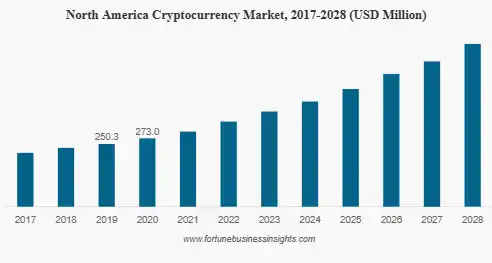
Source: Fortune Business Insights
What is driving adoption is practical infrastructure. Platforms such as Kraken, through its Kraken product, are pushing global transfers and yield features across hundreds of assets, while Revolut integrates crypto trading, staking, and debit card conversions inside a licensed banking framework.
These models make digital assets usable for payments, savings, and treasury management without forcing users to navigate fragmented tools.
The strongest signal comes from traditional finance. JPMorgan Chase partnering with Coinbase shows that large banks are embedding wallet connectivity and stablecoin rails directly into retail banking.
When eighty million bank customers can fund wallets or convert rewards into digital assets, crypto stops being parallel finance and becomes integrated finance. That integration is the real growth catalyst behind crypto bank platforms.

What is a Crypto Bank Platform?
Crypto bank platforms are digital financial institutions that combine traditional banking services with blockchain-based asset management. They allow users to store, transfer, trade, lend, and earn yield on cryptocurrencies, while also supporting fiat on- and off-ramps, debit cards, and regulated custody.
Unlike basic exchanges, these platforms integrate compliance frameworks, identity verification, and secure custody architecture to serve both retail users and institutional investors.
What Security Layers Protect a Crypto Bank Platform?
A crypto bank platform is protected by layered security that combines hardened infrastructure, secure key custody, and strict identity controls. It should actively enforce transaction validation, real-time monitoring, and strong encryption to protect assets and data.
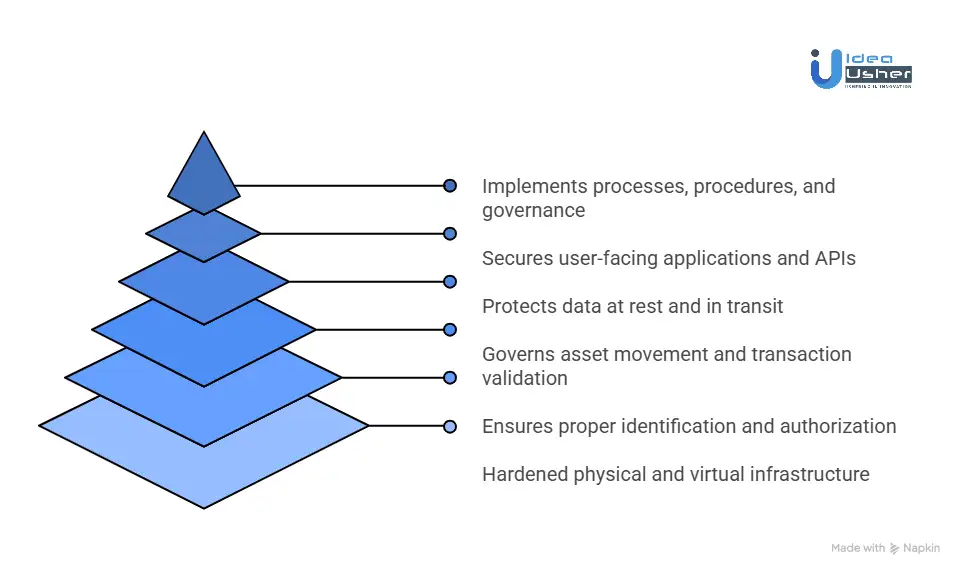
Layer 1: Infrastructure & Hardware Security
Before a single line of code runs, the physical and virtual infrastructure must be hardened.
Hardware Security Modules (HSMs)
HSMs are tamper-resistant hardware appliances specifically designed to generate, store, and manage cryptographic keys. Unlike software-based storage, HSMs ensure that private keys never leave the secure boundary of the device. They are the gold standard for root of trust in any serious crypto bank.
Trusted Execution Environments (TEEs)
Technologies like Intel SGX, AMD SEV, or AWS Nitro Enclaves create secure enclaves within the main processor. Even if an attacker gains root access to the server, they cannot see or modify the data being processed inside the TEE. This is critical for Confidential Computing, ensuring data remains encrypted even during processing.
Geographic Distribution
A resilient infrastructure is not housed in one location. Critical components and key shards are distributed across multiple geographic regions and availability zones. This ensures that a natural disaster, power outage, or regional cyberattack cannot take the entire platform offline.
Layer 2: Identity & Access Management (IAM)
Who gets in, and what can they do? This layer ensures that every human and machine interacting with the system is properly identified and authorized.
Multi-Party Computation (MPC) for Wallets
Unlike traditional Multi Sig, which uses multiple complete keys, MPC shards a single private key into multiple shares distributed across different locations. The key is never reconstructed in one place. To authorize a transaction, a threshold of these shares must participate in a cryptographic computation. This eliminates the single point of failure.
Role-Based Access Control (RBAC) & Policy Engines
Not all employees need access to everything. Granular RBAC ensures that a customer support agent cannot approve a withdrawal, and a junior trader cannot move funds to a whitelisted address.
Modern policy engines go further, allowing programmable rules like: “Transactions over $1M require approval from two specific roles AND a hardware key confirmation.”
Decentralized Identifiers (DIDs)
Moving away from centralized honey pots of user data, some platforms are adopting DIDs. Users control their own identifiers, and the bank verifies credentials, such as KYC status, using verifiable credentials and zero-knowledge proofs, without storing the underlying personal data.
Layer 3: Transaction Security & Validation
This layer governs how assets move, ensuring every transaction is legitimate, authorized, and mathematically sound.
Transaction Monitoring & Anomaly Detection
Real-time AI-powered behavioral analytics monitors every transaction. The system learns typical user behavior, including transaction amounts, frequency, and counterparties, and flags anomalies such as a sudden large transfer to a new address for additional verification or blocking.
Velocity Checks & Circuit Breakers
Automated rules prevent rapid suspicious outflows. If a wallet attempts to move an unusually high percentage of its funds in a short period, the system can automatically pause the transaction and require manual review or multi-factor authentication.
Smart Contract Audits & Formal Verification
For any on-chain logic, rigorous third-party audits are non-negotiable. Leading platforms go a step further by using formal verification, using mathematical proofs to confirm that a smart contract behaves exactly as intended, with no bugs or vulnerabilities.
Layer 4: Data Security & Privacy
This layer protects all data at rest and in transit, ensuring confidentiality and integrity.
End-to-End Encryption (E2EE)
All sensitive data, including user information, transaction details, and internal communication,s is encrypted from the moment it leaves the user device until it reaches its final destination. No one, including internal employees, can read the data in transit.
Zero Knowledge Proofs (ZKPs) for Compliance
ZKPs allow the bank to prove compliance without exposing sensitive data. For example, the platform can prove to an auditor that a user is over 18 and not on a sanctions list without ever showing the auditor the user’s passport or specific address. This is a game-changer for privacy-preserving compliance.
Database Encryption & Tokenization
Sensitive data stored in databases is encrypted at rest using strong modern algorithms, such as AES-256. Additionally, tokenization replaces sensitive values, such as wallet addresses or user IDs, with non-sensitive placeholders, reducing the risk of data exposure if a database is compromised.
Layer 5: Application & API Security
The user-facing applications and the APIs that connect them to the backend are the most exposed parts of the platform.
Web Application Firewall (WAF)
A WAF protects against common web exploits such as SQL injection, cross-site scripting, and DDoS attacks. It filters and monitors HTTP traffic between the web application and the internet.
API Gateway with Rate Limiting & Authentication
APIs are the backbone of any crypto bank. An API Gateway acts as a reverse proxy, authenticates all requests, enforces rate limits to prevent abuse, logs all activity, and validates input schemas. Every API call should require a valid short-lived API key or OAuth token.
Secure Development Lifecycle (SDLC)
Security is built in from the start. This includes regular code reviews, static and dynamic application security testing, dependency scanning for vulnerable libraries, and mandatory security training for all developers.
Layer 6: Operational Security & Governance
Technology is only half the battle. Processes, procedures, and people form the other half.
Multi-Person Control for Administrative Functions
Just as user funds are protected by MPC, critical administrative functions are protected through multi-person approval. No single individual should be able to deploy new code, change database schemas, or modify transaction limits. These actions require approval from multiple authorized parties.
Continuous Auditing & Monitoring
The platform is never set and forget. Continuous security information and event management systems aggregate logs from every layer, using AI to correlate events and detect potential intrusions in real time. Regular external penetration tests and audits are mandatory.
Incident Response Plan
A detailed and tested plan outlines exactly what happens in the event of a breach. It defines who is contacted, how users are notified, how funds are protected, and how the system is restored. A well-rehearsed plan can mean the difference between a minor incident and a catastrophic collapse.
How to Design Security for a Crypto Bank Platform?
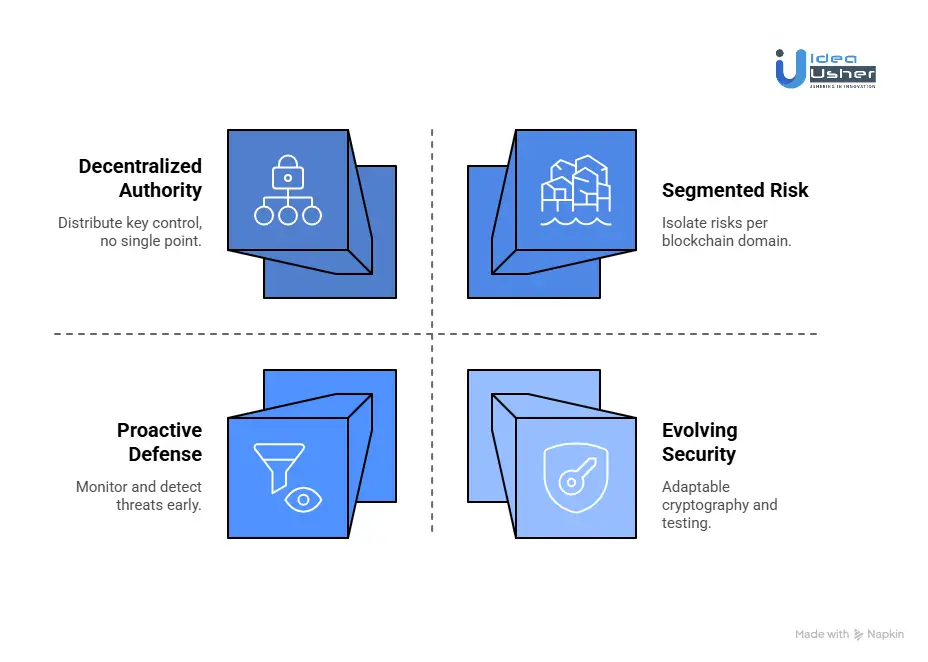
Designing security for a crypto bank platform begins by isolating custody layers and distributing key control via MPC, so no single system holds full authority. Real-time mempool monitoring and adaptive anomaly detection should be embedded to proactively stop suspicious transactions before confirmation.
We have engineered security architectures for numerous crypto bank platforms, and this is the framework we follow.
1. Tiered Custody
We start by separating operational wallets from long-term treasury vaults to define clear capital boundaries. We implement MPC-based signing clusters for transaction execution and anchor critical root shares inside hardened HSM environments. At this stage, we model blast-radius scenarios to ensure that any single compromise remains cryptographically contained.
2. Cross-Chain Segmentation
Every blockchain is treated as its own risk domain. We map exposure per chain and deploy bridge solvency monitors to track wrapped assets and liquidity health. Internally, we implement contagion-isolation logic to prevent a vulnerability on one network from spreading to the rest of the platform.
3. Mempool Threat Detection
Our monitoring layer begins before confirmation. We deploy pre-validation agents that analyze mempool activity for flash loan signatures and abnormal sequencing patterns. These signals feed into adaptive anomaly detection systems that can trigger governance controls to delay high-risk transactions.
4. Privacy-First Compliance
We design compliance to be enforceable without exposing sensitive data. Identity systems are decoupled from transaction-execution layers, and zero-knowledge attestations are used to verify regulatory eligibility. Sensitive off-chain data is encrypted and sharded to reduce centralized exposure.
5. Crypto-Agile Cryptography
We design cryptographic systems that can evolve. A modular verification engine allows algorithm upgrades without operational disruption, and hybrid signature support enables gradual post-quantum migration. Automated key rotation policies ensure long-term resilience against emerging cryptographic threats.
6. Continuous Adversarial Testing
Security is validated through structured red team exercises. We simulate advanced cross-chain exploits and governance abuse scenarios under controlled environments. AI-driven detection systems are stress tested against manipulation attempts to ensure defensive integrity remains strong.
How are Hot, Warm, & Cold Wallets Structured in a Crypto Bank Security Model?
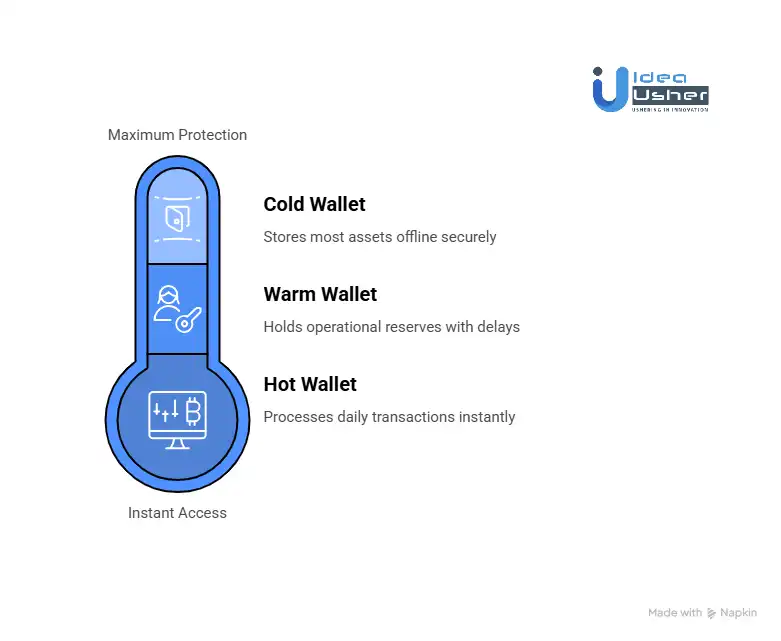
Hot wallets process daily online transactions, enabling funds to move instantly under strict controls. Warm wallets hold operational reserves with added approvals and time delays, so transfers can be verified carefully. Cold wallets store most assets offline with multi-party authorization, so capital remains securely protected.
The Three-Tiered Model: An Overview
Before diving into each layer, it is essential to understand the philosophy behind the segmentation:
| Wallet Type | Primary Use Case | % of Total Assets | Access Speed | Security Level |
| Hot Wallet | Daily withdrawals, trading, and operations | 1–8% | Instant | Moderate |
| Warm Wallet | Regular business operations, larger withdrawals | 15–25% | Minutes to Hours | High |
| Cold Wallet | Long-term storage, reserve funds | 70–80% | Hours to Days | Maximum |
This pyramid structure ensures that even if the most exposed layer is compromised, the vast majority of user assets remain completely untouched.
What Is a Hot Wallet?
A hot wallet is any cryptocurrency wallet that is permanently connected to the internet. In a banking context, these are the wallets that facilitate day-to-day operations: user withdrawals, exchange integrations, liquidity provisioning, and payment processing.
Structural Components
Implementation Architecture:
- Software-based wallets running on secure, monitored servers
- Multi-Party Computation MPC key sharding across multiple data centers
- Threshold signature schemes TSS requiring multiple approvals
- Real-time monitoring with AI-powered anomaly detection
Typical Setup:
- 3-5 MPC key shares distributed across geographic regions
- 2-of-3 or 3-of-5 signature thresholds
- Sub-second transaction signing capability
- Automated reconciliation with internal ledgers
Real-World Example: Phemex
Take Phemex, for example, a global cryptocurrency exchange. Following a security incident in January 2025, Phemex accelerated its security upgrades and now maintains less than 8% of total user assets in hot wallets at any given time.
This deliberate limitation ensures that, even in a worst-case scenario of a hot wallet compromise, the overwhelming majority of user funds remain isolated and unaffected.
Security Measures
Despite being hot, these wallets are far from unprotected:
- Transaction limits: Hard caps on maximum daily outflow per wallet
- Whitelist enforcement: Withdrawals only to pre-approved addresses
- Velocity checks: Automated circuit breakers for unusual activity
- Multi-person approval: Large transactions require multiple authorizers
- Continuous monitoring: 24/7 surveillance for suspicious patterns
Risk Profile
Hot wallets are the highest-risk tier, which is why they hold the smallest percentage of assets, typically just enough to cover 24-48 hours of anticipated withdrawal demand.
What Is a Warm Wallet?
Warm wallets strike the delicate balance between accessibility and security. They are connected to the internet, but with significant operational friction designed to prevent unauthorized access. Think of them as the bank’s operating account, funds that are not needed immediately but may be required for regular business operations.
Structural Components
Implementation Architecture:
- Hybrid custody solutions combining software and hardware security
- Hardware Security Module HSM integration for key storage
- Time-locked transactions with delay mechanisms
- Multi-signature Multi-Sig requirements across distributed parties
Typical Setup:
- Keys stored in HSMs across multiple secure locations
- 3-of-5 or 4-of-7 multi-signature requirements
- Transaction delays of 12-24 hours for large movements
- Geographically distributed approval workflows
Real-World Example: Gate.io
Consider Gate.io’s “Insurance Vault” (Gate 保险箱) solution, which exemplifies the warm wallet principle applied to specific use cases. The platform allows users to create dedicated accounts for different purposes, each with tailored security parameters.
For instance, a “DEX DeFi Account” used to interact with decentralized protocols employs a 48-hour delayed withdrawal mechanism. This provides users with a critical security window to review and cancel any suspicious transactions before funds are moved, a clear example of how warm wallets introduce deliberate friction as a security feature.
Security Measures
Warm wallets introduce deliberate friction as a security feature:
- Time locks: Transactions are not executed immediately but after a preset delay, allowing time for detection and cancellation of fraudulent attempts
- Geographic distribution: Signers located in different countries or time zones
- Dual control procedures: No single individual can initiate and approve a transaction
- Escalation protocols: Unusual transactions trigger additional approval layers
- Cold storage replenishment: Primary mechanism for refilling hot wallets
The Refill Mechanism
The warm wallet serves as the bridge between cold storage and hot wallets. When hot wallet balances run low, funds are moved from warm to hot through a controlled, multi-signature process. This ensures the hot wallet never holds more than necessary while maintaining liquidity.
What Is a Cold Wallet?
A cold wallet is completely offline and air-gapped from any network connection. These are the bank’s vaults, holding the vast majority of customer assets in deep freeze. No amount of remote hacking can access funds stored in properly implemented cold storage.
Structural Components
Implementation Architecture:
- Hardware wallets are stored in physical vaults
- Paper backups seed phrases in bank safety deposit boxes
- Geographically distributed physical locations
- Multi-layered physical security, including biometric access, security personnel, and surveillance
Typical Setup:
- Multiple hardware wallets from different manufacturers for redundancy
- 3-of-5 or 5-of-7 multi-signature across different devices
- Seed phrases split via Shamir’s Secret Sharing across multiple secure locations
- Physical access logs and dual control entry requirements
Real-World Example: Finprime.pro
Finprime.pro provides a textbook example of cold storage implementation. The platform stores a remarkable 95% of client digital assets in offline, air-gapped cold storage vaults secured by multi-signature authorization.
These vaults are geographically distributed to reduce exposure to localized disruptions such as natural disasters or regional cyberattacks.
Security Measures
Cold storage employs the most stringent security protocols:
- Physical air gap: No network connectivity whatsoever
- Geographic dispersion: Hardware and backups in different cities or countries
- Institutional grade vaults: Bank vaults, secure bunkers, or specialized custody facilities
- Multi-person physical access: Requires multiple authorized individuals to be present simultaneously
- Transaction construction offline: Transactions are built and signed on air gapped machines, then transferred via secure media QR codes or USB drives to broadcast
The Withdrawal Process
Moving funds from cold storage is intentionally slow and cumbersome:
- Initiation: Authorized personnel submit a withdrawal request through the banking platform
- Verification: Multiple internal and external parties verify the request’s legitimacy
- Physical access: Authorized signers physically travel to secure locations
- Transaction signing: Transactions are signed on air gapped devices
- Transmission: Signed transactions are securely transferred to online systems
- Broadcast: Transactions are broadcast to the blockchain
- Confirmation: Multiple confirmations are awaited before funds are considered moved
This process is designed to take 24-72 hours. The friction is the security.
How are Suspicious Transactions Frozen or Reversed, if at All?
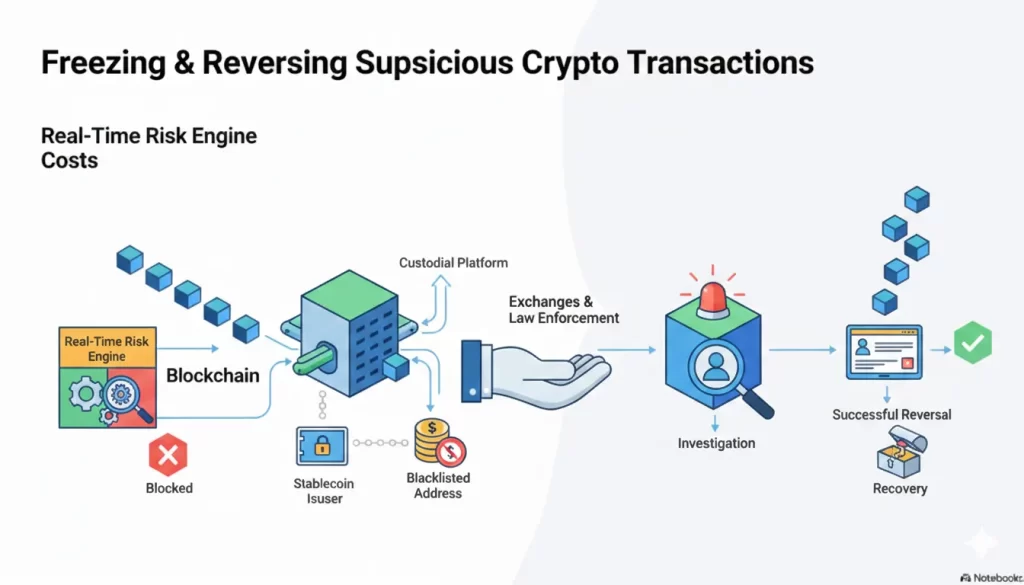
Suspicious transactions are usually intercepted before confirmation through real-time risk engines that can hold or block transfers. Custodial crypto banks can freeze user accounts or specific assets during compliance review. Stablecoin issuers can also freeze tokens at the smart contract level, which can effectively stop further movement on-chain.
1. Pre-Transaction Prevention
The most effective way to handle suspicious transactions is to stop them before they happen. Modern crypto banks employ sophisticated real-time screening mechanisms that would make traditional banks envious.
Real-Time Wallet Screening
Leading platforms integrate blockchain intelligence solutions like TRM Labs or Blockaid that screen every transaction against extensive databases of known malicious addresses. These systems:
- Scan destination addresses against databases of over 1 million reported scam addresses
- Flag high-risk transactions before the user hits “confirm.”
- Display real-time warnings to users about potential fraud
- Block transactions outright to addresses associated with sanctioned entities or known scams
TRM Labs reported that in 2024 alone, fraudsters stole at least $10.7 billion from crypto users, representing 24% of total illicit crypto volume. Real-time prevention aims to stop these losses at the critical moment before funds leave the user’s control.
Behavioral Anomaly Detection
AI-powered systems monitor user behavior patterns to identify potentially compromised accounts:
Sudden changes in transaction patterns, for example, a user who typically sends $100 suddenly attempts $50,000
- New device or location logins combined with large withdrawal attempts
- Velocity checks that flag rapid-fire transactions to multiple new addresses
- Time-based anomalies, for example, large transactions between 2 AM and 5 AM, which risk systems flag as suspicious
When these systems trigger, the platform may temporarily hold the transaction for additional verification, which may require biometric confirmation, video calls, or manual review.
2. On-Chain Freezing
While Bitcoin and Ethereum transactions are irreversible once confirmed, the same is not necessarily true for assets built on top of these blockchains, particularly stablecoins.
Smart Contract Blacklisting
Both USDT Tether and USDC Circle have built-in blacklist functions in their smart contracts. This means that even though the underlying blockchain, such as Ethereum, Tron, or Solana is immutable, the token contracts themselves can restrict movement from specific addresses.
How it works
- The stablecoin issuer adds an address to a blacklist
- The smart contract rejects any transfer attempts from that address
- Funds in that address become “frozen”. They cannot be moved, but they remain visible on-chain
Tether’s Proactive Approach
Tether has established a reputation for aggressive intervention. According to documentation, Tether has built-in blacklist and backdoor mechanisms that allow it to freeze specific addresses and suspend USDT transfer functionality.
Notable examples:
- September 2020. When the KuCoin exchange was hacked, Tether froze approximately $35 million in USDT within hours
- August 2021. During the Poly Network cross chain bridge hack, Tether immediately froze about 33 million USDT in the hacker’s address
- As of September 2024. Tether claims to have frozen at least 1,850 wallets involved in illegal activities, helping recover approximately $1.86 billion in assets
Circle’s Compliance-Driven Model
Circle takes a more conservative approach, typically freezing addresses only upon receiving valid law enforcement or court orders. Circle explicitly states in its terms of service that once USDC completes an on-chain transfer, the transaction is irreversible, and Circle has no unilateral right to reverse it.
However, Circle acts decisively when compliance demands it:
- August 2022. After the U.S. sanctioned Tornado Cash, Circle froze approximately $75,000 worth of USDC on sanctioned addresses
- September 2023. At Argentina’s request, Circle froze two Solana addresses belonging to a fraudulent token team, totaling about 57 million USDC
This difference in approach reflects broader philosophical divisions in the crypto community about the balance between immutability and consumer protection.
3. Exchange-Level Freezing
For crypto banks that operate custodial platforms, where the bank holds users’ private keys, intervention is much more straightforward.
Account-Level Restrictions
When suspicious activity is detected, custodial platforms can:
- Freeze accounts entirely. Preventing any outgoing transfers
- Place accounts in withdrawal-only mode. Allowing funds in but not out
- Freeze specific assets. Restricting the movement of funds linked to suspicious activity while allowing the normal operation of other funds
- Require additional verification. KYC revalidation before restoring access
The “Clean Funds” Paradox
Interestingly, accounts can be frozen even when funds are technically “clean”. As Fedor Ivanov, director of analytics at Shard, explains, an exchange’s risk assessment is shaped by more than just the cleanliness of crypto. It includes registration data, transaction patterns, and broader behavioral factors.
A user might have perfectly legitimate funds, but trigger a freeze through:
- Receiving large transfers from addresses that later become flagged
- Transaction patterns that resemble money laundering, such as rapid movements or round numbers
- Geographic risk factors, for example, European platforms scrutinizing transfers involving certain jurisdictions
4. Fiat Ramp Freezing
Perhaps the most common form of transaction intervention occurs not on the blockchain, but at the fiat on- and off-ramp, where cryptocurrency meets traditional banking.
Bank Account Freezes
When a user converts crypto to fiat and withdraws to a bank account, that fiat enters the traditional banking system with all its regulatory machinery. Banks are legally obligated to monitor transactions under AML and KYC regulations.
Why banks freeze accounts:
| Trigger | Description |
| Large or irregular incoming transfers | Unexpected large deposits from unknown individuals |
| Frequent small credits | Patterns resembling money laundering structuring |
| Flagged wallet connections | Funds from addresses linked to scams or illicit activity |
| P2P trading volume | High volume crypto trading through personal accounts |
As one P2P trader in São Paulo discovered, selling $1,200 worth of USDT led to his account being frozen within hours. The bank’s automated systems flagged frequent crypto-related transfers as suspicious.
The Investigation Process
When a bank freezes an account:
- Automated flagging. The bank’s transaction monitoring system detects suspicious patterns
- Manual review. Compliance officers investigate the flagged transactions
- Account holder contact. The bank may reach out for documentation, such a sthe source of funds or proof of transaction
- Extended hold. Funds can remain frozen for weeks or months during the investigation
- Resolution options. Account unfrozen, funds returned to sender, or funds turned over to law enforcement
5. Law Enforcement Collaboration
When significant fraud occurs, crypto banks work closely with law enforcement to trace and potentially recover funds.
The Time Lag Challenge
One of the most frustrating aspects for users is the time difference in police investigations. As Binance explains, a transaction might be perfectly legitimate at the time of execution, but become problematic months later when a victim reports the scam.
How this happens:
- Scammer uses Victim A’s stolen money to buy cryptocurrency
- At that moment, Victim A is unaware of the theft and hasn’t reported it
- The transaction clears as “clean.”
- Two months later, Victim A reports the crime.
- Police trace the funds backward and freeze the receiving account.
Asset Recovery Mechanisms
When law enforcement becomes involved, several outcomes are possible:
- Wallet blacklisting: The scammer’s address is added to global blacklists, preventing future transactions
- Exchange cooperation: If funds reach a centralized exchange, that exchange may freeze the account holding them
- Court-ordered returns: In some jurisdictions, courts can order the return of frozen assets to victims.
- Asset forfeiture: In criminal cases, seized assets may eventually be returned to victims through legal processes
TRM Labs coordinates with over 150 global agencies and major exchanges through its Beacon Network to enable asset freezes and victim restitution.
Top 5 Crypto Bank Platforms in the USA
We have carefully reviewed the market and identified a few crypto banking platforms that stand out for their security architecture and regulatory depth. These platforms could offer advanced custody frameworks, distributed key controls, and structured compliance systems that are designed for institutional capital.
1. Sygnum Bank – Regulated Digital Asset Bank
Sygnum Bank is a Swiss-licensed digital asset bank offering integrated banking, trading, and custody under strict regulatory supervision. It combines traditional banking controls with an advanced crypto custody architecture designed for institutional protection.
Security highlights:
- Air-gapped cold storage environments
- Multi-Party Computation for distributed key control
- FIPS-140 Level 3 Hardware Security Modules
- Off-balance-sheet asset segregation
- Embedded AML and compliance monitoring
2. Standard Chartered – Institutional Crypto Services

Standard Chartered has expanded into digital asset custody and trading through regulated frameworks. As a global Tier-1 bank, it integrates crypto services into established compliance, capital, and operational risk systems.
Security highlights:
- Bank-regulated custody environment
- Secure fiat-to-crypto settlement infrastructure
- Enterprise-grade compliance and monitoring systems
- Institutional governance controls
3. Anchorage Digital – Federally Chartered Bank
Anchorage Digital Bank N.A. is the first federally chartered crypto bank in the United States. It operates under U.S. banking supervision and focuses heavily on cryptographic security and identity-bound access control.
Security highlights:
- Biometric authentication for transaction approval
- MPC-based key management
- Hardware isolation environments
- Federally regulated custody structure
- Institutional staking with policy controls
4. Xapo Bank – Crypto-Native Licensed Bank

Xapo Bank is licensed in Gibraltar and blends Bitcoin custody with traditional USD banking services. It has historically emphasized deep cold-storage architecture and long-term asset preservation.
Security highlights:
- Deep cold storage vault systems
- Licensed virtual asset service framework
- Integrated USD and Bitcoin accounts
- Structured regulatory compliance
5. BNY Mellon – Institutional Digital Asset Custody

BNY Mellon has expanded into digital asset custody for institutional clients. It integrates crypto custody into its traditional global custody framework, backed by decades of operational risk management.
Security highlights:
- Institutional custody framework integration
- Regulated banking infrastructure
- Enterprise security governance
- Established audit and reporting systems
Conclusion
Designing security for a crypto bank platform involves building adaptive, layered resilience across custody, compliance, liquidity, and cryptography. Platforms that invest early in security-by-design can attract institutional capital, minimize catastrophic exposure, and accelerate regulatory approval. At IdeaUsher, we integrate MPC orchestration, HSM controls, and AI-driven threat monitoring to enable crypto banking systems to scale securely and operate with long-term stability.
Looking to Develop a Crypto Bank Platform?
At IdeaUsher, we design and build crypto bank platforms with institutional-grade custody compliance and liquidity architecture embedded from the start. Our team can implement MPC-based key orchestration, HSM integration, and real-time risk monitoring so the system operates securely under regulatory scrutiny.
With 500,000+ hours of coding experience, our team of ex-MAANG/FAANG developers has engineered financial platforms that handle millions in transactions daily.
What We Bring to Your Project:
- MPC Wallet Architecture — Distributed key sharding, never a single point of failure
- Smart Contract Development — Audited, gas-optimized, production-ready
- Cross-Chain Bridges — Atomic swaps with zero settlement risk
- ZK-Proof KYC/AML — Privacy-first compliance that protects user data
- High-Frequency Trading Engines — Sub-second finality for institutional traders
- Hardware Security Module Integration — Military-grade key protection


FAQs
A1: The custody architecture is the most critical layer because control of private keys ultimately determines control of assets. If key material is exposed even once, capital can be permanently lost. That is why MPC signing, combined with hardened HSM root protection, should be implemented early so asset authority remains cryptographically segmented and resilient.
A2: MPC is generally more secure than traditional multi-signature wallets because it does not reconstruct a full private key at any stage. Signature shares are generated independently and combined mathematically, reducing the risk of a single-point compromise. In institutional environments, this model can significantly strengthen operational security and fault tolerance.
A3: Preparation for quantum risk should begin with a crypto agile architecture that supports modular signature upgrades. Hybrid schemes that combine classical and post-quantum primitives can be introduced gradually without disrupting operations. Automated key rotation and structured migration planning will further strengthen long-term cryptographic resilience.
A4: Cross-chain security requires strict transaction validation and real-time liquidity monitoring across networks. Atomic transfer logic can reduce settlement risk, while bridge solvency tracking helps detect imbalance early. Internal liquidity guards and conditional withdrawal controls should be enforced to prevent failures on one chain from spreading across the platform.