

There was a time when experience alone could guide decisions, but today markets move faster and behave less predictably. Businesses must now act quickly while managing uncertainty that intuition may struggle to handle. Manus AI analysis modes strengthen judgment by testing assumptions instantly and simulating outcomes before commitments are made.
They can also scan live data sources, validate findings across the web, and adapt analysis as conditions change. This approach does not replace human thinking but supports it with structured, context-based reasoning. Manus AI connects research, execution, and verification into a single workflow, rather than fragmented steps.
We have built numerous AI-driven research platforms and agentic analytics solutions over the years, leveraging technologies such as agentic AI architectures and autonomous data orchestration frameworks. As we have this expertise, we’re sharing this blog to discuss how Manus AI analysis modes can be applied to generate reliable business insights.
Key Market Takeaways for AI for Business Insights
According to Fortune Business Insights, the global artificial intelligence market is entering a high-growth phase, with valuations ranging from USD 372 billion to over USD 540 billion in 2025, depending on the methodology. Long-term projections point to multi-trillion-dollar expansion by the early 2030s, driven largely by enterprise demand. North America continues to lead adoption, supported by strong innovation ecosystems and widespread use of AI-powered business intelligence tools across industries.
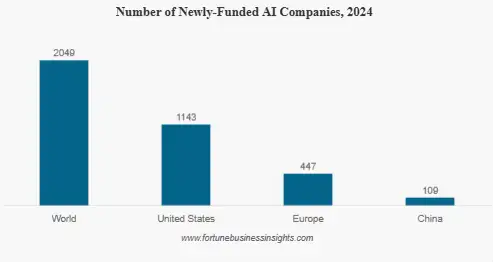
Source: Fortune Business Insights
AI for business insights is accelerating as organizations rely on it for predictive analytics, real-time decision support, and operational optimization. Many businesses now report measurable gains from AI-led decision systems, particularly as cloud-native platforms make advanced analytics accessible beyond large enterprises.
Modern BI is evolving from static reports into intelligent systems that proactively surface insights, using natural language interfaces and generative AI to help non-technical users explore complex datasets with ease.
Real-world implementations illustrate this shift clearly. Domo uses AI-driven dashboards with more than 400 data connectors to help enterprises monitor performance, detect anomalies, and act on insights at scale.
JPMorgan Chase has rolled out an internal LLM Suite to over 200,000 employees, enabling conversational access to data and dramatically reducing information retrieval time. These examples highlight how AI for business insights is moving from experimentation to mission-critical infrastructure.

What is the Manus AI Platform?
Manus is an AI-powered platform designed as an action engine that executes tasks, automates workflows, and delivers practical results beyond simple chat responses. It focuses on hands-on AI tools for productivity, web development, content creation, and automation, with a clear list of user-facing features prominently displayed on its homepage.
How Manus AI Performs on Industry Standard Benchmarks?
Manus AI performs strongly on industry-standard benchmarks because it can reason through tasks and execute them inside real environments rather than stopping at analysis. On benchmarks like GAIA and CUB, it should reliably plan steps, run code, and verify results while adapting to unexpected conditions.
The Benchmarks That Matter
Before reviewing the results, it is important to understand what these benchmarks measure and why they are considered industry standards for evaluating AI agents.
GAIA: The General AI Assistant Benchmark
GAIA is designed to reflect real human work rather than isolated knowledge tests. It evaluates an AI agent’s ability to:
- Follow complex and multi-step instructions
- Use digital tools such as browsers, calculators, and file systems
- Synthesize information from text, images, and structured tables
- Deliver precise and verifiable outputs
Why it matters
GAIA focuses on practical problem-solving rather than trivia. The tasks resemble real-world workplace scenarios, such as calculating growth rates from public datasets, producing summary charts, or completing forms by combining attached guidelines with live website data.
CUB: The Code Understanding and Behavior Benchmark
CUB evaluates how effectively an AI agent operates inside a computational environment. It tests the agent’s ability to:
- Interpret and execute code
- Navigate and manipulate file systems
- Operate within a sandboxed operating system
- Debug errors and adapt to unexpected outcomes
Why it matters
CUB measures technical autonomy. It demonstrates whether an AI can move beyond conversation and actively work inside a computing environment. This capability is essential for automation, advanced data analysis, and software-related workflows.
Manus AI’s Benchmark Performance
Public technical reports and benchmark disclosures show that Manus AI performs at a top tier level across both GAIA and CUB. In many cases, it matches or exceeds the performance of other leading AI agent frameworks. This performance is a direct outcome of Manus’s underlying system design.
| Benchmark | What it Tests | Why Manus Excels |
| GAIA | Manus splits tasks cleanly across planning, execution, and verification, which closely matches how GAIA evaluates real-world task handling. | Manus natively runs code in its own sandbox, making CUB tasks a natural fit rather than a special case. |
| CUB | Code execution and sandboxed environment control | Manus natively writes and runs code inside its own sandbox, making CUB tasks a natural fit rather than a special case. |
How Does the Manus AI Platform Work?
Manus works like a coordinated system rather than a single AI brain, and it can quietly plan complex tasks before any action begins. It then actively executes research code and data processing through autonomous agents that may operate real tools in real time.
Each result is verified and refined, ensuring the platform delivers outputs that feel reliable and technically grounded.
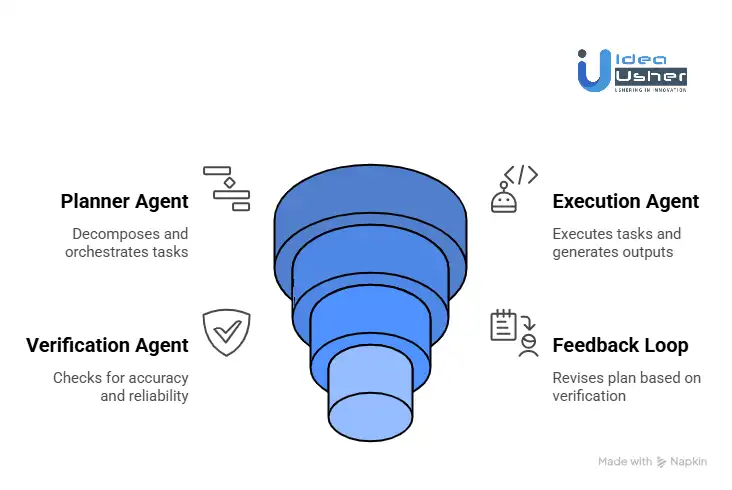
1. The Planner Agent
The process begins the moment a request is submitted, such as “Analyze our top 50 competitors and create a market positioning dashboard.” The Planner Agent is the first to engage and functions as the system’s strategic lead.
Problem Breakdown
This agent does not treat the request as a single instruction. It decomposes the goal into granular actions by identifying required data sources, analytical steps, execution order, and the most suitable output format.
Task Orchestration
It constructs a dynamic workflow that may include steps such as identifying competitors, scraping live pricing data, analyzing sentiment from recent news, estimating market share, and preparing visual dashboards.
Initial Blueprint
This plan acts as an intelligent blueprint rather than a fixed script. It can adapt as new data appears or constraints are discovered during execution.
2. The Execution Agent
Once the plan is finalized, the Execution Agent takes over. This agent is responsible for action and delivery rather than reasoning alone.
Tool Mastery
The agent operates Manus’s internal computing environment. It opens browsers for live research, writes and runs Python scripts in sandboxed terminals, processes files, and builds functional components such as dashboards or web prototypes.
Autonomous Task Completion
It executes tasks sequentially based on the Planner’s instructions. For example, it may extract data from competitor websites, normalize datasets, perform calculations, and generate charts without manual intervention.
Hands-On Output
Its work produces tangible assets, including CSV files, analytical scripts, charts, structured datasets, and draft interfaces that form the foundation of the final output.
3. The Verification Agent
Accuracy is what separates enterprise-grade AI systems from experimental tools. The Verification Agent ensures the output meets strict reliability standards.
Quality and Accuracy Checks
This agent validates calculations, cross checks extracted data against sources, verifies logical consistency, and confirms that visualizations accurately reflect the underlying information.
The Guard Against Hallucination
It ensures every statistic, claim, or conclusion is traceable to real data. Unsupported assumptions or fabricated insights are identified and rejected.
Flagging for Re-Planning
If gaps or inconsistencies are found, the agent flags them back to the Planner Agent rather than silently correcting them.
4. The Feedback Loop
This feedback loop is what gives Manus its adaptive intelligence. The system does not operate in a straight line.
Error Correction and Optimization
Upon receiving feedback, the Planner Agent revises the workflow. It may trigger additional data collection, adjust analysis techniques, or refine assumptions.
Iterative Improvement
The Plan, Execute, Verify cycle repeats until all quality checks are satisfied. This ensures the final output is not a draft but a verified and production-ready business asset.
5. Delivery
Once verification is complete, Manus delivers the final result in a usable and structured format. Depending on the task, this may include:
- A detailed PDF report with charts and written insights
- A live dashboard with interactive visualizations
- A structured dataset, such as a CSV or database export
- A functional prototype web application
What are the Main USPs of the Manus AI Platform?
Manus AI stands out because it can independently plan and execute complex tasks end-to-end with minimal oversight, which may genuinely change how teams delegate technical work. It uses a multi-agent system that can reason, act, and verify in parallel, so results are produced faster and usually with higher reliability.
Because it operates directly with live tools and secure cloud environments, it can realistically move from intent to execution in a way most AI systems still cannot.
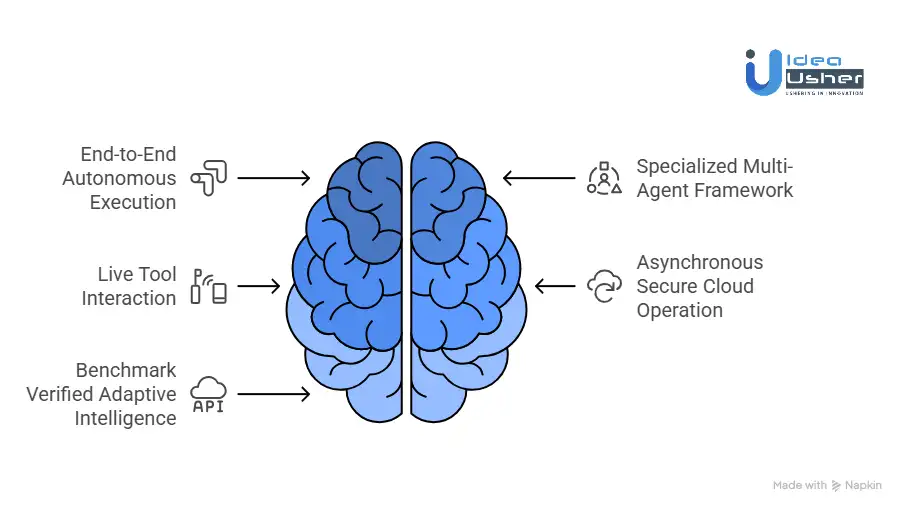
1. True End-to-End Autonomous Execution
While many AI tools assist with tasks, they often require constant human prompting, direction, and quality checking. Manus AI operates differently. You provide a high-level natural language goal, such as creating a competitive analysis of the top 20 SaaS companies in a niche, and the platform takes ownership of the entire workflow.
It plans the steps, executes the research, analyzes the data, builds the report, and delivers a polished and actionable outcome. This fundamentally shifts the user’s role from micro manager to strategic overseer.
The Business Impact: Reclaim critical hours and enable teams to delegate complex digital projects with confidence that tasks will be completed independently and correctly.
2. Specialized Multi Agent Framework
Unlike single model systems that attempt to handle everything sequentially, Manus is built around a coordinated group of specialized agents. This is not a conceptual metaphor but the core architectural design.
- Planner Agent: Defines strategy and decomposes goals into optimal workflows
- Execution Agent: Performs tasks using real digital tools such as browsing, coding, and calculations
- Verification Agent: Audits outputs continuously for accuracy and quality and feeds corrections back into planning
This framework allows planning, execution, and verification to occur in parallel, significantly improving speed, accuracy, and reliability for complex workflows.
The Business Impact: Execute projects at a scale and complexity that typically require an analyst team, a developer, and a QA specialist working together in sync.
3. Live Tool Interaction & Real World Execution
Most AI systems are confined to text generation. Manus AI actively interacts with the digital environment in the same way a human operator would.
- Browses the live web to access current information rather than relying on static training data
- Logs into permitted software tools to extract or input data
- Executes code in sandboxed environments for analysis and software creation
- Manipulates files and applications to generate real deliverables
- This capability transforms AI from an advisory system into an execution engine.
The Business Impact: Automate workflows that span real business operations, from live market research and reporting to building internal tools and functional prototypes.
4. Asynchronous Secure Cloud Operation
Manus executes tasks inside isolated cloud based virtual environments, delivering two core advantages.
- Security and Isolation: Each task runs in a dedicated sandbox, keeping data isolated from other users and the underlying system.
- Asynchronous Execution: Tasks can run for hours without requiring an open browser or active supervision. Users receive notifications once execution is complete.
The Business Impact: Launch long-running and compute-heavy projects without consuming local resources or personal time, while maintaining confidence in data security.
5. Benchmark Verified Adaptive Intelligence
Manus capabilities are validated through industry-standard benchmarks, such as GAIA for real-world task execution and CUB for code and environment interaction.
These results position Manus among the top tier of AI agent platforms. Beyond benchmarks, the system continuously adapts through verification and re-planning loops. It learns from execution failures and optimizes strategies in real time, making it well-suited to unpredictable, evolving business scenarios.
The Business Impact: Lower adoption risk by choosing a platform with objectively measured performance that improves over time, resulting in consistently higher quality outcomes for mission-critical workflows.
What is the Business Model of Manus AI Platform?
The Manus AI Platform operates as a subscription-based general AI Agent service that enables autonomous task execution across research, automation, and application development.
Since its launch in March 2025, the platform scaled rapidly, reaching $100M in ARR within eight months. Its total revenue run rate is approximately $125M, including usage-based fees.
Subscription Tiers
The primary source of revenue comes from recurring subscription plans such as Team and Startup tiers, managed through Stripe Billing. Manus serves SMBs across more than 200 countries and supports localized pricing in 31 currencies, including USD, EUR, and GBP.
Usage-Based Pricing
In addition to subscriptions, Manus applies a credit-based pricing system for compute-intensive workloads. Since launch, the platform has processed over 147 trillion tokens and provisioned more than 80 million virtual computers.
Freemium to Paid Funnel
Growth is driven by a freemium onboarding model that converts free-trial users into paid subscribers. This strategy enabled Manus to reach a $90M revenue run rate within 4 months, supported by optimized checkout flows in which more than 50% of transactions occur via Stripe Link.
Financial Performance
Manus reached a $90M run rate within 4 months of launch in 2025 and crossed $100M in ARR, with a $125M total revenue run rate by December 2025. This marked one of the fastest trajectories to $100M among software startups.
Growth Metrics
The platform maintains over 20% month-over-month revenue growth, serves millions of daily users, and has processed more than 147 trillion tokens across its workloads.
Payment Efficiency
Smart retries and automated invoicing significantly reduced churn and enabled global expansion without the need for region-specific payment infrastructure.
Funding and Acquisition
Manus secured an undisclosed seed round prior to its March 2025 launch. Details on early funding rounds remain limited in public disclosures.
Meta Acquisition
In late December 2025, Manus was acquired by Meta Platforms for a valuation exceeding $2B. The platform is being integrated as an AI execution layer within Meta’s ecosystem, with a continued focus on customer continuity.
Following the acquisition, the company shifted its focus away from fundraising toward product innovation and platform expansion within Meta.
How to Use Manus AI Analysis Modes for Business Insights?
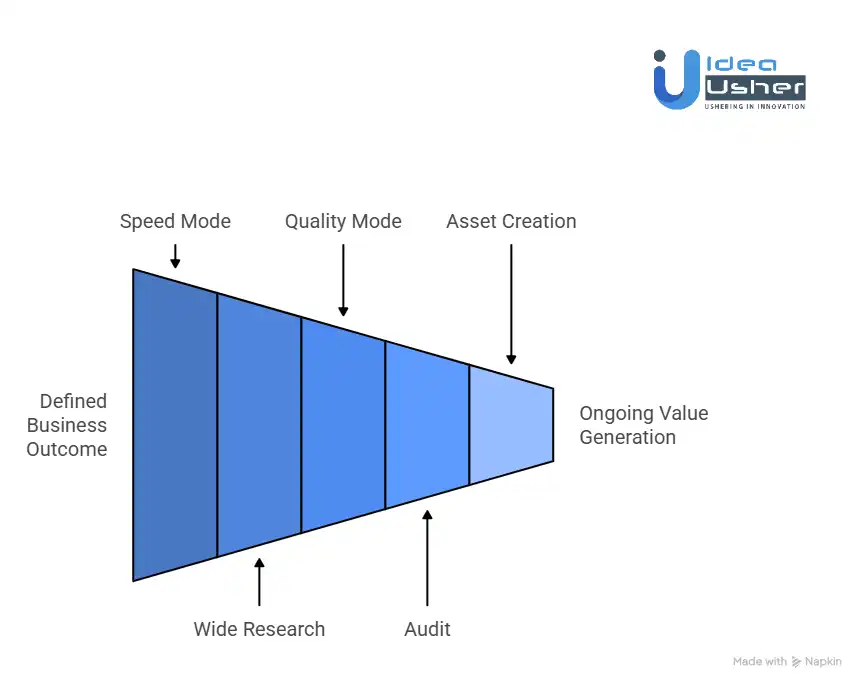
Manus AI analysis modes work best when a clear business outcome is defined first and the system is allowed to plan its execution path. Speed mode may quickly validate direction, while wide research and quality modes should progressively deepen the analysis with structure and verification.
When used this way, insights can reliably support technical decisions and strategic planning.
1. Outcome First, Not Prompts
Manus delivers better results when it is guided by a defined business outcome instead of a question. By stating the decision, output format, and tolerance for error upfront, the system can plan its execution path automatically. This removes the need for repeated prompting and enables true autonomous analysis.
2. Speed Mode for Direction Checks
Speed Mode works best as a fast filter to test whether an idea is worth pursuing. It helps scan trends, review competitors, and validate early assumptions quickly. This allows teams to discard weak opportunities before committing to deeper research.
3. Wide Research for Market View
Wide Research Mode is used once the direction is clear and market-scale intelligence is needed. Manus runs parallel agents to scan many companies and extract structured data with consistent depth. This provides a complete market view rather than a high-level summary.
4. Quality Mode for Final Decisions
Quality Mode turns validated data into decision-ready outputs. Manus builds a structured research plan, performs calculations, verifies findings, and produces polished deliverables. The results are suitable for leadership reviews and strategic decision-making.
5. Audit Before Action
Reviewing execution replays, scripts, and raw data ensures the insights can be trusted. This step makes the analysis transparent and auditable, similar to reviewing the work of an internal analyst. It also supports governance and compliance needs.
6. Turn Insights into Assets
The final step is converting insights into ongoing value. Outputs can be transformed into dashboards, integrated into internal tools, or offered as APIs and subscriptions. This shifts Manus from a research tool into a long-term value generator.
How Does Manus AI Differ from Traditional BI Tools like Tableau or Power BI?
Traditional BI tools like Tableau or Power BI help teams see what already happened through dashboards and reports. Manus AI goes further by analyzing why it happened and could automatically research signals across internal and external data.
It may then act on those insights by executing workflows or preparing decisions rather than stopping at visualization.
The Core Distinction: Presentation vs. Execution
The most critical difference can be distilled into a single concept.
Traditional BI tools (Tableau, Power BI) are Presentation Layers.
It excels at answering: “What happened?” and “What is happening now?”
These tools connect to your databases (SQL, Snowflake, etc.), transform data, and create beautiful, interactive dashboards for human analysis. They are the endpoint of a data pipeline.
Manus AI is an Execution Layer.
It is designed to answer: “What should we do about it?” and “Can you go do it?”
Manus does not just show data. It acts on it. It begins where BI tools often end and uses insights as a trigger for autonomous research, decision-making, and task completion. This shift changes how intelligence is used across the organization.
A Comparative Lens: Other BI Tools vs. Manus AI
Other BI tools are built to help teams explore data and understand patterns after the fact. Manus AI could actively investigate causes and may connect signals across internal systems and the open web. It can then act on those findings by executing analysis driven workflows rather than stopping at charts.
| Aspect | Traditional BI (Tableau, Power BI) | Manus AI |
| Primary Role | Data visualization and exploration | Autonomous analysis and action |
| User Input | Drag and drop configuration and SQL queries | Primarily structured internal data, including databases, data warehouses, and spreadsheets |
| Core Output | Static or interactive dashboards, charts, and reports | Completed outcomes such as research reports, built tools, executed tasks, and synthesized findings |
| Data Source | Historical trend analysis, real-time KPI monitoring, and governed self service reporting | Natural language goals or high-level instructions |
| Process | Any digital source, including live web data, APIs, unstructured documents, internal databases, and competitor websites | Autonomous and AI-driven, where the system plans, gathers, analyzes, verifies, and executes |
| Key Question It Answers | What are our Q3 sales by region | Why did sales decline in the Midwest in Q3 and what are the top five actionable strategies to correct it by next quarter |
| Strengths | Historical trend analysis, real-time KPI monitoring, and governed self-service reporting | Strategic planning, predictive scenario modeling, competitive intelligence, and automated workflow execution |
How Manus AI Complements and Extends Your BI Stack
Think of a BI tool as the instrument panel of your business. It shows speed, fuel levels, and system health clearly and reliably. Manus AI acts like the autopilot and engineering team combined.
1. From Insight Generation to Insight Application
Traditional BI Tools: A dashboard highlights a sudden forty percent drop in website traffic from a key referral source.
Manus AI Next Step: A leader can instruct Manus to investigate the traffic drop from Referral Source X. It can analyze recent changes on the source website, scan news and forums for brand mentions, and draft a response strategy with outreach points. Manus autonomously performs this research and delivers a ready to execute plan.
2. From Internal Data to Holistic External Intelligence
Traditional BI Tools: Tracks internal marketing spend and lead conversion rates.
Manus AI Expansion: A user can ask Manus to analyze the marketing campaigns of the top three competitors over the past quarter. It can estimate spend channels, messaging themes, and audience engagement using public signals. This type of external intelligence sits completely outside the scope of traditional BI platforms.
3. From Static Reporting to Dynamic Workflow Creation
Traditional BI Tools: A weekly report displays new user sign-ups.
Manus AI Automation: A workflow can be defined where Manus analyzes weekly sign-ups every Monday, segments users by plan type and geography, enriches premium European leads with company data, and generates personalized briefs for the sales team. The insight becomes an automated operational process.
The Strategic Verdict
Manus AI is not a better version of Tableau. Using it only to build dashboards would miss its core value.
- Use Tableau/Power BI for: monitoring KPIs, exploring your governed data, creating standardized company reports, and performing manual deep-dive analytical exploration.
- Use Manus AI for: Strategic decision support, automating complex research, generating net-new intelligence from the open web, and executing tasks based on data-driven conclusions.
Together, they form a complete intelligence cycle:
- BI Tools tell you what is happening inside your business.
- Manus AI investigates why it’s happening (using internal and external data) and executes the response.
How does Manus AI Maintain Insight Quality Across Different Industries?
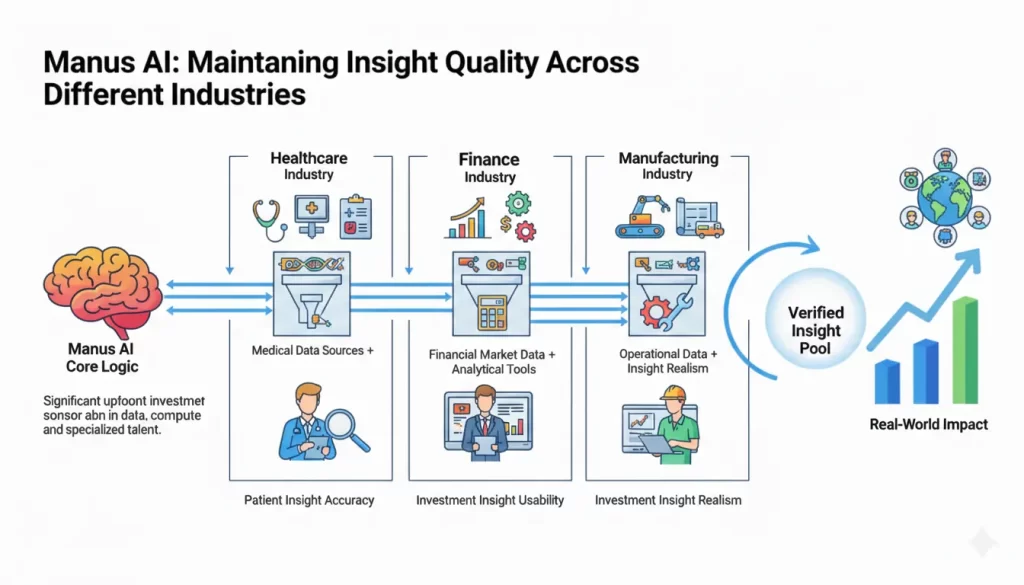
Manus AI keeps insight quality high by adapting its thinking rather than forcing every industry into a single fixed logic. It can usually choose the right data sources and tools for each domain while framing the problem in industry terms. It should then verify its conclusions through domain-specific checks to ensure the insight remains accurate and usable.
1. Adaptive Problem-Solving Architecture
Unlike a search engine or a basic chatbot, an advanced AI platform does not apply the same reasoning to every query. Instead, they use a dynamic framework that shifts strategy based on the task’s nature.
For Financial Analysis
The system recognizes the need for numerical precision, regulatory-grade data sources such as SEC filings, and time series modeling. It prioritizes quantitative agents, statistical validation, and structured outputs like spreadsheets or financial charts.
For example, platforms such as AI21 Labs’ offerings or agent systems built on LangChain may connect to financial databases and perform calculations using structured reasoning. However, they often operate within linear and predefined pipelines tailored to narrow task categories.
For Market and Competitor Research
The system shifts toward qualitative and web-focused agents. It emphasizes sentiment analysis, live website scanning, trend extraction from news and social media, and synthesis into structured SWOT style reports.
For Technical and Product Research
The architecture activates agents capable of parsing technical documentation, academic papers, and code repositories. The focus moves to feature comparison, specification analysis, and gap identification.
2. Context-Aware Execution and Tool Mastery
High-quality insights depend on using the right tools and framing the right questions. Autonomous platforms maintain consistency through the following mechanisms.
Industry Specific Source Prioritization
When researching pharmaceutical trends, the system prioritizes clinical trial databases such as ClinicalTrials.gov, peer-reviewed journals, and FDA announcements over general news sources. In retail analysis, it focuses on ecommerce platforms, review sites, and consumer sentiment data.
Purpose Driven Tool Selection
The platform does not simply perform searches. It selects tools intentionally. This may include a headless browser for interacting with live financial dashboards, a Python environment for running Monte Carlo simulations in engineering analysis, or document parsing agents to extract clauses from legal or real estate contracts.
Domain Aware Prompt Framing
Internal task prompts are shaped by industry context. An instruction to analyze growth looks very different for a SaaS company, where metrics like MRR, churn, and feature adoption matter, versus a manufacturing business, where throughput, unit economics, and logistics dominate.
3. The Iterative Verification Loop
This is the most critical mechanism for maintaining insight quality across domains. A strong insight in one industry could be a serious error in another. The platform embeds a self-checking loop that maintains consistency in its process while adapting its validation logic to each field.
Step 1: Cross-Referencing and Source Validation
After collecting data, a verification agent verifies claims against multiple authoritative industry sources. Drug efficacy claims are validated against published studies, while market share estimates are cross-checked with industry reports.
Step 2: Logical Consistency and Plausibility Checks
The system applies domain-specific reasoning rules. In energy analysis, it flags claims that exceed known physical efficiency limits. In logistics, it questions routes that are geographically or operationally impossible.
Step 3: Output Format and Usability Validation
Quality also means actionability. The platform ensures the final output matches industry expectations. This may include a clinical trial summary for biotech teams, a property comparables report for real estate professionals, or an interactive dashboard for digital marketing teams.
4. Feedback & Pattern Recognition
Without relying on personal user data, sophisticated platforms are engineered to learn from their own execution history. Over thousands of completed tasks:
- They identify which sources consistently produce reliable data for specific problem types, such as government and academic domains for regulatory analysis.
- They refine how complex problems are broken down across industries, improving efficiency and depth over time.
This form of meta learning allows the platform to strengthen its industry specific reasoning capabilities continuously, without manual retraining for every new vertical.
Conclusion
Manus AI analysis modes change how businesses might create and rely on insights in real operational settings. They can gradually shift analytics from static reporting to systems that actively guide decisions and unlock new revenue streams. For platform and enterprise leaders, this could realistically serve as a foundation for building scalable, insight-driven products rather than just another AI capability.
Looking to Develop an AI Agent Platform like Manus?
IdeaUsher can help you design an AI agent platform like Manus that does more than just respond, as it can actively plan, decide, and execute tasks across your systems. We would carefully align the agent logic with your business workflows to reliably automate research coding and operational actions.
With over 500,000 hours of coding experience and a team of ex-MAANG FAANG developers, we turn autonomous agent concepts into real, working business solutions.
Why partner with us?
- We architect real-action engines that enable AI to operate tools, write code, and execute multi-step workflows.
- We build for real-world scale with secure, auditable systems tailored to your business logic.
- We deliver far more than chatbots through live dashboards, automated market intelligence, and parallel analysis systems.
Check out our latest projects to see how we turn visionary AI into tangible results.


FAQs
A1: Manus works within real systems and can directly execute tasks rather than just produce text responses. It can connect to data sources, run workflows, and observe outcomes in context. This means insights are generated from live execution rather than abstract reasoning, making results more operational.
A2: Yes, Manus insights can be audited clearly through execution logs, verifier agents, and replayable workflows. Each step can be reviewed later to understand how a result was produced. This approach should gradually improve trust in AI-driven decisions across teams.
A3: Manus is built for scale and can reliably handle parallel tasks and long-running processes. Its architecture supports complex workflows that may run for hours or days. This makes it suitable for enterprise platforms that require stability and predictable performance.
A4: AI analysis modes in Manus work by executing tasks across real systems while continuously observing inputs and outcomes. The platform can autonomously plan steps, run workflows, and refine results based on live data. This allows insights to be generated in a controlled, verifiable way rather than inferred solely from static prompts.