

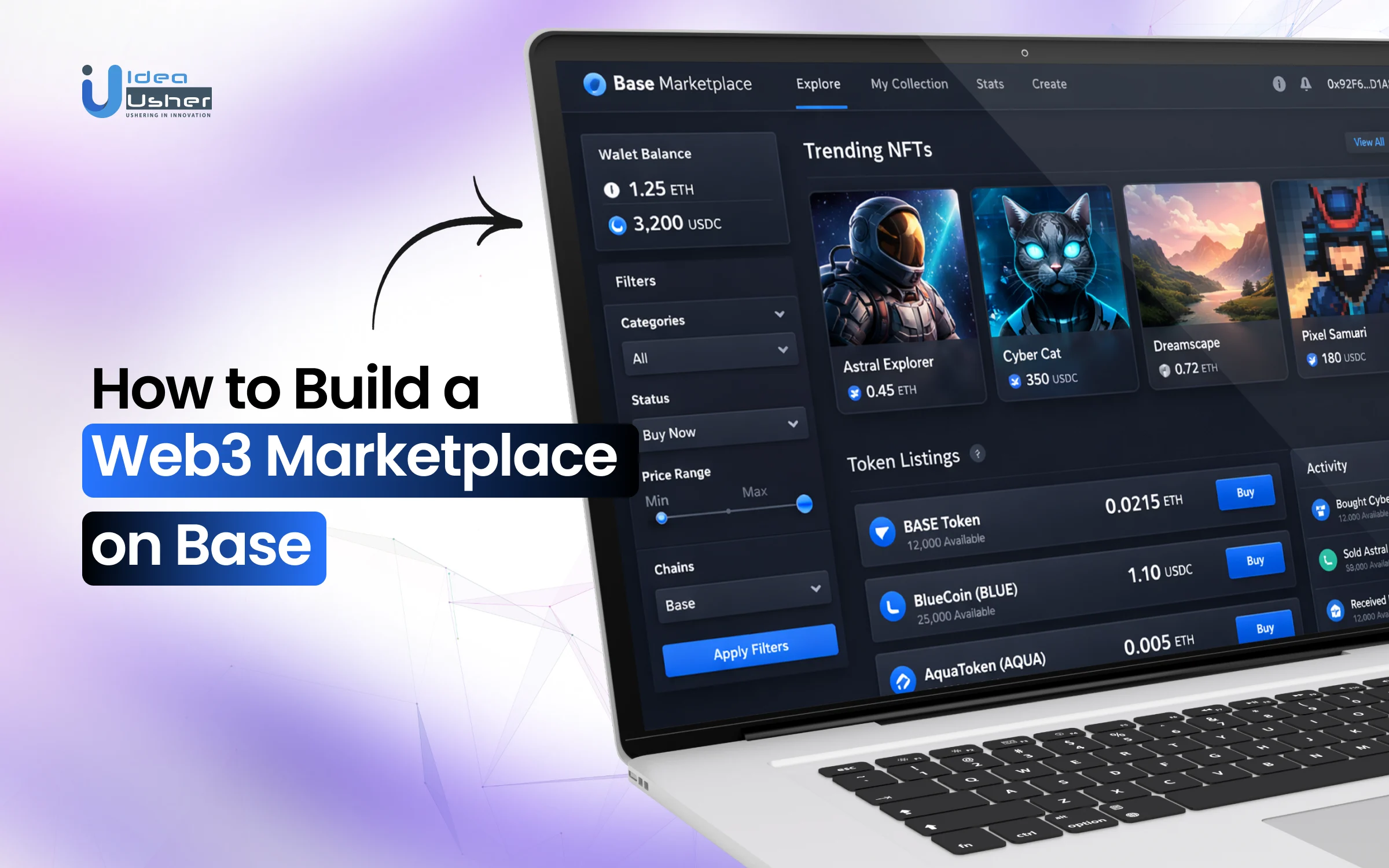
For years, users generated value faster than they received ownership, as reviews, content, liquidity, and reputation powered marketplaces while control stayed centralized. This gap pushed companies to build Web3 marketplaces on Base for creator economies, token-gated access platforms, on-chain loyalty programs, and data-driven commerce, where onboarding feels familiar, and transactions remain low-cost.
Demand grew when Base made ownership practical rather than theoretical, as tokens and NFTs evolved into access controls, reputation signals, and participation rights that can scale without friction. Low fees enable frequent interactions, smart wallet flows reduce user effort, and Ethereum compatibility preserves trust and auditability, making Base viable for real marketplace usage.
Over the years, we’ve developed many Web3 marketplaces and token-driven commerce platforms on Base, powered by smart wallet frameworks and Ethereum Layer-2 execution models. As we have this expertise, we’re sharing this blog to discuss the steps to build a Web3 marketplace on Base.
Key Market Takeaways for Web3 Marketplaces
According to MordorIntelligence, the Web3 marketplace segment is moving from experimentation to measurable economic scale. The broader Web3 market was valued at USD 3.47 billion in 2025 and is projected to reach USD 29.97 billion by 2031, growing at a CAGR of 43.21 percent. This growth is being driven by concrete adoption across DeFi, tokenized assets, and blockchain-based ownership models, positioning marketplaces as core digital commerce infrastructure rather than speculative platforms.

Source: MordorIntelligence
Marketplace traction is accelerating because these platforms directly address the economics of creators and collectors. NFT and tokenized asset marketplaces processed tens of billions of dollars in cumulative trading volume, with OpenSea regaining more than 40 percent share of NFT transactions through improved onboarding and multi-collection support.
Blur captured nearly 50 percent of early 2025 NFT trading volume by eliminating fees and introducing liquidity incentives, while Magic Eden emerged as a leader in active users and gaming NFTs, particularly across Solana and other high-throughput chains.
Ecosystem partnerships are reinforcing this growth at scale. Magic Eden’s collaboration with Sequence reduced marketplace integration time for game developers by weeks and enabled seamless in-game trading flows, following earlier enterprise partnerships such as Ubisoft NFT launches.

What Is a Web3 Marketplace?
A Web3 marketplace is a decentralized digital platform where buyers and sellers interact directly through smart contracts. Instead of relying on a central authority to manage listings, payments, and rules, these marketplaces use blockchain logic to automate transactions and enforce trust programmatically.
In Web3 marketplaces, asset ownership is recorded on the blockchain, giving users verifiable control over what they buy or sell. Payments are settled on-chain, and royalties can be enforced automatically at the protocol level. This is especially valuable for creators, as it ensures transparent revenue sharing and long-term participation in secondary sales.
Web2 vs Web3 Marketplace Models
Traditional Web2 marketplaces are custodial, meaning the platform controls user assets, data, and payouts. Users must trust the platform to act fairly. In contrast, Web3 marketplaces are non-custodial. Users retain control of their wallets, assets, and identities, while smart contracts handle transactions without intermediaries. This shift reduces platform dependency and increases transparency.
What Is Base Blockchain?
Base is an Ethereum Layer 2 blockchain incubated by Coinbase to help bring millions of everyday users into Web3. It is designed to make decentralized applications more accessible by reducing costs, improving transaction speed, and simplifying user experiences without compromising on security or decentralization.
By leveraging Coinbase’s ecosystem and trust, Base acts as a practical bridge between traditional users and on-chain applications.
Built on the OP Stack & Secured by Ethereum
Base is built using the OP Stack, the same open-source framework that powers Optimism. This means Base inherits Ethereum’s security guarantees while offering faster and more cost-efficient transactions through optimistic rollups. Transactions are executed off-chain but ultimately settled on Ethereum, ensuring transparency, auditability, and strong cryptographic security.
Types of Web3 Marketplaces Built on Base
Web3 marketplaces on Base can support digital assets creator commerce and in-app economies. Transactions may settle quickly while ownership stays on the chain. This often helps platforms scale without adding custodial risk.
1. NFT & Digital Asset Marketplaces
Base supports NFT marketplaces for art, collectibles, gaming assets, and digital media. Low transaction fees make minting, trading, and transferring NFTs more accessible to creators and collectors. This encourages experimentation with new formats such as dynamic NFTs, limited drops, and community-driven collections without high cost barriers.
2. Creator & Social Marketplaces
These platforms enable creators to sell content, memberships, or digital experiences directly to their audiences. On-chain ownership and automated payouts help creators monetize without relying on centralized platforms. Base’s scalability also allows creators to support large fan communities while maintaining transparent revenue distribution.
3. Gaming Asset Marketplaces
Game items such as skins, weapons, and virtual land can be traded securely on Base. Faster settlement and lower gas costs support high-frequency in-game transactions and secondary trading. This makes player-owned economies viable at scale, even for games with millions of active users.
4. Tokenized Commerce & Utility Marketplaces
Base enables marketplaces for tokenized services, subscriptions, and real-world asset representations. Smart contracts manage access, usage rights, and recurring payments transparently. This structure reduces disputes and enables programmable business logic that adapts as user demand evolves.
5. DeFi-Integrated Marketplaces
Some marketplaces on Base integrate decentralized finance features such as escrow, staking, and liquidity pools, allowing users to earn yield or access financial utilities alongside trading. This creates multi-layered platforms where commerce and financial incentives operate together within a single on-chain experience.
How Web3 Marketplaces Built on Base Works?
A Web3 marketplace on Base works like a familiar digital product while smart contracts quietly handle ownership, payments, and trust on-chain. Users can sign in with passkeys and interact without managing gas, while the platform settles transactions securely through Base’s Layer 2 execution. This setup lets marketplaces scale efficiently and still deliver real ownership and verifiable value.

1. Discovery and Intent
A user browses the marketplace. They may arrive through a Farcaster Frame embedded inside a social post. They do not yet have a crypto wallet. They click Buy on a digital asset.
Base’s Role
Instead of a MetaMask pop-up requesting a seed phrase, the user sees a passkey login using Face ID or Touch ID in Coinbase Wallet. Within seconds, a secure non-custodial smart contract wallet is created. The friction of entering Web3 is removed at the exact moment of purchase.
2. Transaction Sponsorship
The user confirms the purchase and does not need to hold ETH for gas fees.
Base’s Role
The marketplace backend creates a UserOperation, which represents a meta transaction intent, and forwards it to a Paymaster.
The Paymaster is funded and configured with business rules such as sponsoring gas for first-time buyers. After validating the request, the Paymaster covers the fee and submits the transaction to the EntryPoint contract. For the user, the experience feels like a single free click.
3. On Chain Execution and Settlement
The transaction bundle reaches the Base sequencer, which is currently operated by Coinbase. It is processed in batches, and its data is posted to Ethereum Layer 1 as a blob using EIP-4844.
Smart Contract Actions Executed Atomically
- Escrow and Verification: The marketplace contract checks that the asset is listed for sale, validates signatures, and verifies any required attestations such as buyer reputation or verification status.
- Value Transfer: Payment in ETH or a stablecoin is deducted directly from the buyer’s Smart Wallet.
- Ownership Transfer: The ledger updates immediately, transferring ownership of the NFT or tokenized asset to the buyer’s wallet address.
Value Distribution
The payment is split automatically in a single operation. Seller’s share is sent directly to the seller’s wallet. The platform fee is transferred to the marketplace treasury or DAO wallet.
Creator royalty, if defined, is routed to the original creator’s wallet as encoded in the asset contract.
4. Post Settlement & Social Proof
The transaction completes within seconds. The user now holds the asset inside their Smart Wallet. This action can optionally generate a social post or attestation, which feeds back into Farcaster and drives organic discovery.
The Superchain Advantage
Because Base is built on the OP Stack and operates within the Superchain, the marketplace is not isolated. Users on other Superchain networks, such as Optimism, can securely discover and interact with assets on a Base marketplace using cross-chain messaging. This removes complex bridging and expands liquidity and reach from the launch day onward.
Why This Model Wins for Businesses
- Reduced Fraud: Non-custodial settlement means the platform never holds user funds or assets, significantly reducing operational and legal risk.
- Automated Operations: Fees, royalties, and payouts are enforced directly by smart contracts, removing reliance on manual accounting processes.
- New Revenue Streams: Marketplaces can earn through transparent platform fees, premium Paymaster services, and token-based access or membership models.
- Viral Distribution: Native social integrations transform user activity into shareable signals, turning each participant into a potential distribution channel.
How to Build a Web3 Marketplace on Base?
Building a Web3 marketplace on Base often starts with designing simple trading flows while keeping blockchain logic out of sight. Smart wallets, gasless transactions, and secure contracts should quietly manage access, fees, and settlement.
We have worked on a range of Web3 marketplace projects on Base, and here’s the approach we commonly take.

1. Base-Native Design
We start by defining asset models and ownership rules that align directly with Base. On-chain logic handles value transfer and verification, while off-chain services provide speed and flexibility. The architecture is structured to remain compatible with the Superchain as the platform grows.
2. Smart Wallet Onboarding
We implement smart wallet onboarding that feels familiar to everyday users. Coinbase Smart Wallets with passkey authentication eliminate seed-phrase friction. Users can enter the marketplace quickly while maintaining non-custodial control.
3. Marketplace Contracts
We build modular smart contracts for listings, purchases, royalties, and settlements. Atomic batching reduces the number of steps in transactions and improves reliability. OpenZeppelin standards are applied to enforce security and upgrade safety.
4. Gasless Transactions
We enable gasless actions via paymasters, governed by clear business rules. Entry-level actions are sponsored to drive engagement, while premium actions follow a defined fee structure. Controls are added to prevent abuse as activity scales.
5. Trust Layers
We add trust mechanisms through attestations that validate marketplace participants. Seller reputation and buyer eligibility are verified using EAS. Off-chain signals can be integrated to strengthen credibility without exposing sensitive data.
6. Growth and Distribution
We design for distribution through social and Superchain channels. Farcaster Frames allow marketplace actions to surface directly in social feeds. Analytics and monitoring support ongoing optimization and cross-chain expansion.
How We Ensure Marketplace Security When Base Uses a Centralized Sequencer?
The centralized sequencer operated by Coinbase is one of the most common concerns we address with enterprise clients considering Base. While it raises a theoretical point about centralization, at IdeaUsher, we do not view it as a vulnerability.
We treat it as a known variable in a larger security equation and architect sophisticated multi-layered defenses around it.

1. Understanding the Real Risk
We start by clarifying the actual risk model so teams focus on what truly matters.
- Transaction Censorship Risk: The sequencer could theoretically delay or ignore a transaction. This is a liveness issue rather than a safety issue. User funds cannot be stolen or altered.
- Sequencer Failure Risk: If the Coinbase-operated sequencer goes offline, new transactions pause until a fallback mechanism is activated.
Our architecture addresses both scenarios while anchoring security to the most important guarantee in rollup design which is Ethereum data availability.
2. The Core Defense
This is the non-negotiable foundation of Base security, and we build every marketplace on top of it.
How It Works: Every batch of Base transactions is compressed and posted to Ethereum L1 as calldata using EIP-4844 blobs. This data is immutable, public, and permanently stored on the Ethereum blockchain.
Our Implementation
State Derivation Proof
We design your marketplace contracts and backend to align with the OP Stack’s state-derivation pipeline. The full marketplace state, including balances, ownership, and listings, can be mathematically reconstructed using only Ethereum posted data.
Independent Verification Nodes
We deploy or support independent nodes that monitor Ethereum for Base transaction data, reconstruct the chain state, and validate correctness in real time. This provides continuous assurance against invalid state transitions.
The Bottom Line
Even if the Base sequencer disappeared entirely the full history and final state of your marketplace would remain on Ethereum. User assets stay cryptographically recoverable. We design systems that operationalize this recovery capability rather than treating it as a theory.
3. Safeguards We Implement
Beyond relying on Base guarantees, we embed active safety mechanisms directly into your marketplace.
A. The Escape Hatch & Withdrawal Mechanism
We implement a user accessible safety feature inspired by proven rollup designs.
Architecture: Direct integration with Base L1 bridge contracts on Ethereum.
Function: If the sequencer is offline or persistently censoring transactions beyond a defined threshold, such as 24 hours, users can submit proofs directly on Ethereum to force withdrawals of ETH tokens or NFTs.
Our Role: We build a guided UI flow inside your marketplace called the Asset Recovery Portal. This interface helps users generate Merkle proofs and submit L1 transactions without deep knowledge of the protocol. This converts a theoretical safeguard into a real trust-building feature.
B. Transaction Resilience
To reduce exposure to censorship or downtime, we design redundancy by default.
Architecture: Marketplace backends are configured with multiple RPC providers, including Alchemy Infura and direct node access. If the primary path becomes unreliable, transactions are routed through ERC 4337 compatible bundlers that can still achieve inclusion in future batches.
This keeps buy and sell flows operational even during partial network degradation.
C. Monitoring, Alerting & Governance Preparedness
Security depends on visibility and readiness to respond.
Architecture: We deploy a Sequencer Health Dashboard that monitors finality latency, Ethereum data posting frequency, and delays in the inclusion of abnormal transactions.
Governance Pathway: Contracts and admin controls are structured to support Base decentralization milestones. When Base transitions to a multi-sequencer model, your marketplace can migrate cleanly without disruptive upgrades.
4. Evaluating the Trade Off
We help clients frame the centralized sequencer correctly as a calculated design choice.
The Risk: A single regulated entity temporarily orders transactions.
The Benefit: Enterprise-grade uptime, reduced operational outages, regulatory clarity from a publicly traded US entity, and predictable performance with fast confirmations.
For revenue-focused marketplaces, this trade favors reliability, user trust, and ecosystem reach. The liveness risk is a limited, measurable, and fully mitigated at the architecture level.
Our Holistic Security Posture
Sequencer design is only one layer. Our Base marketplace security stack also includes:
- Multiple smart contract audit cycles with OP Stack and ERC 4337 specialists
- Runtime monitoring using tools such as Forta to detect anomalous behavior
- Structured bug bounty programs to incentivize responsible disclosure
Together, these layers ensure your marketplace remains secure, resilient, and enterprise-ready, even as Base continues to evolve.
How We Prepare Base Marketplaces for Superchain Expansion?
At IdeaUsher, we do not just build marketplaces for Base. We architect them for the Superchain future. The OP Stack vision of an interoperable network of chains, such as Base, Optimism, Zora, and Mode, represents the most important scalability shift since rollups themselves.
For marketplace operators, this is not technical background information. We embed strategic advantages in liquidity access and user growth from day one.

1. The Superchain Opportunity
Traditional multi-chain expansion forces teams to deploy separate contracts, manage fragmented liquidity pools, and push users through complex bridging flows. This approach increases cost, operational risk, and user drop-off.
The Superchain Solution
A standardized, shared protocol layer for OP Stack chains to communicate natively. Your Base marketplace can serve users and assets from Optimism, Zora, and future chains as if they exist on a single network.
Zora provides a clear example. While its marketplace activity currently centers on Base, its protocol is built on the OP Stack. As Superchain interoperability matures, creator drops and listings on Zora can become discoverable and purchasable from interfaces on other Superchain networks without manual bridging. This positioning was intentional from the start.
We prepare your marketplace to capture the same advantage through three architectural pillars.
1. Contract Standards & Portability
We design smart contracts to be Superchain native rather than Base-dependent.
A. Adopting Cross-Chain Ready Token Standards
Implementation: We adopt or extend standards such as ERC 5169 for cross-chain execution. Marketplace utility or governance tokens are designed as Omnichain Fungible Tokens using LayerZero or Axelar SDKs and configured for the OP Stack environment.
Result: Reputation points or platform tokens earned on Optimism can be used immediately to unlock features on your Base marketplace. Liquidity remains unified rather than fragmented.
B. Asset Design for Multi-Chain Provenance
Implementation: For NFTs and tokenized assets, we implement provenance tracking that records the origin chain. Metadata is structured to be chain-agnostic and stored on decentralized storage such as IPFS or Arweave, with stable on-chain pointers.
Result: An NFT minted on Zora can be listed and sold on your Base marketplace while enforcing royalties correctly. The entire cross-chain lifecycle remains verifiable.
Based Art demonstrates this approach through its use of the Ethereum Attestation Service for curation signals. Attestations issued on Base remain verifiable when assets are viewed or transferred across other Superchain networks. This creates a trust layer that extends beyond any single chain.
2. Messaging & Cross-Chain Logic
Interoperability becomes valuable only when communication is active.
Integrating Optimism Portal
Implementation: We integrate the OP Stack cross-chain messaging precompile into your marketplace backend. This allows Base contracts to send verified messages, such as bids placed or sales finalized, to contracts on other Superchain networks.
Practical Use Case: A user on Optimism can watch an auction running on Base. When outbid, they receive a notification triggered by a cross-chain message. They can submit a higher bid directly from their Optimism wallet, with the message securely relayed and executed on Base.
Tessera offers a compelling hypothetical scenario. A collective on Optimism could own fractional shares of an NFT vault hosted on Base. Governance actions such as sale decisions or parameter changes could be executed through cross-chain messages without requiring members to bridge assets first.
3. Unified User Identity & Reputation
User identity and trust signals should persist across networks.
A. Deploying Superchain Wide Attestation Schemas
Implementation: Using Ethereum Attestation Service, which is chain agnostic, we register marketplace specific schemas such as VerifiedTrader or PremiumCollector on Ethereum mainnet or a designated Superchain hub.
Result: An attestation earned on Base is immediately verifiable when a user connects from Optimism. Reputation travels with the user, enabling cross-chain loyalty and trust.
Friend.tech already shows partial portability through Coinbase identity. Extending this model across the Superchain would allow social graphs and trading history to become attestations.
A top trader on Base could gain instant credibility on a prediction market on Optimism, reinforcing network effects across chains.
B. Abstracting the Wallet and Gas Experience
Implementation: We use ERC 4337 smart wallets and Paymaster systems designed with Superchain awareness. Gas sponsorship can be configured not only for Base transactions but also for the originating chain during cross chain execution.
Example User Experience Flow
- The user holds assets on Zora
- They view an item listed on Base
- They click Buy
- The system detects asset location
- Gas for approval on Zora is sponsored
- A secure cross-chain transfer is initiated
- The purchase completes on Base within a single bundled flow
From the user perspective, this feels like one seamless action.
Paragraph, for example, demonstrates the power of abstraction by allowing credit card payments for Base minted assets. A Superchain native extension would allow a merchant to sell collectibles minted on Zora to customers paying with Apple Pay, while cross-chain settlement remains invisible to both buyer and seller.
Top 5 Web3 Marketplaces Built on Base Blockchain
We have done some digging and found several Web3 marketplaces built on Base that quietly stand out. These platforms focus on low-friction trading and practical ownership flows while remaining Ethereum-compatible.
1. Magic Eden

Magic Eden extends its multi-chain NFT marketplace to Base, allowing creators and collectors to mint and trade NFTs with lower fees and faster confirmations. Its Base integration focuses on smooth discovery, reliable liquidity, and familiar UX while maintaining Ethereum-level security.
2. GhostMarket

GhostMarket operates as a cross-chain NFT marketplace that supports Base for creators who want a wider reach without fragmenting liquidity. Assets listed on Base can be managed alongside other supported networks, making cross-ecosystem trading more practical.
3. Emblem Vault

Emblem Vault enables users to bundle and trade multiple digital assets across chains in a single structure. For Base users, it simplifies asset portability and supports more flexible ownership flows without fragmenting assets
4. Rarible

Rarible allows creators to mint and trade NFTs across multiple chains, with Base support extending reach without changing creator workflows. Governance and community participation remain central to its marketplace model.
5. Blur

Blur functions as a high-performance NFT trading platform and aggregator that can index Base assets alongside other chains. It is optimized for fast execution and advanced trading strategies rather than casual discovery.
Conclusion
Building a Web3 marketplace on Base is about setting up infrastructure that matches how users and businesses actually operate today. Base offers Ethereum-grade security with Coinbase-backed reach, which may simplify adoption at scale. When the system is designed with clear data flows and smart contract boundaries, teams can move steadily toward production. With the right technical partner, this transition can happen smoothly and with stronger confidence.
Looking to Develop a Web3 Marketplace on Base?
IdeaUsher can develop a Web3 marketplace on Base by shipping audited smart contracts for listing offers, managing royalties, and settling payments with a clean on-chain event model. The platform uses indexers plus a caching layer, so search and feeds stay fast while transactions remain verifiable.
With over 500,000 hours of coding experience and a team of ex-MAANG/FAANG developers, we understand the precise engineering required to turn Base’s potential into your profit.
We Build What Others Can’t:
- Zero-Friction Onboarding: Integrate passkey logins (Face ID/Touch ID) so users never see a seed phrase.
- Social-First Distribution: Embed your marketplace directly into social feeds with Farcaster Frames.
- Smart Monetization: Implement sponsored gas models so users trade freely while you capture value.
- Enterprise-Grade Security: Build on Base’s canonical rollup architecture with our battle-tuned smart contracts.
Check out our latest projects to see the caliber of work we deliver.


FAQs
A1: Base is designed around real user onboarding rather than raw crypto metrics. It emphasizes smart wallets and social distribution to help marketplaces reach users who are not deeply crypto-native. This focus can quietly reduce friction and improve activation in production environments.
A2: Yes, enterprises can build compliant marketplaces on Base using privacy-preserving identity and attestation layers. These components may support KYC flows and access control without exposing sensitive data. This approach aligns well with enterprise risk and governance models.
A3: Gasless transactions can be sustainable when implemented with Paymasters and clear, rule-based controls. Teams may sponsor fees selectively based on user actions or lifecycle stage. Using this model can act as a growth lever rather than an open cost.
A4: A Base marketplace can scale beyond one chain through Superchain interoperability. Shared standards allow contracts to interact across networks without rewriting core logic. This design may support gradual multi-chain expansion as usage grows.