

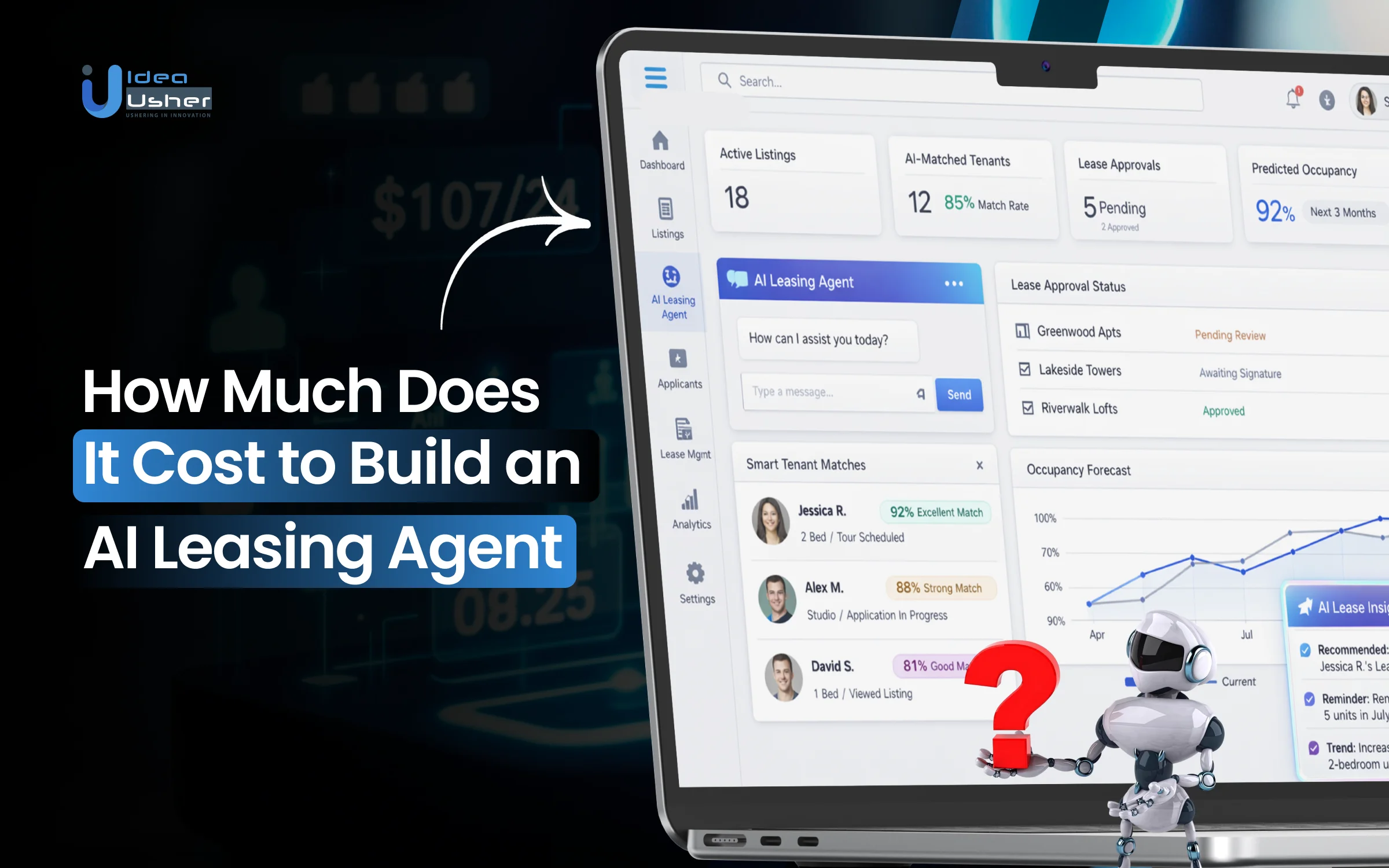
AI leasing agents are increasingly expected to handle conversations, qualify leads, schedule tours, and coordinate follow-ups across leasing workflows. Delivering this automation relies on data access, system integrations, and consistent decision logic rather than conversational AI alone. Once these expectations are clear, the AI leasing agent cost becomes a function of scope, operational depth, and how tightly the agent is embedded into real leasing processes.
Execution realities add to the overall cost beyond the initial build. Integrations with listing feeds, CRM systems, scheduling tools, communication channels, and compliance rules must operate reliably at scale. Ongoing expenses such as model tuning, infrastructure scaling, monitoring, security, and support often exceed early estimates, particularly for agents running continuously across large property portfolios.
In this blog, we explain how much it costs to build an AI leasing agent by breaking down the primary cost drivers, development components, and operational factors that influence budgeting for a scalable and production-ready solution.

What Is an AI Leasing Agent?
An AI leasing agent is a virtual assistant that automates leasing interactions by answering questions, sharing availability, scheduling tours, and qualifying leads using natural language processing. Businesses deploy these agents across digital channels to manage inquiries at scale without human agents.
AI leasing agents integrate with property management systems and pricing engines to deliver real-time, personalized responses. By analyzing user behavior and intent signals, they prioritize high-intent prospects, reduce response delays, and lower operational costs.
- Natural language processing models that understand leasing questions, follow-up intent, and conversational context across multiple turns.
- Conversation orchestration engine that routes user inputs to pricing, availability, scheduling, or qualification workflows in real time.
- Integration layer that connects the agent with property management systems, calendars, pricing engines, and CRM platforms.
- Intent detection and confidence scoring logic that identifies high-intent prospects and prioritizes qualified leasing conversations.
- Knowledge base management system that keeps property details, policies, and availability synchronized across all channels.
- Multi-channel deployment framework that supports web chat, SMS, email, and voice-based leasing interactions.
- Analytics and conversation logging engine that captures interaction data to improve model accuracy and leasing performance over time.
Core Components of an AI Leasing Agent
AI leasing agents rely on interconnected technical components that enable conversation handling, system integration, and automation. Understanding these components helps clarify how AI leasing agents operate within modern leasing environments.
| Component | Purpose | Why It Matters |
| Natural language understanding engine | Interprets renter questions and identifies intent and entities | Enables accurate responses to leasing inquiries |
| Conversation orchestration layer | Manages dialog flow and routes requests to backend systems | Maintains conversation context and logical progression |
| Property and availability data layer | Stores and retrieves real-time listing and availability data | Ensures accurate pricing and scheduling responses |
| Scheduling and calendar integration | Handles tour bookings and availability confirmations | Automates tour coordination and reduces manual effort |
| CRM and lead management integration | Captures prospect data and conversation outcomes | Supports follow-up, analytics, and conversion tracking |
| Compliance and rule enforcement logic | Applies leasing policies and regulatory constraints | Prevents non-compliant or misleading responses |
| Analytics and conversation logging module | Tracks performance metrics and interaction quality | Supports optimization and accuracy improvements |
| Deployment and channel management system | Manages web, SMS, email, and voice deployments | Enables consistent multi-channel leasing experiences |
How AI Leasing Agents Interact With Leasing Systems?
AI leasing agents rely on continuous data exchange with leasing systems to deliver accurate, real-time responses. These integrations allow the agent to retrieve information, trigger actions, and update records without manual intervention.
1. Property and Availability Data Access
The AI leasing agent connects to property management systems to fetch live listing details, availability status, pricing, and policies. This connection ensures responses reflect current inventory and prevents misinformation during leasing conversations.
2. Scheduling and Calendar Integration
The agent interacts with scheduling systems to check tour availability, book appointments, and send confirmations. This integration enables automated tour management and reduces coordination effort for leasing teams.
3. Lead and CRM Synchronization
The agent sends captured prospect details, conversation summaries, and intent signals to CRM systems. This synchronization ensures leasing teams receive qualified leads and complete interaction histories for follow-up.
4. Pricing and Policy Rule Enforcement
The AI leasing agent references pricing engines and leasing rules to provide compliant answers. These integrations ensure pricing disclosures, discounts, and policies remain consistent across all conversations.
5. Workflow Triggers and Status Updates
The agent triggers backend workflows such as follow-up notifications, document requests, or escalation flags. It also updates leasing system records to reflect conversation outcomes and prospect status changes.
6. Secure Data Exchange and Access Control
The agent interacts with leasing systems through secure APIs and permission controls. These safeguards protect sensitive data and ensure the agent accesses only approved information during interactions.
Types of Conversations an AI Leasing Agent Can Handle
AI leasing agents support a wide range of leasing conversations by responding to renter inquiries, automating routine interactions, and guiding prospects through key leasing steps across digital channels in a consistent and structured manner.
| Conversation Type | What the Agent Handles | Why It Matters |
| Availability and pricing inquiries | Answers questions about unit availability, rent, and basic pricing details | Provides instant responses and reduces response delays |
| Property and amenity questions | Explains property features, amenities, and policies | Helps prospects evaluate options without human involvement |
| Tour scheduling and confirmations | Books tours and sends confirmations or reminders | Automates scheduling and reduces manual coordination |
| Lead qualification conversations | Asks screening questions and captures prospect details | Improves lead quality before human follow-up |
| Application guidance | Explains application steps and required documents | Reduces confusion and incomplete applications |
| Policy clarification | Responds to common policy questions accurately | Ensures consistent and compliant messaging |
| Follow-up and status updates | Provides updates on tours, applications, or next steps | Keeps prospects engaged throughout the leasing journey |
How AI Leasing Assistants Increase Lead-to-Lease Conversions by 33%?
The lease management market was valued at USD 5.65 billion in 2024 and is projected to reach USD 8.13 billion by 2030, growing at 6.4% CAGR from 2025 to 2030. This growth reflects increasing use of AI-driven leasing workflows in residential and commercial real estate, especially where lead volumes outpace leasing team capacity.

AI-powered leasing assistants are delivering measurable business outcomes at the funnel level, with platforms reporting up to a 33% improvement in lead-to-lease conversion rates by reducing response delays, automating tour scheduling, and minimizing friction across the leasing journey.
A. Rising Demand for Conversion-Focused Leasing Solutions
As competition intensifies across real estate markets, property owners and operators are prioritizing tools that directly impact occupancy and revenue rather than operational convenience alone.
- Higher inquiry volumes across digital channels: Property listings now generate leads from multiple platforms simultaneously, creating demand for solutions that can manage and convert inquiries efficiently without increasing human workload.
- Revenue pressure from vacancy and churn: Even small improvements in conversion rates have a compounding effect on rental revenue, making AI-driven leasing tools increasingly attractive to landlords and operators.
- Shift from operational tools to revenue enablers: Leasing software is no longer evaluated only on workflow support but on measurable business outcomes, such as lead-to-lease conversion performance.
B. Why There Is Room for New AI Leasing Platforms to Grow?
Despite increasing adoption, the AI leasing space is far from saturated, creating opportunities for new platforms to enter and scale.
- Fragmented prop-tech landscape: Real estate markets rely on a wide range of legacy systems and region-specific tools, leaving gaps for modern platforms that can integrate more seamlessly or serve niche segments.
- Uneven AI adoption across regions and asset types: While large portfolios adopt AI faster, many mid-sized and smaller operators are still early in their digital transformation, representing untapped demand.
- Outcome-driven differentiation: Platforms that can demonstrate tangible results such as faster leasing cycles or higher conversions gain traction more quickly, lowering go-to-market friction for new entrants.
These market signals and outcomes show why AI leasing platforms are growing in prop-tech. With demand for solutions that boost conversion and revenue predictability, there’s room for new platforms to enter, differentiate, and scale. Investing in building an AI leasing platform is a strategic opportunity, not just speculative.
How Much Does It Cost to Build an AI Leasing Agent?
The AI leasing agent development cost depends on conversation complexity, AI training depth, system integrations, and deployment scale. Understanding these factors helps businesses plan realistic budgets and development strategies effectively.

Phase 1: Product Scope and Conversation Strategy
Our developers and AI specialists define the leasing agent’s purpose, supported channels, and conversation boundaries. The team maps leasing use cases, identifies automation opportunities, defines success metrics, and documents conversation flows aligned with business and compliance requirements.
| Activity | Description | Estimated Cost |
| Product discovery and requirements | Define agent goals, target users, and leasing scenarios | $3,000 to $6,000 |
| Conversation use case mapping | Identify inquiry types, escalation rules, and handoff logic | $4,000 to $7,000 |
| Channel strategy definition | Select deployment channels such as web, SMS, email, or voice | $2,000 to $4,000 |
| Integration requirements planning | Define data sources and system touchpoints | $3,000 to $5,000 |
| Compliance and risk assessment | Identify data handling, consent, and leasing regulations | $2,000 to $4,000 |
Estimated Cost for Phase 1: $14,000 to $26,000
This phase relies on senior planning and AI conversation expertise to manage AI leasing agent development cost by preventing misaligned automation, reducing rework, and ensuring accurate, compliant leasing interactions.
Key Takeaways
- Clear conversation scope prevents uncontrolled AI behavior.
- Early channel decisions influence integration and testing costs.
- Well-defined use cases reduce model training complexity later.
- Strong planning improves accuracy and lowers long-term optimization costs.
Phase 2: Conversation Design and UX Planning
Our designers and AI specialists create structured conversation flows, user intents, and response logic for leasing interactions. The team designs conversational UX, fallback handling, and escalation paths while aligning messaging tone with brand and compliance requirements.
| Activity | Description | Estimated Cost |
| Conversation flow design | Design structured leasing dialogues and decision paths | $4,000 to $7,000 |
| Intent and entity definition | Define user intents, entities, and context variables | $3,000 to $6,000 |
| Conversational UX design | Design response structure, tone, and interaction patterns | $4,000 to $8,000 |
| Fallback and escalation logic | Define error handling and human handoff rules | $3,000 to $5,000 |
| Conversation validation and review | Review flows for clarity, compliance, and accuracy | $2,000 to $4,000 |
Estimated Cost for Phase 2: $16,000 to $30,000
This phase ensures the AI leasing agent communicates clearly, handles edge cases correctly, and supports controlled AI leasing agent development cost across all supported channels.
Key Takeaways
- Well-designed conversation flows improve lead engagement.
- Intent clarity reduces AI misinterpretation and retraining effort.
- Escalation logic prevents poor user experiences.
- Strong conversational UX increases leasing conversion rates.
Phase 3: Core Agent Backend and Integrations
Our developers build the backend services that power the AI leasing agent, including session management, conversation orchestration, and integration logic. The team connects the agent with property data, availability systems, calendars, and CRM tools to deliver real-time leasing responses.
| Activity | Description | Estimated Cost |
| Agent backend development | Build services for session handling and state management | $6,000 to $10,000 |
| Conversation orchestration logic | Route user inputs to pricing, availability, or scheduling flows | $5,000 to $9,000 |
| Property and availability integration | Connect agent with property data and listing systems | $5,000 to $8,000 |
| Calendar and tour scheduling | Enable automated tour booking and confirmations | $4,000 to $7,000 |
| CRM and lead capture integration | Store prospect data and conversation outcomes | $4,000 to $7,000 |
Estimated Cost for Phase 3: $24,000 to $41,000
This phase establishes the operational backbone of the platform and helps manage AI leasing agent development cost by ensuring accurate, real-time responses across all leasing workflows.
Key Takeaways
- Backend reliability directly affects conversation accuracy.
- Real-time integrations improve leasing speed and trust.
- Clean orchestration logic supports future AI enhancements.
- Strong integrations reduce manual follow-up and data errors.
Phase 4: AI Model Development and Training
Our AI engineers develop and train natural language understanding models that power the leasing agent’s ability to interpret questions, extract intent, and maintain conversational context. The team fine-tunes models using leasing data and validates response accuracy across scenarios.
| Activity | Description | Estimated Cost |
| NLP model selection and setup | Select and configure language models for leasing use cases | $6,000 to $10,000 |
| Intent classification training | Train models to recognize leasing-related intents accurately | $6,000 to $12,000 |
| Entity extraction and context handling | Enable accurate data capture and multi-turn conversations | $5,000 to $9,000 |
| Model fine-tuning and optimization | Improve response relevance and reduce misclassification | $5,000 to $9,000 |
| AI accuracy testing and iteration | Test and refine models using real leasing scenarios | $4,000 to $8,000 |
Estimated Cost for Phase 4: $26,000 to $48,000
This phase requires specialized AI expertise and iterative training to ensure the leasing agent understands user intent and responds accurately in real-world conversations.
Key Takeaways
- Model quality determines the agent’s leasing effectiveness.
- Fine-tuning reduces incorrect responses and user frustration.
- Accurate intent detection improves lead qualification.
- Continuous iteration increases long-term AI reliability.
Phase 5: Testing, Security, and Compliance Validation
Our developers validate conversation accuracy, system stability, and data security across all supported channels. The team tests edge cases, secures integrations, and ensures the AI leasing agent complies with data protection and leasing regulations.
| Activity | Description | Estimated Cost |
| Conversation and flow testing | Test dialog accuracy, edge cases, and escalation paths | $4,000 to $7,000 |
| Integration and regression testing | Validate backend and third-party integrations | $4,000 to $7,000 |
| Security and access validation | Test data protection and permission controls | $5,000 to $9,000 |
| Compliance review and validation | Verify consent handling and regulatory alignment | $3,000 to $6,000 |
| Load and reliability testing | Test agent performance under high conversation volume | $4,000 to $7,000 |
Estimated Cost for Phase 5: $20,000 to $36,000
This phase ensures the AI leasing agent delivers consistent, secure, and compliant interactions before public deployment or large-scale rollout.
Key Takeaways
- Testing prevents inaccurate or misleading leasing responses.
- Security validation protects prospect data and brand trust.
- Compliance readiness avoids legal and operational risk.
- Reliability testing prepares the agent for high inquiry volume.
Phase 6: Deployment, Launch, and Continuous Optimization
Our developers deploy the AI leasing agent to production environments, configure monitoring, and fine-tune performance based on real user interactions. The team supports launch execution and continuously optimizes conversation accuracy and system stability.
| Activity | Description | Estimated Cost |
| Production deployment setup | Deploy the agent across selected channels and environments | $3,000 to $5,000 |
| Monitoring and logging configuration | Set up conversation logs, alerts, and performance tracking | $4,000 to $7,000 |
| Post-launch tuning and optimization | Improve responses based on real interaction data | $5,000 to $9,000 |
| Scaling and reliability adjustments | Prepare the agent for increased conversation volume | $4,000 to $7,000 |
| Launch support and stabilization | Monitor performance and resolve early issues | $3,000 to $6,000 |
Estimated Cost for Phase 6: $19,000 to $34,000
This phase ensures stable deployment, supports early adoption, and improves leasing outcomes through continuous learning and optimization.
Key Takeaways
- Smooth deployment prevents launch disruptions.
- Monitoring enables rapid issue detection and resolution.
- Continuous optimization improves conversion performance over time.
- Scalability preparation supports future inquiry growth.
Total AI Leasing Agent Development Cost
The total cost of building an AI leasing agent varies based on conversation depth, AI training complexity, integrations, and deployment scale. Below is a realistic cost range based on common implementation levels.
| Build Type | Scope of AI Leasing Agent | Total Estimated Cost |
| MVP | Core conversational AI, basic leasing queries, limited integrations, and single-channel deployment | $70,000 to $120,000 |
| Mid-Scale | Advanced intent handling, multi-channel support, CRM and calendar integrations, and improved AI accuracy | $140,000 to $220,000 |
| Full-Scale | Enterprise-grade AI, complex conversation flows, deep integrations, compliance layers, and continuous optimization | $260,000 to $310,000 |
Note: Cost estimates depend on conversation complexity, channels, AI training, and integrations. Early planning and phased implementation help control costs and ensure scalable leasing agent performance.
Consult with IdeaUsher to get a customized cost estimate and development plan tailored to your leasing workflows, target audience, and business objectives.
Cost-Affecting Factors in AI Leasing Agent Development
AI leasing agents introduce cost drivers that stem from conversational intelligence, real-time integrations, and regulatory sensitivity unlike traditional chatbots. These factors directly influence development effort, AI complexity, and long-term operational spend.
1. Conversational Depth and Leasing Scenario Coverage
The number of leasing scenarios the agent must handle significantly impacts cost. Supporting nuanced conversations around pricing, availability, policies, and objections requires deeper intent modeling, more training data, and extensive conversation testing.
2. Multi-Channel Conversation Consistency
Maintaining consistent leasing behavior across web chat, SMS, email, and voice increases development complexity. Each channel introduces different latency, formatting, and context challenges that require separate orchestration and testing.
3. Real-Time Data Synchronization Requirements
Leasing agents rely on live availability, pricing, and scheduling data. Ensuring real-time synchronization with property systems increases integration complexity and demands robust backend infrastructure.
4. AI Confidence and Escalation Logic
Designing logic that determines when the agent should respond, clarify, or escalate to a human directly affects development cost. Poor escalation handling leads to rework, additional testing, and compliance risk.
5. Compliance Sensitivity of Leasing Conversations
Leasing interactions often involve regulated topics such as pricing disclosures, fair housing rules, and data consent. Embedding compliant conversation behavior requires additional validation, rule enforcement, and legal review.
6. Training Data Availability and Quality
Limited or unstructured leasing conversation data increases AI training cost. Teams must invest in data preparation, synthetic conversation generation, and iterative tuning to achieve acceptable accuracy.
7. Conversation Analytics and Performance Measurement
Building systems to measure conversation success, drop-off points, and leasing outcomes adds development effort. These analytics support optimization but require additional data modeling and reporting infrastructure.
Cost Myths Around Building AI Leasing Agents
Misunderstandings around AI leasing agent costs often lead to unrealistic budgets and poor planning decisions. Clarifying these myths helps businesses evaluate investment requirements more accurately and avoid avoidable development risks.
1. AI Leasing Agents Are Just Simple Chatbots
Many assume AI leasing agents work like basic chatbots, but leasing automation requires advanced intent recognition, context handling, and system integrations, which significantly increases development effort and cost compared to rule-based conversational tools.
2. One-Time Development Covers Everything
Some believe AI leasing agents require only an initial build, but ongoing training, optimization, monitoring, and compliance updates remain essential to maintain conversation accuracy and reliable performance over time.
3. AI Models Work Perfectly Out of the Box
Businesses often expect pre-trained models to handle leasing conversations instantly, but real-world accuracy depends on domain-specific training, continuous tuning, and validation against evolving leasing scenarios.
4. Integrations Add Minimal Cost
Many underestimate the complexity of integrating AI agents with property systems, calendars, and CRM tools. Real-time data synchronization and error handling introduce significant backend and testing effort.
5. Supporting More Channels Costs Little Extra
Adding SMS, email, or voice support appears simple, but each channel introduces unique formatting, latency, and compliance challenges that increase orchestration, testing, and maintenance costs.
6. Compliance Has Limited Impact on Budget
Leasing conversations often involve regulated topics such as pricing disclosures and fair housing rules. Ensuring compliant AI behavior requires additional logic, reviews, and validation that directly affect development cost.
Conclusion
Building an AI leasing agent involves more than coding a chatbot; it requires careful planning of features, integrations, and data management. The AI leasing agent development cost depends on factors such as automation complexity, predictive capabilities, user interface design, and compliance with regulations. Each decision, from core functionalities to system scalability, impacts the overall investment. By understanding these components and aligning them with business objectives, you can estimate a realistic budget that ensures the platform delivers efficiency, improves tenant experiences, and supports long-term growth without unnecessary overspending.
Why Partner with IdeaUsher for Your AI Leasing Platform Development?
At IdeaUsher, we specialize in building intelligent leasing platforms that streamline operations and enhance tenant engagement. Our team combines AI expertise with deep industry understanding to deliver solutions tailored to your business goals.
What Sets Us Apart?
- AI-Driven Solutions: We design smart chat systems and automation tools that improve response times and lead conversions.
- Customized Development: Every platform is built around your unique requirements, ensuring flexibility and scalability.
- Proven Delivery: Our portfolio reflects successful AI-powered products across multiple industries.
- Enterprise-Grade Security: We prioritize data protection and system reliability at every stage.
Explore our case studies to see how we help businesses launch impactful AI products in the market.
Connect with us today to discuss your AI leasing platform idea and turn it into a market-ready solution.


FAQs
The average cost to build an AI leasing agent ranges between $65,000 to $150,000. Pricing depends on features like CRM integration, natural language processing, chatbot capabilities, and whether you choose a custom-built or white-label solution.
Key cost drivers include data training requirements, conversation complexity, third-party integrations, hosting infrastructure, compliance needs, and the experience level of your development team. Custom automation workflows and multilingual support also increase development expenses.
Yes, pre-built AI leasing platforms cost significantly less, typically between $45,000 to $100,000 annually. However, they offer limited customization, branding control, and scalability compared to a fully custom-built AI leasing agent.
You can reduce costs by starting with an MVP, using open-source frameworks, limiting initial features, and integrating existing APIs. Outsourcing development to experienced offshore teams also helps lower overall project expenses.