

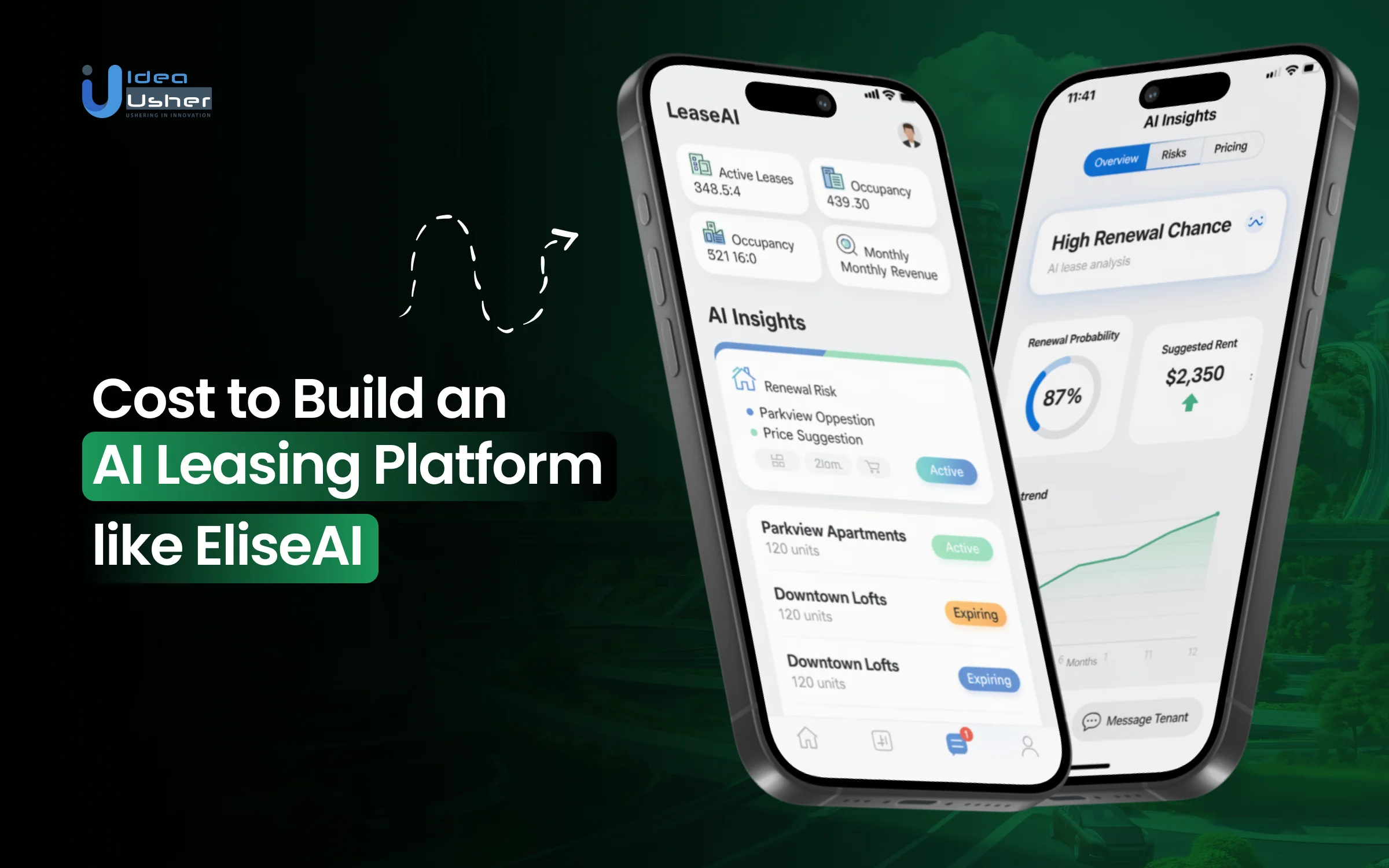
AI leasing platforms are no longer limited to handling inquiries or answering questions. In modern property operations, they support tour scheduling, lead qualification, applicant screening, follow-ups, and coordination across leasing teams. As these systems move deeper into daily leasing workflows, platforms built along the lines of an EliseAI-like AI leasing platform start to resemble core operational infrastructure rather than standalone AI tools.
This level of dependency introduces requirements that directly influence cost. Integrations with listing sources, CRM systems, scheduling tools, communication channels, and policy-driven workflows all need to operate reliably and in sync. Each added dependency increases the need for data consistency, access controls, monitoring, and long-term maintenance, which collectively shape how much effort and investment the platform requires.
In this blog, we break down the cost to build an AI leasing platform like EliseAI by examining how system dependencies, integration scope, and operational depth influence development effort, infrastructure planning, and long-term maintenance costs.
What is an AI Leasing Platform, EliseAI?
EliseAI is an AI-powered automation platform for leasing and property management in housing and property management. It automates prospect inquiries, tour scheduling, 24/7 multi-channel communications (voice, text, email, chat), maintenance requests, and renewals through conversational AI and a centralized CRM, reducing manual workload and accelerating lead-to-lease conversion.
The platform consolidates fragmented workflows for top property managers, centralizing operations to improve lease conversions, cut labor costs, and increase occupancy and retention. With integrations into property management systems, EliseAI offers strong competitive differentiation in high-value enterprise markets.
- Handles omni-channel leasing and resident communications across voice, SMS, email, and web chat in a unified workflow.
- Automates and qualifies up to ~90% of leasing conversations and routine interactions, freeing teams to focus on high-value tasks.
- Built-in AI-first CRM that centralizes prospect and resident data while learning from interactions to improve responses over time.
- Deep integrations with PMS/CRM systems and housing tech partners, enabling seamless scheduling, data syncing, and workflow automation.
- Provides 24/7 real-time answers, tour scheduling, follow-ups, and maintenance routing, ensuring no lead or request goes unanswered.
- Uses agentic conversational AI (not simple chatbots) that adapts to complex inquiries with context and human-like understanding.
- Generates comprehensive operational insights and analytics on leasing performance, maintenance volume, renewals, and engagement trends.
A. Business Model – How EliseAI Operates
EliseAI operates as a domain-specific AI automation platform purpose-built for the housing industry, embedding intelligence directly into day-to-day leasing and resident operations to replace manual workflows and disconnected tools.
- AI-Native Leasing & Operations Platform: Acts as an always-on AI leasing and resident assistant that automates prospect engagement, tour scheduling, follow-ups, maintenance intake, renewals, and resident communications.
- Unified Omni-Channel Communication Layer: Centralizes voice, SMS, email, and web chat into a single AI-driven system, ensuring consistent, real-time responses across every renter touchpoint.
- AI-First CRM & Workflow Engine: Uses a proprietary AI-powered CRM to capture, contextualize, and act on every interaction across the leasing lifecycle, continuously improving through machine learning.
- Deep PMS & Housing Tech Integrations: Integrates seamlessly with existing property management systems to sync availability, pricing, tours, tickets, and resident data without disrupting current operations.
- Operational Augmentation, Not Replacement: Designed to work alongside onsite teams by offloading repetitive tasks while escalating high-intent or complex interactions to humans when needed.
B. Revenue Model – How EliseAI Generates Income
EliseAI generates revenue through a scalable, recurring SaaS model aligned with portfolio size, feature usage, and operational complexity within housing organizations.
- Recurring SaaS Subscriptions: Customers pay ongoing monthly or annual fees for access to the EliseAI platform and its AI automation capabilities.
- Per-Unit or Portfolio-Based Pricing: Pricing scales based on the number of residential units or properties managed, aligning cost with operational footprint.
- Tiered Feature Packages: Higher subscription tiers unlock advanced AI functionality, analytics, integrations, and automation depth.
- Enterprise & Custom Agreements: Large operators may engage under customized contracts that include tailored configurations, onboarding, and dedicated support.
- Value-Aligned Monetization: Revenue depends on operational impact, labor efficiency, faster leasing, better responsiveness, and ongoing resident engagement.
How an AI Leasing Platform EliseAI Works?
Modern leasing teams rely on automation to stay responsive, and EliseAI plays a key role in that transformation by handling inquiries, scheduling tours, and nurturing leads efficiently. Here’s a clear look at how the platform functions in practice.
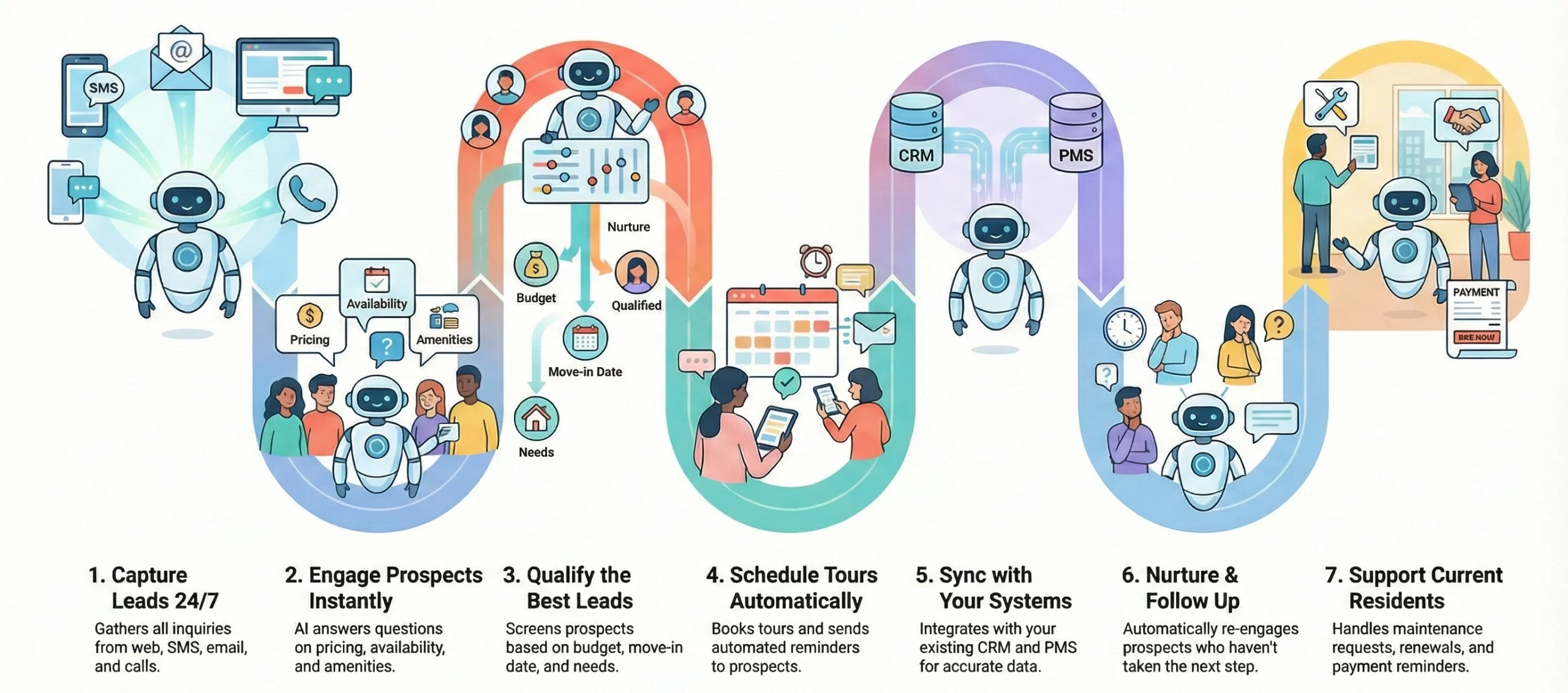
1. Capture & Centralize Inbound Leads
EliseAI continuously listens for new prospect inquiries across multiple channels including web chat on property websites, SMS/text, email, and voice calls, ensuring 24/7 lead capture without gaps. It records every interaction in a centralized AI-first CRM so nothing is lost or siloed.
2. Immediate Conversational Engagement
As soon as a prospect reaches out, EliseAI’s conversational AI responds instantly with natural language understanding to answer questions about availability, pricing, amenities, and lease terms. This initial engagement is personalized and automated, covering basic FAQs and gathering key details without human involvement.
3. Intelligent Qualification & Screening
During these conversations, EliseAI intelligently pre-screens prospects by collecting preferences (e.g., move-in date, budget, unit type, pet policies). This helps filter high-quality leads and prioritizes prospects that match your unit availability and leasing criteria.
4. Tour Scheduling & Management
Once a prospect is qualified, EliseAI automates tour booking by syncing with property calendars and scheduling in-person, virtual, or self-guided AI-assisted tours. It confirms availability and sends automated reminders to prospects, increasing show-up rates and reducing manual coordination.
5. Seamless CRM & PMS Integration
Behind the scenes, EliseAI syncs with your existing Property Management System (PMS) and CRM tools so that unit availability, pricing, and scheduling data remain accurate. It also imports guest cards and stores all communication histories for context-aware follow-ups.
6. Lead Nurturing & Follow-Ups
After initial engagement, the platform automatically follows up with prospects who haven’t yet booked a tour, completed an application, or responded to earlier messages, keeping leads warm and moving them down the leasing funnel.
7. Resident Engagement & Operations
For residents, EliseAI automates routine service requests such as maintenance intake, renewals, payment reminders, and general resident questions, seamlessly routing them to the right teams or tasks when needed.
How AI Leasing Assistants Increase Lead-to-Lease Conversions by 33%?
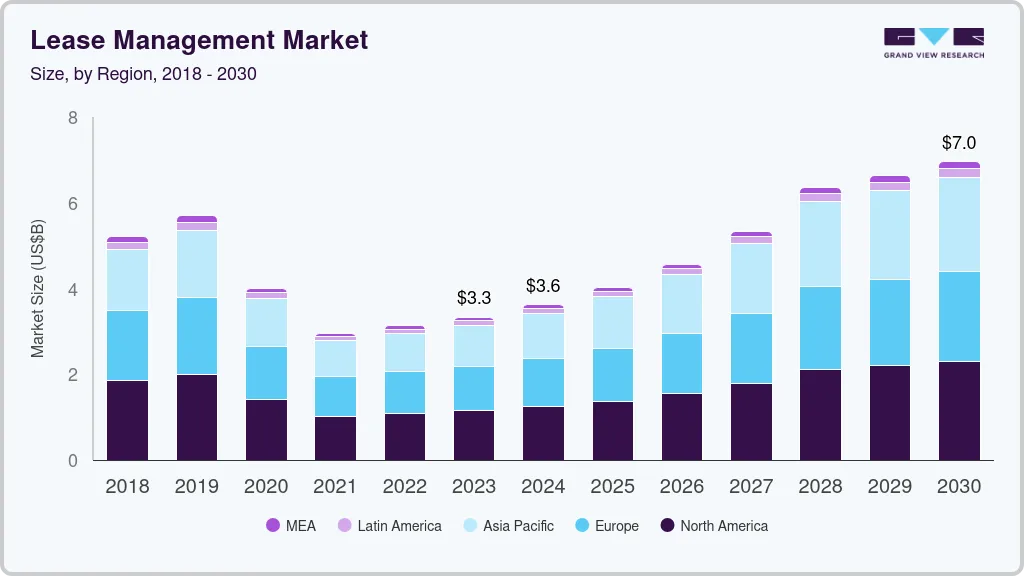
The lease management market was valued at USD 5.65 billion in 2024 and is projected to reach USD 8.13 billion by 2030, growing at 6.4% CAGR from 2025 to 2030. This growth reflects increasing use of AI-driven leasing workflows in residential and commercial real estate, especially where lead volumes outpace leasing team capacity.
AI-powered leasing assistants are delivering measurable business outcomes at the funnel level, with platforms reporting up to a 33% improvement in lead-to-lease conversion rates by reducing response delays, automating tour scheduling, and minimizing friction across the leasing journey.
A. Rising Demand for Conversion-Focused Leasing Solutions
As competition intensifies across real estate markets, property owners and operators are prioritizing tools that directly impact occupancy and revenue rather than operational convenience alone.
- Higher inquiry volumes across digital channels: Property listings now generate leads from multiple platforms simultaneously, creating demand for solutions that can manage and convert inquiries efficiently without increasing human workload.
- Revenue pressure from vacancy and churn: Even small improvements in conversion rates have a compounding effect on rental revenue, making AI-driven leasing tools increasingly attractive to landlords and operators.
- Shift from operational tools to revenue enablers: Leasing software is no longer evaluated only on workflow support but on measurable business outcomes, such as lead-to-lease conversion performance.
B. Why There Is Room for New AI Leasing Platforms to Grow
Despite increasing adoption, the AI leasing space is far from saturated, creating opportunities for new platforms to enter and scale.
- Fragmented prop-tech landscape: Real estate markets rely on a wide range of legacy systems and region-specific tools, leaving gaps for modern platforms that can integrate more seamlessly or serve niche segments.
- Uneven AI adoption across regions and asset types: While large portfolios adopt AI faster, many mid-sized and smaller operators are still early in their digital transformation, representing untapped demand.
- Outcome-driven differentiation: Platforms that can demonstrate tangible results such as faster leasing cycles or higher conversions gain traction more quickly, lowering go-to-market friction for new entrants.
These market signals and outcomes show why AI leasing platforms are growing in prop-tech. With demand for solutions that boost conversion and revenue predictability, there’s room for new platforms to enter, differentiate, and scale. Investing in building an AI leasing platform is a strategic opportunity, not just speculative.
Key Features of an AI Leasing Platform like EliseAI
These are the must-have features required to launch a competitive AI leasing platform in the housing industry. Each feature explains what it does, why it is essential at launch, and how its development cost aligns with the value it delivers.

1. Conversational AI Leasing Assistant
This feature allows the platform to manage real-time leasing conversations with prospects, answering questions, sharing availability, and guiding renters through early leasing steps without human intervention.
- Engages prospects instantly across chat, SMS, email, and voice, which eliminates response delays and improves first-touch experience at launch.
- Handles high volumes of leasing inquiries simultaneously, which reduces staffing dependency and operational strain from day one.
- Collects prospect details during conversations, which supports downstream lead qualification and follow-up workflows.
- Maintains conversational context to manage complex leasing questions accurately and consistently.
Estimated development cost: $40,000 to $80,000, driven by the need for natural language processing, conversation design, multi-channel communication, AI training, and testing to ensure accurate leasing interactions.
2. Omni-Channel Lead Capture and Response
This feature centralizes all renter inquiries into a single system, ensuring the platform captures and responds to leads regardless of where they originate.
- Captures inquiries from website chat, text messages, emails, and phone calls, which prevents lead loss during launch.
- Maintains conversation continuity across channels, which improves renter experience and trust.
- Enables consistent messaging and response logic across all communication touchpoints.
- Supports real-time routing and message handling across multiple systems.
Estimated development cost: $25,000 to $50,000, driven by third-party communication API integrations, real-time data processing, and backend orchestration needed to unify all channels into one workflow.
3. Prospect Management and Lead Conversion Automation
This feature organizes and automates the movement of prospects through the leasing funnel from first contact to tour booking. Automatically captures, scores, and nurtures leads with timely follow-ups to increase tour conversion rates.
- Automatically creates and updates digital guest cards for every prospect interaction.
- Tracks prospect status and engagement history, which improves visibility for leasing teams.
- Automates next-step actions such as follow-ups and reminders, which accelerates lead conversion at launch.
- Reduces manual data entry and coordination for onsite teams.
Estimated development cost: $20,000 to $40,000, based on CRM logic development, workflow automation, data structuring, and integration with leasing operations.
4. Intelligent Lead Qualification and Prioritization
This feature uses AI-driven logic to identify high-intent prospects and prioritize leasing efforts effectively. Automatically analyzes prospect behavior and demographics to rank leads, ensuring agents focus on the most conversion-ready prospects first.
- Collects renter preferences such as move-in date, budget, and unit type during interactions.
- Scores prospects based on predefined leasing criteria and behavioral signals.
- Matches prospect demand with real-time unit availability to improve conversion quality.
- Helps leasing teams focus attention on the most qualified leads at launch.
Estimated development cost: $20,000 to $45,000, justified by the development of scoring models, rule engines, data matching logic, and PMS data synchronization.
5. Automated Tour Scheduling and Self-Guided Tour Management
This feature automates tour coordination, reducing friction for prospects and operational overhead for leasing teams. Enables prospects to instantly book agent-led or self-guided tours while synchronizing calendars, access controls, and follow-up communications automatically.
- Allows prospects to schedule tours including in-person, virtual, or self-guided options without staff involvement.
- Syncs tour availability with property calendars and unit readiness.
- Sends automated confirmations and reminders, which increases tour attendance rates at launch.
- Supports access controls and scheduling logic for self-guided tours.
Estimated development cost: $25,000 to $50,000, driven by calendar integrations, scheduling workflows, access management logic, and real-time availability synchronization.
6. Seamless PMS and Leasing System Integration
This feature connects the AI leasing platform with existing property management systems to ensure operational accuracy. Synchronizes real-time availability, pricing, and resident data across systems to eliminate manual entry and prevent leasing errors.
- Syncs unit availability, pricing, and leasing data in real time.
- Pushes prospect and interaction data into existing systems to maintain operational continuity.
- Eliminates duplicate data entry and reduces data inconsistencies at launch.
- Builds trust with property operators by preserving existing workflows.
Estimated development cost: $30,000 to $60,000, based on custom PMS integrations, data mapping, API development, and extensive testing across systems.
7. Personalized Prospect Nurturing and Follow-Ups
This feature keeps prospects engaged throughout the leasing journey through automated, personalized communication. Delivers tailored messages, reminders, and recommendations across email, SMS, and chat to maintain engagement and accelerate leasing decisions.
- Sends follow-ups based on prospect behavior such as missed tours or incomplete applications.
- Personalizes messages using conversation history and leasing intent.
- Adjusts outreach timing to maintain engagement without overwhelming prospects.
- Improves conversion rates during the critical launch phase.
Estimated development cost: $15,000 to $35,000, justified by behavioral logic implementation, messaging workflows, and AI-driven personalization rules.
8. AI-Driven Resident Lifecycle Management
This feature extends the platform’s value beyond leasing into ongoing resident communication and support. Automates resident touchpoints such as move-in support, maintenance updates, renewals, and satisfaction check-ins to improve retention and resident experience.
- Manages renewals, general inquiries, and resident communication through conversational AI.
- Maintains context across resident interactions to deliver consistent responses.
- Routes complex issues to onsite teams when human intervention is required.
- Positions the platform as a long-term operational tool at launch.
Estimated development cost: $30,000 to $55,000, driven by lifecycle workflow design, role-based access controls, and integration with resident data systems.
9. Smart Maintenance and Service Request Automation
This feature automates maintenance request intake and routing through AI-driven interactions. Uses AI to capture, categorize, and prioritize service requests, automatically routing them to the right teams while keeping residents informed in real time.
- Allows residents to submit maintenance requests through conversational interfaces.
- Categorizes and prioritizes requests automatically to improve response times.
- Sends status updates to residents, which improves satisfaction from launch onward.
- Reduces manual coordination for property teams.
Estimated development cost: $20,000 to $40,000, justified by ticketing workflow development, AI request classification, and PMS integration.
10. AI-Powered Lease Audits and Revenue Optimization
This feature analyzes lease data to identify revenue leakage and operational risks. Continuously reviews lease terms, pricing, and compliance data to flag inconsistencies, uncover missed revenue opportunities, and support smarter pricing decisions.
- Reviews lease records to detect inconsistencies and missing charges.
- Flags potential revenue recovery opportunities automatically.
- Supports portfolio-level oversight for property operators at launch.
- Differentiates the platform from basic leasing automation tools.
Estimated development cost: $25,000 to $50,000, driven by data analysis logic, audit workflows, reporting models, and integration with lease data sources.
Cost to Build an AI Leasing Platform like EliseAI
The cost to build an EliseAI-like AI leasing platform helps property leaders plan technology investments strategically. This overview highlights key cost drivers, development considerations, and realistic budget expectations for modern AI-powered leasing solutions.
Phase 1: Consultation and Platform Architecture
Our developers and solution architects work closely with you to define the vision, scope, and technical foundation of your AI leasing platform. We translate business goals into a clear platform roadmap, finalize feature priorities, and design a scalable architecture tailored for the housing industry.
| Activity | Scope | Estimated Cost |
| Product discovery and requirement analysis | Platform goals, target users, feature scope, MVP definition | $6,000 to $10,000 |
| Technical architecture design | System architecture, AI components, data flow, scalability planning | $7,000 to $12,000 |
| AI feasibility and workflow planning | Conversational AI scope, model approach, training requirements | $5,000 to $8,000 |
| Integration planning | PMS, communication channels, third-party tools | $4,000 to $7,000 |
| Project roadmap and delivery planning | Development phases, timelines, resource allocation | $3,000 to $5,000 |
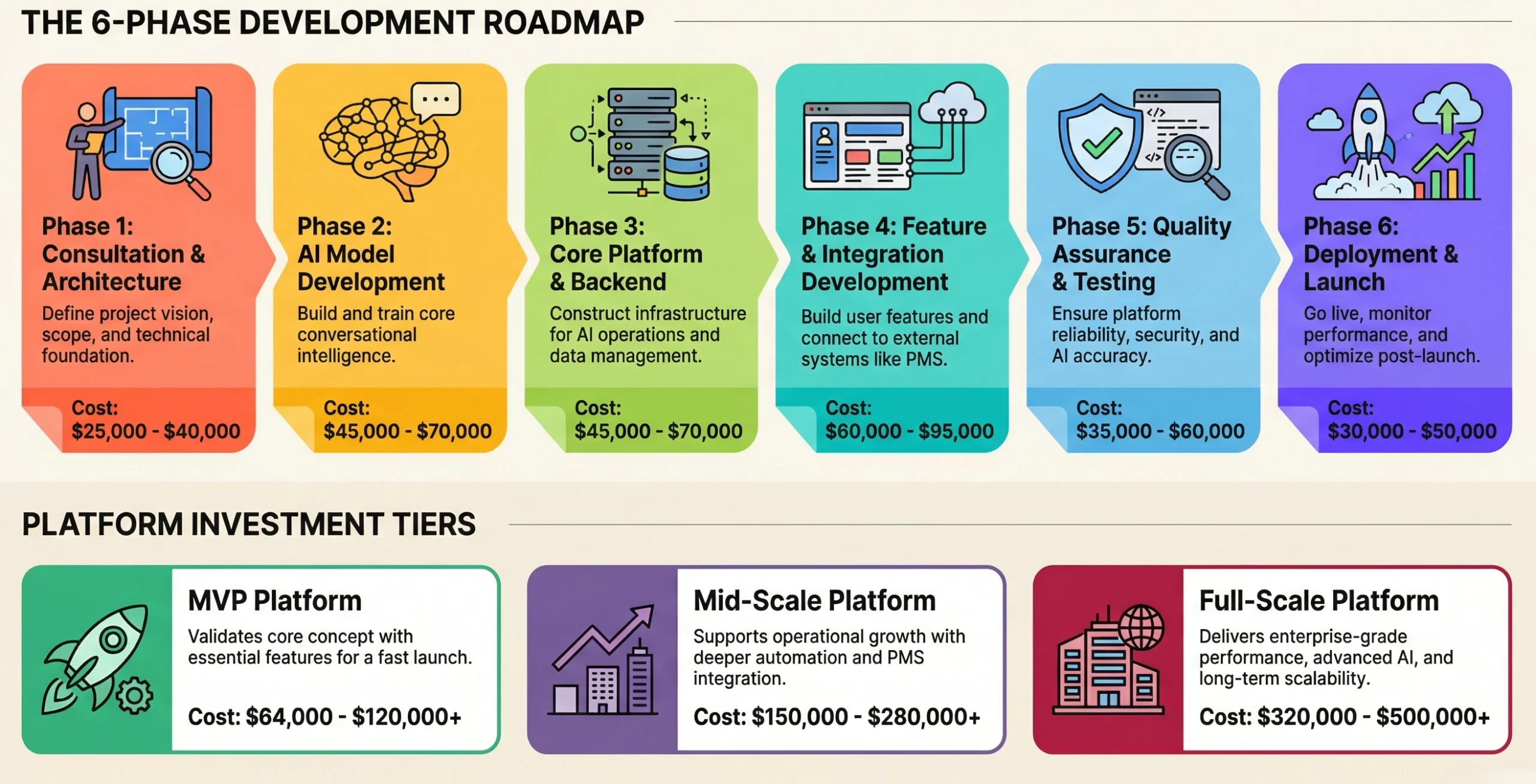
Estimated Phase 1 Cost: $25,000 to $40,000, driven by deep discovery sessions, architectural planning, AI feasibility analysis, and integration strategy required to avoid costly redesigns during later development stages.
Key Takeaways from Phase 1
- A clear, validated blueprint for building an AI leasing platform ready for market launch
- Early identification of technical constraints, dependencies, and feature priorities.
- A scalable system architecture designed to support future growth and feature expansion.
- Strong alignment between business objectives, AI capabilities, and development execution
Phase 2: AI Model Development and Conversational Intelligence
Our AI engineers design and build the conversational intelligence that powers the leasing platform. This includes training AI models to understand renter intent, handle leasing-specific conversations, and respond accurately across multiple interaction scenarios.
| Activity | Scope | Estimated Cost |
| Conversational flow design | Leasing journeys, intent mapping, dialogue structures | $8,000 to $12,000 |
| Natural language processing model setup | Intent detection, entity extraction, response logic | $12,000 to $20,000 |
| AI model training and tuning | Leasing data preparation, training iterations, accuracy optimization | $10,000 to $18,000 |
| Multi-scenario conversation handling | FAQs, availability checks, pricing questions, objections | $7,000 to $12,000 |
| AI testing and validation | Response accuracy, edge cases, fallback handling | $6,000 to $10,000 |
Estimated Phase 2 Cost: $45,000 to $70,000, driven by conversational design complexity, AI model training efforts, iterative testing cycles, and the need to achieve reliable leasing accuracy before platform launch.
Key Takeaways from Phase 2
- A trained conversational AI capable of handling real-world leasing inquiries accurately.
- Structured conversation flows aligned with housing-specific leasing scenarios.
- Improved response consistency and reduced reliance on manual intervention.
- A strong AI foundation that supports future feature expansion and automation depth.
Phase 3: Core Platform and Backend Development
This phase focuses on building the core platform infrastructure that supports AI operations, feature workflows, and data management. Our developers create the backend systems, APIs, and services that enable scalability, performance, and reliable platform behavior under real-world usage.
| Activity | Scope | Estimated Cost |
| Backend system architecture and setup | Core services, database structure, API framework | $12,000 to $18,000 |
| User roles and access management | Admin, leasing staff, and system-level permissions | $6,000 to $10,000 |
| Data management and storage | Prospect data, conversation history, leasing records | $8,000 to $12,000 |
| Workflow and business logic development | Leasing workflows, task handling, automation rules | $10,000 to $16,000 |
| Platform performance and scalability setup | Load handling, optimization, reliability planning | $7,000 to $12,000 |
Estimated Phase 3 Cost: $45,000 to $70,000, driven by backend engineering effort, scalable system design, secure data handling, and the development of core workflows that support all platform features.
Key Takeaways from Phase 3
- A stable and scalable backend capable of supporting AI-driven leasing operations.
- Well-defined APIs and data structures that enable smooth feature development and integrations.
- Secure role-based access and data handling across the platform.
- A strong technical foundation that ensures performance and reliability at launch.
Phase 4: Feature Development and System Integrations
This phase brings the platform to life by building user-facing features and connecting the system with external tools required for real-world leasing operations. Our developers implement core leasing workflows while integrating property management systems, communication services, and third-party platforms.
| Activity | Scope | Estimated Cost |
| Leasing feature development | Prospect management, tour scheduling, follow-ups, resident workflows | $18,000 to $28,000 |
| Maintenance and service workflows | Request intake, categorization, routing, and status updates | $10,000 to $16,000 |
| PMS integration | Unit availability, pricing sync, guest cards, leasing data exchange | $15,000 to $25,000 |
| Communication service integrations | SMS, email, voice, and notification services | $8,000 to $14,000 |
| Feature-level testing and validation | End-to-end testing of workflows and integrations | $7,000 to $12,000 |
Estimated Phase 4 Cost: $60,000 to $95,000, driven by the complexity of feature workflows, custom PMS integrations, external service dependencies, and extensive validation required to ensure seamless operations at launch.
Key Takeaways from Phase 4
- Fully functional leasing and resident-facing features ready for real-world usage.
- Seamless integration with property management systems and communication tools.
- Automated workflows that reduce manual effort across leasing operations.
- A platform experience that feels complete, connected, and market-ready at launch.
Phase 5: Quality Assurance and Compliance Testing
This phase ensures the platform performs reliably, protects sensitive data, and operates as expected under real-world conditions. Our QA engineers and security specialists validate functionality, test AI accuracy, and harden the system before public release.
| Activity | Scope | Estimated Cost |
| Functional and regression testing | End-to-end testing of features, workflows, and integrations | $10,000 to $16,000 |
| AI response and accuracy testing | Validation of conversational outputs, edge cases, and fallback logic | $8,000 to $14,000 |
| Performance and load testing | Stress testing for concurrent users and peak usage scenarios | $6,000 to $10,000 |
| Security testing and hardening | Vulnerability scans, access controls, data protection measures | $7,000 to $12,000 |
| Compliance readiness checks | Data handling practices and platform safeguards review | $5,000 to $8,000 |
Estimated Phase 5 Cost: $35,000 to $60,000, driven by extensive testing cycles, AI validation efforts, performance optimization, and security measures required to ensure a stable and trustworthy platform at launch.
Key Takeaways from Phase 5
- A thoroughly tested platform with stable and predictable behavior across all features.
- Verified AI accuracy and controlled responses for real-world leasing interactions.
- Strengthened security posture to protect prospect and resident data.
- Reduced launch risk through early detection and resolution of issues.
Phase 6: Deployment, Launch, and Post-Launch Optimization
This phase prepares the platform for live usage and ensures a smooth transition from development to production. Our team deploys the system, monitors real-world performance, and optimizes workflows based on early user behavior and operational data.
| Activity | Scope | Estimated Cost |
| Production deployment setup | Cloud infrastructure, environment configuration, release management | $8,000 to $12,000 |
| Platform launch support | Go-live coordination, monitoring, issue resolution | $6,000 to $10,000 |
| Post-launch performance tuning | AI response refinement, workflow optimization | $7,000 to $12,000 |
| Bug fixes and stability improvements | Early issue resolution and platform adjustments | $5,000 to $8,000 |
| Ongoing maintenance planning | Support processes, monitoring tools, optimization roadmap | $4,000 to $6,000 |
Estimated Phase 6 Cost: $30,000 to $50,000, justified by production infrastructure setup, launch support, early optimization efforts, and stabilization work required to ensure consistent performance after release.
Key Takeaways from Phase 6
- A successful production launch with minimal disruption to operations
- Early performance insights used to refine AI behavior and workflows.
- Improved platform stability through real-world monitoring and fixes.
- A clear foundation for ongoing optimization and future enhancements.
Estimated Cost of an EliseAI-like AI Leasing Platform Development
This cost summary consolidates all development phases into three practical investment tiers. Each tier reflects a different level of platform maturity, feature depth, and scalability based on launch goals and time-to-market priorities.
| Platform Scope | Included Phases and Capabilities | Estimated Total Cost |
| MVP Platform | Reduced-scope execution of Phases 1 to 6, covering core architecture, basic conversational AI, essential backend, limited leasing features, and minimal integrations | $64,000 to $120,000+ |
| Mid-Scale Platform | Full execution of Phases 1 to 4, with extended AI intelligence, complete leasing workflows, PMS integration, analytics, and partial optimization | $150,000 to $280,000+ |
| Full-Scale Platform | Full execution of all phases, including advanced AI capabilities, complete feature set, multiple integrations, enterprise-grade performance, and post-launch optimization | $320,000 to $500,000+ |
Note: MVP costs reflect a reduced-scope implementation where selected phases are executed in simplified form to validate the platform quickly and efficiently before scaling.
Consult with IdeaUsher to turn these estimates into a practical development roadmap. Our team helps define the right scope, align costs with features, and plan a scalable AI leasing platform built for launch and growth.
Key Takeaways from the Total Cost Summary
- MVP platforms focus on validating the AI leasing concept with essential automation and faster time to market.
- Mid-scale platforms support operational growth, deeper leasing automation, and real-world property management use.
- Full-scale platforms enable enterprise readiness, advanced intelligence, and long-term scalability.
- Final investment depends on AI depth, feature complexity, and integration requirements defined during early planning.
What Factors Impact AI Leasing Platform Development Cost?
Several technical and strategic decisions directly influence the cost of building an AI leasing platform. Understanding these factors helps founders plan budgets realistically and prioritize features that deliver the most value at launch.
1. AI Model Complexity and Conversational Depth
More advanced conversational intelligence requires deeper intent mapping, context retention, and repeated AI training cycles. As conversational depth increases, development effort, testing time, and optimization costs rise significantly.
2. Number of Communication Channels Supported
Each additional channel such as SMS, email, or voice adds integration, testing, and infrastructure overhead. Supporting multiple channels also increases backend complexity to maintain consistent, real-time conversations.
3. Level of PMS and Third-Party Integrations
Custom integrations with property management systems require detailed data mapping, API development, and validation. Variations across PMS platforms increase engineering effort and ongoing maintenance requirements.
4. Feature Scope at Launch
Launching with a broader feature set increases development time, testing effort, and coordination across teams. A focused MVP reduces cost, while advanced features add complexity and extend delivery timelines.
5. Data Volume and Scalability Requirements
Platforms built for large portfolios require stronger infrastructure, optimized data handling, and performance tuning. Higher scalability expectations increase both development and long-term operational costs.
6. Customization and Automation Depth
Highly customized workflows and deeper automation improve differentiation but require additional logic, configuration options, and quality assurance. Greater automation depth directly increases build complexity and cost.
How to Reduce Development Cost Without Compromising Platform Quality?
Building an AI leasing platform requires disciplined scope control and smart technical decisions. The following strategies help control cost while maintaining performance, scalability, and launch readiness.
1. Launch with a Focused MVP Scope
A focused MVP limits development to core AI leasing capabilities such as conversational engagement and basic workflows. This approach reduces engineering effort, shortens timelines, and validates market demand before expanding features.
2. Follow a Phased Feature Rollout Strategy
A phased rollout releases features in planned stages instead of all at once. This strategy spreads development cost over time and allows teams to prioritize features that deliver immediate operational value.
3. Reuse Proven AI Components and Frameworks
Using established AI frameworks and pre-tested conversational components reduces custom model development. This lowers engineering risk, improves reliability, and accelerates delivery without sacrificing leasing accuracy or performance.
4. Limit Customization During Initial Launch
Restricting deep customization at launch reduces logic complexity and testing effort. Standardized workflows support faster deployment while preserving flexibility to introduce tailored automation after market validation.
5. Plan Scalability Early to Avoid Rebuilds
Early scalability planning ensures the platform handles future growth without architectural changes. A scalable foundation prevents costly rebuilds and protects long-term development investment as usage increases.
Conclusion
Building an AI leasing platform like EliseAI requires careful planning, phased execution, and informed cost decisions. The total investment depends on AI complexity, feature scope, integrations, and scalability goals, not on arbitrary pricing. By approaching development strategically, businesses can launch a high-quality platform that meets housing industry expectations while controlling upfront costs.
A phased development model, a focused MVP launch, and early architectural planning create a strong foundation for long-term growth. Working with an experienced development partner further reduces risk, accelerates time to market, and ensures the platform delivers real operational value from day one.
Why Partner with IdeaUsher for Your AI Leasing Platform Development?
At IdeaUsher, we specialize in building intelligent leasing platforms that streamline operations and enhance tenant engagement. Our team combines AI expertise with deep industry understanding to deliver solutions tailored to your business goals.
What Sets Us Apart?
- AI-Driven Solutions: We design smart chat systems and automation tools that improve response times and lead conversions.
- Customized Development: Every platform is built around your unique requirements, ensuring flexibility and scalability.
- Proven Delivery: Our portfolio reflects successful AI-powered products across multiple industries.
- Enterprise-Grade Security: We prioritize data protection and system reliability at every stage.
Explore our case studies to see how we help businesses launch impactful AI products in the market.
Connect with us today to discuss your AI leasing platform idea and turn it into a market-ready solution.


FAQs
A.1. Development cost depends on features, AI capabilities, integrations, data security, and customization needs. Advanced chat automation, CRM connections, and analytics increase pricing. The choice of development team and technology stack also impacts the overall investment.
A.2. The cost to build an AI leasing platform like EliseAI usually ranges from $64,000 to $120,000 or more. Pricing varies based on project complexity, number of features, AI model training, and ongoing maintenance requirements.
A.3. Custom development offers better control, scalability, and branding compared to prebuilt tools. While it costs more upfront, a tailored platform ensures long-term flexibility, better data security, and improved user experience for property management teams.
A.4. Post-launch costs include cloud hosting, AI model updates, technical support, and feature enhancements. Regular maintenance is essential to keep the platform secure, accurate, and aligned with evolving leasing business requirements.