

Property value has always been treated like a fixed number, but anyone close to real estate knows it rarely behaves that way. The same home can carry different prices based on timing, data access, and who is doing the math. This growing trust gap is where AI valuation apps like HouseCanary began gaining attention, as they support lending decisions, portfolio risk analysis, acquisition pricing, and collateral assessment with greater consistency.
As real estate decisions became faster and more data-heavy, people gradually moved away from gut instinct and static spreadsheets. Modern AI valuation apps can process millions of signals and learn from market behavior in near-real-time, enabling them to continuously update value assumptions rather than react late.
Over the years, we’ve built numerous property valuation solutions powered by ML valuation engines and large-scale property data knowledge graphs. Thanks to this expertise, we’re sharing this blog to discuss the steps to develop an AI valuation app like HouseCanary.
Key Market Takeaways for AI Property Valuation App
According to ResearchandMarkets, AI in the real estate market has grown at a remarkable pace, reaching $222.65 billion in 2024 and projected to reach $303.06 billion in 2025, with a CAGR of 36.1%. Property valuation apps play a central role in this growth, using machine learning to convert complex market data into fast, reliable value estimates.
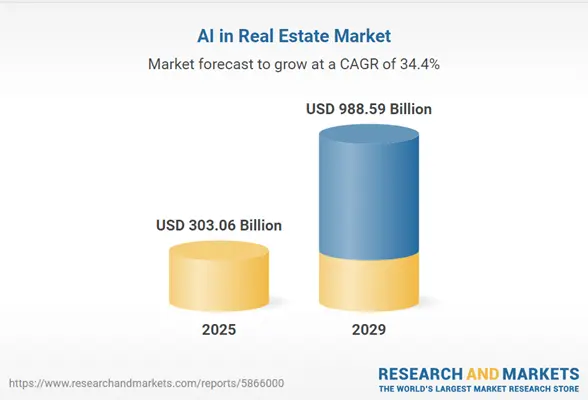
Source: ResearchandMarkets
AI property valuation apps are widely adopted because they combine speed with consistency, pulling from live sales data, neighborhood behavior, and economic signals in real time. Valuations that once took days can now be delivered in seconds, making these tools highly valuable in fast-moving property markets.
Well-known examples include Zillow’s Zestimate and HouseCanary’s CanaryAI, both of which use large-scale machine-learning models to provide instant valuations. CoreLogic also stands out with its Total Home ValueX model, highlighting how AI valuation is becoming embedded across the real estate ecosystem.

What is the HouseCanary Platform?
The HouseCanary Platform is a proprietary 50-state real estate intelligence system built for investors who need speed, accuracy, and depth at scale. It enables users to search, analyze, and underwrite properties using highly customized investment criteria across 136+ million U.S. properties.
What makes the platform powerful is its data architecture and valuation intelligence. Property records are sourced from thousands of public and private datasetsand refined using AI models and manual quality controls. This results in defensible valuations, reliable comps, and forward-looking market forecasts, not just static estimates.
Key Features of the HouseCanary Platform
The platform can reliably combine national property data with dynamic valuation models so investors see value as it truly shifts. It should intelligently assess condition risk using images and market signals, which helps decisions stay grounded in real asset quality.
1. 50-State Property Search
Enables nationwide discovery with investment-specific filters, allowing users to pinpoint opportunities that align with yield, risk, and strategy rather than browsing raw listings. It also supports portfolio-scale scanning, helping investors compare markets and assets consistently across states.
2. Automated Valuation Models
Delivers dynamic property values by reconciling public records, comparable sales, and condition data across 114M+ properties, making valuations more adaptive to real conditions. These values update as new data signals emerge, reducing reliance on outdated or static price assumptions.
3. Comparable Selection Interface
Allows users to manually review and select comps on a single screen, instantly recalculating values and producing defensible CMAs without switching tools. This gives analysts direct control over valuation logic, which is critical for underwriting and lender discussions.
4. Image-Based Condition Assessment
Uses computer vision on property photos to assign standardized condition scores (C1–C6), directly influencing renovation, rent, and ARV calculations. It removes subjectivity from condition grading and scales inspection-level insight across large portfolios.
5. Risk Scoring and Valuation Analytics
Surfaces full risk profiles in a single dashboard, including AVM vs ARV gaps, volatility indicators, and multiple valuation perspectives side by side. This helps investors quickly understand downside exposure before committing capital.
6. Report Generation and Sharing
Creates polished valuation reports or live shareable links, enabling collaboration with partners, lenders, or clients without exporting raw data. Shared reports remain interactive, allowing recipients to explore assumptions instead of viewing static PDFs.
7. Block-Level Market Intelligence
Provides hyper-granular insights such as block-level HPI trends, crime scores, and forecasts, supporting micro-market decisions rather than city-wide assumptions. This level of precision is especially valuable for identifying street-by-street performance differences within the same neighborhood.
How Does the HouseCanary Platform Work?
For professionals in real estate, lending, and investment, confident decisions demand more than raw information. They require instant, accurate, and predictive intelligence. This is the core problem HouseCanary solves.
The platform functions as a full-stack property intelligence engine, converting fragmented property data into actionable strategy that helps users spot opportunities, reduce risk, and simplify complex workflows.
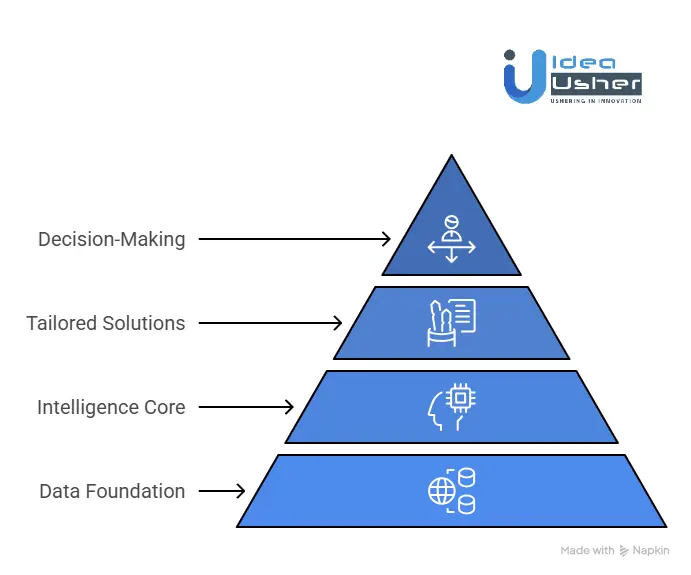
The Foundation
The effectiveness of HouseCanary begins with one principle: better decisions start with better data.
What truly matters here
- National-scale coverage: Insights across 136+ million properties, enabling reliable comparisons and market-wide trend analysis.
- Deep data refinement: Thousands of public and private sources are aggregated, normalized, and standardized, turning messy records into decision-ready datasets.
- Dual-layer quality control: AI-driven anomaly detection paired with manual validation, ensuring high trust and consistency across outputs.
This foundation is what enables the platform to deliver defensible insights rather than surface-level estimates.
The Intelligence Core
Raw data is static. HouseCanary’s advantage lies in its interpretation and prediction.
Key intelligence capabilities
- Advanced Automated Valuation Models: Machine-learning-driven models that analyze sales history, property attributes, and hyper-local market behavior to deliver instant and highly granular valuations.
- Predictive analytics and forecasting: Proprietary models that estimate future value, market direction, and risk exposure, allowing users to plan around probable outcomes rather than historical lag.
- Computer vision and image intelligence: Image recognition that identifies room types, layouts, and property condition from photos, adding qualitative context that traditional numeric models miss.
Together, these layers transform the platform from a valuation tool into a forward-looking decision system.
Tailored Solutions by Industry Vertical
HouseCanary is not a generic platform. Its technology is purpose-built for specific professional workflows.
Where the platform delivers the most impact
| Industry Segment | Core Need | How HouseCanary Helps |
| Mortgage Lenders & Banks | Origination, underwriting, servicing | Instant valuations and analytics across the loan lifecycle |
| Real Estate Investors & REITs | Deal sourcing and portfolio strategy | Custom search, investment scoring, and lifecycle analytics |
| Private Lenders & Institutional Firms | Pre-bid diligence and risk analysis | High-confidence valuations and large-scale portfolio insights |
| Mortgage Servicers | Loss mitigation and asset management | Fast access to data for informed recovery and disposition decisions |
This vertical focus ensures each user group gets precision tools aligned to how they actually operate.
Why This Architecture Matters
The real strength of HouseCanary lies in how these layers work together. Massive, clean data feeds intelligent models, those models generate explainable and predictive insights, and those insights are delivered through workflows designed for specific market roles.
The result is a platform that not only reports property data but also actively guides real-time decision-making.
What is the Business Model of the HouseCanary Platform?
HouseCanary operates on a SaaS-first, data-driven business model designed to monetize intelligence rather than transactions alone. At its core, the platform sells AI-powered property data, valuations, analytics, and forecasts across 136 million-plus U.S. properties, serving lenders, investors, agents, and proptech firms that rely on speed, accuracy, and predictive insight.
Revenue Streams
HouseCanary’s revenue is anchored in recurring access to proprietary data that competitors cannot easily replicate.
Primary revenue drivers
- Subscription fees for analytics platforms powered by normalized data from thousands of sources
- Pay-per-use pricing for AVMs and API calls across 19,000-plus zip codes
- Brokerage-related revenue is tied to valuation and decision support rather than pure deal execution
- Enterprise licensing for institutional clients, embedding analytics into loan origination, portfolio management, and investment systems
The emphasis is on high retention and expanding account value, not one-time transactions.
Financial and Operational Signals
While detailed financials remain private, the operating signals clearly point to a highly scaled and efficient platform. Coverage across 136 million-plus properties with block-level granularity provides greater precision than MSA-based competitors, while industry-leading accuracy is reinforced by machine learning models, image recognition, and crime score integration, which materially improve decision reliability.
At the operational layer, up to 90 percent faster billing and internal workflows signal strong process automation and enterprise readiness. This efficiency reduces client risk, lowers operational burden, and consistently strengthens long term contracts built on trust and repeat usage.
Funding and Growth Strategy
HouseCanary has been venture-backed since its founding in 2013 by Jeremy Sicklick and Chris Stroud.
What funding enabled
- Heavy investment in data infrastructure and AI model development
- Expansion across web, mobile, and API based delivery
- Scaling coverage to 140 million homes and over 100,000 neighborhoods
Total funding is estimated in the tens of millions, supporting a strategy focused on data depth, predictive accuracy, and enterprise adoption rather than mass consumer volume.
How to Build an AI Valuation App Like HouseCanary?
Building an AI valuation app like HouseCanary should start with a unified property data layer that removes duplication and bias. Predictive models can then be trained on pre-listing signals and condition data to produce stable valuations.
Our team has developed numerous AI valuation solutions inspired by HouseCanary. Here is how we do it.
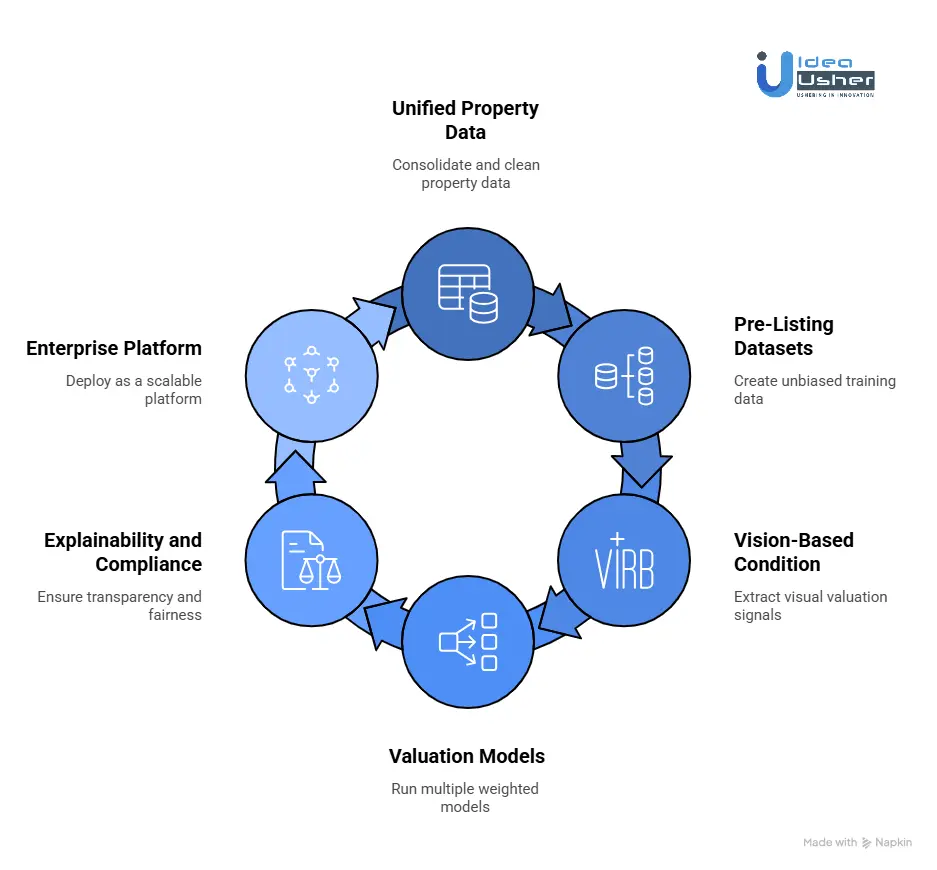
1. Unified Property Data
We start by consolidating tax records, deeds, MLS feeds, permits, and imagery into a unified property data layer. Our team implements entity resolution and property identity matching to eliminate duplication and ambiguity. A universal property ID system is created to ensure that every model and workflow operates on a consistent, trusted data foundation.
2. Pre-Listing Datasets
We engineer training datasets that reflect property value before market influence sets in. Historical property states are captured prior to listing activity, and data is time-sliced to remove listing-related bias. Intrinsic value signals are labeled carefully so models learn structural worth rather than market sentiment.
3. Vision-Based Condition
We build computer vision pipelines that translate visual data into valuation signals. Images are normalized and classified by room type, and features related to finishes, age, and maintenance quality are extracted. These visual outputs are mapped to valuation multipliers that adjust price estimates based on actual condition.
4. Valuation Models
We design valuation engines that run multiple models in parallel instead of relying on a single estimator. Each model is weighted by market dynamics, asset type, and data depth. Confidence scores are generated dynamically, enabling clients to assess both the valuation and its level of certainty.
5. Explainability and Compliance
We embed explainability and compliance directly into the valuation workflow. SHAP-based reasoning layers explain why a value was produced, while fairness and bias testing workflows help align with regulatory expectations. Detailed audit logs ensure full traceability of valuations for reviews and disputes.
6. Enterprise Platform
Finally, we package the valuation engine as an enterprise-ready platform. Analysts receive intuitive web dashboards, lenders and PropTech partners access secure APIs, and role-based controls manage permissions and pricing tiers. This approach ensures the platform scales reliably across teams, markets, and use cases.
Choosing the Right Foundation for Your AI Valuation App
Launching an AI-powered real estate valuation app is a major technical decision, and one of the first choices you will face is the development foundation. Native versus cross-platform is not just a tooling debate. It is a strategic decision that directly affects performance, user experience, cost, and long-term scalability.
For AI-driven valuation platforms, the right choice depends on where intelligence lives and how users interact with complex data.
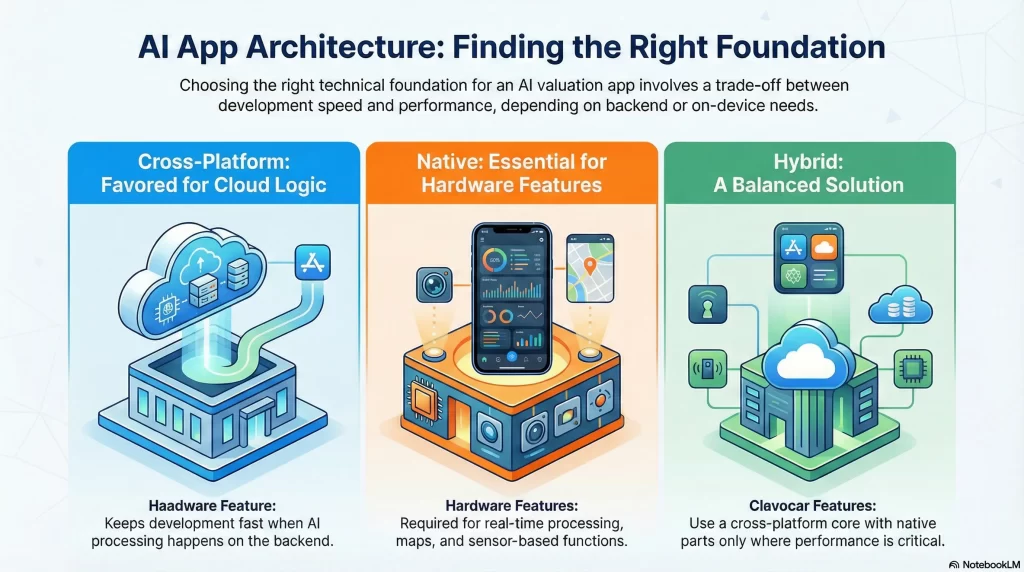
Where Does the Heavy Lifting Happen?
For an AI valuation app, the most important architectural question is where the intelligence is processed.
- If the app primarily serves as a fast interface to cloud-based AI models and backend analytics, most computation occurs on servers. In this case, a cross-platform approach is often efficient and practical.
- If the app requires real-time on-device processing, advanced graphics, or sensor-driven intelligence, then device-level performance becomes critical. This naturally favors a native approach.
Native vs Cross Platform: Use Case Comparison
| Consideration | Native Development Swift iOS Kotlin Android | Cross Platform Development Flutter React Native |
| Best Fit | High performance and hardware-intensive features | Data-driven valuation and analytics apps |
| Performance Strength | High FPS map rendering, advanced geospatial layers, on-device ML, deep camera, and GPS control | Smooth rendering of charts, reports, dashboards, and forms driven by backend AI |
| Development Speed and Cost | Higher cost and longer timelines with two codebases | Faster time to market with a single shared codebase |
| User Experience | Fully native feel with OS level polish and animations | Consistent experience across platforms with minor trade-offs in advanced interactions |
| Device Feature Access | Immediate access to new OS and hardware APIs | Dependent on framework plugins and update cycles |
| Long Term Maintenance | More complex due to duplicated fixes and updates | Simplified core updates with framework dependency |
How Enterprise Platforms Apply a Hybrid Strategy
Enterprise-grade real estate platforms rarely treat this as a binary choice. Platforms such as HouseCanary follow a pragmatic hybrid approach that optimizes for speed, cost, and performance where it matters most.
Cross-Platform for the Core App Layer
The main mobile application is often built using Flutter or React Native. This layer handles:
- Viewing valuation reports and market analytics
- Managing portfolios and alerts
- Interacting with backend-driven AI insights
This makes sense because these are data presentation and interaction tasks. A shared codebase ensures consistency across iOS and Android while reducing development and maintenance overhead. More importantly, it allows teams to focus resources on backend AI models and data pipelines, which are the real competitive differentiators.
Native Modules for Performance Critical Features
When features demand peak performance or deep hardware integration, they are implemented as native modules and embedded into the cross-platform app. Common examples include:
- High-performance map rendering with layered geospatial data
- Augmented reality features for spatial property visualization
- Advanced camera workflows with real-time image processing
This approach delivers native level performance without sacrificing overall development efficiency.
How to Choose the Right Strategy for Your App
Use this framework to guide your decision.
Choose Native First If:
Your core innovation depends on advanced graphics, real-time sensor data, or immersive experiences such as AR-driven property analysis. Performance and platform-specific optimization are non-negotiable, and you have the budget and timeline to support parallel development teams.
Choose Cross Platform If:
Your app is primarily a window into a powerful cloud-based AI system. Valuation accuracy, analytics depth, and speed of insights matter more than pushing mobile hardware limits. Your goal is to launch quickly on both platforms and iterate fast based on user feedback.
Plan for Hybrid from Day One If:
You expect most of the app to be cross-platform, but already know that a few high-impact features will require native performance. Designing for this upfront avoids costly architectural changes later.
How Large Should the Development Team Be for an AI Valuation Platform?
Launching a production-grade AI real estate valuation platform requires more than general engineering capacity. It demands a carefully balanced mix of technical, data, and domain expertise. Many projects struggle not because of weak ideas, but because the team structure underestimates the complexity of property data, AI modeling, and regulatory expectations.
A strong team is defined less by headcount and more by complete functional coverage. For a serious MVP with market intent, certain roles are essential and cannot be skipped.
The Core Development Team
For an initial launch, a lean but complete core team of 7 to 9 technical members is typical.
| Role | Core Responsibilities | Why It Is Non-Negotiable |
| Backend Developers (2 to 3) | Build data pipelines, APIs, and scalable integrations with external data sources. | Reliable data flow and performance are foundational to the entire platform. |
| AI and ML Engineers (1 to 2) | Build, train, and deploy valuation and prediction models. | This role defines valuation accuracy and long term IP value. |
| Mobile or Frontend Developer (1) | Develop the user-facing web or mobile interface. | User trust depends on a clear and responsive experience. |
| UI and UX Designer (1) | Design dashboards and workflows for complex data. | Good design turns dense data into usable insights. |
| QA and Test Engineer (1) | Test platform stability and model output accuracy. | Errors in valuation directly impact credibility and risk. |
The Foundational Roles
These roles ensure the platform solves real business problems and reaches the market effectively.
Project Manager or Technical Lead (1)
This role coordinates execution. They translate business goals into technical tasks, manage timelines, reduce delivery risk, and keep communication aligned across specialists. Without this role, progress often becomes fragmented.
Business Analyst or Domain Expert (1)
This role anchors the product in real estate reality. They define valuation logic, ensure regulatory alignment for AVMs, validate comparable selection rules, and confirm that AI outputs make sense in practical use cases. Teams that skip this role often build technically impressive systems that fail in real-world adoption.
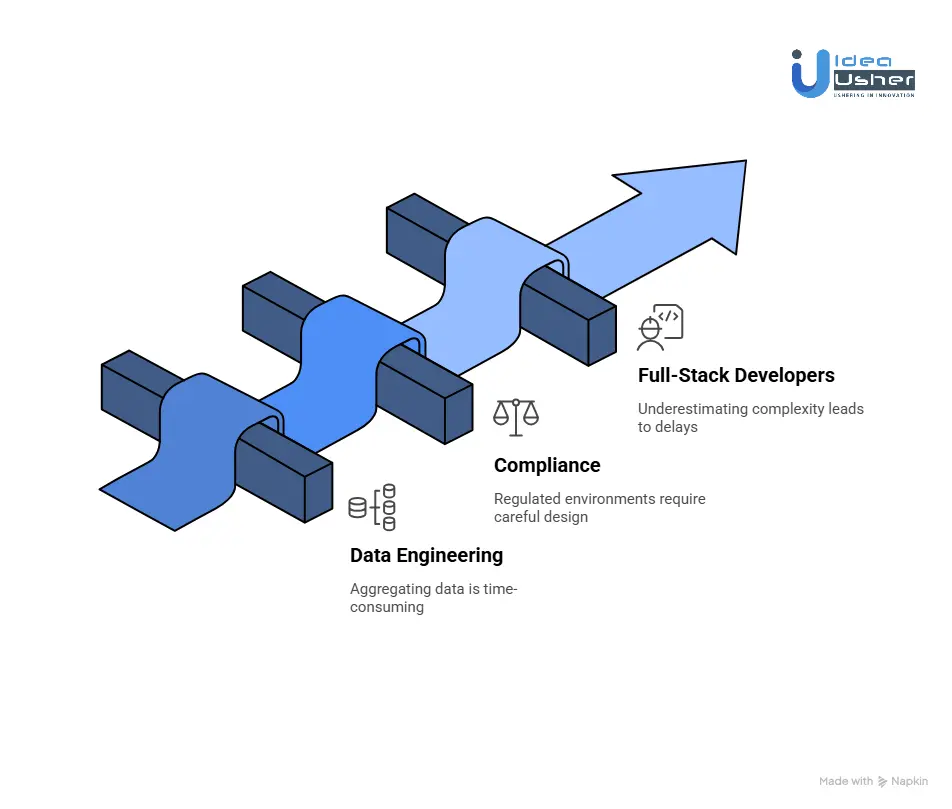
The Common Pitfall
Early-stage teams often start with just 2 or 3 full-stack developers. This almost always leads to delays or failure because two areas are consistently underestimated.
The Data Engineering Challenge
Aggregating, cleaning, normalizing, and updating property data from hundreds of counties, MLS feeds, and third-party providers is a full-time effort. One or two backend engineers are often consumed by data work alone before any model training begins.
The Compliance Challenge
Valuation platforms that support lending or investment decisions operate in regulated environments. Auditability, explainability, and bias control must be designed into the system early. This requires planning and domain awareness beyond general development skills.
Team Structure and Evolution
Phase 1. MVP Build (Months 0 to 9)
Start with the core 7 to 9-person team. Focus on one market, a reliable data pipeline, a single well-tested valuation model, and a clean functional interface.
Phase 2. Scale and Expansion (Year 2 and Beyond)
As traction grows, expand the team with specialized roles such as:
- DevOps or Site Reliability Engineers to manage infrastructure and deployments
- Additional AI and ML Engineers for new models like rental yield or renovation ROI
- More Frontend or Mobile Developers to accelerate feature delivery
- Data Scientists for deeper research and continuous model optimization
Profitable Business Models for AI Real Estate Valuation Apps
The accuracy of an AI valuation model builds user trust. The business model determines long-term viability and revenue.
For AI-powered real estate platforms, success depends on aligning pricing with the specific value delivered to each customer segment, from individual homeowners to large financial institutions. The most resilient companies layer multiple models to diversify revenue and reduce dependency on a single stream.
1. Subscription SaaS Model
Customers pay a monthly or annual fee for tiered access. Pricing tiers are usually based on usage limits, such as monthly valuation limits, data depth, and advanced features such as forecasts, portfolio analytics, or API access.
Target Audience: Real estate agents, brokers, mortgage loan officers, and small to mid-sized investment firms.
Real World Example and Pricing
HouseCanary primarily operates on this model. While exact revenue figures are not public, enterprise SaaS pricing is typically tiered and ranges from $ 150 to over $ 500 per user per month, with larger enterprise contracts extending to higher annual commitments.
Zillow also offers a performance-based variation through its Premier Agent and Flex programs, in which partners share 20 to 35 percent of commissions in exchange for exclusive leads, operating as a results-driven subscription model.
2. Transaction-Based & Commission Model
The platform earns revenue only when a deal closes. This can be structured as a fixed fee per valuation report used in a transaction or as a percentage of the agent’s commission or loan value.
Target Audience: Instant buyer platforms, active real estate investors, and transaction-focused marketplaces.
Real World Example and Revenue
Opendoor is the clearest example of a transaction-driven model powered by valuation AI. Its algorithms generate instant purchase offers, and revenue comes from the margin between purchase and resale prices after renovation costs are accounted for.
In 2023, Opendoor reported approximately $6.9 billion in revenue, underscoring the scale achievable with transaction-led valuation systems.
3. Freemium & In-App Purchase Model
A basic Automated Valuation Model is provided at no cost. Advanced features are locked behind one-time or recurring in-app purchases, such as detailed reports, historical pricing trends, neighborhood analytics, renovation impact tools, or access to professional contacts.
Target Audience: Homeowners, buyers, and sellers in early research and discovery stages.
Real World Example and Monetization
Zillow’s Zestimate is the most widely known example. While the valuation itself is free, the surrounding ecosystem generates revenue through agent advertising and lead placement. This free entry point drives a multi-billion dollar revenue engine.
Redfin follows a related approach by offering free valuations and monetizing through reduced listing commissions, often around 1.5 percent compared to the traditional 2.5 to 3 percent, effectively bundling valuation access into a premium transaction service.
Conclusion
AI valuation apps are no longer optional for enterprise real estate, as decision speed directly shapes margins and risk, and platforms must respond instantly to market signals. HouseCanary clearly shows that valuation should be treated as a risk science rather than a simple price guess since models can continuously learn and adjust with data.
Businesses that invest early can steadily build defensible data advantages and platform intelligence that competitors may struggle to replicate later. Partnering with experienced builders like Idea Usher can significantly shorten time-to-market and reduce execution risk while keeping systems accurate and scalable.
Looking to Develop an AI Valuation App like HouseCanary?
IdeaUsher can help you design an AI valuation platform similar to HouseCanary by building reliable data pipelines and valuation models that reflect real market behavior. We would carefully train and validate models so outputs remain explainable and lender-ready.
With over 500,000 hours of coding expertise, our team of ex-MAANG/FAANG developers deconstructs platforms like HouseCanary to build their next-generation successors. You will get:
- Predictive Modeling: Algorithms that forecast value shifts, not just report current averages.
- Granular Data Fusion: Blending traditional MLS data with alternative feeds (satellite imagery, permit data, foot traffic).
- Explainable AI: Building trust by showing users why a valuation changed, not just the final number.
Check out our latest projects to see how we transform complex data into sleek, user-centric applications.


FAQs
A2: Developing an AI valuation app starts with building a strong property data foundation and reliable ingestion pipelines. Over time, the platform must evolve through continuous learning and regulatory alignment to remain trustworthy.
A2: AI valuation can be legally acceptable for lending when used in accordance with defined regulatory conditions. Lenders often combine AI outputs with human review to reliably meet audit and regulatory expectations.
A3: AI valuation models are often more consistent than human appraisers across large portfolios. In practice, the strongest results come when AI handles baseline valuation and humans review edge cases thoughtfully.
A4: Building an AI valuation app typically takes 6 to 12 months, depending on scope and data readiness. More advanced systems with forecasting and risk scoring may take longer because models must be trained carefully and validated over time.