

Commercial rental decisions rarely fail because of effort but because the truth is scattered across records that never fully connect. That is why many teams now rely on AI rental data platforms like Reonomy to surface ownership structures, reveal off-market assets, and understand landlord intent early. These systems go deeper by tracing who actually controls an asset, linking related entities, and exposing financial pressure points tied to debt and portfolio exposure.
The shift occurred when businesses realized that speed alone was not enough and clarity mattered more. AI integrates rental activity, ownership behavior, and transaction history into a single, living intelligence system, while machine learning consistently uncovers hidden relationships and value signals that humans miss.
We have built numerous AI-driven real estate intelligence solutions powered by property knowledge graphs and geospatial intelligence pipelines. Given our expertise in this space, we’re writing this blog to outline the steps to develop an AI rental data platform like Reonomy.
Key Market Takeaways for AI Rental Data Platforms
According to Htfmarketinsights, the Digital Rental Experience Platforms market is expanding rapidly, growing from $2.8 billion in 2024 to $8.1 billion by 2033, at a CAGR of 13.80%. This growth is being driven by urbanization, rising renter expectations, and widespread adoption of proptech tools across leasing, tenant management, and rent payments.
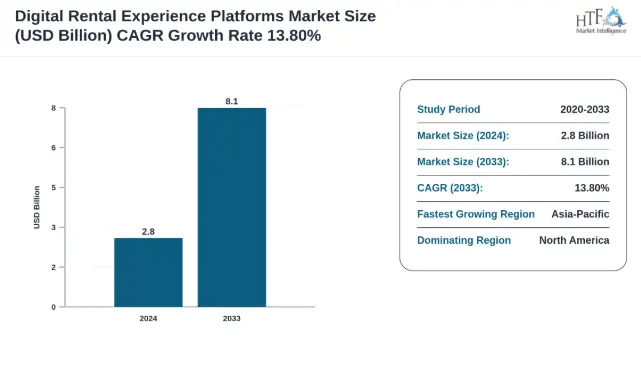
Source: Htfmarketinsights
AI rental data platforms are gaining traction because they replace slow, manual analysis with machine learning models trained on rental prices, vacancy patterns, and localized demand signals. Investors use these systems to spot high-potential assets earlier, while landlords rely on dynamic pricing insights to improve revenue efficiency in competitive markets.
Platforms like HouseCanary are leading this shift by providing AI-powered property valuations and rental forecasts for more than 136 million U.S. properties.
Solutions such as HelloData.ai focus on multifamily rent comps and benchmarking, while operational platforms like Breezeway integrate ChatGPT and tools like SmartRent to improve guest communication and predictive property maintenance.

What is the Reonomy Platform?
Reonomy is an AI-powered commercial real estate intelligence platform that reveals off-market opportunities and hidden ownership structures across the US. It aggregates and analyzes data on more than 54 million commercial properties, transforming fragmented public and private records into actionable CRE insights for brokers, investors, lenders, and service providers.
StandOut Features of the Reonomy Platform
Reonomy functions as a research partner, quietly connecting ownership, transactions, and intent into a single, clear view. The real owners behind complex structures can be quickly uncovered, and properties likely to transact soon can be identified with confidence.
1. Advanced Property Search
Search across 50+ million properties using 200+ filters, including asset type, size, zoning, location, and demographics, to surface precise deal targets. This allows teams to narrow massive CRE markets into actionable shortlists aligned with specific investment or leasing criteria.
2. True Ownership Identification
Pierce through LLCs and trusts to reveal real decision makers, associated entities, and verified contact details. This eliminates dead-end outreach and helps users engage directly with parties who can actually approve transactions.
3. Transaction History Access
Analyze sales history, debt records, and ownership changes to assess pricing context and opportunity timing. Historical visibility helps users spot distressed assets, refinancing pressure, and early signals of disposition.
4. Portfolio Analysis
View an owner’s entire property portfolio, related companies, and investment patterns to enable strategic outreach. This insight supports portfolio-level deal strategies rather than isolated single asset conversations.
5. Occupant and Tenant Search
Identify where specific tenants or industries operate nationwide, supporting site selection, expansion, and competitive analysis. This is especially valuable for retail, logistics, and corporate real estate planning teams.
6. Predictive Likelihood to Sell
An AI-driven sale probability score ranks properties based on behavioral, financial, and market signals drawn from billions of data points. This helps users prioritize outreach toward owners most likely to transact in the near term.
7. API Integration
Live data feeds connect directly into CRMs and internal systems, enabling automated prospecting, scoring, and analytics workflows. This turns Reonomy into a real-time intelligence layer embedded inside existing enterprise processes.
How Does the Reonomy Platform Work?
Reonomy consolidates fragmented property records into a single intelligent system so you can see the full picture quickly. It can clean and connect ownership data using machine learning to reveal who actually controls an asset.
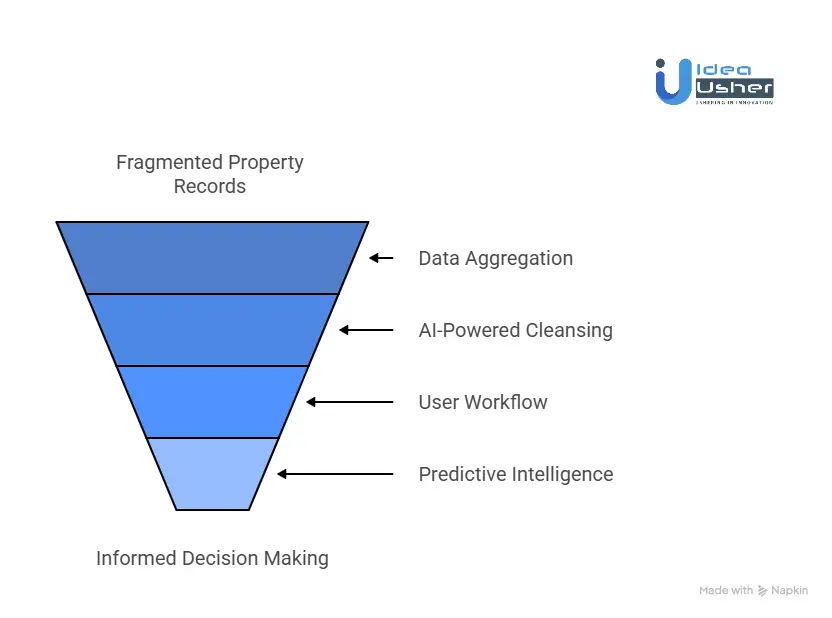
1. Data Aggregation
Reonomy does not just pull public records. It standardizes them. The system aggregates data from more than 3,000 counties, along with:
- Title and deed records
- Assessor data
- Loan and transaction histories
- Geospatial and demographic datasets
- Business entity filings
All this information is linked using the proprietary Reonomy ID, which acts as a digital fingerprint for every property. This is what allows the platform to pierce the veil of shell LLCs and uncover true ownership. A major advantage for deal sourcing.
2. AI-Powered Cleansing and Connection
Raw data is messy. Reonomy applies machine learning algorithms to:
- Match disparate records to the correct property or owner
- Fill in data gaps using predictive modeling
- Flag inconsistencies for review
For example, if “123 Main St” is listed under five slightly different LLC names across multiple databases, Reonomy’s AI identifies that they refer to the same entity and consolidates the records into a single unified profile.
Step 3: The User Workflow From Search to Action
Users typically move through a four-step discovery process:
| Step | What Happens |
| Search | Users enter an address, owner name, or location. The platform scans 54 plus million plus properties almost instantly. |
| Filter | Users apply 200-plus criteria, including asset type, sale history, loan details, and neighborhood demographics, to narrow results. |
| Analyze | Users review 100-plus data points per property, including debt history, ownership structures, tenant details, and the Likelihood to Sell score trained on billions of data points. |
| Activate | Users export contact data, sync with CRM systems, or use built in outreach tools to connect with decision makers directl |
4. Predictive Intelligence
Beyond historical records, Reonomy applies predictive analytics to quietly reveal where the market may be heading. It can map complete ownership portfolios, signal which assets are likely to come to market soon, and compare each property against similar nearby assets to support more confident decisions.
Who Benefits Most from This Technology
- Brokers and Investors: Discover off-market opportunities and identify motivated sellers earlier.
- Lenders and Analysts: Evaluate property debt exposure and transaction risk with greater confidence.
- Appraisers and Developers: Access reliable comps and localized market insights instantly.
- Service Providers: Efficiently identify property owners and connect with the right contacts for bids and partnerships.
What is the Business Model of the Reonomy Platform?
Reonomy operates as a SaaS platform delivering AI-powered commercial real estate intelligence, primarily through subscription-based access to its extensive property database.
Acquired by Altus Group in November 2021 for $ 250 million, the platform focuses on brokers, investors, lenders, and service providers seeking off-market opportunities across more than 54 million U.S. commercial properties.
Subscriptions
The primary revenue driver is tiered recurring subscriptions. These plans provide access to the core platform, advanced property search, ownership intelligence, real-time updates, and analytical tools designed for daily deal workflows.
Enterprise Solutions
Large brokerages, lenders, and financial institutions purchase custom solutions such as API integrations, proprietary data feeds, and enriched sales and debt datasets to support internal analytics and underwriting systems.
Data Licensing
Reonomy licenses ownership portfolios and demographic intelligence to external systems, including CRM platforms such as Salesforce, enabling automated lead tracking, prospecting, and outreach workflows.
Financial Performance
Detailed revenue figures for 2024 and 2025 remain private following the acquisition. However, Reonomy holds an estimated 1.40 percent share of the real estate CRM market, with approximately 93.88 percent of its customer base located in the United States.
Its long-term value is driven by AI-powered efficiency, which significantly reduces the time required to research off-market deals and strengthens Altus Group’s broader commercial real estate analytics ecosystem.
Funding History
Reonomy raised approximately 130 million dollars across nine funding rounds from 22 investors. This included a 60 million dollar Series D round in November 2019.
Early funding included $ 22 million from Bain Capital and SoftBank, which supported initial expansion in New York City, covering 1.2 million properties. This was followed by a nationwide rollout in 2017 and later enhancements,s such as CMBS data integration to deepen debt and transaction visibility.
How to Develop an AI Rental Data Platform Like Reonomy?
To develop an AI rental data platform like Reonomy, the process should begin with an ownership-focused data foundation that reflects real control structures. Multi-source data ingestion and behavioral models can then surface intent and financial pressure signals early.
We have successfully developed several AI rental data platforms, including Reonomy. The following outlines our approach.
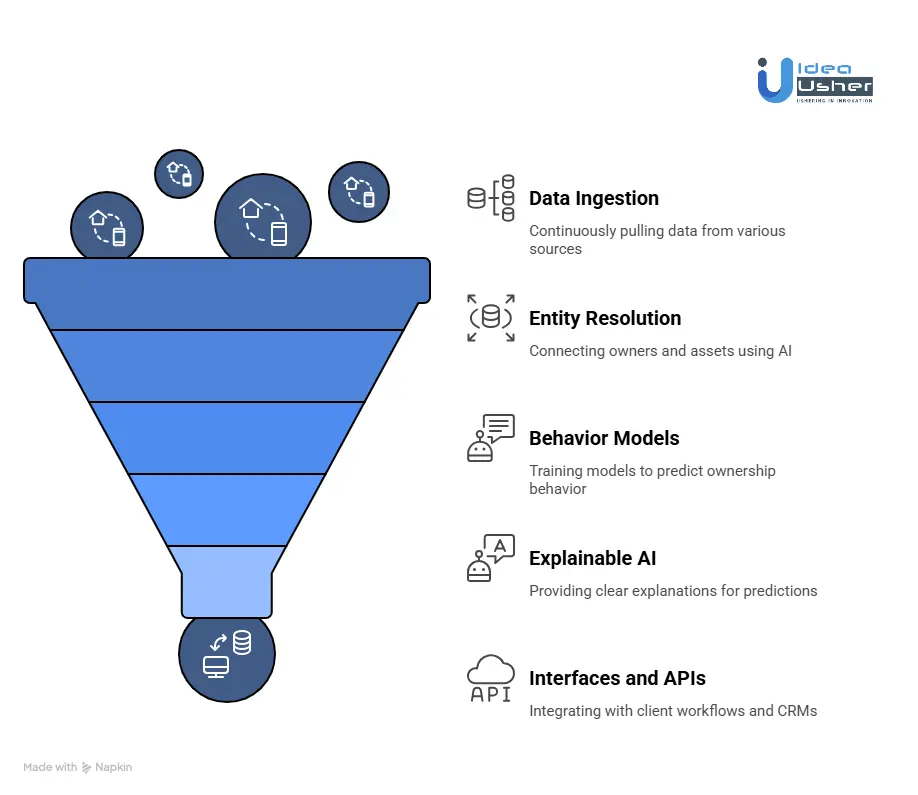
1. Ownership Data Model
We start by designing the system around owners, LLC structures, debt, and portfolios rather than isolated properties. This allows the platform to map real control relationships and understand how decisions propagate across multiple assets and markets.
2. Data Ingestion
We build scalable ingestion pipelines that continuously pull data from public records, permits, utilities, filings, satellite sources, and proprietary feeds. These pipelines operate asynchronously to keep data fresh without slowing down the platform.
3. Entity Resolution
We implement probabilistic entity resolution using graph-based linking and AI matching logic. Instead of rigid rules, the system connects owners and assets using confidence scores that reflect real-world data uncertainty.
4. Behavior Models
We train machine learning models that focus on ownership behavior such as sale likelihood, refinancing pressure, and portfolio shifts. These models learn from historical patterns to surface early intent signals.
5. Explainable AI
We ensure every prediction is supported by clear, human-readable explanations. This transparency helps enterprise users trust the output and confidently use it in investment and outreach decisions.
6. Interfaces and APIs
We design dashboards, exports, and APIs that plug directly into client workflows and CRMs. This turns intelligence into action while making the platform ready for monetization and scale.
How AI Rental Data Platforms Adapt to Residential & Mixed-Use Markets
AI rental data platforms are adapting by shifting focus from property-level snapshots to unit-level signals that update more frequently. They can intelligently model tenant behavior, rent movement, and usage patterns across residential and mixed-use assets with precision.
1. The Power of Granular Unit Level Intelligence
Commercial platforms typically analyze properties as single entities. Residential-focused platforms go deeper by tracking individual units, tenant behavior, and lifestyle-driven demand patterns.
Key Example:
A strong example is AirDNA, which applies AI to short-term rental markets. In addition to ownership, it analyzes nightly rates, occupancy trends, seasonality, amenity performance, and competitive positioning across millions of listings.
Its MarketMinder product uses machine learning to predict revenue potential at the individual property level by combining geospatial signals, tourism flows, and historical performance. This demonstrates how AI excels in fragmented, high-turnover residential markets.
2. Predictive Modeling for Dynamic Cash Flow
Residential and mixed-use assets experience more frequent pricing changes than long term commercial leases. AI platforms in this space focus on predicting behavior rather than just reporting transactions.
Key Example:
RealPage provides AI-driven revenue management across more than 20,000 multifamily properties. Its models dynamically price units based on hundreds of variables, including competitor rents, local events, seasonality, lease expirations, and even weather patterns.
For mixed-use assets, the same logic can optimize residential rents alongside retail or office components. For example, a high-performing café or grocery tenant can directly influence apartment demand and pricing. Traditional commercial platforms rarely model this type of cross-asset interaction.
3. Mixed Use Complexity Unlocked by AI
Mixed-use properties combine residential, retail, and office assets, creating relationships that siloed tools struggle to capture. AI-driven data platforms are now connecting these signals.
Key Example:
Cherre uses a real estate knowledge graph to unify residential, commercial, and market data. For a mixed-use building, its AI can reveal how retail foot traffic affects residential lease premiums or how nearby office vacancy influences condo sale prices.
By linking zoning data, tenant performance, and neighborhood trends, these platforms manage complexity that older systems cannot.
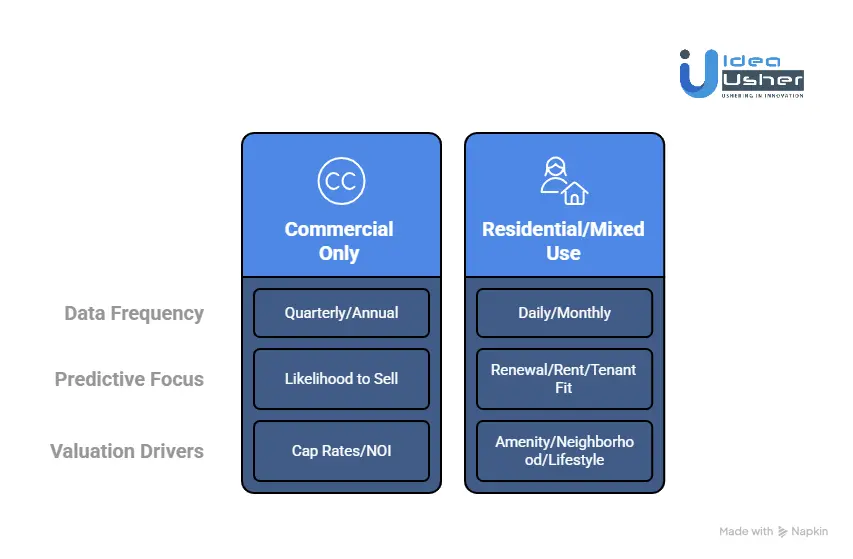
Key Advantages Over Commercial-Only Platforms
| Factor | Commercial Only AI Platforms | Residential and Mixed Use AI Platforms |
| Data Frequency | Quarterly or annual lease updates | Daily or monthly rent rolls and tenant behavior |
| Predictive Focus | Likelihood to sell | Renewal probability, rent optimization, tenant fit |
| Valuation Drivers | Cap rates and NOI | Amenity value, neighborhood momentum, lifestyle premiums |
Real World Applications
For Residential Investors and Property Managers
- Portfolio Optimization: Identify underperforming units and automatically recommend rent adjustments or targeted upgrades.
- Tenant Risk Scoring: Use AI models to assess tenant reliability based on employment signals, rental history, and behavioral patterns.
- Acquisition Targeting: Detect renovation upside or value-add potential using disrepair indicators and neighborhood growth signals.
For Mixed Use Developers and Operators
- Revenue Synergy Analysis: Quantify how retail or office tenants influence residential occupancy and pricing.
- Usage Pattern Intelligence: Analyze foot traffic, occupancy heatmaps, and space utilization across asset types.
- Regulatory Compliance Monitoring: Track residential tenant law changes and commercial licensing requirements through automated alerts.
For Lenders and Appraisers
- Cash Flow Verification: Validate real-time rent rolls against market benchmarks.
- Mixed-Use Valuation Models: Apply AI-driven valuation approaches tailored to hybrid assets.
- Default Prediction: Identify early warning signs for at risk residential or retail tenants.
Accuracy of “Likelihood to Sell” Predictions in AI Rental Data Platforms
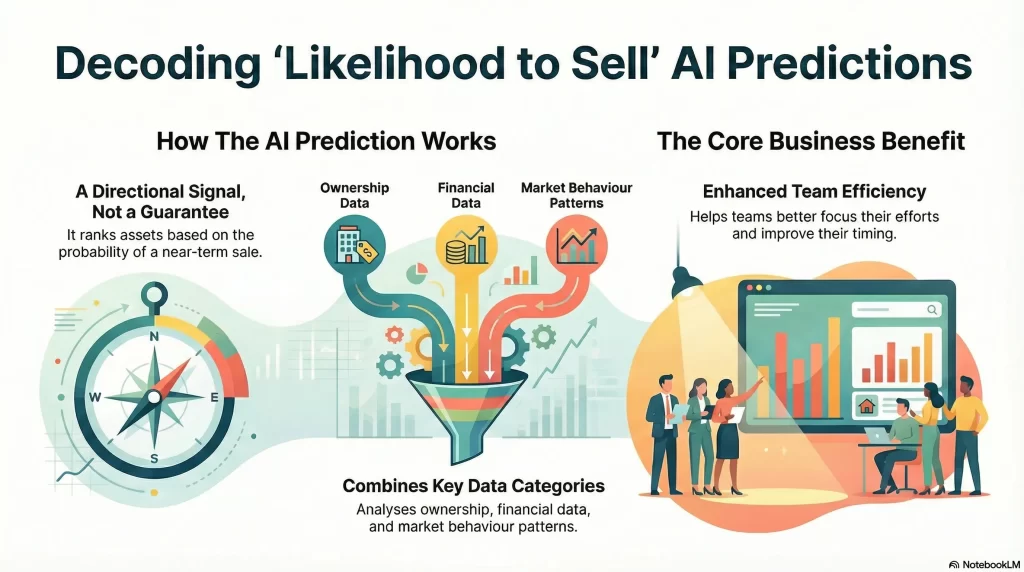
Likelihood-to-sell predictions are generally accurate when used as probability signals rather than guarantees. In real rental data platforms, these models can consistently highlight assets that may transact sooner by analyzing ownership behavior and financial pressure.
When combined with human judgment, they usually help teams focus effort more efficiently and reduce wasted outreach.
How Likelihood to Sell Models Actually Work
These models are not simple scoring formulas. They are ensemble machine learning systems trained on billions of historical data points across transactions, ownership behavior, and market dynamics.
Property Specific Signals
Ownership tenure, portfolio concentration, refinancing activity, and physical condition together reveal how financially flexible and strategically positioned an owner is. Properties held for long periods with significant equity or deferred renovations often indicate a higher readiness to sell.
Market and Behavioral Signals
Local market dynamics add behavioral context to ownership data. When prices have appreciated well beyond an owner’s entry point, and comparable assets are turning over quickly, models can better distinguish between long-term holders and repeat sellers.
Macro Economic Indicators
Broader economic forces shape selling decisions across portfolios. Interest rate cycles influence exit timing, while demographic and migration trends reshape demand and help anticipate shifts in selling behavior.
For example, Reonomy analyzes more than 68 million commercial transactions to identify patterns that historically precede a sale. The output is not just a label but also a probability score, with contextual drivers informing it.
Real World Accuracy Benchmarks
Commercial Properties
75 to 85 percent predictive accuracy
In commercial real estate, where decisions are more financially driven, AI models perform best.
- 6-month prediction windows typically reach 75 to 80 percent accuracy
- 12-month windows average 65 to 70 percent accuracy
- False positives usually fall between 15 and 25 percent
A property with high equity, aging systems, and an owner divesting similar assets might receive an 82 percent score. In practice, these properties transact roughly 8 out of 10 times within the forecast window.
Platforms such as Reonomy and Cherre consistently operate within this range.
Residential Properties
70 to 80 percent accuracy
Residential behavior includes more emotional variables, which slightly reduces predictability.
- Owner-occupied homes average 60 to 70 percent accuracy
- Investor-owned residential assets reach 75 to 80 percent accuracy
- Seasonal markets can swing by plus or minus 10 percent
Consumer-focused platforms such as Zillow and Redfin use similar seller-intent scoring, particularly for lead prioritization.
Where These Predictions Perform Best
Identifying Investor Churn
AI models are highly effective at recognizing repeat investor behavior across portfolios. When firms follow consistent hold periods and exit strategies, such as selling multifamily assets after 5 to 7 years and reinvesting through 1031 exchanges, those patterns become predictable at scale.
Financial Trigger Detection
AI reliably identifies properties under financial pressure by analyzing signals such as upcoming loan maturities, compressed cap rates, and repeated cash-out refinancings. These indicators often precede sales decisions and help identify assets nearing an exit point.
Portfolio Rebalancing Signals
When an owner sells one asset, AI can detect correlated selling behavior across similar markets or property types. This allows platforms to identify portfolio rebalancing activity in near-real-time, before it becomes visible in public records.
Industry Adoption and Trust Levels
| User Type | How Predictions Are Used | Trust Level |
| Brokers | Lead prioritization and outreach timing | High |
| Investors | Deal pipeline forecasting | Medium to High |
| Lenders | Portfolio risk assessment | Medium |
| Service Providers | Territory and account targeting | High |
How AI Rental Data Platforms Generate Recurring Revenue?
AI rental data platforms are built on recurring revenue mechanics rather than one-time sales. Their strength lies in combining predictable subscriptions with high-value enterprise contracts, premium intelligence layers, and long-term customer retention. When executed correctly, these platforms achieve strong margins and durable growth.
1. The Subscription-Based Foundation
Most AI rental data platforms rely on multi-tier Software-as-a-Service subscription models. This structure generates predictable, recurring revenue while aligning pricing with the value each customer derives from the platform. Tiers are usually based on usage limits, data depth, analytics sophistication, and API access.
Example
AirDNA illustrates this clearly through its tiered pricing:
- Basic tier at 19.99 dollars per month with limited market reports and five property searches
- Professional tier at 99 dollars per month, offering advanced analytics and up to fifty daily searches
- Enterprise tier at 499 dollars per month and above with API access, custom markets, and unlimited data exports
AirDNA reportedly serves more than 100,000 subscribers across these tiers and generates an estimated $ 40- $60 million in annual recurring revenue. This demonstrates how specialized rental intelligence platforms scale efficiently through subscriptions.
2. Enterprise API Licensing
While subscriptions provide revenue breadth, enterprise API licensing delivers revenue depth. Institutional clients such as REITs, large property managers, and financial institutions require direct integration of rental intelligence into their internal systems.
Example
RealPage exemplifies this model. As a publicly traded company, RealPage reported 1.54 billion dollars in total revenue for 2023, with roughly 85 percent coming from recurring subscription and transaction fees.
Its AI-driven revenue management products serve more than 22,000 multifamily communities.
Enterprise clients typically pay between $ 50,000 and $ 500,000 per year for predictive analytics, large-scale data access, and system integration. RealPage’s average revenue per unit is estimated at $ 15- $20 per unit per month, underscoring how scale multiplies recurring revenue.
3. Value Added Services
Leading platforms move beyond raw data delivery into premium services that carry higher margins and deepen customer lock-in.
1. Custom Analytics and Reporting
Cherre generates enterprise revenue by transforming fragmented real estate data into unified analytics. Its enterprise contracts typically range from 25,000 to over 150,000 dollars annually and often include:
- Custom data model development starting at around 50,000 dollars
- Ongoing analytics services are priced at 10,000 to 25,000 dollars per month
- System integration projects costing 25,000 to 100,000 dollars
Revenue comes not just from access, but from turning data into decision-ready intelligence.
2. Predictive Intelligence Products
HouseCanary monetizes predictive valuation and risk intelligence at a premium. Institutional clients pay approximately $ 75,000 to $ 300,000 per year for access to AVMs, forecasting tools, and portfolio analytics. With hundreds of enterprise customers, this model shows how predictive AI commands significantly higher pricing than raw data.
3. Marketplace and Transaction Fees
Some platforms layer marketplaces on top of data products.
Zillow demonstrates the scale of this approach. In 2023, Zillow’s Premier Agent program generated about $ 1.2 billion in revenue, representing 39 percent of total revenue.
Rental-focused platforms operate on similar principles, connecting landlords with property managers, maintenance providers, insurers, or lenders, typically charging 10 to 30 percent transaction fees or fixed referral payments.
4. Data Licensing to Third Parties
Once data infrastructure is built, licensing aggregated and anonymized datasets becomes a high-margin revenue stream. Typical buyers include:
- Academic institutions pay 5,000 to 50,000 dollars annually
- Government agencies paying 10,000 to 100,000 dollars or more per contract
- Market research firms pay 25,000 to 200,000 dollars annually
- Financial institutions pay 50,000 to 500,000 dollars or more for risk models
Example
CoStar Group reported 2.16 billion dollars in revenue for 2023. Its information services segment alone generated 647 million dollars, largely from recurring data subscriptions across more than 190,000 customers. This highlights how data licensing can deliver gross margins above 80 percent.
Geographic and Market Expansion
Recurring revenue scales rapidly as platforms expand coverage and vertical depth.
- Initial market focus often generates 1 to 5 million dollars in ARR
- Regional expansion increases ARR to 5 to 20 million dollars
- National scale pushes ARR to 20 to 100 million dollars or more
- International expansion can exceed 100 million dollars in ARR
Example: Rentberry followed this pattern by expanding from San Francisco into more than 30 US cities and later internationally, reaching valuations exceeding $ 40 million during its growth phase.
Platform Stickiness and Customer Lifetime Value
The real power of recurring revenue lies in retention and expansion.
Typical performance metrics for successful AI rental data platforms include:
- Enterprise retention rates between 85 and 95 percent
- Average customer lifespans of 3 to 7 years
- LTV to CAC ratios between 5 to 1 and 8 to 1
- Annual revenue expansion of 20 to 40 percent from existing customers
Example: AppFolio reported a 92% gross retention rate and a 114% net retention rate in 2023. This means customers not only stayed but also increased spending.
Average revenue per customer grew from $284 per month in 2020 to $382 per month in 2023, demonstrating how expansion revenue compounds over time.
Conclusion
AI rental data platforms like Reonomy represent where real estate intelligence is steadily heading. Businesses that invest early can build durable data moats and may unlock recurring revenue through enterprise adoption. With a strong data foundation and disciplined execution, these platforms can reliably change how decisions are modeled and validated across real estate portfolios.
Looking to Develop an AI Rental Data Platform like Reonomy?
IdeaUsher can help you design an AI rental data platform similar to Reonomy with a strong focus on data accuracy and model reliability. We will carefully build scalable data pipelines and AI models that can predict rental trends and portfolio signals with confidence
Why partner with us?
- 500,000+ hours of coding experience — led by ex-MAANG/FAANG engineers who’ve scaled systems used by millions.
- Full-stack AI integration — from predictive analytics to computer vision for property insights.
- Ownership & transparency — we pierce through data complexity to deliver clean, actionable intelligence.
- Designed to scale — robust APIs, real-time dashboards, and modular architecture ready for growth.


FAQs
A1: Developing an AI rental data platform typically starts by defining the rental problems you want to solve and the data sources you can reliably access. You should then design a clean data pipeline to collect listings, lease terms, and market signals in near-real-time. Over time, the platform can become more intelligent as more transactions and user behavior are captured in the system.
A3: The cost of building an AI rental data platform can vary widely depending on the depth of the data and the complexity of the models. A focused MVP may cost moderately and can still deliver useful rental insights early. You should realistically plan budgets in phases so spending grows only when value is proven.
A3: An AI rental data platform typically includes rental price analytics, market trend tracking, and location-based comparisons. Predictive features can help forecast rent changes and vacancy risks over time. Advanced platforms may also offer API access, enabling other systems to easily consume rental intelligence.
A4: From a long-term view, the cost should be seen as a strategic investment rather than a one-time build. Initial development costs are only part of the picture because ongoing data acquisition and model tuning will continue. However, the platform can steadily pay for itself if it becomes a trusted source of rental intelligence.