


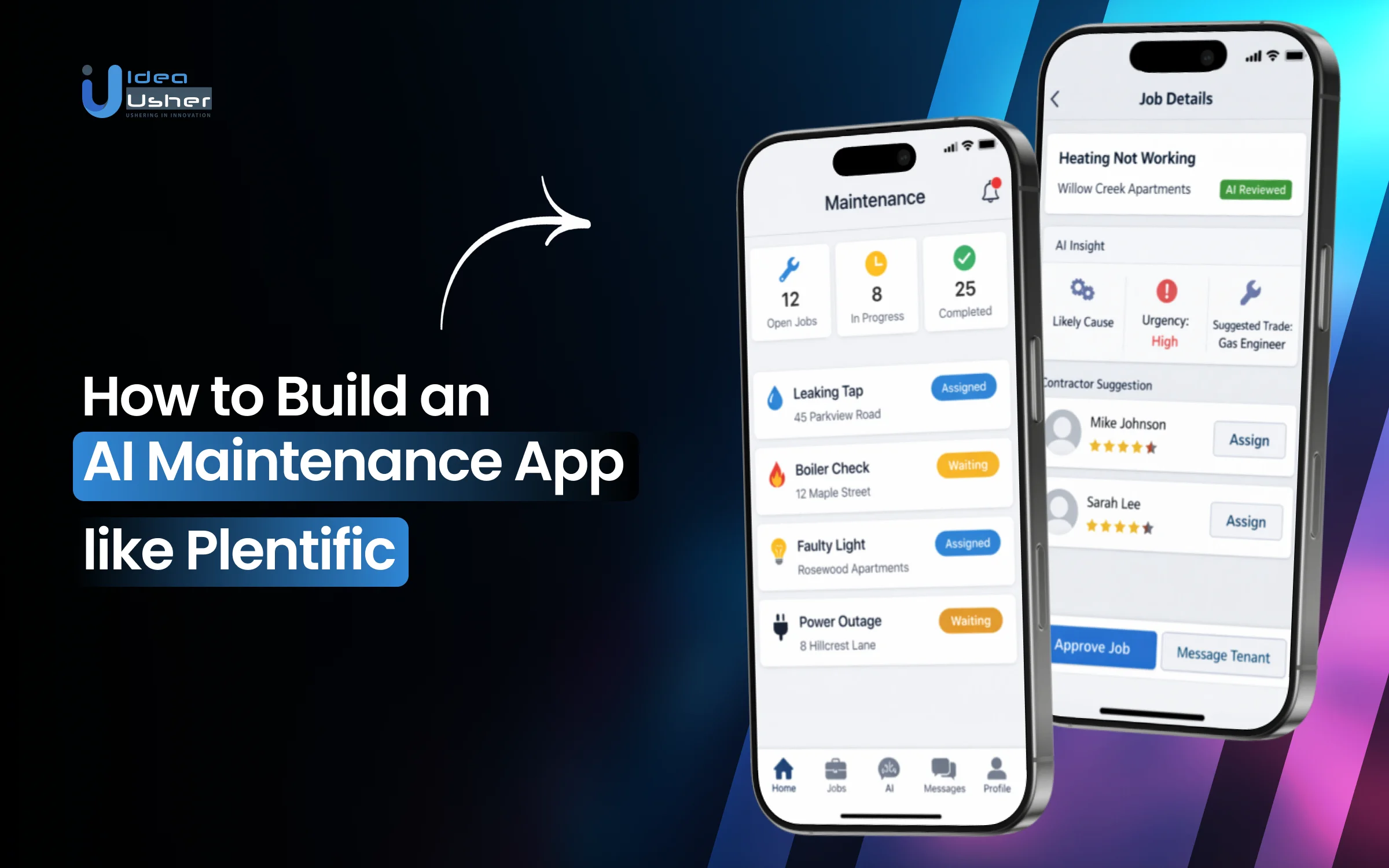
Property maintenance generates constant operational activity, from issue reporting and contractor coordination to compliance checks and resolution tracking. As portfolios grow, managing these workflows manually or across disconnected tools quickly becomes inefficient and error-prone. This operational complexity defines the need for a Plentific-like AI maintenance app, where maintenance requests, decisions, and actions are coordinated through a single intelligent system.
At the system level, maintenance intelligence depends on how well requests are routed, prioritized, and resolved across multiple stakeholders. The platform must connect tenant inputs with property data, contractor availability, service level rules, and approval workflows to automate decisions in real time. Designing this requires reliable integrations, structured data models, workflow automation, and safeguards that ensure maintenance is handled consistently across properties and regions.
In this blog, we explain how to build an AI maintenance app like Plentific by breaking down the core system components, integration requirements, and design considerations involved in delivering scalable and dependable property maintenance operations.

What is an AI Maintenance App, Plentific?
Plentific is an AI-powered property operations platform that unifies maintenance, repairs, compliance, and contractor management into a single SaaS solution. Trusted by leading real estate operators, it connects property portfolios, service providers, and tenants to improve efficiency, visibility, and performance across millions of units.
The platform uses AI and automation to streamline work orders, optimize resources, and connect vetted contractors. With open APIs, mobile access, and analytics, Plentific improves fix rates, cost certainty, and resident satisfaction, making it a compelling PropTech solution for modern property operations.
- Includes a vendor marketplace of vetted contractors where service providers compete on price and quality, enhancing sourcing and supply chain flexibility.
- Offers planned maintenance solutions to shift operations from reactive to proactive scheduling, automating recurring repair workflows and reducing unplanned work.
- Provides resident self-service tools and portals for reporting issues and tracking progress, improving transparency and satisfaction.
- Supports cloud-based real-time reporting, offline mobile app capabilities and robust security controls (e.g., ISO/IEC 27001 compliance).
- Integrates with major property tech systems (CRMs, ERPs) via open APIs and webhooks for seamless tech stack augmentation.
- Includes modules for compliance, voids management, complex projects (e.g., damp/mould) and inspection tools to centralise operational workflows.
- Enables dynamic scheduling and dispatch automation of in-house teams and external contractors.
- Offers advanced analytics and custom reporting to monitor KPIs, trends and portfolio health for data-driven optimisation.
Business Model
Plentific uses a SaaS platform to digitise and coordinate property operations by linking asset owners, operators, residents, and service providers in a single ecosystem. This scalable model integrates into daily property workflows across portfolios, regions, and asset types.
- Unified Operations Platform: A modular, cloud-based system that centralises maintenance, compliance, inspections, contractor management and analytics into one operational layer.
- Ecosystem Orchestration: Connects internal teams, external contractors and residents through shared workflows, real-time data and automated communication.
- Marketplace-Enabled Workflow: Embeds a vetted contractor marketplace directly into operational processes, reducing sourcing friction and improving service outcomes.
- Enterprise & Portfolio Focus: Built for multi-asset, multi-location operators with configurable workflows, role-based access and integration into existing property systems.
Revenue Model
Plentific follows a hybrid recurring and usage-based revenue model, combining predictable SaaS income with transaction-driven monetisation linked to operational activity on the platform.
- SaaS Subscriptions: Recurring license fees paid by property owners and operators based on portfolio size, modules used and service tier.
- Marketplace Transaction Fees: Revenue generated from maintenance and repair jobs fulfilled through the platform’s contractor marketplace.
- Premium Modules & Add-Ons: Incremental revenue from advanced analytics, AI-driven tools, compliance modules and specialised operational features.
- Implementation & Services: One-time or recurring fees for onboarding, integrations, configuration and enterprise-level support services.
How an AI Maintenance App Plentific Works?
Plentific works by connecting property managers with service providers through a centralized digital platform that automates maintenance requests and job tracking. This system ensures faster issue resolution and streamlined service coordination.

1. Issue Capture and Intelligent Request Intake
Plentific gathers maintenance issues from residents, property teams, or connected systems via mobile apps, portals, and integrations. It uses AI-assisted request intake to standardise descriptions, classify faults, and attach asset and location data, ensuring accurate, structured requests from the outset.
2. Work Order Creation and Smart Prioritisation
Plentific automatically converts incoming requests into structured work orders. The platform applies predefined rules, compliance requirements, and service-level agreements to assign urgency and priority. Property teams gain full visibility through a central dashboard that supports faster decision-making and consistent response times.
3. Contractor Matching and Marketplace Coordination
Plentific routes work orders to internal teams or to its contractor marketplace based on skill requirements, availability, location, and historical performance. Contractors submit quotes directly through the platform, enabling transparent comparison and informed selection while reducing manual coordination and delays.
4. Scheduling, Dispatch, and Real-Time Communication
After selection, Plentific schedules the job and dispatches it to the assigned provider. The platform sends real-time updates, appointment confirmations, and status notifications to property managers, contractors, and residents. This ensures clear communication and coordinated execution throughout the repair process.
5. Job Execution, Verification, and Compliance Control
Contractors complete tasks using mobile tools to record progress, upload evidence, and confirm completion. Plentific supports inspections and quality checks to verify that work meets regulatory, safety, and operational standards before final approval.
6. Financial Processing and Insights
The app automates invoicing and payments after approval, capturing operational data across jobs and turning it into insights via dashboards. Property teams use these to improve performance, cut costs, boost first-time fix rates, and support proactive maintenance.
Core Components of an AI Maintenance App
An AI maintenance app relies on smart automation, data analytics, and system integrations to manage property operations efficiently. These core components ensure smooth workflows and reliable service delivery.
| Core Component | Explanation |
| Data Ingestion and Normalisation Layer | Collects maintenance requests, asset data, images, and logs, then cleans and standardises inputs to ensure reliable data for workflows and AI decision-making. |
| AI Intelligence and Decision Engine | Analyses historical and real-time data to support diagnostics, prioritisation, duplicate detection, and predictive maintenance insights. |
| Workflow Orchestration and Automation Layer | Manages work order lifecycles, approvals, SLAs, scheduling, and escalations to ensure consistent and scalable maintenance operations. |
| Asset Intelligence and History Management | Maintains complete asset records including repair history, costs, and failure patterns to support informed decisions and proactive maintenance planning. |
| Contractor and Workforce Management | Organises vendor profiles, certifications, availability, and performance to enable accurate job matching and service accountability. |
| User Interaction and Experience Layer | Provides role-specific interfaces for residents, managers, and technicians that enable fast reporting, approvals, and job updates with minimal friction. |
| Communication and Notification System | Delivers real-time alerts, reminders, and status updates to keep all stakeholders aligned throughout the maintenance process. |
AI-Powered Maintenance Cuts Cost Up to 29% Globally
The global generative AI market in real estate was valued at USD 437.65 million in 2024 and is projected to reach USD 1,302.12 million by 2034, growing at 11.52% CAGR from 2024 to 2034. This growth is driven by demand for AI automation that boosts lead engagement, response speed, and conversion efficiency.

A survey of over 1,000 homeowners found that those who used AI guidance for home repairs reported an average 47% reduction in repair or maintenance costs and 29% felt less stressed about managing home repairs. The most significant savings were seen in appliance repairs (51%), plumbing (49%), and general handyman work (46%).
Cost Pressure Is Driving AI Maintenance App Development
Rising operational costs push property owners and enterprises to look for smarter maintenance solutions. AI maintenance apps directly address structural inefficiencies that traditional systems fail to control.
- Escalating repair and labour costs: Reactive maintenance increases overtime, emergency callouts, and repeated site visits, which significantly inflates annual maintenance budgets.
- High cost of unplanned downtime: Unexpected asset failures disrupt operations, impact resident satisfaction, and force costly short-notice repairs and replacements.
- Limited visibility into maintenance performance: Fragmented tools prevent teams from understanding true maintenance costs, contractor efficiency, and asset health across portfolios.
How AI Maintenance Platforms Deliver Measurable Cost Savings?
AI maintenance platforms reduce costs by replacing manual decision-making with intelligent automation and data-backed insights throughout the maintenance lifecycle.
- Predictive maintenance reduces emergency repairs: AI identifies early warning signs and schedules fixes before failures occur, lowering expensive reactive interventions.
- Smarter work order prioritisation: Intelligent prioritisation ensures teams address high-risk and high-cost issues first, preventing escalation and secondary damage.
- Optimised contractor and workforce utilisation: Context-aware matching reduces idle time, repeat visits, and misallocated resources, leading to consistent cost efficiency at scale.
AI-powered maintenance platforms address rising cost pressures by transforming reactive operations into intelligent, data-driven workflows. By reducing downtime, optimising resources, and improving decision-making, these systems explain why organisations increasingly invest in building scalable AI maintenance apps to achieve long-term operational efficiency.
Key Features of an AI Maintenance App like Plentific
The Plentific-like AI maintenance app streamlines property operations through automation, predictive insights, and centralized workflows. These features improve response times, reduce costs, and enhance tenant satisfaction across portfolios globally.

1. Work Order Management
The AI maintenance app centralises the full maintenance lifecycle from creation to closure within a single workflow. Teams create, prioritise, assign and track work orders in real time, ensuring clear ownership, SLA adherence, and consistent execution across properties.
2. AI-Driven Duplicate Work Order Detection
The platform uses AI to analyse incoming requests and automatically detect potential duplicates based on location, asset type and symptoms. This capability prevents redundant jobs, reduces contractor callouts, and helps teams consolidate issues into a single, efficient resolution path.
3. AI-Assisted Request Intake and Diagnostics
Multimodal AI processes text, images and videos submitted by residents to identify issues accurately. The system enriches requests with probable fault categories and suggested actions (e.g., “possible valve failure”), producing clearer work orders and improving first-time fix rates.
4. Contractor Matching and Vendor Management
The platform matches jobs to contractors using skill fit, proximity, availability and historical performance. Vendor profiles evolve continuously through completed work data, enabling smarter sourcing decisions and maintaining quality across a scalable, trusted service provider network.
5. Planned Maintenance Automation with Reminders
The system automates recurring maintenance schedules based on asset type, compliance rules and usage patterns. It triggers reminders, work orders and follow-ups proactively, helping teams prevent failures, extend asset life, and shift operations from reactive to planned maintenance.
6. Mobile Access for Field Teams
Field technicians use mobile apps to receive jobs, view instructions, update status and upload photos or videos on site. Offline functionality ensures continuity in low-connectivity areas, while real-time syncing keeps property teams informed throughout job execution.
7. Real-Time Resident Experience Feedback Tools
The platform captures resident feedback immediately after job completion through short, in-app prompts. Teams track satisfaction trends, identify service gaps, and link feedback directly to contractors and assets to drive continuous service quality improvement.
8. Contextual Asset History and Decision Support
Each work order displays a full asset timeline including past repairs, costs, images and failure patterns. This context supports faster diagnosis, informed approvals, and smarter decisions, especially for repeat issues or high-value assets requiring careful intervention.
9. Smart Dispatch with Predictive Arrival Times
The system calculates optimal schedules using job duration data, technician workload and location signals. It predicts arrival windows and updates them dynamically, improving transparency for residents and enabling teams to balance resources more effectively.
10. Reporting and Analytics Dashboard
The platform transforms operational data into actionable insights across cost, turnaround time, contractor performance and asset health. Teams use these insights to improve efficiency, increase first-time fix rates, and support data-driven maintenance strategies at scale.
How to Build an AI Maintenance App like Plentific?
Building a Plentific-like AI maintenance app requires strategic planning, scalable architecture, and intelligent automation to streamline property management workflows effectively. Our developers follow structured methodologies and industry best practices to deliver reliable, high-performing solutions.

1. Consultation
We begin by working closely with our clients to understand operational pain points, portfolio scale, compliance needs, and user roles. This phase defines the product vision, success metrics, and AI value opportunities, ensuring the platform solves real maintenance and property operations challenges.
2. Workflow and Use Case Definition
Our developers map end-to-end maintenance workflows from issue reporting to closure. We define core use cases for residents, property managers, and contractors, ensuring the app supports real-world operational complexity rather than idealised processes.
3. AI Capability Planning
We identify where AI creates the highest impact, such as request diagnostics, prioritisation, duplicate detection, and decision support. This step focuses on practical AI automation, ensuring intelligence enhances workflows instead of adding unnecessary complexity.
4. Data and Process Structuring
We design clean data structures for assets, work orders, users, and vendors. Our team ensures consistent data flow across the system, which allows AI models and automation logic to operate accurately and deliver reliable outcomes over time.
5. User Experience and Interaction Design
We design intuitive interfaces for residents, managers, and field teams, focusing on clarity and speed. Our developers prioritise low-friction task completion, ensuring users can report issues, approve work, and update jobs with minimal effort.
6. Core Platform Development
Our team builds the core platform logic that powers work orders, scheduling, communication, and approvals. We ensure the system remains modular and scalable so clients can expand functionality as portfolios, regions, and operational needs grow.
7. AI Model Training and Refinement
We train AI models using historical maintenance patterns, asset data, and operational rules. Continuous refinement improves diagnostics, recommendations, and prioritisation accuracy, allowing the platform to deliver measurable efficiency gains from early adoption.
8. Testing and Operational Validation
We conduct scenario-based testing across multiple maintenance workflows to validate accuracy, reliability, and performance. This phase ensures the platform handles real operational edge cases before launch and supports consistent service delivery.
9. Deployment and Continuous Improvement
After launch, we monitor usage patterns, feedback, and system performance. Our developers iterate continuously, enhancing automation, intelligence, and workflows to ensure the platform evolves alongside changing property operations requirements.
Cost to Build a Plentific-like AI Maintenance App
Estimating the cost to build a Plentific-like AI maintenance app depends on features, integrations, and the development complexity involved. This section outlines key pricing factors to support informed planning decisions.
| Development Phase | Description | Estimated Cost |
| Consultation and Discovery | Define product goals, user roles, operational challenges, and AI-driven maintenance strategy | $5,000 – $10,000 |
| Workflow and Use Case Design | Design end-to-end maintenance flows that reflect real operational complexity | $8,000 – $15,000 |
| AI Capability Planning | Identify automation, intelligence layers, and high-impact AI use cases | $12,000 – $20,000 |
| Data and Process Structuring | Structure assets, work orders, vendors, and workflows for clean, reliable AI inputs | $10,000 – $18,000 |
| UI and UX Design | Create intuitive interfaces focused on speed, clarity, and low-friction task completion | $15,000 – $25,000 |
| Core Platform Development | Build scalable systems for maintenance, scheduling, approvals, and workflow orchestration | $40,000 – $70,000 |
| AI Model Development and Training | Train and refine models for diagnostics, prioritisation, and predictive maintenance intelligence | $30,000 – $60,000 |
| Testing and Quality Assurance | Validate performance across real scenarios and ensure operational reliability at scale | $10,000 – $18,000 |
| Deployment and Initial Optimization | Launch platform, monitor usage, and optimise automation accuracy and performance | $8,000 – $14,000 |
Total Estimated Cost: $66,000 – $120,000
Note: Development costs vary with product scope, portfolio size, data readiness, compliance, and AI sophistication, influenced by custom workflows, advanced intelligence, and ongoing optimisation.
Consult with IdeaUsher to get a personalised cost estimate and a detailed roadmap for building a scalable, AI-powered maintenance platform tailored to your operational goals.
Challenges and Solutions in Building an AI Maintenance App
Building a Plentific-like AI maintenance app involves data integration, scalability, and security challenges that impact performance and reliability. Our developers implement proven technical approaches to resolve these challenges and ensure consistent platform performance.

1. Fragmented and Inconsistent Maintenance Data
Challenge: Maintenance data often exists in disconnected systems with inconsistent formats, missing histories, and unreliable records, which reduces AI accuracy and slows down development.
Solution: We standardise data models early, clean historical records, and design validation rules that ensure consistent asset and work order data across all workflows.
2. Poor Quality Inputs from Residents and Field Teams
Challenge: Residents and technicians frequently submit vague descriptions, unclear images, or incomplete information, which leads to misdiagnosis and inefficient maintenance workflows.
Solution: We implement AI-assisted request intake, guided prompts, and contextual validations that help users submit clear, structured inputs without increasing reporting effort.
3. Balancing AI Automation with Human Control
Challenge: Over-automation can reduce trust when AI decisions override operational judgment, especially in safety-critical or high-cost maintenance scenarios.
Solution: We design human-in-the-loop workflows where AI provides recommendations, while managers retain approval authority for prioritisation, contractor selection, and cost decisions.
4. Accurately Matching Contractors to Complex Jobs
Challenge: Maintenance jobs often require nuanced skill matching that basic vendor lists or rule-based assignment logic fail to capture accurately.
Solution: We use context-aware contractor matching that evaluates trade skills, historical outcomes, location, and asset type to improve job fit and service quality.
Compliance and Security Standards for AI Maintenance Platform
An AI maintenance platform must follow strict compliance and security standards to protect sensitive property and user data. This ensures regulatory adherence and builds long term trust with stakeholders.

1. Data Protection and Privacy Compliance
The platform complies with data protection regulations such as GDPR by enforcing data minimisation, consent management, and clear data usage policies. These measures protect resident, contractor, and operational data across all maintenance workflows.
2. Role-Based Access Control and Identity Management
The system enforces strict role-based access controls so users only access relevant data and actions. This approach reduces internal risk and ensures secure operational boundaries between residents, managers, and service providers.
3. Secure Data Storage and Transmission
The platform encrypts data at rest and in transit to prevent unauthorised access. Secure communication protocols protect work orders, images, documents, and financial records throughout the maintenance lifecycle.
4. Audit Trails and Activity Logging
The system records all critical actions such as approvals, updates, and completions. These immutable audit logs support compliance verification, dispute resolution, and operational transparency.
5. AI Governance and Responsible Automation
The platform applies clear rules around AI decision-making, ensuring automation supports operations without overriding human control. Explainable outputs and approval checkpoints maintain trust, accountability, and regulatory alignment.
Conclusion
Building a Plentific-like AI maintenance app is not only about technology, it is about creating real value for property managers and residents. By focusing on intelligent automation, seamless workflows, and reliable data insights, you can deliver faster issue resolution and better asset performance. The success of a Plentific-like AI maintenance app depends on thoughtful planning, user-centered design, and strong system integration. When you align your business goals with practical functionality, you create a solution that feels intuitive, dependable, and genuinely helpful for everyday operations and long term efficiency overall success.
Why Partner With Us for Your AI Maintenance App Development?
We specialize in building intelligent maintenance platforms that streamline operations and improve service efficiency for property managers and service providers. From requirement analysis to deployment, our team ensures your app is scalable, secure, and aligned with your business objectives.
Why Work With Us?
- Domain Expertise: Our team has a deep understanding of property management processes, maintenance workflows, and service coordination. This allows us to design features that solve real operational challenges and improve day to day efficiency.
- Custom Development: We do not rely on templates or generic frameworks. Every solution is tailored to your specific requirements, ensuring your platform supports your business model and user expectations effectively.
- Proven Delivery: We follow structured development practices and quality standards to ensure timely project delivery without compromising performance or security.
- Future Ready Architecture: Our solutions are built with scalability in mind, allowing you to add new features, users, and integrations as your business grows.
Our portfolio showcases a wide range of digital products developed across industries, reflecting our commitment to quality and innovation.
Connect with our experts to discuss your project and transform your maintenance operations with confidence.


FAQs
A.1. An AI maintenance app should include automated ticketing, predictive maintenance alerts, vendor management, real-time dashboards, mobile access, and reporting tools to help property managers resolve issues faster while improving asset performance and tenant satisfaction.
A.2. You can monetize through subscription plans, usage-based pricing, enterprise licenses, or premium features. Offering tiered packages helps attract small property managers while supporting large enterprises with advanced analytics and automation tools.
A.3. Implement encryption, role-based access, secure authentication, and regular security audits. Compliance with data protection regulations builds trust and protects sensitive property and tenant information from unauthorized access or breaches effectively.
A.4. Training requires historical maintenance records, asset performance data, sensor inputs, repair timelines, and cost details. High-quality data helps AI models predict failures, prioritize tasks, and recommend preventive actions accurately for the success of teams’ daily operations.


