

Renters no longer plan questions around office hours and expect answers at any moment. Pricing, availability, and tour details are often requested at the last minute or during busy periods. Leasing teams still operate in fixed windows, and that gap has become impossible to ignore. This shift led businesses to rely on AI leasing software, such as LeaseHawk, to handle inbound calls, capture prospect details, and automatically book tours.
Demand increased when property managers realized the issue was availability, not effort. These systems can respond instantly, qualify leads, and route complex cases to staff when needed. They also keep conversations consistent across phone and messaging channels without manual follow-ups.
Over the years, we’ve developed numerous AI leasing software solutions that leverage technologies such as leasing intent graphs and conversation confidence scoring. Given our expertise, we’re sharing this blog to outline the steps to create AI leasing software like LeaseHawk. Let’s start!
Key Market Takeaways for AI Leasing Softwares
According to GrandViewResearch, the AI-as-a-Service market is expanding at scale, growing from USD 20.26 billion in 2025 to USD 91.20 billion by 2030, at a 35.1 percent CAGR. This growth reflects a clear shift toward AI models that can be adopted without heavy infrastructure investment. Leasing software aligns well with this trend by enabling businesses to access advanced AI capabilities on demand, scale usage gradually, and control costs as operations grow.
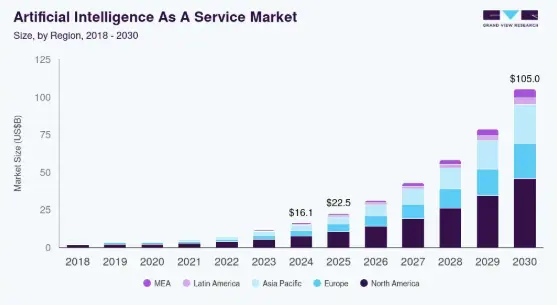
Source: GrandViewResearch
AI leasing software is becoming mainstream because it delivers measurable operational gains. By automating responses, lead qualification, and lease documentation, these systems significantly reduce manual workload and shorten leasing cycles.
In many deployments, teams report faster lead handling, fewer drop-offs during follow-ups, and shorter vacancy periods because conversations continue outside office hours.
Platforms such as Leasey.AI and EliseAI illustrate this impact with clear numbers. Leasey.AI automates up to 90 percent of leasing tasks, syndicates listings to 48-plus platforms, and accelerates tenant screening and lease creation.
EliseAI manages high volumes of leasing conversations, tour scheduling, and resident inquiries through conversational AI, helping property managers improve response times and consistently increase conversion performance at scale.
What is the LeaseHawk Platform?
LeaseHawk is an AI-powered platform built for multifamily property management. It focuses on automating renter interactions, leasing workflows, and performance analytics to help teams close leases faster and improve profitability. The platform centralizes communication across calls, texts, chats, and emails.
At the center of LeaseHawk is the ACE AI Assistant, which supports prospect nurturing, resident concierge services, and call analysis for apartment owners and leasing teams. The platform integrates CRM functionality, call tracking, and business intelligence to monitor marketing sources, agent performance, and renter lifecycle activity.
Here are some of its standout features,
- ACE AI Assistant: Answers renter inquiries 24/7 via calls, texts, chats, and emails, providing real-time pricing, availability details, and tour scheduling.
- CRM Communication Hub: Allows teams to send and receive calls, texts, and emails from a single interface, with all conversation history automatically logged for easy reference.
- Call Recording and Transcription: Records and transcribes calls automatically, then summarizes conversations and highlights clear action items for follow-up.
- Agent Performance Scoring: Uses AI to score calls in real time based on customizable benchmarks, with voice biometrics supporting accurate agent identification.
- Prospect Nurturing Tools: Automates lead qualification, follow-ups, and guest card collection across multiple communication channels.
- Resident Concierge Portal: Manages maintenance requests, rent reminders, and lease renewals through interactive AI-driven workflows.
- Marketing Call Tracking: Assigns unique trackable phone numbers to attribute incoming calls to specific ads, websites, or marketing campaigns.
How Does the LeaseHawk Platform Work?
At the core of the LeaseHawk platform is ACE, an omnichannel AI Assistant. Think of ACE as a twenty-four-seven digital team member that never sleeps and instantly engages prospects and residents across their preferred channels, including phone calls, text, chat, and email.
ACE uses multiple layers of advanced artificial intelligence and natural language processing to create conversations that feel natural and human-like.
- For prospects, ACE functions as a property expert. It conversationally answers questions about amenities, provides real-time pricing and availability by checking directly against the property management system, and schedules tours that sync instantly with the leasing team’s calendar. This ensures no lead goes unanswered and every opportunity is captured.
- For current residents, ACE acts as a round-the-clock concierge. It delivers instant access to resources, handles routine maintenance requests, and sends personalized communications such as rent reminders and lease renewal notifications. This improves the resident experience while reducing the workload for onsite staff.
The Integrated Workflow
The true value of the platform lies in how its features work together as a single system. Below is a typical end-to-end journey.
Lead Capture and Attribution
A prospective renter discovers a community online and calls a unique and trackable phone number provided by LeaseHawk. This number can be placed on advertisements or websites using Dynamic Number Insertion. It automatically identifies which marketing source generated the call.
AI-Powered Engagement
ACE answers the call instantly. The system qualifies the lead, responds to questions, and schedules an appointment without human involvement. If the call needs to be transferred to a leasing agent, the full context of the conversation is seamlessly passed along.
Relationship Management
Every interaction, whether handled by ACE or the leasing team, is captured in LeaseHawk’s CRM. Leasing professionals can manage tasks, follow up quickly through text, email, or calls, and push guest card data directly into the property management system.
Performance and Business Intelligence
After the interaction, LeaseHawk’s analytics engines analyze the data and generate insights across marketing, leasing, and operations.
Actionable Intelligence for Every Role
The platform delivers role-specific insights that help teams operate more effectively.
For Executives and Marketing Teams
LeaseHawk closes the loop on marketing ROI. Leaders can see which advertising sources generate actual leases, not just inquiries. Customizable business intelligence reports provide visibility into portfolio-wide performance and operational efficiency.
For Regional Managers
The Agent Insights feature modernizes call monitoring. Instead of relying on occasional secret shopper reports, it automatically scores leasing agent performance on every eligible prospect call. Voice biometrics identifies agents and benchmarks their performance against industry standards, highlighting coaching opportunities.
For Leasing Professionals
The CRM reduces manual data entry by automatically pre-filling guest cards and centralizing all prospect communication. Conversation Insights transcribes and categorizes every call, summarizes renter priorities, and creates clear follow-up actions.
What is the Business Model of the LeaseHawk Platform?
LeaseHawk provides AI solutions, including ACE (a virtual leasing assistant), Funnel CRM, and Fenix agentic AI, to centralize renter management from inquiry through renewal. The model emphasizes resolution-based pricing where operators pay only for results such as completed tasks or resolutions rather than fixed seats or units.
This approach aligns costs with ROI and targets property managers seeking up to 65 percent reductions in call management expenses, as seen with client UDR.
- Subscription SaaS: Core revenue comes from Funnel CRM and AI tools, estimated at $6.8M annually, with 52 employees, translating to roughly $130,500 in revenue per employee.
- Resolution-Based Pricing: Fenix AI charges per successful outcome such as lead conversions or problem resolutions.
- Enterprise Add-Ons: Custom integrations for call analytics, performance tracking, and virtual assistants. Pricing is quoted based on request.
Financial Performance
Annual revenue stands at $6.8M as of recent estimates, serving major multifamily operators with tools proven to save millions in operational costs. No public profitability data are available, but client testimonials highlight quantifiable savings, such as a 65 percent reduction in OPEX for call handling. Growth is focused on expanding AI capabilities to meet evolving demands in the multifamily market.
Funding and Acquisition
No venture funding rounds are disclosed, and total funding is listed as N/A. In August 2021, LeaseHawk was acquired by MRI Software and integrated into its real estate software suite, with no publicly specified deal value. Founded in 2008 in Scottsdale, AZ, the company scaled primarily through organic growth prior to the acquisition.
How to Develop AI Leasing Software Like LeaseHawk?
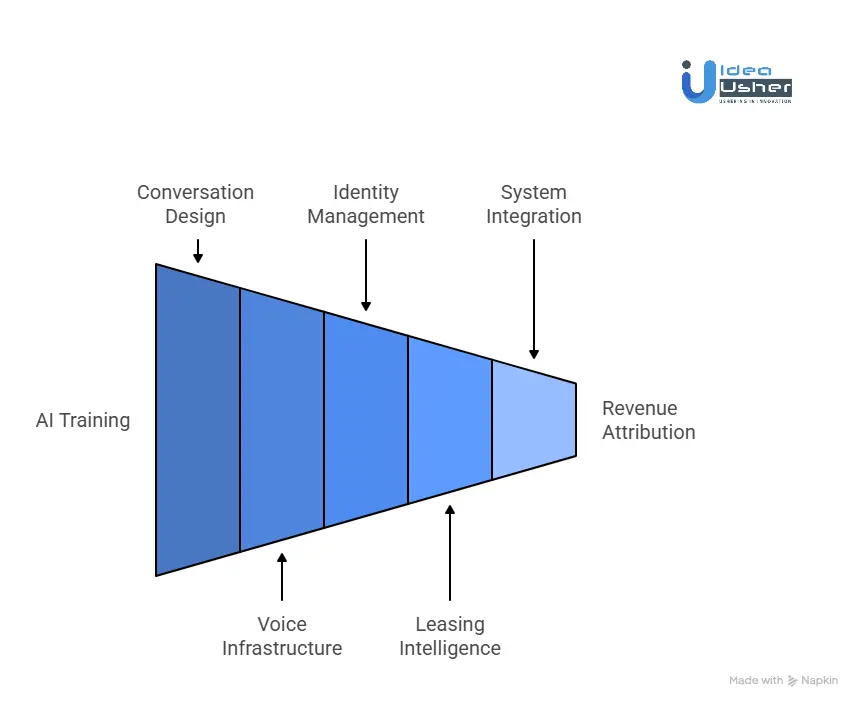
Developing AI leasing software like LeaseHawk usually starts by training the AI to understand real leasing conversations and respond accurately across voice and digital channels. The system should integrate tightly with property data to answer availability and pricing questions in real time.
We have helped several clients build AI leasing software inspired by LeaseHawk. Here is the process we follow.
1. AI Leasing Conversations
We design the AI around leasing intent rather than generic dialogue. Pricing inquiries, availability checks, and tour requests are mapped into clear conversation flows. A voice-first approach ensures responses sound natural on calls. Compliance logic is embedded early, so regulated leasing topics are handled correctly.
2. Voice & Telephony Stack
We build the infrastructure that enables real phone conversations at scale. SIP-based telephony supports inbound and outbound calls. Speech-to-text and text-to-speech pipelines convert live conversations into structured data and spoken responses. Voice biometrics can be added to recognize repeat callers and reduce misuse.
4. Identity & Context Management
We ensure conversations continue seamlessly across channels. User identity and session state persist across voice and chat. Conversation memory stores prior intent and progress. Context-aware logic allows the AI to respond based on where the prospect is in the leasing journey.
4. Leasing Intelligence & Scoring
We implement intelligence layers that evaluate leasing quality. NLP models analyze caller behavior and intent strength. Scoring frameworks rank leads and AI responses using leasing best practices. Dashboards provide visibility into performance and conversion quality.
5. PMS & System Integrations
We connect the AI to operational systems that power leasing decisions. PMS integrations provide real-time pricing and availability. Calendar systems automate tour scheduling. Data normalization keeps records consistent across platforms.
6. Analytics & Revenue Attribution
We close the loop by linking conversations to business outcomes. Lead-to-lease attribution tracks revenue impact. ROI dashboards surface performance across properties and channels. APIs enable enterprise-level reporting and data access.
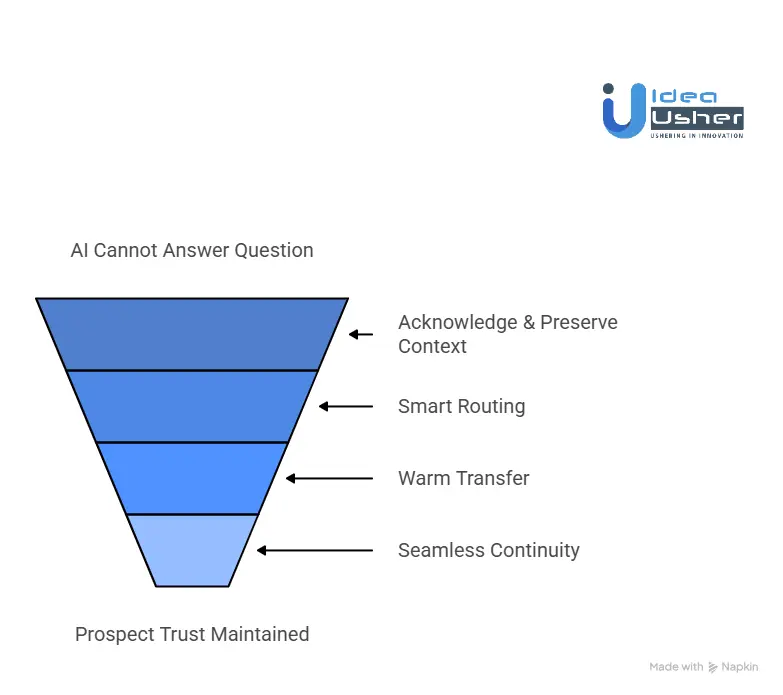
What Happens if the AI Cannot Answer a Prospect’s Question?
When an AI cannot answer a question, you stand at a critical juncture. How the platform handles this moment determines whether you keep the prospect’s trust or lose a potential resident. A poorly managed handoff can quietly undo the efficiency gained through automation. The solution lies in a structured process known as intelligent escalation.
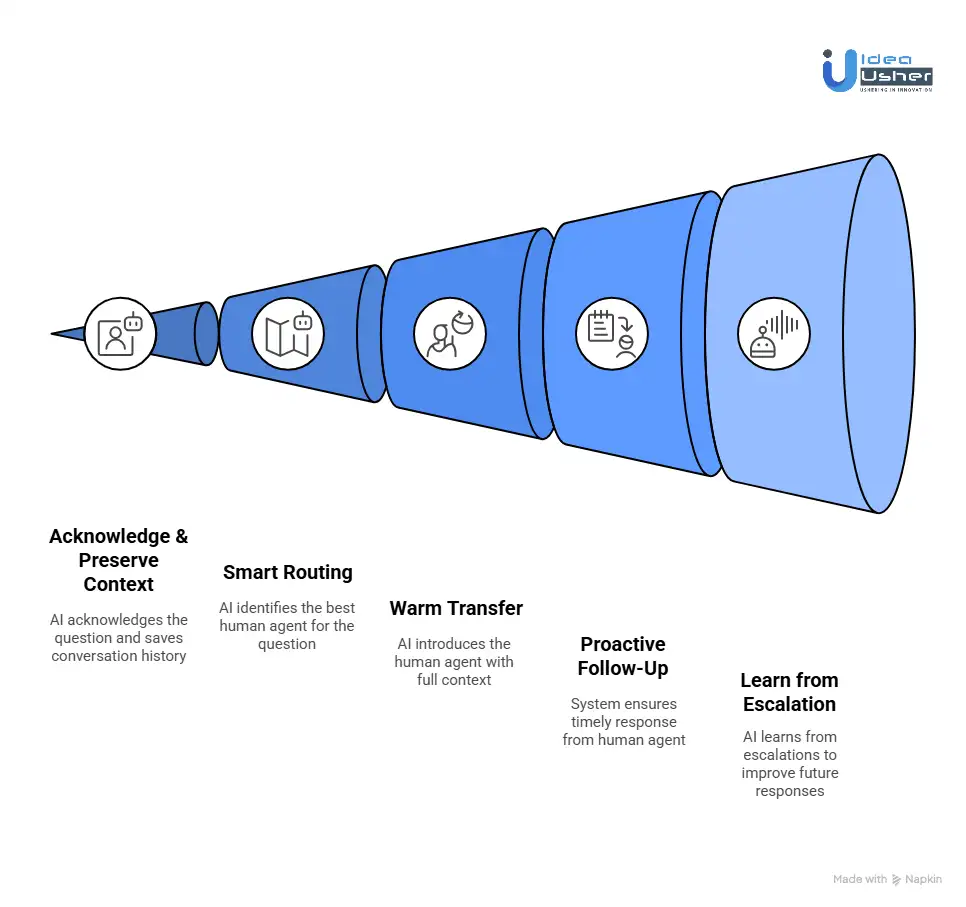
1. Acknowledgment & Context Preservation
The AI begins with a clear and transparent response. For example, it may say that this is an important question about local noise ordinances and that a property specialist will provide a precise answer.
At the same time, the AI captures the full conversation context. This includes the prospect’s question, prior messages, and relevant preferences. The information is bundled into a digital handoff file so the human agent never needs to ask the prospect to repeat themselves.
2. Smart Routing and Real-Time Alerting
The platform then identifies the most suitable human agent based on several factors.
- Question types such as legal, financial, maintenance, or a custom request
- Agent expertise and current availability
- Prospect value where high intent leads may receive priority
The selected agent receives an alert through their preferred channel such as Slack, Teams, SMS, or an internal dashboard. The alert includes a direct link to enter the live conversation immediately.
3. Warm Transfer & Seamless Continuity
The AI introduces the human agent by name to the prospect and confirms that they are joining the conversation with full context.
The agent sees the complete chat history, the unanswered question, and key data points, including the prospect’s name, contact details, unit preference, and move-in timeline. This allows the agent to respond naturally and precisely, keeping the conversation on track without interruption or confusion.
The Safety Net and Learning Loop
A robust AI rental platform includes safeguards and continuous improvement mechanisms.
Proactive Follow-Up: If a human agent does not respond within the defined service-level agreement (e.g., 2 minutes), the system can automatically notify a backup agent or manager to prevent delays.
Learn from Escalation Feedback Loop
Each escalation is logged and tagged for analysis. When the same question appears repeatedly, the system flags it for review. The correct response is then added to the AI knowledge base, ensuring that similar questions are handled automatically going forward.
How AI Leasing Software Handles Compliance & Call Disclosures?
AI leasing software embeds compliance directly into conversations, ensuring every response stays within legal limits. It will automatically announce call recording and use approved language. If a question crosses a boundary, it can quickly hand off to a human with full context.
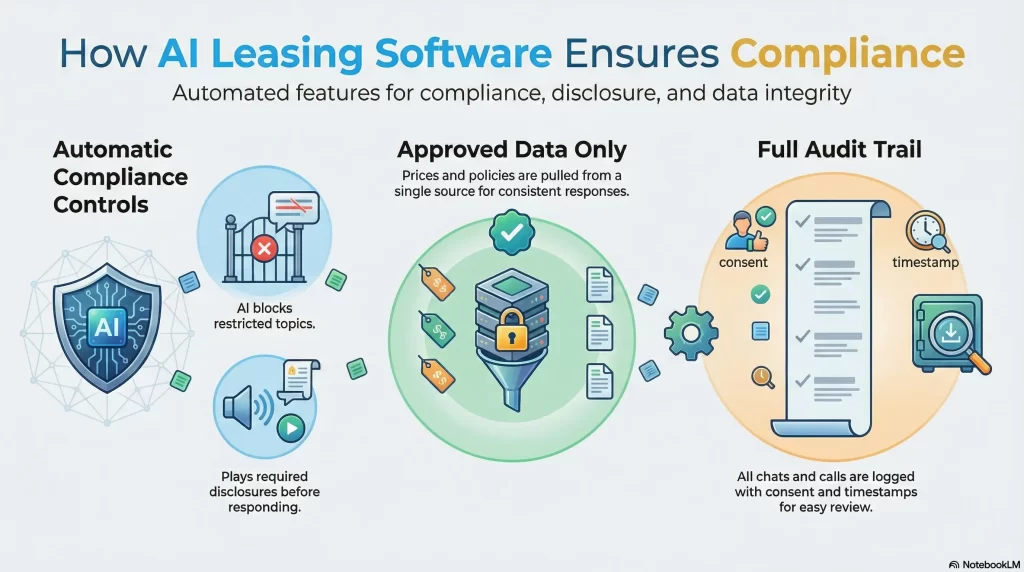
1. The Proactive Guardrails System
This is the most critical capability. AI leasing software actively guides conversations away from non-compliant territory.
Keyword and Intent Blocking: The AI is trained not to respond to questions or provide information about protected classes.
Example prospect question: Is this a good neighborhood for young families?
AI guardrail response: This community is designed to serve a wide range of residents. I can share details about floor plans, amenities, and general neighborhood features such as nearby parks and schools.
Scripted Disclosures
At specific moments in a conversation, the AI automatically inserts legally required language.
- Fair Housing disclosure: Often included in greetings or signatures stating that the property operates in compliance with all federal, state, and local Fair Housing laws.
- Call recording disclosure: For voice interactions, the AI announces that the call may be recorded for quality and training purposes. This disclosure occurs at the start of the call to meet applicable party consent requirements.
Consistent Phrasing
All high-risk topics, such as fees, deposits, and qualification criteria, use pre-approved and legally vetted language. This removes the risk of off-script interpretations.
Platforms such as LeaseHawk apply this through a dedicated compliance layer. Every outbound message is screened against regulatory rules before delivery, ensuring Fair Housing standards are consistently upheld.
2. The Unwavering Source of Truth
Compliance often fails when information is fragmented. AI leasing software eliminates this risk by acting as a single authoritative communicator.
Integrated Policy Database
Rent prices, fees, pet policies, and qualification rules are pulled directly from the property management system. The AI only communicates approved data and never guesses.
Automated Updates
When pricing changes or regulations are updated, the AI reflects those updates instantly across chat, text, email, and phone channels. This ensures consistent and accurate messaging at all times.
3. The Immutable Audit Trail
When disputes arise, documentation is essential. AI leasing platforms provide a complete and verifiable record.
- Full Conversation Logs: Every message, email transcript, and recorded call is stored with timestamps and linked to the prospect profile, assuming proper disclosure has been given.
- Transparency and Retrieval: Property managers can retrieve any interaction at any time to demonstrate fair and lawful treatment for all prospects.
Navigating the Voice Compliance Maze
Voice interactions introduce added complexity due to differing state recording laws. Advanced platforms address this with precision.
Jurisdiction Detection: The system determines applicable laws based on the caller’s area code or the provided address.
Dynamic Disclosure Scripts
- In two-party consent states, such as California, the AI opens the call by requesting explicit consent to record and proceeds onlyafter confirmation.
- One-party consent means the AI provides clear notice that the call may be recorded.
Secure Storage
All recordings are encrypted and stored in alignment with data protection frameworks such as CCPA and GDPR.
Platforms like EliseAI treat VoiceAI as a compliance workflow engine rather than a simple conversational tool. Consent handling is a mandatory first step on every call, ensuring legal compliance as the baseline for all interactions.
Most Successful Business Models for AI Leasing Softwares
The AI leasing software market is rapidly maturing and shifting from experimental tools to core operational infrastructure. This growth is driven by well-defined business models that align with different customer needs and expansion strategies. Understanding these models and the revenue logic behind them is critical for stakeholders across the proptech ecosystem.
1. The SaaS Subscription Model
This is the most predictable model, with companies charging a monthly or annual fee based on portfolio size, such as units or properties. It generates steady, recurring revenue and aligns vendor growth with improved leasing performance, enabling the same platform to scale from small operators to large REITs.
Industry standard: Most established platforms, including EliseAI and Knock, rely on this model to fund ongoing AI research, voice systems, and deep PMS integrations.
Pricing tiers
- Entry tier for small portfolios of 50 to 200 units typically ranges from $250 to $750 per month.
- The enterprise tier for portfolios above 5,000 units often ranges from $5,000 to $20,000 per month, billed annually.
A portfolio of 50,000 units priced conservatively at $0.50 per unit per month generates $300,000 in annual recurring revenue from a single client.
Market validation: The model’s strength is reflected in venture funding. EliseAI’s $1.2 billion valuation after its Series E round is built on its ability to secure and expand high-value SaaS contracts with major operators.
2. The Transaction-Based or Per-Lease Model
Instead of a fixed subscription, the vendor charges for each successful outcome, most commonly per lease generated, using a cost per lease or pay-for-performance model.
This approach ties software spend directly to measurable ROI, reduces adoption risk for property managers, and makes the value proposition clear since clients pay only when the AI delivers real leasing results.
Direct ROI alignment: Performance-driven platforms such as RentSense or similar models may charge $200 to $400 per lease secured.
Client economics
A property closing 30 leases per year would spend $6,000 to $12,000 annually. If AI improves conversion by even 10 percent, the added leases generate far more revenue than the software cost. Vendor revenue scales directly with client success.
3. The Enterprise Licensing
This model serves large enterprises that require deep customization or a fully white-label AI leasing system, with pricing that includes upfront implementation and annual recurring license fees. It appeals to national operators and proptech platforms seeking control and differentiation, while providing vendors with long-term, high-value contracts and strong competitive moats.
High-value contracts: Enterprise or white-label agreements commonly range from $500,000 to more than $2 million annually.
Strategic integrations
Consider platforms like Zumper or Apartments.com. Deep AI leasing integration for platforms at this scale represents a multi-million-dollar strategic investment, whether through licensing, acquisition, or internal development.
Economic justification
A firm managing 100,000 units can save millions in staffing costs while increasing revenue by improving conversion. Paying around $1 million per year for a proprietary AI system that manages millions of renter interactions becomes a rational and strategic decision.
Conclusion
AI leasing software, such as LeaseHawk, signals a clear shift in how modern leasing systems should operate. It replaces manual workflows with intelligent decision engines that can consistently improve speed, accuracy, and renter engagement. If you are building or scaling a proptech platform, this type of system could quietly become a long-term revenue driver rather than just a support tool.
With a strong architecture, reliable AI models, and clean integrations, you can realistically launch a platform that meets how renters behave today. Working with an experienced development team like IdeaUsher can often help you move faster and deliver an enterprise-ready system that performs under real-world demand.
Looking to Create AI Leasing Software like LeaseHawk?
IdeaUsher can help you create AI leasing software like LeaseHawk by designing an intelligent system that handles calls, messages, and tours with consistent accuracy. We build core AI workflows that connect availability, pricing, and renter intent in real time.
Why Build with Us?
- 500,000+ Hours of Elite Engineering: Our ex-MAANG/FAANG developers architect systems that scale, learn, and outperform.
- Beyond Chatbots: We build omnichannel AI ecosystems across voice, SMS, and social media that maintain context across every touchpoint.
- Hyper-Personalization Engine: Go beyond basic availability. Integrate local market data, competitor pricing, and resident sentiment to craft irresistible offers.
- Real-Time Performance DNA: Live agent scoring, predictive lead routing, and marketing attribution that connects ad spend directly to signed leases, with zero guesswork.
Let’s build your competitive edge together.


FAQs
A1: You usually start by mapping the full leasing journey and deciding which steps should be automated with intelligence. You can then design a secure architecture with data pipelines, APIs, and an AI layer that supports chat routing, lead scoring, and workflow actions. If integrations are planned early, the platform may scale cleanly across PMS, CRM, and calendar systems while staying stable in production.
A2: Build time depends on the scope of integrations and the complexity of the AI layer. A narrow MVP could take a few months while a full production platform may take longer because model tuning, security reviews, and operational testing can be extensive. If the roadmap is staged properly, delivery can remain predictable, and improvements can ship steadily.
A3: Cost depends on the feature set, the number of integrations, and whether you are training custom models or using managed AI services. A basic product can be built within a controlled budget, whereas enterprise builds typically cost more due to compliance, scalability, observability, and continuous model maintenance. If you define phases clearly, you can keep spending aligned with measurable outcomes.
A4: Typical features include AI chat and voice support, lead qualification, automated follow-ups, and scheduling. Strong platforms also include CRM synchronization, analytics, conversation-quality monitoring, and admin controls for policies and compliance. When these pieces work together, the system can improve response speed, consistency, and leasing conversion rates.