


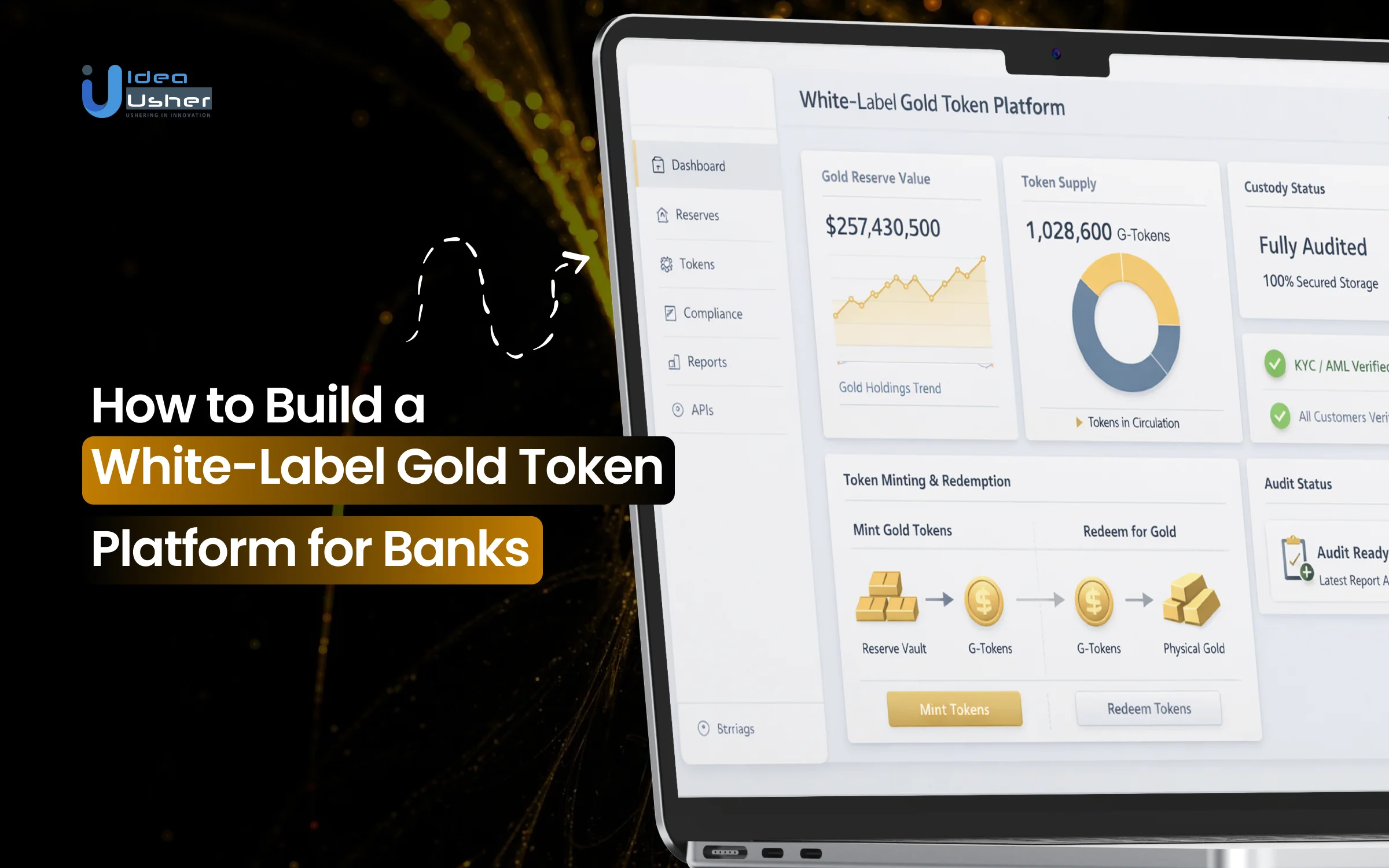
For years, gold sat quietly on bank balance sheets, valuable yet largely inactive. It protected wealthbut could not operate efficiently within modern financial systems, limiting its strategic use. This dormancy led institutions to explore white-label gold token platforms as a practical alternative.
Through tokenization, gold evolved from static storage into usable on-chain liquidity. Blockchain-enabled fractional ownership, real-time settlement, and transparent reserve verification make gold operational rather than passive. Banks can now activate gold, unlocking faster settlement, new fee-based revenue, and lower operational friction without changing gold’s trusted role.
We’ve developed multiple gold tokenization solutions using permissioned token standards and atomic settlement engines designed for regulated environments. Drawing on this experience, we’re sharing this blog to outline practical steps for developing a bank-grade white-label gold token platform.
Key Market Takeaways for Gold Token Platforms
According to FutureMarketInsights, the global tokenization market reached USD 3.32 billion in 2024 and is projected to reach USD 12.83 billion by 2032, reflecting rising institutional confidence in blockchain-based asset infrastructure. For banks, this growth signals that tokenized real-world assets are moving from experimentation into core financial systems.

Source: FutureMarketInsights
White-label gold token platforms are becoming a practical entry point for banks seeking speed without compromising compliance. These platforms allow institutions to tokenize vaulted gold, offer fractional ownership, and enable continuous settlement while integrating with existing custody and core banking systems.
Recent launches validate this shift. HSBC introduced a tokenized gold platform that creates digital representations of physical gold held in its London vaults, enabling near-real-time settlement via Evolve FX.
In parallel, SEBA Bank, now operating as Amina Bank, launched a regulated gold token backed by physical gold from Argor-Heraeus.

Overview of White-Label Gold Token Platforms for Banks
A white-label gold token platform for banks is a bank-grade system that enables institutions to issue digitally backed gold tokens under their own brand. Each token represents physical gold in regulated custody and is governed by embedded compliance, identity-based transfers, and secure custody controls, enabling banks to quickly offer digital gold products without building the infrastructure from scratch.
How It Fundamentally Differs from Retail Digital Gold Apps?
Although both models involve digital representations of gold, a bank-grade platform operates at a completely different level of regulation, control, and integration.
1. Bank-Grade Compliance vs Consumer-Grade Onboarding
Retail apps rely on lightweight KYC processes optimized for speed and rapid user growth. Compliance checks are usually performed once during onboarding and remain static.
A bank platform embeds continuous and programmable compliance directly into the system. It operates under strict AML and CFT frameworks, enforces ongoing transaction monitoring, screens against sanctions lists, and applies jurisdiction-specific regulatory rules such as MiCA where applicable.
Here, compliance is not an add-on feature. It is the foundation of the platform.
2. Identity-Aware Tokens vs Open ERC-20 Transfers
Retail apps commonly issue standard ERC-20 tokens on public blockchains. These tokens are transferable to any wallet address, whether or not the wallet is verified, creating significant regulatory risk for licensed institutions.
A bank platform uses permissioned and identity-aware token standards. Each token is cryptographically linked to a verified, whitelisted identity. Transfers to unverified or sanctioned wallets are technically impossible by design.
This ensures the bank retains full sovereign control over asset movement, satisfying internal risk teams and external regulators.
3. Regulated Custody vs App-Level Wallets
Retail apps often manage assets through simplified custodial wallets that frequently pool user funds. This structure does not meet the audit, balance-sheet, or risk requirements of regulated banks.
A bank-grade platform implements a multi-layered regulated custody framework, including:
- Segregated vaulting where every gram of gold is held in LBMA-certified vaults with transparent audit trails.
- Institutional key management using MPC or HSM systems to eliminate single points of failure.
- Hybrid custody models that allow fully bank-managed custody, co-custody, or qualified self-custody for sophisticated clients, all within insured and regulated boundaries.
Types of White-Label Gold Token Platforms Used in Banks
Banks typically deploy white-label gold token platforms across several models, depending on regulatory requirements, customer segment, and balance-sheet strategy.

1. Balance-Sheet Gold Token Platforms
These platforms tokenize the bank’s gold holdings. Tokens appear as digital claims backed by the bank’s physical reserves and are often offered as gold savings or treasury products. Compliance, custody, and settlement remain fully internal.
Example: UBS
UBS has explored tokenizing bank-held precious metal reserves for internal settlement and balance-sheet optimization through blockchain pilots. In this model, the gold remains a bank asset while tokens are used to improve settlement speed and operational efficiency.
2. Client-Owned Allocated Gold Platforms
Here, tokens represent customer-owned gold held in segregated vaults. The bank acts as issuer, custodian, and compliance controller, while clients retain direct economic ownership of the metal.
Example: HSBC
HSBC launched a blockchain-based platform that tokenizes client-owned allocated gold stored in its London vaults. Each token maps directly to a specific gold bar, giving institutional clients digital ownership while HSBC maintains custody and compliance.
3. Gold-Backed Deposit Token Platforms
This model combines gold tokenization with deposit-like behavior. Tokens function similarly to tokenized deposits, supporting programmable transfers, collateralization, and real-time settlement on regulated banking rails.
Example: JPMorgan Chase
JPMorgan’s digital asset infrastructure allows commodity-backed token experiments within its permissioned network. While best known for deposit tokens, the same framework has been tested with gold-linked settlement instruments, which behave like regulated tokenized deposits.
4. Treasury and Liquidity Management Platforms
Designed for interbank, institutional, or corporate treasury use, these platforms allow tokenized gold to be used for collateralization, liquidity optimization, and atomic settlement rather than retail investment.
Example: Standard Chartered
Standard Chartered has run pilots where tokenized gold is used as collateral in institutional and interbank settlement workflows. These platforms prioritize liquidity efficiency over retail access.
5. Hybrid Retail and Institutional Platforms
These platforms serve both retail and institutional clients from a single core system, applying different compliance rules, custody models, and transfer permissions based on user tier and jurisdiction.
Example: DBS Bank
DBS operates a digital asset platform that supports both institutional and high-net-worth clients, enabling tokenized assets, including gold-linked products, under strict compliance. Retail and institutional users access the same core infrastructure with tiered controls.
How Do White-Label Gold Token Platforms Work in Banks?
A white-label gold token platform enables a bank to convert physical gold into secure digital tokens. It uses smart contracts to manage minting, transfers, and redemption with compliance built in. This way, the bank can seamlessly and securely offer digital gold within its existing systems.

Phase 1: Foundation
Everything begins with real, allocated gold. The platform does not create synthetic exposure. It creates digital representations of verified physical bars.
Vault onboarding and auditing
The bank partners with LBMA-certified vaults or regulated custodians. Each gold bar is audited and recorded with its serial number, purity, weight, and vault location. This data is stored in a tamper-resistant registry using secure APIs or vault reporting systems.
The legal ownership bridge
A clear legal framework establishes that each token represents direct ownership of a specific fraction of physical gold. This look-through ownership structure is essential for investor protection, balance sheet recognition, and regulatory approval.
Phase 2: Minting
This phase governs how gold tokens are created under strict institutional control.
Dual-control minting authority
Tokens cannot be minted freely. The system requires multi-signature approval from both the bank and the independent custodian. Only after the physical gold is confirmed as allocated does the smart contract authorize minting.
Identity-bound token issuance
Tokens are issued as ERC-3643-compliant assets or equivalent permissioned standards. They are assigned only to KYC-verified and pre-whitelisted wallets, ensuring the token is born compliant from the first transaction.
Phase 3: Distribution and Management
This is where the platform becomes part of the bank’s branded ecosystem.
White-label administrative dashboard
Bank teams access a branded control panel to monitor assets under management, circulating token supply, vault balances, and proof-of-reserves in real time. Regulatory reporting and client segmentation are managed from the same interface.
Seamless customer experience
Customers do not interact with blockchain tools. They view Digital Gold Holdings directly inside the bank’s existing web or mobile banking app. Transactions are handled through APIs that translate blockchain activity into core banking formats such as ISO 20022, preserving a familiar user experience.
Phase 4: Transactions
All activity is governed by embedded compliance logic.
Atomic settlement for gold transactions
When a customer buys or sells gold, the platform executes an atomic delivery-versus-payment transaction. Fiat, digital cash, and gold tokens can be exchanged simultaneously, eliminating settlement risk.
Compliance-driven transfers and screening
All transfers are automatically screened against sanctions lists, jurisdiction rules, and risk thresholds at the smart contract level.
Collateralization and expanded utility
Gold tokens can be used as programmable collateral for treasury operations, interbank lending, or repo structures. Banks may also enable automated gold savings features such as recurring investments or round-up mechanisms.
Phase 5: Redemption and Lifecycle
The platform proves its legitimacy by allowing a seamless return to physical gold.
Burn-to-physical redemption
When a client requests delivery, the platform permanently burns the corresponding digital tokens and instructs the vault to release the allocated bar for delivery or branch pickup.
Continuous audit and regulatory reporting
Every mint, transfer, and burn is recorded immutably. Real-time proof-of-reserve oracles maintain continuous alignment between on-chain supply and physical custody. Compliance reports for regulators, tax authorities, and internal audit are generated automatically.
How to Build a White-Label Gold Token Platform for Banks?
Start by designing a custody and legal model that banks can trust and that maps each token to vaulted bars. Then issue permissioned tokens with embedded KYC and AML logic to ensure transfers remain compliant and auditable. We have developed many white-label gold token platforms for banking use cases, and here is how we do it.

1. Vault to Token Model
We design the processes for sourcing, vaulting, and mapping physical gold to the token supply. Minting is set up under dual control, so both the bank and the custodian approve issuance. We also align the legal structure with local regulations so ownership and redemption remain fully enforceable.
2. Identity Bound Tokens
We implement permissioned token standards that embed compliance at the protocol level. Every token is linked to verified identities through integrated KYC and AML checks. Jurisdiction-based transfer rules ensure tokens move only within approved regulatory boundaries.
3. Proof of Reserves Layer
We connect vault inventory systems to Oracle networks to continuously verify reserves. Token supply is reconciled with physical gold in near-real-time. If a mismatch is detected, governance controls can pause activity until integrity is restored.
4. Atomic Settlement
We build delivery-versus-payment logic that settles gold tokens against stablecoins, CBDCs, or bank deposit tokens. Smart contracts are tested to ensure settlement finality. This removes counterparty risk during high-value transactions.
5. Hybrid Custody
We deploy MPC and HSM-based custody models that balance security with operational control. Clear recovery and inheritance workflows are defined from the start. These policies are aligned with banking-grade risk and compliance requirements.
6. Banking Integration
We integrate the platform with core banking systems using ISO 20022-compatible middleware. White-label web and mobile interfaces are delivered for seamless user access. Gold tokens appear inside existing banking apps as a native digital product.
How Does the Platform Handle Gold Price Discovery and Valuation?
A gold token platform anchors value to globally accepted spot benchmarks and then updates it continuously using verified on-chain price feeds. You can expect the token price to adjust smoothly through market trading and arbitrage as supply and demand change. This approach may reliably keep valuation aligned with physical gold while enabling real-time settlement and usage.

The Traditional Foundation: The LBMA Gold Price
Every legitimate gold token platform anchors its valuation to the London Bullion Market Association Gold Price. This is the legally recognized global benchmark for physical gold.
How it works
- Twice daily at 10:30 AM and 3:00 PM London time, leading banks and institutions participate in an electronic auction
- The resulting price becomes the benchmark for more than 30 billion dollars in daily gold transactions worldwide
- Platforms like PAX Gold and Tether Gold explicitly peg their tokens to this benchmark
Take Paxos as an example. Every PAXG token is redeemable for one troy ounce of a London Good Delivery gold bar. The redemption value is based on the LBMA Gold Price at the time of redemption.
If PAXG trades below spot, arbitrageurs can buy tokens, redeem physical gold, and sell it, pushing the token price back in line with global markets.
The On-Chain Innovation Layer
Blockchain adds continuous verification and round-the-clock pricing on top of traditional benchmarks.
1. Oracle Networks as the Price Bridge
Gold token platforms do not rely on a single data source. They use decentralized oracle networks such as Chainlink to aggregate prices from multiple independent feeds.
Flow: Data sources → Multiple APIs → Oracle nodes → Consensus → On chain price
Sources may include LBMA, COMEX, Shanghai Gold Exchange, Reuters, Bloomberg, and TradingView. If one source reports incorrect data or goes offline, it is excluded from the consensus. Smart contracts only see a validated price.
2. Continuous Price Discovery Through Liquidity Pools
On-chain gold trades 24 hours a day, even when traditional markets are closed.
- Automated market makers create continuous trading
- The ratio between gold tokens and stablecoins determines real time price
- Deep liquidity pools become active price discovery venues
For example, a PAXG USDC pool on Uniswap can reflect real demand during Asian trading hours when London is closed, allowing price discovery to continue without interruption.
The Valuation Framework
The valuation of gold tokens has three interconnected layers.
1. Intrinsic Value from Physical Gold
Value = Gold ounces backing token × LBMA price × Purity adjustment
Platforms undergo regular attestations by firms such as Withum or Cohen & Co. These confirm that tokens in circulation never exceed gold held in custody.
If you hold one PAXG, you own one troy ounce of 99.99 percent pure gold. The intrinsic value is clear and auditable.
2. Market Value from Trading Dynamics
Market price = Intrinsic value ± Liquidity premium or risk discount
Key factors include redemption friction, market sentiment, and liquidity depth. In March 2020, PAXG traded at a premium because investors valued immediate access to gold amid physical delivery constraints.
3. Utility Value from DeFi Integration
Total value = Intrinsic value + Yield + Collateral utility + Programmable benefits
Gold tokens can earn yield, be used as collateral, and participate in composable strategies. For instance, a PAXG token that earns yield on Aave while backing a loan can deliver greater economic value than apassive gold holding.
The Arbitrage Mechanism
The most critical safeguard in gold token platforms is arbitrage.
Flow: Price discrepancy → Arbitrage opportunity → Market correction
If PAXG trades below spot, traders buy tokens, redeem physical gold, and sell the physical gold. If it trades above spot, traders mint new tokens backed by physical gold and sell them. These actions naturally pull prices back toward equilibrium.
This mechanism works without trust. Economic incentives enforce price accuracy automatically.
How to Prevent Over-Minting and Eliminate Fractional Reserve Risk?
For a bank, the cardinal sin in gold tokenization is issuing a digital promise without a physical asset backing it. Over minting, which means issuing more tokens than there is gold in the vault, creates a modern fractional reserve risk and slowly destroys trust in the system.
A robust white-label gold token platform prevents this not through goodwill, but through an immutable, multi-layered architecture built on cryptographic proofs and enforced processes. It replaces periodic human audits with continuous, automated verification.
1. The Physical Vault Digital Handshake
Everything begins and ends with physical gold. The platform never operates independently of real-world custody.
- Certified and Segregated Vaults: Gold is stored in LBMA-accredited vaults and held in segregated, auditable accounts. It is never mixed with general inventory.
- Cryptographically Attested Data Feeds: Vaults do not send spreadsheets. They provide digitally signed inventory data through secure APIs or IoT systems.
This data includes bar serial numbers, weight, and purity, creating an unforgeable link between a specific bar and the blockchain.
2. The Oracle Bridge
Raw vault data cannot be pushed directly onto a blockchain in a bank-grade system. Decentralized oracle networks, such as Chainlink, fetch vault-signed inventory data from independent nodes and validate it through consensus.
The oracle then publishes this verified data on the chain with timestamps, creating a tamper-proof and auditable record that smart contracts can reliably trust.
3. The Smart Contract Enforcer
This layer is the heart of overminting prevention.
Reserve Management Smart Contract: Only one smart contract is authorized to mint tokens. Its core rule is absolute. Tokens in circulation must always be less than or equal to verified physical gold.
Minting Gatekeeper Logic:
When a mint request is submitted, the contract checks in real time:
(Current token supply + mint request) ≤ (on-chain verified gold balance)
Automatic Execution or Rejection
- If TRUE: The mint proceeds. The token supply increases precisely in line with the attested physical increase.
- If FALSE: The transaction reverts automatically. It is impossible to execute. This is a non-negotiable, code-level enforcement.
There is no override. The code enforces discipline.
4. Procedural and Cryptographic Locks
Human involvement is secured with institutional-grade controls.
Multi-Signature Minting Authorization
A single bank employee cannot mint tokens. The platform requires digital signatures from multiple authorized parties (e.g., one from the bank’s treasury, one from the independent custodian) to approve any minting transaction. This mirrors the “two-key” system of a physical vault.
Identity-Bound Minting Rights: These authorizations are tied to secure, hardware-based keys (HSMs), ensuring only pre-approved individuals can initiate the process.
5. Continuous Transparency and Market Discipline
The final layer is radical transparency, which serves as a powerful deterrent in the market.
Real-Time Proof of Reserves Dashboard: The platform provides a public or auditor-accessible dashboard that displays in real-time:
- Total Physical Gold Held: (Sourced from the oracle).
- Total Gold Tokens in Circulation: (On the blockchain).
- The 1:1 Ratio: A simple, always-green “Fully Backed” status.
Anyone, at any time, can cryptographically verify that the system is solvent. This transparency makes it both technically impossible and immediately detectable to engage in fractional reserve practices, thereby protecting the bank’s reputation.
What Pricing Models Work Best for Banks Offering Tokenized Gold?
Before any bank margin is applied, the platform establishes a neutral baseline price using decentralized oracle infrastructure. This consensus price is derived from Tier 1 sources, including the London Bullion Market Association, COMEX, and other regulated market feeds.
This reference price represents the wholesale or spot value of gold. All client-facing prices are built on top of it. Because the base price is independently verifiable, customers can immediately see that the bank is not quoting an arbitrary or inflated number. This transparency is critical to building trust and regulatory confidence.
1. The Bid Ask Spread Model
This is the most familiar and widely adopted model for banks, closely resembling traditional bullion and FX desks.
How it works: The bank continuously quotes two prices:
- Ask price (Buy from bank): Consensus spot price plus a premium
- Bid price (Sell to bank): Consensus spot price minus a discount
The difference between these two prices is the bank’s gross spread and represents its core trading revenue.
Why it works for banks
- Familiarity: Mirrors existing bullion and FX trading operations
- Transparency: The spread can be clearly disclosed, for example, a 1.5 percent spread over the live market price
- Aligned incentives: Revenue scales naturally with trading volume and client activity
This model performs especially well for active traders and short-term allocators.
Example:
UBS applies a bid-ask spread across its digital and allocated gold offerings, quoting buy and sell prices directly over global spot benchmarks. The bank earns revenue through a clearly defined spread, a structure that translates directly into tokenized gold by enforcing the same pricing logic through programmable rules.
2. The Tiered Subscription or Custody Fee Model
This model is designed for long-term holders and wealth-focused products such as digital gold savings accounts.
How it works: The bank charges an annual custody or management fee on the total value of gold tokens held in client accounts. Typical ranges fall between 0.25 percent and 0.75 percent annually. The fee structure can be:
- Tiered, with lower fees for higher balances
- Bundled into premium banking or wealth management offerings
Why it works for banks
This model delivers predictable recurring revenue linked to assets under management while encouraging long-term holding since frequent trading is not penalized. It scales smoothly across retail, high-net-worth, and institutional clients and closely reflects how banks already price custody and advisory services.
Example:
DBS Bank provides digital gold custody through its wealth platforms, charging annual fees based on the total value of gold held. This AUM-driven model aligns well with tokenized gold, positioned as a long-term savings or wealth-preservation product.
3. The Transaction Fee Model
This model monetizes operationally expensive, or value-added actions, beyond basic buying and selling.
How it works: The bank applies fixed or percentage-based fees for specific services, such as:
- Physical redemption fee for burn to ship workflows, covering logistics and reminting
- Peer-to-peer transfer fee for sending tokens between verified clients
- FX conversion fee when purchasing gold in a currency different from the vault base currency
Why it works for banks
This model recovers real operational costs while clearly separating low-cost digital convenience from higher-cost physical handling. By pricing physical services higher, banks can gently guide users toward efficient on-chain usage.
Example:
Industrial and Commercial Bank of China offers digital gold accounts with options for physical redemption and transfers, charging fees for logistics-intensive activities such as delivery. A tokenized gold platform follows the same logic by pricing operational complexity while keeping digital holding efficient.
Conclusion
White-label gold token platforms are becoming part of core banking systems because they integrate custody, settlement, and compliance into a single, controlled layer. Banks that move early may gain trust, liquidity, and durable revenue advantages while avoiding long build cycles. Building in-house is risky and slow, so white-label models can accelerate innovation. With the right technology partner, banks could launch securely and compliantly with confidence.
Looking to Develop a White-Label Gold Token Platform?
IdeaUsher helps you design a compliant gold token platform by first structuring the legal and custody layers to securely tokenize physical gold. We then build the blockchain and compliance logic to automatically enforce transfers and settlements while integrating seamlessly with banking systems.
With over 500,000 hours of coding experience, our team of ex-MAANG/FAANG developers delivers not just software, but a de-risked pathway to innovation.
- ERC-3643 Tokens for programmable, compliance-enforcing transactions.
- Real-Time Proof of Reserves via oracle networks for radical transparency.
- Atomic Settlement to eliminate counterparty risk and unlock capital.
- Hybrid MPC Custody balances ironclad security with user flexibility.
Explore our latest projects to see the institutional-grade work we deliver.


FAQs
A1: A white-label gold token differs from a gold ETF because ownership is recorded directly on the chain rather than held through fund units. Settlement can occur in near-real-time, and redemption may be executed outside market hours. This structure can give institutions clearer control over custody and balance sheet treatment.
A2: Tokenized gold can be legally compliant for banks when it is designed with permissioned access and regulatory logic built in. Identity checks and transfer rules are enforced at the protocol level, and reporting is automated. This approach may align well with jurisdiction-specific banking requirements.
A3:Banks can offer both digital and physical redemption by linking tokens to a burn-to-redeem workflow. Once tokens are destroyed, the custodian releases the allocated gold through approved channels. This process usually works smoothly and strongly reinforces trust in the system.
A4: Launching a white-label gold token platform can take weeks because core infrastructure is already validated. Legal wrappers and custody integrations are reused while branding and rules are configured. Compared with traditional products, this speed enables banks to move faster without sacrificing control.


