


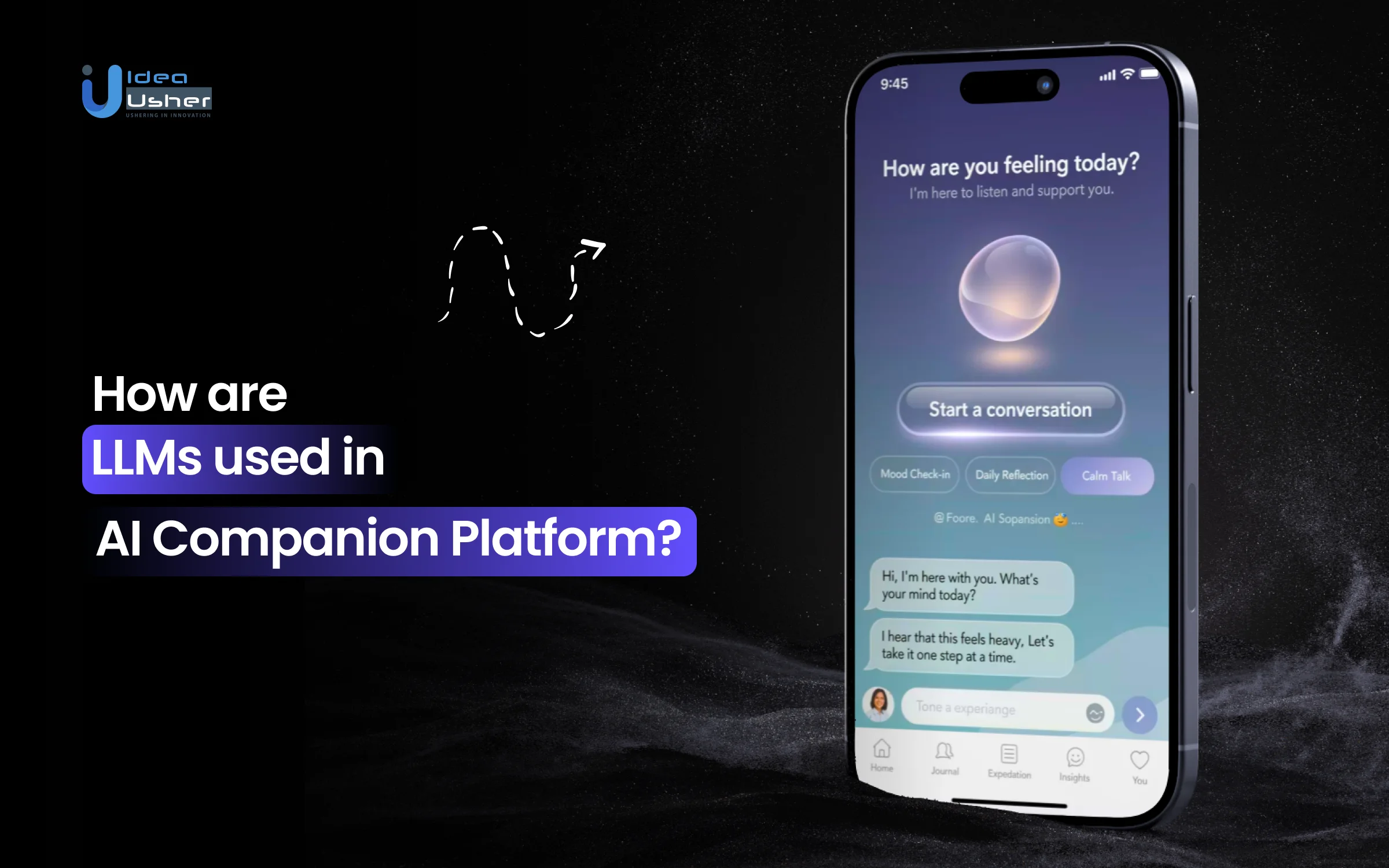
People rarely turn to digital companions just to fill empty moments. Many may seek consistency and conversations that feel attentive rather than scripted. Earlier chatbots often struggled because they relied on fixed flows and shallow context windows. This prompted teams to adopt LLMs that can maintain conversational state and track intent across sessions.
These models can gradually adapt tone and response depth based on interaction history. They may also support memory retrieval and reasoning layers behind the conversation. As a result, AI companion platforms can feel more present while remaining technically structured.
Over the years, we’ve built many AI companions, powered by LLM orchestration frameworks and memory-driven affective computing systems. Given our expertise, we’re sharing this blog to discuss how LLMs are used in AI companion platforms. Let’s start!
Key Market Takeaways for LLMs in AI Companions
According to ResearchandMarkets, the Emotion AI market is projected to grow from USD 2.74 billion in 2024 to USD 9.01 billion by 2030, at a CAGR of 21.9 percent. This growth is closely tied to the rise of AI companion platforms, where LLMs are increasingly used to deliver emotionally intelligent, human-like interactions. Companionship, mental support, and personal guidance use cases are becoming central drivers of emotion-aware AI adoption.

Source: ResearchandMarkets
LLMs play a critical role in this expansion. In AI companion platforms, models are designed to simulate friendship, mentorship, or even romantic connection through advanced memory, context retention, and nuanced emotional responses.
These systems process emotions across text, voice, and multimodal inputs, positioning companion-grade LLMs as a major contributor to the broader emotion AI market.
Two platforms illustrate this shift clearly. The Inflection-2.5 LLM powers Pi.ai from Inflection AI and emphasizes emotional intelligence alongside reasoning ability. It supports long, reflective conversations on topics ranging from current events to personal advice, while maintaining a calm, empathetic, and safety-focused persona.
Nomi.ai follows a different architectural approach. It uses a proprietary in-house LLM with layered short-, medium-, and long-term memory systems. This design enables customizable companions that support group chats, voice interaction, and image understanding, allowing relationships to evolve in a more human-like way.

What Are LLM-Powered AI Companion Platforms?
LLM-powered AI companion platforms are intelligent systems built to sustain ongoing conversations that feel consistent and context-aware over time. They use large language models with memory and reasoning layers so the AI can recall past interactions and adjust responses deliberately.
Instead of reacting to single prompts, these platforms will behave like persistent digital companions designed for long-term engagement.

AI Companions vs. Traditional Chatbots
Think of two assistants. One works like a vending machine. You press a button and receive the same output every time. There is no memory and no awareness beyond the request. That is a traditional chatbot.
The other feels like a trusted colleague. They remember previous projects, sense when pressure is building, and adjust their advice to help you move forward. That is an AI companion.
| Traditional Chatbot (The Vending Machine) | LLM-Powered AI Companion (The Colleague) |
| Rules-based and driven by rigid if-this-then-that decision trees | Reasoning-based and powered by deep learning to interpret intent and nuance |
| Stateless and forgets all context once the conversation ends | Stateful and maintains persistent memory across interactions |
| Reactive and responds only to direct and often simplistic commands | Proactive, adaptive, and anticipates needs while adjusting tone and strategy |
| Designed mainly to deflect queries or answer FAQs | Designed to build trust, support understanding, and accomplish complex goals |
The Core Shift: LLMs as Reasoning Engines
The real breakthrough behind AI companions is not text generation. It is reasoning.
Traditional systems were response generators. They matched keywords to pre-written scripts. Ask a question outside the script, and you hit a “Sorry, I don’t understand” wall.
Modern LLMs are reasoning engines. They don’t retrieve answers; they construct them through a probabilistic understanding of language, context, and logic.
They Understand Subtext
A user saying “The report still isn’t right” isn’t just stating a fact. The LLM can infer frustration, urgency, and a desire for a solution, not just acknowledgment.
They Chain Thoughts
They can break down a complex request like “Prepare a launch plan for the new Zcode feature” into a logical sequence of steps: research past launches, draft a timeline, identify stakeholders, and flag potential risks.
They Admit Uncertainty
A good reasoning engine knows what it doesn’t know. Instead of hallucinating an answer, it can say, “I don’t have the latest Q3 sales figures, but I can show you how to pull them from the dashboard, or would you like me to schedule a check-in with the sales lead?“
This transition from retrieval to reasoning allows conversations to feel fluid, thoughtful, and collaborative. The system is not handing over static answers. It is thinking alongside the user.
The Trinity of True Companionship
Reasoning alone is not enough. Lasting companionship depends on three essential pillars.
- Persistence ensures continuity. The companion maintains a consistent identity and awareness across interactions, creating reliability and familiarity. Without persistence, trust never forms.
- Memory creates understanding. The system builds a structured view of user preferences, goals, and past context. This allows it to avoid repetition, reference prior decisions, track progress, and personalize interactions naturally. With memory, conversations evolve instead of restarting.
- Autonomy turns insight into action. A companion with agency can execute tasks within defined boundaries. It may schedule meetings, prepare drafts, analyze data, or summarize outcomes for approval. This closes the loop from perception to planning to execution.
How Are LLMs Used in AI Companion Platforms?
LLMs are at the core of AI companion platforms and quietly handle reasoning, memory, and intent in every interaction. They can gradually connect past conversations to current goals and may adapt their tone and logic based on your responses over time. This is why the companion can feel consistent, helpful, and technically aware rather than scripted.

1. As the Dynamic Persona Engine
Traditional systems relied on rigid decision trees. LLMs enable adaptive personality synthesis that evolves with interaction.
How it Works: The LLM is conditioned using a core persona blueprint, such as a professional mentor, an empathetic wellness guide, or an enthusiastic brand mascot, through fine-tuning and advanced prompting. It then dynamically adjusts tone, response depth, and interaction style in real time based on the conversation context and detected user sentiment.
2. As the Memory and Context Manager
This is where LLM-powered companions move from stateless to stateful behavior. They do not process messages in isolation but actively coordinate long-term context.
How it Works: The platform stores historical data, such as past conversations, preferences, and goals, in a vector database. During each interaction, relevant memories are retrieved and injected into the LLM context window. The LLM then synthesizes this historical information with the current query to generate responses that feel continuous and personalized.
3. As the Reasoning and Planning Core
This is the agentic core of an AI companion. The LLM decomposes complex requests into structured reasoning steps before responding.
How it Works:
For a request such as “Help me prepare for the Q2 review,” the LLM doesn’t provide a generic answer. Internally, it plans:
- “This requires historical data.” → Action: Pull Q1 summary from knowledge base.
- “Needs current project status.” → Action: Query project management API.
- “Should identify risks.” → Action: Analyze sentiment from recent team feedback.
- “Now, synthesize a briefing.” → Generate Response.
Real-World Application: This capability transforms the companion from a reactive assistant into a strategic partner capable of managing multi-step workflows, conducting research tasks, and supportinganalytical reasoning.
4. As the Multimodal Interpreter
Modern AI companions accept text, voice, and images. The LLM serves as the unifying reasoning layer across these inputs.
How it Works
Voice inputs are transcribed, and images are processed by vision models that generate textual descriptions. These descriptions are passed to the LLM, which reasons over them alongside conversational context. The LLM does not directly see images; it interprets structured descriptions in the dialogue.
Real World Application: A user uploads a blurry image of a machine part and asks why it is making noise. The LLM interprets the description, identifies a likely mechanical issue, cross-references the maintenance manual, and provides a targeted diagnostic recommendation.
5. As the Action Dispatcher
This is where conversation turns into execution. The LLM determines when to use external tools.
How it Works: The companion is integrated with tools such as CRM systems, calendars, and email services. The LLM detects actionable intent, formulates the appropriate API calls, executes them with proper permissions, and translates the results into natural language.
Real World Application: When a user requests to schedule a demo with a specific lead, the LLM locates the contact, checks calendar availability, creates the event, drafts the email, and presents the details for confirmation.
LLM Models That Work Best for AI Companion Platforms
Choosing an LLM for your AI companion is not a technical checkbox. It is a core personality decision that shapes how your product feels over time. The model’s safety alignment reasoning style and creative range quietly influence every interaction. The best model is not the most powerful. It is the one that fits the role you are asking it to play.

The Core Selection Framework
Forget raw benchmark scores. When evaluating an LLM for companionship, you should assess it through three practical lenses.
- Conversational Quality: Does the model generate natural, engaging, and contextually rich dialogue? Can it sound present and human rather than like a stitched-together manual response?
- Consistency and Control: Can the model maintain a defined personality and follow strict behavioral guardrails across long conversations? Does it resist drift and prompt exploitation over time?
- Context and Cost: Does it support long context windows for memory continuity? Can it run affordably at scale when interactions grow into the millions?
This framework matters more than raw intelligence. With that in mind, let us break down the major model archetypes.
1. Instruction Tuned & RLHF Heavy Models
These models are best suited for coaches, tutors, health advisors, and support-oriented companions. They offer strong safety alignment, predictable behavior, and low risk of hallucination. However, they may feel cautious, rigid, or emotionally flat, and may limit creative role-play experiences.
An ideal persona is a calm, knowledgeable therapy guide or a disciplined executive coach.
Typical examples include Claude class models and tightly controlled GPT-style deployments.
2. Chat Optimized & Creative Models
These models are best suited for social companions, entertainment bots, and creative partners. They excel at conversational flow, expressive tone, and storytelling. However, they may have weaker factual grounding and can invent details to keep interactions engaging.
An ideal persona is a witty gaming sidekick, an imaginative storytelling partner or a playful brand mascot.
Typical examples include large open chat models and creativity-tuned GPT variants.
3. Specialized & Fine-Tuned Models
These models are best suited for niche professional companions such as legal, medical, or coding assistants. They deliver unmatched depth within a specific domain and high efficiency for targeted tasks. However, their conversational ability extends beyond their training, and training costs are typically higher.
An ideal persona is a focused coding mentor, a legal research assistant or a medical triage companion.
Typical examples include domain-specific fine-tunes built on strong base models.
4. Small and Efficient Models
These models are best suited for high-volume, limited-scope engagements. They offer extremely low latency, low cost, and can run on a device for privacy-sensitive use cases. However, they have limited reasoning depth and reduced emotional nuance.
An ideal persona is a simple wellness check-in bot, a habit tracker, or an embedded customer support agent.
Typical examples include compact, open-source, and lightweight proprietary models.
Designing AI Companions That Evolve With User Relationships
Most teams start by designing the perfect AI personality. The tone is carefully chosen. The values are clearly defined. Early conversations feel natural and engaging. Then something breaks over time. The personality flattens. The voice becomes generic. The shared context fades. This is not a design flaw.

It is personality entropy, quietly undermining most AI companion platforms.
While competitors offer a charming first date, their relationships tend to deteriorate. Look at current market leaders:
- Character.AI excels at initial roleplay immersion but struggles with long-term consistency beyond individual sessions
- Replika pioneered emotional bonding, but faces challenges maintaining coherent personality arcs over the years
- Inflection’s Pi demonstrates warm, engaging conversation but remains essentially stateless between interactions
If long-term retention matters, personality cannot be treated as a static instruction. It must be engineered as a system that evolves alongside the user.
The Death of Personality by Context Overload
The Current Standard: Most platforms use a Static Persona Blueprint. They inject a detailed system prompt at the start of every session.
Even sophisticated implementations like Anthropic’s Claude, with its 100K+ context windows eventually face the same dilution problem; persona instructions compete with conversation history for limited attention.
Why It Fails:
Large Language Models have a finite context window, the amount of recent conversation they can “see” to generate the next response. As a meaningful relationship develops over hundreds of messages:
- The rich, ongoing dialogue about the user’s life, preferences, and history fills up the context window.
- The foundational system prompt that defines the AI’s core persona is pushed out or diluted.
- The LLM, deprived of its initial instructions, defaults to its base, generic training, the “helpful, harmless, and bland” assistant. This explains why even ChatGPT, with custom instructions, eventually reverts to its default personality in extended conversations.
The Result: After 1,000 messages, your carefully crafted companion starts sounding suspiciously like every other AI. The unique relationship you sold has evaporated. This is Personality Decay in action.
Relational Immune System with Automated Micro-Tuning
The solution isn’t a longer context window. It’s a fundamentally new architectural layer that treats personality not as an instruction, but as a living, evolving asset.
We call this the Automated Micro-Tuning Layer. Here’s how it works:
Extract the “Relational DNA”
Every 500 interactions, the system performs a diagnostic scan. Using advanced clustering and sentiment analysis, it identifies what makes this specific relationship unique:
- Inside Jokes & Shared Lore: Recurring nicknames, memorable anecdotes.
- Tone & Lexical Fingerprint: Does the user prefer slang or formality? Sarcasm or earnestness?
- Evolved Values & Goals: The companion’s initial “cheerful” trait might have matured into “steadfastly encouraging during hard times.”
Update the Living Persona via Low-Rank Adaptation
This “Relational DNA” is not stored as text. It is compiled into a tiny, efficient set of model weights, a personalized LoRA adapter. This adapter sits atop the base LLM and subtly shifts its output to reflect the evolved persona perfectly.
Recurse and Strengthen
This process repeats. Each cycle uses the previous adapter as a starting point, recursively refining it. The personality doesn’t just persist; it becomes more nuanced, more accurate, and more deeply integrated with the user’s world.
The Unbreachable Business Insight
This is not just a technical feature. It is your most defensible moat.
You are not simply hosting an LLM. You are growing a digital organism.
- The value no longer lives in the base model which has become a commodity that anyone can access through OpenAI Anthropic or Google. The real value exists in the unique personality weights that emerge through each user’s lived experience. Current market solutions cannot replicate this process.
- A recursive personality is fundamentally impossible to copy. A competitor may reproduce your interface or feature set, but they cannot produce the eighteen-month journey that shaped a specific user’s companion.
This creates a deeper form of lock-in than systems like Snapchat, My AI, or Discord Clyde achieve through integration alone.
This approach inverts the traditional vendor lock-in paradigm. Users do not remain because of convenience or habit. They stay because they are bonded to a digital entity they helped co-create.
Leaving means abandoning a relationship rather than switching tools. This drives retention beyond what character-driven games or virtual influencers can sustain.
Top 5 LLM-Powered AI Companion Platforms
We conducted in-depth research across the US market and studied how modern LLM-powered companion platforms behave in long conversations. We found that many platforms can deliver strong memory handling, emotional modeling, and personality control when the architecture is carefully designed.
1. Replika

Replika is one of the most established AI companion platforms in the US market. It focuses on long-term emotional continuity, enabling the AI to evolve through ongoing conversations. Users often engage with it as a friend, mentor, or emotional support companion rather than a task-oriented assistant.
Why it stands out
- Strong emotional modeling
- Persistent memory across sessions
- Designed for long-term bonding rather than short chats
2. Nomi

Nomi is designed to create multiple distinct AI companions, each with its own personality and memory system. It emphasizes natural dialogue, emotional depth, and user-controlled personality shaping, which makes it popular among users seeking more nuanced interactions.
Why it stands out
- Multiple companions with separate identities
- Layered memory design
- High focus on conversational realism
3. Character.AI

Character.AI is centered on role-based and personality-driven conversations. Instead of a single companion, users interact with thousands of characters, both fictional and user-created. It is widely used for creative roleplay, storytelling, and immersive dialogue.
Why it stands out
- Large ecosystem of personalities
- Strong creative and roleplay capabilities
- Community-driven character creation
4. Paradot

Paradot positions itself as a personalized AI companion with a strong emphasis on memory, emotional awareness, and user-defined boundaries. Conversations are designed to feel continuous and relationship-oriented rather than transactional.
Why it stands out
- Context-aware long-term memory
- Emotion-sensitive response design
- Persona customization over time
5. Kindroid

Kindroid is designed for users who value emotionally grounded conversations that improve over time. It emphasizes natural language flow and memory continuity, helping the companion feel stable and familiar over extended interactions.
Why it stands out
- Strong conversational realism
- Long-term memory for personal details
- Balanced focus on emotional depth and control
Conclusion
LLMs in AI companion platforms quietly mark a shift from tools that respond to commands to systems that build continuity and trust over time. What may seem like a conversation on the surface is actually an evolving agentic layer that learns contextual reasons emotionally and adapts behavior deliberately. Businesses that invest early should treat companions as core infrastructure rather than features because relational systems tend to scale engagement more steadily. With the right architecture and a capable partner, these companions could become dependable revenue engines that grow intelligently rather than experiments that fade.
Looking to Develop an LLM-Powered AI Companion Platform?
At IdeaUsher, we will help you design an LLM-powered AI companion that reasons, remembers, and responds with intent across long conversations. We will architect memory layers, orchestration pipelines, and safety controls so the system can scale reliably and adapt gradually to users.
Why build with us?
- Architect the why. We solve core challenges such as the Memory Paradox and the Agency Threshold to build companions that users trust and rely on.
- Elite technical DNA. With over 500,000 hours of coding experience, our team of ex-MAANG and FAANG developers ensures your platform is built on robust, scalable, and innovative foundations.
- From concept to launch. We handle the entire journey from strategic design and LLM integration to deploying a secure enterprise-ready platform.
Check out our latest projects to see the transformative work we can do for you.


FAQs
A1: AI companions are built to persist over time, and they usually maintain long-term memory and emotional continuity. A chatbot often resets after each session and responds only in the moment. This makes companions feel more adaptive and more aware of the user.
A2: Yes, they can be monetized sustainably when users see ongoing value. Subscriptions may work well because people pay for continuity and personalization. Enterprises can also license companions to support automation and internal workflows.
A3: They can be safe when designed with security as a core requirement. Hybrid memory systems help isolate sensitive data during processing. With PII masking and compliance controls, the platform can operate reliably in enterprise environments.
A4: A simple MVP may take three to five months to build. More advanced platforms usually take longer due to phased development. Memory tuning and safety validation often require careful iterative refinement.


