


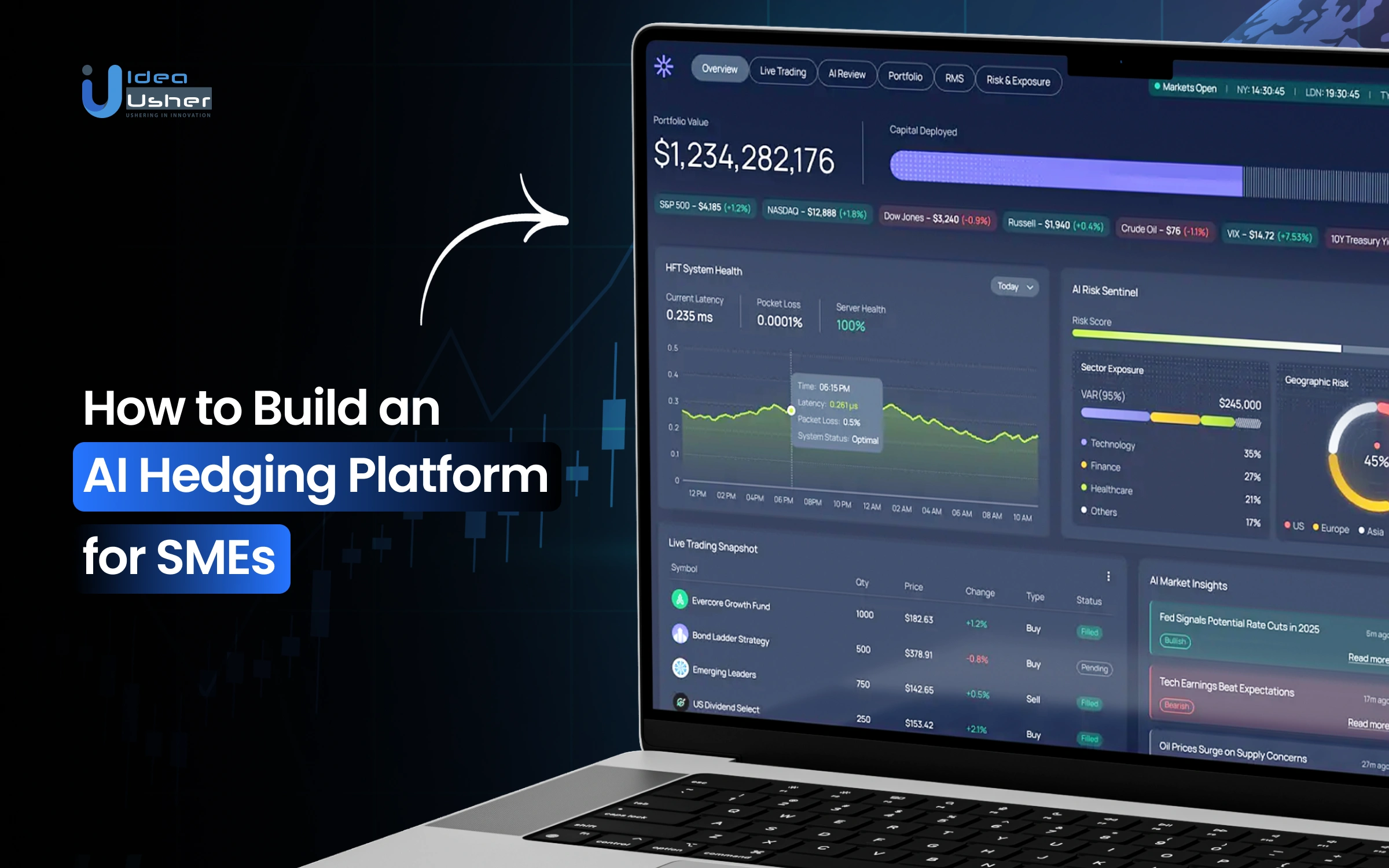
Small and medium-sized businesses face rapidly shifting risks such as currency swings, supplier delays, volatile commodity prices, and sudden market movements. Many SMEs struggle to manage these fluctuations because they lack the tools or expertise for continuous monitoring. This is why more companies growing interest in an AI hedging platform that analyzes risks in real time and helps protect margins without relying solely on manual decisions.
AI turns hedging into a proactive process by forecasting market movements, recommending strategies, automating execution, and adapting through machine learning and predictive analytics. By combining market, operational, and historical data, these systems give SMEs advanced financial protection that previously only large enterprises could access, strengthening decision-making and margin defense.
In this guide, we’ll walk through how AI hedging platforms work, the key features you need to build one, and what it takes to develop a reliable, scalable solution for SMEs. Whether you’re planning to launch a new financial product, this blog will give you a clear roadmap for designing an AI-powered hedging system that truly delivers value.

What is an AI Hedging Platform for SMEs?
An AI Hedging Platform for SMEs is a technology solution that uses advanced machine learning to help small and mid-sized businesses automatically identify, quantify, and mitigate financial risks such as currency, interest-rate, and commodity exposure.
It continuously analyzes real-time market data, forecasts potential volatility, and recommends or executes optimal hedging strategies that were previously accessible only to large enterprises.
For investors, these platforms unlock a large underserved market by reducing SMEs’ financial uncertainty, improving cash-flow stability, and enabling data-driven risk management at scale with minimal human intervention.
- AI-driven exposure mapping that pinpoints where and how financial risks impact the business.
- Predictive market intelligence that forecasts currency, rate, and commodity movements with high frequency.
- Strategy automation engines that convert risk insights into tailored hedging actions for each SME.
- Integrated execution workflows that allow businesses to implement hedges with minimal manual steps.
- Real-time monitoring and optimization that adjusts hedges as market conditions or business exposures evolve.
- Cost-efficient risk management access that delivers enterprise-grade hedging capabilities without enterprise-level overhead.
AI Hedging Platforms vs. Traditional Hedging Tools
SMEs face unique financial challenges, and this comparison highlights how AI-driven hedging solutions offer practical, accessible advantages over traditional tools.
| Category | AI Hedging Platform | Traditional Hedging Tools |
| Ease of Use | Intuitive, automated interface designed for non-experts. | Complex tools requiring financial or treasury expertise. |
| Risk Visibility | Automatically maps SME cash flows, invoices, and exposures. | Limited visibility; SMEs often rely on manual spreadsheets. |
| Market Awareness | Provides real-time alerts and AI-driven forecasts tailored to SME exposures. | SMEs rarely get timely insights; depend on delayed reports or advisors. |
| Strategy Guidance | Offers step-by-step recommendations specific to SME size, volume, and sector. | Minimal guidance; SMEs must interpret market data themselves. |
| Execution Complexity | One-click or automated execution reduces operational burden. | Manual coordination with banks or brokers; time-consuming for small teams. |
| Cost Structure | Designed to be affordable with transparent pricing and lower overhead. | Expensive due to advisory fees, minimum trade sizes, and manual labor. |
| Resource Requirements | No dedicated treasury team needed – AI handles analysis and monitoring. | Requires internal finance expertise SMEs typically lack. |
| Speed of Response | Instant adjustments to market changes or shifting business exposures. | Slow response due to periodic reviews and human decision cycles. |
| Scalability | Easily scales with SME growth across new markets and products. | Difficult to scale without adding more tools, advisors, or staff. |
How an AI Hedging Platform Works?
An AI hedging platform uses advanced data intelligence to protect businesses from currency, commodity, and interest rate risks. It automates analysis, forecasting, and hedging decisions to deliver faster, smarter, and more cost-efficient risk management.
1. Data Ingestion (Gathering All Financial Information)
The platform continuously gathers real-time market data and internal ERP, accounting, procurement, and CRM information to maintain a complete, current view of financial obligations, exposures, and historical transactions.
Example :
HedgeAI Pro (a generic AI hedging platform) connects to a manufacturer’s SAP system, pulling €2.3M payment due in 45 days, $800K JPY receivable in 60 days, and 500 tons aluminum purchase over 6 months. It streams live data from Bloomberg and Reuters showing EUR/USD at 1.0850, USD/JPY at 149.50, aluminum at $2,340/ton, plus 3 years of historical transaction data. Updates occur every 15 minutes continuously.
2. Risk Modeling & Forecasting
AI analyzes volatility, correlations, historical patterns, and macro indicators, running simulations to predict best-case, worst-case, and likely market outcomes tailored to each financial exposure.
Example :
The platform runs 10,000 Monte Carlo simulations for the €2.3M payment: 70% probability EUR/USD stays 1.07-1.09 (minimal impact), 20% probability strengthens to 1.10-1.12 ($46K-$92K cost increase), 10% extreme movement beyond 1.12 ($115K+ cost). The AI detects oil above $85/barrel correlates with aluminum spikes 78% of time within 30 days, providing customized forecasts based on specific exposure timing.
3. Exposure Analysis (Understanding Your Financial Risk)
The platform quantifies net exposures by currency, commodity, and timing, highlighting concentration risks, natural hedges, mismatches, and cascading impacts with clear financial impact estimates.
Example :
Analysis reveals $3.1M net EUR exposure (vulnerability to euro strengthening), but Japanese receivables create natural hedge leaving only $340K net JPY exposure. Critical finding: 67% of EUR payments occur in Q1 but only 31% of sales, creating seasonal mismatch.
Color-codes risks: EUR “red-critical” ($115K+ potential loss), aluminum “orange-moderate” ($280K maximum), JPY “yellow-low” ($34K maximum with partial hedge).
4. Hedging Strategy Optimization
AI evaluates hundreds of combinations, including forwards, options, futures, collars, and swaps, to balance hedging costs, flexibility, risk tolerance, and cash-flow constraints across all exposures.
Example :
For €2.3M payment, it evaluates 247 strategies and recommends: lock 70% via forward contract at 1.0865, remaining 30% use collar strategy (put at 1.0950, call at 1.0750) costing $2,800.
For aluminum, hedge only 60% (300 tons) at $2,355/ton since AI forecasts 62% probability of price stability. Optimized strategy reduces worst-case losses from $429K to $67K while costing only $18,400, achieving a 5.7:1 protection-to-cost ratio.
5. Execution or Recommendations
The system auto-executes or provides detailed trade recommendations, continuously monitoring markets, sending alerts, and suggesting adjustments to keep hedges effective.
Example :
Configured in “hybrid mode”: auto-executes hedges under $500K, requires approval above. The platform instantly executes aluminum futures (300 tons) in 4 seconds through JP Morgan, requiring $47,100 initial margin.
For €2.3M hedge, it generates a detailed recommendation report for CFO mobile approval, executes forward contracts and collar options within 90 seconds. Sets automated rebalancing trigger: if EUR/USD moves 2%, reassess hedge immediately.
How 50%+ AI Adoption in Risk Management Is Reshaping Demand for AI Hedging Platforms?
The hedging platform market, worth USD 3.45 billion in 2024 and projected to reach USD 8.6 billion by 2033 at a CAGR of 10.8%, is rapidly moving toward AI-driven automation. This shift opens the door for platforms offering advanced risk management to underserved SMEs.

A 2025 Moody’s survey shows that over 50% of financial institutions now use or trial AI for risk and compliance, compared to 30% in 2023. This increase highlights a global shift toward automated risk management and indicates strong market conditions for AI Hedging Platforms designed for SMEs.
AI-Driven Risk Management Is Opening New SME Hedging Opportunities
Enterprise AI adoption has transformed risk management, but SMEs lack advanced hedging tools, increasing their vulnerability to market volatility. AI Hedging Platforms offer immediate, unique value in closing this exposure gap.
- SMEs are under-equipped for modern risk management, unlike large enterprises adopting AI at scale. Globally, 60% of financial institutions already use AI for financial operations and risk-related tasks.
- AI enables SMEs to access analytics traditionally reserved for large finance teams. This levels the playing field by providing prediction, modeling, and automated hedging capability without large staffing costs.
- Manual hedging workflows aren’t sustainable for SMEs facing real-time volatility. AI-driven decision engines can continuously adjust exposure, something traditional processes cannot replicate.
- AI can significantly reduce operational risk for SMEs. Automated systems minimize human error and remove the need for costly external consultants.
- Compliance complexity is rising for SMEs, increasing the need for automated tools. With institutional players accelerating digital compliance, SMEs must adopt similar systems to avoid falling behind.
AI Hedging Platforms Leverage the Shift to Automated Risk Tools
As AI transforms risk management in global finance, platforms offering automated hedging and exposure control are becoming more valuable. SMEs are a high-growth segment because they need simple, accessible, AI-driven risk solutions.
- AI adoption is becoming the norm across industries. 88% of companies worldwide now use AI in at least one business function, demonstrating a broad readiness for AI-driven financial tools.
- Financial services markets with high SME activity are already heavily AI-enabled. In the UK, 75% of financial services firms report using AI, showing a market primed for AI-based risk products.
- Institutional investors are openly embracing AI as part of risk analysis. 86% of hedge fund managers allow their teams to use generative AI, reinforcing the credibility of AI-supported financial decision-making.
- Automated risk tools are becoming essential infrastructure rather than “nice-to-haves.” This accelerates pressure on SMEs to adopt automated hedging solutions to remain competitive and resilient.
- AI Hedging Platforms can outperform traditional software by adapting in real time. Dynamic AI models respond instantly to market changes, offering SMEs an unprecedented advantage.
AI adoption in risk management and growth in the hedging market create strong opportunities for innovation. As large enterprises automate and SMEs face challenges, demand for accessible, AI-driven hedging platforms increases. Tailored solutions for SMEs meet specific needs and enable more efficient risk management, offering a distinct opportunity for founders and product teams.
Benefits for SMEs, Investors, and Decision Makers
SMEs, investors, and decision makers gain measurable financial and operational advantages from AI hedging platforms, creating stronger stability, higher efficiency, and long-term value across the entire risk management ecosystem.
1. More Stable Cash Flows
AI-powered risk management helps SMEs maintain predictable cash flows by identifying exposure early and recommending timely hedges. This stability strengthens day-to-day operations and supports long-term planning with greater confidence.
2. Lower Exposure Losses
The platform continuously monitors market shifts and SME transactions, allowing businesses to act before volatility hits. This proactive intelligence reduces unexpected losses and protects margins that would otherwise erode during adverse market movements.
3. Better Negotiation Power With Suppliers
When SMEs understand their true cost exposures, they can negotiate pricing, payment terms, and contract structures with greater accuracy. This improved visibility gives decision makers stronger leverage in supplier discussions.
4. Faster Financial Decision Making
AI-driven insights eliminate guesswork and provide real-time clarity on exposures, pricing scenarios, and risk levels. This enables leaders to make informed financial decisions quickly without waiting for manual analysis or external advisors.
5. AI Reduces Manual Workload and Errors
Automated exposure mapping, forecasting, and strategy generation minimize repetitive tasks that typically burden finance teams. By reducing human error and manual calculations, SMEs achieve more reliable outcomes with significantly less effort.
6. Attractive Recurring Revenue Potential
For investors, AI hedging platforms offer a subscription-based model with high retention due to their mission-critical nature. Continuous risk monitoring and automated intelligence create strong recurring revenue streams and long-term customer value.
Key Features of an AI Hedging Platform for SMEs
AI hedging platforms equip SMEs with smart, automated tools to manage currency and market risks more efficiently. By combining real-time data with adaptive algorithms, these platforms bring enterprise-level risk management within reach for growing businesses.

1. AI-Driven Exposure Mapping
This feature automatically scans cash flows, invoices, and payment schedules to identify where financial risks originate. By using machine-learning classification, SMEs gain a clear, real-time view of currency, rate, and commodity exposures without manual effort.
2. Predictive Market Intelligence
The platform applies forecasting models to evaluate potential market volatility and price movements. This gives SMEs early insight into risk hotspots and improves decision-making by replacing guesswork with data-backed projections tailored to their specific exposure profile.
3. Automated Strategy Generation
AI converts exposure data into tailored hedging strategies optimized for SME-scale operations. It blends rules-based logic with dynamic models to propose the most efficient instruments, ensuring actions remain aligned with changing market conditions and business needs.
4. One-Click or Full Auto Execution
Streamlined workflows enable SMEs to execute hedges instantly or let the system act automatically based on predefined rules. This reduces operational friction and ensures timely, disciplined execution, which is often difficult for small teams with limited treasury capacity.
5. Real-Time Risk Alerts & Threshold Controls
The platform continuously tracks market movements and exposure levels, triggering instant alerts when risks approach predefined thresholds. With AI-calibrated limits, SMEs can act proactively, preventing sudden volatility from disrupting cash flow or margin stability.
6. Continuous Monitoring & Optimization
The platform tracks both market conditions and the SME’s evolving exposure in real time. It automatically recalibrates hedges when conditions shift, providing a continuous risk-to-coverage balance that keeps protection aligned with business activity.
7. Cost-Efficient Risk Management
By replacing manual processes and advisor-heavy models with automation, SMEs access enterprise-grade hedging at a fraction of traditional costs. Transparent pricing and reduced overhead make risk mitigation practical even for smaller budgets.
8. Integrated Reporting & Insights
SMEs receive clear dashboards and analytics summarizing hedge performance, cash-flow impact, and exposure trends. These AI-enhanced insights simplify financial planning and support better budgeting by transforming complex market data into actionable, easy-to-read summaries.
How to Build an AI Hedging Platform for SMEs?
Creating an AI hedging platform for SMEs involves combining data infrastructure, predictive models, and decision engines into a simple, user-friendly system. This enables businesses to access robust risk-management tools without needing complex treasury expertise.

1. Consultation
We begin with an in-depth consultation where the client walks us through their financial workflows, exposure challenges, and hedging pain points. This allows us to define the problem precisely and ensure our platform’s architecture and risk models align with real operational needs and business goals.
2. Design a Unified Data Architecture for AI
Our developers structure transactional, financial, and market data into a clean, unified model. This AI-compatible data framework enables real-time ingestion, accurate exposure analysis, and seamless integration, critical for powering continuous risk intelligence across SME operations.
3. Develop AI Exposure Detection Models
We build machine-learning models that automatically identify and classify exposures hidden in invoices, orders, and payment cycles. These pattern-recognition algorithms adapt as SMEs grow, allowing the platform to detect risks dynamically without manual intervention.
4. Build Predictive Market Modeling Engines
We create forecasting engines that simulate volatility, trend shifts, and correlation scenarios. These predictive AI models help SMEs anticipate risk events before they occur, giving them greater clarity and reducing uncertainty during volatile market conditions.
5. Create AI-Assisted Strategy Optimization Logic
Our optimization engine blends rules-based hedging with adaptive AI scoring to evaluate cost, timing, and exposure depth. The result is dynamic, context-aware hedge strategies that remain aligned with both market movements and SME constraints.
6. Integrate Automated Execution & Decision Support
We develop automated workflows that convert AI insights into actionable hedging steps. With configurable triggers and guided prompts, our system provides AI-backed execution support, enabling SMEs to hedge efficiently even without in-house treasury expertise.
7. Build Intelligent Risk Alerts & UX Signals
We implement real-time, AI-driven alert systems that highlight exposure spikes and market shifts. These contextual alerts help SMEs act quickly and confidently, reducing reliance on constant manual monitoring.
8. Design Insight-Driven Dashboards
Our dashboards translate complex AI outputs into clear, actionable insights. Through explainable AI visualizations, SMEs can assess exposure trends, hedge performance, and scenario outcomes, supporting better planning and long-term financial stability.
9. Embed Security & Compliance Automation
We integrate automated compliance checks, anomaly detection, and data protection controls. These AI-enabled safeguards ensure regulatory alignment, strengthen system integrity, and protect sensitive SME financial data at every step.
10. Testing & Launching
We conduct extensive backtesting, simulation runs, and user testing to validate accuracy and usability. Once every component meets SME standards, the platform is rolled out in controlled phases, ensuring a stable, market-ready launch with ongoing refinements.
Cost to Build an AI Hedging Platform
Building an AI hedging platform for SMEs varies based on data infrastructure, model complexity, and integrations. Knowing these helps estimate costs and plan scalable development.
| Development Phase | Description | Estimated Cost |
| Consultation | Initial discovery sessions to understand SME workflows, pain points, and risk intelligence needs. | $3,000 – $6,000 |
| Data Architecture for AI | Structuring financial, transactional, and market data into a unified, AI-ready environment. | $10,000 – $15,000 |
| AI Exposure Detection Models | Developing machine-learning models to identify and classify SME-level risk exposures. | $14,000 – $25,000 |
| Predictive Market Modeling Engines | Creating forecasting models to simulate volatility and predict market movements. | $13,000 – $18,000 |
| AI-Assisted Strategy Optimization | Designing adaptive logic that converts data signals into hedging recommendations. | $16,000 – $30,000 |
| Execution & Workflow Automation | Building automated execution flows and decision-support systems for seamless hedging. | $10,000 – $14,000 |
| Risk Alerts & UX Signals | Implementing intelligent notifications that help SMEs act on risk changes in real time. | $5,000 – $10,000 |
| Dashboards & Insight Layer | Designing user-friendly interfaces and explainable AI-driven analytics dashboards. | $6,000 – $12,000 |
| Testing & Launching | Ensuring regulatory alignment, system security, rigorous testing, and launch readiness. | $12,000 – $22,000 |
Total Estimated Cost: $65,000 – $128,000
Note: Actual development costs vary with project scope, data quality, regulations, AI complexity, external system integration, and optimization cycles.
Consult IdeaUsher for a custom cost estimate and development plan to ensure your AI Hedging Platform has the right strategy, architecture, and intelligence for SME financial risk management.
Challenges & Solutions for AI Hedging Platform Development
Developing an AI hedging platform faces technical, regulatory, and data challenges that slow deployment. Identifying these early and applying targeted solutions helps create a platform that’s accurate, compliant, and SME-friendly.
1. Limited or Fragmented SME Data
Challenge: SME financial data often originates from multiple unstructured sources, making it difficult for the AI hedging platform to generate reliable exposure insights and maintain consistent risk intelligence across transactions.
Solution: We solve this by creating smart data normalization pipelines and automated connectors that merge bank feeds, ERP exports, and invoices into one AI-ready dataset, ensuring clean inputs for accurate exposure modeling at scale.
2. Ensuring Accurate Exposure Detection
Challenge: Identifying subtle exposures within diverse SME transactions is difficult because cash flows, invoice timings, and currency risks shift frequently and often lack consistent tagging or categorization.
Solution: Our developers build pattern recognition models trained on broad financial datasets that detect shifting exposure patterns and continuously refine classifications, allowing our AI hedging platform to stay aligned with real SME transaction behaviors.
3. Predicting Volatile Market Movements
Challenge: Rapid changes in financial markets make it challenging for SMEs to rely on consistent forecasting, especially when volatility spikes across currency pairs, interest rates, or commodity prices.
Solution: We use multi-factor predictive engines that blend historical data, market correlations, and real-time volatility indicators, giving the platform the ability to deliver future-focused risk projections that SMEs can confidently act on.
4. Aligning AI Recommendations With SME Constraints
Challenge: SMEs operate with tighter budgets, smaller transactions, and shorter cash cycles, making traditional hedging strategies unsuitable or difficult to adopt without operational compromise.
Solution: We design context-aware optimization logic that evaluates SME scale, liquidity, timing, and risk tolerance, allowing our AI hedging platform to generate realistic, actionable strategies that match financial capacity and operational rhythms.
Top AI Hedging Platforms for SMEs: Automating Risk Management in 2025
For SMEs, managing currency and commodity risks is challenging. Traditional methods like spreadsheets and banking consultations are slow, costly, and error-prone. AI hedging platforms automate risk management, optimize decisions, and help protect margins. Here are 5 AI hedging platforms that are making waves globally:
1. HedgePilot

HedgePilot uses AI and market data to aid SMEs in making hedging decisions. It analyzes inputs like risk tolerance, transaction volume, and forecasts, along with FX trends, to recommend when and how much to hedge. This reduces guesswork, helping SMEs protect margins without a full treasury team.
2. Pangea Prime

Pangea Prime is a next-generation FX risk management platform for SMEs. It leverages AI to automate hedging, multi-currency payments, and cash-flow management. The platform is especially useful for SMEs conducting international trade, enabling them to manage FX exposure and reduce currency risk seamlessly.
3. BankHedge (by ALT21)

BankHedge offers an automated hedging solution for SMEs, embedding FX instruments such as spot, forward, and options into a user-friendly self-service platform. Its AI-enhanced optimization ensures SMEs can hedge efficiently, while API integration allows seamless incorporation into existing accounting or ERP systems.
4. Grain Finance

Grain Finance provides an AI-powered FX hedging API that SMEs can integrate directly into their payment systems or marketplaces. By automatically analyzing exposures and recommending hedges, Grain removes the complexity of currency risk management, making it accessible even for companies without dedicated finance teams.
5. Attara

Attara takes AI-driven hedging a step further by including commodity price risk. SMEs in sectors like manufacturing, agriculture, or energy can use Attara’s platform to monitor volatility, model scenarios, and hedge price exposure efficiently. This broadens AI hedging beyond FX to protect against market swings.
Conclusion
Building an AI Hedging Platform gives SMEs a practical way to manage market volatility with clarity and confidence. When advanced algorithms work alongside real business data, companies can make smarter decisions without depending on manual forecasting or slow legacy systems. This approach supports stronger financial stability by helping businesses anticipate risk and react faster. With the right architecture and tools, an AI Hedging Platform becomes more than a risk solution. It becomes a strategic asset that strengthens long term resilience and supports sustainable growth.
Why Choose IdeaUsher for Your AI Hedging Platform for SMEs?
At IdeaUsher, we specialize in developing intelligent financial solutions tailored to small and mid‑size enterprises. Our experience building trading and analytics platforms like EQL gives us the insight to deliver robust AI hedging platforms that help you manage currency risk, commodity exposure, or market volatility with precision.
Why Work with Us?
- Expert Risk Modeling: We build AI‑driven models that analyze market data, forecast exposure, and automate hedging strategies.
- Custom Integration: Whether you handle foreign exchange, inventory risk, or commodity costs, we design solutions aligned with your business flows.
- Proven Track Record: Our work on platforms handling real‑time financial data demonstrates reliability under load and accurate analytics delivery.
- Scalable & Compliant: Solutions are built to scale with your growth while adhering to data security and compliance standards.
Explore our portfolio to see how we’ve empowered SMEs and fintech firms with reliable risk solutions.
Contact us today for a free consultation and let us build your tailored AI hedging framework.


FAQs
An AI hedging platform is a digital system that helps SMEs manage market exposure by analyzing real time data and suggesting risk minimization strategies. It uses predictive algorithms to guide businesses toward smarter financial decisions with reduced uncertainty.
AI enhances hedging accuracy by processing large data sets, identifying market patterns, and forecasting price movements. This helps SMEs execute timely strategies, reduce manual errors, and maintain stronger control over financial risks.
An AI hedging platform should include automated risk assessment, real time analytics, predictive modeling, alert systems, integration with financial data sources, and a user friendly dashboard. These features help SMEs track exposure and respond quickly to market changes.
Implementing an AI hedging platform requires compliance with financial regulations, data protection laws, and industry-specific risk management standards. SMEs must ensure transparency, auditability, and proper oversight to avoid legal and operational penalties while using AI-driven strategies.


