


Key Takeaways
- Scaling a trading app to 1 million users is a systems design challenge, requiring real-time execution and high concurrency.
- Success depends on robust architecture, microservices, and event-driven systems that handle market spikes while maintaining trust.
- Platforms must focus on active user engagement, liquidity, and transaction volume, as user count alone is a vanity metric.
- Building at scale requires multi-asset support, risk management, compliance automation, and infrastructure to ensure stability and profitability.
- How Idea Usher can help you to develop trading apps with scalable architecture, real-time systems, and secure infrastructure tailored for high-performance growth.
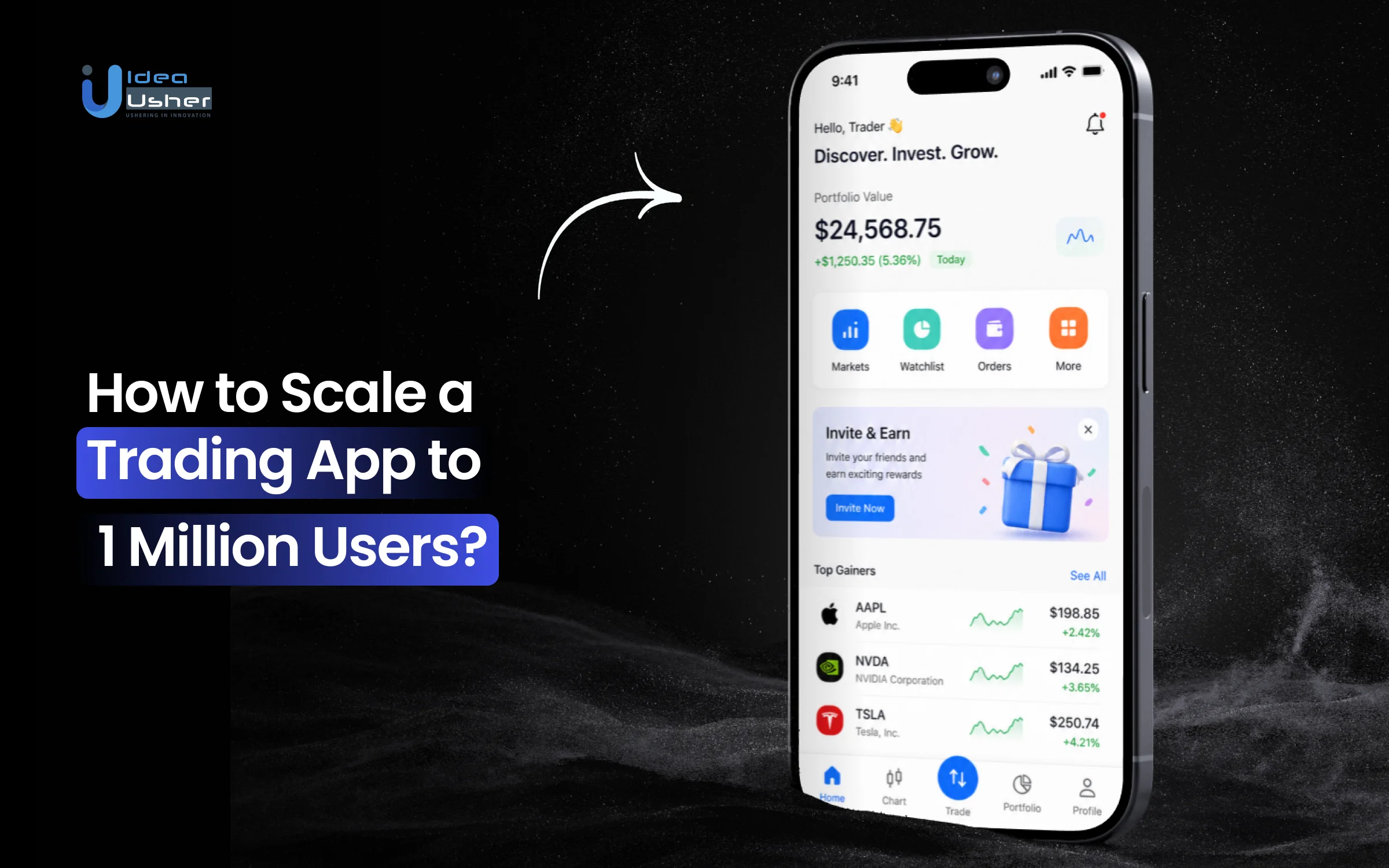
What if scaling a trading app to 1 million users is not a growth problem, but a systems design failure? Most teams still tie scale to marketing or feature velocity, but user behavior has shifted. Traders now demand real-time execution, zero-latency feedback, and constant portfolio visibility in highly volatile environments. They are not passive users. They act in bursts, react instantly, and expect systems to keep up. The old approach, built for periodic engagement and predictable load, breaks under this intensity.
As acquisition becomes easier and barriers continue to fall, the focus shifts to whether your system can sustain trust under pressure. One delay or failed transaction is enough to lose a user permanently. Scaling today means designing for concurrency, resilience, and behavioral spikes from the start, not retrofitting later. The opportunity is clear for builders who rethink infrastructure, data flow, and user experience as a single system that holds up when it matters most.
Over the years, we’ve built and scaled trading platforms designed around high-frequency user behavior, real-time data flow, and execution-critical systems. With this experience, we’re breaking down what it truly takes to scale a trading app to 1 million users without compromising performance, trust, or system stability.
Market Demand Driving Modern Trading Apps
According to Grand View Research, the global stock trading market is undergoing a massive shift, projected to reach over USD 140 billion by 2030. For investors, this represents a transition from traditional high-fee brokerages to agile, tech-driven ecosystems. Success at scale requires an engineering focus on high-concurrency infrastructure and sub-millisecond execution to manage traffic spikes during volatile market events without latency.

Source: Grand View Research
To capture this growing demand, platforms must move beyond simple interfaces to offer professional-grade tools like advanced charting and real-time sentiment analysis. The competitive edge lies in combining a low-friction user experience with a robust back-end capable of processing thousands of transactions per second. This balance of technical depth and seamless onboarding is what allows a platform to secure long-term market share and user trust.
Global Growth in Retail Trading
The democratization of finance has evolved from a trend into a permanent market fixture. We are seeing a massive influx of retail capital into equities and digital assets, fueled by financial literacy and digital access. This growth is global, with emerging markets showing explosive expansion as mobile penetration increases.
For an entrepreneur, this signifies a diversified revenue opportunity. You are tapping into a user base that views trading as a primary vehicle for wealth creation. Platforms like Robinhood pioneered this movement in the USA by removing the barrier of commissions, proving that a simplified entry point can attract tens of millions of users rapidly. Strategically, your platform must be built for localization to capture this global retail momentum effectively and compliantly.
Need for Multi-Asset Consolidation
The modern investor is experiencing app fatigue. The competitive edge in fintech lies in consolidation. A platform that allows a user to pivot from stocks to commodities and ETFs within a single account offers a superior value proposition. This increases user retention and boosts the lifetime value of each customer.
Building this requires deep integration with liquidity providers and market makers. A multi-asset platform also provides a natural hedge for the business. When one market is stagnant, volatility in other assets can maintain high trading volumes and revenue. Investors should prioritize architectures that allow for the addition of new asset classes as trends shift.
Preference for Mobile Experiences
Mobile devices are now the primary terminals for the majority of retail traders. A mobile-first strategy involves optimizing for glanceability, which is the ability for a user to assess risk and execute a trade in seconds. This requires a UI that balances technical depth with a clean aesthetic.
Apps such as Webull have successfully captured the more active segment of the US market by offering advanced technical indicators and real-time data within a highly responsive mobile interface. To achieve scale, the experience must leverage native capabilities like biometric security and low-latency notifications. The technical challenge is keeping the front-end synchronized with the back-end in real-time. Investing in a high-performance framework is essential to ensure the app feels responsive, reflecting the high stakes of the capital being managed.

Why Scaling Trading Apps Is Uniquely Complex?
Scaling a standard e-commerce or social media platform involves managing steady growth and predictable traffic peaks. In contrast, financial trading apps face a unique set of technical hurdles where even a few milliseconds of delay can result in significant capital loss for users. For investors, the complexity lies in building an infrastructure that is both rigid enough to meet strict security standards and fluid enough to handle explosive, unpredictable market events.
To understand the architecture required, one must look at three critical pillars of complexity:
- Concurrency Demands: Unlike standard apps, trading platforms require thousands of users to access the exact same data points simultaneously without desynchronization.
- Data Integrity: In most sectors, a temporary database lag is an inconvenience. In fintech, an out-of-order execution or a missed price update is a catastrophic failure.
- Infrastructure Elasticity: The system must be able to scale its processing power up by 10x within seconds to meet sudden market interest, then scale back down to manage operational costs.
1. Performance and Market Volatility
Market volatility is the ultimate stress test for any trading platform. During major economic announcements or unexpected geopolitical shifts, user activity does not just increase—it explodes. A system designed for average daily volume will inevitably fail during these periods of high volatility if it lacks automated, horizontal scaling capabilities.
High-net-worth investors should prioritize platforms built on containerized microservices. This allows specific parts of the app, such as the price feed or the order execution engine, to scale independently without needing to reboot the entire ecosystem. This modular approach ensures that even if the news feed lags, the ability to close a position remains functional and fast.
2. Real-Time vs Traditional Scaling
Most modern applications rely on caching to improve performance. However, in trading, cached data is old data. Real-time execution requires a constant, bidirectional stream of information between the user and the exchange. Traditional scaling methods often fall short because they cannot handle the persistent socket connections required for live price updates.
- Low Latency: Systems must utilize technologies like WebSockets or gRPC to maintain always-on connections.
- Order Matching: The back-end must be capable of matching buy and sell orders across various liquidity pools instantly.
- Synchronized State: Every user must see the same price at the same time. Achieving this at a scale of one million users requires sophisticated message brokers like Apache Kafka to manage the massive flow of data without bottlenecks.
3. Regulatory Compliance and Growth
In the world of fintech, growth without a regulatory foundation is a liability. Naive scaling strategies often focus on user acquisition while neglecting the complex web of Know Your Customer, Anti-Money Laundering, and regional licensing requirements. For an entrepreneur, the challenge is integrating these hurdles into a seamless user experience.
Regulatory compliance often impacts the technical architecture in the following ways:
- Data Residency: Certain jurisdictions require that financial data be stored on servers physically located within their borders, complicating a unified global cloud strategy.
- Audit Trails: Every single action taken by a user must be logged in an immutable format for years, requiring massive, high-speed storage solutions that do not degrade system performance.
- Risk Management: Automated systems must check every trade against the user’s available margin and regional restrictions in real-time before the order is ever sent to the exchange.
What 1M Users Really Means in Trading Apps?
For an investor, a million users is a major milestone, but in high-stakes fintech, that number is only the start of the analysis. Scaling to seven figures requires understanding that not all users contribute equally to the bottom line. The financial viability of the platform depends on the ratio of active participants to dormant accounts, as maintaining high-concurrency infrastructure is costly regardless of user activity.

Success is measured by engagement quality. A million users who log in once a month are a marketing expense. A million users who interact with the market daily are a powerful engine for revenue and data.
1. Active vs Passive User Breakdown
When evaluating the growth of trading apps, it is essential to segment the audience by behavior and capital contribution, as this breakdown dictates both your infrastructure requirements and your path to profitability. This segmentation ensures that your engineering resources are allocated to the high-value features that drive the most significant transaction volume.
- Active Intraday Traders: These users demand peak performance. They trade multiple times daily and rely on low-latency feeds. Apps like Moomoo have gained traction in the USA by catering specifically to this segment with professional-level research tools and high-speed execution.
- Swing Traders: This group logs in weekly. They require robust research tools and historical data. Webull has successfully captured this audience by providing a balance of advanced technical indicators and a streamlined mobile interface.
- Long-term Holders: These users interact during monthly rebalancing. While they contribute to Assets Under Management (AUM), they place the least stress on the live trading engine. Fidelity remains a leader for this group, offering deep retirement planning and long-term investment stability.
| User Type | System Load | Revenue Model | Key Retention Driver |
| Active Trader | Extreme | Spreads/Fees | Execution Speed |
| Swing Trader | Moderate | Per-trade/Subscription | Analysis Tools |
| Passive Investor | Low | AUM/Interest | Security / UX |
2. Liquidity Over Signup Totals
In the brokerage business, a signup is a lead, but volume is a business. A platform with a million users but low trading volume will struggle to attract top-tier liquidity providers. Liquidity ensures that when a user wants to execute, there is a counterparty available at a fair price. Platforms like Robinhood have mastered this by aggregating massive retail volume, which in turn attracts significant liquidity from market makers.
High-volume platforms create a virtuous cycle. As trading volume increases, the platform attracts better market makers. This leads to tighter spreads, which attracts more professional traders. For the entrepreneur, the goal is to facilitate capital flow. The depth of the order book is a much more accurate predictor of success than total app downloads.
3. User Count as a Vanity Metric
Relying on total user count as a primary KPI can be a strategic mistake. While user growth is the initial story, long-term profitability requires a shift toward Average Revenue Per User and Net Deposit Flow. Public.com has pivoted effectively here by expanding into multi-asset offerings like bonds and high-yield cash accounts, focusing on increasing the wallet share of each user rather than just chasing raw signup numbers.
High-net-worth investors should realize that a vanity metric like user count can mask issues like high churn. If acquisition costs exceed the lifetime value of a low-deposit user, the platform is scaling a loss. To build a sustainable asset, focus on:
- Retention Cohorts: Percentage of users active after six months.
- Platform Stickiness: Usage of multi-asset features beyond simple stock picks.
- Capital Velocity: How frequently deposits are turned over through trading activity.
Ultimately, one million users validate the market, but the business value lies in transaction volume and the depth of liquidity that those users generate.
Core Architecture Needed for Massive Scale in Trading Apps
Building a trading app for a million users is an exercise in high-stakes systems engineering. At this level, the primary goal is to eliminate single points of failure while ensuring data travels across the network at near-instantaneous speeds. The technical architecture is the most significant asset of the company, as it determines the ability of trading apps to remain online when competitors crash during market hysteria.
1. Event-Driven Trading Systems
Standard web applications wait for a user to ask for data. Trading apps cannot afford to wait; they must push data to the user the moment the market moves. An event-driven architecture treats every price change, order fill, and deposit as an independent event that triggers a chain of automated actions across the system.
- Message Brokers: Using tools like Apache Kafka allows the system to ingest millions of price updates per second and distribute them to the right users without lag.
- Reactive Streams: The front-end stays live by subscribing to these events, ensuring the price a user sees on their screen is the price they get when they hit buy.
- Decoupled Logic: If the notification service fails, the order execution service remains unaffected because they are not hard-wired together.
2. Microservices vs Monoliths
Many early-stage platforms start with a monolithic architecture because it is faster to deploy. However, a monolith is a liability at scale. If one small feature develops a memory leak, it can take down the entire trading engine. For a million-user platform, microservices are the only viable path.
| Feature | Monolithic Architecture | Microservices Architecture |
| Development Speed | Fast at the start | Slower initial setup |
| Scalability | Scale the whole app or nothing | Scale specific high-load services |
| Fault Tolerance | Single point of failure | Isolated failures |
| Cost Efficiency | Low for small apps | High for large apps |
Apps like Robinhood utilize hundreds of microservices to ensure that their core order-matching engines are isolated from less critical background tasks. This modularity allows the engineering team to update specific parts of the app without ever taking the entire system offline.
3. Managing Peak Load Spikes
The true test of a trading platform is not a quiet Tuesday afternoon but the opening bell on a day of extreme market volatility. When a major asset gaps 20% in minutes, every user opens the app at once. Without a sophisticated load-handling strategy, the system will experience a thundering herd effect that crashes the database.
To survive these spikes, the architecture must implement auto-scaling groups that spin up new server instances in seconds based on CPU and memory demand. Additionally, circuit breakers should be integrated into the code to gracefully degrade non-essential features, like social feeds or news, to prioritize order execution and portfolio balances during peak stress.
Features Users Expect in Trading Apps Today
Building a trading app that attracts significant capital requires a deep understanding of user psychology and technical necessity. When users select their preferred trading apps, they prioritize professional-grade functionality within a mobile-first environment. Each feature must be engineered for reliability to prevent user churn and reputational damage.

1. Real-Time Baseline Charts
Accurate, tick-by-tick data is a fundamental requirement. Users expect high-fidelity charting tools that update without manual refreshes, reflecting live market movements instantly. Delivering this requires a robust data pipeline capable of handling millions of concurrent streams. When platforms fail to provide live data, users often pivot to third-party tools like TradingView, weakening the primary app’s ecosystem.
2. Instant User Execution
In a market where prices change in milliseconds, execution speed is a critical metric. Users expect the price they see to be the price they get upon tapping the trade button. Optimizing connections to liquidity providers, a hallmark of Interactive Brokers, is essential to maintaining the trust of active traders who rely on precision and minimal slippage.
3. Alerts and Automation
Automation maintains user engagement even when they are away from their screens. Custom price alerts and automated recurring investments, similar to the systems found in eToro, transform the app into a proactive financial assistant. This functionality significantly increases retention by ensuring users never miss a market opportunity relevant to their specific strategy.
4. Multi-Device Synchronization
Modern traders often start research on a desktop and execute trades on mobile. A seamless transition is mandatory; all watchlists and open positions must sync in real-time across touchpoints. This requires a centralized cloud-based state management system, a standard effectively set by Charles Schwab across its various web and mobile interfaces.
5. Advanced Strategic Orders
To attract sophisticated capital, platforms must offer more than simple market orders. Features like trailing stop-losses and OCO orders provide the strategic control professional traders demand. Implementing these requires a sophisticated order management system, similar to the engine driving thinkorswim, that executes complex logic automatically without manual intervention.
6. Transparent Fee and P&L Visibility
Trust is the most valuable currency in fintech. Users demand absolute clarity on profit and loss (P&L) and transaction costs. Real-time tracking allows for instant, informed decisions. Robinhood excelled here by simplifying the visual representation of performance, building loyalty by removing the “hidden cost” complaints common in legacy brokerage systems.
7. High-Performance Volatile UI
The interface must remain responsive during extreme market volatility. Engineering for this involves offloading heavy processing from the main UI thread to ensure the app does not freeze when prices surge or crash. A stable, fluid interface during these high-stress periods is often what separates market leaders like Webull from less resilient competitors.
8. Risk Management and Insights
Sophisticated investors value tools that help manage exposure. Providing built-in risk metrics, such as diversification scores and margin alerts found in Moomoo, adds immense value. Integrating these analytics directly into the workflow encourages responsible trading, which protects user capital and reduces the overall risk profile of the platform.
Scaling Risk Management Systems in Trading Apps
As a trading app scales to a million users, the margin for error in risk management shrinks to zero. In high-frequency environments, a delay in calculating exposure can lead to systemic failure. Engineering a robust risk engine means moving beyond simple balance checks to a proactive system that monitors every tick across the entire ecosystem.
To maintain stability during extreme volume, the architecture must treat risk as a high-priority service sitting directly in the execution path, ensuring no trade is cleared without a sub-millisecond safety validation.
1. Real-Time Exposure Tracking
Traditional batch processing is insufficient for modern trading apps. Risk must be calculated in a continuous stream to account for fluctuating market prices and their immediate impact on user collateral and margin, as even a few seconds of stale data can lead to under-collateralized positions during a flash crash
- Dynamic Margin: The system recalculates maintenance margins for every user in real-time as underlying asset prices move.
- Liquidation Engines: When equity falls below a threshold, automated engines, similar to those used by Interactive Brokers, trigger liquidations to protect the platform.
- Live Stress Testing: The engine simulates “what-if” scenarios, such as a 20% market gap, ensuring the platform has enough liquidity to cover extreme movements.
2. Automated Compliance and Reporting
Scaling globally requires navigating a patchwork of international regulations. Manually auditing millions of transactions is impossible; therefore, compliance must be baked into the code as an automated, immutable process. By embedding these regulatory rules directly into the transaction logic of trading apps, firms can ensure that every trade is pre-validated for regional legality before it even hits the order book.
Technical Guardrail: Use a sidecar pattern in your microservices. While the main service handles the trade, a compliance sidecar instantly logs the transaction to an immutable ledger and checks it against AML and sanctions lists.
Platforms like Robinhood have integrated automated KYC flows that allow for instant onboarding while maintaining strict adherence to financial laws. This reduces administrative overhead and allows the platform to scale without a linear increase in compliance staff.
3. Physical vs. Financial Contracts
As platforms move from simple equities to complex derivatives and physical assets, managing risk between a financial contract and the underlying asset requires a sophisticated settlement engine. This infrastructure must handle the intricate “basis risk” that arises when the price of a derivative diverges from its physical counterpart, ensuring that trading apps remain solvent even when markets become disconnected.
- Contract Standardization: The back-end normalizes data from different exchanges to ensure consistent risk assessment across asset classes.
- Delivery Risk: For apps offering commodities or crypto with withdrawal capabilities, the system must track “cold” vs “hot” storage levels to ensure liquidity.
- Cross-Margining: Advanced platforms like Webull allow users to use stock holdings as collateral for other trade types, requiring a risk engine that understands correlations to prevent over-exposure.
A successful risk system is invisible to the user but omniscient in the background, balancing a frictionless experience with the ironclad necessity of protecting the platform’s capital.
How to Build a Multi-Asset Trading App?
Developing trading apps that support stocks, crypto, forex, and commodities requires more than just adding new buttons to a UI. We have developed numerous trading apps, and we know it demands a fundamental rethink of how data is stored and processed. A true multi-asset system must reconcile different settlement cycles, decimal precisions, and trading hours within a single high-performance environment.

1. Scalable Architecture
We have learned that a multi-asset backend cannot be built on a one-size-fits-all database because different assets have different shapes of data. While a stock trade has a T+2 settlement, a crypto trade is near-instant. We address these variations by implementing a multi-layered storage architecture that optimizes for the unique latency and regulatory requirements of each specific instrument
- Service Isolation: We use specific microservices for each asset class like an EquityService and a CryptoService that communicate via a common AccountService.
- Polyglot Persistence: We implement a mix of SQL for relational user data and NoSQL or Time-Series databases for high-frequency price history.
2. Diverse Data Feeds
Market data is the lifeblood of our trading apps. We do not just connect to one exchange; we orchestrate a symphony of providers like Refinitiv, Polygon.io, or direct feeds from the NYSE and Binance. We aggregate these disparate sources into a single, low-latency stream, ensuring that our users always have access to the most accurate global pricing available.
| Asset Class | Key Data Requirement | Typical Source |
| Equities | SIP Consolidated Tape | NBBO Feeds |
| Forex | Interbank Rates | ECNs |
| Crypto | Global Liquidity | Exchange WebSockets |
| Commodities | Futures Curves | CME or ICE Feeds |
3. Unified Order Management
The Order Management System is the brain of the operation. We build it to translate a user simple buy intent into a complex set of instructions that the specific market understands. Our unified OMS normalizes these instructions so whether a user is buying 0.5 BTC or 10 shares of Apple, the internal ledger records the transaction with the same level of integrity. By abstracting the asset-specific logic, we reduce the risk of balance errors across the portfolio.
4. Liquidity and Smart Routing
In a multi-asset world, price discovery is fragmented. We treat Smart Order Routers as essential components to ensure users get the Best Execution. By scanning dozens of liquidity pools in real-time, our logic identifies the optimal path for every trade to minimize slippage and maximize fill rates.
Our SOR Logic: When a trade is placed, our SOR scans multiple liquidity pools such as dark pools, public exchanges, and market makers to find the lowest spread. In our trading apps, this automation is what prevents slippage and keeps the platform competitive against institutional-grade terminals.
5. Multi-Asset Compliance
Regulations are not just border-specific; they are asset-specific. We ensure the platform enforces KYC for all, but might need Accredited Investor verification for private equity or specific disclosures for options trading. By automating these checks, we ensure that a user cannot accidentally move into a high-risk asset class they are not legally permitted to trade, protecting the platform from massive regulatory fines.
6. Consistent Cross-Asset UX
The biggest challenge we face is making complex financial instruments feel simple. We believe a user should not have to learn a new interface just to switch from trading Tesla to trading Gold. We bridge this gap by using a universal design language that applies a familiar logic to all asset classes, ensuring that professional power never comes at the cost of usability.
- Unified Wallet: We create one balance to rule them all. Users should see their total Buying Power regardless of which asset they hold.
- Standardized Interaction: We use consistent icons, buy or sell placement, and charting gestures across the board.
- Contextual Tools: While the UI is consistent, we make the tools adapt. We show leverage sliders for Forex but dividend yield for stocks, ensuring the most relevant data is always front and center.
How Does Idea Usher Design for Beginners and Pro Traders?
We focus on the delicate balance of serving the novice buying their first stock alongside the quant who needs deep liquidity. At Idea Usher, we do not believe in dumbing down the experience. Instead, we focus on cognitive load management. Our philosophy provides a clean starting point that unfolds into a high-powered terminal as the user gains confidence.

By utilizing modular UI components, we ensure the platform evolves with the trader. This prevents the interface from feeling cluttered for a beginner or restrictive for a professional.
1. Simplifying UX
Complexity is inevitable in finance, but complication is a choice. We strip away jargon and replace it with intuitive visual cues. A user should not need a finance degree to understand their profit and loss, but they should have instant access to Greeks and volatility charts when they are ready for them.
- Progressive Disclosure: We hide advanced features like stop-limit orders behind a simple toggle, a technique used effectively by Charles Schwab to keep the primary view focused on execution.
- Visual Hierarchy: Price action and the trade button always take precedence, while order books are positioned as secondary supporting data. Webull excels here by centering its mobile charts while keeping advanced data just a swipe away.
- Micro-Interactions: We use haptic feedback and subtle animations to confirm trades, similar to the satisfying tactical responses in TradeLocker, which reduce the anxiety associated with high-value transactions.
2. Layered Interfaces
We categorize our design architecture into layers to serve a diverse audience without creating two separate apps. We use a Level Up approach where users customize their dashboard based on expertise. This structural flexibility allows the interface to grow alongside the user, transitioning from basic price tracking to professional-grade data visualization with a single setting change.
| Interface Layer | Target User | Key Features | App Example |
| Standard Mode | Retail Beginner | Line charts and curated news feeds. | Zerodha Kite |
| Advanced Mode | Active Trader | Candlestick patterns and indicators. | Upstox Pro |
| Pro Terminal | Professional | Multi-monitor support and Level II data. | Dhan DEXT T3 |
3. Automation and Control
The modern trader wants the speed of an algorithm and the final say of a human. We build systems that allow for seamless switching between manual execution and automated strategies. This integration ensures that while high-speed engines handle the heavy lifting, the user retains total oversight to adjust for sudden market shifts or personal preference
The Idea Usher Approach: We design Guardrail Automation. A user can set a strategy like a recurring buy, but the UI always provides a Kill Switch for immediate manual intervention. In our trading apps, this balance ensures users feel in control of their capital, a feature prioritized by platforms like AlgoTest, where manual overrides are essential for safety.
We believe a successful platform should feel like a partner. By focusing on this dual-audience design, we help our clients build platforms that achieve high retention across every segment of the market.
Scalability Challenges in Multi-Market Trading Apps
Operating a platform that spans New York, London, and Tokyo means the system never truly sleeps. When we build trading apps, we solve the paradox of 24/7 availability while maintaining sub-millisecond precision. A delay in one market cannot be allowed to cascade into another. This requires a backend that is both globally distributed and centrally synchronized.
The true test of a multi-market architecture is its ability to remain invisible to the user. We provide a seamless experience even as the underlying systems navigate the chaos of overlapping global sessions.
1. Handling Global Market Hours
We design systems to manage a complex matrix of opening bells, closing auctions, and holiday schedules across dozens of time zones. This is not just about a countdown clock on a UI. It is about managing state transitions for millions of orders. Our backend uses high-precision schedulers to synchronize order validation with exchange heartbeat signals, ensuring trades hit the market at the exact microsecond of liquidity
- State-Aware Logic: We implement scheduled triggers that automatically transition orders from Queued to Active the moment a specific exchange opens.
- Holiday Cross-Referencing: Our engines maintain a dynamic calendar to prevent orders from being sent to closed markets. This avoids unnecessary rejection fees and API errors.
- Maintenance Windows: We use Blue-Green deployment strategies to update services without downtime. While the NYSE is closed, the crypto and forex markets remain fully operational.
2. Managing Simultaneous Price Updates
In a multi-asset environment, the volume of incoming data is staggering. A single spike in Bitcoin volatility can generate millions of price updates per second. This can easily choke a standard data pipeline. To combat this, we implement high-throughput stream processing that prioritizes critical price movements while filtering out redundant data packets.
| Market Type | Update Frequency | Primary Challenge |
| Equities | High (Market Hours) | Synchronizing bid and ask spreads across regional exchanges. |
| Crypto | Extreme (24/7) | Managing consistent global pricing across dozens of pools. |
| Forex | Continuous | Filtering noise from interbank feeds to provide tradable rates. |
We solve this by using Conflation Algorithms. Instead of pushing every single tick to the phone, we intelligently sample the data. This ensures the user sees a smooth and real-time chart. The backend still maintains the full and high-fidelity tick data for execution and audit purposes.
3. Preventing Overload During Volatility
Market crashes and rapid rallies are the ultimate stress tests for trading apps. When volatility strikes, user traffic and data volume can increase by 20 times within minutes. We handle these bursts by deploying predictive scaling protocols that anticipate traffic surges before they hit critical limits. This proactive buffering ensures the platform remains responsive, allowing users to execute trades with confidence while others are sidelined by system failures.
The Elastic Infrastructure: We use auto-scaling groups that spin up additional worker nodes when latency crosses a specific threshold. By decoupling the Data Ingestion layer from the Order Execution layer, we ensure that a user’s ability to close a position and protect capital is never compromised.
We also implement Backpressure Mechanisms throughout the system. If a specific microservice struggles, the system gracefully degrades non-essential features like social feeds or news updates. This prioritizes the core trading and risk management engines. This safety-first approach prevents a platform from going dark exactly when users need it most.
User Growth Strategy for Trading Apps
Attracting users to a financial platform requires more than just a slick marketing campaign. It requires a growth engine that scales alongside the infrastructure. For trading apps, growth is a function of trust and efficiency. If a user cannot deposit funds or verify their identity in minutes, they will move to a competitor. Our strategy focuses on creating a frictionless pipeline that converts curious observers into active and high-volume participants.
1. High-Value Trader Segments
While retail volume provides the base, high-value traders like day traders and institutions provide liquidity. We design features that appeal to these segments without alienating beginners. By integrating institutional-grade order types and customizable layouts, we allow power users to fine-tune for high-frequency execution.
This mirrors how platforms like Interactive Brokers attract pros by offering deep-tier pricing and global asset access while still serving retail traders.
- Advanced Tooling: Offering API keys for custom bot integration.
- Tiered Rewards: Implementing fee rebates for users who hit specific monthly volume milestones.
- Deep Liquidity Access: Routing orders through multiple dark pools to ensure better price execution for large blocks.
| User Segment | Acquisition Hook | Retention Driver |
| Retail Novice | Zero-commission trades | Educational content and social proof |
| Active Swing Trader | Professional charting tools | Low-latency execution and margin availability |
| Power User / Quant | Robust API documentation | High throughput and customizable workspace |
2. Building Trust in Financial Products
In finance, trust is the primary currency. Users need to know their capital is safe before they increase their deposit size. We build this trust by making transparency a core part of the user journey. Transparency means more than just showing a balance. It means providing clear proof of reserves and instant access to tax documentation.
We integrate real-time audit trails and clear explanations of fee structures directly into the interface. By removing the mystery of where money is held and how it is protected, our trading apps foster a sense of security that naturally leads to higher lifetime value per user.
This level of openness is critical for long-term retention, much like how Fidelity uses its long-standing reputation for asset safety and clear fee disclosures to maintain multi-generational user loyalty.
3. Reducing Onboarding Friction
The first five minutes of a user experience determine if they will stay for five years. We optimize the onboarding flow to be as fast as legally possible while maintaining strict compliance standards. Every additional step increases drop-off and weakens early trust.
The Fast-Track Engine: We utilize automated KYC systems powered by AI to verify government IDs and perform liveness checks in real time. Instead of waiting days for manual approval, users can often go from downloading the app to placing their first trade in under three minutes.
Monetization Models That Scale With Users in Trading Apps
Building a profitable platform at scale requires a balance between growth and revenue. As competition intensifies, firms move toward diversified stacks that stabilize cash flow even during low volatility periods. Successful trading apps align incentives with user success, ensuring revenue scales without feeling predatory.
1. Transaction vs Subscription
The industry is split between traditional pay-per-trade models and modern subscription tiers. Choosing between them depends on the target demographic and their trading frequency. High-volume scalpers often prefer a flat commission for transparent cost-basis tracking, while casual long-term investors gravitate toward the predictable monthly overhead of a subscription.
- Fixed Transaction Fees: Ideal for platforms where users prioritize execution quality over cost. Interactive Brokers excels here, reporting over $6.2 billion in 2025 revenue. Their transparent commissions appeal to professionals who value low latency and global reach.
- Subscription Pivot: Many platforms offer premium tiers. For a monthly fee, users get zero commission trading or better data. This creates a predictable floor of recurring revenue.
- Hybrid Approaches: We often see a free tier supported by power user subscriptions. This allows for massive acquisition while monetizing the top traders who demand professional tools.
2. Spread-Based Revenue
For retail-focused trading apps, zero-commission headlines are often powered by the spread. This model monetizes the difference between buy and sell prices, making revenue invisible to casual users while providing smooth onboarding. By aggregating liquidity from various providers, the platform captures a fraction of every trade while offering competitive execution.
| Model Type | Primary Revenue Driver | User Perception |
| PFOF | Rebates from market makers for routing orders. | High (Zero commission lure) |
| Mark-up Spreads | Widening the bid ask spread on assets. | Moderate (Cost built into price) |
| Liquidity Provision | Internal matching engines capturing the full spread. | Low (Often opaque) |
Robinhood is the standard for this model. In 2025, they achieved $4.5 billion in revenue. While their Gold subscription base grew to 4.2 million users, transaction-based revenues from options and equities routing remain a massive engine for their business.
3. Enterprise Licensing
At a million-user scale, the technology becomes a product. Firms realize that proprietary infrastructure built for concurrency and security is valuable to other institutions. Enterprise licensing allows a platform to act as a B2B provider. This includes white-labeling the app for regional banks or licensing microservices like fraud detection.
Charles Schwab demonstrates this power, managing nearly $12 trillion in client assets. Their ability to provide clearing and custodial services to thousands of advisors helped drive a massive $23.9 billion in 2025 revenue. Diversifying into these flows ensures profitability even when retail participation drops during bear markets.
Cost to Build and Scale a Trading App
Building a financial platform is a capital-intensive journey where the initial code is only the first milestone. Beyond the user interface, the true costs lie in the plumbing: the data feeds, regulatory compliance, and the elastic infrastructure required to handle a market spike. Developing a modern trading app requires balancing high performance with strict security protocols.
1. Development Cost by Complexity
The price of development scales with the level of sophistication and the regional rate of the engineering team. A basic app focusing on a single asset class like equities requires a significantly lower budget than a professional-grade exchange. By choosing between a single-platform native build or a more versatile cross-platform framework, developers can further influence the initial burn rate to match their speed-to-market goals.
- Simple MVP ($45,000 – $80,000): Includes basic user accounts, a simple order book, and standard portfolio tracking.
- Moderate Complexity ($100,000 – $250,000): Adds real-time charting, advanced technical indicators, KYC automation, and multi-asset support.
- Enterprise / High-Frequency ($400,000 – $1,000,000+): Built for institutional-grade speed with microsecond latency, complex algorithmic engines, and deep liquidity routing.
2. Data Licensing and API Costs
Data is the lifeblood of financial platforms, but it is rarely free. Licensing real-time feeds from global exchanges is a recurring expense that grows as your user base expands. Many vendors transition from flat enterprise fees to per-user models once a platform scales, meaning market data can eventually consume up to 60% of gross revenue if not optimized.
| Data Type | Estimated Monthly Cost | Purpose |
| Real-Time Equities Feed | $2,000 – $15,000 | Live price updates for major stocks and ETFs. |
| Brokerage Execution API | $8,000 – $25,000 | Routing trades to exchanges and clearing houses. |
| KYC/AML Verification | $2 – $5 per user | Automated identity and anti-money laundering checks. |
The Compliance Premium: Regulatory reporting tools can cost an additional $15,000 to $30,000 annually. These systems ensure the platform meets strict legal requirements for data retention and transaction monitoring.
3. Infrastructure and Scaling Expenses
Infrastructure costs are dynamic. While a quiet market day might cost a few hundred dollars in server fees, a massive rally requires immediate, expensive scaling to prevent system crashes. The cost of maintenance typically runs 15% to 20% of the initial development price annually. This budget covers routine security patches, server stability, and cloud hosting.
Platforms like E*TRADE manage this by investing heavily in redundant data centers to ensure that even during peak volatility, the cost of extra compute power is a worthwhile trade-off for zero downtime.
Cloud setups using AWS or Google Cloud offer elasticity, often starting at $2,000 per month for small apps and scaling to $50,000+ per month for platforms handling millions of concurrent requests. This proactive scaling ensures your platform remains a reliable tool rather than a liability when users need it most.
Key Factors Affecting Trading App Scalability
Scalability in a trading app is not just about supporting more users; it is about maintaining millisecond precision under extreme pressure. When millions of data points collide with thousands of simultaneous orders, architecture must expand instantly or risk catastrophic slippage and system failure.
1. Handling Market Volatility
Market volatility is the ultimate stress test. During economic events or flash crashes, trade requests can surge 50 times beyond the baseline within seconds. Robust systems utilize load balancers to distribute this sudden traffic across multiple server clusters, ensuring that no single node becomes a point of failure during peak activity.
- Order Queueing: Systems decouple order submission from execution to prevent bottlenecks in the UI.
- Auto-Scaling Triggers: Cloud resources spin up new instances based on CPU thresholds before latency impacts the user.
- Circuit Breakers: Intelligent systems implement internal throttles to protect the database from rapid-fire API calls.
2. Data Throughput Limits
A trading app is only as good as its data. The challenge lies in processing massive streams of tick data from various exchanges and pushing that information to user devices without delay. By utilizing optimized binary protocols instead of heavy JSON formats, systems can strip away unnecessary overhead to deliver price updates at a fraction of the bandwidth.
| Component | Challenge | Solution |
| Ingestion | Handling millions of price updates. | WebSocket clusters for bi-directional streams. |
| Syncing | Consistent balances across devices. | Distributed caching layers like Redis. |
| Broadcasting | Pushing updates to active users. | Pub/Sub architectures grouped by asset. |
Performance Note: Even a 100ms delay can lead to phantom quotes, where a user attempts to trade at a price that no longer exists on the exchange.
3. Infrastructure Readiness
True scalability requires infrastructure that anticipates growth. Relying on a single server or a rigid database leads to bottlenecking where the system slows down despite having unused hardware capacity. Implementing a distributed database strategy allows for horizontal sharding, spreading the data load across multiple nodes to maintain peak performance during high-traffic events.
The transition from monolithic to microservices architecture is essential for any trading app aiming for the million-user mark. By isolating the login service from the execution engine, a surge in new logins won’t interfere with the ability of existing users to close positions.
Infrastructure must also be region-aware. Deploying edge servers closer to the user reduces the physical distance data travels, ensuring a trader in London experiences the same snappy performance as one in New York. This global footprint ensures the platform remains stable regardless of where the next market surge originates.
How Idea Usher Prevents Scaling Failures Early?
Engineering a resilient trading app requires a proactive approach that treats failure as a possibility to be engineered out of existence. We at Idea Usher utilize a Stability First framework, ensuring architecture is stress-tested before the first real dollar is traded. By simulating worst-case scenarios, we eliminate structural weaknesses that typically cause platforms to crash during market rallies.
1. Identifying Weak Points
Precision auditing is our first line of defense. Instead of waiting for a crash to reveal a bottleneck, we perform deep code analysis to find inefficiencies in the data pipeline. By inspecting how data moves from the server to the user interface, we can eliminate redundant requests that often slow down mobile performance during heavy market sessions.
- Query Optimization: We ensure portfolio fetches do not trigger cascading server loads.
- Rate Limiting: We set thresholds that prevent malfunctioning bots from overwhelming the engine.
- Dependency Mapping: We identify every external service to ensure one failure does not sink the entire app.
2. Load Testing Stages
Stability is a metric, not a feeling. We at Idea Usher employ rigorous automated testing cycles that mimic extreme behavior to find the infrastructure’s breaking point. By measuring latency and error rates under artificial stress, we gain the empirical data needed to guarantee the platform can handle real-world volatility without compromise.
| Test Type | Objective | Result |
| Spike | Mimicking a 500% traffic surge in 60 seconds. | Validates auto-scaling trigger speed. |
| Soak | Running at 80% capacity for 48 hours. | Identifies memory leaks and fatigue. |
| Concurrency | Thousands of simultaneous trades on one asset. | Ensures order matching integrity. |
Our Red Team Approach: Our engineers act as adversarial testers, intentionally triggering outages to verify how quickly self-healing protocols kick in.
3. Reducing Growth Risks
Rapid success is dangerous if an app is not built for hyper-growth. We bridge the gap between MVP and enterprise powerhouse by implementing modular design patterns. By breaking the trading app into isolated microservices, we enable the platform to scale individual components.
If a news feed becomes popular, we only need to allocate more resources to that server, leaving trade execution untouched. This isolation prevents a domino effect where a minor bug crashes the entire trade floor.
Our Low-Latency System Strategy for Trading Apps
In the world of high-stakes finance, speed is the only currency that matters. A delay of even a few milliseconds can be the difference between a profitable exit and a significant loss. We at Idea Usher architect every trading app with a focus on cutting out every unnecessary microsecond of lag, ensuring that users always see and act on the most current market reality.
1. Global Market Speed
Engineering for speed starts with geographic proximity. We utilize a distributed edge computing strategy to ensure that the physical distance between the user and the exchange is minimized. By placing high-speed servers in data centers located directly next to major stock exchanges, we shave valuable milliseconds off the data round-trip time.
- Global Node Deployment: We host core execution engines in major financial hubs to reduce round-trip time.
- Smart Routing: Our systems automatically detect the fastest path for data to travel across the internet, avoiding congested network junctions.
- Protocol Optimization: We replace standard web protocols with high-speed binary formats to pack more data into smaller, faster packets.
2. Real-Time Execution Infrastructure
Processing millions of requests simultaneously requires an infrastructure that never blinks. We build execution layers using non-blocking I/O architectures to handle massive order influxes without bottlenecks. This asynchronous approach manages thousands of connections while matching orders at lightning speed.
| Component | Strategy | Benefit |
| In-Memory Processing | Storing active order books in RAM rather than disk. | Near-instant data retrieval and matching. |
| Direct Market Access | Reducing the number of middleman servers. | Lower latency from tap to execution. |
| Load Balancing | Distributing traffic across hot-standby clusters. | Zero downtime and consistent response times. |
3. Minimizing Processing Delays
Beyond the network, we focus on the internal compute lag within the app itself. We optimize every line of backend code to ensure that the logic used to validate a trade or check a balance happens in the blink of an eye. By offloading heavy analytical tasks to secondary threads, we keep the main execution path clear and unobstructed.
We also implement Optimistic UI updates. This technique allows the app to show the user a pending state immediately upon their tap, providing instant visual feedback while the server completes the heavy lifting in the background. This psychological and technical alignment ensures that the trading app feels snappy and authoritative, even during periods of intense market activity.
Idea Usher’s End-to-End Scaling Roadmap for Trading Apps
Scaling a trading app is not a one-time event but a continuous evolution. We at Idea Usher follow a structured roadmap that transitions your platform from a verified concept to a global financial powerhouse. Our process ensures that every line of code written during the early days is capable of supporting a future with millions of active traders.
1. From Validation to Launch
The journey begins with a bulletproof architectural blueprint. Before building the first feature, we define the data flow and concurrency requirements to ensure the foundation can support rapid expansion. By mapping out potential traffic spikes early, we select database schemas that allow for horizontal growth without requiring a future code rewrite
- Proof of Concept: Validating core order matching logic in a sandboxed environment.
- Infrastructure Selection: Choosing high-elasticity cloud providers that offer specialized financial networking tools.
- Compliance Integration: Embedding regulatory tracking into the data architecture from day one.
2. Growth Aligned Development
We believe in a development cycle that breathes with your user base. By adopting an iterative approach, we can scale specific features based on real-world usage patterns without rebuilding the entire system. This flexibility allows us to deploy targeted updates that enhance performance exactly where demand is highest.
Development Philosophy: We prioritize the decoupling of services. By isolating the wallet, the trade engine, and the user profile, we ensure that a bottleneck in one area never paralyzes the entire trading app.
This modularity allows us to push updates and scale resources to the specific parts of the app that need them most during high-growth phases. If your platform sees a sudden interest in options trading, we can scale the derivatives engine independently, keeping costs low while maintaining peak performance for all users.
3. Post-Launch Optimization
A launch is simply the start of the race. Once the platform is live, we transition into a phase of constant monitoring and micro-tuning to squeeze every bit of efficiency out of the environment. We analyze real-time execution logs to identify and resolve minor latencies before they can impact the user experience.
- Real-Time Monitoring: We track server health and execution latency 24/7 to catch anomalies before they affect users.
- Database Refinement: As your data grows, we continuously optimize indexes and sharding strategies to keep search and retrieval times flat.
- Security Hardening: Regular penetration testing and vulnerability scans ensure that your scaling success never comes at the cost of user safety.
Partner With Idea Usher to Build a Trading App
Choosing the right partner determines whether your platform leads the market or lags. We at Idea Usher bring an elite level of technical discipline to your project, ensuring that your vision is supported by world-class engineering. With over 500,000 hours of coding experience, our team of ex-MAANG/FAANG developers understands exactly what it takes to build, secure, and scale high-concurrency financial systems.
Avoid Costly Rebuilds
Many startups fail because their initial code cannot handle sudden success. We prevent this by implementing an enterprise-grade foundation from the very first sprint. By anticipating the demands of high-frequency trading and massive data ingestion early on, we save you the immense cost and downtime of having to refactor your entire backend once you hit your first 100,000 users.
Launch Faster With Scalable Architecture
Speed to market is essential, but speed without stability is a liability. We utilize a library of battle-tested financial modules and cloud-native patterns to accelerate your development timeline without cutting corners. This library allows us to implement complex features like encrypted wallets and real-time order matching using proven, high-stress-tested code.
- Modular Design: We build independent components so features can be added or updated without risking the core trade engine.
- Automated CI/CD: Our deployment pipelines allow for rapid, safe updates that keep your app ahead of the competition.
- Elastic Infrastructure: We configure your environment to breathe, automatically expanding resources during market volatility and shrinking them during lulls to manage costs.
A Platform Ready for Millions
We don’t just build for your current user base; we build for the global audience you aim to capture. Our systems are engineered to manage millions of concurrent sessions and billions of data points with zero performance degradation. By implementing advanced horizontal scaling and distributed database clusters, we ensure that every new user experiences the same lightning-fast response times as the very first one
The Idea Usher Advantage: Our developers have spent years inside the world’s largest tech ecosystems. We apply those same high-availability principles to your trading app, ensuring that your infrastructure remains invisible, reliable, and incredibly fast as you scale to the top of the app store.
Conclusion
Scaling a trading app to one million users requires a perfect harmony between high-performance architecture and proactive engineering. By focusing on low-latency infrastructure, modular scaling, and continuous optimization, we ensure your platform remains fast and reliable under immense pressure. Partnering with a team that possesses the right technical DNA allows you to focus on market growth while we ensure your technology never misses a beat.
FAQs
A1: Scaling a trading app to this magnitude requires a microservices architecture that decouples core functions like order matching, user authentication, and portfolio tracking. By using load balancers and auto-scaling groups, the infrastructure can automatically spin up additional server instances as traffic peaks. This ensures that the trading app remains stable and responsive, even during high-volatility events when millions of traders act simultaneously.
A2: To support a trading app with a massive user base, developers often implement database sharding and read replicas to distribute the data load. Real-time data, such as live price feeds and active order books, is typically handled by high-speed in-memory databases like Redis. This multi-layered data strategy allows the trading app to retrieve and update millions of records per second without hitting the performance bottlenecks common in traditional relational databases.
A3: In the world of finance, latency is a critical factor that can determine the success of a trading app. As the user base grows, the increased data volume can slow down execution speeds if not managed through edge computing and CDNs. By placing execution nodes closer to the user and optimizing the network stack, a trading app can maintain sub-millisecond execution times, ensuring that users in any global location receive fair and immediate trade fills.
A4: As a trading app grows to millions of users, it becomes a high-value target for cyberattacks, making robust security non-negotiable. Implementing multi-factor authentication, end-to-end encryption for all data in transit, and real-time fraud detection systems is essential. Regular security audits and automated vulnerability scanning help the trading app protect user assets and maintain regulatory compliance while scaling its operations globally.


