

The resale economy is no longer just a digital version of a flea market. It has evolved into a high-velocity sector where peer-to-peer marketplaces operate as sophisticated micro-ecosystems. For entrepreneurs and stakeholders, the goal has shifted. Success in 2026 is not about building a generic platform to compete with every retail giant. Instead, it is about engineering niche marketplaces that solve specific logistical and trust-based problems.
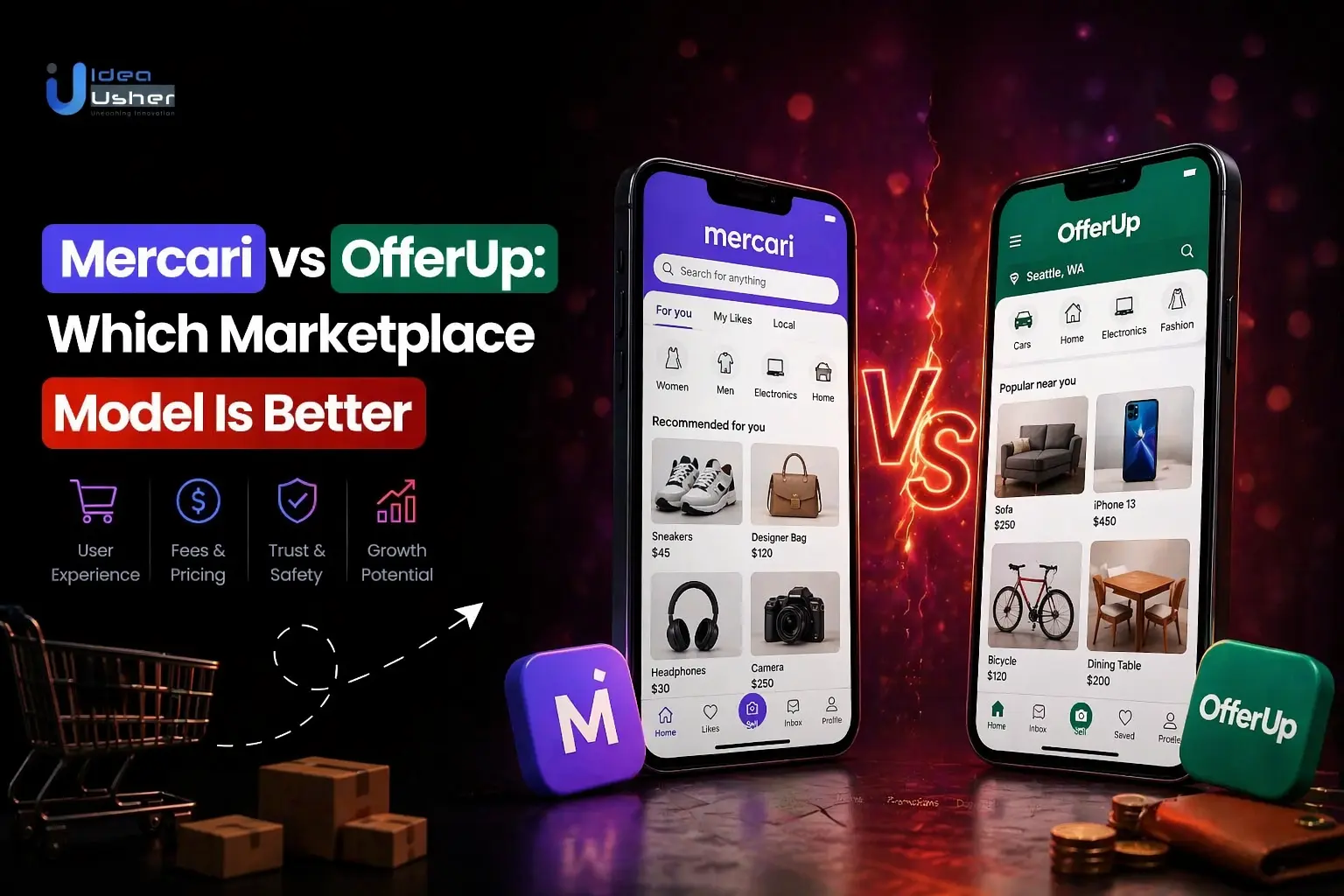
When deciding how to architect your own platform, the blueprint often narrows down to two dominant but distinct strategies. You have the streamlined, shipping-centric model of Mercari and the community-driven, local-first approach of OfferUp. Choosing the right foundation depends entirely on whether your business aims to master nationwide logistics or dominate local hyper-growth.
In this guide, we will break down the mechanics of both models to help you determine which architecture fits your business goals.
Understanding the Mercari Model
Mercari has carved out its market share by removing the “human” barrier from the transaction. From a business perspective, this model is built on scalability and automation. It treats every seller like a micro-warehouse and every buyer like a remote customer.
- Nationwide Reach: By focusing on a “ship-it-to-me” infrastructure, the model isn’t limited by geography. Your app’s potential user base becomes the entire country from day one.
- Revenue through Integration: This model thrives on integrated shipping labels and automated payment processing. Revenue is often generated through fixed transaction fees and a cut of the shipping logistics.
- Low Friction, High Trust: Because the platform holds funds in escrow until the item is delivered, it eliminates the “parking lot meetup” anxiety, making it more attractive for high-volume, professional resellers.
Understanding the OfferUp Model
OfferUp dominates by digitizing the local classifieds experience, emphasizing speed and community interaction. This model is designed for apps that want to foster high user retention through frequent, local engagement.
- Hyper-Local Density: This model relies on “liquidity” within a specific ZIP code. It’s less about shipping and more about connecting people within a 10-mile radius, which significantly reduces overhead costs related to logistics.
- Hybrid Monetization: Beyond simple transaction fees, an OfferUp-style model allows for diverse revenue streams like “Promote Plus” features for sellers or verified dealer subscriptions for local businesses (like auto shops).
- The “Social” Factor: With heavy emphasis on user profiles, ratings, and instant messaging, the business value here lies in the data and the stickiness of the community. It’s a marketplace that functions like a social network.
rough identity verification programs like “TruYou” and designated safe meetup spots, shifting the logistical burden away from the company and onto the user community.
Quick Overview: Mercari vs OfferUp
Choosing the right architectural path for your marketplace depends on how you want your users to interact. Mercari and OfferUp have both dominated the resale space by focusing on completely different logistical foundations.
| Feature | Mercari | OfferUp |
|---|---|---|
| Model | Shipping-first marketplace | Local-first marketplace |
| Geography | Nationwide | Hyperlocal |
| Revenue Model | Commission-based fees | Ads + premium boosts |
| Trust System | Ratings + shipping protection | Profiles + verified meetups |
Breaking Down the Business Architecture
The Mercari model is built for a frictionless, hands-off experience. It operates as a shipping-first platform, meaning the business logic is centered around national logistics. For a company building an app like this, it requires heavy integration with shipping APIs and an escrow-based payment system. The revenue comes primarily from commission fees. This creates a highly scalable revenue stream because the platform takes a cut of every transaction. Trust is maintained through the platform acting as a middleman, holding funds until the tracking number confirms delivery.
The OfferUp model prioritizes community density and local speed. While it has expanded into shipping over the years, its core value remains the hyperlocal experience. The revenue strategy here is often a mix of advertising and premium features. While basic listings are free, the platform makes money through digital products like boosted listings or subscriptions for professional sellers. This model is ideal if you want to build a high-engagement ecosystem. Trust is managed through identity verification programs and designated safe meetup spots, which shifts the logistical burden away from the company and onto the community.

Mercari Business Model Explained
From a product and scalability perspective, Mercari functions more like an e-commerce giant than a traditional classifieds site. It is designed to remove the geographic barriers that usually limit peer-to-peer selling.
Core Features
The backbone of the Mercari model is its integrated shipping system. By providing sellers with pre-paid, printable labels directly in the app, the platform eliminates the most common friction point in online selling. This is paired with a robust seller protection program that insures items against loss or damage, creating a professional environment that attracts serious resellers. Because discovery is nationwide, users can find niche items that might not be available in their local town, which keeps the “search and find” loop very active. Finally, the listing flow is stripped down to the essentials, allowing a user to go from a photo to a live listing in under a minute.
Monetization Strategy
Mercari generates revenue through a high-volume transaction model. The primary source of income is the seller fee, where the platform takes a percentage of every successful sale. In addition to this, they offer boosted listing options for sellers who want to pay for better placement in search results. There is also a small margin earned on payment processing and service fees charged to the buyer. This multi-layered approach ensures that as long as items are moving, the platform is generating cash flow without needing to rely on traditional display ads.
Strengths from a Founder POV
For a founder, the biggest advantage of this model is regional scalability. You do not need to wait for a specific city to reach a “critical mass” of users before the app becomes useful. Since everyone ships to everyone else, the platform feels populated from day one. The strong logistics integration also creates a “sticky” product; once a seller gets used to the ease of printing a label and dropping off a package, they are unlikely to switch to a platform that requires manual coordination. This leads to high transaction volumes and predictable growth patterns.
Limitations
The main challenge with this model is the heavy dependency on shipping logistics and external carriers. If shipping prices rise or carrier services are disrupted, your core user experience suffers. There is also a higher level of operational complexity compared to local apps. You must manage a sophisticated dispute resolution team to handle shipping claims, lost packages, and returns. This requires a larger backend support staff and more complex coding to handle the automated tracking and escrow releases.
OfferUp Business Model Explained
From a product development perspective, OfferUp is designed to replicate the speed of a garage sale with the security of a modern social network. It prioritizes the “now” and the “near,” making it the go-to architecture for high-velocity local trading.
Core Features
The technical foundation of OfferUp starts with location-based listings. The app uses precise geolocation to show users items within walking or short driving distance, which creates an immediate sense of relevance. This is supported by a robust in-app chat system that keeps communication off third-party platforms like WhatsApp, allowing the company to monitor for fraud and keep users engaged. Security is handled through the TruYou verification system, which uses official IDs to build a “trust score.” Finally, the app promotes local meetups by suggesting “Community MeetUp Spots” well-lit, monitored public locations to bridge the gap between digital interaction and physical exchange.
Monetization Strategy
Unlike commission-heavy models, OfferUp makes money by helping sellers stand out. Featured listings allow users to pay a one-time fee to keep their items at the top of the local feed. The platform also leverages its high traffic through targeted display ads, showing users relevant products based on their browsing history. For power sellers, OfferUp offers subscription boosts, providing a monthly “Promote Plus” package that automates the visibility of multiple items. This model allows the platform to stay free for casual users while extracting value from high-volume traders.
Strengths
The primary strength of the OfferUp model is the speed of the transaction. Because buyer and seller are often in the same neighborhood, a sale can happen in minutes rather than days. From a business standpoint, this results in extremely low logistics costs. The platform does not have to worry about shipping labels, lost packages, or carrier disputes. This leads to high engagement in local markets, as the app becomes a daily utility for people looking for immediate deals nearby.
Limitations
The trade-off for low logistics is limited scalability. An OfferUp-style app is only as strong as its presence in a specific city; having a million users spread across the country is useless if there aren’t at least a few hundred in the same zip code. This creates fragmented liquidity, where the user experience varies wildly from one city to the next. Additionally, relying on physical meetups introduces trust issues that the platform cannot fully control. No matter how many verification badges you add, the “last mile” of the transaction happens offline, beyond the app’s direct supervision.
Mercari vs OfferUp: Key Differences That Matter for Businesses
When building your own marketplace, choosing between these two paths will dictate your technical roadmap and your long-term growth strategy. Here are the insight-driven comparisons you need to consider.
1. Scalability: Global vs City-Level
Mercari is built for global scalability. Because it relies on shipping, a user in New York can sell to a user in California without any friction. This allows you to scale your user base nationally from day one. OfferUp requires a city-by-city growth strategy. You have to “win” one market at a time to ensure there is enough local inventory to keep users interested, which usually requires a higher marketing spend in specific regions.
2. Liquidity Model: Centralized vs Fragmented
Mercari benefits from a centralized marketplace. All inventory is available to all users, creating a massive pool of liquidity. This makes it easier for buyers to find rare or specific items. OfferUp operates on fragmented local pools. Liquidity is trapped within geographic boundaries. While this is great for common items like furniture or strollers, it makes the platform less effective for niche collectibles that require a national audience to find a buyer.
3. Trust Layer: Platform-Controlled vs User-Dependent
In the Mercari model, the platform is the ultimate authority. It handles the money, the shipping, and the disputes. This “platform-controlled” trust makes users feel safer, but it increases your operational costs. OfferUp uses a “user-dependent” trust model. The platform provides the tools (ratings and ID checks), but the users are responsible for the final safety of the transaction. This is cheaper to run but carries a higher risk of negative user experiences that you cannot easily fix.
4. Revenue Predictability: Commission vs Ad Revenue
Mercari offers high revenue predictability. Since they take a percentage of every sale, revenue grows in direct proportion to transaction volume. It is a clear, math-based growth curve. OfferUp relies more on variable ad revenue and optional boosts. While this can lead to high margins, it is often less predictable, as it depends on how many users feel the need to pay for extra visibility rather than the inherent success of every sale on the platform.
Which Model Should You Choose for Your Marketplace App?
Deciding between these two frameworks isn’t just about personal preference; it is about aligning your platform’s architecture with your long-term business goals. Both models have proven to be highly successful, but they serve very different types of founders and market needs.
Choose a Mercari-like model if:
- You want national or global scale: If your vision involves a massive, borderless user base where a buyer in one corner of the country can seamlessly purchase from a seller in another, this is your blueprint. It removes the geographic “ceiling” on your growth.
- You can integrate deep logistics: This model is perfect if you have the technical resources to build or integrate sophisticated shipping and escrow APIs. It requires more backend work upfront, but it results in a more professional and automated user experience.
- You want recurring commission revenue: If you prefer a business model where every single transaction contributes to your bottom line, the commission-based structure of Mercari is the most predictable way to generate cash flow.
Choose an OfferUp-like model if:
- You target a niche local market: If you are building an app specifically for a certain city, a college campus, or a neighborhood community, the local-first approach is far more effective. It builds “density” and makes the app feel like a local utility.
- You want a faster MVP launch: Because you don’t necessarily need to solve the complex puzzle of shipping labels, weight calculations, and carrier disputes on day one, you can get an OfferUp-style MVP (Minimum Viable Product) into the hands of users much faster.
- You want low operational overhead: This model is ideal for leaner teams. By letting users handle the “last mile” the meeting and the exchange you significantly reduce the need for a large customer support team to handle logistics-related complaints and insurance claims.
Cost to Build an App Like Mercari or OfferUp in 2026
Building a marketplace is a multi-layered investment. While a basic interface is simple to code, the “invisible” layers—trust algorithms, payment security, and real-time logistics drive the bulk of the cost.
Development Cost Ranges
| Project Phase | Estimated Budget | Best For |
| MVP (Minimum Viable Product) | $25,000 – $50,000 | Early validation, local launch, or securing seed funding. |
| Mid-Scale Platform | $60,000 – $120,000 | Regional growth with integrated shipping and custom UI. |
| Enterprise Solution | $150,000+ | National/Global scale with AI moderation and multi-layered security. |
Feature Cost Breakdown
To understand where the budget goes, we have to look at the core infrastructure required to make a marketplace functional and safe.
1. Backend Infrastructure ($15,000 – $35,000)
The backend is the engine of your app. It handles user data, listing management, and search indexing. In 2026, this includes auto-scaling cloud architecture (like AWS or Google Cloud) to ensure the app doesn’t crash during high-traffic periods, such as holiday sales or local viral trends.
2. Real-Time Chat & Notifications ($5,000 – $10,000)
Marketplaces live or die by communication. This isn’t just a simple text box; it requires “socket” technology for instant delivery, push notifications to drive engagement, and automated filters to block users from sharing sensitive info (like phone numbers) off-platform.
3. Payment & Escrow Integration ($5,000 – $12,000)
Integrating Stripe Connect or Razorpay is a major technical hurdle. You aren’t just taking payments; you are managing a three-way split between the buyer, the seller, and your own commission. For a Mercari-style model, this also includes escrow logic, where funds are held until the tracking number confirms delivery.
4. AI Moderation & Recommendations ($8,000 – $20,000)
In 2026, manual moderation is too slow. You need AI to automatically scan photos for prohibited items, detect fraud patterns, and suggest “smart pricing” to sellers. It also powers the discovery engine, showing buyers items based on their previous browsing history to increase conversion rates.
5. Admin Control Panel ($7,000 – $15,000)
The “hidden” part of the app. This is the dashboard where your team manages disputes, bans problematic users, tracks revenue analytics, and adjusts featured listing prices. A weak admin panel leads to high operational costs because your team will have to solve problems manually.
Must-Have Features for a Marketplace App in 2026
To compete with established giants, your app cannot just be a digital catalog. In 2026, the standard for “user-friendly” has shifted toward AI-native functionality and deep social integration.
Intelligent Selling & Discovery
- AI-Powered Product Recommendations: Gone are the days of simple “similar items” lists. Modern marketplaces use behavioral AI to create hyper-personalized feeds. Two users opening the app at the same time should see entirely different content sequences based on their past engagement and real-time intent.
- Smart Pricing Suggestions: To keep your marketplace liquid, you need to help sellers price their items correctly. By analyzing millions of data points including historical sales, competitor pricing, and current demand your app can suggest the “sweet spot” price that ensures a fast sale without leaving money on the table.
- Voice & Image-Based Listing: Reducing friction is key. In 2026, users expect to snap a photo and have AI automatically fill in the category, brand, and description. Furthermore, voice-to-listing allows sellers to dictate product details hands-free, making the listing process a 30-second task rather than a 5-minute chore.
Trust & Security Infrastructure
- Next-Gen Fraud Detection: Traditional rule-based systems are no longer enough. Modern apps utilize “Network Effect AI” to detect coordinated fraud rings and sophisticated bot attacks in real time. This system learns from global transaction patterns to stop “friendly fraud” and account takeovers before they impact your users.
- Escrow Payment Systems: Trust is the currency of any marketplace. Integrating a secure escrow layer ensures that funds are held by the platform and only released to the seller once the buyer confirms the item is as described. This significantly reduces the risk of scams and provides a structured path for dispute resolution.
The Social & Engagement Layer
- Social Commerce Integration: People want to buy where they socialize. Adding a social layer such as shoppable video stories, “followable” seller profiles, and collaborative wish lists turns your marketplace into a community. This increases “stickiness” and encourages users to browse the app even when they don’t have a specific purchase in mind.
- Verified Meetup Points: For local-first models, the app should integrate with maps to suggest “Safe Exchange Zones” at local police stations or high-traffic public areas. This moves the trust factor from a digital badge to a physical reality.
How Idea Usher Helps You Build Marketplace Apps Like Mercari or OfferUp
Building a marketplace that competes with industry leaders requires more than just clean code. It requires a partner who understands the delicate balance between user trust, technical scalability, and monetization. At Idea Usher, we specialize in turning complex marketplace blueprints into high-performing digital realities.
Why Partner with Idea Usher?
We don’t just build apps; we engineer business ecosystems. Our approach is designed to give you a competitive edge through technical superiority and market insight.
- Deep Experience in Marketplace Development: We have a proven track record of launching peer-to-peer platforms that handle high transaction volumes. We understand the specific friction points like shipping logistics and dispute management and we build solutions to solve them.
- Blockchain + AI Integration Capability: Whether you want to use AI for automated content moderation or blockchain for transparent, immutable transaction records and smart contracts, our team stays at the cutting edge of emerging tech.
- Scalable Backend Architecture: We build using a microservices approach. This means as your user base grows from a single city to a nationwide audience, your infrastructure expands seamlessly without the need for a total rebuild.
- Custom Monetization Models: We help you implement the right revenue strategy for your specific niche. From complex commission-splitting logic to premium subscription tiers and integrated ad platforms, we ensure your app is built to be profitable.
Our Comprehensive Service Suite
We handle the heavy lifting so you can focus on growing your business. Our end-to-end process ensures that every aspect of your marketplace is polished and professional.
- End-to-End Development: From the initial wireframes to the final deployment on the App Store and Play Store, we manage the entire lifecycle of your project.
- Human-First UI/UX Design: A marketplace is only successful if people enjoy using it. We focus on creating intuitive, “low-friction” interfaces that make listing and buying feel like second nature.
- Advanced AI Integration: We implement the features that modern users expect, such as image recognition for instant listings, AI-driven fraud detection, and personalized recommendation engines.
- Continuous Maintenance & Scaling: Post-launch, we stay by your side. We provide ongoing support to patch security vulnerabilities, update features based on user feedback, and scale your servers as your traffic spikes.
Real Use Cases We Can Build for You
The “one-size-fits-all” marketplace is a thing of the past. Success in 2026 comes from dominating a specific niche with tailored features. Here are the types of high-growth platforms we can help you launch:
Niche Resale Marketplaces
General platforms often struggle with authenticity and specialized logistics. We build marketplaces dedicated to high-value verticals, such as designer fashion or refurbished enterprise tech. These platforms include integrated authentication workflows and category-specific search filters (like battery health for electronics or serial number verification for luxury goods) to build the high level of trust required for premium transactions.
Hyperlocal Services Marketplaces
The “near-me” economy is booming, and it has moved beyond just food delivery. We develop platforms for on-demand home repairs, beauty services, or pet care. These apps feature real-time geolocation tracking, automated scheduling engines, and integrated service-level agreements (SLAs) to ensure that local providers meet your quality standards.
B2B Resale Platforms
Businesses often need to liquidate surplus inventory or source specialized equipment from other companies. We build B2B-specific marketplaces that support bulk pricing logic, tax-exempt transactions, and corporate account hierarchies. This allows multiple employees from one company to manage a single procurement profile with different permission levels.
AI-Powered Flipping Marketplaces
For users who treat reselling as a business, we build platforms that use AI to identify “underpriced” listings. These apps can automatically alert users to arbitrage opportunities across different regions or suggest the best time to list an item based on predictive demand analytics. It turns a simple marketplace into a powerful tool for professional resellers.
Community-Based Trading Apps
Social commerce is the future of peer-to-peer trade. We create apps focused on “micro-communities” such as university campuses, hobbyist groups, or eco-conscious “zero-waste” circles. These platforms prioritize social discovery, follower-based feeds, and reputation-heavy profiles over anonymous transactions, fostering long-term user retention.
Final Verdict: Mercari vs OfferUp
Choosing between these two giants depends on your risk appetite and your vision for the user journey. Both have proven that the resale economy is not a “winner-take-all” market; rather, it is a market where the best user experience wins.
The Executive Summary
- Mercari wins for scale and predictable revenue. If your goal is to build a nationwide brand with a steady, commission-based income stream, the Mercari model is the gold standard. It turns the entire country into a single, accessible warehouse, making it the preferred choice for high-volume, professional sellers.
- OfferUp wins for speed and simplicity. If you want to launch quickly and build a high-frequency, high-engagement community, the OfferUp model is superior. By removing the complexity of shipping, you lower the barrier to entry for casual users and create a platform that becomes a part of their daily local routine.
The Real Opportunity: The Hybrid Model
While both models are successful, the next generation of marketplace apps in 2026 will not choose one over the other. The real market gap lies in a hybrid approach that merges the best of both worlds.
The future belongs to platforms that offer the hyper-local speed of OfferUp for furniture and large goods, while simultaneously providing the seamless, automated shipping logistics of Mercari for smaller items. By layering in AI-driven personalization, you can show users the right fulfillment method based on what they are browsing.
Imagine an app that automatically suggests a local meetup for a couch but switches to a “one-click shipping” label the moment the user looks at a smartphone. This level of intelligence combining logistics, local density, and AI is where the next billion-dollar marketplace will be built.
At Idea Usher, we have the technical expertise and the strategic vision to help you build that hybrid future. Whether you want to master the local market or go national from day one, we provide the infrastructure to turn your vision into a scalable, profitable reality.
Build Your Marketplace App Today
The marketplace landscape is moving fast, and the window for capturing niche market share is wide open. Whether you are looking to disrupt the local classifieds space or build a nationwide e-commerce powerhouse, the right technical partner makes the difference between a stalled project and a successful launch.
Ready to turn your marketplace vision into a high-growth reality? Let’s map out your path to market.
How to Get Started
- Book a Strategic Consultation: Sit down with our product experts to discuss your business model, target audience, and feature roadmap. We’ll help you refine your concept for the 2026 market.
- Draft Your MVP Plan: We help you identify the “must-have” features to get you to market quickly and efficiently, ensuring you validate your idea without overspending on the initial build.
- Get a Detailed Cost Estimation: Receive a transparent, line-item breakdown of the investment required for your specific project from backend infra to AI integration.
Don’t leave your marketplace to chance. Partner with a team that understands the architecture of success.
(FAQ)
1. Which model is more profitable: commission-based or ad-based?
The most profitable model depends on your transaction volume. A commission-based model (like Mercari) is highly predictable and scales directly with your sales volume. It is generally more profitable for high-value items where a 10% fee is significant. However, an ad-based or “freemium” model (like OfferUp) often leads to higher user retention for casual sellers. In 2026, many successful founders are opting for a hybrid approach: offering free local listings to build a user base while charging commissions for “verified shipping” transactions.
2. How do you handle trust and safety in a peer-to-peer (P2P) app?
In 2026, trust is managed through a multi-layered “Safety Stack.” For local meetups, this includes identity verification (KYC) and integrating with maps to suggest “Safe Exchange Zones” at public locations. For shipping-based models, trust is built through escrow payments, where the app holds the buyer’s money until the item is confirmed as described. AI-driven moderation is also essential to automatically flag fraudulent listings or suspicious chat behavior before they reach your users.
3. Can I build a marketplace app that does both local pickups and national shipping?
Yes, this is known as a hybrid marketplace, and it is the dominant trend for 2026. To build this, your app architecture must be flexible enough to handle two different checkout flows. The “Local” flow triggers in-app chat and meetup coordination, while the “National” flow triggers shipping label generation and escrow payments. Building a hybrid model allows you to capture a wider audience from people selling heavy furniture locally to those shipping small electronics nationwide.
4. How long does it take to launch an MVP for a marketplace app?
A standard Minimum Viable Product (MVP) typically takes 3 to 5 months to develop. This timeline covers the essential features: user profiles, product listings, secure chat, and basic search. Using cross-platform frameworks like Flutter or React Native can speed up this process, allowing you to launch on both iOS and Android simultaneously. If you require advanced features like AI image recognition or complex blockchain-based payments, expect the timeline to extend to 6–9 months